Every Soldier A Rifleman
An illustrated History of the 250th (Airborne) Light Composite Company, R.A.S.C. from North Africa to Italy, Arnhem and Norway
by Robert Hilton
Preface.
One of the first 250 Company veterans I had contact with was 'Jim' Wild. He attended the Reunions of the 'Parachute 2 Club' at Stoke Rochford and the Remembrance Services at Caythorpe in 1997, and as a result of my enquiries about his unit, he responded with a very generous contribution: "I am sending our Personnel Roll Book for you to check on and hand over to the Museum, if possible. The list of men you have sent me is not complete, so you can check from the Book. The Roll Book was compiled by our Q.M. and is one of three." [1]
The next person I had personal contact with was 'Bill' Chedgey. After corresponding in 1997, we were able to meet up (when he was visiting his daughter at Farnborough), at the Airborne Forces Museum in Aldershot. His account of what happened to him at Arnhem/Oosterbeek was later used by Frank Steer for his book.
My military service then interrupted things for several years, but completely by chance, I then met Raymond Whitwell at the Arnhem/Oosterbeek War Cemetery in September 2007. He had begun his airborne service with 250 Company, but moved to H.Q, R.A.S.C. with Major Packe when he became the C.R.A.S.C.
The 31st May 2014 was a momentous day, for several reasons. Firstly, it was the unveiling of a Memorial at Barkston Heath Airfield, commemorating its part in the Second World War, and secondly the two veterans invited to attend were 'Jack' Taylor and 'Les' Ransom. What an event it was, brilliantly organised by Sergeant Major 'Ben' Wildblood of the Army Air Corps. The events on that day rekindled my interest in the 250th (Airborne) Light Composite Company, R.A.S.C. and matters were about to become even more interesting.
'Jack' Taylor ensured the continuation of the unit scrap-book, begun by Alec Smallwood, and then ensured its safe keeping with Sophie Bainbridge, after his death.
I was working as the Assistant Curator at the Airborne Assault Museum at Duxford, when, in 2015, I received a notification from Regimental Headquarters, the Parachute Regiment at Colchester that the M.O.D. (Ministry Of Defence) had informed them that the remains of a soldier found on Ginkel Heath in Holland had been positively identified. However, having positively identified Driver John Joseph Kennell, who had been reported as 'Missing In Action' since Monday, 18th September 1944, and since listed as having No Known Grave, the M.O.D. then made a mistake about the identification of his unit, by stating that he was a member of the 2nd Parachute Battalion, and had, through R.H.Q. at Colchester, requested that 2 PARA take on the task of his interment at the Oosterbeek C.W.G.C. War Cemetery in September of that year.
This caused quite a 'stir', amongst those of us in the Airborne Assault Museum and amongst the staff of the Recovery and Identification Unit based at Soesterberg in the Netherlands. This was because, Driver John Joseph Kennell, was not a member of the 2nd Parachute Battalion, but a member of No 2 Parachute Platoon, 250th (Airborne) Light Composite Company, Royal Army Service Corps. The efforts to correct this mistake, and make sure the descendent unit was correctly informed and participated in his interment, brought me into contact with Geert Jonker. He was the commander of the R.I.U. in the Netherlands, and had worked tirelessly since September 2012 to positively identify who it was that had been found in a shallow grave on Ginkel Heath.
My own input to the identification of the unit Driver Kennell came from was thanks to my correspondence with James 'Jim' Wild in September 1997. He had served in No 3 Platoon, 250th (Airborne) Light Composite Company, R.A.S.C. and had helped to organise Reunions of the unit in the 1970's through to the 1990's. As stated above, he had sent me the Personnel Roll Book that listed every man that served with the unit up to August 1944.
The interment of Driver John Joseph Kennell took place on the 15th September 2015, with full military honours by a burial party provided by 13 Air Assault Support Regiment, Royal Logistic Corps.
It was to be three years before I had the opportunity of meeting Geert in person, and we arranged a meeting to discuss further research on the history of the 250th (Airborne) Light Composite Company, R.A.S.C.
On Wednesday, 14th November 2018 this meeting took place at Geert's Office at the R.I.U, along with his colleague, Patric van Aalderen, and we looked through the many files and folders that they had now compiled. Within a few hours a long held wish of Geert's and Patric's was realised when I agreed to help with the writing of a book that would, finally, tell the full history of the 250th (Airborne) Light Composite Company, R.A.S.C.
NOTES:
[1] Letter to Bob Hilton from Jim Wild. 1 September 1997.
Introduction.
The pre-war strength of the Royal Army Service Corps, including the Regular Army, Regular Army Reserve, Territorial Army, Territorial Army Reserve, Supplementary Reserve and Militia, was 2,289 Officers and 46,000 Other Ranks.
It would not be enough and those in charge of the Corps knew it, and had planned ahead. Instead of the expected intake of just under 10,000 men that they expected to train in the Depot Battalions, 29,000 men were trained between the 3rd September and 15th November 1939, mostly to make sure that the British Expeditionary Force would be sent to war with adequate logistical support.
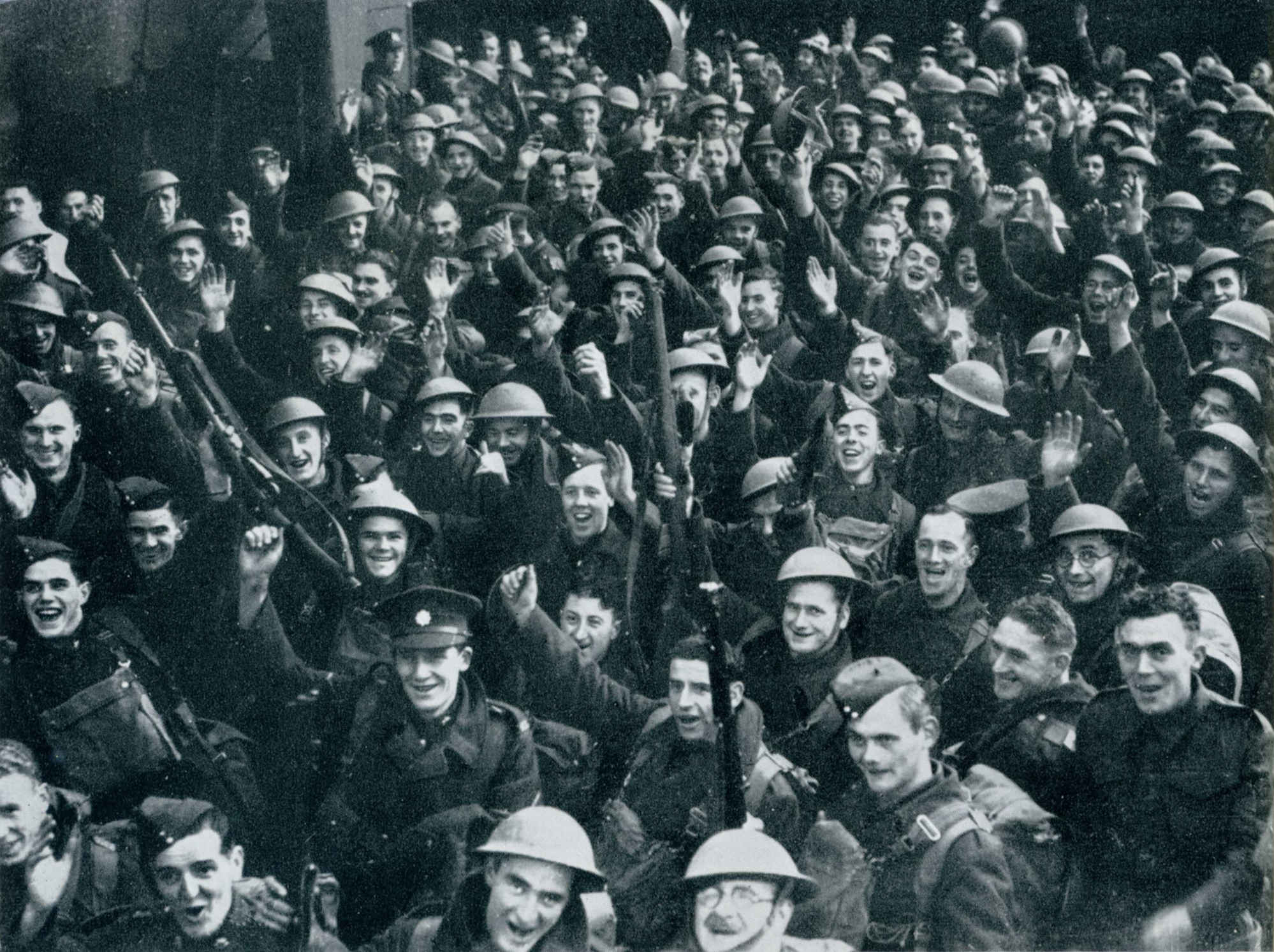
A unit of R.A.S.C. of the B.E.F. on board a ship bound for France. Circa October 1939. The photographer has obviously encouraged the men to give a rousing cheer for the camera! Courtesy of the I.W.M.
It was a good start for a Corps that would end the war with a total strength of 15,900 Officers and 312,019 Other Ranks, but events in France and Flanders in 1940 would overtake it, and leave it without most of its vehicles, equipment, supplies, and a large loss of men.
After being at war with Germany for nearly a year, things were going badly for the British Armed Forces. With huge losses in merchant ships at sea, and the Royal Navy stretched to their limits, the British Expeditionary Force being forced to withdraw back from France via Dunkirk and other French ports, and now anticipating an invasion by German forces, the British now, literally, 'had their backs to the wall'. To make matters worse, Italy had declared war on Britain on the 10th June 1940, which exposed British shipping in the Mediterranean to attacks by enemy land based aircraft, forcing ships carrying vital supplies to make longer journeys around the southern tip of Africa. The Italian invasion of Greece, in October, also forced Britain to dispatch aircraft desperately needed for home defence, and the sending of ground troops from Egypt.
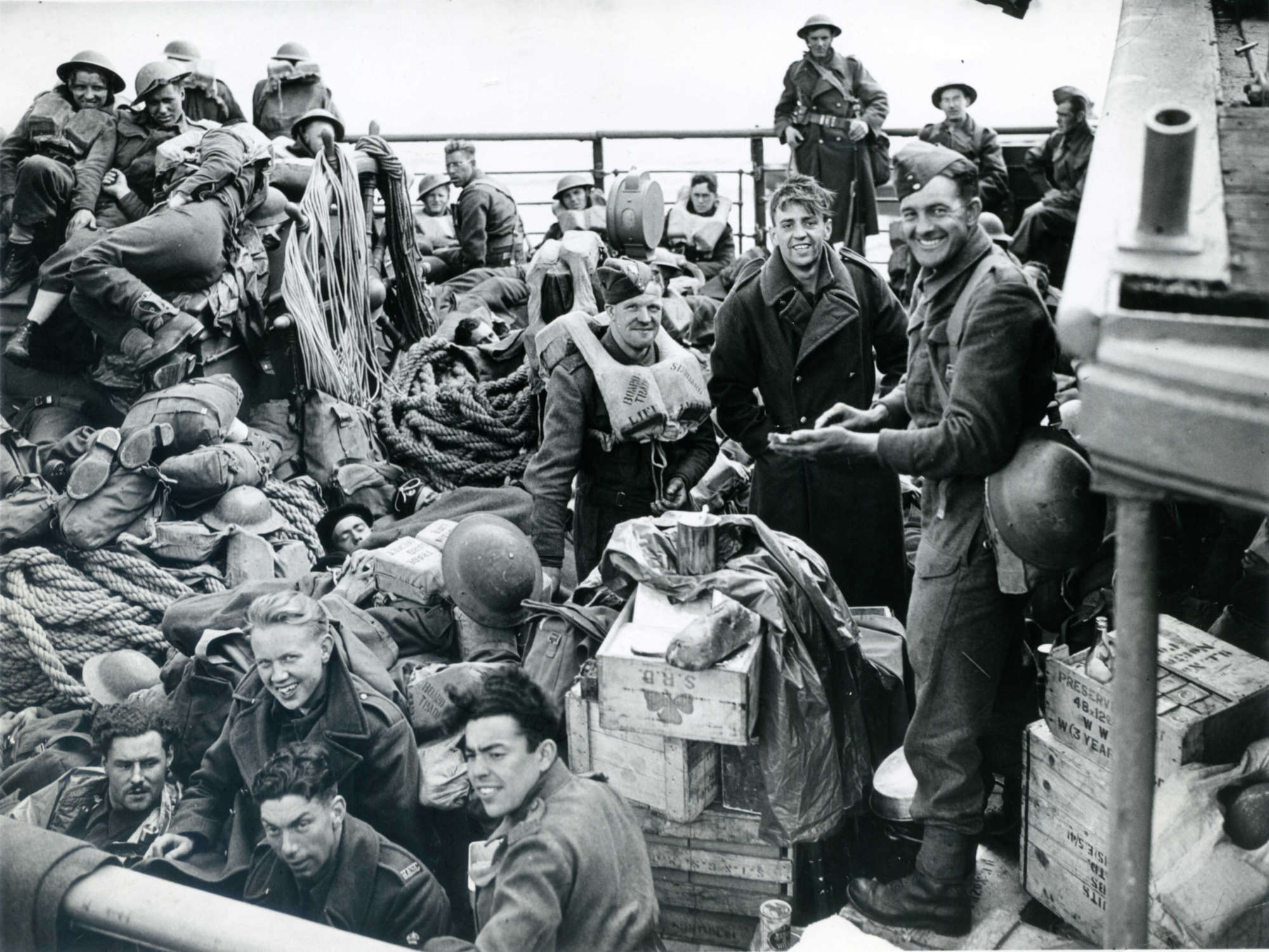
A unit of R.A.S.C. on board a ship bound for England from France. May 1940. The original caption reads: "A scene on the deck of one of the troopships. One soldier is having a meal while others enjoy a sleep after their [gruelling] journey from the battle front to the port". C1750. Courtesy of the I.W.M.
The only viable force left in Britain was Fighter Command of the Royal Air Force, and they were about to be sorely tested. The British Army needed to expand, re-equip, train and get ready fast.
One way of providing troops, already in fighting formations, was to bring them back from overseas, which is how three infantry battalions came from India in July 1940 to form the nucleus for the 31st Independent Infantry Brigade Group. Another infantry battalion, with Arms and Services were attached to the Brigade, from other Regular Army units to make it a self-contained independent formation.
The 31st Independent Infantry Brigade Group were spread over a large area of South Wales, where they had been training for mountain warfare partly on a pack animals basis. In December 1941 came the news that they were to get a new role, and with it a new title - the 1st Airlanding Brigade - which would mean swapping their pack mules for gliders. Experienced units, strong in personnel, they were well-suited to their new role, but they were no better trained or equipped than the majority of the British Army at home at that time and were far from fit for modern war. Their immediate problem was to sort out the personnel because, although service in the air-landing brigade was not to be on a voluntary basis, it was obviously necessary to retain only the right type of men who were suitable and willing for the proposed training. Consequently commanding officers were allowed to get rid of whom they wished and a considerable turnover would take place. [A]
Within the Brigade was a Royal Army Service Corps transport unit, who were about to become one of the most unique formations in the British Army.
NOTES:
[A] Airborne Forces 1939 - 1945. Lt-Col. T. Otway. Pages 41 - 42.
Acknowledgements.
First and foremost I would like to thank all of the veterans that responded to my enquiries (which started back in the mid 1990's), or left their accounts with various archives: Richard Adams, Norman Allcock, Wilfred Bater, Burnham Blaxley, Charles Boardman, Jack Brooks, William Chedgey, John Cranmer-Byng, Leslie Dean, William Gell, John Gifford, Thomas Jones, William Mitchell, Raymond Moon, John McAndrew, Robert Neilson, Ronald Nutley, Ronald Pearce, John Prime, Jason Leslie Ransom, Samuel Staple, John Taylor, James Wild, Leslie Withey and Eugene Zambonini.
From 93 Company, attached: Raymond Weaver.
From H.Q, R.A.S.C: Raymond Whitwell.
Next of Kin: Mrs. E. Norgate (widow of Capt. R.G. Norgate), Mrs. Barrett (widow of Dvr. F. Barrett), Miss. J. Myers (daughter of S/Sgt. G. Myers), Mrs. J. Legg (daughter of Dvr. G.S. Smith), Mrs. A. McAndrew (widow of Dvr. J.E. McAndrew), Mr. A. Jones (grandson of Pte. J.S. Jones), Mr. B. Kavanagh (brother of Capt. D.T. Kavanagh), Mrs. W. Gibbons (daughter of Dvr. J. Beal), Mr. P. Pringle (grandson of Dvr. G. Gelsthorpe) and Mrs. Beer (widow of Dvr. A.J. Beer, 93 Company).
I must pay a tribute to Brigadier Frank Steer, M.B.E. a retired officer of the Royal Logistics Corps (late of the Royal Army Ordnance Corps) who served for 34 years in the British Army. I had made contact with Brigadier Steer in December 1998, whilst serving in Northern Ireland on an operational tour. We re-established contact in June 1999, and arranged to meet at his house, in Andover the following month. I was able to get a land-rover from the Motor Transport Officer for the day, as I just mentioned the fact that I was going to see a Brigadier, and was able to take my boxes full of files and notes down to him, which he was able to use extensively for his book "ARNHEM, The Fight To Sustain. The Untold Story of the Airborne Logisticians", which was published in 2000. This was the first time that anyone had published a book that looked at the Airborne Logistics of the Battle of Arnhem. Frank Steer, unfortunately, died of a serious illness on the 11th September 2011.
Others:
The Airborne Assault Museum, Duxford.
The Cornelius Ryan Archives, Boston.
Mark Hickman. Webmaster for www.pegasusarchive.org
Patric van Aalderen, Jon Baker, James Brudenell, Martijn Cornelissen, David Finch, Bob Gerritsen, Ken Greenhough (deceased), Arie-Jan van Hees, John Howes, Geert Jonker, Alexander Junier, Geert Jonker, David Locke, Geert Maasen, James Middleton, Berry de Reus, Donna and Simon Rowe, Peter Scarcliffe, Sam Stead, Alistair Taylor and Geoff Teece.
And last, but by no means least, my wife, Wendy, who helped with typing up War Diaries, and proof reading.
Contents
Chapter 1. Transport and Supply duties. 1940 - 1941.
Chapter 2. A new role. 1941 - 1943.
Chapter 3. North Africa and Italy. 1943.
Chapter 4. Return to United Kingdom re-organisation and expansion. 1943 - 1944.
Chapter 5. The Administrative Plan. August - September 1944.
Chapter 6. Sunday, 17th September 1944.
Chapter 7. Monday, 18th September 1944.
Chapter 8. Tuesday, 19th September 1944.
Chapter 9. Wednesday, 20th September 1944.
Chapter 10. 21st to 26th September 1944.
Chapter 11. Aftermath, and life as a POW. 1944 - 1945.
Chapter 12. Rebuilding, Norway, and disbandment. 1944 - 1946.
Chapter 13. Addendum.
Appendix I. THE ROLL OF HONOUR.
Appendix II. Honours and Awards.
Appendix III. Nominal Roll. September 1944.
Appendix IV. Report on activities of RASC, 1st Airborne Division. 14 July 1943.
Appendix V. Special Order of The Day. 18 July 1943.
Appendix VI. Report on Exercise 'Despatch'. HQ, RASC. 4 August 1943.
Appendix VII. Supply By Air. January 1944.
Appendix VIII. Pannier & Roller Conveyor diagrams. 1943 - 1944.
Appendix IX. War Establishment. April 1944.
Appendix X. Glider Loading Diagrams. June 1944.
Appendix XI. Standing Operational Instruction. 8 August 1944.
Appendix XII. Operation 'Transfigure'. Instruction No 1. 11 August 1944.
Appendix XIII. Orders for Operation 'Market'. September 1944 + Appx 'A' & 'E'.
Appendix XIV. HQ, RASC. Admin Order No 1. 16 September 1944.
Appendix XV. ORBAT - A/Q Staff & Services. 17 September 1944.
Appendix XVI. 93 (Airborne) Composite Company, R.A.S.C. War Diary September 1944.
Appendix XVII. Admin Instruction Operation 'Doomsday'. 7 May 1945.
Appendix XVIII. Arm of Service Signs
Abbreviations.
|
AA & QMG A/C ACC ADOS AE AEAF AFDAG AFDC AFEE AFPU AG AMGOT ARP BOWO BRASCO CEME CIMT CRASC CREME DAA DAQMS DDST DID DMA DZ EFI FGCM FMA FMACC FMC GHQ GMC GOC GS GSO 1 GT HMT IOO KOSB L of C LST LZ MT NAAFI NCO OCTU OFF OO PC PIAT POL RAOC RASC RCT RDI RE REME REPCS REPS RH RLC RMO RPC SAA SDP SLP SHAE SNCO SOP SP ST VOR WD WO WS |
Assistant Adjutant and Quartermaster General - normally a Lieutenant Colonel Aircraft Army Catering Corps Assistant Director of Ordnance Services - normally a Lieutenant Colonel Ammunition Examiner Allied Expeditionary Air Force Airborne Forward Delivery Airfield Group Airborne Forces Development Centre Airborne Forces Experimental Establishment Army Film and Photographic Unit Adjutant General (his Branch of the Staff) Allied Military Government for Occupied Territories Amn Ammunition Air Raid Precaution Brigade Ordnance Warrant Officer Brigade Royal Army Service Corps Officer Chief Electrical and Mechanical Engineer Chief Inspector of Mechanical Transport Commander Royal Army Service Corps Commander Royal Electrical and Mechanical Engineers Divisional Administrative Area Deputy Assistant Quarter Master Staff Deputy Director Supplies and Transport - normally a Colonel or Brigadier Detail Issue Depot Divisional Maintenance Area Dropping Zone Expeditionary Forces Institute Field General Courts Martial Forward Maintenance Area Forward Maintenance Area Control Centre Forward Mounting Centre General Headquarters General Motors Corporation General Officer Commanding General Service General Staff Officer Grade One - normally a Lieutenant Colonel General Transport His Majesties Troopship Inspecting Ordnance Officer King's Own Scottish Borderers Line of Communication Landing Ship Tank LZ Landing Zone MT Motor Transport NAAFI Navy Army and Air Force Institute Non-Commissioned Officer Officer Cadet Training Unit Ordnance Field Park Ordnance Officer Pioneer Corps - up until 1951 Projector Infantry Anti-Tank Petrol, Oil, Lubricants Royal Army Ordnance Corps Royal Army Service Corps Royal Corps of Transport Residual Driver Increment Royal Engineers Royal Electrical and Mechanical Engineers Royal Engineers Postal and Courier Service Royal Engineers Postal Section Rail Head Royal Logistic Corps Regimental Medical Officer Royal Pioneer Corps - after 1951 Small Arms Ammunition Supply Dropping Point Supply Loading Point Supreme Headquarters Allied Expeditionary Force Senior Non Commissioned Officer Standard Operating Procedure Start Point Supplies and Transport Vehs Vehicles Vehicle Off Road War Department War Office Work Shops |
Sources.
Published.
'The Day Gone By'. Richard Adams. (Hutchinson, London. 1990)
'First to Go'. Alan Brown. (Eon Graphics. 1980's)
'Red Berets and Red Crosses'. Niall Cherry. (RN Sigmond. 1998)
'The Airborne Forces Experimental Establishment'. Tim Jenkins. (Helion & Company. 2015)
'Arnhem 1944, The Airborne Battle'. Martin Middlebrook. (Penguin Books. 1995)
'First Airborne'. Michael Packe. (Secker & Warburg, London. 1948)
'The R.A.S.C. at Arnhem'. By Lt-Col. M. St. Packe.
The Journal of The Royal Army Service Corps, Volume LXIX, No 2, 1944.
'The Story of the Royal Army Service Corps 1939 - 1945'. (The Institution of the Royal Army Service Corps)
'Supplies and Transport'. Volume I. (The War Office. 1954)
'Supplies and Transport'. Volume II. (The War Office. 1954)
'A Bridge Too Far'. Cornelius Ryan. (Simon and Schuster. 1974)
'Arnhem The Fight To Sustain. The Untold Story of the Airborne Logisticians'. Frank Steer. (Pen & Sword. 2000)
'Arnhem'. Major General. R. E. Urquhart, CB, DSO. (Cassel, London. 1958)
'Brotherhood of the Cauldron'. David Truesdale. (Redcoat Publishing, 2002)
'Tugs and Gliders to Arnhem'. Arie-Jan van Hees.
'Green On'. Arie-Jan van Hees. (Privately published, 2004)
'When Dragons Flew'. Stuart Eastwood, Charles Gray & Allan Green. (Published by the Regimental Museum, 1994 & 2009)
Unpublished.
31st Independent Brigade Group Company, R.A.S.C. War Diary. 1040 - 1941.
250th (Airborne) Light Composite Company, R.A.S.C. War Diary. 1941 - 1945.
253rd Airborne Division Composite Company, R.A.S.C. War Diary. 1943 - 1945.
93rd Airborne Division Composite Company, R.A.S.C. War Diary. 1943 - 1945.
H.Q. No 48 Air Despatch, R.A.S.C. War Diary. 1944.
H.Q. No 49 Air Despatch, R.A.S.C. War Diary. 1944.
63rd Airborne Division Composite Company, R.A.S.C. War Diary. 1944.
223 Company, R.A.S.C. (Air Despatch). War Diary. 1944.
799 Company, R.A.S.C. (Air Despatch). War Diary. 1944.
800 Company, R.A.S.C. (Air Despatch). War Diary. 1944.
Headquarters, R.A.S.C. 1st Airborne Division. War Diary. 1943 - 1945.
1st Parachute Brigade Headquarters. War Diary. 1941 - 1945.
2nd Parachute Brigade Headquarters. War Diary. 1942 - 1945.
4th Parachute Brigade Headquarters. War Diary. 1942 - 1944.
1st Air Landing Brigade Headquarters. War Diary. 1941 - 1945.
st Airborne Division. Report on Operations in Italy. September - October 1943.
1st Airborne Division. Report on Operation 'MARKET'. 17-26 September 1944.
"The 250 Airborne Light Composite Company, R.A.S.C. Newsletter."
The Arnhem 1944 Veterans Club Newsletters.
Pegasus, the Journal of the Parachute Regiment and Airborne Forces.
R.A.F. Ringway Parachute Course Reports. 1941 - 1945.
Index.

