Chapter 1
Transport and Supply duties. 1940 - 1941.
"Victory is the beautiful, bright coloured flower. Transport is the stem without which it could never have blossomed". Sir Winston S. Churchill, The River War, 1899.
The 31st Independent Infantry Brigade Group was formed in the United Kingdom of Great Britain on the 17th July 1940 under the command of Brigadier H.E.F. Smyth. To provide it with a Supplies and Transport Unit, No 4 General Headquarters Company, Royal Army Service Corps were given "orders to wind up 4 G.H.Q. Coy and to form No's 237 and 250 Companies RASC from the existing establishment" on the 15th July 1940.
The new title for the unit was 250 (31 Infantry Brigade Group) Company, R.A.S.C. and the first Officer Commanding was Capt. E.A.E. Dean, with Maj. F.L. Dickson taking over on the 26th July. The unit was at full strength, as per the War Establishment, being deficient just one Subaltern, when all the personnel of the Company were checked over the next few days. Within ten days the whole structure of the Company had been sorted out, preliminary training had been carried out, and on the 25th July the unit War Diary stated that the "whole Company on route march, respirators being worn during the course of the march. Extended order and attack also carried out, with rifle defence against air attack".
Amongst the men who formed the Company were thirty four who would still be with it in September 1944, and by then, the following were in key posts: William 'Bill' Chedgey, who was born in October 1915 and came from Bridgewater in Somerset, was working as a Postal driver before he enlisted on the 7th March 1940, and would reach the rank of Sgt and serve in 'B' (Motor Transport) Platoon, having been posted to the Company on the 17th July 1940. Ford Edmonds, who was born in April 1915 and came from Oxford, was a grocer, and would also reach the rank of Sgt, serving in No 2 Parachute Platoon Transport Section. Others who reached the rank of Sgt were, William 'Bill' O'Dell, who was born in May 1918 and came from Plaistow in London, worked as a lorry driver before the war, and served in Company Headquarters. George Smith, who was born in February 1916 and came from Witney in Oxford had also been a grocer, and served in 'C' Transport Platoon, and John Walsh, who was born in July 1905 and came from Leominster in Herefordshire would serve in 'A' (Airfield) Platoon, and be the Platoon Sgt of No 1 Parachute Platoon in 1944.
To bring the Company up to full strength more men were posted into it. One of them was Dvr. Raymond Whitwell, who had been born in March 1919 and came from Malton in East Yorkshire, where he was working as a 'Seedman'. He joined the Company on the 29th July, and was assigned to the Headquarters Platoon: "I was conscripted into the Army in 1939 (December 1st). I served in France and Belgium in 1940 with No 3 Petrol Company, R.A.S.C. Our unit was bombed and we lost vehicles. I was left behind in France after the evacuation of Dunkirk. I was on the run for 16 days, and I came out of the port of Cherbourg on June 13th, 1940." [1]
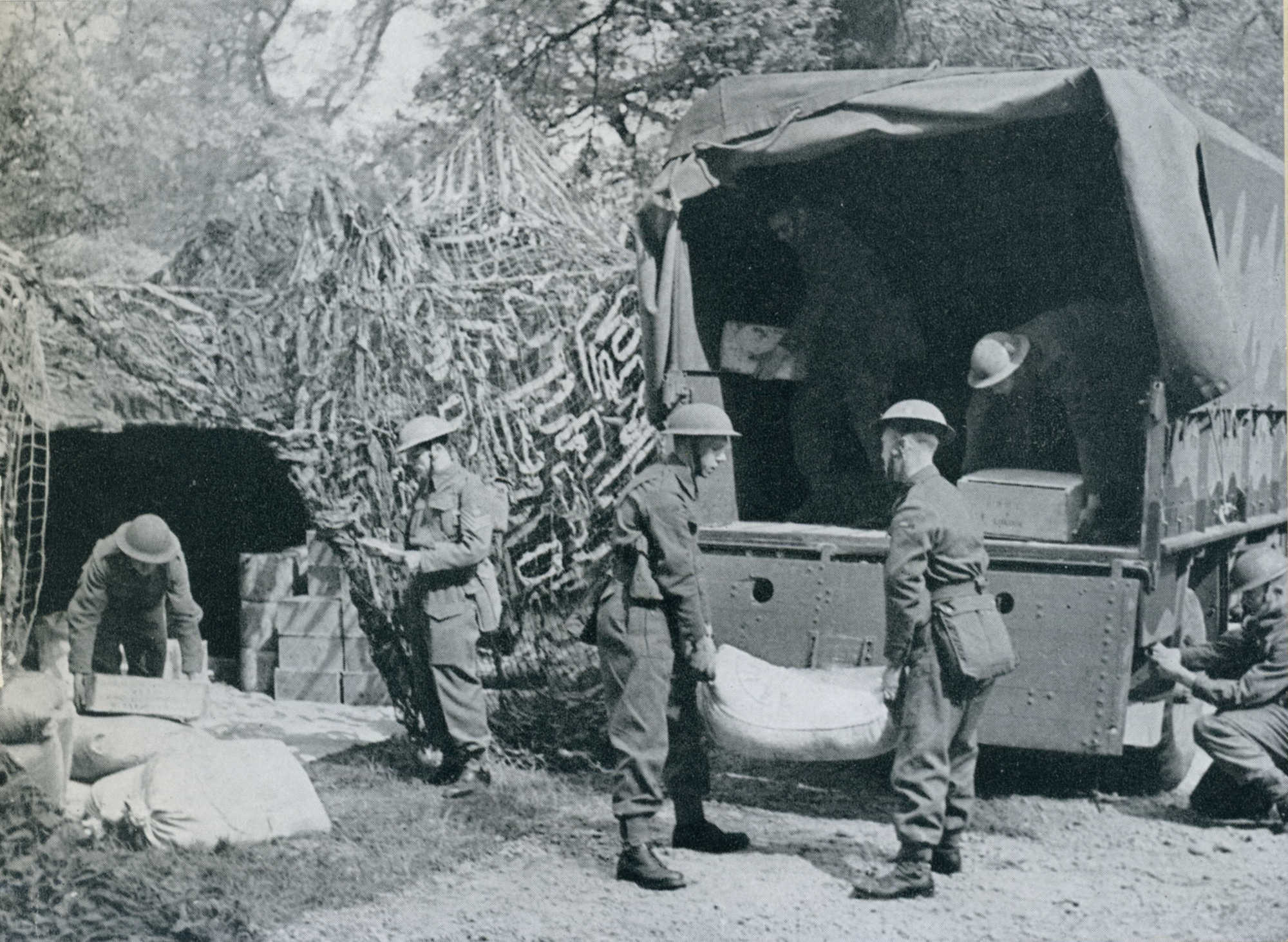
R.A.S.C. Supply and Transport troops in training. 1941. Courtesy The Story of The Royal Army Service Corps 1939 - 1945.
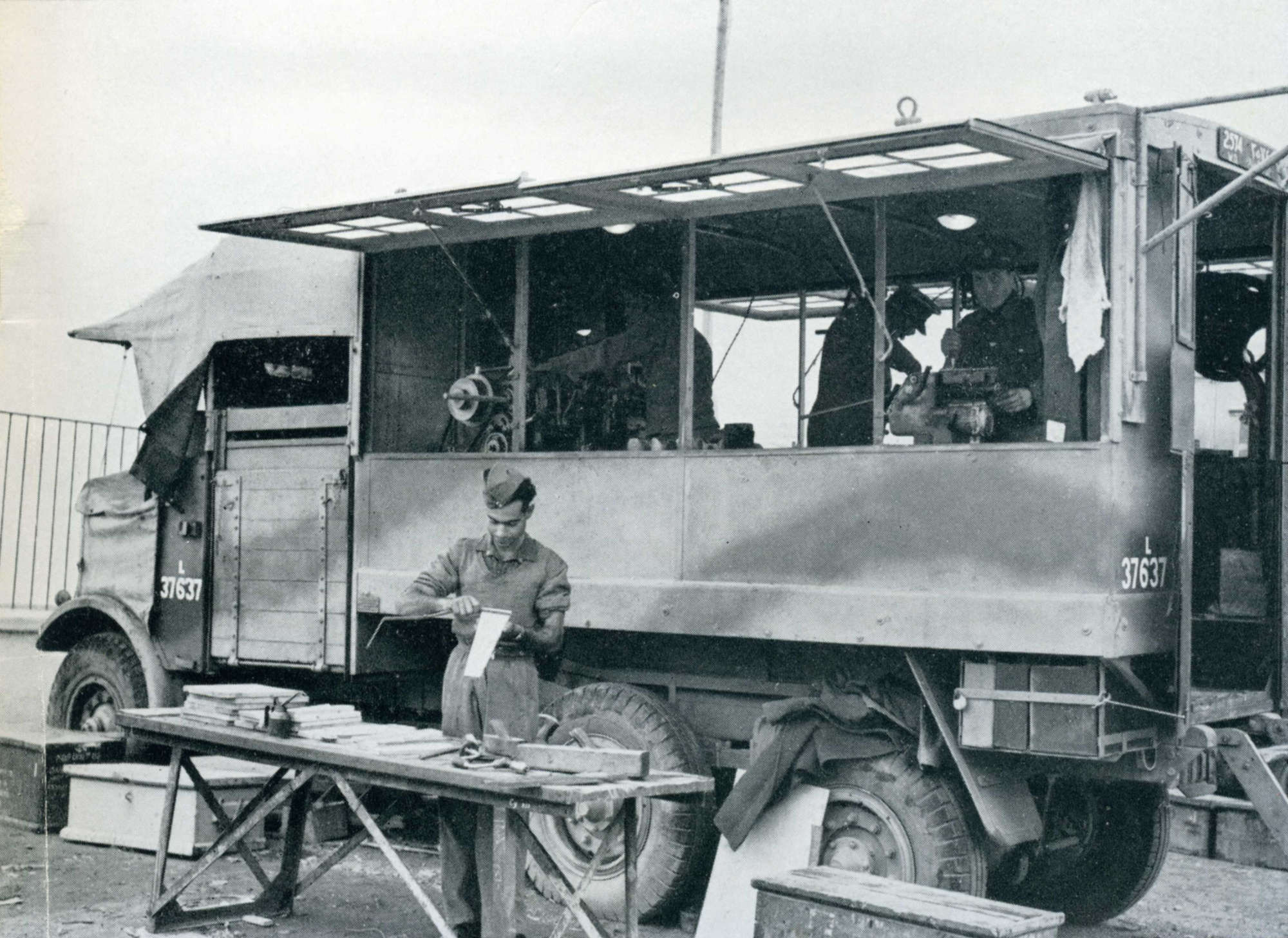
An R.A.S.C. Workshops lorry - 'open for business'. 1940/41. Courtesy The Story of The Royal Army Service Corps 1939 - 1945
Along with the rest of the Brigade Group the Company had several moves over the next few months, including one to Ashford in Kent at the beginning of October 1940, when the threat of invasion was still high. The rest of the 31st Brigade had moved into position to defend the Royal Military Canal line, a few miles from Hythe and Dover on the 26th - 27th September. Maj. J. Allen assumed command of the Company in this first week (2nd October), and having issued orders to each Section to stand by for 'immediate action'. It was fortunate that they were, as a German bomber dropped an incendiary bomb just ten feet from a laden ammunition lorry, and there were men on hand to extinguish it, with no damage done.
And so, the Company's work went on, with regular details sent out each day, training and preparation for direct attack, and all the time the air battle taking place directly over their heads, with 'stray' bombs dropping regularly in the area. In the middle of October, the unit title was changed to 31st Infantry Brigade Group Company, R.A.S.C.
The Company started another move on the 10th November, to Ware in Hertfordshire, where they were complete in place four days later. However, they were no sooner settled in, than another move was planned, and carried out on the 20th November. To give some idea of the dispersion of units at this period of the war it is worth quoting the War Diary;
08.30 hrs. Company moved by Sections to new location in Hertford, arriving from 09.00 hrs to 10.00 hrs.
Vehicle Park - in Ware Park, Hertford.
Company Office, The Orderly Room, Cookhouse, and all Section Officers at St Nicholas Hall, Hertford.
Men's billets:-
Cowbridge Hall - Petrol Section.
17 North Crescent - Supply Section.
Mangrove House - HQ, Workshops, Supply Details, and ½ Ammunition Section.
Baptist Hall - ½ Ammunition Section.
Workshops - opposite Cowbridge Hall.
Petrol Pumps, 1 x 500 gallons; 1 x 300 gallons - Wachett's Garage, Hatfield Road.
Officers Mess - Mangrove Lodge, Mangrove Road.
Medical Arrangements - Dr. Vivian, 17 Castle Street, Hertford.
By 18.00 hrs that first evening, the unit suffered their first complaint - the local ARP (Air Raid Precaution) Warden told them that the blackout of all the billets and offices was not good enough! This highlighted another factor that is not commonly understood about the situation in England at that time - the relationship between the civilian population and the Armed Forces - as the Staff Capt Quartering visited the Company at 15.00 hrs on the 21st November, and suggested that the Vehicle Park be moved "to avoid bad feeling with owners". The next day the Vehicle Park and Workshops were moved to Desborough Park. The Officers Mess then got a visit from the Military Police at 20.30 hrs that same day, obviously as a result of the ARP Warden contacting them, to warn them of a blackout infringement. This, and other issues with the M.P's would rumble on for some months, at one stage involving the Brigade Commander! In the end it would result in a summons for Capt. E.A.E. Dean, and a prosecution case being brought against him. This was heard in court on the 9th January 1941, with the case being, fortunately, dismissed.
There were further issues with regard to how much the civilian Doctor could do for the Company and arrangements had to be made with a Medical Officer arranged by the A.D.M.S. of the Hertford area. This would not be resolved properly until the middle of December, when the R.M.O. 2nd Battalion, the South Staffordshire Regiment was made responsible for the Company's medical needs. The billeting arrangement was also cramped and further locations had to be found to put some of the men, and the Vehicle Park and Workshops had to be moved several times.
On the 27th November, the subject of an increase in establishment and extra vehicles was raised. A fourth Infantry unit, the 1st Battalion, The Border Regiment, was joining the Brigade, and would need transport to move them to their new billets, and the Company was still expected to meet all its other commitments. The routine of 'details' each day, that is regular transports task, of ferrying troops from one place to another, delivering ammunition, supplies, coal or petrol, went on. As well as this, a regular training programme had to be maintained, such as Rifle Ranges, First Aid Training, Anti-Gas practices, etc. There were also the regular maintenance tasks, especially of the vehicles, and inspections took place on a weekly basis - all of this in a civilian environment.
The threat of invasion had not receded, and the British Isles were now bracing themselves for the first winter under siege. Here is the War Diary, in full, for Christmas Eve, Christmas Day and Boxing Day 1940.
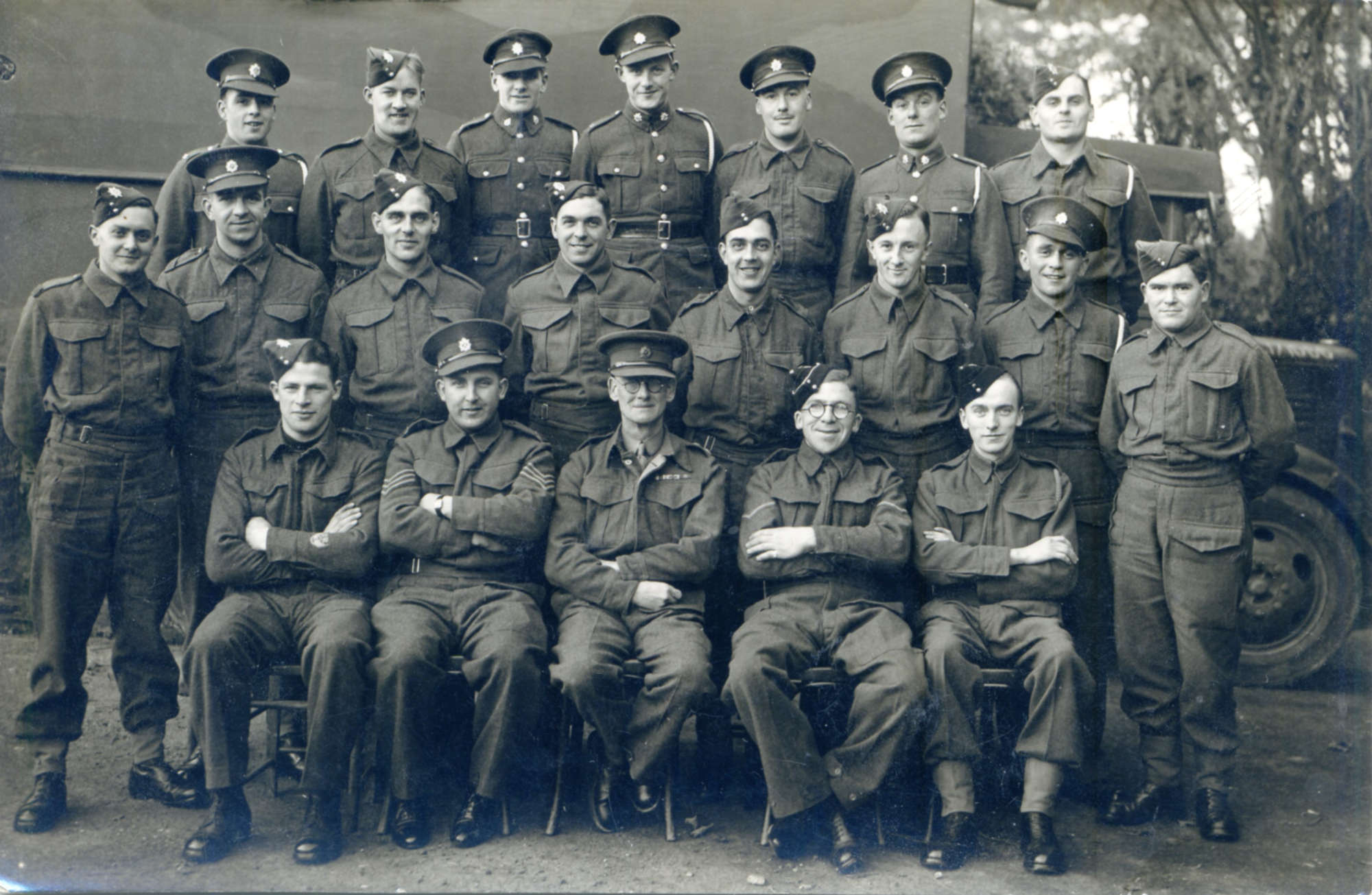
A Detachment of 'F' Company, R.A.S.C., Haywards Heath. December 1940. Back Row, 2nd from left is Dvr. Joseph 'Joe' Middleton. This photo shows the great mix of kit that men were issued with as Britain faced the threat of invasion. 'Joe' was born on the 18th September 1914 and came from West Molesey, Surrey. Before enlisting, on the 19th November 1939, he worked as a driver. He would be posted to Amesbury Abbey in May 1942, and then join 250 Company in July. Courtesy of Jim Middleton.
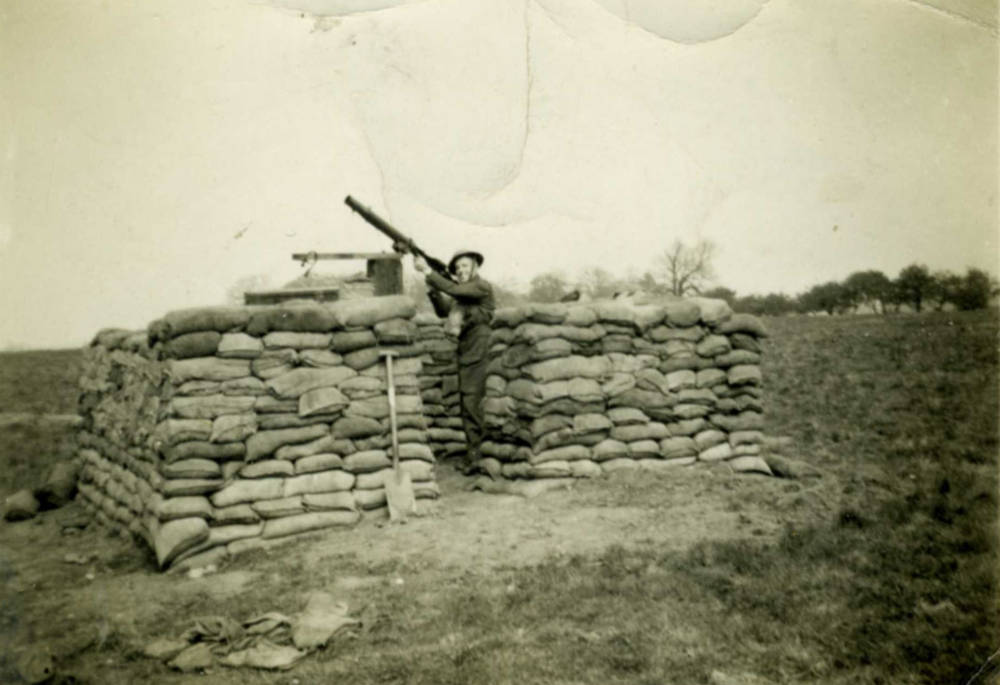
Geoffrey Gelsthorpe was born on the 24th September 1921, and came from Chesterfield in Derbyshire. He enlisted on the 4th January 1939, and served with an Anti-Aircraft Artillery Unit, where the main weapon appeared to be World War One vintage Lewis Guns! Courtesy of Philip Pringle.
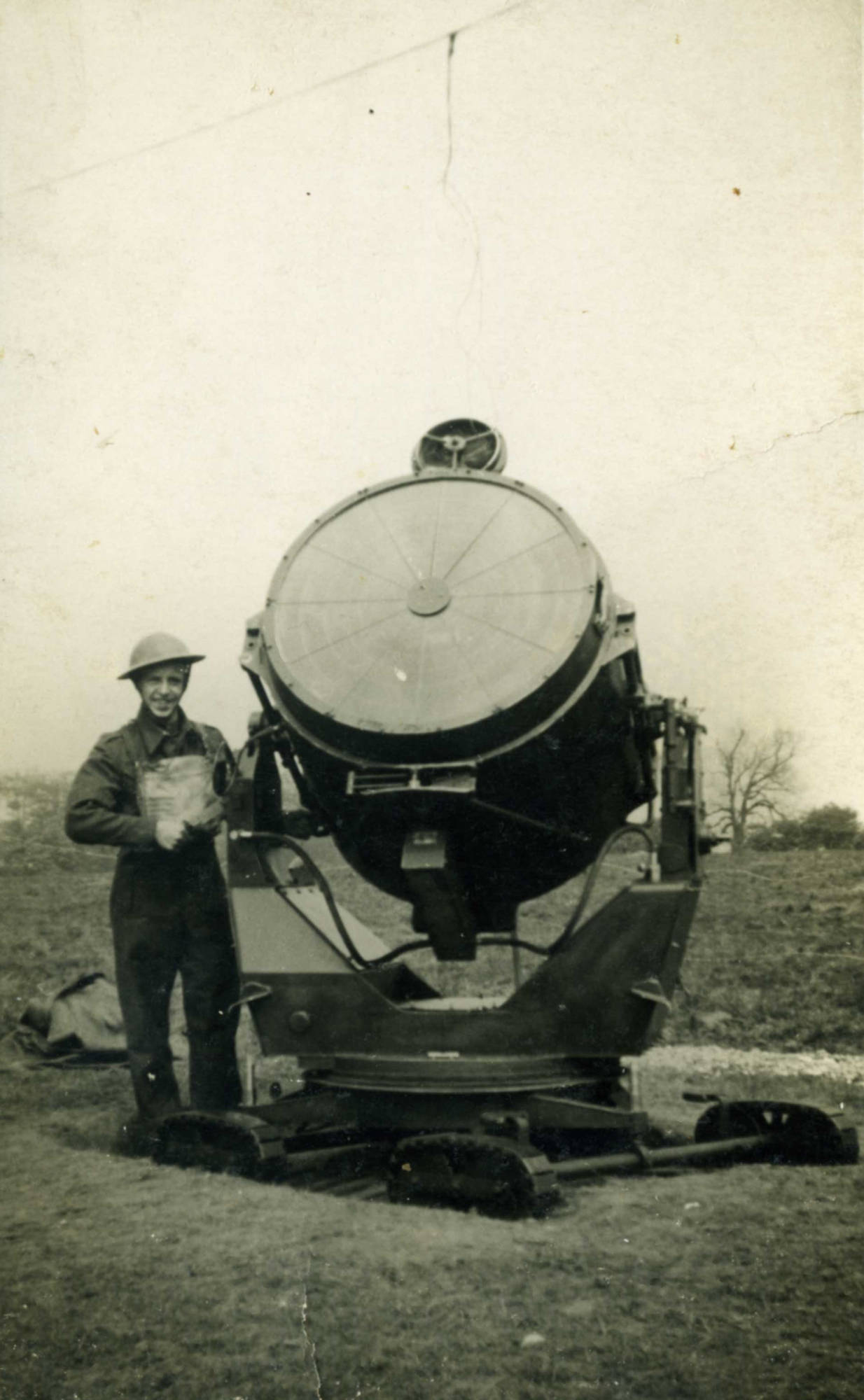
Dvr. G. Gelsthorpe posing with a mobile searchlight in 1940. He served with this Unit through 1940 into 1941. Courtesy of Philip Pringle.
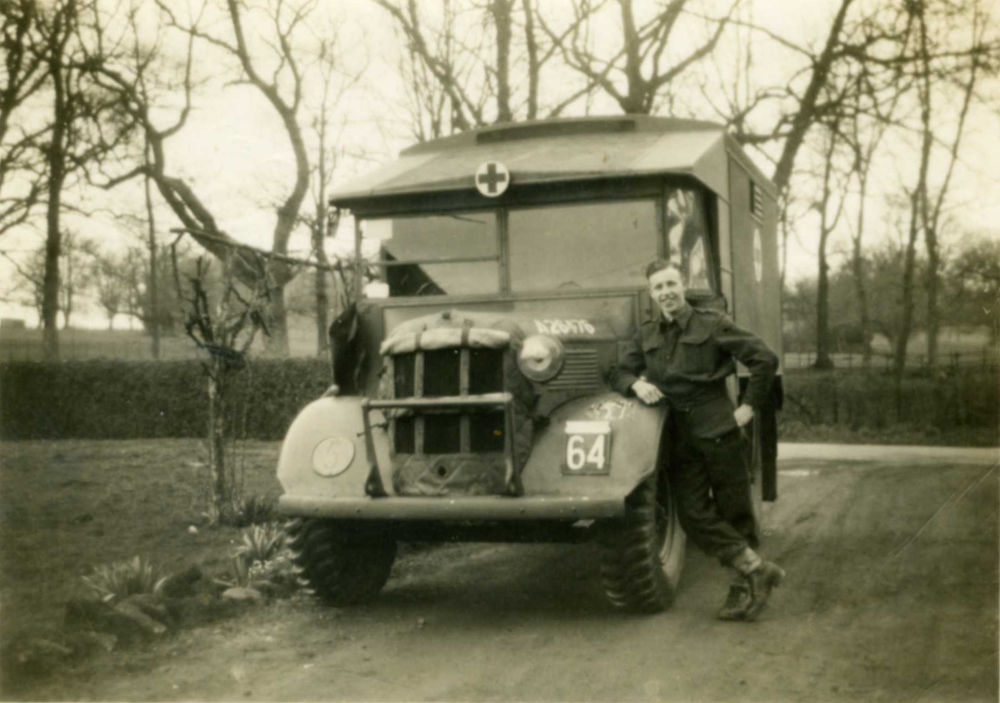
Dvr. G. Gelsthorpe went on to serve with a Medical Unit, as an ambulance driver, from 1941 into 1942, when he volunteered for Airborne Forces. Courtesy of Philip Pringle.
24th December 1940.
05.00 hrs. 2 lorries x 3 tons and 3 OR's (Other Ranks) reported to G.P.O. (General Post Office) Hertford for postal duties.
10.00 hrs. Capt. E.A.E. Dean attended FGCM (Field General Courts Martial) at 2nd R.U.R. as officer under instruction.
11.30 hrs. Conference at Brigade H.Q. of all CO's. Maj. J. Allen attended.
Normal work. Weather cloudy & damp.
25th December - Christmas Day - 1940.
13.00 hrs. Dinner Menu - Beef, Pork, Turkey, potatoes, greens, carrots, Christmas pudding, beer.
17.30 hrs. Tea Menu - Bread & margarine, jam, trifle, assorted cakes, tea.
2 lorries x 3 tons reported to G.P.O. Hertford for postal duties.
26th December 1940.
09.45 hrs. Lt. Gifford proceeded to 2nd S/Staffs Regt at St Albans to attend F.G.C.M. as officer under instruction.
14.30 hrs. O.C. paraded Cpl. Reynolds before Brigade Commander with reference to reduction in rank.
A good Christmas for some, not so good for others, and very bad for Cpl. Reynolds!
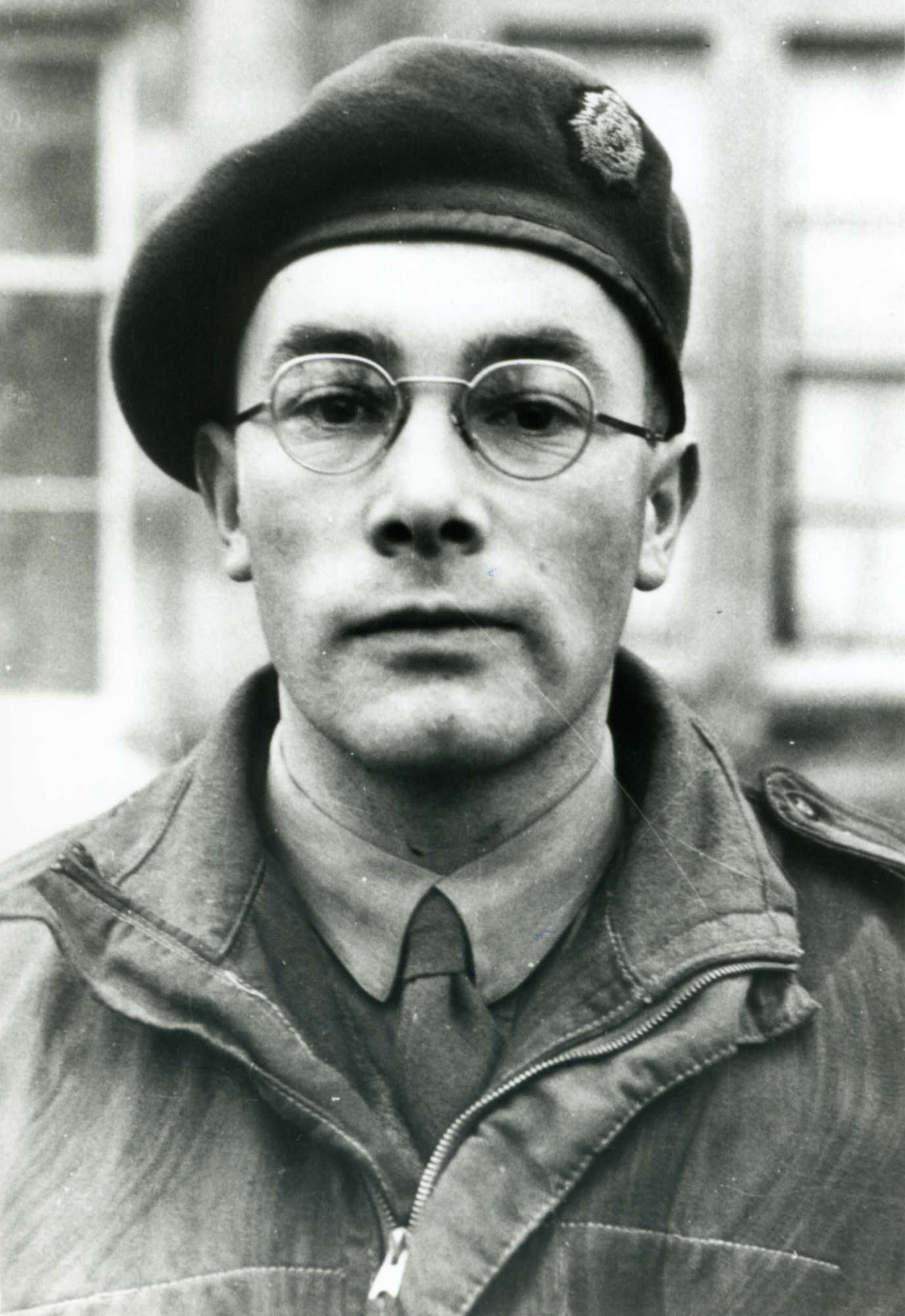
Maj. John Gifford. This photo was taken in October 1944, just after he had returned from Operation 'Market-Garden'. Courtesy I.W.M. H40934.
Lt. John Gifford had originally served in the ranks of the 26th Anti-Aircraft Group Company, R.A.S.C. (T.A.) from January 1938 to March 1939. He was then granted a commission as a 2/Lt on the 2nd March 1940, and was then posted to 4 G.H.Q. Company, R.A.S.C. on the 16th March 1940, until 22nd July 1940, when it was re-named the 31st Independent Brigade Group Company, R.A.S.C.
As the Company moved into the New Year, the duties continued on a regular basis, with very little to break the monotony, except the case of 2/Lt. D.G. Pennington, who, on the 3rd January had been absent for 21 days, and was now classed as a deserter - he was placed on the 'Y' List. However, on the 26th January, he surrendered himself. The ensuing General Court Martial would drag on for months, and involve Maj. Allen and Capt. Dean on a regular basis, thus interrupting the smooth running of the Company.
There were four new 2/Lt's posted in to the Company on the 30th January 1941, amongst them were 2/Lt J.L. Cranmer-Byng, and F.G. Bate. Along with Lt J.H. Gifford, who had been with the Company from almost the beginning, and 2/Lt. D.G. Clark, who had been posted in during the middle of 1940. They would all go on to feature quite prominently in the history of Airborne logistics.
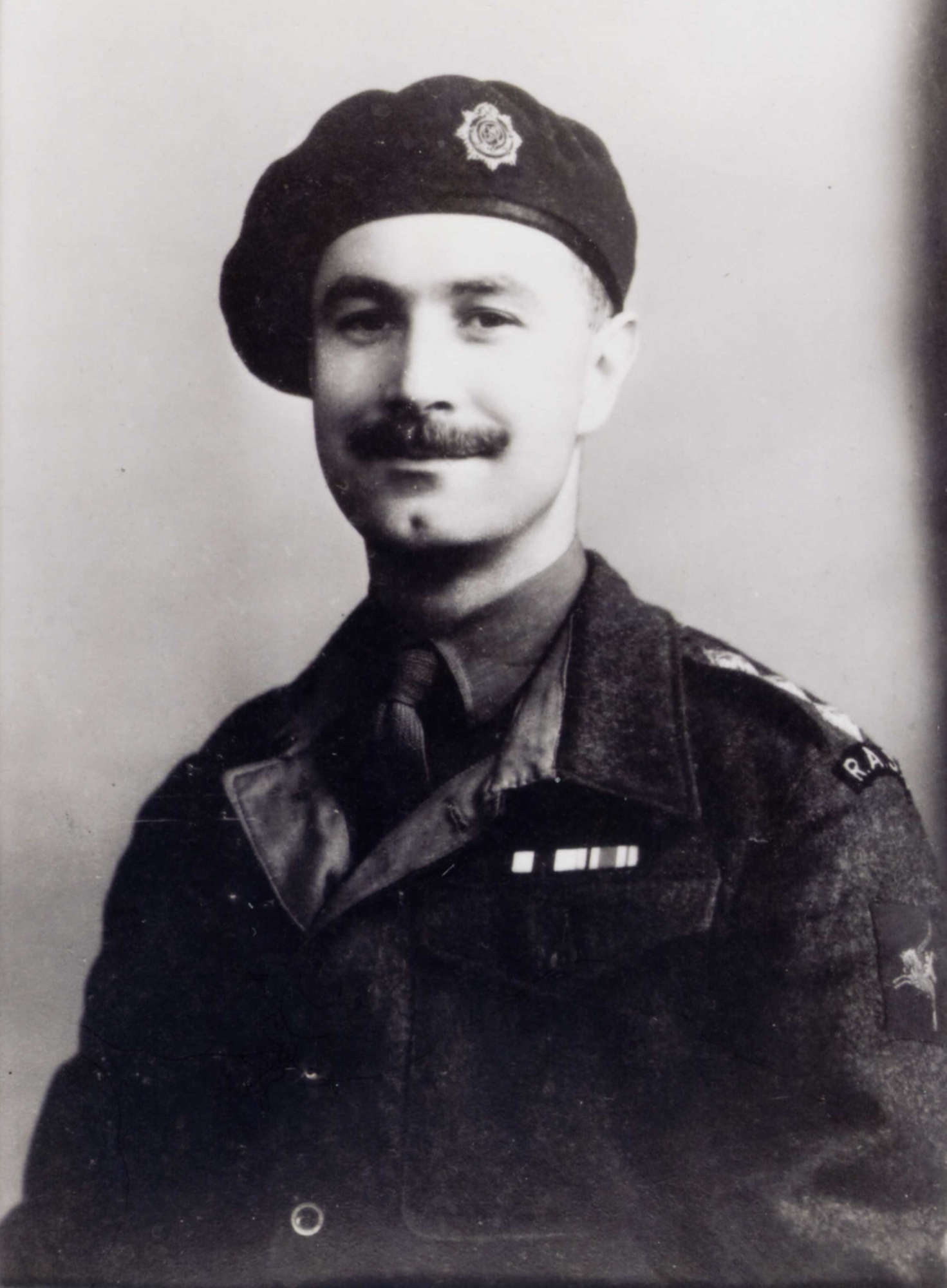
Capt. J.L. Cranmer-Byng. He would command No 1 Parachute Platoon at Arnhem. Photo taken after Arnhem (1944/45), when he had been awarded the Military Cross. Courtesy of F. Huibers.
In February came a move, not only of the Company, but the entire Brigade to a new location, and so, on the 8th February, 2/Lt's D.G. Clark and J.L. Cramer-Byng, with 18 Other Ranks, 2 cars, 5 lorries x 3 tons and a motorcycle set off for Tal-y-coed and Abergavenny in Wales, as part of the Advance Party to carry out billeting and supply arrangements for the move. The move took just over a week to complete and they had to stage through Cirencester, but finally the Company was established, with the Headquarters and Workshops Sections at Taly-y-coed and the Supply, Petrol and Ammunition Sections at Clytha, which was about 5 miles away.
After settling, in a large Corps size exercise took place, which lasted for three days (5th - 7th March), and involved the Company setting up Petrol Points and Ammunition Points for the rest of the Brigade, and immediately it had finished the Company received 197 men as reinforcements. On the 8th March the ongoing saga of Second Lt Pennington continued with him being brought back to the Company, under escort, whilst awaiting his General Court Martial.
One of those who missed the Corps exercise was Dvr. Jack Douglas Brooks. He had been born on the 6th August 1920, enlisted on the 9th January 1941, and had been posted to the Company on the 8th March 1941. In later years he would remember: "I was a Driver in 250 Company. I was proud to be a 'Red Devil'. I was a good soldier, but did a lot of 'Jankers', the Sergeant Major and I hated each other!" [2]
Another draft of 60 Drivers arrived from No 4 Training Battalion at Perham Down on the 14th March, as the unit was finally being brought up to its full War Establishment. The exercises continued through into April, as well as the daily details, and training programme. Then on the 21st April at 12.35 hrs, the final part of the General Court Martial for 2/Lt Pennington was announced on Company Detail - he was to be cashiered.
In May 1941 there was a slight departure from the normal routine with trials on the 12th and 15th with No 1 Pack Horse Transport Company, R.A.S.C. for the carriage of ammunition, petrol and blankets, at 200 to 250lbs per horse load. This was in preparation for a Pack Transport exercise, that would take place the following month, along with Indian Mule Transport Companies. This exercise got underway on the 9th June with the Indian Mule Transport Contingent providing the 1st Line (A and B Echelon's) transport for the Brigade Group, the No 1 Pack Transport Company provided the 2nd Line transport, and the 31st Independent Company provided the 3rd Line (M.T.) transport for the Brigade, and lasted for four days. From the 24th to the 26th June another Pack exercise was carried out, but on a slightly reduced scale, with the rest of the Company carrying out normal transport duties and details.
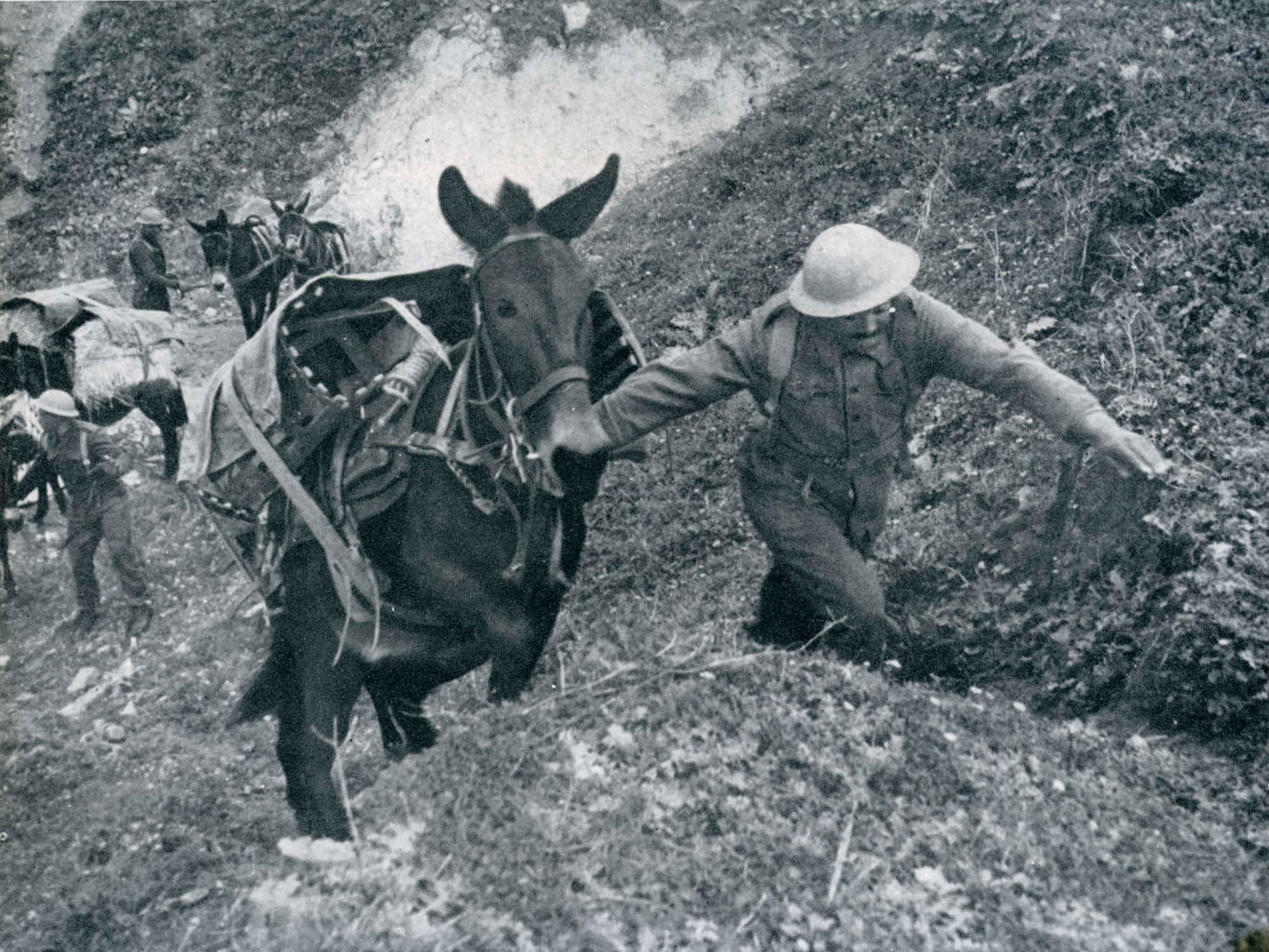
A Pack 'Horse' transport column and handlers. 1943. Courtesy The Story of The Royal Army Service Corps 1939 - 1945.
There were more Pack Transport Loading Trials and another exercise in early July, and then on the 14th of the month, an Officer and 18 Other Ranks commenced a course on animal management at No 1 Pack Transport Company, R.A.S.C.
Pte. I. Coulthard died at Maindiff Hospital, Abergavenny on the 12th August 1941. This was as the result of an accident the day before. There had been numerous accidents, usually road traffic ones, inevitable in the circumstances of wartime Britain, but this was the first fatality. An inquest the following day, at Abergavenny Police Court, gave a verdict of 'accidental death'.
At this time the Company moved once again, this time to Aber Marlais House, Llangadock, Carmarthenshire, and the next day the location was inspected by the Brigade Commander. On the 30th August a War Establishment for the Company under the new R.A.S.C. reorganisation was handed into Brigade Group H.Q., and the next day there was a conference of all officers in the Company as to how it would affect the Company.
On the 4th September the Company reorganised as follows:
Company Headquarters.
2 Relief Driver Increments.
Composite Platoon (A, B, C and D Sections).
4 Transport Platoons.
Workshop Platoon (H.Q. and 3 Sections).
There were now personnel for 2 Transport Platoons, which were surplus, and awaiting posting orders. A short exercise took place two days later, to test the new structure. On the 7th September, there was a Church Parade - National Day of Prayer - and 320 Officers and men attended. On the 26th September, more bad news was received when it was reported that Dvr. E.F.G. Connolly had died at 12.00 hrs that day in the Royal Gwent Hospital at Newport, as a result of an accident.
Capt. John Reginald Halls reported for duty with the Company from 349 General Transport Company, R.A.S.C. on the 24th October - he was another officer that would feature prominently in the history of Airborne logistics. During most of October the men had been busy erecting accommodation huts, completing the task on the 1st November, with stores and messing huts to be erected next. This task was carried on through the first two weeks of November, whilst the rest of the Company carried out the normal round of driving duties and details. On the training programme side, three days (17th, 18th and 19th) were allocated to firing on the ranges.
The Command of the Brigade was changed over on the 27th October, when Brig. George Frederick Hopkinson took over from Brig. Smyth.
It is ironic that having spent a month virtually constructing a new camp that the Company was moved once again, this time to Newbury on the 3rd and 4th December 1941. Upon arrival the men's billets were to be at Newbury Racecourse and the Vehicle Park was at Hamstead Marshall. One of the first tasks for the Company was to provide 58 lorries and drivers to move the Brigade's infantry battalion's baggage to their new locations on the 7th December.
Two men who would be delighted to be billeted in the area were Arthur and Albert Piper. Both born on the 6th October 1916, and coming from Shaw Hill, Newbury, the twins had enlisted into the Royal Army Service Corps on the 15th February 1940, their Army Service Numbers being T/162730 and T/162733 respectively. They had been posted to the Company on the 1st August 1940. Arthur would go on to do parachute course No 38 at R.A.F. Ringway, and rise to the rank of Sgt in 'G' Platoon, whilst his brother would serve as a Private in 'F' Platoon. Both of them would be on the 1st Sea tail for Operation 'Market-Garden'.
The sort of transport detail previously mentioned, went on for several more days, with up to 20 trucks and drivers being used or detached to other units, whilst they moved into their new billets and areas. However, a big change was about to take place, and the whole emphasis of the Company's future in the war was about to change.
FOOTNOTE:
T/213168. Private. Ivor Coulthard is buried in Brandon (Meadowfield) Cemetery, Durham. Sec C, Grave 125.
T/167898. Driver. Ernest Frederick George Connolly is buried in Portesham Cemetery, Dorset, Top Plot, Row 9, Grave 335.
NOTES:
[1] Letter from Raymond Whitwell. 16 October 2015.
[2] Letter from Jack Brooks to Bob Hilton. 8 October 1997.

