Chapter 2
A new role. 1941 - 1943.
"Plans for operational supply must be flexible, and those responsible for delivery resourceful". R.A.S.C. Doctrine. 1939 - 1945.
On the 13th December 1941 the 31st Independent Infantry Brigade Company, Royal Army Service Corps, was re-designated the 1st Air Landing Brigade Group Company, Royal Army Service Corps - the first unit of the R.A.S.C. to be given an airborne role, with the authority for such a change being dated the 9th December 1941.
It must have been apparent that something 'big' was about to happen, as messages to the unit suggesting a change, and a conference of all Unit Commanders had taken place at Brigade Group Headquarters at 14.30 hrs the day before.
In his semi-autobiographical book 'First Airborne', published in 1948, Michael Packe describes the formation of the Company, and its role in the 1st Airborne Division. However, he starts off by stating: "This book is neither a history nor a novel, but somewhere between the two." He uses fictional characters to portray some of the highlights of the Officers and Men from 250 Light Company, sometimes combining two characters into one. He goes on to state: "Every incident related in the story occurred and is recorded to the best of my ability." Thus, where it has been found that an actual event has occurred and there is no other first-hand account, extracts from his book will be used.
Although he was not present at the time, Michael Packe describes the way in which the Company found out about the change in their role: 'Something had gone wrong this morning; the usual routine had been interrupted by the statement that their Commanding Officer was coming to address them. Yet never for a moment did he dream that the information which they were to receive from such an authoritative source would send a thrill through his body like an electric shock, leaving him weak and quaking.
'Boomer' [Maj. J. Allen] had started in a gracious, even conciliatory manner, speaking of his long association with the unit. He reminded them of the solid if not distinguished progress they had made during the last two years, in their monthly moves across England and back again; he spoke of the fine spirit which held them together, and of the loyalty which they owed each other. This puzzled rather than alarmed his audience, now straining forward to catch his meaning.
"We have all looked forward," he said, "to the day when we should be privileged to take an active part in the fight against Nazi Germany. Well, today our chance has come, and it is a very special part which we are to play. I have been informed that this unit is to become Airborne, and will soon form a part of the new Airborne Division."
Amidst a breathless hush, he continued; "The facts are these. We shall be transferred bodily as a unit, and our new role will require us to fly in gliders; but I understand that nobody will be called upon to parachute unless he specifically elects to do so. Furthermore, a lot of people will have to leave the unit because an extra high medical category is essential, and they will be replaced by volunteers from other units. Also, everyone will be given an opportunity to get out, if he wishes to do so, for everyone must be inspired with a high degree of keenness and enthusiasm. Now don't be alarmed; I'm not going to apply the old army joke and say 'step forward three volunteers, you, you and you'."
A hoarse ripple of laughter and a bout of coughing greeted this sally, and he went on more easily. "I shall allow you until tomorrow evening to report your decision to the office. Unfortunately, I fear that my age will count me out of the running for one. But I hope that all of you who are fit will stay. That's all." [A]
Dvr. Wilfred Frank Bater had been with the Company since the 5th August 1940, having enlisted on the 1st April 1940. From Paignton in Devon, and born on the 25th February 1916, he had been working as a Dairy Receptionist before the war. "In 1941 I was a RASC Driver in the 4 G.H.Q. Company, and we were visited by General Browning for the purpose of forming a RASC Unit for the 1st Airborne Division, and he was looking for volunteers - I was one who did, later receiving a stripe. I went on a Small Arms Weapon Training Course, then onto a Battle Course Instructors, and having passed both was given two stripes. I was then the Company Instructor, which finished up under Captain Kavanagh. Most of the 250 Company were originally stationed at Amesbury, and we did our training on Salisbury Plain, where we were also sent on glider courses." [A1]
Sgt. 'Bill' Chedgey: "The Company was re-named when we became part of the 1st Air Landing Brigade (not Para's). It had been a normal R.A.S.C. Unit - Supply, Transport and Workshops. There were many changes and by 1944, the Company was scheduled to divide into four parts for operational purposes. A platoon was to be attached to each Brigade H.Q. As I recollect, each Platoon consisted of one Captain, one Lieutenant, two Sergeants and about 50 O.R's. There was a Fitter element, but I can't remember if they were a part or an addition." [A2]
Capt. John Halls was made the Officer in charge of the Workshops Platoon on the 15th December, and two days later there was an inspection by the Brigade Commander. This was less than two months after Brig. Hopkinson had taken over, and was probably the first occasion on which most of the Company would have seen him.
Over the next few days, there were several conferences, both at Brigade level, and with the Adjutant General, about the question of personnel for the unit, and one of them, on the 19th December, the Brigade Commander's Conference was attended by Capt. John Gifford: "How fortunate I was to be commissioned into 4 G.H.Q, Company RASC in early 1940. This was split in two after Dunkirk - 237 Company to serve 29 Independent Brigade Group and 250 Company to serve 31 Independent Brigade Group. This became 1 Airlanding Brigade after a visit in Wales from Lord Allanbrooke. I accordingly stayed with my original Platoon and gained promotion within the same Company". [B1]
At this stage, Britain's Airborne Forces were undergoing a rapid expansion, and a lot of things were happening at once, or in rapid succession. One of the things that had not yet been worked out was what exactly the main source of transport would be for Airborne Forces. This is partially explained in the official account: 'The Second World War 1939 - 1945, Army, Airborne Forces' by Lt-Col T.B.H. Otway, DSO - 'Although the United States of America was not yet at war, no-one could have given more enthusiastic assistance to British Airborne Forces than their Embassy in London. It was, for example, to Lt-Col. Tom Wells, United States Military Attache, that we owe the early trials of the 'Jeep' as airborne transport and the chance to place an immediate order for their provision. He produced and lent to Divisional Headquarters the first 'Jeep' within a few days of its arrival in England in November, 1941, and a day or two later, several very senior officers forced it into the Horsa Glider 'mock-up' at Ringway.'
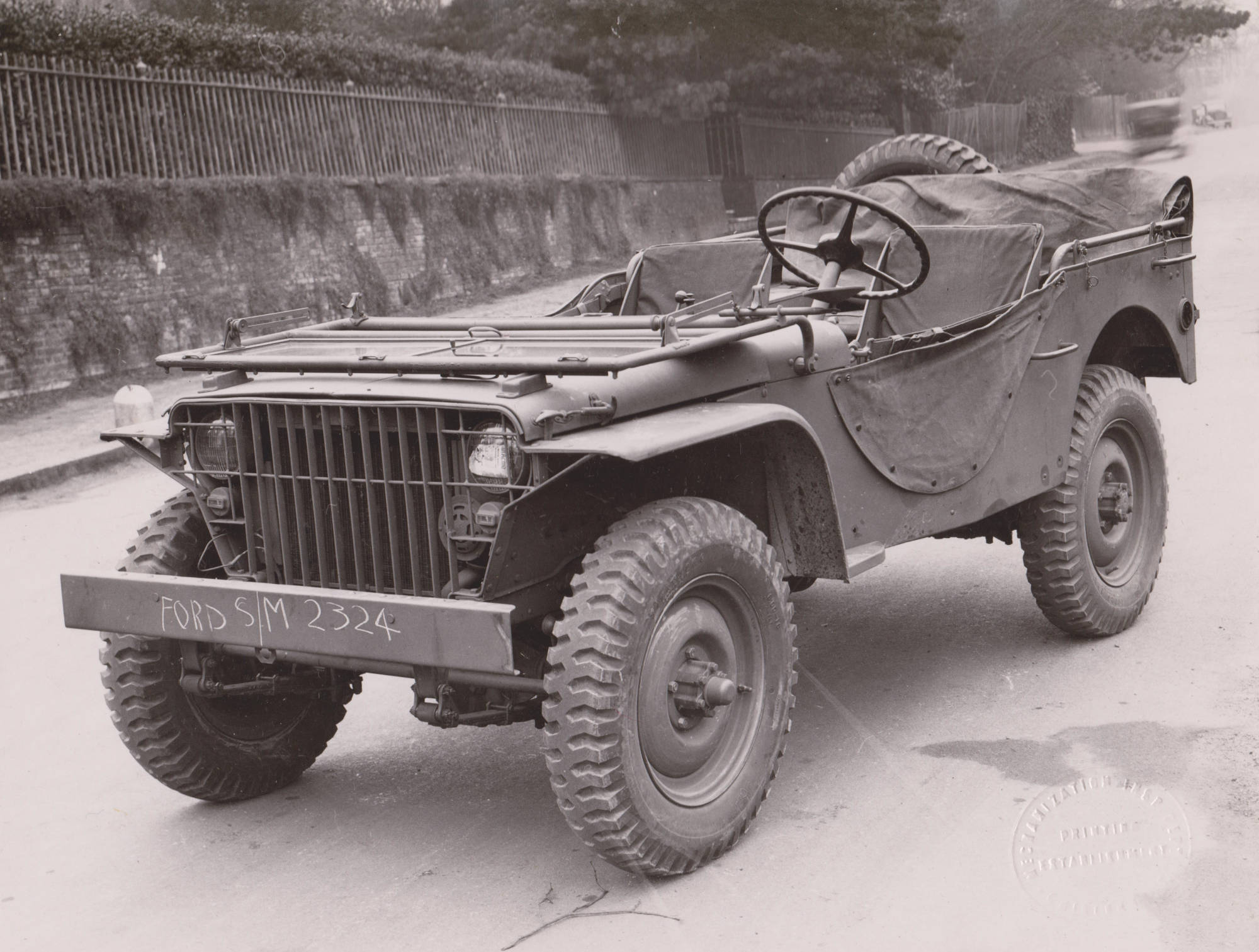
A Ford Car 5-cwt 4 x 4. (S/M 2324). One of the first 'Jeeps' to be sent to Britain for evaluation in 1942. Courtesy of Airborne Assault Museum, Duxford.
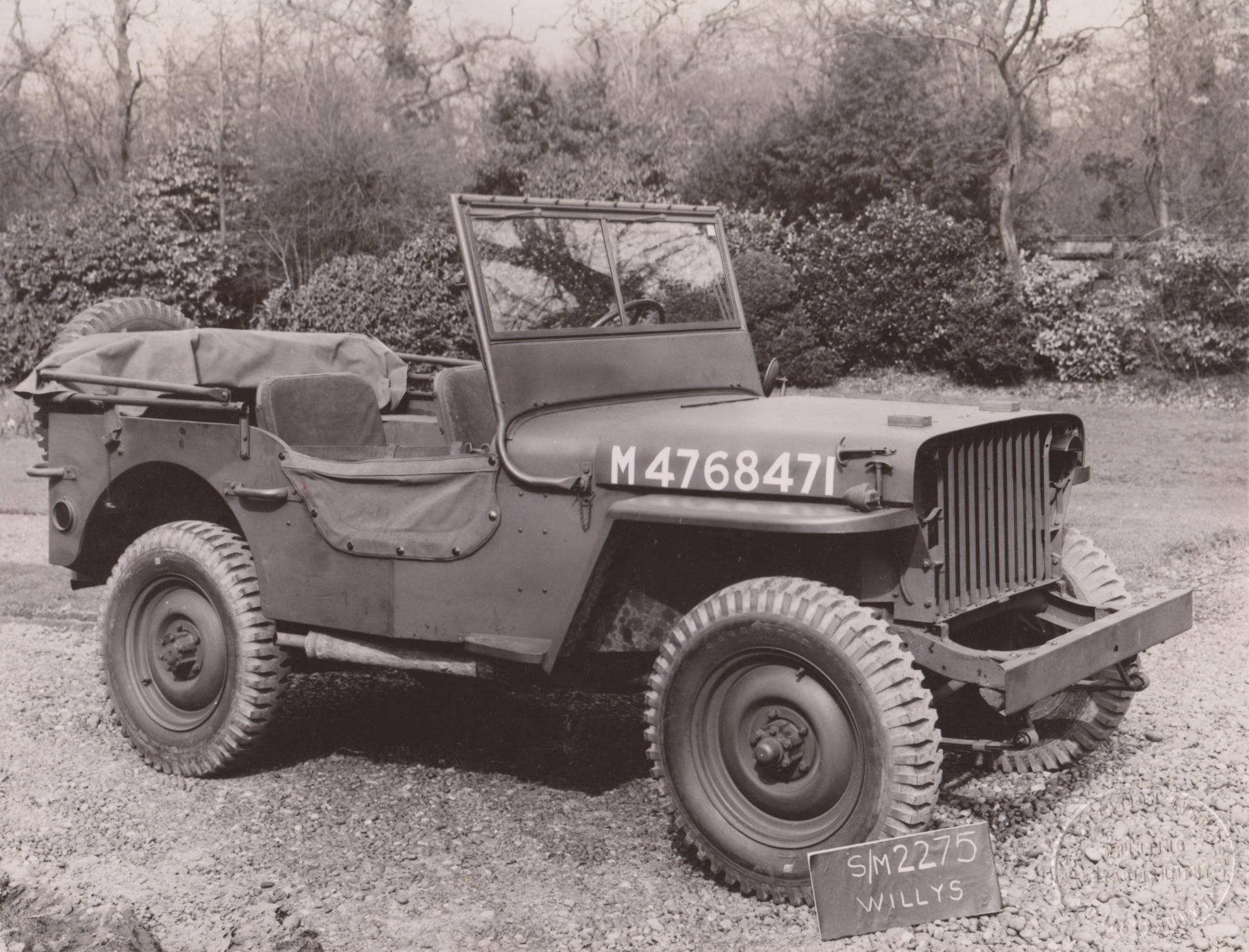
A Willys Overland Model M-B, Car 5-cwt 4 x 4 (S/M 2275). Another of the first 'Jeeps' to be sent to Britain for evaluation in 1942. Courtesy of Airborne Assault Museum, Duxford.
In some War Diaries and documents of Airborne Forces, the new 4 x 4 Utility Vehicle (Jeep) was called a 'Blitz Buggy', a name that did not 'catch on' with the men, and it was commonly referred to as the Jeep throughout its use in the British Army. Although it had been shown to the British as a suitable means of transport for Airborne Forces, it would take time to get them shipped across to the U.K. in any quantity, thus delaying the development of the Airborne Division.
Names of men who wanted to volunteer for The Glider Pilot Regiment were submitted to 1st Air Landing Brigade Headquarters on the 20th December. The next day was a Sunday, and as on most Sunday's, the men were allowed to attend a voluntary church service, of whichever faith they belonged to. However, it had also been arranged that all 350 Other Ranks would first be tested by a Psychiatrist!
Christmas Day for the Company included a Church Parade of all ranks at 09.00 hrs, of all denominations. Later, those from the Church of England on parade, conducted a March Past for the Brigade Commander.
As December 1941 came to an end, and the Company approached the New Year, each of the Platoons started a series of visits to the firing ranges. In between these trips to the ranges, the normal work of daily details and driving duties continued, and on New Years Eve a film of the German Army was shown to the Company.
Strangely, there is no War Diary that can be found for the period of January through to the end of April 1942 for the Company. However, the Company's activities were reported on in the 1st Air Landing Brigade Headquarters War Diary, probably because they were still considered a Brigade asset, and would still have been providing daily driver details.
On the 1st January 1942 the G.O.C., Maj - Gen. Browning, visited the 1st Air landing Brigade Signals Section, The Air Reconnaissance Company, the Independent Group Air Company R.A.S.C. and the 1st Bn, The Royal Ulster Rifles. This was taken from the Divisional Headquarters War Diary, notice the use of the term 'Air' instead of 'Airborne', even Unit titles were not completely understood by War Diary compilers at this stage!
The only entry for January is for the period 11th to 17th January, when they practiced Field Craft on foot and in vehicles, and gave a camouflage demonstration. For the period of the 8th to 14th February, it was reported that the Company carried out Bren Gun firing on the ranges at Churn, and held lectures on care and maintenance of Ammunition, petrol economy, and economy in rations.
For the month of March the Brigade War Diary compiler must have been supplied with much more information, as there were a total of six entries!
Between the 1st and the 7th March the Company carried out night lorry driving instruction and lectures on; 'Ammunition In The Field', 'Supplies In The Field', and 'Methods Of Camouflage'. During this period they also received a visit from the Deputy Brigade Commander, Col. P.H.W Hicks, who visited Units in the following order:-
2nd March - 2nd Bn, The South Staffordshire Regiment, the Reconnaissance Company, and the Group Company, R.A.S.C.
3rd March - 1st Bn, The Border Regiment, the Brigade Workshop, and the Light Battery, R.A.
5th March - 2nd Bn, The Oxfordshire and Buckinghamshire Light Infantry, and the 9th Field Company, R.E.
From the 8th to 14th March, the Company carried out compass reading instruction, night field craft, and firing practice with the newly introduced Thompson Sub-Machine Gun. The firing practice with the Thompson S.M.G. carried on into the following week, along with firing practices of their Bren Guns and rifles at Beacon Hill and Bulford Ranges. There were also lectures on convoy discipline, camouflage, petrol and tyre economy. These lectures carried over into the next week, 22nd - 28th March, as well as further visits to Beacon Hill Range to carry out firing practices with the rifle, and Bulford Range for the Bren Guns. They also practiced their field craft by day and night, and received instruction on aircraft and tank recognition.
Although no Horsas had been delivered to 38 Wing, loading trials with these gliders had begun during the period, and in March at Ringway, Maj-Gen. Browning, among others, watched the staff of the Airborne Forces Experimental Establishment attempt to load a jeep into the first Horsa prototype. Their attempt was frustrated by the managing director and chief designer of Messrs. Airspeed Ltd., of Portsmouth, the makers, who said that it would break the glider as the floor and loading ramp had been constructed for the motor-cycle combination which had been called for in the specifications. This caused consternation all round and shortly afterwards 1 Air-landing Brigade was ordered to provide samples of all equipment for loading trials to Airspeed Ltd. So began a close liaison between the makers and the users, initially working out methods of fitting the equipment into a Horsa mock-up at Portsmouth, and ascertaining the necessary loading and lashing gear required, and subsequently, beginning on 6th July, proving the loads and lashing in one of the six prototypes at Netheravon. Brig. Hopkinson and his Brigade Major, Maj. Campbell, who became the acknowledged airborne expert on the subject, spent many weeks personally on these trials. This, incidentally is an example of how much guess-work had to be done by the Division in the early days in that they had no opportunity of testing loads in an actual Horsa glider until eight months after the Division was formed. [B2]
At the end of March and going into the first week of April, the Company's activities were described as; carrying out field craft by day and night, walking and running march, aircraft and tank recognition. Range firing, and lectures on motor cycle training, and ammunition recognition. It was highlighted that this was all carried out as well as the daily vehicle tasks and details.
On the 9th April Sir Charles Petrie gave lectures to the Brigade Group Company and the Reconnaissance Company on "Why we are at War". This was the first of these lectures, and was a new initiative to keep the men, many of whom were now being conscripted, informed of what was going on.
For the week of the 5th to the 11th April, the Company carried out tank and aircraft recognition, and bayonet weapon training. The did night convoy work, and lectures on convoy discipline. There was also instruction on First Aid and stretcher work, as well as the vehicle daily maintenance tasks.
Discussions were now taking place on the further expansion of the Airborne Division, and some of the Brigade assets were about to become Divisional assets.
Accordingly, on the 31st March 1942 Maj. Michael St. John Packe was appointed as the Officer Commanding the Company. Born on the 21st August 1916, in Eastbourne, Sussex, and the son of a military father, he was granted a commission in the Royal Army Service Corps on the 29th February 1936, as a 2/Lt. Serving in the Supplementary Reserve, he was promoted to full Lt in March 1939, and then mobilized on the 24th August 1939 (apparently receiving the news whilst in the midst of a cricket match for Leicestershire against Derbyshire), and the following month he was promoted to Capt. He had taken part in the campaign in France and Flanders, in the 2nd Infantry Division Supply Column as the Echelon Supply Officer, and was not evacuated until the 26th September. He had spent some time as an Instructor at 202 O.C.T.U., R.A.S.C. before volunteering for Airborne Forces. Maj. Michael St John Packe: "One of the maxims pounded into the heads of students at R.A.S.C. Schools and O.C.T.U's during the last war was that plans for operational supply must be flexible, and those responsible for delivery resourceful. This at once became the keynote of the R.A.S.C. elements in the 1st Airborne Division when it was raised early in 1942. They consisted, at first, of a single company belonging to an independent brigade group which was transformed en bloc into the 1st Airlandmg Brigade, and they were promptly promoted to the status of divisional troops: under the jealously paternal eye of the Divisional Q Staff. Their task, in addition to fulfilling the constant although limited R.A.S.C. requirements of formation in home training, was to investigate the hitherto unexamined question of how a division deposited by air well behind the enemy lines could be maintained in action, possibly for several weeks, until relieved by advancing ground forces. The unusual feature of a theoretical study of this kind was that, having made their plan, they were immediately required to prepare themselves to carry it out at a date and in a theatre for the moment undisclosed." [B3]
The Brigade Commander held a conference on the 1st May, which all unit Adjutants attended. It was at this conference that the details of changes in status were announced and the Company designation became Airborne Division Composite Company, R.A.S.C. and they were to become Divisional Troops. Its role and responsibilities were outlined in a publication titled, Transport and Supplies. Volume I:
The Airborne Divisional R.A.S.C., as at first conceived in May 1942, when the formation of this type of division was being considered, had the following tasks:-
(a) Maintenance of the Division, and supply of all second line scales of commodities on wheels when the formation was "grounded";
(b) In the event of active operations in the United Kingdom, to carry out the same tasks as any other Divisional R.A.S.C. Company;
(c) By virtue of its particular role, to be responsible for the carriage and delivery of all commodities to numerous airfields and for the skilled task of loading freight-carrying aircraft and gliders. This task would be divided into two stages:-
(i) The initial loading of the airborne force, before the operation began;
(ii) The subsequent distribution to airfields, and loading of all supplies to the force, up to the maximum of six days.
It was expected that these tasks would be made more difficult by enemy counter-air action, necessitating wide dispersion and the use of a large number of airfields. The standard War Establishment was not generally applicable to the requirement, without numerous modifications, increments, etc. In view of the role of the company, and particularly in view of the points referred to in (c) above, it was not considered that the functions of the non-airborne portion of the company should be carried out by the general pool of transport at the disposal of G.H.Q., Home Forces.
Airborne Divisional Composite Company.
A special War Establishment was therefore designed, for an Airborne Divisional Composite Company, R.A.S.C., organized in two wings, an Airborne, and a Non-Airborne. The former comprised part of company H.Q., an airborne transport platoon, parts of the composite platoon and of the workshop platoon, and one relief driver increment. The non-airborne wing, consisted of the balance of company H.Q., and of the composite and workshop platoons, together with four transport platoons, each of standard composition and equipped with 3-ton lorries.
The airborne transport platoon (called at first the Blitz Buggy, i.e., Jeep, Platoon), was organized in a headquarters and seven sections, each of the latter comprising five Jeeps. The platoon included a defence section of 21 drivers, to man three L.M.Gs., five anti-tank rifles, and three 20-rnm. anti-aircraft and anti-tank guns.
The initial intention, was that each jeep should tow one 10-cwt. trailer, but it was later proposed that each of the 32 load-carrying Jeeps should pull two trailers in tandem, in order to increase the lift. Some doubt as to the wisdom of this method was expressed by the technical experts, on the grounds that prolonged towing would have serious effects on the towing vehicle, and that difficulties would arise over braking on hills, and on greasy surfaces. There was no objection to towing in tandem over short distances in an emergency. As the result of tests, however, using the Ford car (and not the Willys, which was more powerful), it was decided that no serious difficulties would arise, and 64 trailers were accordingly added to the establishment. [C]
As part of the preparation for the new role, two officers had already been sent on a parachute course. Capt's. Bate and Clark attended Course No 12 at R.A.F. Ringway, which ran from the 20th April until the 1st May, when they returned to the Company. This was a long course consisting of five descents - two from a balloon and five from an aircraft. At the same time as their return, 2/Lt. J.G. Sibbald reported for duty from No 202 Officer Cadet Training Unit.
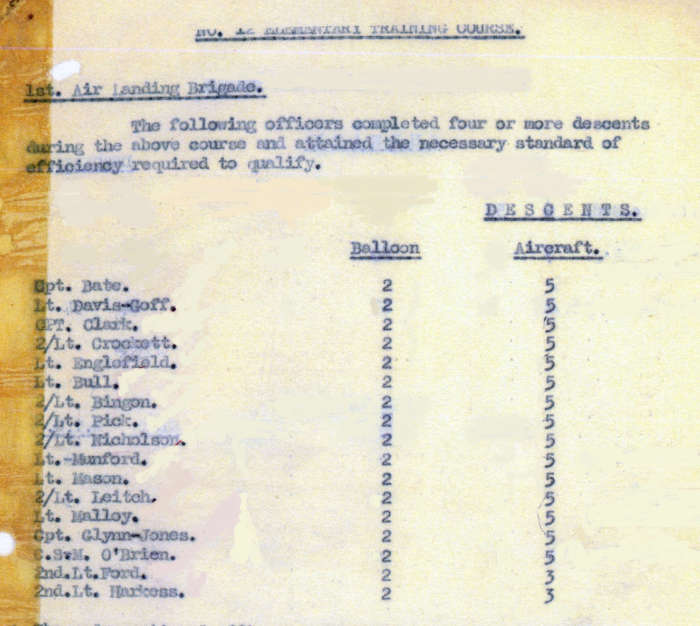
Parachute Course No 12, R.A.F. Ringway, 20th April to 1st May 1942. Notice Capt. Bate and Capt. Clark, and at the bottom 2/Lt. Harkess. Courtesy of Airborne Assault Museum, Duxford.
The 3rd May, was a Sunday, with warm, fine weather, for the morning route march. The Company were given the afternoon off, and Church Parade was voluntary. Monday was to be a very busy day, as the Company were moving to a new Camp at Amesbury, and all the 2nd Line ammunition and 2nd Line petrol, along with stores, clothing and reserve rations were to be loaded. At 08.30 hrs that morning, the Advance Party of an Officer and 26 men set out for the new Camp. Further preparations went on over the next two days, and then at 09.00 hrs on the 7th May, the Company moved from Newbury Racecourse to Amesbury Abbey, arriving there at 12.00 hrs. The rest of the day was spent settling in. Upon arrival, the unit designation was changed, yet again, to 250 Divisional Airborne Light Composite Company, R.A.S.C.
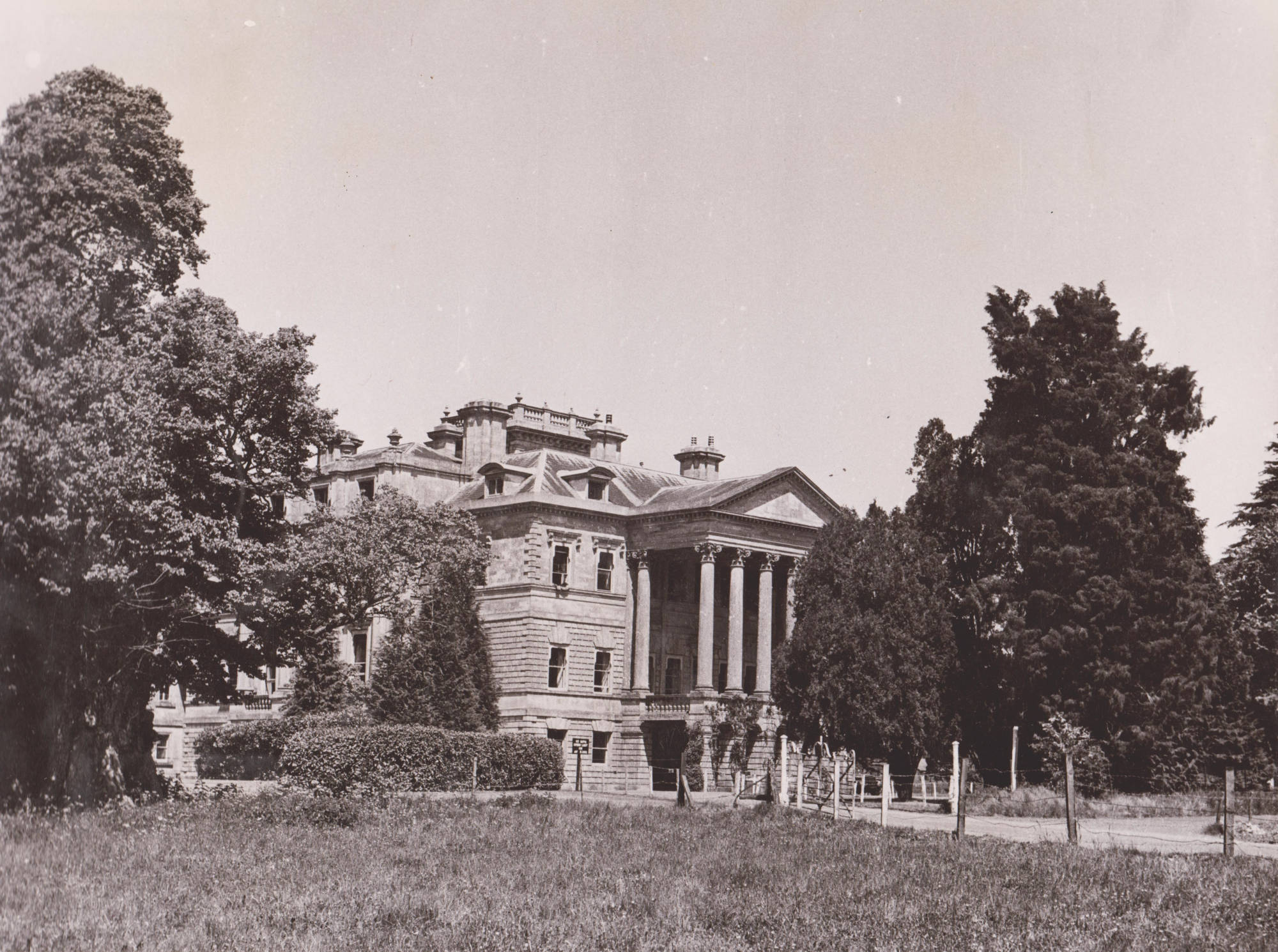
Amesbury Abbey. Photo taken some time between 1943 and 1945. Courtesy of Airborne Assault Museum, Duxford.
The following day was another of the frustrating petrol-less days, which the unit had to put up with considerably through 1942 but, the time was spent settling in and arranging vehicle parks and stores. 2/Lt. Desmond Thomas Kavanagh had reported for duty at the beginning of the month. Known to all as 'Paddy', he had been born in 1919, in Liverpool, and was granted an emergency commission in the Royal Army Service Corps on the 30th August 1941.
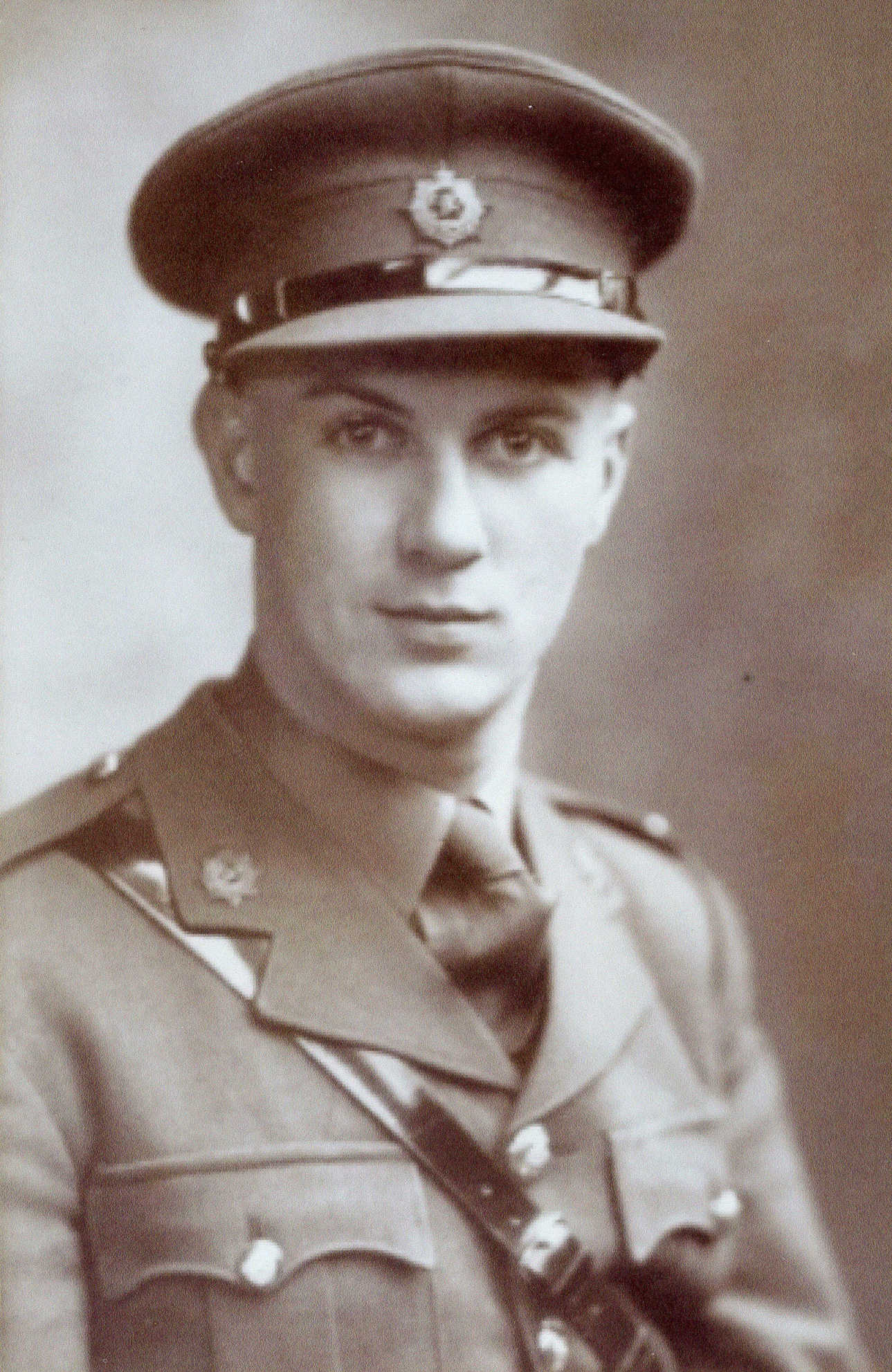
Desmond Kavanagh, as a newly commissioned Second Lieutenant in the R.A.S.C. in August 1941. Courtesy of Brian T. Kavanagh.
This move was part of what Maj - Gen. Browning had been recommending, so that his Division was concentrated in an area which was suitable for the tactical training of troops, open enough to provide good dropping and landing zones, and enabled gliders to be retrieved easily after exercises. The salvaging of gliders and the collection of parachutes, was an important factor when considering areas for airborne training. The gliders were valuable and liable to be damaged in close country, or bogged in soft ground, while parachutes had to be loaded into lorries which had to get on to or near the dropping zones.
Between the 9th and the 13th May, part of the Company started to establish ammunition dumps for the Division, whilst on the 11th May, 133 All Ranks had flying experience in Hotspur gliders at Netheravon. There was one forced landing, but no other incidents. Flying was suspended during the morning owing to low cloud. Sgt. 'Bill' Chedgey: "I have a strong memory of glider training and the attempts made to cure air sickness. We went to Newbury race course [Netheravon] with the thirty blokes most susceptible to the problem and kept sending them up with different tablets and timed the time to sickness. It was horrible." [D]
It was on the 14th May that there is an entry in the War Diary, worthy of note: "Experiment in basket loading with A.A. & Q.M.G. (Div) and D.A.Q.M.S. Parachute Bde". Throughout April and into May, Maj. Packe had been wrestling with the idea of how to drop more supplies than could be delivered by the metal cylindrical containers, which had yet to be introduced into service. It was whilst at home that his eye had fallen upon the family laundry basket. Realising its qualities of strength, resilience and lightness he had returned to the Company with it, and trials would subsequently prove the success of his concept.
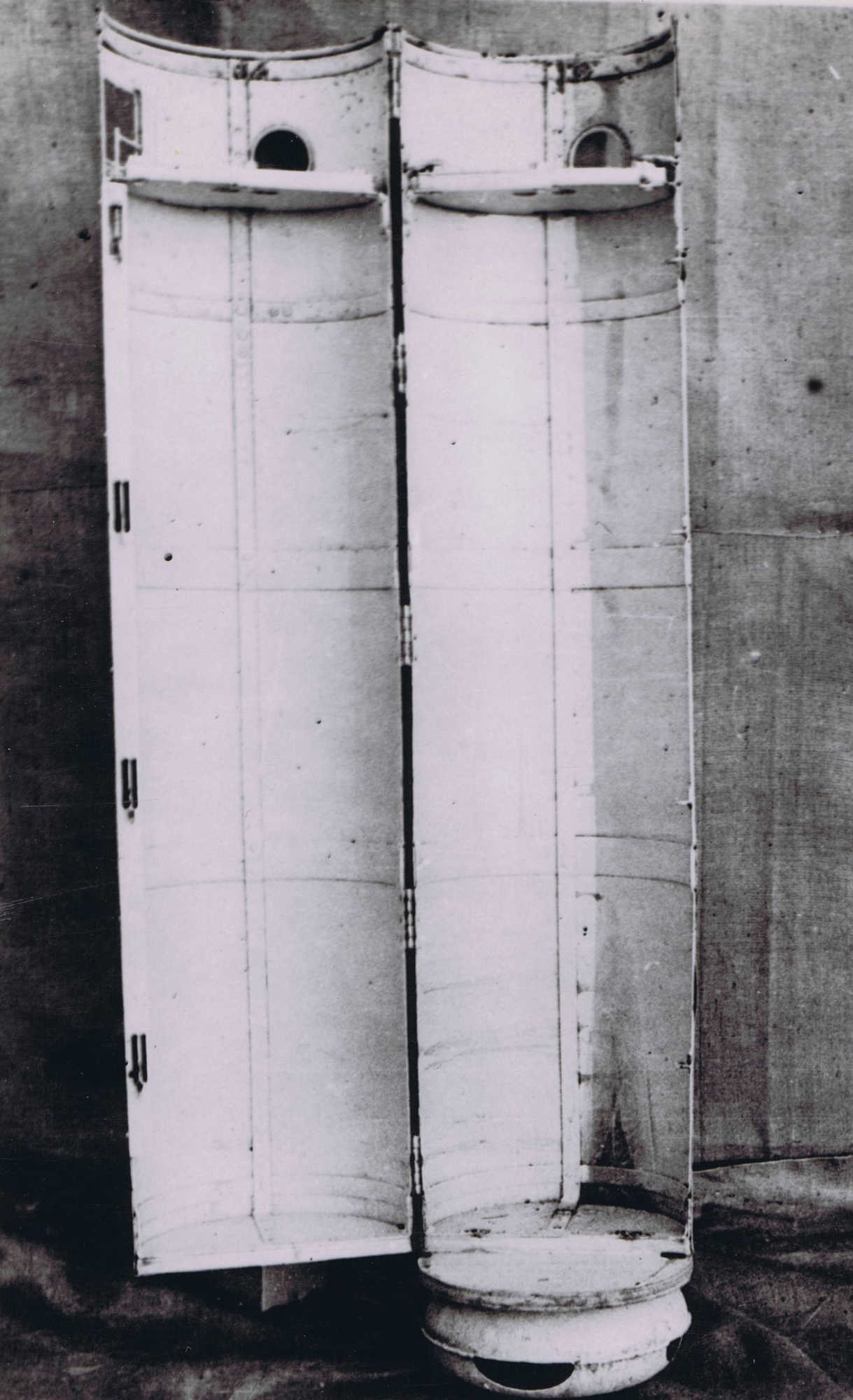
C.L.E. Mk III Bombcell Container. Internal dimensions:- Length = 53 inches. Diameter = 13 ½ inches. Parachute fits into top "bucket". Courtesy of Airborne Assault Museum, Duxford.
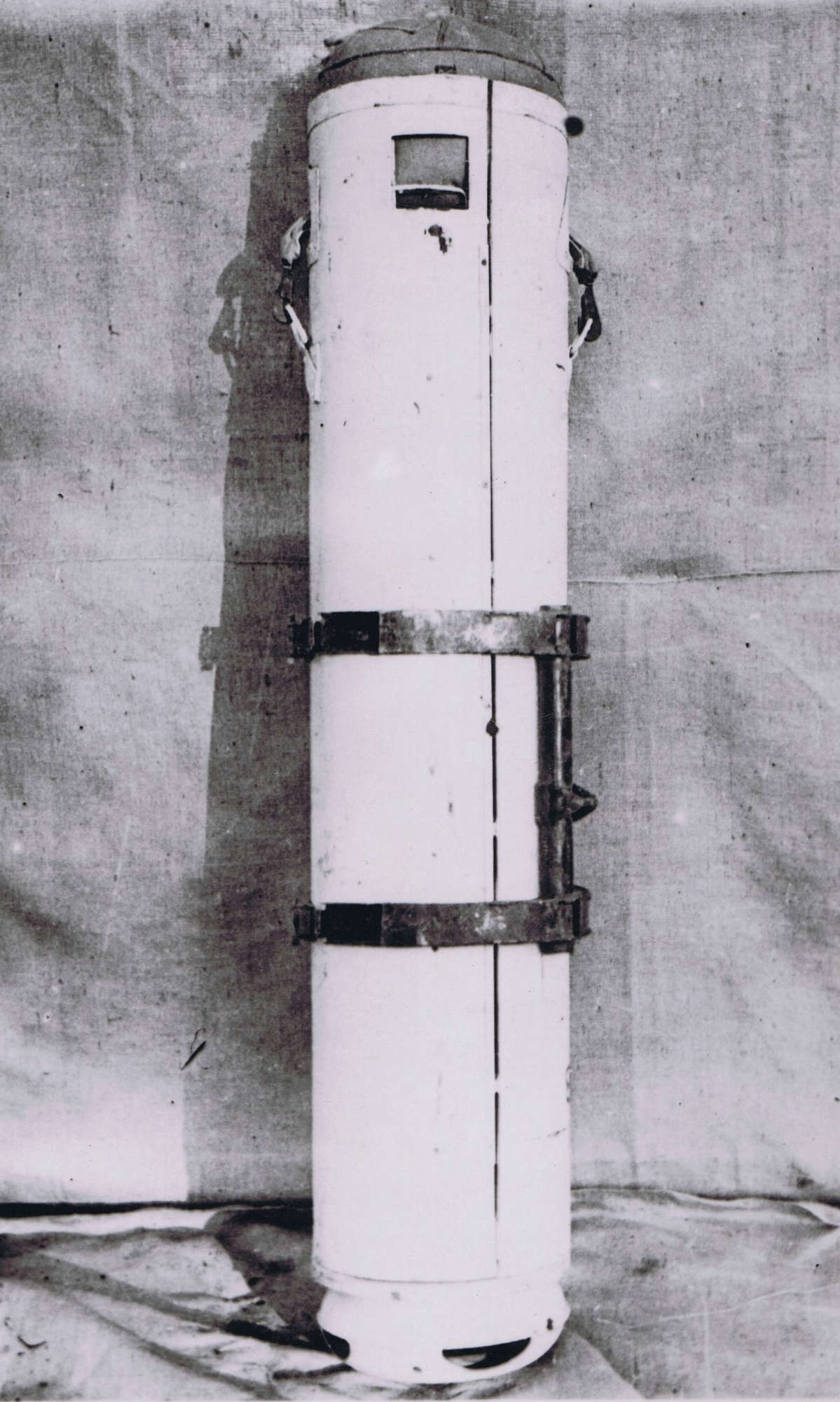
C.L.E. Mk III Bombcell Container, with cradle and clips attached, ready for dropping. Parachute is fitted into "bucket" and attached to 'D' rings on Container. Courtesy of Airborne Assault Museum, Duxford.
A proposed experiment in dropping supplies by air in baskets by parachute, was postponed owing to weather on the 17th May, but a drop then took place at 11.15 hrs on the 19th May. An experimental basket containing ammunition, a 4 gallon can of water and 12 man ration packs was successfully dropped by parachute from a balloon at 600 feet. This experiment was repeated with the Divisional Commander and Staff in attendance at 17.15 hrs. Unfortunately, the parachute failed to open, and the contents suffered considerable damage. The basket, however, withstood the strain well, and ammunition was thought to be fit to fire. The following day, at 17.00 hrs, more baskets, containing supplies, were dropped by parachute, and proved to be successful.
A series of photo's showing a wicker pannier after experimental drop testing at the A.F.D.C. (Airborne Forces Development Centre). 23rd June 1944. Courtesy of Airborne Assault Museum, Duxford.
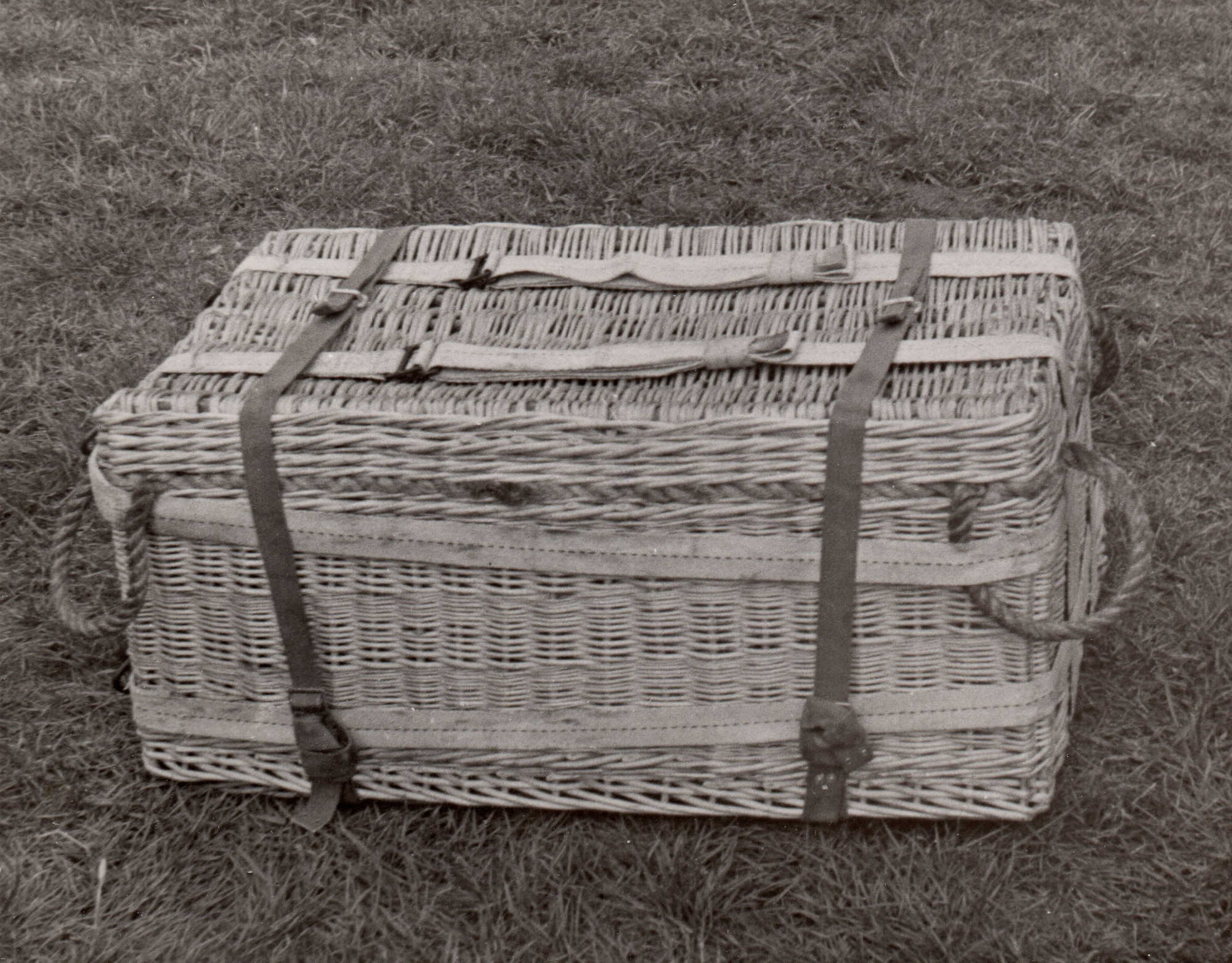
Packed and ready for loading.
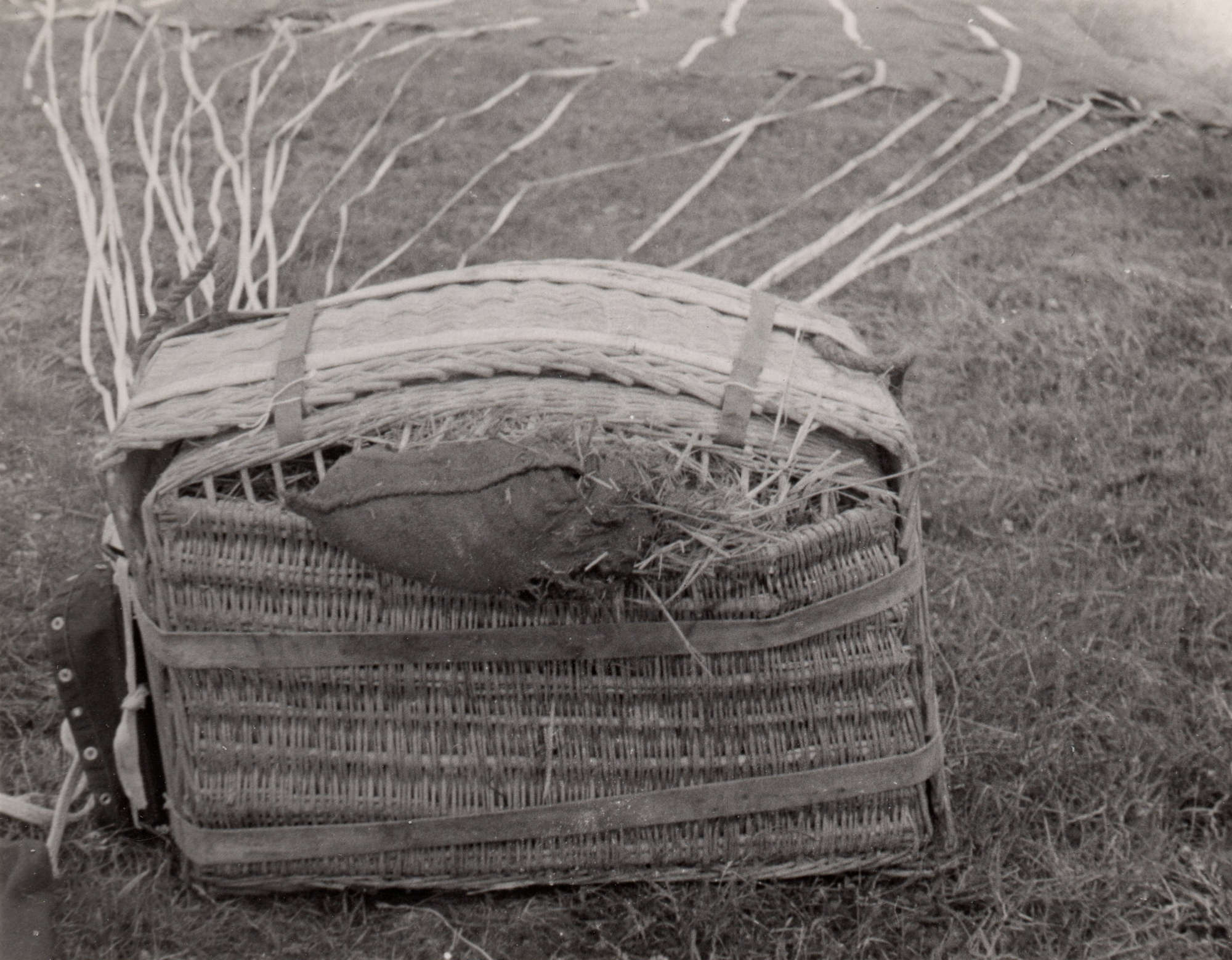
Partial damage to bottom of the pannier.
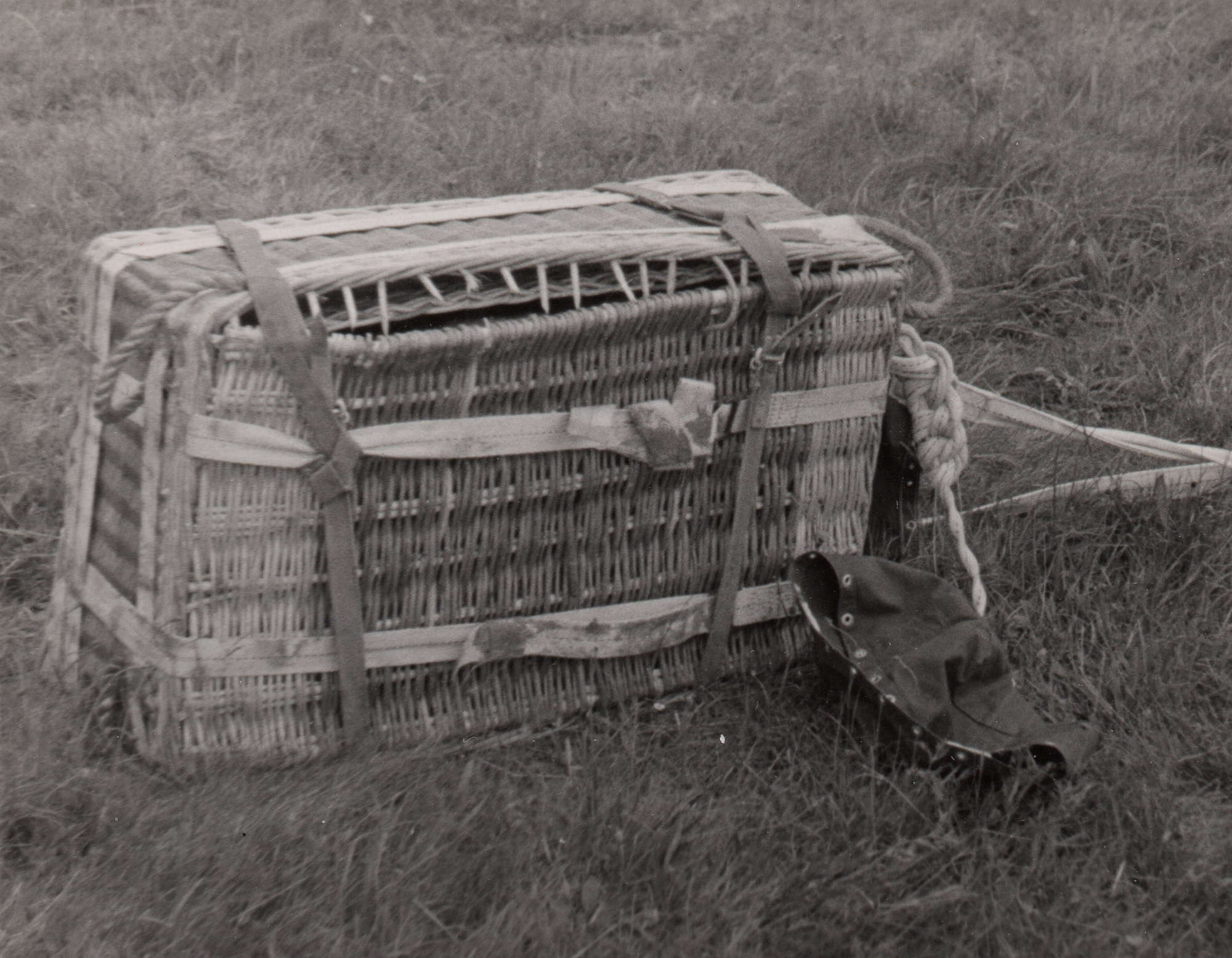
No damage to top of the pannier, or contents.
At 09.30 hrs on the 21st May eight officers and 130 Other Ranks of the Company paraded on Brigmerston Down to be inspected by H.M. The King, and to witness a demonstration of an airborne attack. However, the demonstration was postponed owing to rain, but took place later in the day. At 14.00 hrs, 65 All Ranks paraded in Bulford to take part in lining of the streets during the visit of H.M. The King and Queen, to 1st Parachute Brigade. The following day at 09.30 hrs, the Company was inspected by Maj - Gen. Browning. This included a ceremonial parade and inspection of turn-out, an inspection of barrack rooms, kits, vehicles, Workshops and all Company Lines, and also of the Company Offices and books. There was also a demonstration of various forms of training. The G.O.C expressed himself well satisfied with what he saw.
The new Mark IV rifles were used on 'B' Range at Perham Down on the 24th May, and at the same time, Officers and Senior NCO's fired the new Colt .45 automatic pistols, apparently with satisfactory results.
As well as getting the Company ready for its future, proper, Airborne role, the normal everyday transport duties were still required of it, and on afternoon of the 26th May they provided 24 x 3 ton lorries and drivers from 'C' Platoon to ferry the 2nd Battalion, The South Staffordshire Regiment from Kingsclere to the Bulford area, returning the following afternoon. This was followed by providing 6 x 3 ton lorries for the move of the 181st Airlanding Field Ambulance into the Bulford area on the 28th May. Another 30 vehicles and drivers were then provided for the move of the 1st Battalion, The Royal Ulster Rifles on the 1st June, which proved to be a very busy day, as the Divisional A.D.M.S. visited the Company, and construction of a new road within the camp was begun.
Another 189 All Ranks participated in glider flying experience at Netheravon on the 27th May. This was followed on the 2nd June by 16 Other Ranks having map reading experience in a Tiger Moth at Shrewton, and then 83 All Ranks had airborne glider experience in Hotspurs at Netheravon on the 4th June.
On Saturday, 6th June it was reported that the weather was fine and warm, and the Company was occupied with normal duties and training in the morning. In the afternoon the, Finals of the Company Sports were held, which went off very successfully with good times being recorded. 'A' Platoon won the Platoon Challenge Cup, and Lt. Kavanagh won the Individual Cup, but stood down in favour of Dvr. Farrar, who was second. In the evening a Company Dance was held, where the presentation of Cups took place.
On Monday, 8th June the Company received information that the northern area of 'C' and 'D' Platoon's vehicle park was to be requisitioned, so work was immediately started on an Assault Course in the same area - in an effort to thwart the authorities! Dvr. 'Jim' Wild: "The Assault Course was also a 'must' each week, so we built our own along the same lines as the one at Hardwick." [E12] The following day was an important one for the Company as they were visited by the Assistant Inspector of the R.A.S.C. He studied everything from the documentation in the Company Office to the Workshops and the Bulk Breaking Point that had been set up in Beacon Barracks. After being taken to see the Divisional A.A. & Q.M.G. in the afternoon, he was shown Hotspur gliders at Netheravon. He departed at 19.00 hrs.
An Officer from the Company accompanied the 'Supply Committee' to Portsmouth, on the 11th June, to visit Airspeed Limited, who were producing the new Horsa Mark I glider, and they would experiment in glider loading.
Maj. Packe departed for Hardwick Hall on the 13th June, to undertake his Pre-Parachute Selection Course - which he successfully completed. He then went on Parachute Course No 16 at R.A.F. Ringway, 22nd to 27th June 1942. This was a short course of 4 descents, two from a balloon and two from a Whitley aircraft. Note, there were no other 250 Light Company men on the course with him.
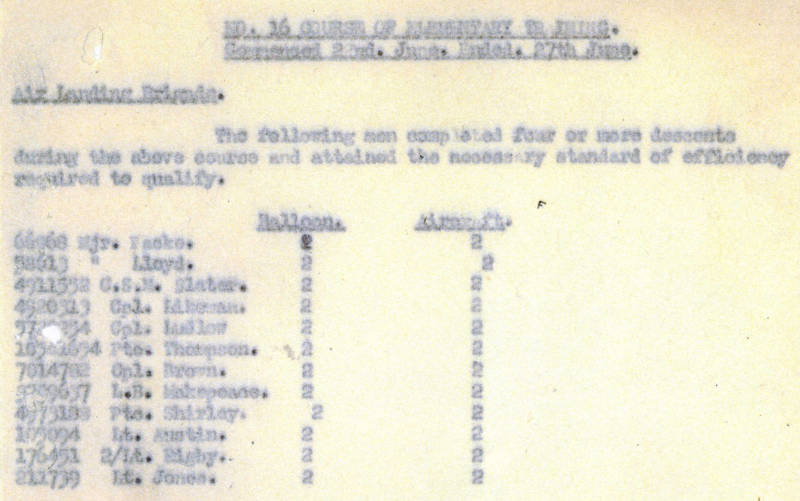
Parachute Course No 16, R.A.F. Ringway, 22nd to 27th June 1942. This was a short course, notice Major. Packe. This document shows the limitations in quality of wartime paper. Courtesy of Airborne Assault Museum, Duxford.
Also on the 13th June, whilst part of the Company carried out a firing practice on Perham Down Range, the other part went through the Assault Course - it would appear the Company had triumphed over the authorities! On the 16th June the Divisional A.D.O.S. visited the Company, followed two days later by the A.D.S.T. Home Forces and the Divisional A.A.Q.M.G. All of these visits were part of the co-operation between 'Departments' within the Division to make sure that everyone was working towards the same aim.
The month of June continued with regular visits to the ranges (where everything from rifles to Bren guns were fired, and grenades were thrown), route marches, and transport duties. Once a week, there was also, either a training film shown or a lecture on some aspect of the War - such as the 17th June, when a Maj. Hooper talked to men of the Company about Russia, followed on the 24th June by a talk by Dr. Aris about the book by Adolf Hitler, "Mein Kampf", which was to 120 men of the Company.
Capt. Gifford, representing the O.C. went to a meeting of the War Establishment Sub-Committee at the War Office on the proposed War Establishment, on the 25th June, which was followed by a visit to the same on the 29th June by Maj. Packe to seek approval from them. This was a regular occurrence for the officers of the Company, as they, and the rest of the Division, were engaged in developing their units, and training them. They were also trying to work out the best organisation for them - a bureaucratic process, but necessary with so few resources at this stage of the war. To make sure that all the resources invested in the new Airborne Division were being used correctly, there were also regular inspections. Amongst the first of these for the Company was a visit by the Chief Inspector of Mechanical Transport (C.I.M.T.), Capt. Middleton, R.A.S.C on the 29th June, which would take until the 19th July.
An application was made to Division by Maj. Packe on the 1st July, that a Commander R.A.S.C. (C.R.A.S.C.) was needed as part of the War Establishment.
The difficulties of the Company's tasks, and what was expected of it were summed up by Maj. Packe in an article in 1952: "The problem was obviously twofold. First, how to get the requisite quantities of ammunition, petrol and supplies into the area held by the airborne troops. Secondly, how to administer them when they got there. As regards the former, after a good deal of more or less technical discussion and experiment involving a few hearty explosions but, happily, no loss of life, it was decided that the necessary commodities should be pre-packed by the R.A.S.C. and held by them at base until an operation started. Some were to be in the cigar-shaped containers which could be dropped by parachute from the bomb-racks of heavy aircraft; others, in rectangular wicker baskets (wicker being both light and resilient) which were to be parachuted by despatching crews of R.A.S.C. personnel from the doorways of Dakota's fitted with metal roller conveyors. The second was a more human problem, and the pace was set by the Divisional Commander who was determined that his force should go to battle accompanied by sufficient detachments of all arms and services to make it completely self-contained and that in the meantime all the units under his command, without distinction, should be very much m the family [the Airborne Division], well equipped, imbued with a very high morale, smart and soldierly, strictly disciplined, observant, healthy, and· above all trained to the last point as fighters with every conceivable weapon under all imaginable conditions. In return for these extreme standards of' conduct, all ranks received small privileges, extra week-end leaves; airborne pay; immunity from the more frustrating type of regulations; the chance to win the parachute wings and the red beret. In attempting to achieve all this, the R.A.S.C. element received the greatest consideration from its own Corps. A.G. 8 and the O.I.C. records were most helpful, with the result that every officer and practically every man were hand picked. War Establishments and G. 1098 tables were approved very much as submitted by the Company Commander; wide training facilities were offered, and even the C.I.M.T. (at that time the Grand Inquisitor to most companies) showed some inclination to be tolerant." [C1]
During the month of July the Company kept up its 'infantry' skills with regular visits to the ranges, usually once a week, sometimes twice, with anti-tank rifle practice on the 2nd July, four rifle practices, two live grenade practices, and two sessions by officers and S.N.C.O's with revolvers. This was enhanced with a street fighting exercise for two Platoon's in a blitzed area of Southampton on the 4th July. And this was followed by a lecture on personal concealment to 100 men of the Company on the 29th July and a demonstration the next day for 70 men.
Between the 7th and 12th July a short parachute course at R.A.F. Ringway was attended by Capt. 'Paddy' Kavanagh and sixteen men of the Company. This was Parachute Course No 17, and was the first one where Other Ranks from the Company qualified as parachutists. Capt. Kavanagh and thirteen of the men passed the course, Sgt. O'Dell, Cpl. Stephenson, Cpl. Rawlings, and Dvr's. Bruce, Olson, Bunstead, Ware, and Bricker, and Pte's. Boardman, Ridgeway, Kane, Egerton and Hurst. One of those that failed was Sgt Maj. Walter Gibbs, who sprained his ankle. Four days later they were involved in the first Company exercise in the airborne role, which was observed by the D.A.Q.M.G. of the Airborne Division.
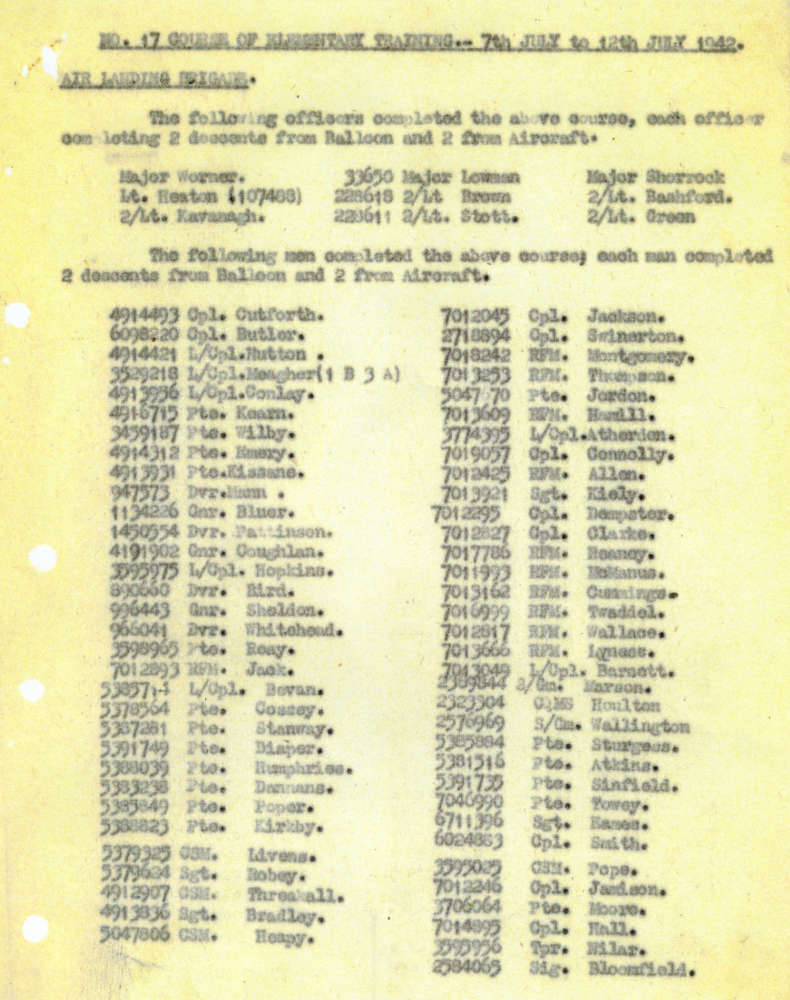
Parachute Course No 16, R.A.F. Ringway, 7th to 12th July 1942. This was another short course for members of the Air Landing Brigade, and included 2/Lieut. Kavanagh, and included sixteen other men of 250 Company, with thirteen of them qualifying.
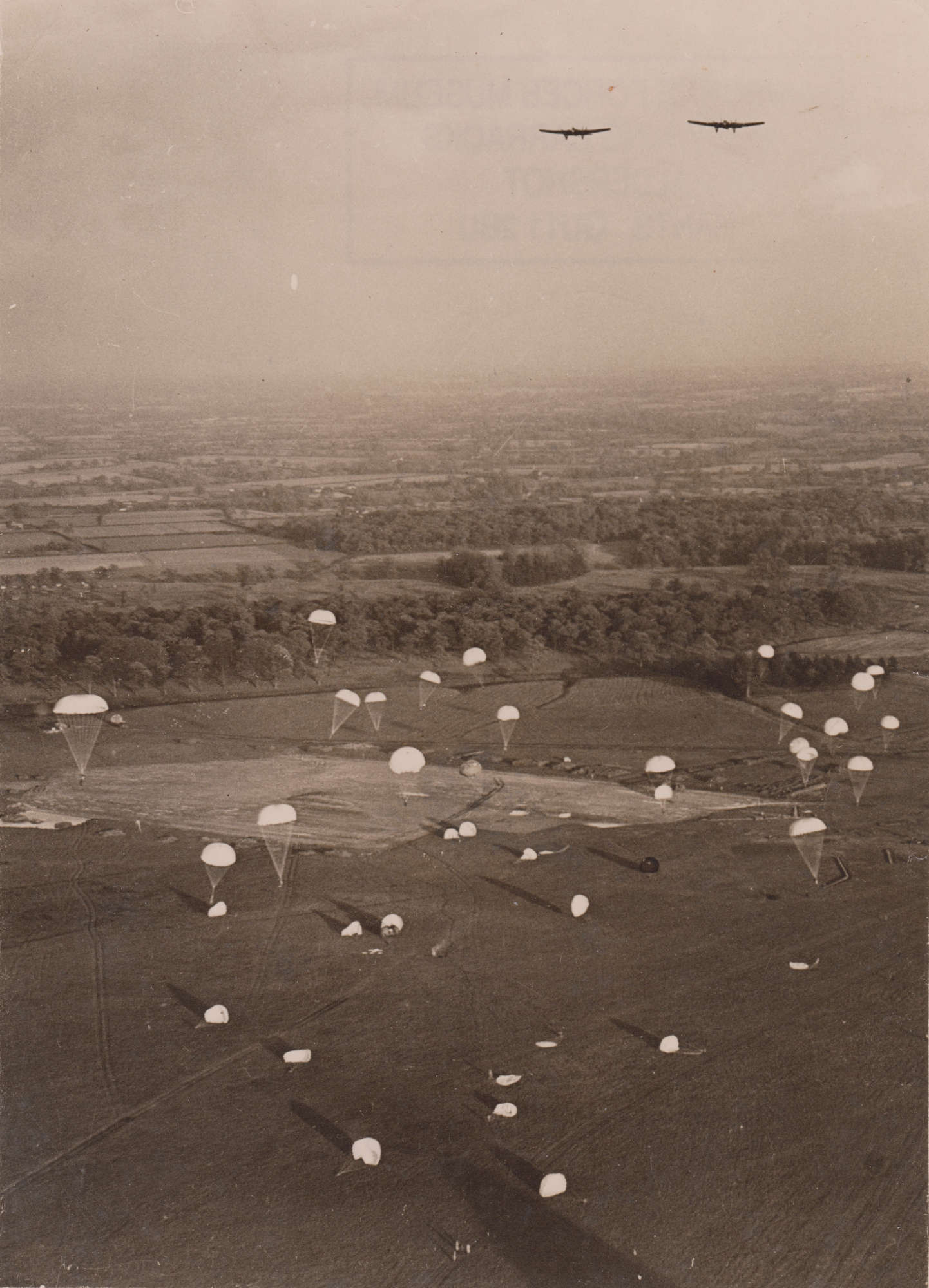
Trainee parachutists dropping over Tatton Park. 1942. Tatton Park belonged to Lord Maurice Egerton, the 4th and last Baron of Tatton, and in his mid 60's when War broke out. He offered the use of the Park to nearby R.A.F. Ringway to be used as a Drop Zone. The nearby Home Guard units had to be informed that sightings of parachutists in the area were 'friendly'! Courtesy of Airborne Assault Museum, Duxford.
With 56 more men undergoing gliding experience at Netheravon on the 19th July, and a supply loading experiment with Harrow aircraft and experimental dropping by parachute of petrol cans, followed by another 112 all ranks undergoing glider flying experience at Netheravon on the 21st July, the Airborne Wing of the Company was beginning to take shape.
Dvr. Ronald 'Ron' Nutley joined the Company in this month: "I was called up in February 1942. I was told to report to Bovington. The following day I was sent to Catterick camp for 6 weeks basic training. I was 20 years old. I was posted to Hadrian's Camp, Carlisle. After a month at Carlisle having commenced training in tanks, I decided I did not care too much for my chances at being trapped in a burning tank so volunteered for the Airborne. From Carlisle I moved to Amesbury then on to Hardwick Hall to do parachute training. I then moved to R.A.F. Ringway (which is now Manchester Airport). I did 5 'jumps' and was then sent back to Amesbury. I joined the 1st Airborne Division to be attached to the Airborne as a Transport Company driver. I drove 3 ton trucks. During this period I completed the rest of my 'jumps'. I needed to do 8 to get my wings. These jumps were done over Salisbury Plain." [J]
No sooner had these men returned to the Company, than another party departed for its parachute course. This was run at R.A.F. Ringway from the 20th to the 27th July, and was Course No 19. Nine men from the Company were on it, Cpl. Manderville, L/Cpl. Breeman, L/Cpl. Taylor (038), and Dvr's. Russell, Chapman, Tapper, Roffey, McGarry and Stanley.
The implementation of the new War Establishment was started on the 2nd August, with a re-organisation, on paper, on the 7th, and a re-organisation parade was then held on the 9th. The next day was the first time that the War Diary recorded the activities of the two parts of the Company: Airborne Wing = Training. Remainder of Company = normal duties and vehicle details. This would be the usual format for the War Diary entries for several months, with the Remainder of Company written in as Non Airborne Wing.
At 10.00 hrs on the 6th August, the A.A. & Q.M.G. from Division oversaw loading trials of panniers into a Horsa glider, and then at 17.30 hrs Company exercise, 'Glider II', started. On the 11th August there was a visit to the 1st Parachute Brigade to arrange Container Loading Trials, and then a visit to the 1st Air landing Brigade to discuss Glider Loading Tables. The next day, another 36 men underwent glider flying experience at Netheravon.
The third and fourth parachute courses for the Company departed for Hardwick Hall, and then R.A.F. Ringway at the end of July and the 14th August. Unfortunately, there are no records for Courses No 21 and 22, but it is thought that perhaps ten to fifteen men attended Course No 21 and an Officer and 14 men attended Course No 22. It is thought that the Officer was Capt. Gifford.
On the 18th August, there was an experiment at loading a 2000 lb parachute container, the outcome of which was not reported as the next day news of the Combined Operations Raid on Dieppe was announced. However, four days later a visit was made to Facility Parachutes in Woking for a conference on the new 2000 lb container. On the 25th August, 80 All ranks of the Airborne Wing went to Cranborne Chase for a week of camping and field firing. They would finish off with a night march back to Camp.
Then on the 27th there was 'leap forward' in the Company's progress as an Airborne Unit, with a visit to Divisional Headquarters to demonstrate a 'Blitz Buggy' and a trailer fully loaded with six basket packs of ammunition.
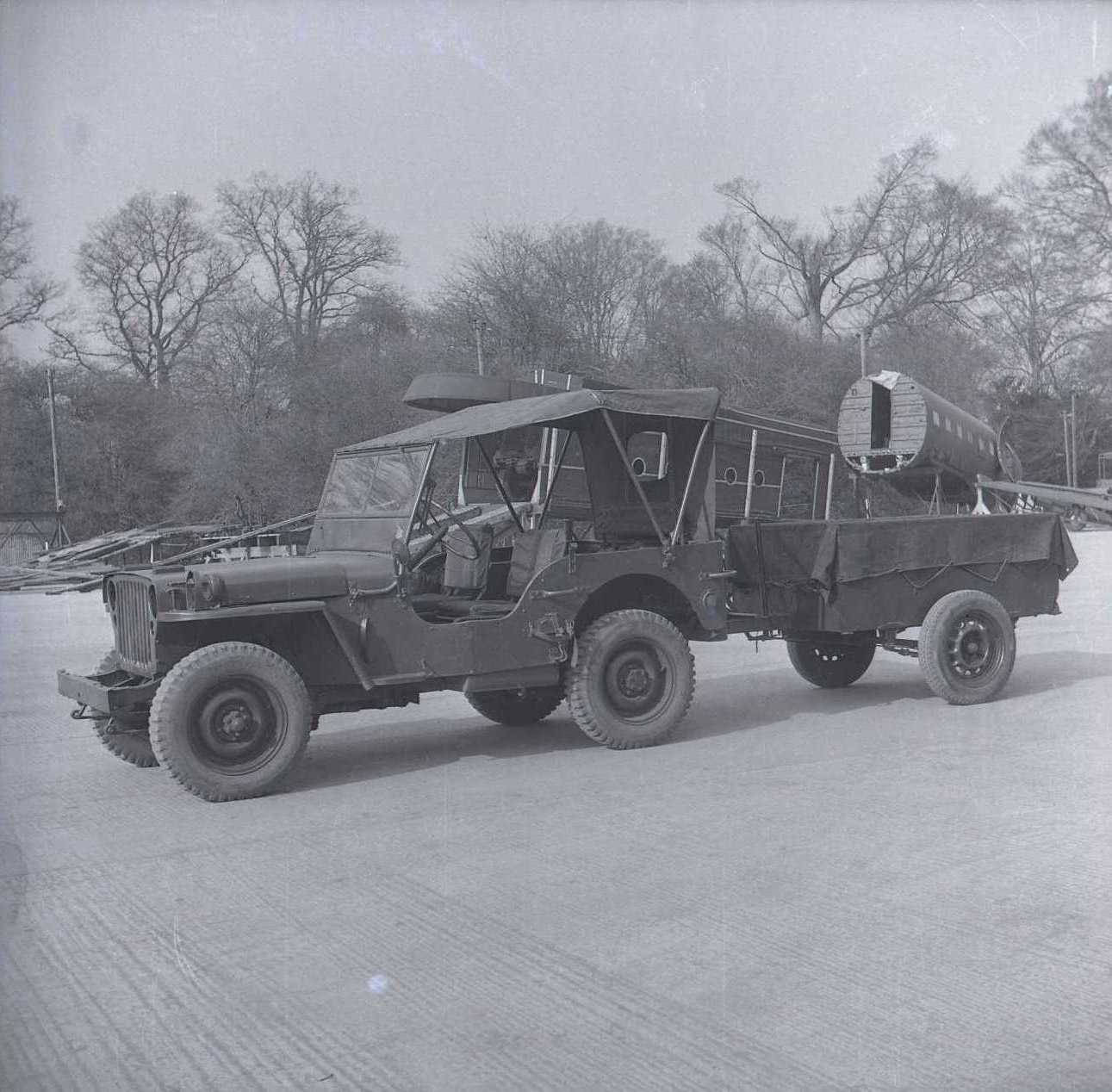
A partially modified Jeep ('Blitz Buggy') and an airborne 10cwt trailer at the A.F.D.C. 1943. Courtesy of Airborne Assault Museum, Duxford.
There was a demonstration of loading parachute containers and of finding the centre of gravity at the Headquarters, 1st Parachute Brigade on the 29th August. Two days later, the officers of the Company proceeded to Netheravon to arrange for Mk I Parachute Containers for wing bombs cells to be fitted to a Whitley for trials, that were to take place the next day. These trials were continued on the 4th September.
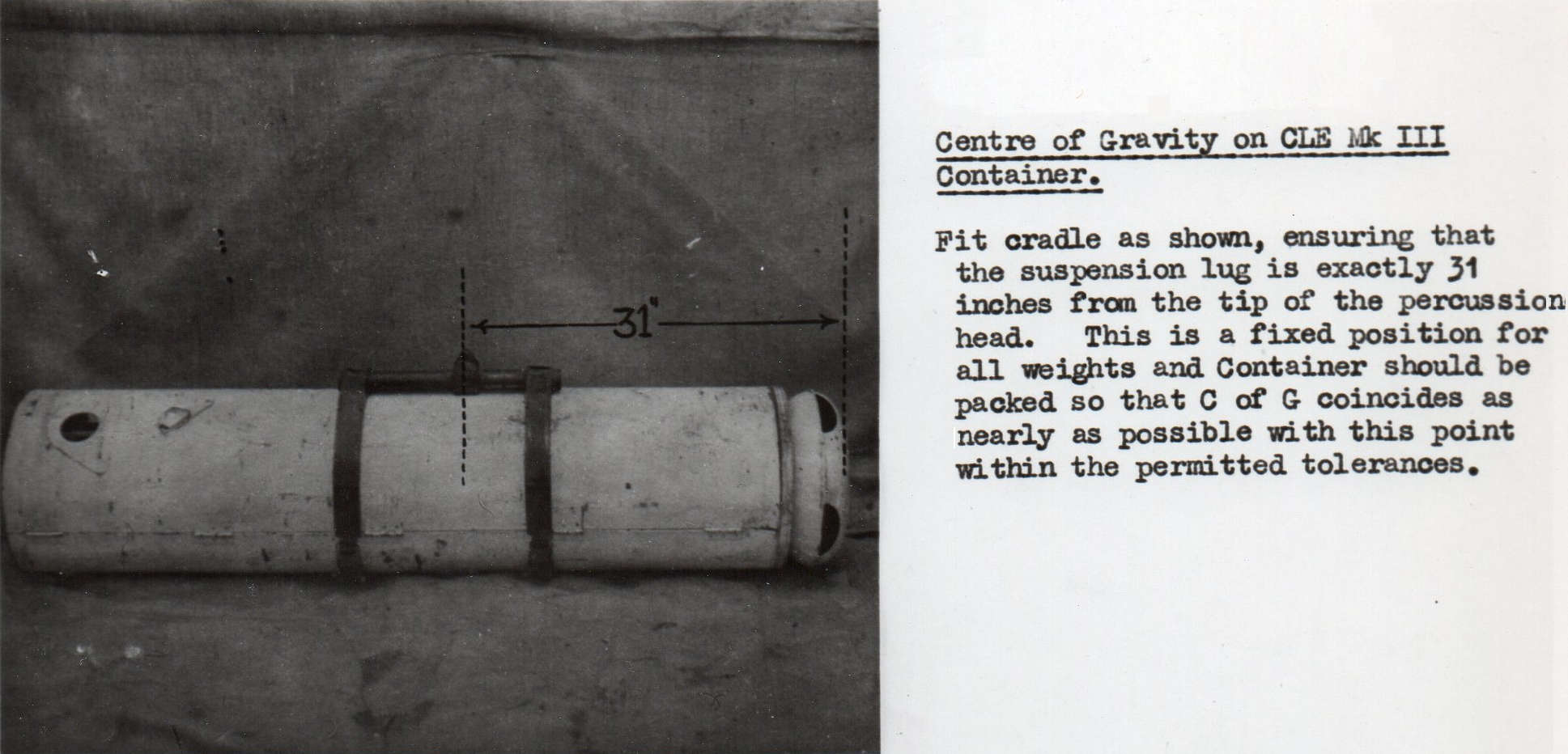
Centre of Gravity test on a C.L.E. Mk III Parachute Container. Part One. A.F.D.C. 1943. Courtesy of Airborne Assault Museum, Duxford.
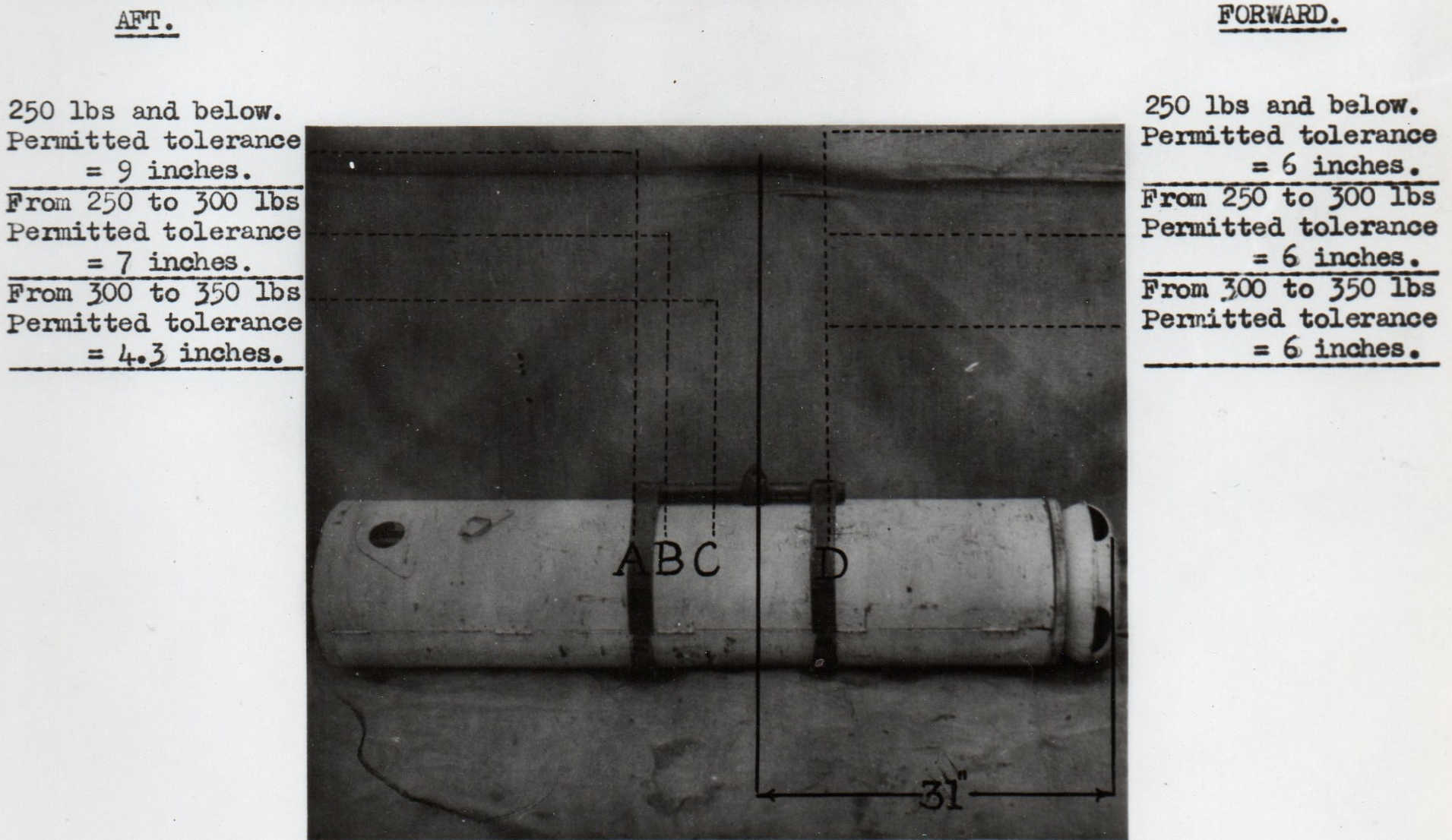
Centre of Gravity test on a C.L.E. Mk III Parachute Container. Part Two. A.F.D.C. 1943. Courtesy of Airborne Assault Museum, Duxford.
Centre of Gravity - permitted tolerances.
With the suspension lug positioned at the fixed distance of 31 inches from the tip of the percussion head, the actual Centre of Gravity of each Container must be at or within, the distances shown from the suspension lug, aft or forward, in accordance with the weights specified i.e:-
At 250 lbs or below - between A and D.
From 250 lbs to 300 lbs - between B and D.
From 300 lbs to 350 lbs - between C and D.
NOTE: Weights are all up, including weight of parachute, cradle and clips.
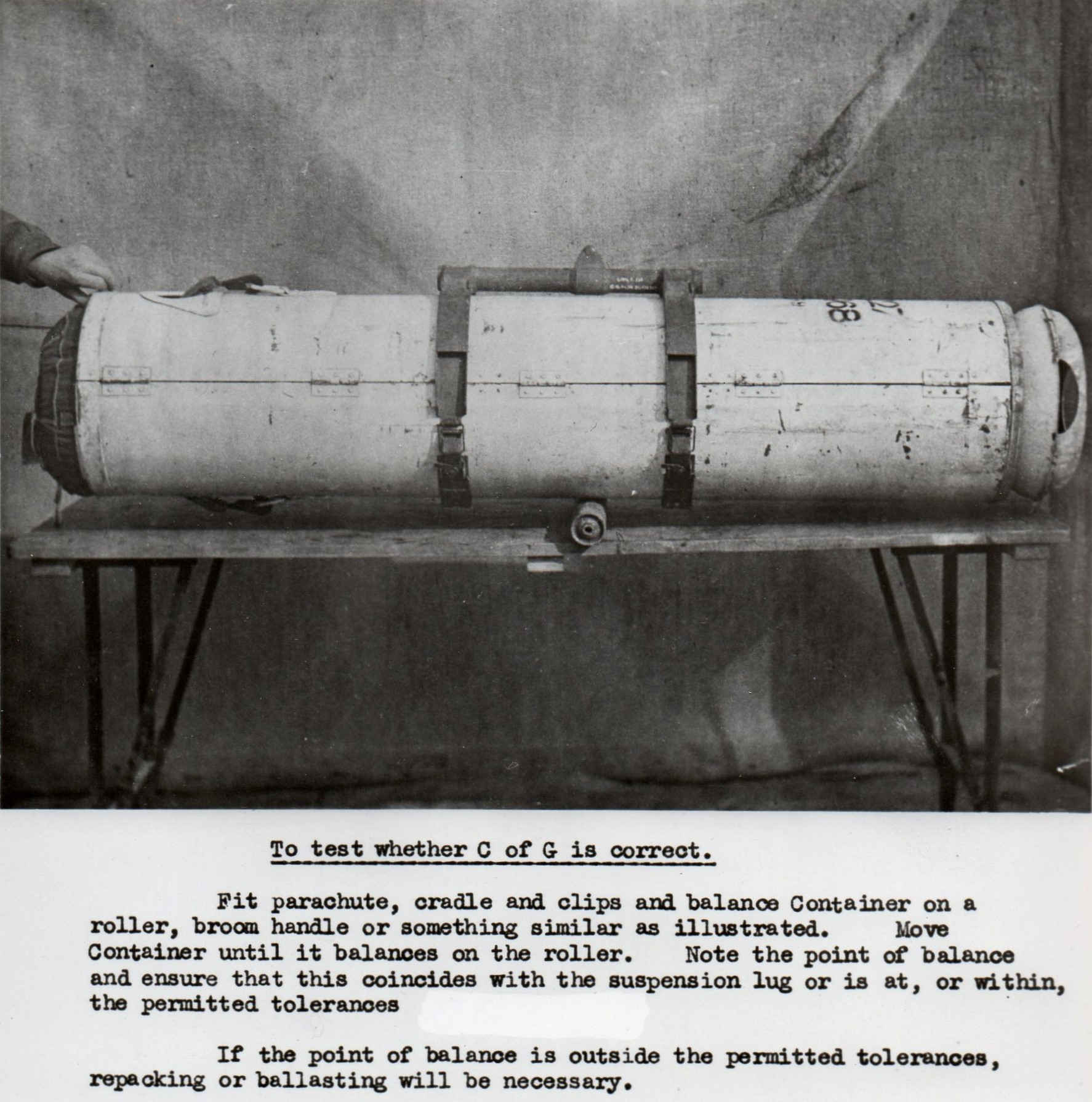
Centre of Gravity test on a C.L.E. Mk III Parachute Container. Part Three. A.F.D.C. 1943. Courtesy of Airborne Assault Museum, Duxford.
On the 8th September, the Company carried out its first airborne exercise. In the morning, the Defence Section and loading personnel were conveyed by Harrow aircraft from Netheravon to Shrewton, where they established an S.L.P. Later, supply baskets, loaded with ammunition, were also landed by air, and were unloaded and delivery effected to Units. In the afternoon, there was further flying experience for the Airborne Wing in the Harrow aircraft. Throughout the day, men of the Airborne Wing were also tested for night vision. There was also a firing practice on Kimmeridge Bay Field Firing Range, and the next day, the Anti-Aircraft Section fired their Hispano anti-aircraft guns on the Bulford A.A. Range. On this same day, loading trials were conducted on the American Troop Carrier - i.e: C47, Dakota aircraft.
Discussions had been held at the H.Q. 1st Parachute Brigade on the 6th September about Exercise 'DISTAFF', and the preparations for it were carried out on the 10th, with parachute containers being loaded. The next day, 'B' Platoon departed for Hurn aerodrome to take part in the exercise. On the 12th September, Exercise 'DISTAFF' took place with supplies of ammunition, rations and water packed by the Company, being dropped direct by Whitley aircraft to units of the 1st Parachute Brigade operating North of Swindon. The afternoon of the next day was spent in recovering all the equipment and moving back to Camp. As this was the first exercise of its kind for the Company, in co-operation with another unit, there was an administrative conference at H.Q. 1st Parachute Brigade on the 13th September, where any improvements on what took place could be discussed.
Twenty Other Ranks departed for Hardwick Hall on the 13th September, and after the selection process, eleven of them then went onto R.A.F. Ringway, on the 18th September, where they completed Parachute Course No 27, on the 24th September. These were Sgt. Chedgey, and Sgt. McDowell, L/Cpl. MacPherson, and Dvr's. Bigling, Carr, Caddock, Farnworth, McKinson, Tripp, Taylor (841) and Zambonini. Amongst these men, some were becoming noticed as S.N.C.O's who could be relied upon to get a job or task done, without fuss, and with great efficiency. There are always some that stand out in any unit or formation of men. Men that are steady, and that other men would look up to, such men were 'Bill' Chedgey and 'Mac' McDowell.
In the meantime, the rest of the Company prepared for a Divisional Exercise - 'MERLIN' - which started on the 15th September. The Umpires conference took place at 17.30 hrs. Then at 20.00 hrs, approximately 60 vehicles from the Non Airborne Wing reported to Battalion's of the 1st Airlanding Brigade for troop carrying tasks during the night. The Airborne Wing, complete with all available personnel and vehicles, passed S.P. (Stonehenge Inn) at 11.55 hrs, and travelled all night. On the 16th, the Non Airborne Wing went into a harbour area South of an area code-named "Coastline" for the duration of the exercise. The Airborne Wing 'landed' by 'glider' at 07.30 hrs, and operated throughout the day, forming Supply Loading Points and delivering ammunition. At night, they took part in a fighting withdrawal involving a long M.T. march without lights. The exercise ended at 09.00 hrs on the 17th September, with the Company moving back to Camp by M.T. The Non Airborne Wing was again employed on troop carrying. The conference on this exercise took place in Carter Barracks Gym on the 21st September.
On the 19th September, there were further dropping trials with the Mk I parachute container, but also with the new Mk III parachute container. In the afternoon, there was a Company Sports Meeting and 'G' Platoon came out as the overall winners. The next day, twenty All Ranks proceeded to Shobdon for a weeks gliding experience as human 'freight' in Horsa gliders. However, their stay at Shobdon was extended and they did not return to the Company until the 9th November. At the same time, sixty All ranks, mostly from a recent intake, would undergo air experience flying in Sparrow aircraft. The party at Chobden returned on the 27th, and were immediately replaced by another party for the same experience.
The first of a series of a series of talks and discussions, mostly for Other Ranks, by A.B.C.A. (Army Bureau of Current Affairs) was held on the 24th September. This was a new innovation and was designed to educate the soldiers with these informal discussions, and there was also to be a small booklet published on a regular basis, with the first one appearing just four days earlier - it was called 'WAR'. This was the brainchild of Capt. Stephen Watts and Capt. Anthony Cotterell, and as Capt. Watts said, "Cotterell and I decided on the title 'WAR', and I drew its glaring red and white cover. Also, while doodling away those warm summer afternoons, I devised the beehive shaped monogram of the letters ABCA which became our trademark. Cotterell was emphatic that our first publication should be called 'WAR', because it afforded the opportunity to answer the telephone with the words 'This is WAR'. [E1]
Maj. Packe returned from a short duty in London on the 1st October, whilst the main part of the Company were out on 'G' Range at Bulford all day. It was then a pleasant surprise for them when they returned to Camp to find that 6d per day had been granted to each man as proficiency pay.
At 11.00 hrs on the 3rd October, a stick of ten Officers, N.C.O's and men from the Company dropped without incident by parachute from a Whitley aircraft onto the Divisional D.Z.
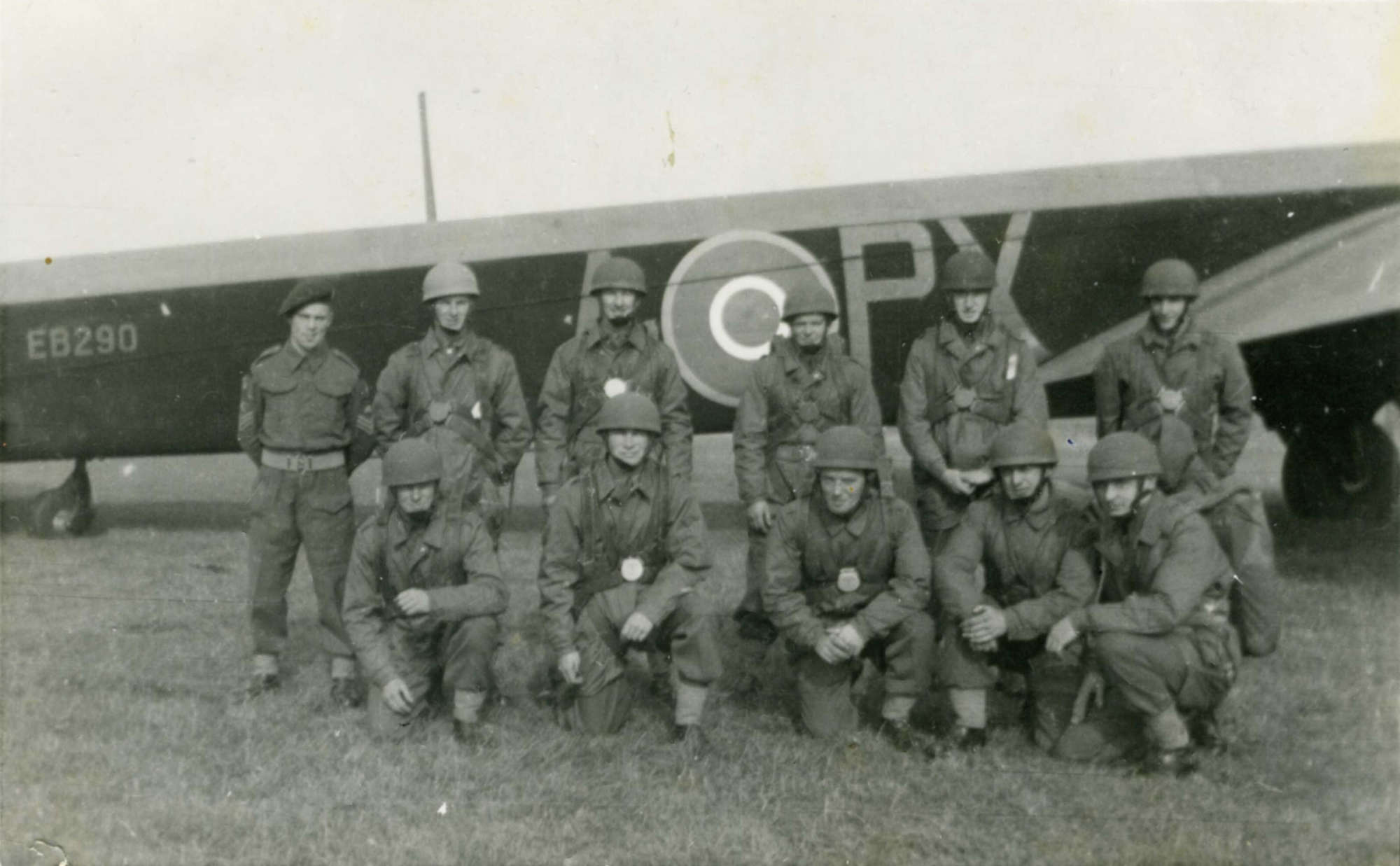
The first R.A.S.C. stick of parachutists, Netheravon, 3rd October 1942. Numbers in brackets refer to their Parachute Course Number. Courtesy John Gifford.
Back Row, L to R: S/Sgt. G. Myers APTC (3), Capt. D.T. Kavanagh (17), Capt. F.G. Bate (12), Dvr. H. Bryce (17), Sgt. W.C. O'Dell (17), Major. M. St J. Packe (16).
Front Row, L to R: L/Cp1. J. Stanley (19), Capt. J.H. Gifford (22), Sgt's. J. Walsh (21/22), W.H. Chedgey (27), L.H. Whitehead (17).
In the afternoon of the 3rd October, there was a short conference at the H.Q. Air Landing Brigade about a demonstration, that was to take place on the 5th. This was followed by a lecture at Netheravon by Air Marshall, Sir Arthur Barrett, Commander-in-Chief Army Co-operation Command, who had been in constant contact with Maj - Gen. Browning from the very start of the Airborne Division. At 09.30 hrs on the 5th October, the demonstration was laid on by All Arms of the Division to Student Officers from the Staff College. The Company's part in it was to demonstrate Supply by Air. There was also a lecture and demonstration to Administrative Personnel of the 1st Parachute Brigade on basket and container packing.
On the 6th October was the Company Commander's afternoon route march, lasting two hours. Sixteen men of the Company were not on this though, as the day before, they had travelled to R.A.F. Ringway to do Parachute Course No 30, which lasted until the 13th October. This was a short course of four descents, and the following men completed it, L/Cpl's. Beardmore, Buchan and West, and Dvr's. Allen, Doubleday, Hamill, Hill, Lauder, Mead, Phillips, Plant, Thompson, Walker and Willis, plus Pte's. Butler and Cassford.
At 11.00 hrs on the 7th October was one of the first of the Company Commander's Vehicle Inspection's. This and other inspection's, would become a regular feature of the Company routine from now on. Late that day, at 17.00 hrs was a lecture by the Divisional A.A. & Q.M.G. on 'Supply by Air'. The following day was field training for the Airborne Wing, whilst the Non Airborne Wing, carried out the normal duties, i.e: driving details, etc. These regular duties and training were interspersed by the showing of training films, ABCA talks, lectures (such as "What Totalitarianism is like", by Professor Dahl on the 14th and "German Concentration Camps", by Sgt. Baer on the 15th), and at least once a week sports fixtures - usually football.
What was becoming a regular occurrence, took place on the 13th October - a demonstration for the Press, in which the Company provided a static display. Even in the midst of a total war, at which the country was under siege, it was still a democracy, and the military had to show the 'people' what their taxes were being spent on, with this 'new fangled' Airborne Division. This was accomplished through organised and chaperoned Press or Parliamentary visits. The problem was, that it took men away from essential, and sometimes vital training, and also meant that equipment that should have been used for training, was used for displays.
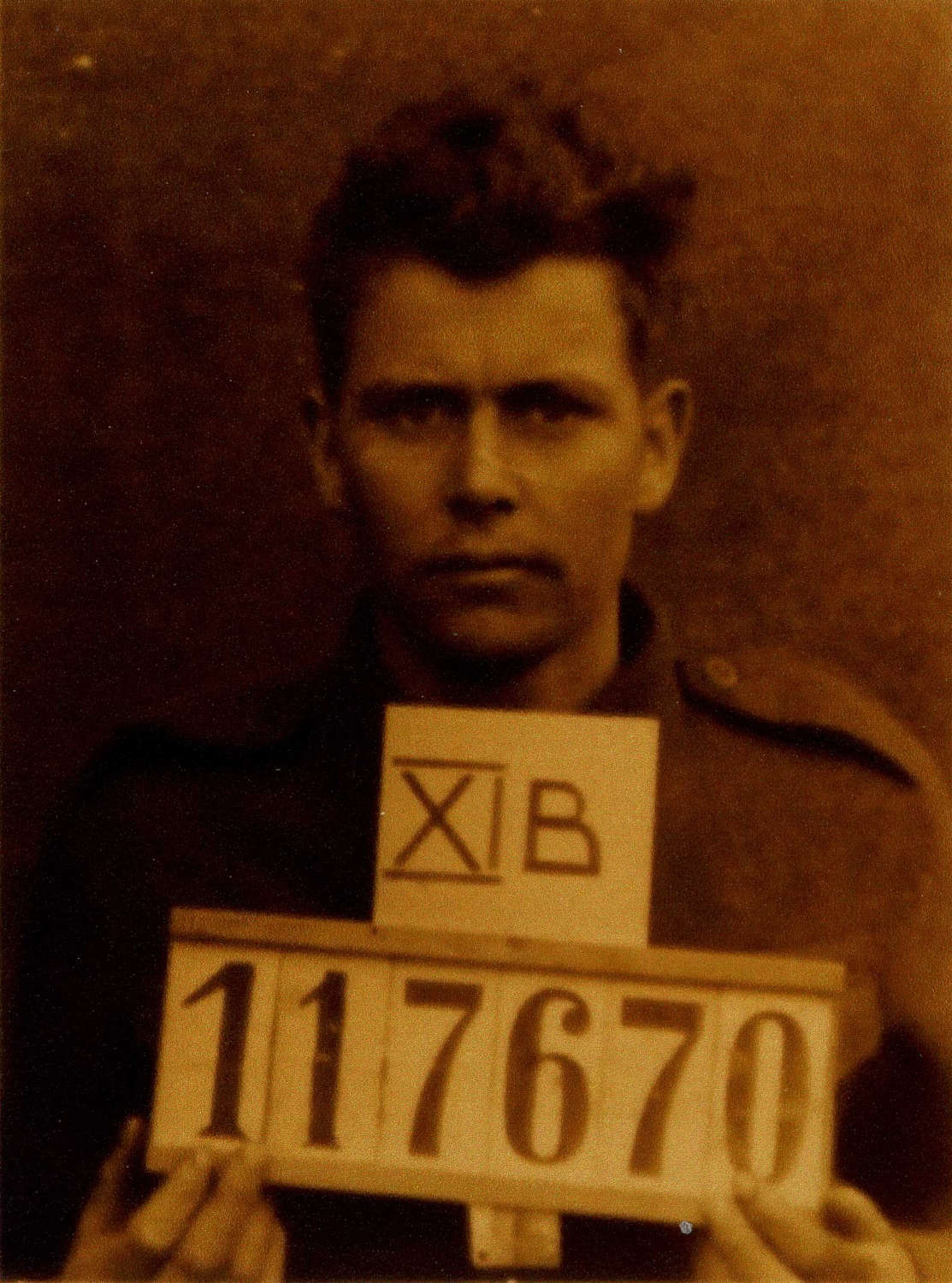
Dvr. Benjamin Jennings was born on the 23rd August 1919. He came from Buckinghamshire, and was a Labourer before enlisting on the 16th July 1939. He was posted to the Company on the 8th October 1942. It is likely that he did his parachute course in North Africa in 1943, and was initially posted to 'E' Platoon, which later became No 3 Parachute Platoon. He took part in Operation 'Market', and was wounded by a gun shot to his right shoulder, and initially sent to the 'Airborne' Hospital at Apeldoorn. He left there, as walking wounded, on the 26th September 1944, and as a prisoner was sent to Stalag 11B, at Falingbostel in Germany. Photo taken 28/09/44. Courtesy of John Howes.
There was gliding experience in both Hotspurs and Horsas on the morning of the 15th October, and then on the 17th, the O.C. and Officers attended a conference on the War Establishment with the G.O.C. of the Airborne Division. Throughout the past two weeks there had been regular training sessions in the packing of the Pannier baskets, usually at Netheravon, and often followed by a trial drop. But, on the 21st October, there was a 'first' - the practice with the 1st Parachute Brigade of an experimental drop from a C47 with roller equipment. Two days later, were what was called "Daisy Chain" dropping trials. This would have been the dispatching of multiple panniers, one after the other, or linked together.
Whilst these experiments and trials were taking place, another seventeen men went on Parachute Course No 35, at R.A.F. Ringway, which ran from the 19th October to the 7th November. This was another short course of four descents, and those who qualified were, Dvr's. Bennett, Berge, Best, Clay, Elkington, Gibbs (038), Hughes, McAndrews, Morris, Mackrell, Smith (075), Stewart, Stacey, Thompson, Wild and Pte's. Payne and Staples.
Dvr. 'Jim' Wild: "I joined the Company on September 17th, 1942, and at that time they had just joined the Airborne Division a year before. Our role in the Airborne seemed to be unknown, or at least trial and error, at that time. We found out we had to provide Air Dispatch personnel as well as ground personnel doing Air R.A.S.C. work, that is, providing rations and ammo to the Division. Regarding Air Dispatch, the first thing we did was load containers and baskets, to the correct weight suitable for loading and carrying in aircraft. We spent several weeks on that exercise, and then we found that the dispatchers had to do a 4 jump course at Hardwick Hall and Ringway. I went in the November to Hardwick Hall, and then onto Ringway. In those days if there was any spare parachutes at Tatton Park, where we dropped and did our balloon jumps, then you could do extra drops, which I did." [E11]
Twenty All ranks of the Company carried out a parachute drop at Netheravon, from Whitley aircraft on the 27th October, and the next afternoon experimental container dropping was done from the balloon, and at the same time, some of the men managed some parachute descents from the balloon as well.
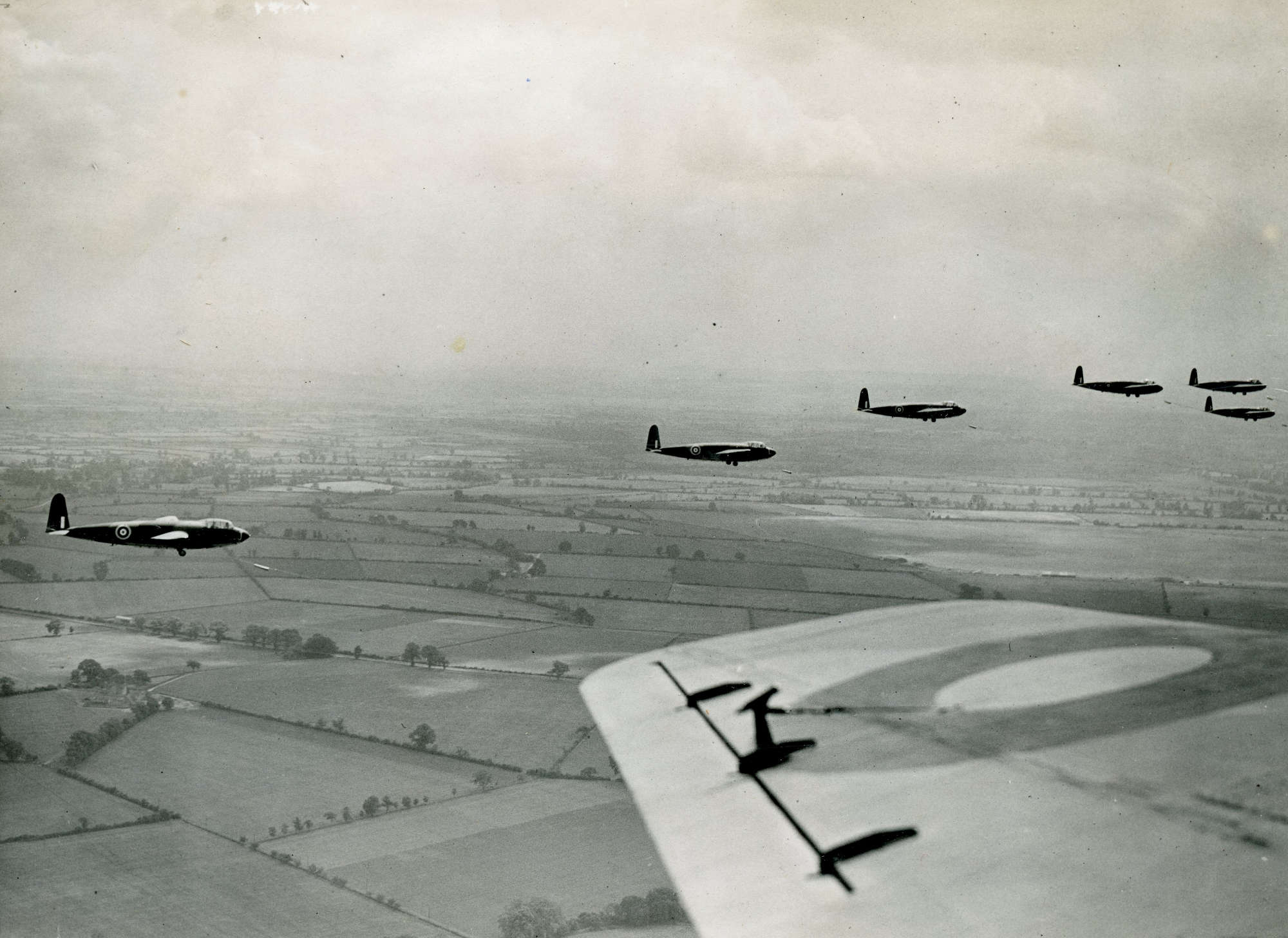
A formation of Hotspur gliders on a training flight. 1942. Courtesy of Airborne Assault Museum, Duxford.
Towards the end of October and into the beginning of November, the weather had turned, and it had rained fairly regularly, which had curtailed some of the training. However, on the 2nd November, twenty Other Ranks were able to get gliding experience in Hotspurs, when the weather turned out fine. The next day was the 1st Anniversary of the Airborne Division, and there was a visit by the Chief of the Imperial General Staff. Representative parts of the Company were introduced to him. He also examined a Horsa loaded with standard basket loads and inspected an Airborne Supply Section with 'Blitz Buggy' (Jeep) and trailer. The next day was a Divisional holiday, with no organized training or sport.
Whilst the rest of the Division were enjoying this welcome break, the bulk of the 1st Parachute Brigade were in a convoy of ships bound for North Africa as part of Operation 'Torch'. The inclusion of the 1st Parachute Brigade in the Order Of Battle for the combined American and British landings in Morocco and Algeria, was very much a last minute affair and they had been hurriedly completed to War Establishment by drawing on the resources of the remainder of the 1st Airborne Division. They were also going with the bare minimum of support - attached were the 1st Parachute Squadron Royal Engineers, the 16th Parachute Field Ambulance Royal Army Medical Corps and 'J' Section 1st Airborne Divisional Signals, but no R.A.S.C. Platoon. However, in the 1st Parachute Brigade Headquarters was Capt. Cecil Distin Byng-Maddick, R.A.S.C. who was the D.A.A. & Q.M.G. and his small staff. Capt. Byng-Maddick had served with the original 31st Independent Brigade Group Company, R.A.S.C. as a 2/Lt in November 1940. There was also a R.A.S.C Detachment with the 16th Parachute Field Ambulance under the command of Sgt Maj. Granville Richard Rowe, who was awarded the Military Medal for his conduct during the North African campaign. See Appendix II.
During the 5th and 6th November the Company had visits from several senior officers to observe loaded Horsa gliders, and study Airborne Supply. On the 10th there was a visit to 38 Wing .R.A.F. to discuss the forthcoming Company Exercise - "QUENTIN". The next day, the O.C. visited Airspeed Ltd, in Portsmouth for a conference on the internal mechanism of the Horsa glider, that would relate to Supply by Air. At the same time 'E' Platoon were continuing their practice of loading and lashing trials on the Horsa mock-up, and the Airborne Wing returned from Cranborne Chase after a 24 hour exercise. The following day, they practiced their loading and lashing trials on the Horsa mock-up.
For the first time in two years, on the 15th November, the Church bells rang out across the country to celebrate the victory of the 8th Army at El Alamein. Two days later, there was the first of two conferences to discuss Exercise "PEREGRINE", with the second one being at Netheravon, which was to be one of the largest that the Company had taken part in to date. On Friday, 20th November, there were further dropping trials carried out from the balloon. On the Saturday, the Airborne Wing returned from a two day route march, which was followed by an afternoon of sports activities, mostly football and rugby. On the Sunday, in the morning, was a Church Parade, and then in the afternoon, the loading of gliders for Exercise "PEREGRINE" commenced. This took place on the 23rd November and involved a Company of the 2nd Bn, The South Staffordshire Regiment, a Detachment of the 9th (Airborne) Field Company, R.E., a Detachment of the 181st Airlanding Field Ambulance, R.A.M.C. and a Reconnaissance Section of 250 Company (complete with their own weapons, a vehicle and wireless equipment). In total, 15 Horsa gliders were used to lift the Group, which included Jeeps, taking off from Aldermaston aerodrome. One of the gliders had to make a forced landing, after the tow-rope broke on take-off. It landed back at the aerodrome, with no casualties. 250 Company reported that it 'took a successful and highly mobile part'.
At 10.30 hrs on the 24th November, there was a demonstration of the principle of Supply by Air, followed by a parachute jump of a mixed stick of Polish troops with men of the Company. This was followed in the late afternoon by a conference for the Company Exercise - "QUENTIN". The loading of the gliders for this exercise took place the next day, and the day after that, the Airborne Wing were carried in Horsa gliders to Thruxton aerodrome, which they then placed in a state of defence. Supplies in baskets were also brought in by glider, unloaded and distributed to units. The Company were not allowed to rest on their laurels, as on the 28th November, they were loading Horsa gliders for the Airlanding Brigade Exercise - "AIRWORTHY" - which took place the following day. A small Detachment of the Airborne Wing proceeded by road to make a 'token' landing and unload supplies delivered in two supply gliders.
Whilst all this was taking place, another fifteen men of the Company went to R.A.F. Ringway on the 20th November, where they did Parachute Course No 38. This was another short course of four descents, and fourteen of the men qualified on the 1st December, Cpl's. King, Moore and Piper (730), Dvr's. Beresford-Jones, Edmondson, Edmunds, Hewitt, Jones (118), Mitchell, McDondach, Olley, Taylor (991) and White, and Pte. Brown (765). Strangely, the course report also lists Dvr. McFarlane as carrying out the required two descents from a balloon, and two descents from an aircraft, but shows him as failed. However, he remained with the Company, and served in North Africa and on the Sea Tail for Operation 'Market-Garden'.
The 1st December saw the Airborne Wing carrying out street fighting training in Southampton, in unseasonably warm weather! The next day there was further glider flying experience for 35 men of the Company in Hotspur gliders, and on the 4th, twenty personnel carried out parachute drops from Whitley's. There was yet another demonstration of the Company's Airborne capability, for the Press, on the 3rd December. The airborne training continued with further practices of loading on the Horsa mock-up, glider flying experience, and parachute drops on the 6th , 7th , 8th and 9th December. After carrying out a range practice with Bren guns on 'G' Range at Bulford, on the 9th December, the Airborne Wing marched to Wilton Brail, to carry out a two day exercise on the 10th. Having had to drop down to the rank of Dvr, from Cpl when he volunteered for Airborne Forces L/Cpl. Burnham Blaxley had enlisted on the 17th April 1941, and was 22 years old. Soon after his arrival at the Company, on the 8th December 1942, a small practical joke was played on him: "I reported to the Duty Sergeant who told me where to kip down and report next morning to Cpl. Stormy, who was the Coy Office Corporal. A good start. It so happened C.S.M Gibbs was in the office when I asked for Cpl. Stormy. 'Cpl. Fairwever to you', he corrected and I watched my step from then on!"
After the shock of his introduction into the Company by C.S.M. Gibbs, he found that things were very different in this unit to any other he had served in: "I now met one of my neighbours in the Company, Cpl. 'Ted' Nye and he helped me settle in. Reading Company Orders the day after my arrival I found the following day we were to assemble outside the Abbey at 14.00 hours Dress P.T shorts only (no top clothing) and P.T shoes. It was a cold day and we were to complete a cross country run of 6 miles in all. As we started off I joined an established member of the Company after running beside him for a couple of miles, I found he was strong in both wind and limb, I found it difficult to keep pace with him. At one point Staff Sgt Myers was directing the runners into the swollen river. Croucher [Cowcher] jumped in feet first and I saw his hair floating on the top of the water. That's deep I thought as I followed him and jumped in too. I was a poor swimmer at that time so I floundered to the other side. Thank goodness that's over I puffed. We continued running on this bank flagging by now when I couldn't believe it we were expected to jump in again and swim to the other side. The second immersion was not such a shock as I had become acclimatised. On our arrival at the Abbey grounds gate I began to feel pleased with myself as I had never done anything like this before. On our return to our Nissen Huts we had a good rub down and changed into dry clothing. I felt a glow of well being and wondered what next. This was the prelude to an intensive training course. It was stimulating to join the 250 Company at this stage as it was and entirely new concept and was feeling it's way all of the time." [H2]
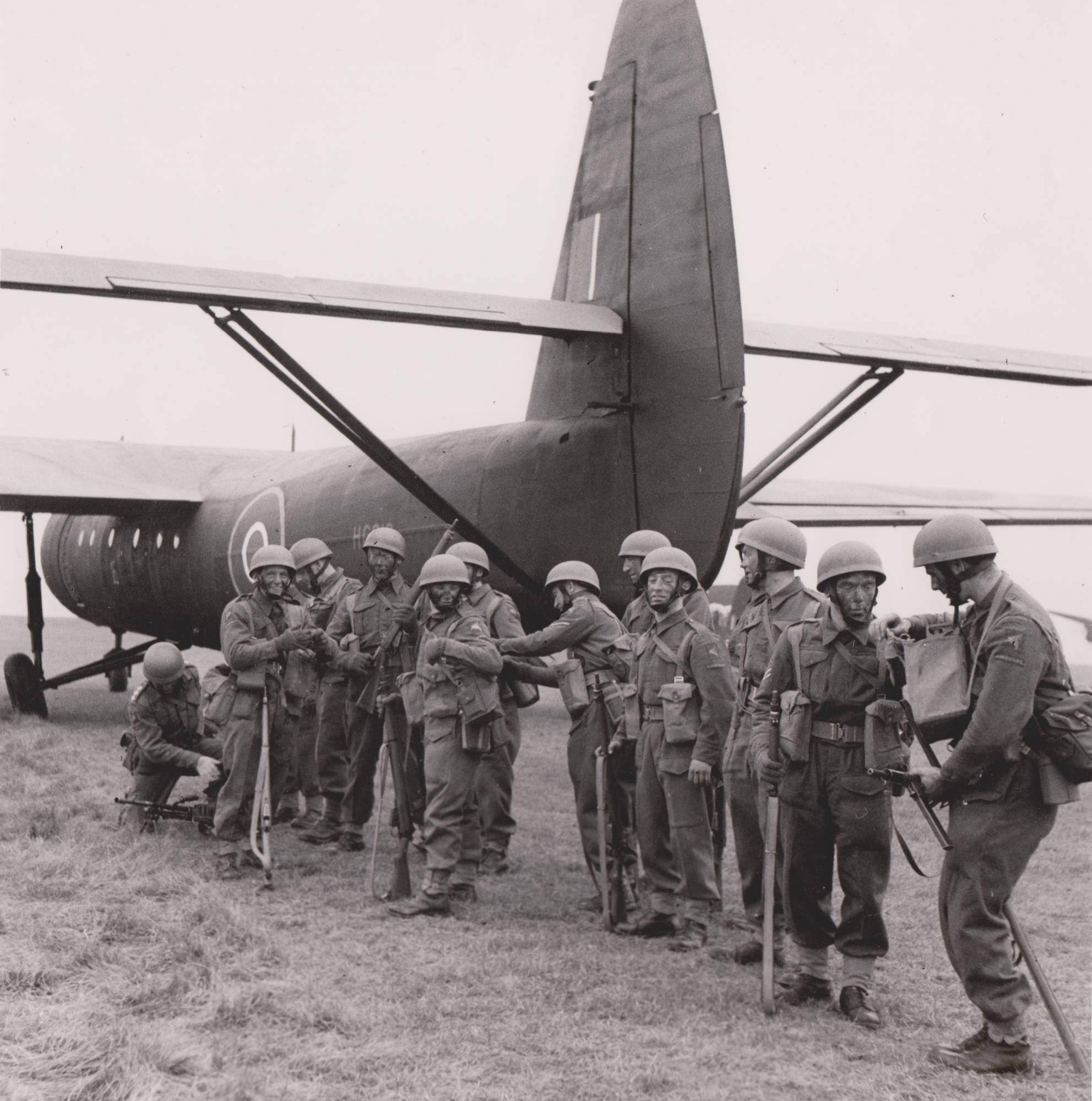
Airborne troops preparing to board a Horsa glider. The man kneeling at the front is a Captain, and at the end is the a radio operator. England. December 1942. Courtesy I.W.M. H25874.
On the 12th and 14th December, there was a change from the regular duties and details for the Non Airborne Wing, with 70 and 49 all ranks, respectively, undergoing glider flying experience at Netheravon. The Airborne Wing undertook some Battle Drill training in a most unusual setting on the 15th December - Stonehenge! The first three day packing course for the 2nd Parachute Brigade started on the 17th December, and the second course started on the 21st, with a third starting on the 28th December.
All the operationally qualified parachutists of the Company carried out a drop on the 19th December. This was followed two days later, by a visit from the Assistant Inspector of the R.A.S.C. who took a Parade and March Past of the Company, which the Divisional A.A. & Q.M.G. also attended. The day after this, he visited the Netheravon D.Z. and the new War Establishment was discussed, along with the A.A. & Q.M.G.
Christmas Day was started by a Company Church Parade at 10.00 hrs, and was followed by a football match of the Officers versus Sergeant's - the result was not recorded. The Other Ranks were then served their Christmas Dinner by the Officers and Senior Ranks at 13.00 hrs, with a Company 'sing song' in the evening. The result of the next day's football fixture against 63 Troop Carrying Company, R.A.S.C. - a Cup match - they lost 4 - 3. However, there was better news on the sporting front on the 30th December, in the Divisional Boxing Competition, when the Company beat the Light Battery, R.A.
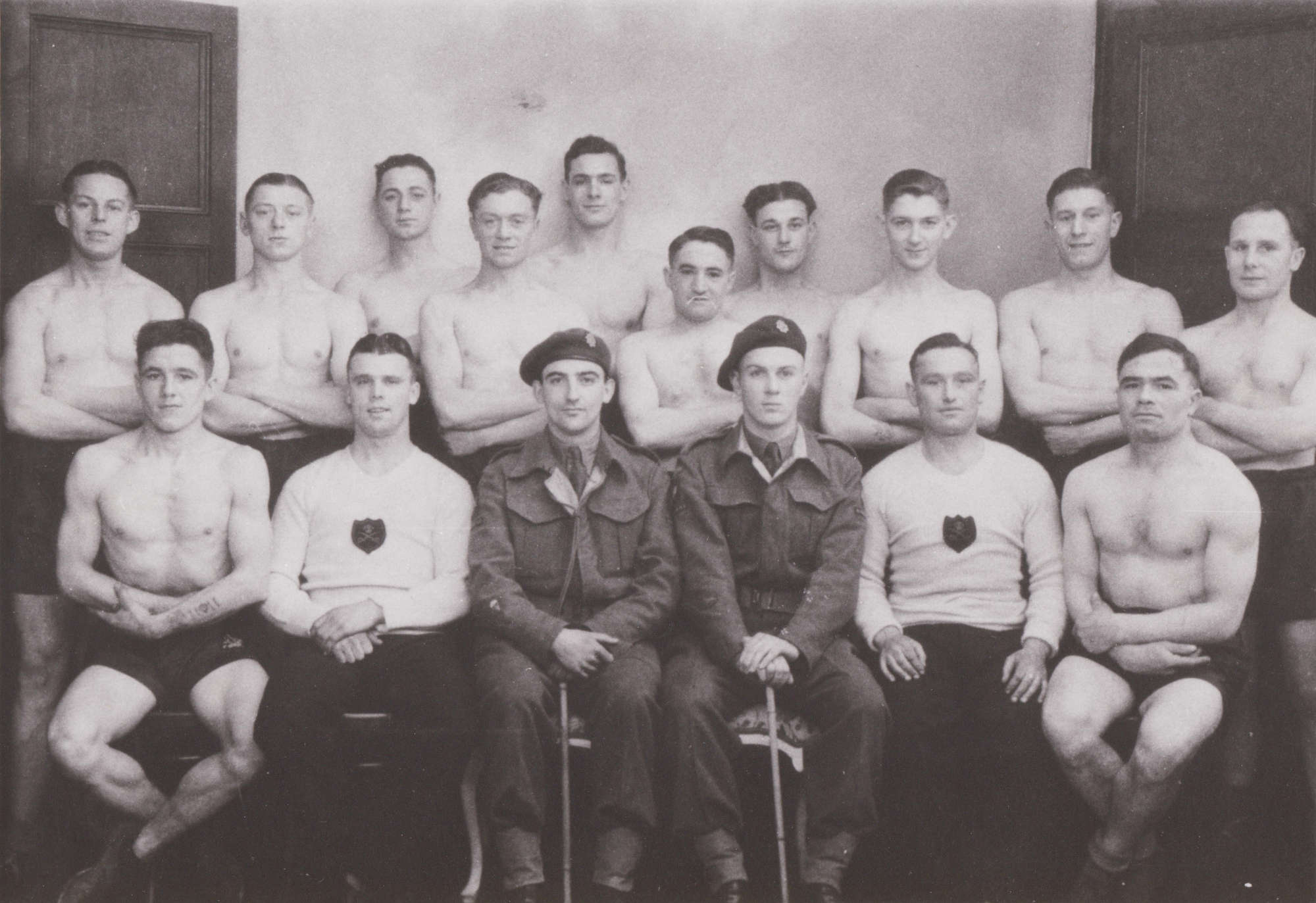
Boxing team 250th (Airborne) Light Composite Company, R.A.S.C. U.K. 1944. Courtesy of Jim Wild.
Back row, L-R: Cpl. L.J. Judd, Dvr's. G. Bluss, W.E. Turner, G.E. Chapman, L/Cpl. J.G. Sawyer, Dvr's. E. Hall, H.C. Payne, J.L. Bishop, Cpl. D.E. Bolton & Dvr. D.A. George.
Front row, L-R: Dvr. F. McGarry, S/I. G. Myers (APTC), Maj. M. St J. Packe, Capt. D.T. Kavanagh, Cpl. H.G. Whittet & Cpl. J.G. Roalfe.
It is of note that between the 1st May and the 30th December there were 48 petrol-less days, which must have hampered the driver training for the Transport Platoons. This did not improve with the New Year, as the 1st January 1943 was also a petrol-less day!
The year ended with the following entry in the War Diary for the 31st December: "Normal details. Weather fine and warmer. Non Airborne Wing - gliding experience. Airborne Wing - battle drill, river crossings with rubber boats. Non - Airborne Wing - night driving exercise. Airborne Wing - night camping exercise. End of a good year of training".
A series of photo's of packed Panniers, the 'Roller Conveyor' - fitted in a Dakota - and Panniers ready to be despatched. These photo's were taken at the A.F.E.E. on the 22nd December 1942. Courtesy of Airborne Assault Museum, Duxford.
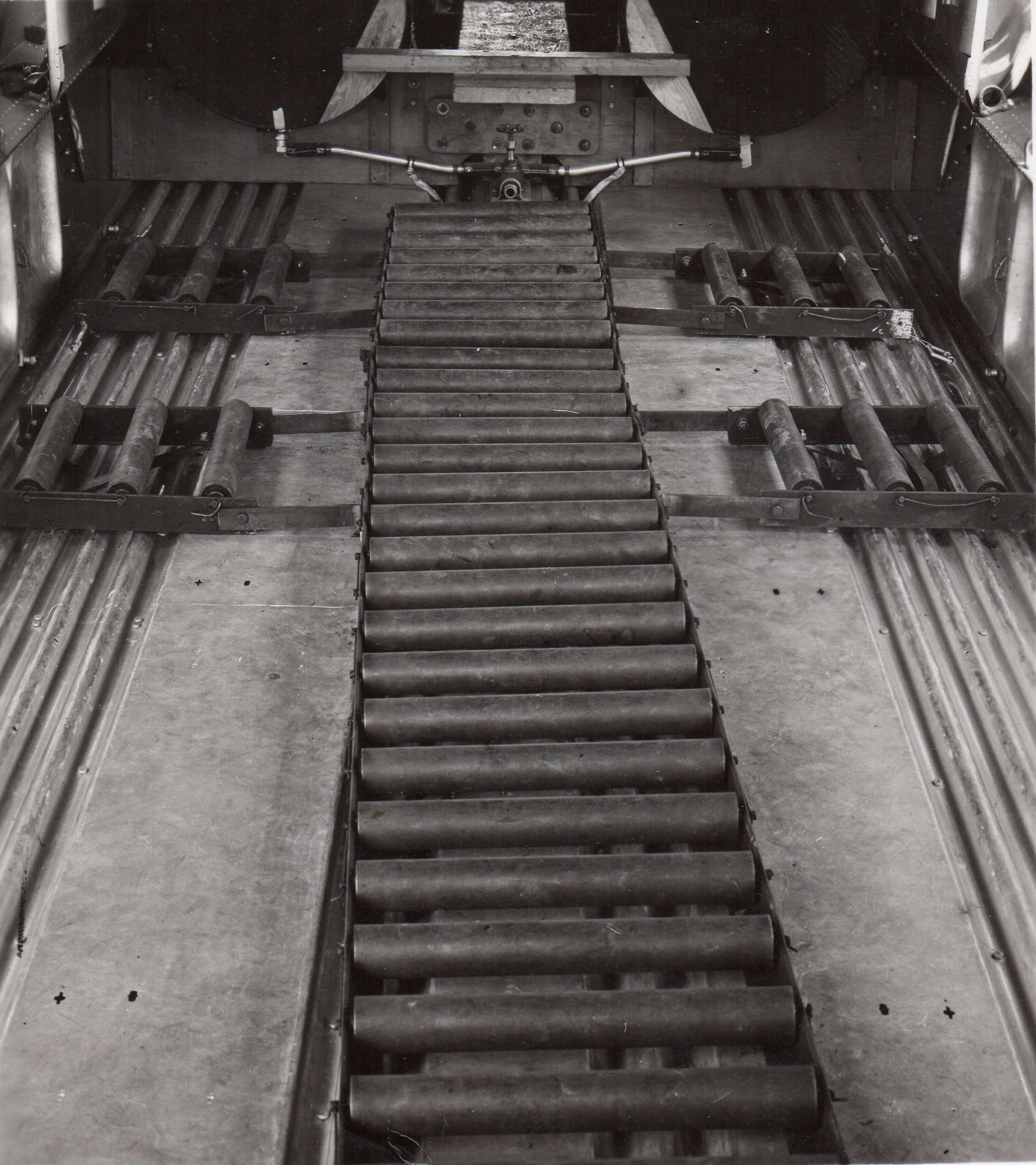
The straight portion of a Roller Conveyor.
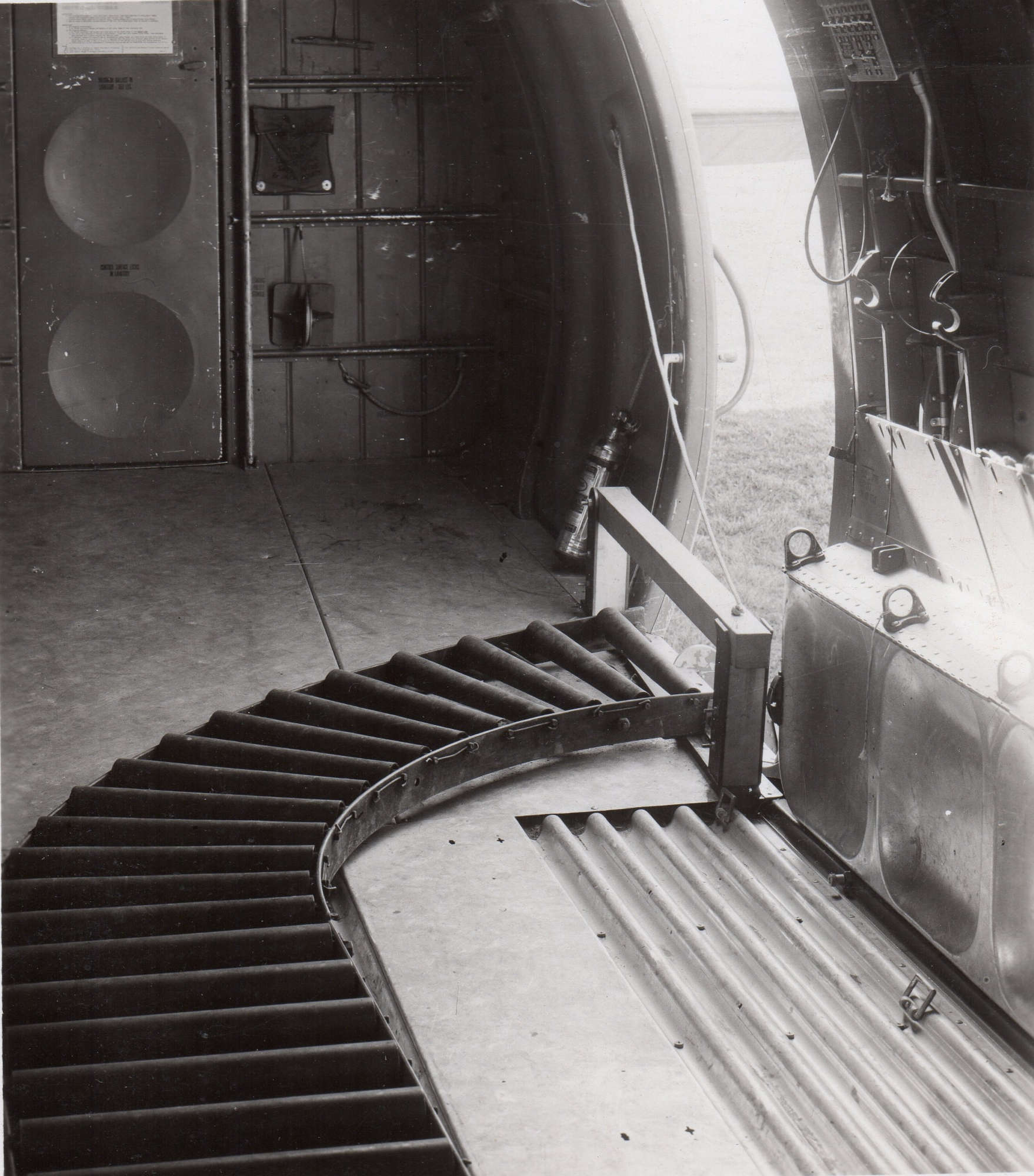
The curved portion of a Roller Conveyor.
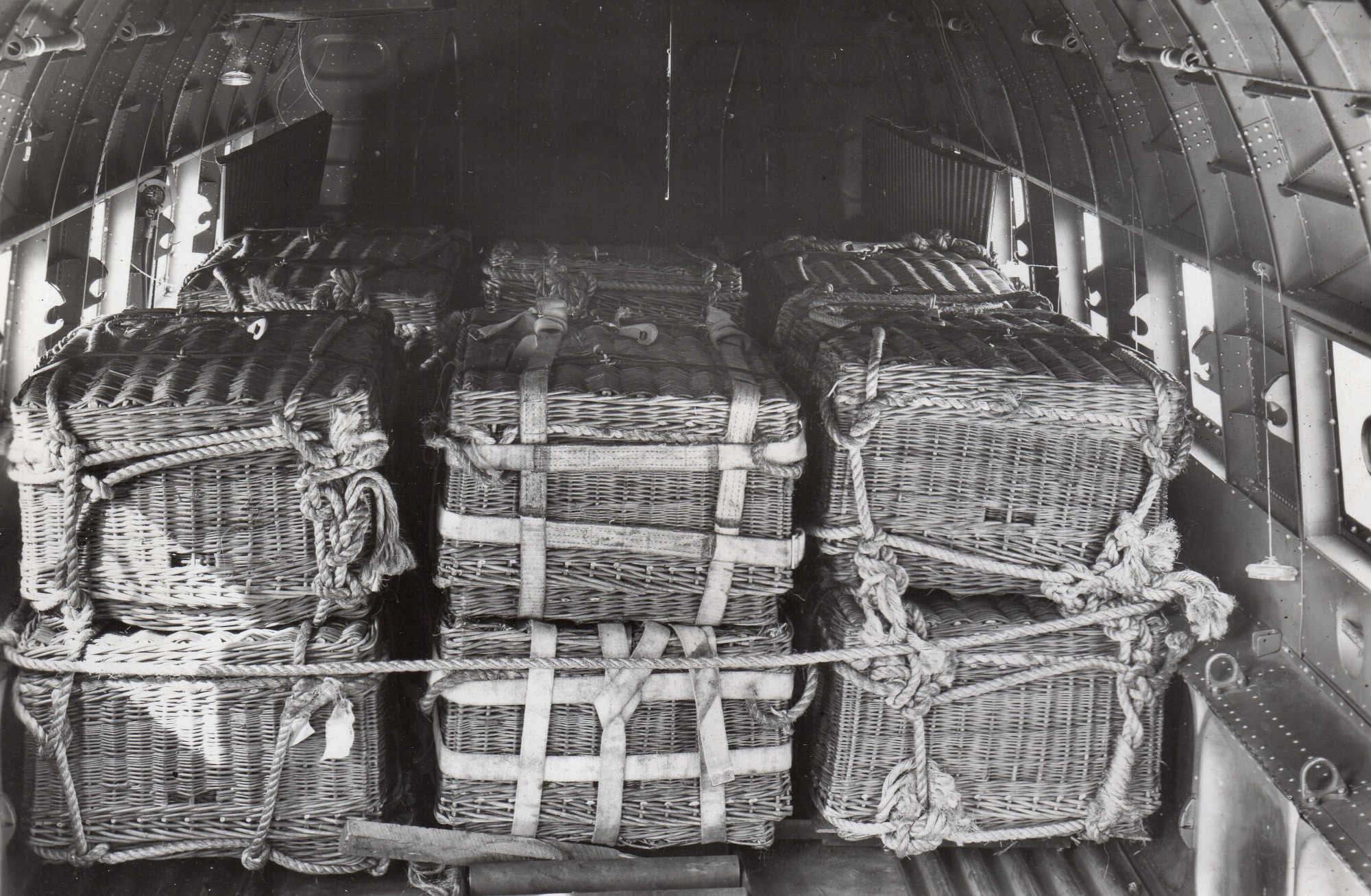
The arrangement of 'baskets' looking forward.
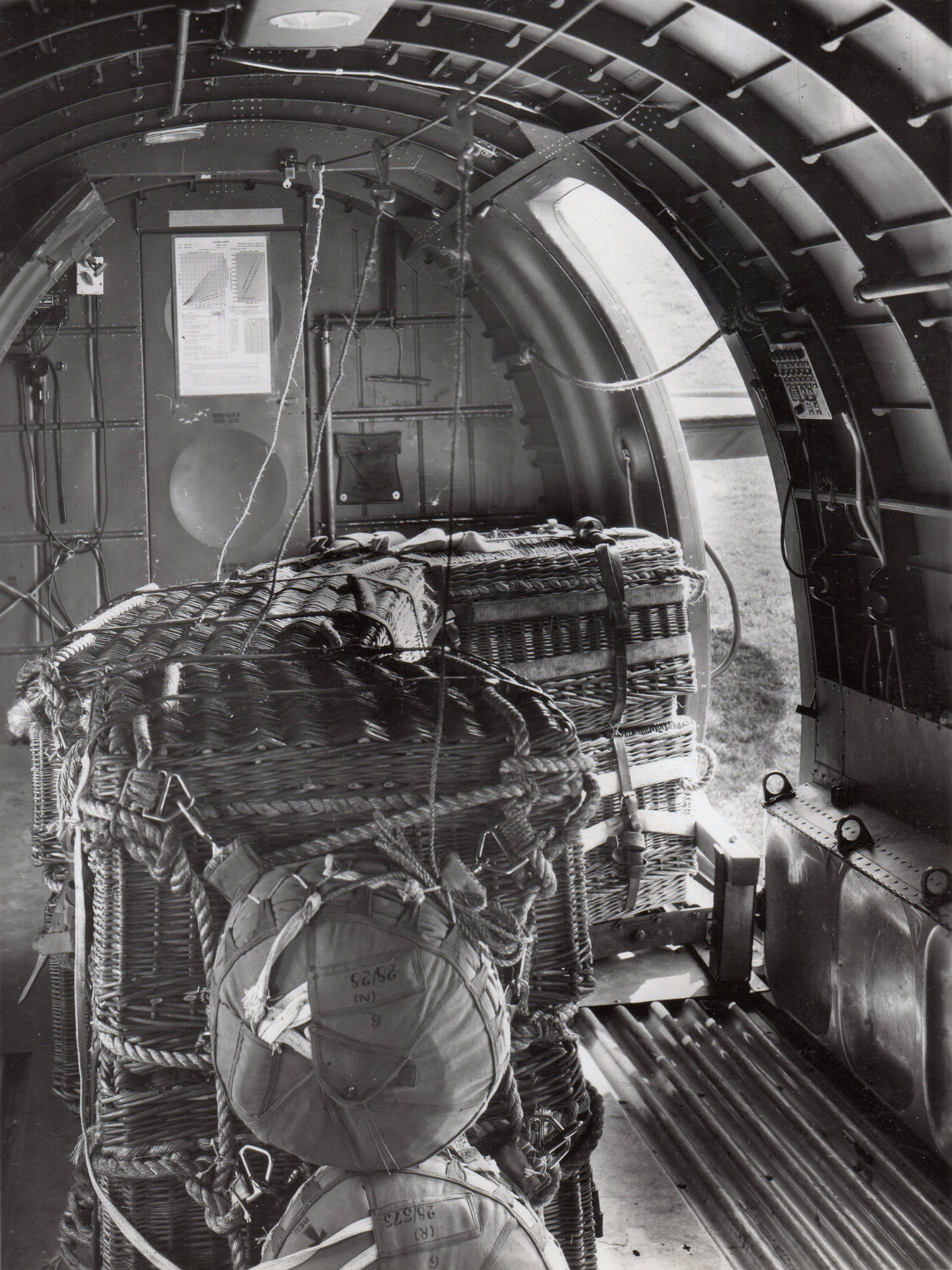
The arrangement of 'baskets' looking aft.
Parachute Course No 43, ran from the 20th December 1942 to the 2nd January 1943, with seven men of the Company going to R.A.F. Ringway to attend. Six men completed it, L/Sgt. Hoyle, Dvr's. Dailly, Green (160), Hill (184), Middleton (345) and Wiggins.
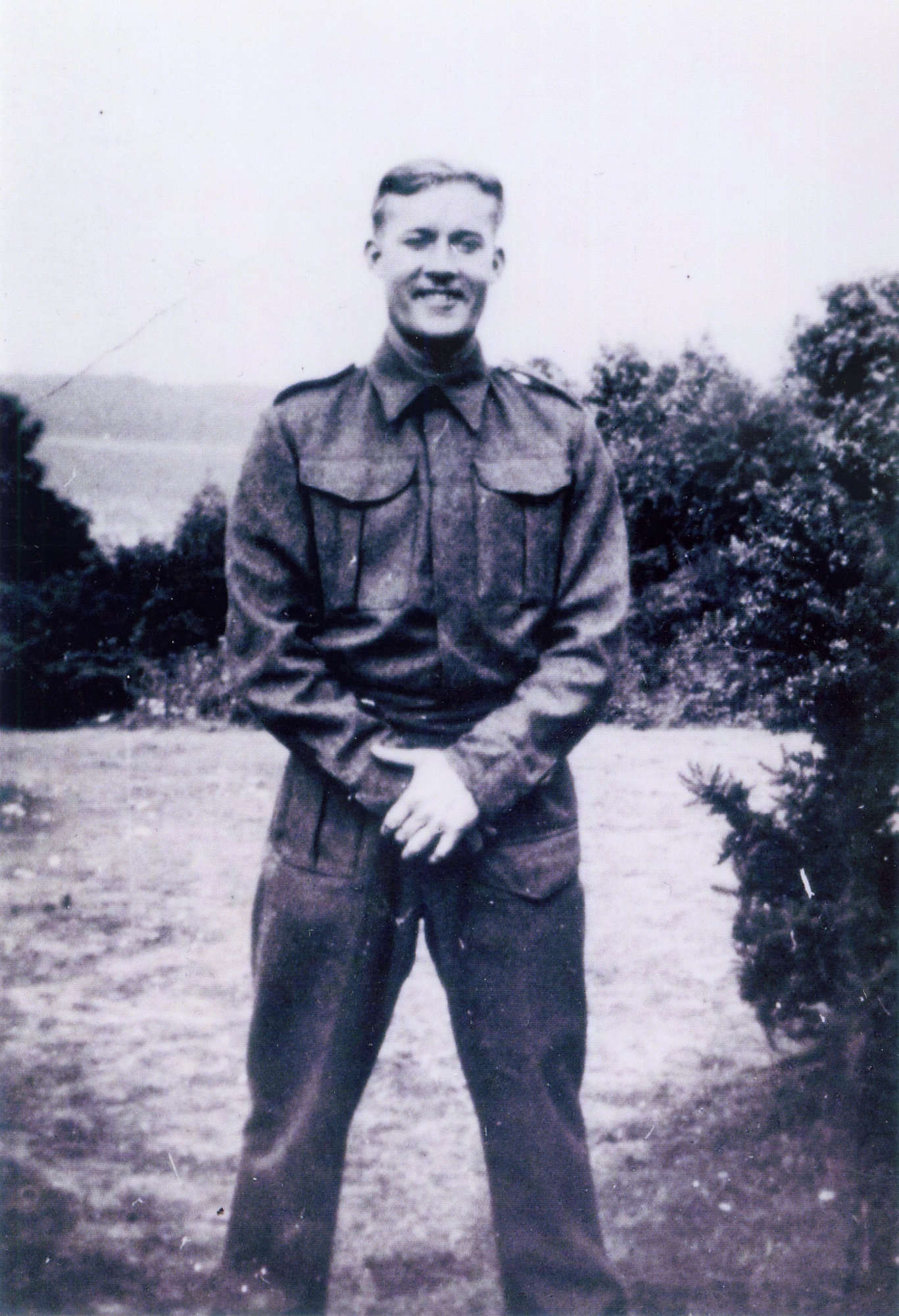
Dvr. 'Joe' Middleton in 1940/41. He would do parachute course 43 at R.A.F. Ringway in December 1942, and would also do para course 104 in February 1944. He initially served in 'B' (M.T.) Platoon, before being posted to No 2 Parachute Platoon. He would serve in North Africa, and take part in Operation 'Slapstick', in Italy in September 1943. Courtesy of Jim Middleton.
Big changes were now about to take place, as a result of the conferences towards the end of the previous year, and on the 5th January the O.C. visited the Adjutant General to discuss the Officers that would be needed to fill the vacancies created by the forthcoming formation of a Commander Royal Army Service Corps Headquarters within the Airborne Division. Two days later, a Warning Order was received, from H.Q., R.A.S.C. Airborne Division, by 253 Company, reference the re-designation of the Company, that with effect from this date, the designation of unit was changed from 253 Troop Carrying Company, R.A.S.C. to 253 Airborne Divisional Composite Company, R.A.S.C.
Maj. Packe: "It had soon become plain that an Airborne Division, when not in the air, required, with its multifarious equipment and continual troop-lift to airfields or to training grounds, more, rather than less R.A.S.C. assistance than an ordinary formation. On mobilizing for North Africa in April 1943, therefore, an H.Q. C.R.A.S.C. was authorized and his command increased from one to three companies. Of these, the original company, now specially trained and equipped with jeeps and trailers, and known as the Light Company, was to provide the airborne detachment in operations. The other two were normal composite companies - one to carry out the daily maintenance of the Division while in training; the other to look after the packing, maintenance loading and operational despatch of the base reserve dump, at the same time helping as far as possible with the troop-lift." [E2]
This unit re-forming, together with 93 Airborne Division Composite Company, R.A.S.C., which would not take place until April, and 250 Light Composite Company, R.A.S.C. was to establish a full R.A.S.C. Column within the Airborne Division. The Warning Order stated that unit would mobilize in its present location, and that mobilization would probably be completed by the 6th May 1943. This meant there was just four months to complete the re-organisation before a possible deployment overseas.
Whilst the Officers, and some of the administrative staff, of the Company wrestled with how to accomplish this, the rest of the men carried on with their regular training programme - ranges, route marches, Platoon level exercises, driving duties and details, lectures, and dropping trials with containers and panniers (which included a drop of a 14 man Compo pack at the balloon site, Bulford on the 8th January). Sports were regularly included, especially competitive fixtures, as in the football Cup Match against 63 Troop Carrying Coy on the 9th January, which 250 Company won 6 - 5. On this same day, Jeep and trailer trials were conducted.
L/Cpl. Burnham Blaxley, was now a Section Commander in 'D' Platoon: "From now on we experimented with baskets and containers which would eventually be transported by aircraft. The containers were designed to carry weapons and ammunition, these being carried with parachute attached in the Bomb Bays or under the wings of aircraft. The baskets were designed from a laundry basket which was the brainchild of Major St John Packe (as he was at that time) he based it on a laundry basket seen at home. The baskets were made of wicker, and the lid fitted completely over the whole base and were kept in place by two webbing strips and firmly fastened. These contained rations, clothing, blankets and all medical supplies." [H2]
With the allocation of the other Company to the R.A.S.C. allotment in the Airborne Division, 250 Company were relieved of some of the driving details and duties, and the Non-Airborne Wing was able to start refresher training on the 11th January. The next day, preparations for Exercise "BASKET" began. This entailed the loading of Horsa gliders at R.A.F. Thruxton on the afternoon of the 15th January, when trials of new lashings for the supply basket had been completed on the Horsa mock-up that morning. The exercise took place the next day, but the Horsa gliders did not fly, due to last minute instructions, but a stick of operational parachutists dropped safely, and the ground part of the exercise continued as planned.
Lt-Col. Thomas Henry Jefferies, M.C. was appointed Commander Royal Army Service Corps to the 1st Airborne Division on the 16th January 1943. Born on the 26th April 1905 at Small Heath, Birmingham, he had enlisted into the Royal Army Service Corps at Winchester, as a Private, on the 6th December 1921, and was trained as a Clerk in General Duties, at Aldershot. He was posted, upon completion of his training, on the 19th April 1922, to 'A' Command H.Q. in Aldershot, where he was assigned to 'C' Supply Company, R.A.S.C.
He was officially discharged on the 31st January 1926, upon request to become an Officer. He joined Sandhurst as a Gentleman Cadet on the 1st February 1926, and was commissioned into the Royal Army Service Corps as a 2/Lt on the 1st September 1927. He spent several years attached to The King's African Rifles in Africa, returning to Britain in 1936, and by 1939 he held the rank of Acting Major.
He joined the British Expeditionary Force in France on the 8th January 1940, serving with 1st British Infantry Corps as Staff Capt 'Q'. During the subsequent battle in France and Flanders, his H.Q. was driven back towards Dunkirk, from where he was evacuated back to England on the 31st May 1940.
Back in the U.K. he took up the post of D.A.A. & Q.M.G. of 10 Corps. From the 27th February 1941 to the 4th August 1942, he served in West Africa, as the A.A. & Q.M.G. for the Sierra Leone area, where he was promoted to the rank of Temporary Lt-Col on the 7th April 1941. He then returned to Britain and attended a Senior Staff College Course at Camberley, from the 6th August 1942 until the 16th January 1943, when he took up his new post, and just six days later, he visited 250 Company. This was a busy day for the Company, with the Airborne Wing and 'F' Platoon on 'G' Range at Bulford, and a Basket (Pannier) and Container packing course in its second day.
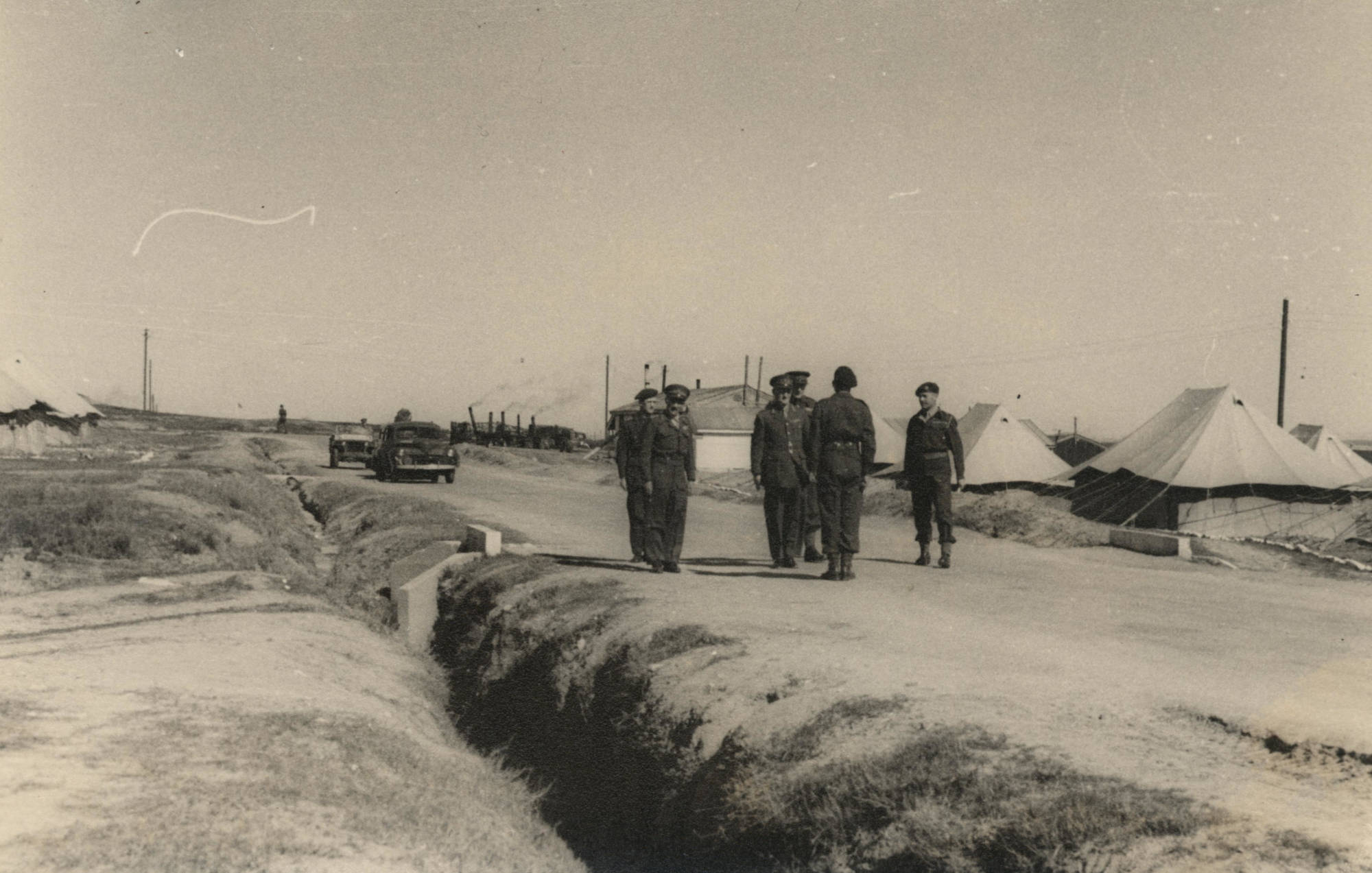
A visit by the Deputy Adjutant General, R.A.S.C. - Major General Sir Guy de Courcy Glover to inspect the 250th (Airborne) Light Composite Company, R.A.S.C. and the Detachment of the 181st Airlanding Field Ambulance, R.A.M.C. Bulford Fields. 21st January 1943. Here he is presented to one of the Company officers. NNA/0360/3. Courtesy the RLC Museum.
A visit by the Deputy Adjutant General, R.A.S.C. - Major General Sir Guy de Courcy Glover to inspect the 250th (Airborne) Light Composite Company, R.A.S.C. and the Detachment of the 181st Airlanding Field Ambulance, R.A.M.C. Bulford Fields. 21st January 1943. Here he is talking to one of the Company officers. NNA/0360/2. Courtesy the RLC Museum.
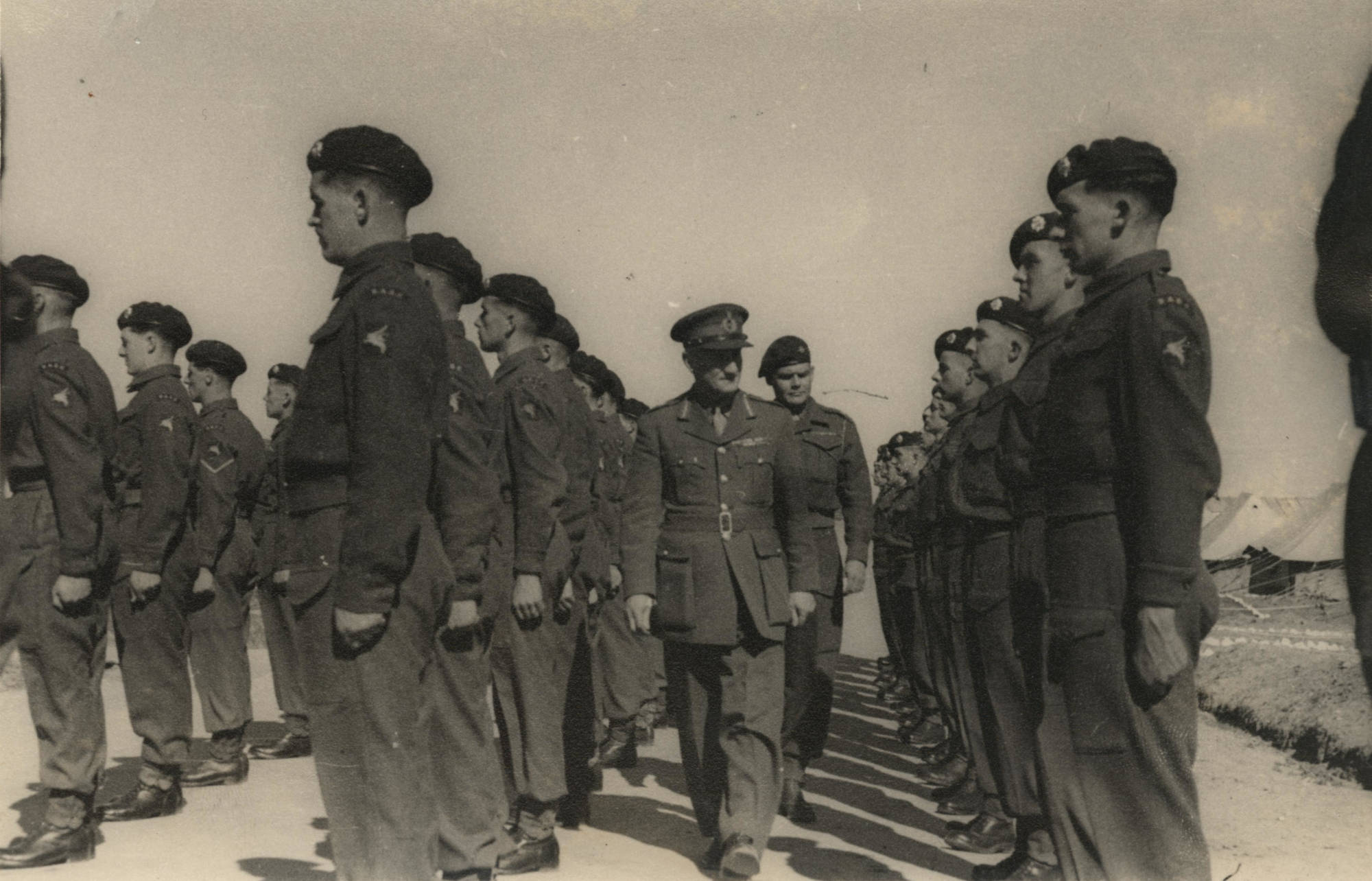
A visit by the Deputy Adjutant General, R.A.S.C. - Major General Sir Guy de Courcy Glover to inspect the 250th (Airborne) Light Composite Company, R.A.S.C. and the Detachment of the 181st Airlanding Field Ambulance, R.A.M.C. Bulford Fields. 21st January 1943. Here he is inspecting the troops formed up on parade. NNA/0360/1. Courtesy the RLC Museum.
Most of the 27th January was spent preparing for a demonstration to Members of Parliament, which took place the next day. Forty-six members of Parliament visited the Division in the morning, and the majority of them flew from Netheravon aerodrome to Dumbell Copse, on Salisbury Plain, in two Horsa gliders. One glider made a hard landing and a number of minor casualties resulted, which were treated by R.A.M.C. personnel of the 181st Air Landing Field Ambulance, on the spot. Miss Ellen Wilkinson, M.P. suffered a broken ankle and was taken by ambulance to Tidworth Hospital. The G.O.C. injured his shoulder. The wet weather programme was continued after luncheon. The next day the G.O.C. was taken to Shaftesbury Hospital, and Brig. G.F. Hopkinson, O.B.E., M.C. assumed command of the Division in his absence.
Members of the Company visited R.A.F. Boscombe Down on the 30th January, to investigate the possibility of carrying supply panniers in bombers. On the 6th February, there was a visit to the 1st Airborne Division Ordnance Field Park, R.A.O.C. at their Camp at Barton Stacey, to see the new 'pocket' workshops proposed for Light Company, R.A.S.C. on the new War Establishment. This was followed two days later by a reciprocal visit to Netheravon for the Ordnance men, who joined others of Southern Command, to witness a demonstration of supply by air by 250 Company. Containers were dropped from Whitley's, Albermarle's and Halifax aircraft, also a Basket (Pannier) 'Daisy-Chain' from a C47. Two baskets of M.T. spares were dropped by parachute, with negligible damage to stores. One basket of wireless and signal stores were placed on static display. This was the start of what needed to be close co-operation between the R.A.S.C. and the R.A.O.C. within the Airborne Division, to make sure that the delivery of supplies and stores was carried out as efficiently as possible.
The Airborne Ordnance Field Park, R.A.O.C. was commanded by Maj. Cecil Cyril Chidgey, always known as 'Bill'. His was another unit that had begun life with the 31st Independent Infantry Brigade and converted to the Airborne role. They had moved to Barton Stacey Camp, along with the 1st Battalion, The Border Regiment, at the end of 1941, where they also started experimenting with how to load gliders, and undertaking glider flying experience. The role of the O.F.P was to support the Airborne Division with its requirements for 1st and 2nd line technical spares and assemblies plus all clothing and general stores. It also held large quantities of lashing equipment for gliders and for packing stores to be dropped by parachute. 1st Line support was essentially that provided by a unit, its quartermaster and any attached tradesmen, such as armourers or mechanics. 2nd Line support was more sophisticated and usually provided to a fighting unit by a separate logistic unit at brigade or divisional level with more equipment and better working facilities. The Ordnance Field Park: A 'Park' is a storage area in the open, and both the RAOC and the Royal Engineers had them, in the latter case to hold engineer stores. 'Field' shows that the storage area is for the support of a field force formation. Hence 'Ordnance Field Park', a deployable unit holding Ordnance Stores. [F]
There was a drop of twenty parachute qualified personnel on the 13th February, and a recce for Exercise 'LONGFORD', which was to take place on the 16th through to the 20th, along with elements of the Guards Armoured Division. The O.C. the Non-Airborne Wing and 'A' and 'C' Platoons would participate. At 14.00 hrs on the 17th February, there were dropping trials with a new basket of fibre materials in view of the wicker shortage. The pace of exercises and trials was increasing as the next day was Exercise 'BROADCAST', with Company Headquarters and the Wireless Section using the No 18 Wireless sets operationally for the first time. And then there was another parachute drop for twenty men of the Company on the 21st on the Divisional D.Z. On the 24th, there was a visit from Lt- Col. Jefferies, and an Officer and seven men of the Company participated in a "Broadcast Recording Parachute Descent" for the B.B.C. Weapon training continued all through this period with regular visits to the ranges at Bulford, but on the 26th, the Company were introduced to the P.I.A.T. on the Ogbourne St George Range.
The Airborne Wing proceeded to Cranborne Chase on the 27th February, for four days, to practice 'living in the field'. In the 1947 Newsletter, Capt. Cranmer-Byng wrote about a return trip to the area where this training took place: "Last Autumn, I suddenly found that I was working with a man who had a house in Cranborne Chase, in the village of Ashmore to be exact. Well, it was too much of a coincidence to let slip. I told him all about our training camps in Tollard Common and in Well Bottom and the field firing in Shepherd's Bottom. He immediately accused me of being responsible for the death of two of his 'brothers' cows - blown up by unexploded mortar bomb "blind"! Anyway, I hastily shifted the blame on to 'Jock' Sibbald, with his unexploded P.I.A.T. bomb hanging down from a thorn bush, and we had a drink on it!
This chap invited me down to his house for a weekend. We made a plan of campaign that we would march over to Tollard Royal village and drink in the pub there, and then another day, we would go past Well Bottom (where we camped in February 1943 and had a large bonfire one night in spite of the blackout - and Dvr. Douglas Power played his mouth organ while we sang some new songs), up over the hill and drop down into the village of Fontmell Magna where there was a good pub.
So, I had my long weekend in Cranborne Chase and visited all the places again. Walking along Shepherd's Bottom towards Hatts Barn, I went mighty careful, I knew how many "blinds" there might be lying about! We also made a trip over Melbury Down and then descended the zig-zag to the Glynn Arms, scene of many a quick one during various schemes over the Downs in the good old days. The place hasn't changed a bit. Still large areas of woodland where a chap can get lost (even with a compass) and the unfortunate village of Ashmore with a church, a chapel but no pub. The only thing that had changed for me was the method of getting there and back. The London train stopped at Salisbury and we got out and changed into a local train… I didn't try marching from Salisbury through Bower Chalk and Sixpenny Handley. That wasn't on! No thank you!" [G2]
Exercise 'OWL' was a demonstration to the Staff College on the 1st March, in which all types of work carried out by the Airborne Division were shown, including supply dropping from a Dakota C47, Halifax and Whitley aircraft. All were deemed highly successful, as there was also a static display, including of the above, that showed the roller conveyor and loads, plus a loaded Horsa glider. It helped that the weather was good, and warm for the time of year. The next day, experiments with dropping supplies from a Wellington aircraft were carried out, which were not considered satisfactory.
Orders were received by the Company, on the 5th March, that everyone was to be dispatched on Embarkation leave as soon as possible, and that the G1098 scales for the new War Establishment were to be cleared up. The first batch of 200 men left on the 10th March, and the second batch, of 110 men left on the 19th. In the meantime, 2/Lt. Winter-Goodwin joined the Company on the 8th March, and was assigned as a Subaltern to Headquarters. Unfortunately, not much is known about Benjamin Charles Winter-Goodwin, except that he had been granted an emergency commission as a 2/Lt. in the R.A.S.C. Whilst all this hectic activity was taking place, the Company was still expected to carry out training courses for other units, and on the 11th March, a 'Basket and Container Packing Course' for the 3rd Parachute Brigade commenced. Lt W.V.A. Gell joined the Company on the 15th of the month. Born on the 23rd June 1920, William Vincent Aloysius 'Bill' Gell had been granted an emergency commission as a 2/Lt in the R.A.S.C on the 13th December 1941, and had then been promoted to War Substantive Lt on the 1st October 1942. "Until early in 1943 I was with 902 Company R.A.S.C. C(M)T, part of the 59th South Staffordshire Division and stationed in Northern Ireland. I regularly applied for various postings, but was equally regularly blocked by my C.O., complimentary I supposed, but I wanted a more active life. When an A.C.I. (Army Council Instruction) circulated that advised that any officer who wished to volunteer for Airborne Units could not be withheld, I then volunteered for posting to The Glider Pilot Regiment, and in due course was posted to the 1st Battalion, G.P.R. at Bulford. I only survived one day with the Regiment due to a slight difference of opinion with the C.O. When I refused to return to Northern Ireland, I ended up at 250 Company. The Company was based at Amesbury Abbey, with Michael Packe as C.O." [H1]
On exactly the same day as Lt. 'Bill' Gell's arrival in the Company, the last group of men from the unit were about to start their parachute course. This was Course No 55, at R.A.F. Ringway, and would run from the 15th to the 22nd March. Of the eight men that attended, seven passed: L/Cpl. Blaxley, and Dvr's. Middleton (515), Peel, Robinson, Syme and Smith (564) and Withey. This meant there were now approx. 120 - 125 parachute trained Officers and men in the Company. L/Cpl. Burnham Blaxley: "From now on our sister Company 253 Coy took over the Heavy Transport and we were relieved of that responsibility. Our mode of training was now completely altered. We received supplies of Jeeps and Trailers. Completely new vehicles to us. Two trailers were allocated to each Jeep. I being Corporal was now responsible for 5 Jeeps and 10 Trailers. Capt Kavannagh was now our Platoon Officer, he took his Parachute Training Course, and returned full of enthusiasm that we should follow suit. It was decided that as we were to work closely with Gliders a shortened Parachute Course would be sufficient. We needed a stick of 10, L/Cpl Syme and myself as N.C.O's and eight other ranks. We were duly posted to Hardwick Parachute Training Centre near Chesterfield. Here we were subjected to a programme of intensive but varied physical training. On arrival we were stretched out on the couch and pummelled relentlessly by the Doctor. I could not believe what I was hearing when he said to me "There is some Flab here needing to come off". I thought I knew what to expect, but in no way could I envisage what was to come. Firstly No Smoking at all. Then we doubled everywhere. When we stood still we ran on the spot. If we rested between exercises in the Gym, and folded our arms across our chest, we had to sprint three times around the Gym. I lost my Flab." [H2]
He continues: "On Saturday at the conclusion of the course, we marched 10 miles from Hardwick Hall to Chesterfield in full Marching Order which was Large Pack, Small Pack and Webbing, probably about 60lb in weight. At Chesterfield we entrained and travelled to Ringway Airport Manchester. It was here we started our Parachute Training. We were split into our sticks of ten men. A Sergeant Instructor was allocated to each stick, and he guided us through this next period of training." [H2]
One of the other men on this parachute course was considered an experienced soldier with nearly four years of service behind him, however, he was still only 19 ½ years old. Dvr. Leslie Withey had enlisted on the 19th January 1939, but having only been born on the 31st May 1923, he was only 15 ½ years old and was enlisting as a 'boy soldier'.
These photo's were taken at the A.F.E.E. on the 19th March 1943. Courtesy of Airborne Assault Museum, Duxford.
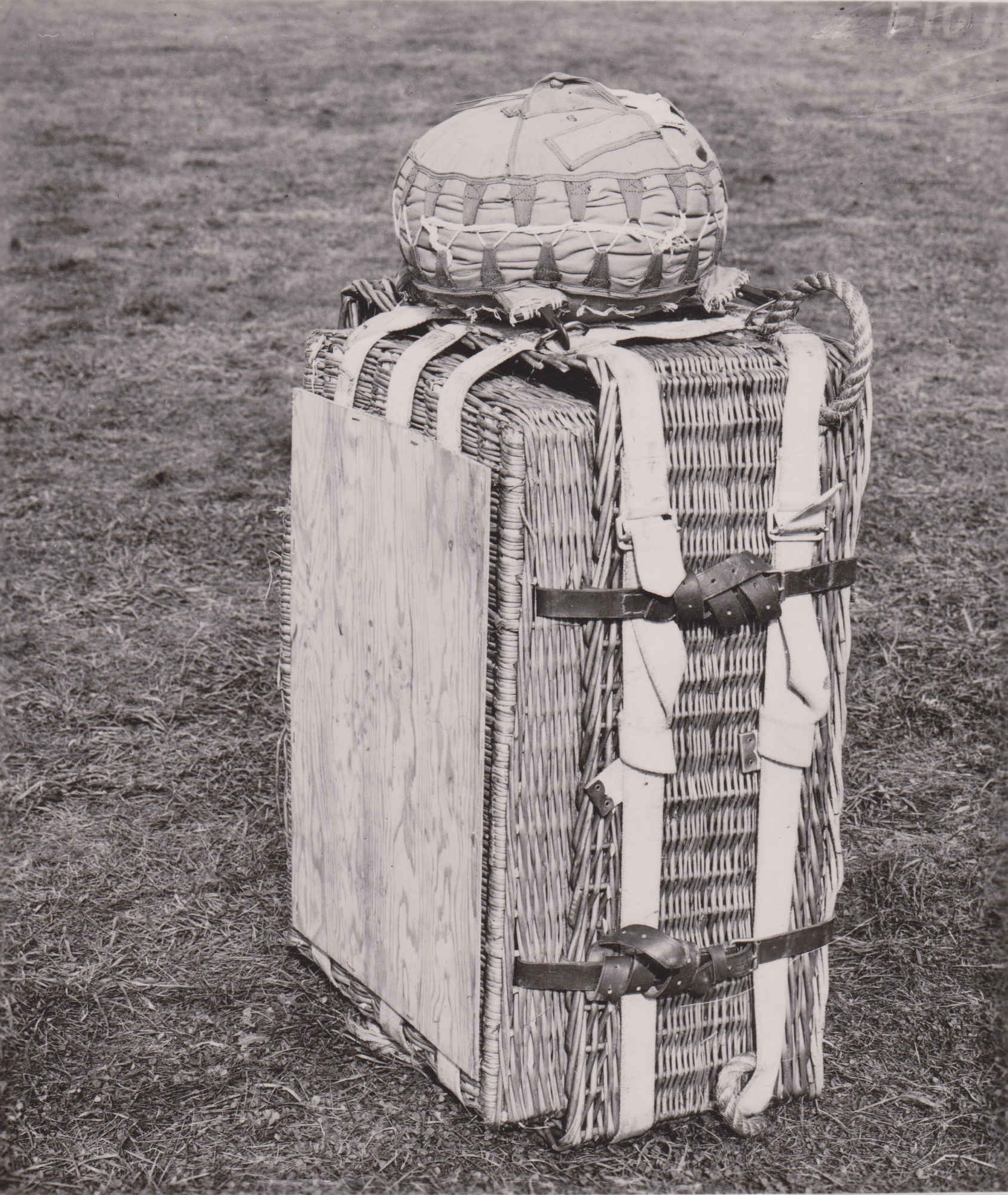
A single Pannier showing the three ply bottom.
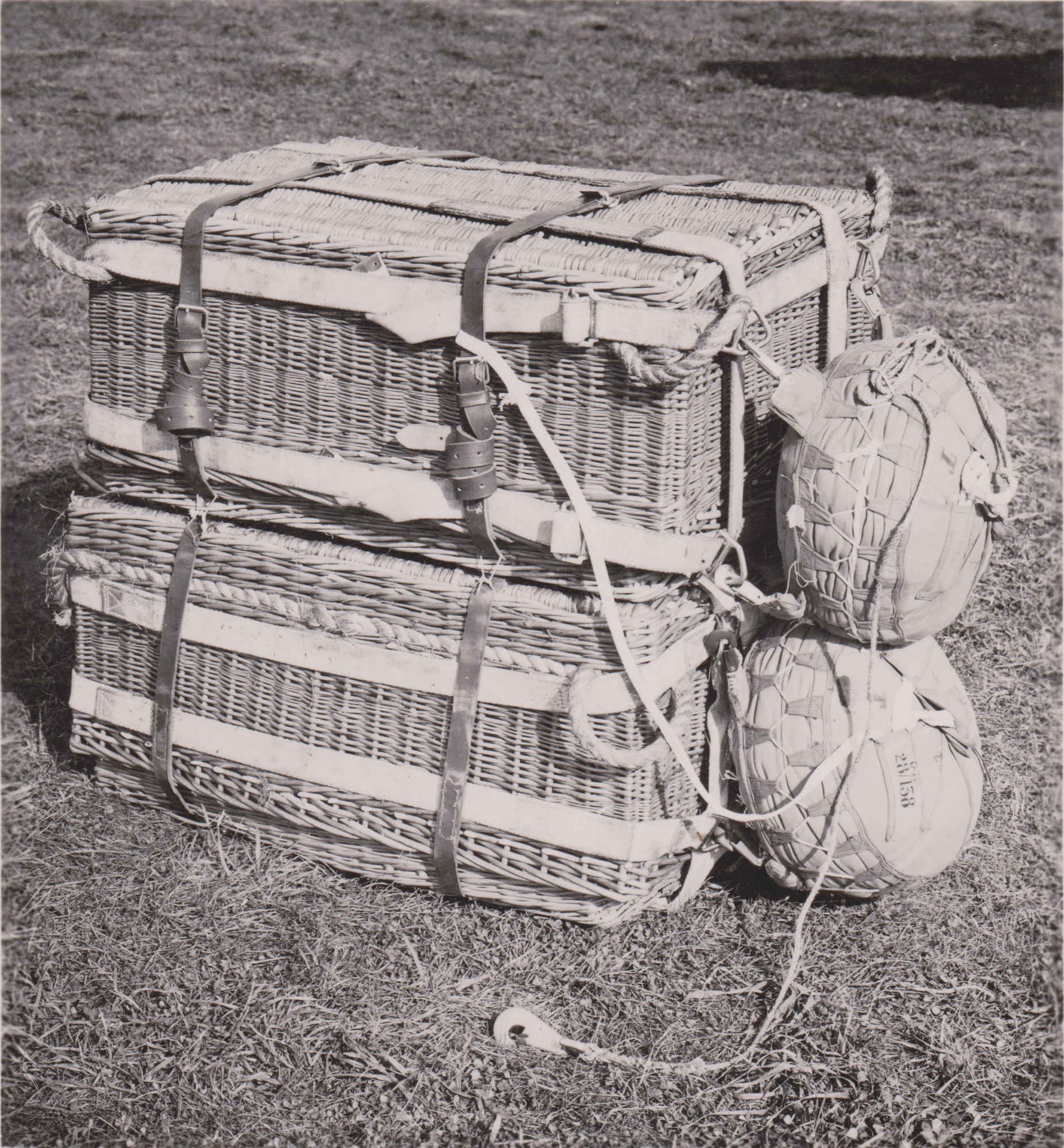
Panniers packed in pairs.
For the Transport Platoon's there was regular Jeep instruction throughout March, interspersed with regular exercises, with the main one being 'SCRAMBLE', which entailed the packing of 300 baskets and 132 containers. The exercise took place between the 28th and the 29th March, with 12 aircraft and 12 gliders being loaded up, with a total of 50 tons of supplies, ammunition and petrol included, being dropped from 24 aircraft or landed by glider. On the ground these were then delivered successfully to units by the Airborne Wing, who had also dropped or air landed. There were sufficient quantities of supplies for a Brigade Group. Even the 9th (Airborne) Field Company, R.E. made a note in their War Diary: 'Skeleton Field Company took part in "Exercise Scramble", which involved practice in Airborne Supply, in the Field. This was the first Exercise that the Company had taken part in, in which actual delivery of all types of supply by air were made. Company was represented by 1 Officer, 1 D.R. and 1 x 15 cwt truck.'
For two days everything that moved was cleaned, scrubbed and polished and anything that didn't, was white-washed! This was in preparation for a visit by His Majesty, The King to inspect the Division on the 2nd April at Bulford Fields, behind Carter Barracks. The Divisional R.A.S.C. Contingent of six officers and 156 Other Ranks was commanded by Lt-Col. Jefferies. Note that the other 700 men of the R.A.S.C. Company's in the Division were on other duties. The parade was concluded with a March Past, and a salute taken by H.M. and Brig. G.F. Hopkinson, who was in overall command that day.
Michael Packe gives a vivid description of the parade in his book "First Airborne": Bulford Fields stirred with an excited bustle, and with something of the flurry of a race meeting. The King had slept in his train in a siding the previous night, whilst his loyal subjects polished and scrubbed, whistled and swore as they brought their clothes up to the required standard.
Today, the sky had the peculiar beauty which is only familiar to those who know Salisbury Plain. In half sunshine, fleecy clouds were chased by a delicate wind, as long columns of troops, picked out by the sunlight flashing from their various cap badges, wound steadily over the top of the ridge. The grasses could be seen to swish and sway as they marched, making no sound. The confused throbbing of drums, and the conflict between pipes and brasses, made a strange martial comment upon this military scene.
James and his party breasted the ridge, and were picked up importantly by their guide. Under brisk supervision, they were shepherded obediently into rigid lines on their appointed front. They were measured against whitened corner stones and bits of tape. They were inspected with disdain by an alien Sgt Maj, and with contented pride by James [Maj. Packe]. Then they were stood easy and relapsed into desultory conversation to while away their age-long task of waiting.
James reported to his Colonel [Jefferies]. "Very big show this," said the Colonel absently after they had exchanged salutes. And indeed it was, for the long straight lines stretched away beyond them on either side, extending over the rolling yellow grass, merging away towards the blue haze of the morning until the red of their berets was no longer distinguishable. "It looks as though we really are off at last", said the Colonel; "the King always comes to review formations ordered overseas". "I remember doing this last year", said James simply; "I'm glad it's a good day today. Last time it poured with rain, and we stood for ages; nobody was at his best". "Um - yes", said the Colonel; he was not pleased, because he was a newcomer, and had not been there last year.
A silence fell, and out of the white clouds three Spitfires came diving down, circled round like porpoises playing in the surf, and disappeared. Below, at the bottom of the hill, there were signs of a dignified commotion as a procession of cars, led by a gleaming black monster with a flag on its bonnet, slid up to a halt.
The King did not waste any time over his inspection; he came straight up, talking to the General, and the parade gave their salute. Then he walked rapidly down the line, meeting each commanding officer in turn at the right flank of his detachment. The long retinue followed in his wake, and the cars themselves, as though irresistibly compelled to keep pace with Majesty, passed silently along behind them.
The King rode off down the hill through the swaying grass, and with the General and his train, took up his stand in a covered pavilion. James, who came late in the procession, watched the units moving off from the right of the line with a rhythmic precision. The Division was as yet unfledged; but the idea bred of wartime and disaster had become a human reality, and had carried its pride forward. In this moment, in the sun and wind, these turbulent individuals from all over the British Isles had no design or desire other than their part in the whole, now focussed into the business of marching with practised ease of bearing before the figure which represented all that they shared between them.
The band played the march of each unit as it came into view, swinging along the straight tarmac and past the saluting base. It looked impressive from a distance, and weird, the arms and legs tied together and moving by a common consent; they could be seen to move before the pulsing of the drums had covered the intervening space borne on the easy breeze.
James saw the Welsh Battalion, their goat clipping along in front of them; and even at such a distance, the swirl of the kilts of the Scottish Battalion was plain. So they came on in endless procession, marching to a pace so regular that in time it seemed that they alone were stationary, and Salisbury Plain itself was moving back past them.
It was nearly an hour before James had to move; during all that time, the Royal Party were still in their pavilion, saluting back to the myriad faces continually uplifted towards them. At last, he was safely past, and he led his party briskly on to where the transport was waiting to take them all back to their dinner and their workaday clothes. [I]
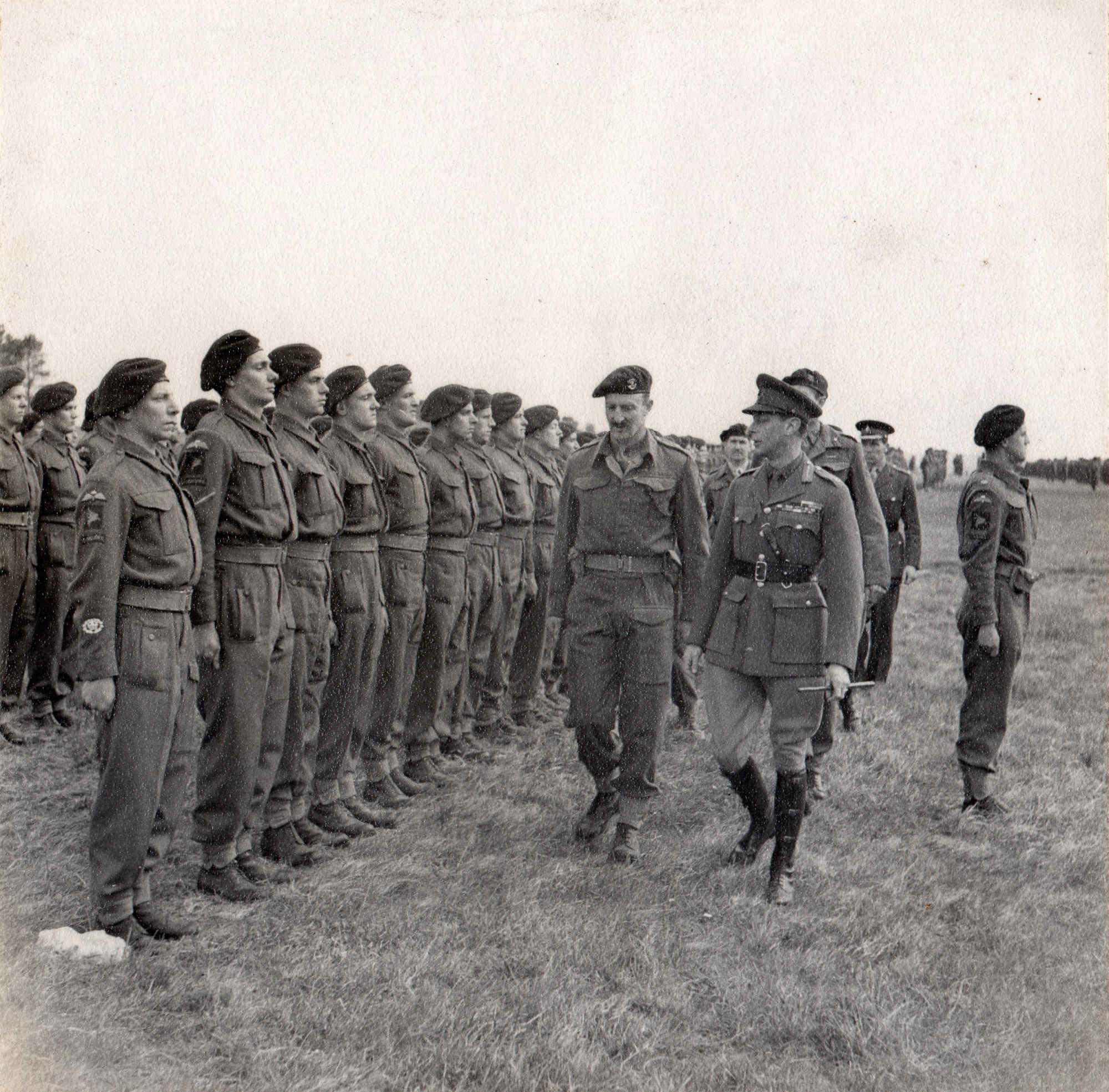
H.M. The King inspects the 7th (Light Infantry) Parachute Battalion, accompanied by the Commanding Officer, Lt-Col. H.N. Barlow, M.B.E. Bulford Fields. 2nd April 1943. Notice the 'white-washed' stone next to the Sergeant Major's right foot! Note: Later promoted to Colonel, and the 2 i/c of the Air Landing Brigade at Arnhem, Barlow would be killed in action on the 19th September 1944. Courtesy of Airborne Assault Museum, Duxford.
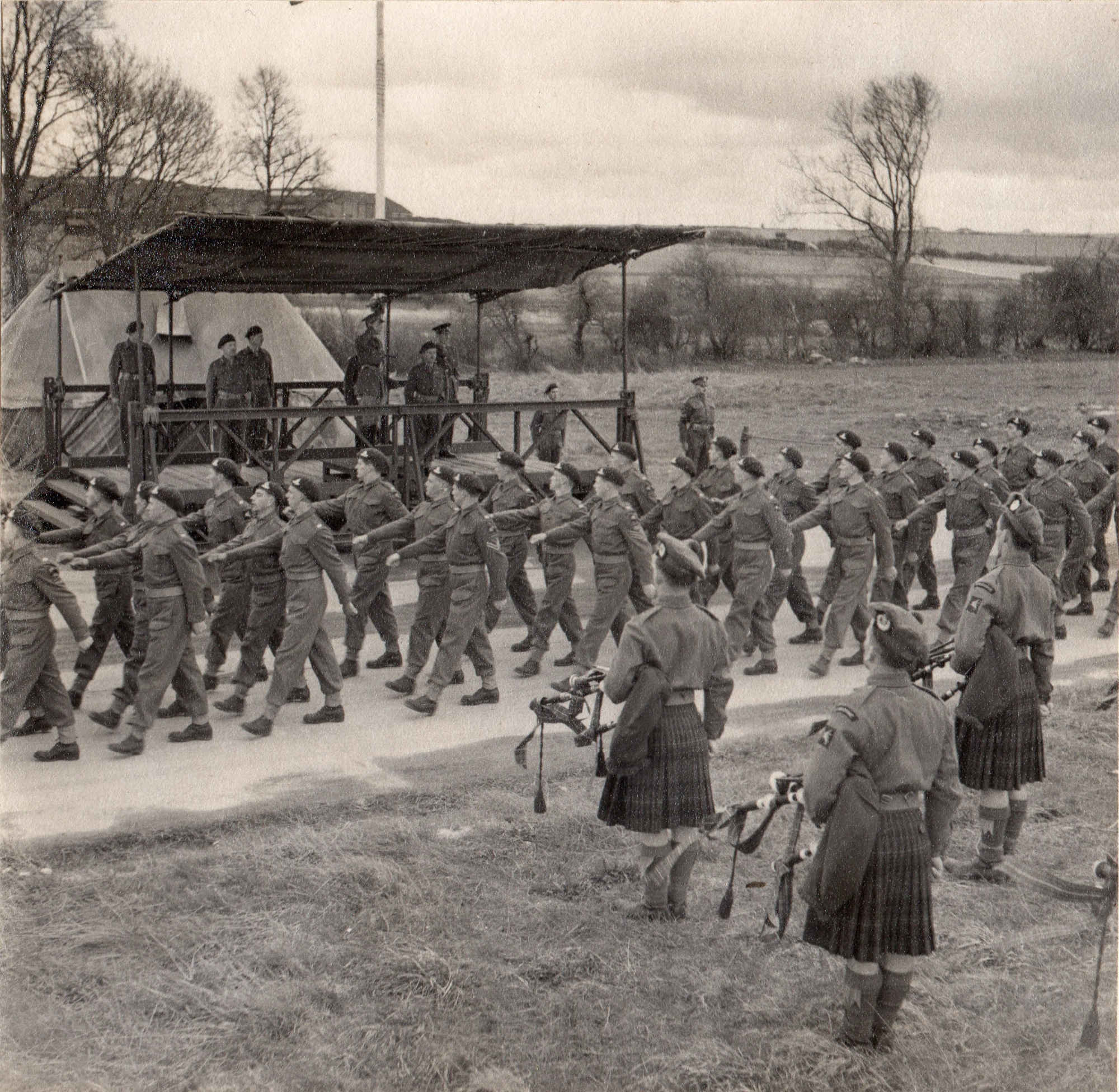
H.M. The King and Brig. G.F. Hopkinson, OBE, MC, taking the salute at the March Past of the Airborne Division. In the foreground is the Pipe Band of the 5th (Scottish) Parachute Battalion. Bulford Fields. 2nd April 1943. Courtesy of Airborne Assault Museum, Duxford.
It was now, with just over a month to go to complete mobilization, that Col. Jefferies, Maj. Packe, and the two O.C's of 93 and 253 Company's, Maj's. F.A. Lovegrove and R.K. Gordon respectively, had regular trips to Divisional Headquarters and London to sort out the new War Establishment's. On the 9th April, the C.R.A.S.C. pointed out to Divisional H.Q. the difficulties of proceeding with the conversion and preparation for move of the new Divisional R.A.S.C. without any formal, written instructions. He followed this up with a letter to the War Office, outlining the situation. The most pertinent parts of which are listed here:
1). The following action has been taken to put into effect verbal requests for conversion of RASC, Airborne Division to new W.E. and subsequent mobilization:-
(a) Coy Comds have been warned of the action required to be taken when conversion orders are issued vide ST/19/2 dated 6 Apr 43 which was issued on information then available.
(b) Coys have investigated the changes of personnel and vehicles which must be effected and the deficiencies which must be made up.
(c) 250 Coy has completed Embarkation leave and inoculation and vaccination also size rolls, etc except for 40 O.R's arriving today.
(d) 253 Coy is sending 1st party on leave 10 Apr 43 - 2nd party on 21 Apr 43.
(e) 93 Coy is sending parties on leave as in (d). Both above Coys will complete leave by 1 May 43.
(f) Inoculations and size rolls are being completed for 93 and 253 Coys and HQ, RASC.
(g) War Officer (AG 8) has been asked to post officers to HQ, RASC.
2). The situation as at today is as follows:-
(a) W.E. for HQ, RASC, Airborne Lt Coy, RASC and composition of Comp Coys passed W.E. Sub-Committees on 7 Apr 43. They are not yet finally approved; numbers have not been allotted them.
(b) No written instructions have been received regarding conversion or mobilisation of RASC, Airborne Div.
(c) 93 Coy is not yet under command and has not yet been released by 20 Armd Bde.
(d) Details for up to 120 vehicles per day are being carried out by 250 and 253 Coys and 93 Coy is still feeding 20 Armd Bde.
(e) TCV's of 253 Coy are still on detachment at Hardwick and with units.
(f) AFs G 1098 have not yet been approved for HQ, RASC and Lt Coy, RASC.
(g) HQ, RASC still consists 1 Lt-Col, 1 Capt, 3 clerks only - no personnel can therefore be sent on leave.
In a further paragraph the situation with regard to vehicles was outlined;
(i) 448 new vehicles to be issued by RAOC to 250 Coy, 106 vehs at present held to be retained and prepared making a total of 554 vehs for the Coy. 177 vehs at present held to be disposed of. Of the 448 above 173 Jeeps to be modified.
(ii) Vehs of 93 and 253 Coys are of mixed makes and mixed types. These should be corrected by new issues, but ignoring variations in makes and types:- 24 vehs to be issued to 93 Coy. 117 vehs to be issued to 253 Coy. 66 TCV's to be withdrawn from 253 Coy.
In addition, there was to be a considerable cross-posting of personnel, some of them would go to the new units being formed within the new 6th Airborne Division. Capt. D.S. Bremner, 716 (Airborne) Light Composite Company, R.A.S.C.: "In May 1943, at Weybridge, Surrey, Major E. Clive Jones, R.A.S.C., was handed a massive pile of literature and apprised of his appointment as O.C. of this new unit. Gradually officers and men made their appearance to join him in this new venture, many of them from 716's sister unit 250 Company of the 1st Airborne Division which had not long sailed for North Africa." [F2]
Looking ahead, the C.R.A.S.C. also noted the requirement for shipping to move the R.A.S.C. Group of 1,300 all ranks, with 900 vehicles of all types. On the 12th April he noted that the conversion of 250 Company, R.A.S.C. should be carried out simultaneously with that of 253 and 93 Company's, R.A.S.C. This will permit transfers of surplus personnel and vehicles being effected at once locally, thus, saving delay. The resultant surpluses and deficiencies being dealt with by postings or transfers from records and C.O.O., Chilwell, respectively. Two days later he submitted a loading table for the:
Airborne Division R.A.S.C. on the new W.E. now about to be approved and recommend as follows:-
|
(a) One Airborne Composite Coy (90 x 3-ton). (i) One day's rations on the 14 man pack basis for whole Division (ii) One day's petrol and lubricants at 50 m.p.v. for whole Division (iii) Reserve clothing and equipment and anti-gas reserves (iv) R.E. Stores (v) Ordnance Stores (vi) Medical Stores (vii) Pool of transport to carry stores of one Para Fd Amb (viii) Ammunition (51 tons) (ix) Glider loading equipment (100 tons)
(b) One Airborne Composite Coy (90 x 3-ton). Ammunition (270 tons). (c) Airborne Light Coy (140 x 1-ton). (i) Ammunition (112 tons) (ii) Reserve of bridging equipment for interchange of Sec with Field Park Coy, RE (iii) One day's 48 hr rations for whole Div. (iv) Not loaded. |
3-ton lorries. 9 17 5 2 2 2 6 17 30 90
90
112 5 16 7 140 |
2). The loading within Div R.A.S.C. will have to be varied by me according to circumstances, i.e. the same RASC Coy may not always carry the same items, but the total lift within Div RASC will be the same.
3). The above allows broadly for the lifting of:-
Two days rations.
One days petrol.
Ammunition at scales given in AFB/MS/1005/6/AQ dated 9 Apr 42 Divisional reserves of clothing and stores.
And also allows of one Airborne Composite Coy being available for troop carrying after Divisional authority has been given for the dumping of its ammunition. For the delivery to units of fresh rations, other reserves would have to be dumped as well.
On the 16th April instructions were issued to 250 Light Company, 253 Composite Company and 93 Composite Company for the postings of personnel and transfers of vehicles in anticipation of orders. Verbal approval was given by Lt. Col. W.J.J. Allen, the AG 8 for the postings and Lt. Col. Gray, the WS 6 for vehicles as might be required by C.R.A.S.C.
Dvr. 'Jim' Wild: "By early 1943 we had taken over, from the Americans, 100 Jeeps and 200 trailers. In the meantime, we found we had to provide 3 Platoon's, one for each of the Para Brigade's, and one platoon for the Air Landing Brigade. Our roles were still to provide rations and ammo, also to act as Defence Platoon, if the need arose. That meant that we had to carry out full infantry training, including route marches in Airborne fashion - that is, run and march - on all our route marches. Everything we did was new, and even the officers were feeling their way around everything. What we did in those days meant that we were 'jack of all trades' and trained to do any job, within reason, in the Airborne Division." [E12]
By now the reorganization of the three R.A.S.C. Companies was complete. This establishment was tentative and provisional, and, in the light of subsequent experience, revision was necessary. The non-airborne wing of the company, which had no R.D.Is., as these had been used to provide the airborne wing, was continuously employed on normal transport duties for the division, at the expense of vehicle maintenance and training. The Airborne Divisional R.A.S.C. was reorganized in March, 1943, in three companies, i.e., two ordinary Composite Companies and one Light Composite Company. The advantages of this arrangement were that each company could be trained separately in its particular role, especially the light company, the personnel of which, had to be free from other duties. While one composite company carried on the routine work of the division, the other could be trained in the work of packing and loading supplies, which was part of their role; and, if the division was committed operationally, one composite company could carry on the packing and loading for the maintenance of the formation, while the other went to relieve the light company in the new theatre.
The composite companies were each composed of three transport platoons, three R.D.Is., a composite platoon, and a workshop platoon. The light composite company consisted of four airborne transport platoons, two R.D.Is., a composite platoon and a workshop platoon. Each airborne transport platoon consisted of seven sections, each of five Jeeps and ten trailers. The workshop platoon of this company had the innovation of trailers, instead of 3-ton lorries, for the carriage of its equipment and stores, on the scale of two for stores, one machinery, one generator, and one electrical repair. Each transport platoon in the light company included a defence section of 17 other ranks. A total of 25 all ranks of the light company were operational parachutists.
An H.Q., C.R.A.S.C., was now included in the establishment of the Airborne Division. There had not until this time, been a R.A.S.C. representative on the Divisional H.Q, although, the administrative detail, both planning and executive, for an airborne and air-maintained force was of greater complexity than for a normal division.
Reorganization of Light Composite Company
In April, 1944, the establishment of the Airborne Light Composite Company was again altered. As the result of operations in the Central Mediterranean theatre and elsewhere, as well as of a careful study of the maintenance problems of an airborne division, it was considered possible to relate an efficient organization to actual requirements.
The new establishment was designed to include:-
(a) Company headquarters and domestic transport;
(b) three self-contained parachute platoons, each capable of:-
(i) Landing with a Brigade Group, and marking out and holding, a supply dropping point or points;
(ii) clearing, stacking, and guarding panniers and supplies dropped on the S.D.P., and effecting subsequent distribution;
(c) three transport platoons, each capable of: -
(i) unloading supplies from aircraft or gliders, and delivering them speedily over difficult country, whilst affording their own protection within the platoon;
(ii) acting alternatively as air crews, if not employed in transport roles;
(d) one R.D.I., providing relief drivers;
(e) Workshop Platoon, capable of maintaining its own company vehicles, and jeep transport of all units affiliated for maintenance, and of modifying and constructing equipment, as used by the Light Company for supply by air.
Each parachute platoon consisted of two officers and 34 other ranks, the latter including a proportion of supply storemen and artificers, the balance being drivers.
Each transport platoon was organized in seven sections, each of five Jeeps and five 10-cwt. airborne trailers, a reduction in the scale of transport being necessary. The transport platoons included a total of 40 operational parachutists, as a pool for keeping the parachute platoons up to strength, the remaining personnel of the transport platoons being trained in aircrew duties. [G]
In the last week of April, the Company began mobilization training with a full Company parade on the 25th to re-organize to the new War Establishment. The following extracts from the War Diary give a 'flavour' of these hectic days: 28th April. Mobilization and training. Defence Section and Workshops on Beaches Barn ranges. Sorting of G1098 Equipment. Parachute drop - stick of 8. Workshops packing up vehicle parks for return. Evening - Officers firing small arms. 29th April. C.R.A.S.C. Conference at 10.30 hrs. Information received that vehicles probably available from Slough shortly. Capt. P.E. Bushby, the new Work Shops Officer was posted to the Company. Training - Bulford 'D' range. 30th April. 7th day of mobilization. Arrangements in hand for drawing of new vehicles tomorrow. Packing of G1098 Equipment. New stores beginning to arrive. Painting of kit-bags. Issues of ammunition to bring unit up to 1st line scale. Last day of delivering supplies to Division. Drop and loading trials on C47 cancelled owing to weather.
This continued into the following month, with the packing of all stores, receiving extra drivers (to bring them up to the full War Establishment, and then to interview and train them), deliveries of 75 Jeeps, new trailers, modifications and desertization of vehicles, and finally the dispatch of two large convoys to the port of embarkation at 07.00 and 09.30 hrs on the 6th May. The final batch of vehicles departed for the port on the 8th, and the Company paraded at 17.00 hrs on the 15th May, to entrain at Amesbury Station at 20.00 hrs. They arrived at the port of Leith, Edinburgh, at 06.45 hrs the following morning, embarked and set sail that night. This was the second Divisional convoy.
L/Cpl. Burnham Blaxley: "We had no idea of our destination, but entrained at Bulford and travelled to Liverpool overnight. We embarked early morning on the Stirling Castle of the Union Castle Line and made our way to safe anchor. We later joined a rendezvous point and dropped anchor. We were gradually joined by a number of ships of varying size forming a Convoy. The Royal Navy were to escort us we were joined by several Corvettes and Destroyers, and one or two hastily converted ships which had flight decks recently fitted." [H2]
There had been a farewell address to the Company by Maj-Gen F.A.M. Browning, who was appointed as Major-General, Airborne Forces, having handed over command of the 1st Airborne Division to Maj-Gen. G.F. Hopkinson in April.
As the Company were packing up and preparing to leave Amesbury Abbey, a newly created unit was about to move in - the Airborne Forces Development Centre was officially created on the 11th May 1943 - and would take over a lot of the work that the Company had pioneered.
A visit by General. B.L. Montgomery to the A.F.D.C. at Amesbury Abbey on the 8th March 1944. He can be seen standing on a Jeep in the middle of the photo, and the troops on parade are about to be gathered around him. In the background can be seen a complete Horsa mock-up, for practicing loading and unloading. Courtesy of Airborne Assault Museum, Duxford.
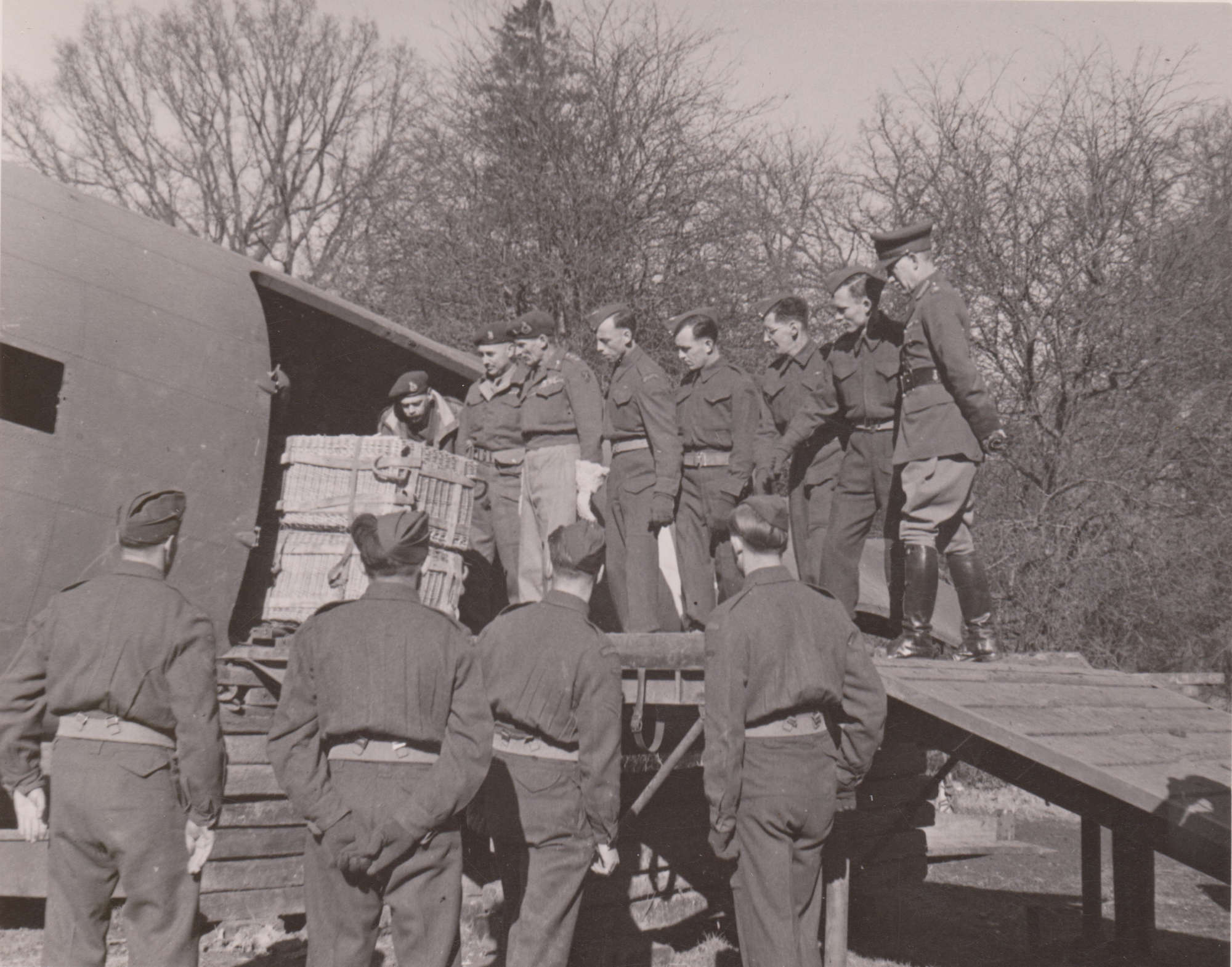
Maj-Gen. R.N. Gale, Brig. E.W.C. Flavell, Gen. B.L. Montgomery, four Air Despatchers & Gen. K.N. Crawford inspecting supply panniers in the doorway of a Dakota at the A.F.D.C. Amesbury Abbey, 8th March 1944.
FOOTNOTE: [B2] An Experimental Section was added to the Central Landing School (R.A.F. Ringway) in September 1940. This was renamed the Airborne Forces Experimental Establishment (A.F.E.E.) in February 1942. It moved to Sherburn-in-Elmet, North Yorkshire, in August 1942.
FOOTNOTE: [C1] G1098 is the shortened term for an official book (Army Form G1098) which records the unit's account of its equipment.
NOTES:
[A] "First Airborne". Michael Packe.
[A1] Letter to Bob Hilton from Frank Bater. 26 September 1997.
[A2] Letter to Bob Hilton from Bill Chedgey. 28 September 1997.
[B1] Letter from John Gifford to Frank Steer. 8 February 1999.
[B2] 'The Second World War 1939 - 1945, Army, Airborne Forces' by Lt-Col T.B.H. Otway, DSO. Page 57.
[B3] The Royal Army Service Corps Review Vol. 1, Nr 5. 1952. R.A.S.C. IN THE 1st AIRBORNE DIVISION-- FORMATION AND ACTION AT ARNHEM, by Lieutenant-Colonel M. St. J. PACKE, R.A.S.C. [C] & [G] Transport and Supplies. Volume I. Pages 96-97.
[D] & [F] "ARNHEM. The Fight Too Sustain". Brig. F. Steer. Pen & Sword. 2000.
[E1] "Major Cotterell at Arnhem". By Jennie Gray. Page 66.
[E11] & [E12] Letter from Jim Wild to Frank Steer. 1990's.
[E2] The Royal Army Service Corps Review Vol. 1, Nr 5. 1952. R.A.S.C. IN THE 1st AIRBORNE DIVISION-- FORMATION AND ACTION AT ARNHEM, by Lieutenant-Colonel M. St. J. PACKE, R.A.S.C. [F2] Captain. D.S. Bremner. 3 May 1953.
[G2] 250 Company Newsletter. 1947.
[H1] Letter from Bill Gell to Brig Frank Steer. 11 January 1999.
[H2] Letter & account to Bob Hilton from Burnham Blaxley. 9 July 1998.
[I] "First Airborne". Michael Packe.
[J] Letter & account of Ron Nutley to Bob Hilton. 8 September 2004.


