Chapter 3
North Africa and Italy. 1943.
"In spite of every handicap, however, the troops were somehow kept supplied with their wants, casualties were expeditiously dealt with and vehicles continued to run." Lt-Col. R.F.K. Goldsmith. The work of the Services in Italy on Operation 'Slapstick'. 1943
250 Company were at sea between the 17th and the 26th May 1943, where life on board ship, was reported as 'routine'.
The Company ORDER OF BATTLE was now;
|
Major. M. St J. Packe. Captain. J.H. Gifford. Captain. J.L. Cranmer-Byng. Captain. D.T. Kavanagh. Lieut. P. Jerome. Lieut. W. Millar. Lieut. W.V.A. Gell. Lieut. J.G. Sibbald. Lieut. B.C. Winter-Goodwin. Captain. F.G. Bate. Captain. P.E. Bushby. |
Officer Commanding. Second in Command. Adjutant. Headquarters. Headquarters. 'A' Platoon. 'B' Platoon. 'C' Platoon. 'D' Platoon. 'E' Platoon. 'F' Platoon - Workshops. |
There were two Warrant Officers and 451 Other Ranks in the Company, with 6 Motorcycle Combinations, 177 General Purpose Jeeps, 2 Stores Jeeps and 1 Breakdown Jeep, and a total of 105 x 10-cwt trailers.
L/Cpl. Burnham Blaxley: "The weather now turned rough so much so that the destroyers seemed to disappear into the waves. The alarm sounded on board ship on several occasions and we could see the aircraft taking off from the Carriers. There were times when lying in my bunk I heard the sudden crack of a depth charges fuse followed by an intense vibration on the hull of our ship. Thank goodness for our escort our beleaguered little Island was dependant on these gallant crews. After our intensive blackout for months on end we suddenly saw brilliant lights to Port and Starboard of us. Two neutral Countries, Spain and Morocco. We were entering the Mediterranean. Not long after we reached Oran. We disembarked, I was not prepared for the stifling heat, it seemed to rise from the ground itself. There were swarms of flies thousands of them." [A1]
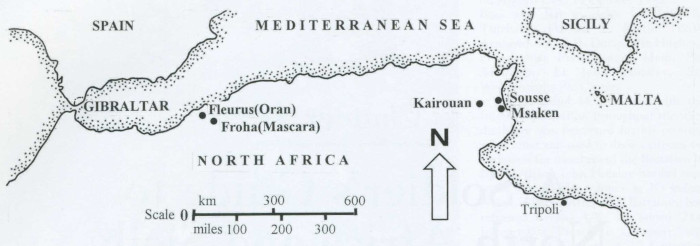
They docked at the port of Oran on the night of the 26th May, and began disembarkation in the early hours of the 27th. They then sat on the quayside for four hours, before being transported to Staging Camp No 2 at Fleurus, in trucks provided and manned by the U.S. Army where they arrived at 05.30 hrs. Here, they were deposited on a sandy wasteland without cover of any sort. This was the start of an awful day in the full heat of an African summer sun without any shade, little food, and little water. However, by the evening, the situation was under control, with tents erected, and food and water obtained. This construction of their camp carried on into the next day, and within two days, the Company had started a training programme and were carrying out driving details for the Division. The O.C. visited Mascara on the 29th May, to view a further Company location, which offered better facilities. At the same time, he took the opportunity to visit the Advance Section of the Company acting as Supply Company for the Advance elements of the Division.
Also in this camp area were the Headquarters R.A.S.C., the 93rd Airborne Division Composite Company, and the 253rd Airborne Division Composite Company. Making the 1st Airborne Divisional R.A.S.C. element complete, with a combined strength of approx. 1300 all ranks.
North Africa. 1943.
Lt-Col Jefferies produced an appreciation of the Divisional R.A.S.C. situation on the 30th May, which was circulated to all the units. In it, he stated that the main objectives, which were closely linked, were:
(a) To prepare the R.A.S.C. Airborne Division for Operations in the shortest possible time.
(b) To carry out all R.A.S.C. Services for the Division at all times.
He summed up the situation of the units and their dispositions, and then gave a summary of the state of training:
250 Lt Coy is fit for operations. 253 Coy has had almost no experience of supply by air. 93 Coy has had no experience of supply by air what-so-ever, apart from some flying experience. All Coy's are fully trained in R.A.S.C. duties. All Coy's have had theoretical instruction in supply by air while in transit. 250 Coy are fully trained in use of weapons, except 20mm Hispano. 93 & 253 Coy's are about 70% trained in the use of weapons, i.e. 30% have not fired, but all have had theoretical instruction. All duties within Coy's for supply by air have been sub-allotted to individuals, who are being theoretically trained in their individual duties. Only a few sets of maps are available for each Coy. Deductions.
(i) Divisional R.A.S.C. must take part in Exercise if the admin situation permits.
(ii) Range allotments are required if possible.
(iii) Pl Offr's must instruct drivers in relative position's of North African towns - A system of route cards must be used.
(iv) An allotment of A/C is required for R.A.S.C. Exercise.
The rest of his appreciation revolved around the future commitments of the R.A.S.C. Coy's, the supply of water, supplies and P.O.L., ammunition, transport, and the plan (in three phases) of how to accomplish it all.
The Airborne Division had arrived in two main convoys, the first one carrying the 2nd Parachute Brigade and the 1st Airlanding Brigade, and supporting units. The second convoy consisted of the Divisional Support Units, and was itself split into two, with personnel arriving first, and the vehicles, in six ships arriving later. With the 1st Parachute Brigade having recently moved into the area, and the 4th Parachute Brigade arriving from Palestine, via Egypt and Libya, the whole 1st Airborne Division would be concentrated for the first time.
Maj. Packe and Lt-Col. Jefferies went on a recce of the ports, on the 31st May, at which the Divisional vehicles and equipment were expected to arrive. They were expecting at least three ships at the port of Arzew on the 3rd June. Accordingly, 'B' Platoon were dispatched to the port on the 3rd to unload the ships, only to find that they had not docked, and which had failed to appear at all. Arrangements were made for them to remain at the docks, and the party spent the afternoon swimming. The next day, the ships arrived, and the unloading commenced and continued all night. Whilst the rest of the Company were training at Fleurus, a further Advance Party was sent up to the new area. The unloading of these ships, and the collecting of the Company's own vehicles, went on to the 7th June. By now only a third of the Company was at Fleurus (engaged in supply and transport details), while the rest had moved forward to Mascara.
L/Cpl. Burnham Blaxley: "We spent the night at a prearranged Staging Camp where we received notification that our Jeeps and Trailers had arrived at a small port nearby. We were more than glad to be transported there by truck and we split ourselves into work parties, working day and night to unload them and service them for the road. This entailed removing strapping, refilling sump with oil, checking battery and reconnecting. Then adding sufficient petrol to reach our next supply and, big problem, keep constant guard as we were a prime target for theft. We now formed a convoy of Jeeps and trailers and made our way to Mascara where we consolidated ourselves our transport and the stores we carried. This camp was well organized and consisted of Officers Mess, Sgts Mess and cooking facilities under awnings, a small Marquee which we used as a Mess also the N.A.F.F.I, was housed there. The tents were in orderly lines and were our 125 lb'rs. Camouflaged outside with a dark blue lining inside keeping off the harsh light of the sun and completely storm proof. All vehicles including Vehicle Workshops were parked close by and very closely guarded. This left space for Coy Parade Ground. The whole of this area had recently been harvested of wheat, which left stubble eliminating the dust problem so prevalent elsewhere. Immediately at the back of this encampment was a steep hill bestrewn with boulders. The powers that be decided that we should run up this hill and down again at Reveille each day. This might re-establish our physical fitness. I noticed a distinct usage of expletives whilst performing this unwelcome task." [A1]
C/Sgt. Alec Smallwood, the C.Q.M.S., wrote a book whilst in North Africa, called "So Many days", and this is a short extract from it: "As a port, Oran is an amazing place, the sightseer will find ample scope for his curiosity in all quarters of the city, although I must confess that this particular evening we did not intend to do any sightseeing. After the scorching heat of the day, we wanted a cooling drink. We eventually settled in a bar in the centre of the city and proceeded to study with interest the various types of nationalities there, at the same time as sipping iced Muscatel. My ability to converse in French soon landed us deep, in loud and amusing conversation with a French man, our iced Muscatel still being consumed but at a quicker rate and in larger quantities. Thereby hangs a tale, sufficient it is, to record that at the end of the evening, Myers [Sgt. George Myers. A.P.T.C.] supported by Goodfield [L/Cpl. Clarence Goodfield. Stores N.C.O.] and I, was half carried half dragged, back to the vehicle park. Rather shame facedly, I must admit that we dumped him there on the pavement and returned to see if we could get another drink, a journey which met with no success, but was compensated by the purchase of some lemons and dates from a charming French girl in a little fruit shop on the Square. It might be appropriate to add that Myers was hellishly sick that night!
The day following our binge in Oran, Capt. Cranmer-Byng, Officer i/c The Advance Party which had sailed from England some six weeks before us, descended upon the camp in a powerful American truck. He had an air of complete superiority and gave the impression that he had been in North Africa for at least 6 years. This was what we had been waiting for. Someone to bully-rag and blame for our disgusting reception in this country. He apparently was comfortably installed in a Hotel in Mascara some 60 miles away and had been fully occupied doing Supply Work for the Divisional Advanced Parties. Hence, the lack of preparation for our arrival. (We afterwards found that the story of Hotel Accommodation was pure fabrication) We could not therefore justly blame him, and our pre-panned tirades had to remain unspoken! With him was Arnold Gledhill, "B" Platoon Sgt. And we marvelled at his neat and clean appearance. He informed us that he and his laundry were done by a Frenchwoman in Mascara and talked of beer, champagne and Scotch whiskey. It was obvious that such a conversation was sheer delight to him, he fairly gloated over our misfortunes, and accordingly, we hated him.
Then I hit upon a brilliant plan, purely selfish, but I was determined to try it out. I bounced into the O.C's tent and suggested that, as the Company would surely join Cranmer-Byng and his Party at Mascara in the near future, would it not be a good idea if I were to go to Mascara in "My Official Capacity" and get a few things organised. I proposed taking with me my understudy, one Sgt. Chedgey, better known as 'Arry', together with a party of men who could dig latrines, soakaways and erect a certain number of tents. The idea was indeed sound, said the O.C but to my dismay he said that he could not spare me at the time, but he saw no reason why Chedgey should not push off at once. I was furious and Chedgey deliriously happy.
After Chedgey's departure, to me Fleurus seemed to be a veritable hell on earth. Sweltering heat, dust storms, dirt and sand in our food, sand everywhere, and flies, millions of them, all bloodthirsty bastards longing to bite our faces, arms and legs. I wrote, frantic letters home asking for iodine, boracic powder and soap. To look at us you would have thought that we had been in North Africa for months, we were a lovely sunburnt brown but at nights it all washed off - it was dirt!" [A2]
Company Headquarters moved to the Mascara area on the 9th June, leaving Capt. Gifford to bring the remainder of the Company by road. The next day was spent organizing the new camp area, and the remainder of the Company arrived in vehicles driven by 253 Company, in the afternoon. This camp area was very hot, but had less dust than at the previous location, and generally better organization as the Company had time to prepare the site for themselves. A canteen was opened for the sale of wine: however, it was too strong for most of the men. The rations were better, and included eggs, meat, bread, free cigarettes and ice. Lt-Col Jefferies visited the Company to see how they were settling in.
Dvr. 'Ron' Nutley: "In May 1943 I was sent to Oran by boat, I think it was 'The Duchess of Bedford'. Oran is on the North coast of Africa in Algeria. Two days after my arrival Tunis fell. I drove supplies to our lads and also supplies to the Americans who were also in Oran at that time. One day I was driving along the road and a train of Camels was coming towards me. One of the smaller camels got spooked by the noise of our trucks and ran in front of mine, I unfortunately ran over it. I am afraid I had to shoot it to put it out of it's misery. The owner, a Sheikh, was none too happy about his camel being killed. I apologised most profusely and later on the Sheikh invited some of us lads over to his home. On our way back to camp we helped ourselves to some of his melons. They were great. (Frank Bater remembers this incident too)." [A3]
On the 11th June a training programme was started in the new area, however the hot weather affected the men's inclination to work, several cases of heat-stroke being reported. It was clearly going to take some time to acclimatize. There was still no sign of any incoming mail, and there were also no green envelopes, for the men to be able to write home. Both were a source of grievance amongst the Other Ranks. By the 13th nearly all the G1098 equipment had arrived and a training programme for the following week had been worked out. This included a series of regular range firing practices, including the training of the Defence crews.
This training was severely interrupted by an epidemic of scarlet fever in 253 Company, and 250 Company had to take over all their duties - by 17.00 hrs 80 vehicles were out on details. The next day, the Company was sub-divided into two - 'A' consisted mainly of the Transport Platoon's with own transport, and 'B' composed of the Defence Platoon running 3 tonners of 253 Company. With fifty men only just returning from collecting motor-cycles and thirty more away collecting American vehicles, this was a difficult day. A transport detail for 90 vehicles was successfully met. The Company Workshops was divided into two shifts, one working all day, the other all night. Having finally settled down to a regular training programme, with the heavy demands of daily transport details also being met, it was announced on the 19th June that the whole Division was moving to a new area, starting on the 21st June.
This necessitated the first ever Operation Order for the Light Company, and detailed the exact composition of the groups, extra trailers to be towed (although, it was stipulated that "under no circumstances will more than one trailer be towed behind one Jeep"), the loads of each trailer (including the carriage of scrim nets), ammo, rations, water, order of march, spacings and speed limit (15 m.p.h.). The ten 3-tonners allotted to the Company, driven by men of 93 Company, were to be loaded under the supervision of Sgt. 'Bill' Chedgey. All the preparations and organization were to be complete by the 20th June, and the first convoy departed at 07.00 hrs, 21st June. The 'A' Company convoy arrived at Affreville- Southwest of Algiers, a distance of 160 miles, at 18.30 hrs, where they stayed the night.
L/Cpl. Burnham Blaxley: "Having re-established ourselves as a working unit once more and Advance Party was organized to move to a new location. This entailed our breaking Camp, the majority of the tentage being dismantled and taken with them by lorry. We were to follow later bringing the remainder of the transport with us in convoy with the workshops forming a rear guard. It was not until we were ready to move that it was disclosed we were making our way to Sousse, a 1,000 mile journey, part of which would be through the Atlas Mountains. I now rode a B.S.A Motorbike with two others one of them being Sergeant Staples. We went on ahead to check the track and the other two motor cyclists were detailed to monitor the convoy on route. The three ton lorries were no problem but the workshop vehicle was long and cumbersome and needed monitoring on the bends." [A1]
The convoy left Affreville at 06.00 hrs the next morning and continued with the gruelling journey, via a mountain road, refuelling at L'Arba, South of Algiers and then proceeded South East through the Atlas Mountains, to Beni Mansour, where they refueled and stayed the night. At 07.30 hrs, on the 23rd, they departed Beni Mansour, through to Setif, proceeding East to Ain M'Lila, where they stayed the night and refueled. The natives in this area proved to be hostile, and eight kit-bags were stolen during the night. Worse still, there was a bad accident between a vehicle fetching drinking water and a drunken American driver, which, as well as the complete loss of one Jeep and trailer, resulted in the death of Dvr. Henry Green.
On the 24th June, at 06.00 hrs, they departed Ain M'Lila proceeding to Tebessa through flat semi-desert country. Passing through Tebessa, they proceeded over the mountains to Feriana, then turned North along a very bad road for forty miles through Kasserine to Sbeitla, where they stayed the night under their own unit arrangements, since nothing appeared to have been arranged forward of Tebessa. It rained heavily during the better part of journey, making the going very heavy, and Sbeitla was reached only as darkness fell and the rain stopped. The Company's start on the 25th was delayed until 09.00 hrs, owing to flooding. The journey finally resumed over half flooded mud tracks towards Kairouan, nearly due North. They passed there between 15.00 and 16.00 hrs, refueled and entered the new Divisional area, and then entered their new Camp location in amongst some olive groves Southwest of M'Saken at 18.00 hrs, completing the journey of 930 miles, with only one accident.
L/Cpl. Burnham Blaxley: "These roads were most hazardous with sharp hairpin bends. A driver had plunged to his death not long before when he had driven over the edge into a ravine. I was detailed to go on in front and check the track and report back as necessary. On one occasion we over-nighted in some flat pasture off the main road. We made the vehicles secure and under guard then started to prepare a meal. A number of local villagers appeared from nowhere with their produce which they offered for sale at a reasonable price. Hard boiled eggs, tomatoes onions, various fruits including melons and pomegranates. At the same time an Arab headman possibly from the village came and looked us over. He was mounted on a magnificent horse, akin to one of our best Arab Race horses the rider and the horse looked welded as one. Early the next morning after each of us had prepared our own meal the convoy moved on. I rode on in front again and suddenly encountered a wall of thick mist and continued forward. Just as suddenly I emerged from this mist and saw the nearest mountain peak encircled by its own ring of mist. The sun blazed from a cloudless sky of brilliant blue, I almost started to descend when I recollected my obligations to the following convoy, and returned to prepare them for the situation ahead." [A1]
The 26th June was spent unloading vehicles, erecting tents, drawing rations and generally organizing the new Camp. In the evening, the whole party went swimming in the sea at Sousse. The next day, even though it was a Sunday, was spent with more organizing of the Camp and on vehicle maintenance. The Company Commander attended a conference of Lt-Col. Jefferies at 17.30 hrs. On the 28th June, another routine programme was started, which included a P.T. parade, vehicle maintenance, a route march, and a re-organisation of the vehicle lines. From now on, as often as was possible, the day would be finished off with a swim. At 11.45 hrs, on the 30th, the Company was visited by both Maj-Gen. Hopkinson and Lt-Col. Jefferies, which was part of a tour of all the Divisional R.A.S.C. units to make them aware of the forthcoming operations. That night the elements, of the second convoy, 'B' Company, arrived at the new location, thus leaving just 15 vehicles and the Workshops Detachment still to rejoin.
L/Cpl. Burnham Blaxley: "Slowly and carefully we continued in this way until we reached Sousse and just by M'Saken was the site which had been prepared for us. It was near a small village called Nice. The advance party had laid out the Camp most successfully. They had placed the tents close together in such a manner that all the adjoining tents could open their tent flaps and encourage a flow of air throughout the whole area controlling the temperature. They had also pumped water from the local wells into our water wagon. I, and several others bought pottery water containers made by the local villagers which we hung from the trees by their double handles. The evaporation caused cooling allowing us to have our own supply of deliciously cool water in this parched area." [A1]
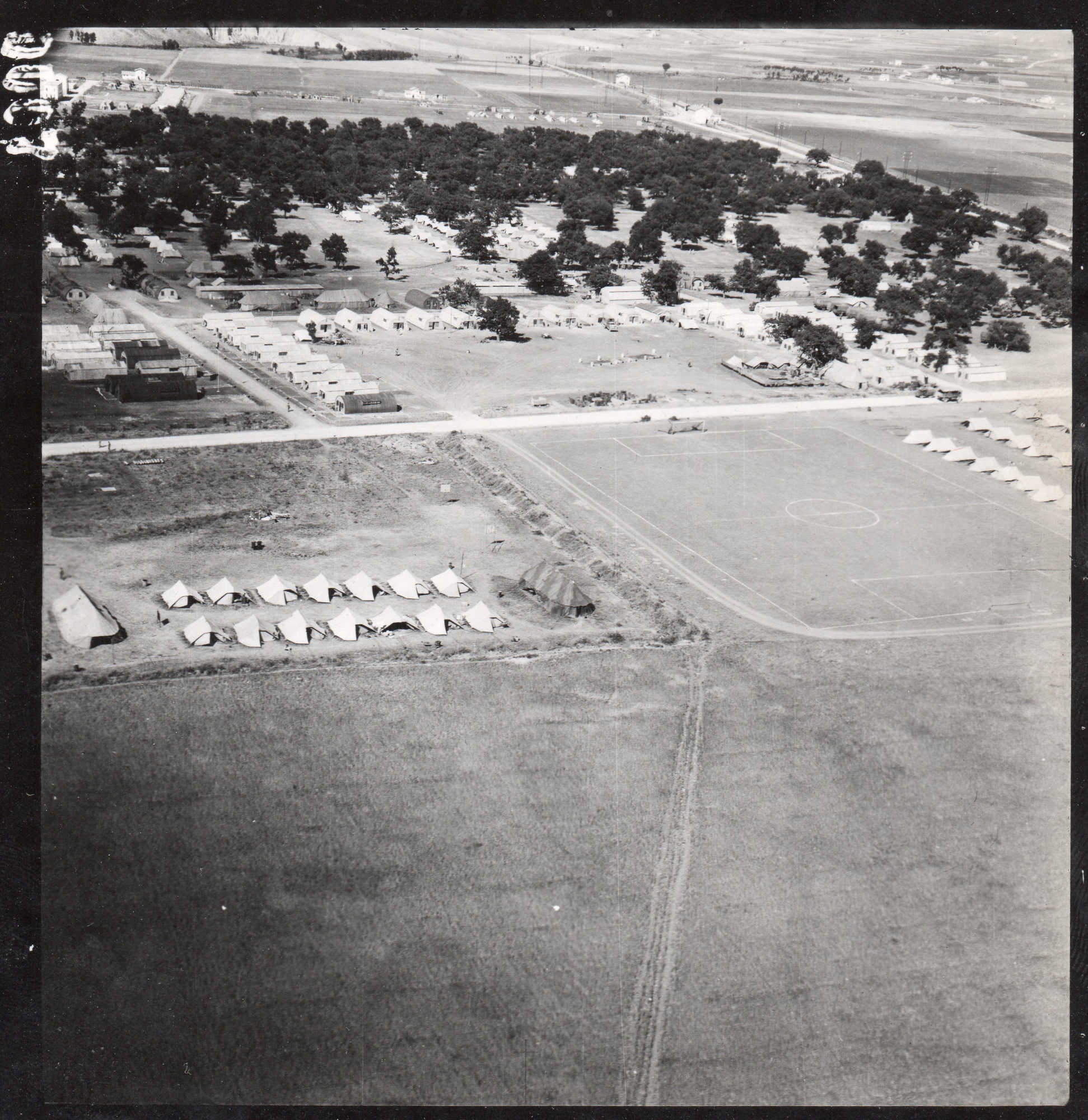
Aerial photo of Kairouan Camp, Tunisia. July 1943. This was the main location for the 1st Airborne Division as it prepared for operations in Sicily and Italy. Courtesy of Airborne Assault Museum, Duxford.
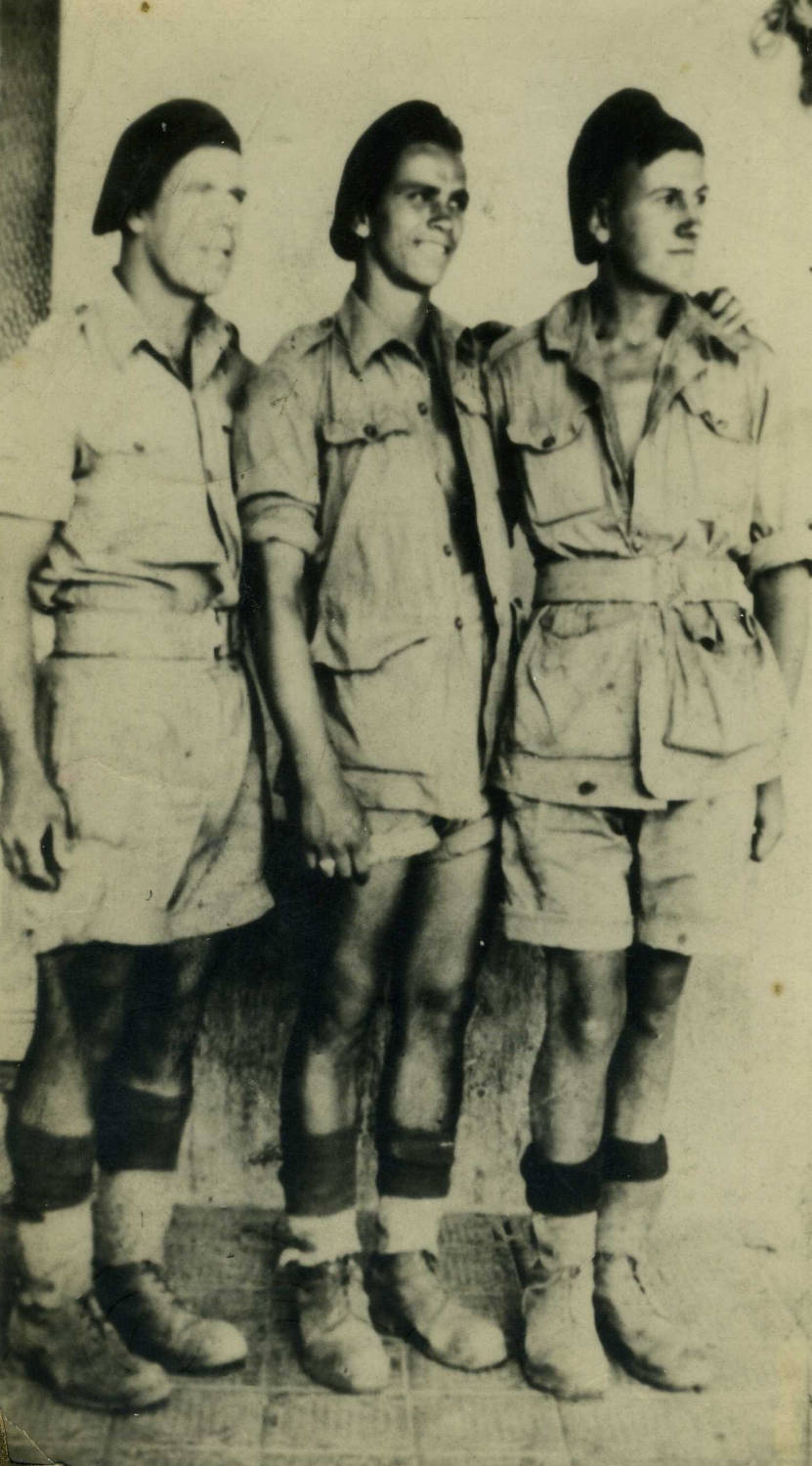
Driver. George Smith, No 3 Parachute Platoon, in the middle, has his photo taken with two pals whilst off-duty in North Africa. 1943. Photo courtesy Mrs. Johanna Legg.
The stragglers from 'B' Company were still limping into Camp, and the Workshops had still not arrived on the 1st July, when at 09.00 hrs, there was the first of several conferences with Lt-Col. Jefferies, in which the Administration Instruction No 1, outlining the Company's responsibilities on Operation 'Husky', the invasion of Sicily. In broad terms these were;
(a) The despatch of all Airborne Supplies, of all kinds, for 1 Airborne Division.
(b) All duties in connection with Divisional R.A.S.C. Supply Dumps.
(c) The despatch of all stores for Airborne Supplies for British Army and R.A.F. and also American common user stores.
(d) Providing experts in packing and loading to assist the 82 American Airborne Division in supply by parachute.
(e) Providing personnel in aircraft to drop stores by parachute.
Although it was stated that 250 Light Company was not likely to be required to move by air to the new theatre, it was to have a 'stick' of parachutists and a Transport Platoon prepared to move by air after D + 4, if required. The main requirements for the Airborne part of the assault force was to be taken by sea, but a full logistical back-up plan was put in place to carry out supply by air. To this end, the Heads of Services were asked to deliver any special stores already pre-packed to the Officer Commanding 250 Light Company by D - 1. i.e. Signals stores, Medical stores, etc. 30 panniers Airborne, marked with Red Crosses were to be delivered to the A.D.M.S. by R.A.S.C.
(a) Panniers Airborne are to be withdrawn from units and delivered to C.R.A.S.C. by D - 6 Day.
(b) 2500 panniers are being provided by A.D.O.S. 2500 parachutes are being provided under arrangements with 'G' Branch (Training)
(c) Coloured parachutes in proportion to quantities of supplies to be dropped and harness's will be drawn by 250 Light Company from A.D.O.S. as well as 2 reels of 100 lbs breaking strain silk cord, also static line for extensions to static lines. "It will not be possible to have a set code for coloured parachutes."
(d) 100 containers will be drawn under arrangements with G.I. Branch (Training) by 250 Light Company by D - 6 Day.
Any S.D.P's that were to be set up in Sicily were to be on a Brigade Group basis, and no calls were to be made for a supply drop for any formation smaller than a Battalion.
This was not the only responsibility for the Divisional R.A.S.C. There was the transportation to the airfields of the troops taking part in the operations, the manning of the airfields, and the constant daily details to fetch supplies from the various depots and dumps.
Maj. Packe was made responsible for:
(a) Staffing airfields 'E' and 'F' and all duties on these airfields including the running of airfield dumps as necessary, M.T. parks and loading of aircraft.
(b) Providing supervision for packing teams to be found by other R.A.S.C. Company's.
(c) Providing No's 1 and 2 for fifty aircraft crews for supply dropping.
(d) Supervision of fitting of parachutes and harness.
(e) Providing a few experts to assist the 82 American Airborne Division.
The Officer Commanding 93 Airborne Division Composite Company was made responsible for:
(a) All duties in connection with GREEN, RED and BLUE dumps including guards, layout and stacking, keeping Tally boards, etc, up to date.
(b) Providing labour for packing teams and for fitting parachutes and harness as required by 250 Coy.
(c) Providing 3-ton lorries for loading pre-packed panniers and for delivery to airfields.
(d) Providing a proportion of personnel to act as No's 3 and 4 of aircraft crews as demanded by 250 Coy.
The Officer Commanding 253 Airborne Division Composite Company was made responsible for:
(a) Providing labour for packing teams and for fitting parachutes and harness as required by 250 Coy.
(b) Providing a proportion of personnel to act as No's 3 and 4 of aircraft crews as demanded by 250 Coy.
(c) Traffic Control duties on all R.A.S.C. routes between dumps and airfields.
Maj. Packe was to be at Airfield 'E' and Capt. Bate at Airfield 'F'. Each of them was to have another officer detailed to relieve him. All Baskets and containers were to be packed by R.A.S.C. Packing teams in the Divisional R.A.S.C. Area. Pre-packed baskets were not to be moved to airfield dumps before 20.00 hrs on D Day.
So much for the plan, how did things actually 'pan-out'. Although preparations were well in hand, with details of what the Brigade's might need, and then agreed upon, with two of the Platoon's starting the pannier packing on the 5th July, there was only a limited amount of time left to get everything ready. The next day, the work continued, as well as the formation of dumps, with the regular halt called at mid-day, to avoid the worst of the heat and rest, before starting again in the afternoon. The men had hardly started back to their tasks, when at 14.30 hrs a tremendous explosion was heard from the direction of 93 Coy's location, and it soon became evident that their ammunition dump had been caught by a heath fire and was ablaze and exploding. A hot wind carried the fire rapidly and soon, the whole Division, almost, including the Light Company, was out fighting the fire amidst a hail of falling shrapnel. By 18.00 hrs the fire was under control. CRASC's Headquarters were completely gutted: the ammunition was completely burnt out: there were a few minor casualties, but no sabotage was suspected. Fortunately, all other supplies and petrol were untouched.
Michael Packe has the following observation in his book, "First Airborne": There was a great Court of Inquiry, attended by flat-hatted experts from far and wide. They nosed about amongst the ruins, taking statements in reams; finally, well-satisfied with their work, they departed, leaving upon the records the startling conclusion that there had been a 'Fire'.
Now, under considerable pressure, the Company continued with their task, over the next two days, resuming the packing of supplies, ammunition and petrol for Red and Green Dumps, with good progress being reported, and Green Dump being completed on the 8th July. This same day saw an inspection of part of the Division by General. Montgomery, the 8th Army Commander.
This period of the Company's activities is also remembered by L/Cpl. Burnham Blaxley: "We were introduced now to E and F Landing Strips for D.C.3. Aircraft belonging to the U.S.A. Air Transport Command. Suddenly one afternoon an extremely loud explosion was heard nearby followed by the cracking and spitting of exploding ammunition. Our ammunition from our first line Ammunition Dump had ignited somehow possibly instantaneous combustion in this extreme heat. All available men were marshalled together and surrounded the area, then lying low on the ground inched their way to any available ammunition considered safe and dragged it away from the danger zone. This continued for several hours but was eventually subdued. From now on we established a routine at 14.00hrs each day a number of us in turn were taken to the local beach to have a swim. It was beautiful silver sand we were taken and returned by lorry. We had been relieved of many of our menial tasks in order for this to happen. We needed now to spend all our time becoming familiar with our work with Air Despatch and the D.C 3's. Each morning a lorry was despatched to pick up a number of Prisoners of War either from the Italian or German Camps and to return them later. It was strange to see their different characteristics. The Italians surged forward when we arrived clambering onto the lorry to make sure they would be included. 'Me too Tommy, Me too', they would call and were smiling and most happy to be collected. The German Prisoners, were most sombre and correct. They would march towards us singing their favourite Army tunes and behave very correctly. There were many cleaning jobs they could do and also we gave them the job of bashing the used food tins we had already burned off and burying them. It kept the Camp clear of flies. We were on constant guard with our stores, clothing and possessions or they melted away into nothingness." [A1]
On the 8th July L/Cpl. Burnham Blaxley was told to have himself and his three crew ready, in their best kit, and to: "Pack 12 baskets with parachutes attached, plus a set of rollers on to a lorry which was already waiting, and present ourselves immediately. We were to follow the escorting jeep which held Major St John Packe, Capt Kavannagh and Capt Gifford. We travelled about 4 miles along the road towards Sfax where we suddenly turned off to the right onto a dirt track. Here we hastily arranged a layout on the ground identical to that in the aircraft. We waited for almost an hour when a small convoy was sighted coming towards us. We immediately took up our positions and stood to attention to be inspected by no less than General Montgomery himself. He greeted our officers and asked for a rundown on the layout we had prepared. I stood quite close to him, he was wearing his Black Beret with badges attached Khaki Drill Uniform and suede desert boots. He carried a horse tail fly switch attached to a short wooden handle. His conversation was directed to Maj St John Packe, and he appeared most enthusiastic." [A1]
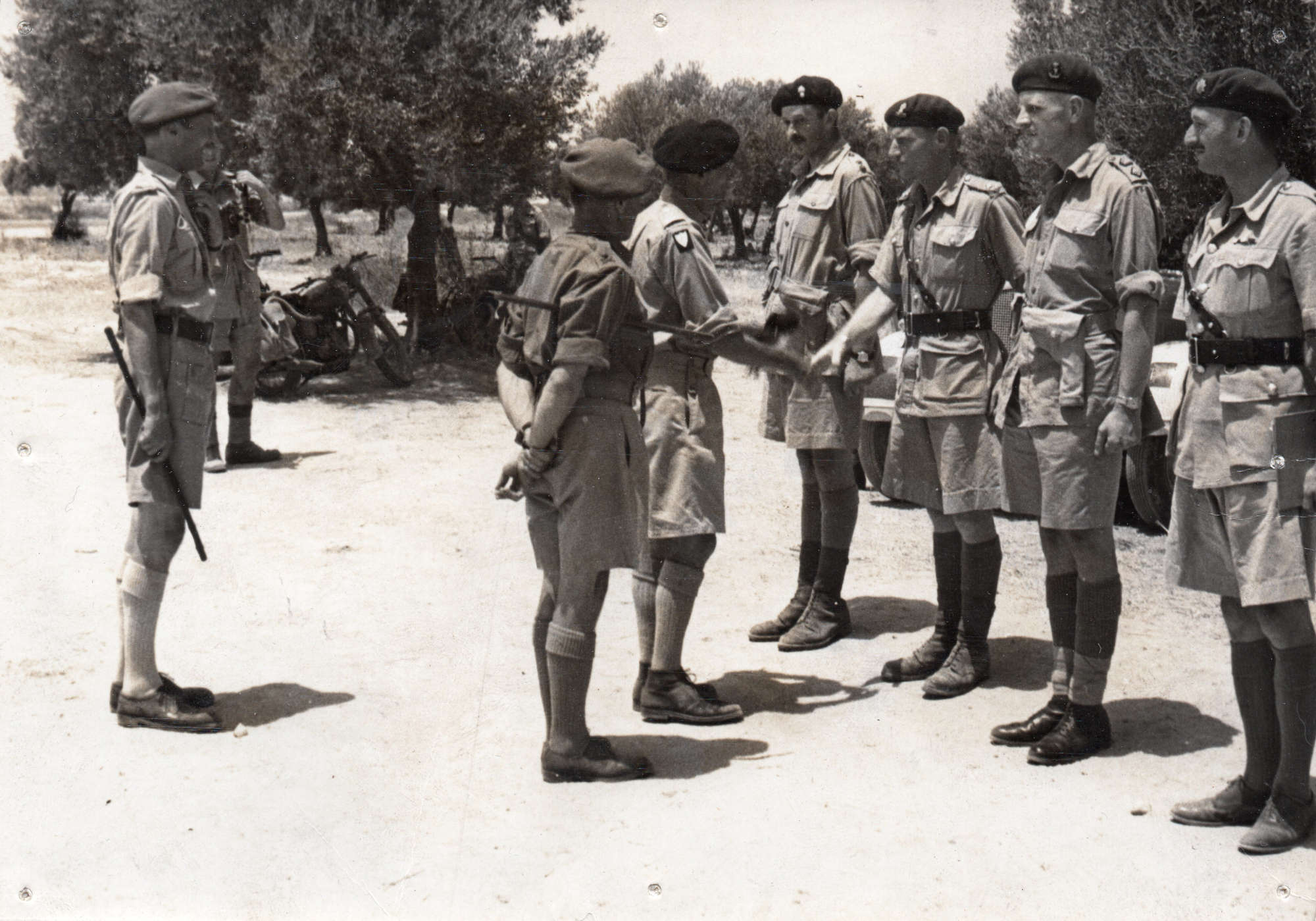
Visiting and Inspecting, the 1st Airborne Division at Kairouan Camp, Tunisia, 8th July 1943. L-R: Maj-Gen. F.A.M. Browning, Maj-Gen. G.F. Hopkinson, Gen. B.L. Montgomery. Being inspected, L-R: Col. J.A. Goschen (A.A. & Q.M.G.), Col. M.C.A. Henniker (CRE), Lt-Col. R.J. Moberly (C.R.Sig's) and Lt-Col. T.H. Jefferies (C.R.A.S.C). Photo taken by Lieut. Powell-Davies. NA4060. Courtesy of Airborne Assault Museum, Duxford.
Loading continued at considerable speed on the 9th July, with the packing for Green and Red Dumps being finally completed. The final C.R.A.S.C. conference was held at 17.00 hrs to discuss the operation as effecting the Divisional R.A.S.C. Then at 18.00 hrs, the 1st Bn, The Border Regiment, the 2nd Bn, The South Staffordshire Regiment, along with Headquarters, 1st Airlanding Brigade, Medical, Signals, and Royal Engineer Detachments took off from the Divisional airfields in the area. This was Operation 'Ladbroke', and the objective was the Ponte Grande Bridge, a mile to the Southwest of Syracuse, on the Southeast coast of Sicily.
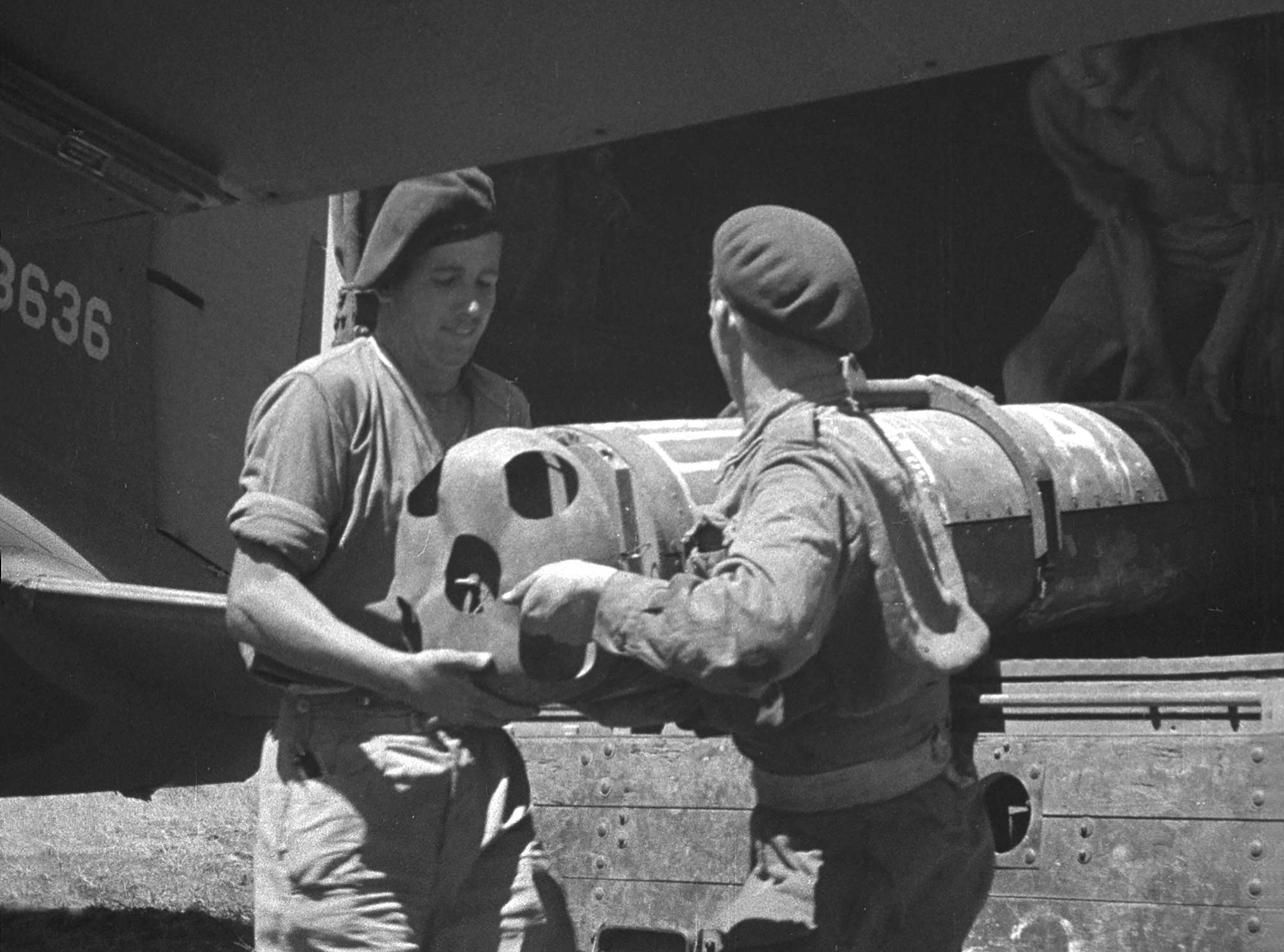
Two men taking a C.L.E. container off the back of a lorry at an airfield near Sousse, North Africa. July 1943. Courtesy of Airborne Assault Museum, Duxford.
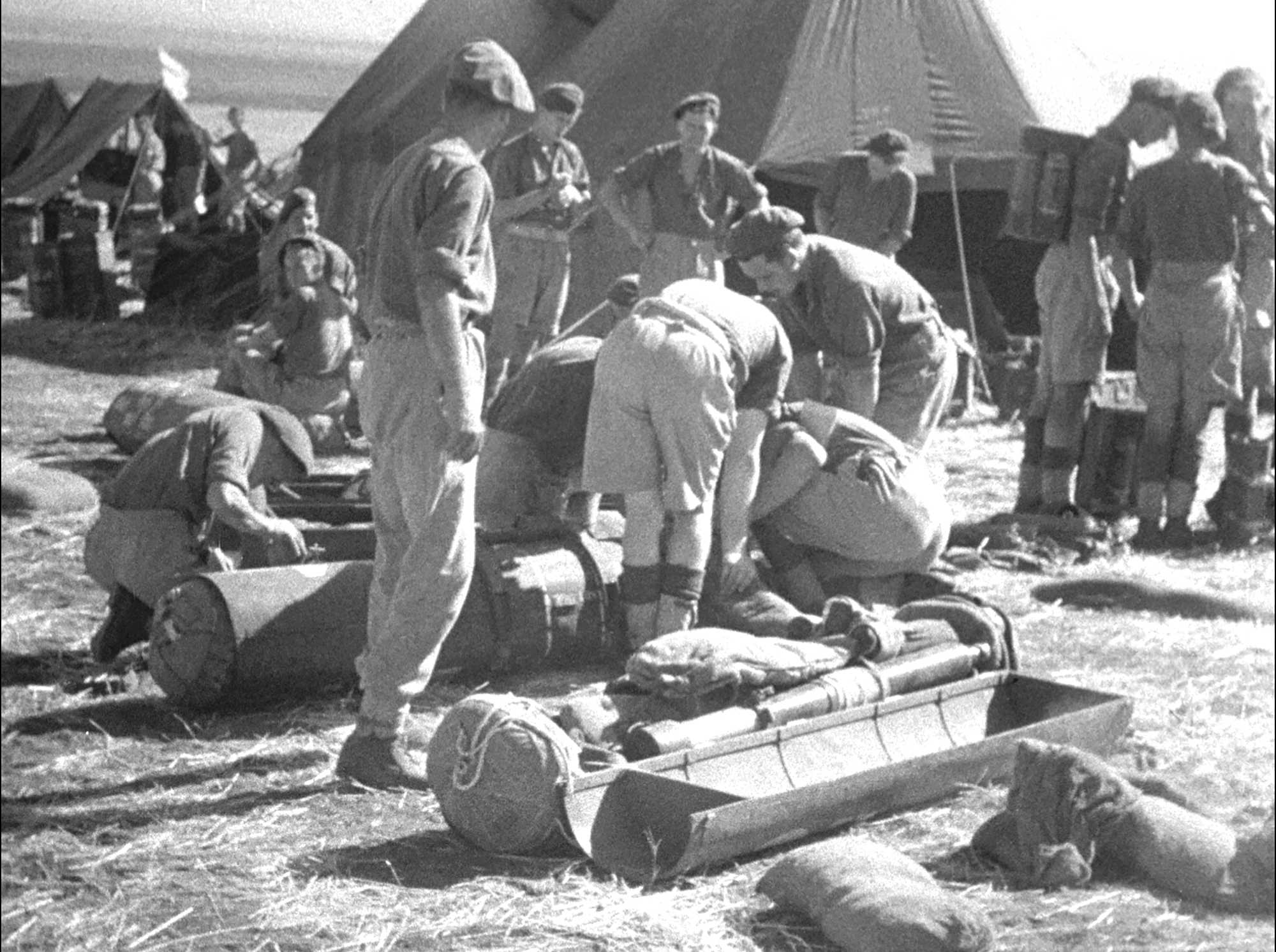
The C.L.E. containers being packed with ammunition and equipment. Sousse, North Africa. July 1943. Courtesy of Airborne Assault Museum, Duxford.
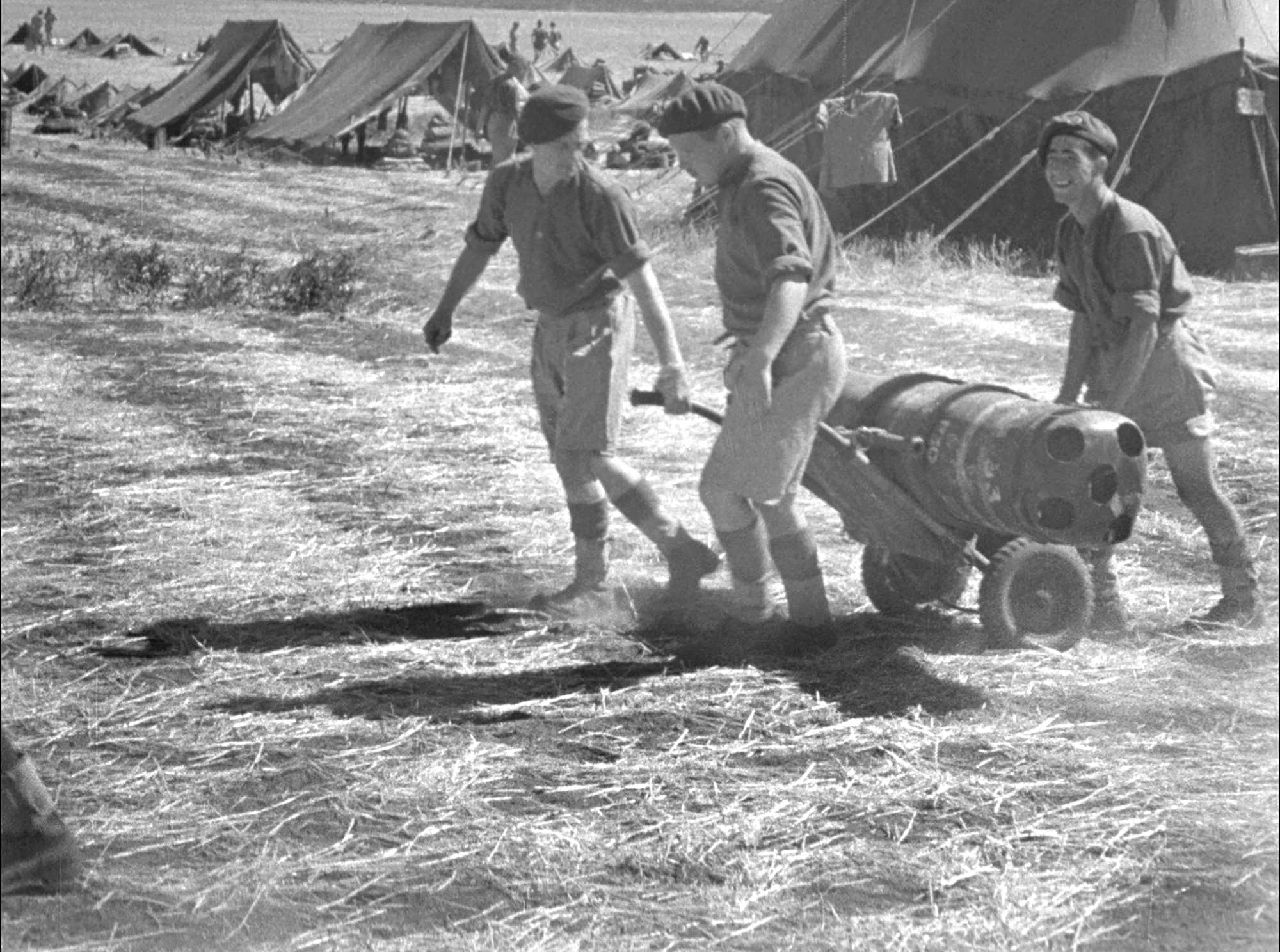
The loaded C.L.E. containers are moved over to the aircraft with the aid of an Airborne Trolley. Sousse, North Africa. July 1943. Courtesy of Airborne Assault Museum, Duxford.
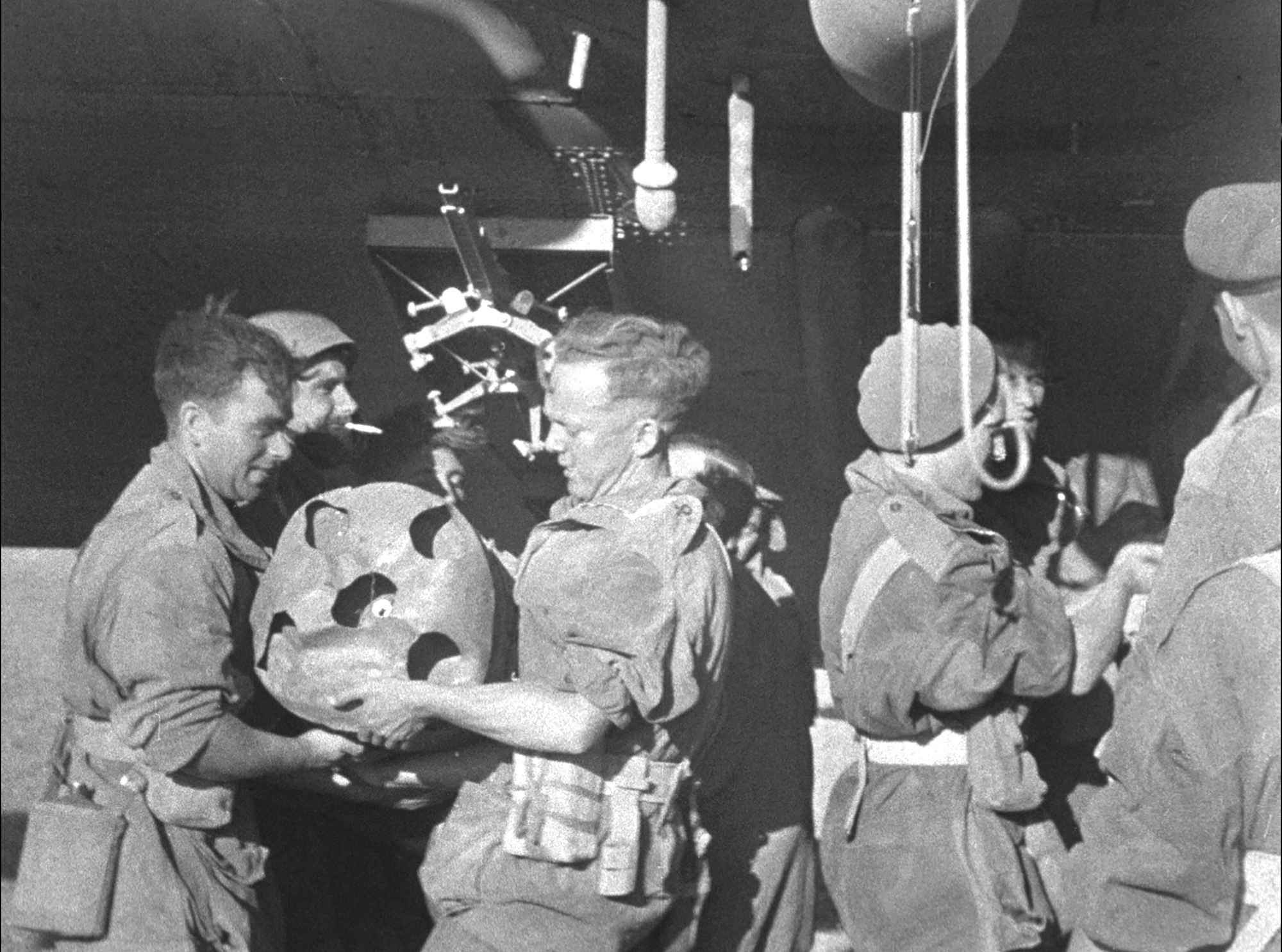
Many hands are needed to lift the C.L.E. containers for fitting to the aircraft. Sousse, North Africa. July 1943. Courtesy of Airborne Assault Museum, Duxford.
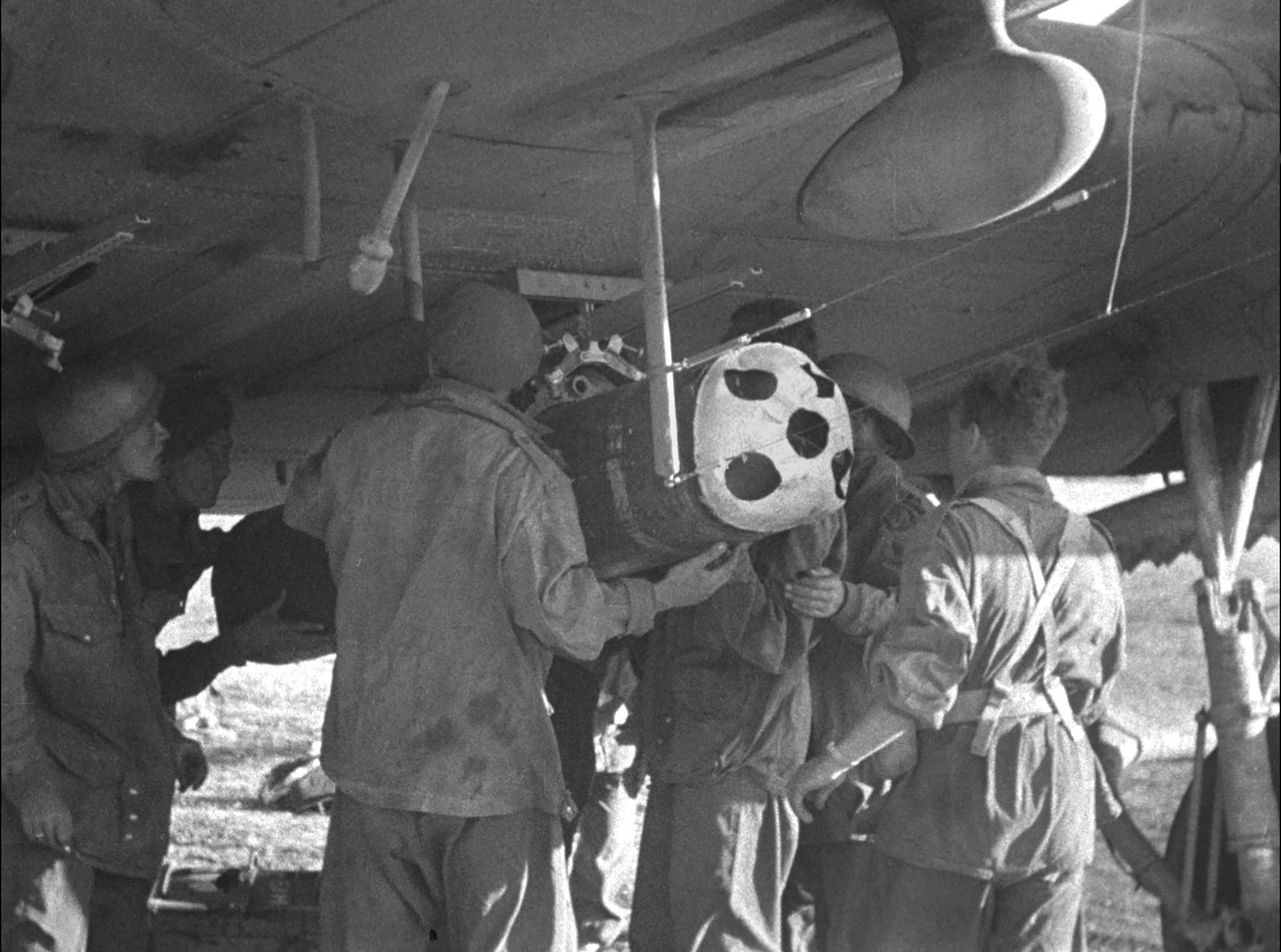
The C.L.E. containers are fitted to the aircraft, and final checks will then be carried out. Sousse, North Africa. July 1943. Courtesy of Airborne Assault Museum, Duxford.
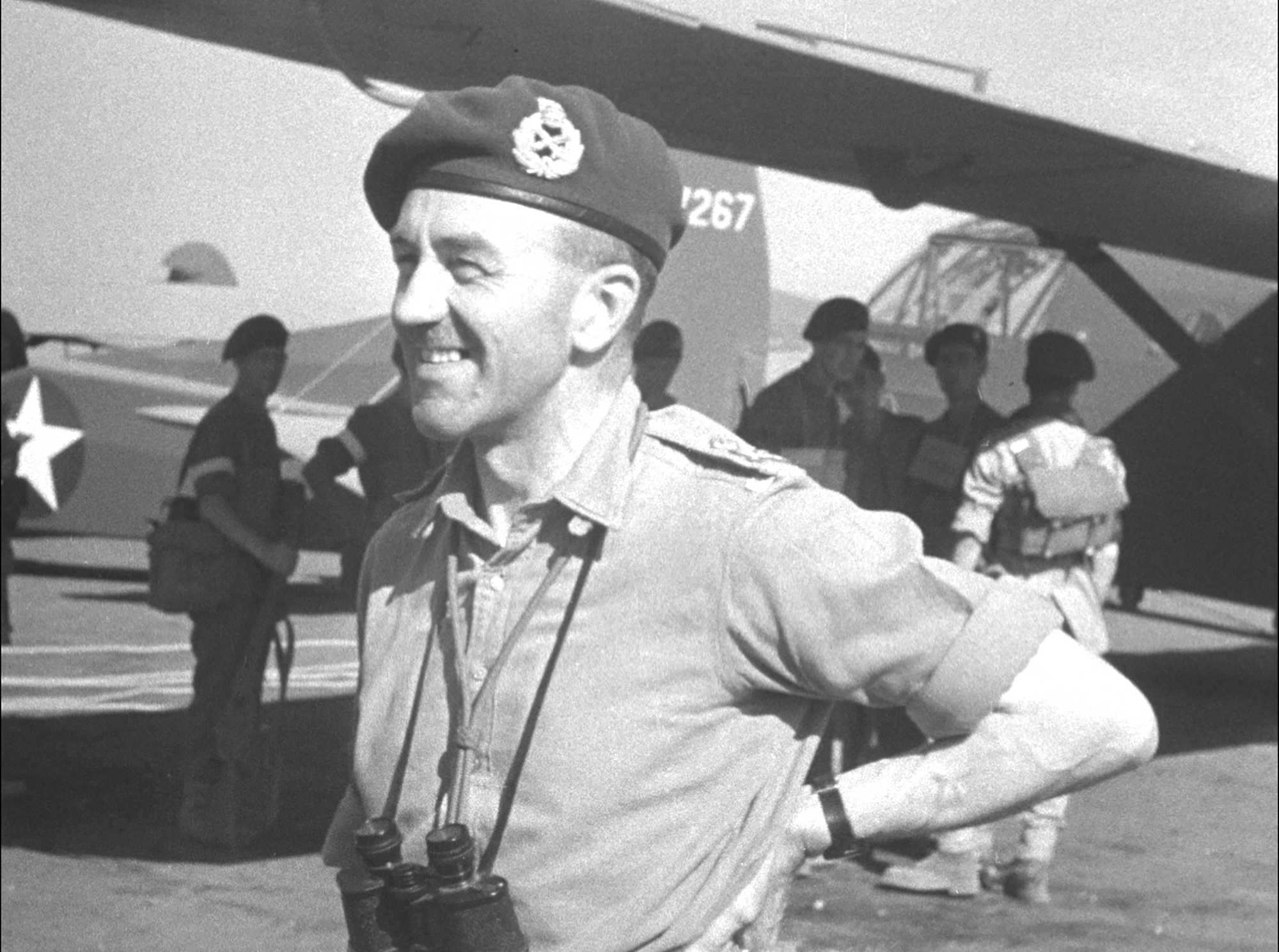
Maj-Gen. G.F. Hopkinson, G.O.C. 1st Airborne Division. Sousse, North Africa. July 1943. Courtesy of Airborne Assault Museum, Duxford.
A short period of intense frustration now followed. News of the Allied landings in Sicily were officially announced the next day, and the Light Company stood by on two airfields to carry out resupply by air. However, detailed information of what was happening and what progress was being made, was hard to come by. Then the 2nd Parachute Brigade take-off was delayed. The Company War Diary reported a: "Quiet night. Still standing by on airfields". It further reported that news was still scarce, but that the initial landings were apparently successful, and a bridgehead had been opened,. The 5th Infantry Division was reported to have relieved the Airlanding Brigade, and had entered Syracuse. The Divisional Commander, Maj-Gen. Hopkinson, had joined up with the Headquarters of 13 Corps. The final note in the Company War Diary for the day was: "Operations are proceeding".
Throughout the 12th and 13th July, elements of the Light Company continued to stand-by, but there were no further developments, and the 2nd Parachute Brigade's operation had been cancelled. Some small scale training by Platoon's was recommended, probably to relieve the strain and tension amongst the men. That night the 1st Parachute Brigade took off, and initial reports received at midday, on the 14th, indicated that supply by air might become necessary. The Company stood to again, but demand was cancelled owing to reluctance of American Pilots to fly. After standing by all through the 15th and into the 16th July, the Company was finally stood down, as resupply by air was not needed. An immediate programme of demonstrations and instruction for the other two Company's was put into effect, and the rest of the Company went back to the normal routine.
Maj. Packe flew to Sicily on the 21st July, and on the 30th a Salvage Party consisting of Capt. Bate and 11 Other Ranks, with 9 Jeeps left by sea to join the O.C. One of those in this party was probably Dvr. Raymond Whitwell, "Our Company was made Airborne in 1941. I served in 250 Coy Airborne RASC in North Africa, with the 1st Army, Sicily and then Italy, as far as Foggia, on the East coast." [1]
Other elements that were sent to Sicily on salvage duties included Lt-Col. R.T.L. Shorrock, the 1st Airborne Division C.R.E.M.E., who spent over a week travelling the various sites where the airborne actions had taken place, and in some cases, recovered equipment that had been left behind. He returned to the 1st Airborne Division's Main base in M'Saken in North Africa on the 9th August. Another was Capt. C.C. Chidgey, the Officer Commanding the Ordnance Field Park, R.A.O.C., who departed with 3 Other Ranks to salvage important war materials that had been 'lost'. He was there, with his small party for considerably longer than the rest and did not return until the 24th August. His 'haul' of recovered stores comprised 6 x 6-pounders, parachutes, small arms, and other valuable equipment. Maj. Packe and his Salvage Party had returned on the 9th August. The War Diary states that they had, "collected stray panniers [containers]".
There was a Company fire-power demonstration by the Defence Section on the 19th July, where they fired their Hispano A.A. guns, the P.I.A.T.'s, Brens, Mortars and rifles. On the same day Headquarters R.A.S.C. circulated a Special Order of the Day from Lt-Col. Jefferies, and a report from him, labelled 'Secret & Confidential', was sent 'up' to Divisional Headquarters. This was a candid letter on the difficulties encountered by the 1st Airborne Divisional R.A.S.C. Column, from its formation up to and including, Operation 'Husky'. See Appendix IV and V.
Interspersed with the regular training was an opportunity for 'refresher' parachute training, which started on the 22nd July, and went on for a whole week, with synthetic (ground) training on Albemarle aircraft. However, a planned drop from C47 Dakota's, of 32 men from the Company on the 29th July, was cancelled owing to strong winds.
Conditions were deemed to be a lot better on the 31st July, and accordingly, at 08.00 hrs, three Officers and 27 Other Ranks dropped from three Albemarle's on Exercise 'Despatch'. This was in support of the 4th Parachute Brigade, although they only had a 'token' presence with a Signals Detachment, to represent them. The R.A.S.C. group moved to an R.V. using airborne trollies and two 'abandoned' enemy vehicles, where they set out a S.D.P. Containers and panniers were then dropped by 93 and 253 Coy from two Albemarles. The supplies were then collected ready for delivery. Maj. Packe appeared very pleased with the performance of all involved. However, Lt-Col. Jefferies made the following point in his after exercise report: "The conclusion is that, although, it is understood that the Sections engaged were not previously trained together nor did they form part of Defence Sections or Platoons, all ranks must be trained in Elementary Infantry tactics, and further training is required within the Coy to attain this." How fortunate it was that this was highlighted, and acted upon.
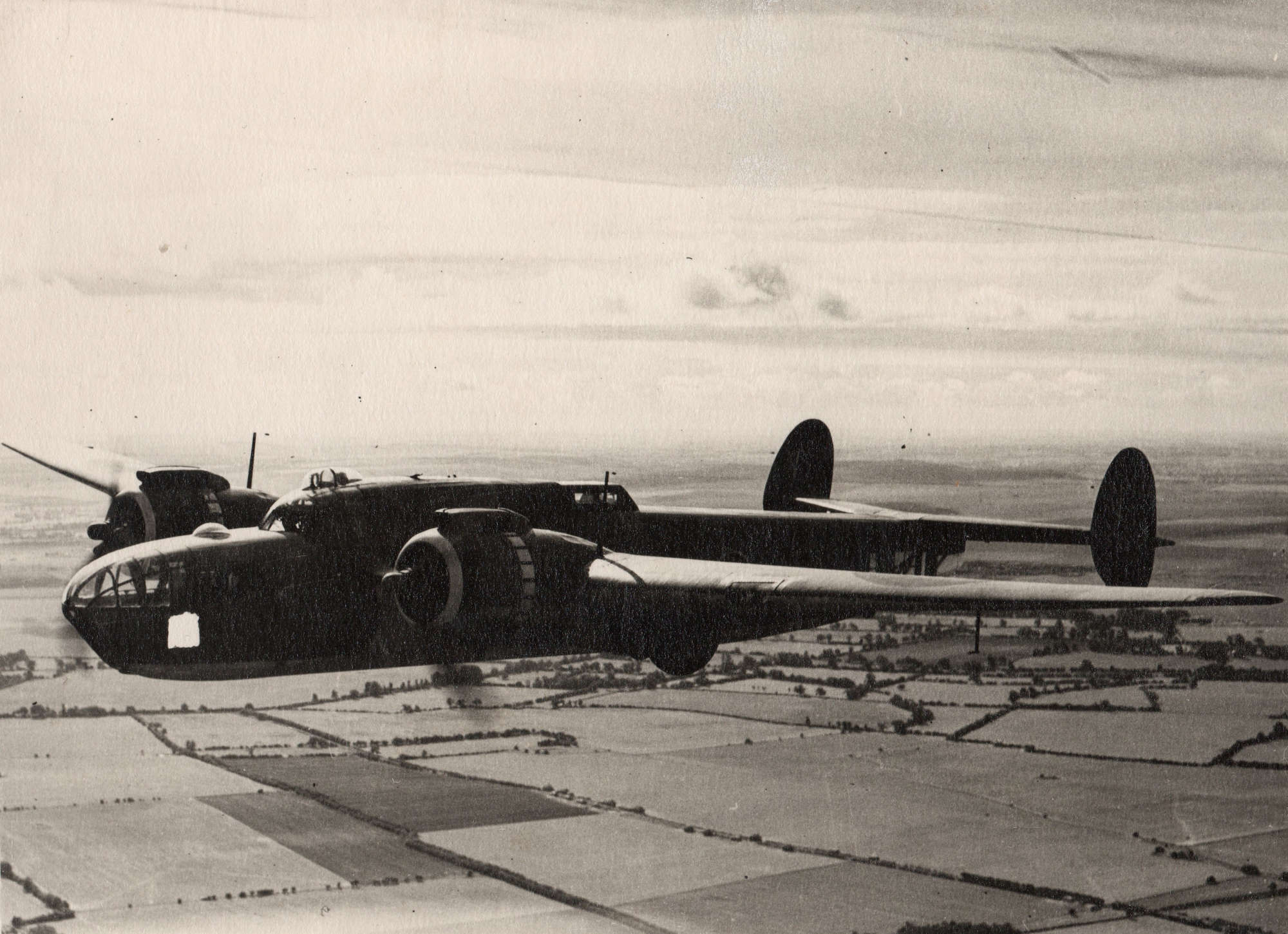
An Albemarle aircraft, as operating by the R.A.F. especially 296 Squadron, between 1942 and 1944, in support of Airborne Forces. CH12048. Courtesy of Airborne Assault Museum, Duxford.
This exercise was followed the next day, 1st August, with Exercise 'Dim', and a night drop of one stick of men attached to the 6th Parachute Battalion, and the setting up of a S.D.P. and a successful drop of 20 panniers the next morning at 06.00 hrs. On the 3rd August, at 08.00 hrs, there was a full Company Parade for Lt-Col. Jefferies, where he also conducted a full inspection of the Camp and the Company Books.
There was to be no let up in the pace of life for the men of 250 Company, with planning and briefings for Exercise 'Consolation' taking place between the 4th and 6th August, with a fire-power demonstration taking place in between for the C.R.A.S.C. and 100 men from 93 and 253 Coy's, and a rehearsal for a Church parade on the 7th. At 07.30 hrs on Sunday, 8th August, the entire Divisional R.A.S.C. held a Church Parade and then conducted a March Past for the Divisional Commander. At mid-day, the Company was stood-to for Exercise 'Consolation', and at 20.00 hrs two sticks of parachutists took off, but were unable to drop owing to high winds. Fifteen planes loaded with panniers took off at 22.00 hrs, with R.A.S.C. Aircrews, who dispatched the loads onto the S.D.P. north of Mahdia, at 23.00 hrs. These were collected, formed into a Supply Point, and Battalions of the 2nd Parachute Brigade began making collections. This was a busy day for the Company to get a new Cook Sgt, but Sam Fletcher duly reported on this date. Born on the 6th September 1912, he had enlisted into The Sherwood Foresters on the 12th July 1939. Later, he transferred to the Army Catering Corps. He would remain with the Company, return to England with them, and take part in the Seaborne Echelon move almost a year later.
For the next week, normal training and details were carried out. Lt-Col. Jefferies held a discussion with Maj. Packe about the re-organization of the Company on the 10th August, and the implementation of these changes began four days later. The Company would now consist of the following:
Company H.Q.
Specialist Platoon.
Airborne Transport Platoon.
1 Parachute Platoon.
2 Parachute Platoon.
1 Aircrew Platoon.
2 Aircrew Platoon.
Workshop Platoon.
This would not be the last time that the Light Company would be reorganised!
On the 16th August, a short parachute course began, in which twenty volunteers from the Company were included. Instructors for this were provided by the 4th Parachute Brigade, and a full range of ground training aids had been constructed for the purpose, with aircraft being provided by the U.S.A.A.F. This was one of several short parachute courses carried out in Tunisia, in which all the training was done in a week: Monday and Tuesday would be ground training, and the five jumps needed to qualify carried out between Wednesday and Friday. On the day after this course started, authorisation was received for the Company to have fifty more operational parachutists. Whether this included the previous twenty is not known, and whether all of them completed the shortened course is also unknown, as after the 25th August, the aircraft were withdrawn for operational reasons, and further parachuting was cancelled.
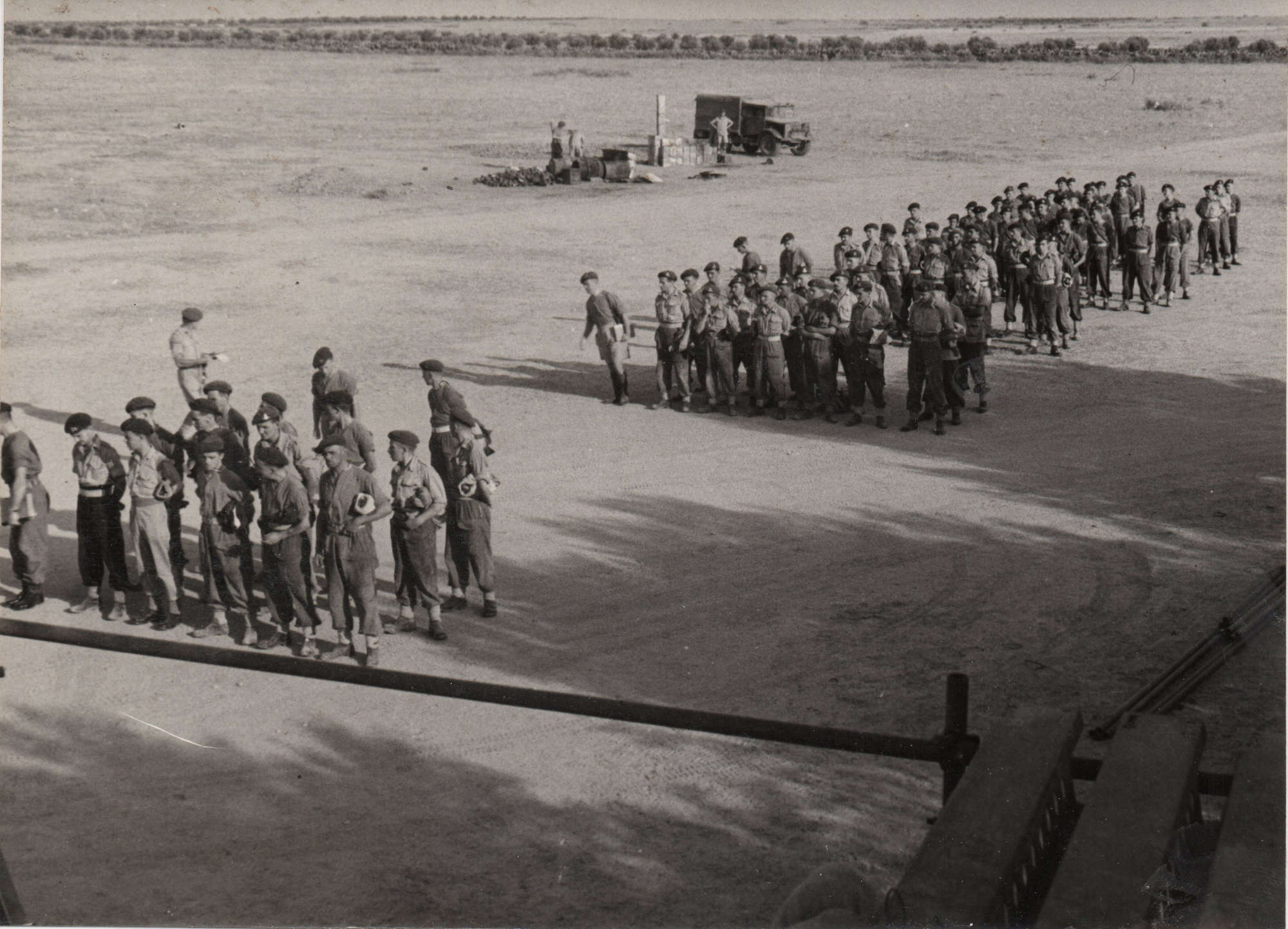
The 1st Airborne Division Parachute School set up in Tunisia in July-August 1943, and run by the 4th Parachute Brigade. A parachute course on parade, ready to begin a fitness lesson. Photo by Sgt. J.P. Christie, No 2 A.F.P.U. NA5636. Courtesy of Airborne Assault Museum, Duxford.
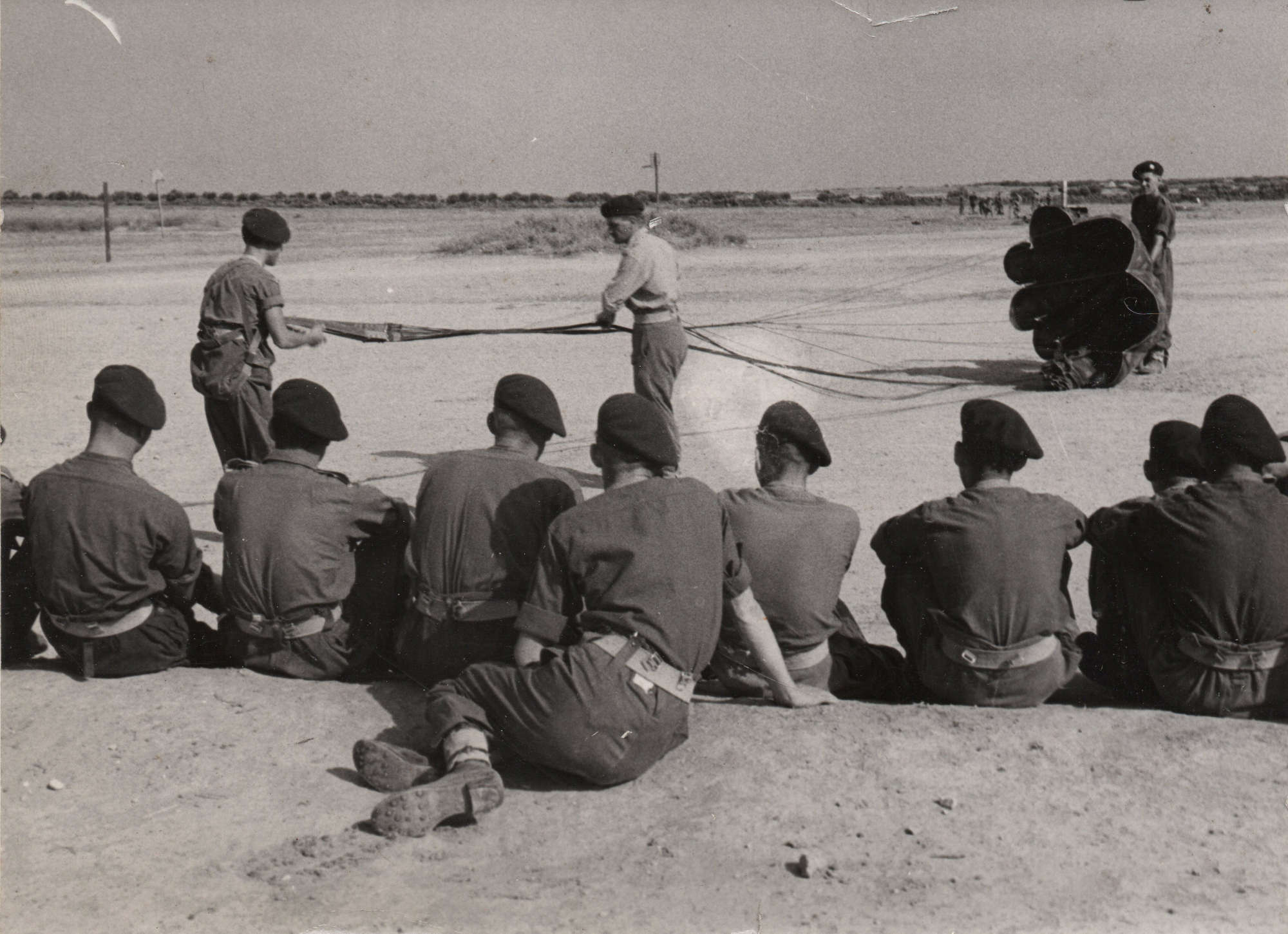
The 1st Airborne Division Parachute School set up in Tunisia in July-August 1943, and run by the 4th Parachute Brigade. A parachute course getting a 'ground' instruction on the parachute & harness characteristics. Photo by Sgt. J.P. Christie, No 2 A.F.P.U. NA5640. Courtesy of Airborne Assault Museum, Duxford.
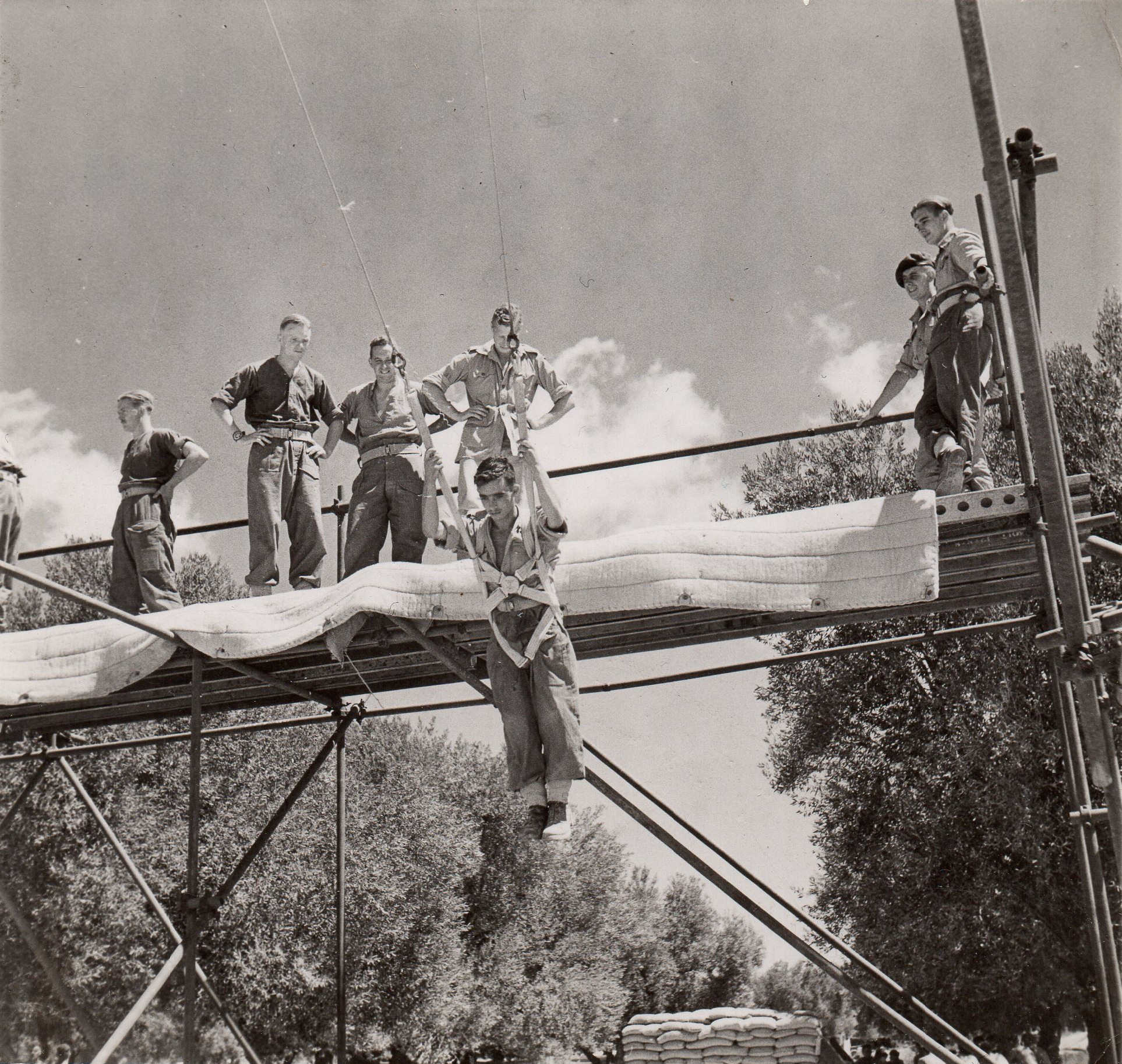
The 1st Airborne Division Parachute School set up in Tunisia in July-August 1943, and run by the 4th Parachute Brigade. Making a parachutist. A pupil swings in his harness from the swings. Feet and knees locked together. Photo by Sgt. J.P. Christie, No 2 A.F.P.U. NA5642. Courtesy of Airborne Assault Museum, Duxford.
Trials drops with panniers with various stores still continued, and on the 17th August such a trial was conducted with Royal Engineer stores. This was recorded as being successful, with two exceedingly good sticks, neither more than 200 yards long. The following day, No 1 Parachute Platoon was attached to the 156 Parachute Battalion, to take part in an exercise, and then a proposed operation. On this day, the third of a series of night exercises was concluded, that had been practising the men in their basic infantry skills. Half the Company left for a four day visit to the Tunis Rest Camp, on the 19th, but half had to be recalled in the middle of the night to go out on a Convoy drive the next day. At the same time, news came through from Division that all units would now be grounded for a month and half and would not be able to get any aircraft. This meant the 4th Parachute Brigade exercise and operation was therefore cancelled, and No 1 Parachute Platoon returned on the 1st September.
The task for which the men had been recalled was to fetch 900 vehicles from Tripoli and drive them to Bone. The 150 drivers of the Company joined another 750 from throughout the Division, and were transported in vehicles of 253 Company, the task would take ten days, leaving only 70 all ranks in Camp. Over the next week, only routine domestic duties were performed around the Camp, work on a new cook-house was started and the return of stores from the per-packed pannier dump was undertaken.
On the 23rd, 26th and 29th of August, Maj. Packe had yet more discussions with Lt-Col. Jefferies reference another proposed War Establishment for the Company. This new proposal would see the Company reduce the number of Jeeps from 180 to 37, the back-loading of 286 Trailers, and a slight reduction in the number of personnel. The Company would be reorganized thus:
|
Sub Unit. Company HQ. Prepacked Stores Platoon. Airborne Transport Platoon. No 1 Parachute Platoon. No 2 Parachute Platoon. No 3 Parachute Platoon. No 1 Aircrew Platoon. No 2 Aircrew Platoon. Workshop Platoon. |
Officers. 3 1 1 2 2 2 2 2 1. |
Other Ranks. 70 24 41 33 33 33 70 70 28 |
On the morning of the 25th, there was a talk by Maj-Gen. Hopkinson, and in the afternoon, the trial of a modified roller conveyor for a C 47, to protect the door of the aircraft, which was tested with a trial drop on the 1st September. Throughout the last part of August, there was a regular training programme, which included route marches to maintain the Company's high standard of fitness, but there were also regular opportunities for swimming. The War Diary noted on the last day of the month, the 31st August: "Flies now very troublesome, with Autumn weather coming in, and Coy fly catching competition was begun. Also petrol economy campaign in force throughout Tunisia."
Night time training exercises continued with No 2 Parachute Platoon carrying out "night movement", on the evening of the 2nd September. The next day, orders were received to recommence the pre-packing of ammunition stores for Dumps, as part of Exercise 'BETTY', but the big news was the announcement of the invasion of mainland Italy. Then on the 5th September, orders were suddenly received that the Division was to be prepared to move at short notice to an unknown destination overseas. The move was to be by sea, and the pre-packing for supply by air continued. The day was spent in reorganising the Company into three parties to proceed one with each Brigade Group, providing 30 Jeeps and trailers for each. The remainder of the Company were to remain in M'Saken prepared to carry out the original supply by air programme, if required. All the parties on the Tripoli detail had now returned save one, which comprised an 'B' Aircrew Platoon. These arrangements were satisfactorily completed, more or less, by nightfall as ordered, however a "stand fast" message was received at 20.30 hrs.
This was a classic case of the standard (unofficial) Army procedure of "hurry up, and wait". Having been given a Warning Order, which galvanized everybody, the Company were now told to "hold on". The 6th September was spent in a less frenzied manner, preparing for the operation, whilst awaiting final orders from Division. At Divisional Headquarters the 'Q' Staff were producing load tables, lifts, etc for what was to be known as Operation 'Slapstick'.
Maj - Gen. Hopkinson had attended a high level meeting with General Alexander at 15th Army Group Headquarters in Cassabile, Sicily on the 4th September. At this interview, which was attended by a Naval Representative of Admiral Cunningham and an Italian General representing Marshal Badoglio, Maj-Gen. Hopkinson was instructed to occupy the Italian port of Taranto and hold it against any German attacks until the arrival of further British Forces. The arrival at Taranto would coincide with the announcement of the Italian Armistice, and it was expected that there would be no Italian resistance, though the plan had to take account of this possibility. The nearest German troops were believed to be in the Altamura area, about 45 miles Northwest of Taranto, and consisted of the German 1st Parachute Division at low strength after its operations in Sicily. It was not expected that other German forces could be spared to intervene, in view of the projected Salerno landings and the advance of 8th Army up 'the toe'.
The plan was to embark the 1st Airborne Division, at the port of Bizerta, and in two lifts, using a force of six Naval Cruisers, land at Taranto on the 11th September. As the units were being allocated to each lift, the operation was brought forward by 36 hours, and at 19.00 hrs, 7th September, Maj. Packe, Capt. Bate, Capt. Kavanagh and Lt. Millar, with 103 Other Ranks from the Headquarters Platoon, No 1 and No 2 Parachute Platoon's proceeded to Bizerta. Joining them from H.Q., R.A.S.C. were Lt-Col. Jefferies, Capt. J. Rankine, Capt. J.R. Halls, with 10 Other Ranks, a Jeep and 3 motor-cycles. They were also joined by Detachments from 93 and 253 Airborne Composite Company's. On arrival at Bizerta', it was found that the loading plans, based on a capacity of 750 men for each ship, were a bad over estimation, and that it was only 450 per ship. This meant a huge readjustment, and the main elements that had to give way were those of the R.A.S.C. The H.Q., R.A.S.C. Detachment, most of the 250 Company, and lesser Detachments from 93 and 253 Company were allocated space, but with no vehicles! Capt. J.D. Naylor, recently posted to 253 Company from the 2nd Parachute Brigade, where he had been the B.R.A.S.C.O., and 3 Other Ranks were allocated to the 4th Parachute Brigade.
The orders given by H.Q., R.A.S.C. were:
(a) Emergency Supply Dropping, as at present ordered from TUNISIA.
(b) Personnel for control of Italian improvised M.T. Company's to be formed at destination.
(c) Troop carrying to Ports of Embarkation.
(d) Requisitioning of all requirements of M.T. and Supplies & Petrol at destination.
(e) Despatch in bulk and subsequent distribution at destination of Reserve Ammunition, Supplies and Petrol.
The R.A.S.C. Plan was as follows:
The 1st Lift was supposed to consist of 355 x RASC personnel, 1 x Jeep and 16 x M/C's.
The 2nd Lift was supposed to consist of 118 x RASC personnel, 5 x Jeeps, 69 x 3-tonners and 16 x M/C's.
The 3-tonners would be carrying 200 tons of ammo, 40 tons of supplies, 30 tons of water, and 30 tons of other stores.
The 250 Company Detachment were embarked on H.M.S. 'Aurora', and they sailed at 17.00 hrs, 8th September. The force of Cruisers picked up their escort force soon after, the Battleships H.M.S. 'King George V' and 'Howe', and a screen of Destroyers. From Michael Packe's book, 'First Airborne': "Cruisers are not designed to carry men at arms, still less the vehicles and encumbrances which make them into a fighting force. The force which sailed could therefore count upon a lift of only half a dozen jeeps and a few motorcycles, together with a very bare margin of supplies and ammunition. For the remainder, it had to depend upon the co-operation, willing or compulsory, of its Italian allies. But the Navy take the business of host very seriously, and in this particular case they were determined that the Fourth Brigade should not, whatever else they had to leave behind, go short of their antique but treasured Breda field guns. It was in fact quite a naval occasion, and despite the incursion at short notice of many hundred heavy footed soldiers, sliding in their boots about the polished decks, there was no sign of bother.
Maj. Packe enquired of one of the Naval Officers on board about the fleet of British ships: "Well, there's 'Dido'; the next, 'Sirius'; then old 'Pepperpot' - H.M.S. 'Penelope', you know, Malta convoy and all that. That's about all I can see for the moment - Oh yes, there's 'Abdiel' over there; she's a mine laying cruiser, very fast, one of the newest we've got."
At 14.00 hrs, 9th September, the force had reached the minefield belt covering Taranto and a destroyer, H.M.S. 'Javelin', went in alone to fetch a pilot, and by 16.00 hrs had returned with one on board. Meanwhile, the Italian squadron from Taranto, which included two Cavour battleships, could be observed hull down on the horizon, stealing away to Malta to give themselves up according to the Armistice terms.
At 17.00 hrs, the U.S.S. 'Boise' and H.M.S. 'Penelope' steamed straight into the mercantile harbour (Porto Mercantile), and came alongside to unload. The other vessels, anchored in the outer harbour, and while troops, stores and the few vehicles were discharged by lighter, Admiral Power and Maj-Gen. Hopkinson received the Italian Admiral, commanding Taranto on board H.M.S. 'Aurora', where general details of the surrender were discussed.
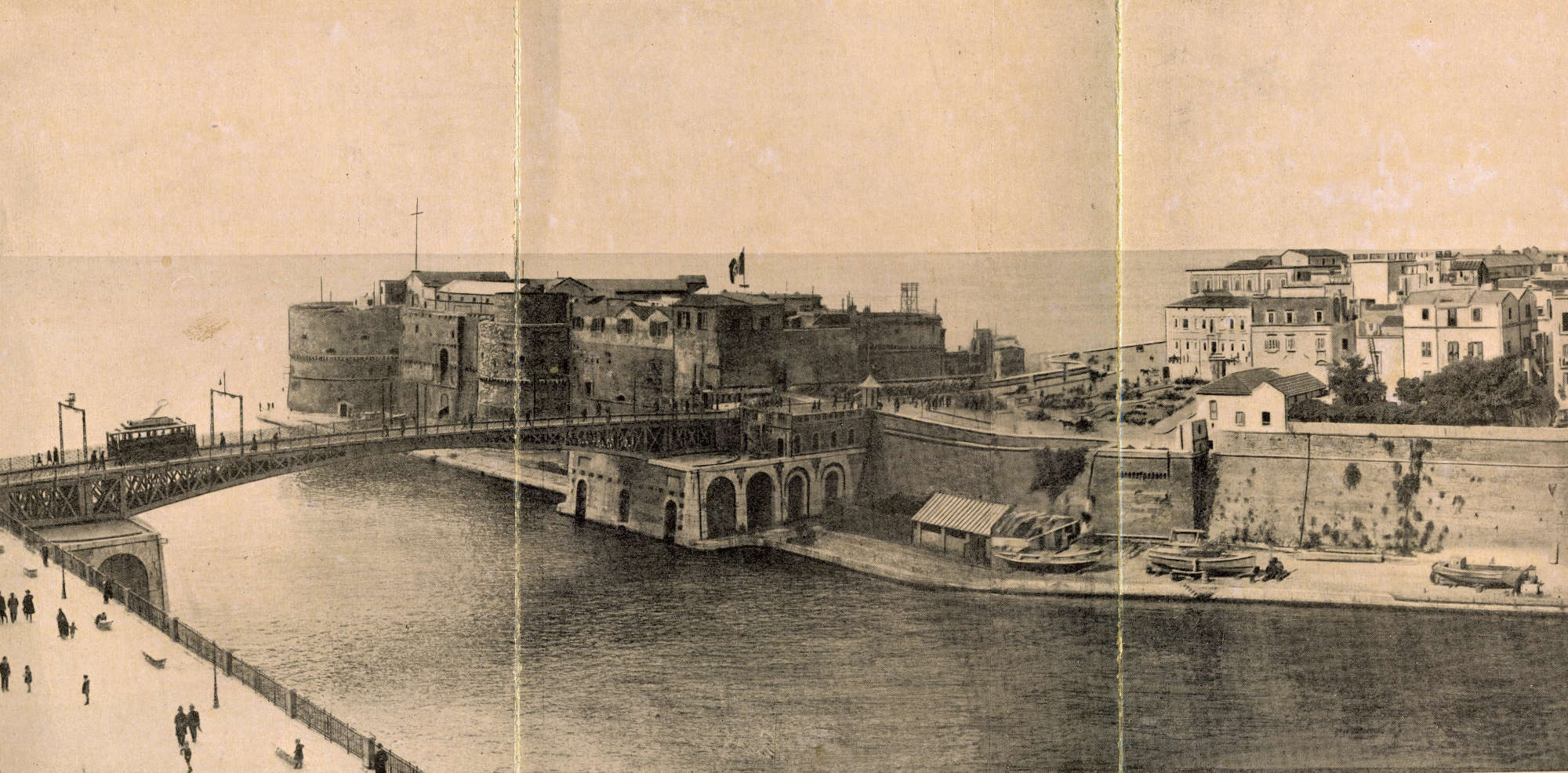
A panorama of Taranto harbour showing the Swing Bridge, which allowed access from the Grande Mare (Grand Harbour) to the Mare Piccolo (Small Harbour). 1930's. Courtesy of Steven Bates collection.
The cruisers H.M.S. 'Penelope' and the U.S.S. 'Boise' sailed up to the Mercantile Quay, just as the light was failing. There were no signs of life in the town, and a detachment of S.A.S. went ashore, and cleared the quay as far as the Customs House without incident. There was no opposition and the main disembarkation began a few minutes before 20.00 hrs. The plan arranged in North Africa, was immediately put into operation, with the 10th Parachute Battalion covering the area from the sea to the Massafra Road, 156 Parachute Battalion covered the Massafra Road with its H.Q. in the Railway Station. The 4th Parachute Brigade H.Q. was set up in the Customs House at the head of the Mercantile Quay. 2nd Parachute Brigade H.Q. and the 4th Parachute Battalion took up a position North of the town covering the Martina Franca Road, and the 5th (Scottish) Parachute Battalion marched through the town with pipes playing, to cover the Eastern approaches, while the 9th (Airborne) Field Company R.E., took over the internal security of the town. 1st Airborne Divisional H.Q. was set up at the Albergo Europa Hotel which had been evacuated by the Germans the same morning and which still bore evidence of their occupation in the form of bottles, standing orders and extensive murals depicting the strength of the German Navy.
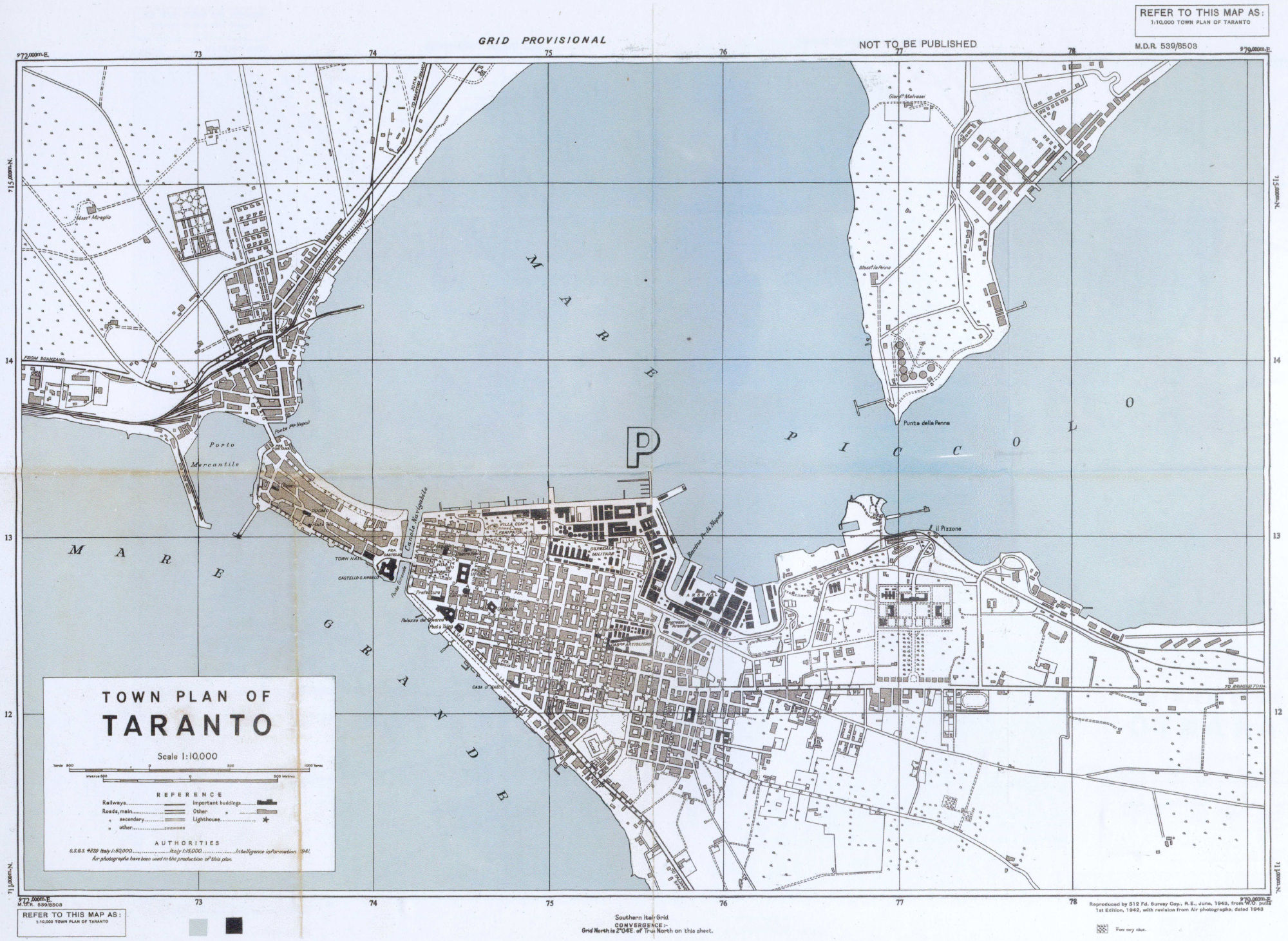
A 1;10,000 Scale town plan map of the Italian port of Taranto. 1942/43. This what some of the troops landing there in September 1943 were issued with. Courtesy of Airborne Assault Museum, Duxford.
The R.A.S.C. Detachments began to disembark at 19.00 hrs, and then to set up a report Centre, but this lead to an unusual situation, as described in Michael Packe's book 'First Airborne': "James [Maj. Packe] and his party came off among the first. In the darkness, not knowing what reception lay ahead in the eerie silence, they quickly formed up in tactical order and marched to their prearranged rendezvous, which they soon put into a state of defence. An Italian sentry watched them dispassionately; it was the first he had heard of any armistice, and in his view, there was no doubt that the British enemies were trespassing. However, he wisely decided that in the circumstances, his duty required no more of him than a prudent watchfulness. He was able to inform them by gesture that the Germans had pulled out of the town that morning, and in return for this information, he demanded a cigarette.
After half an hour, a patrol reported mysterious movement in their direction up the main road; James went out to investigate.
"Who's that?" he called.
The scuffling ceased abruptly; after a brief pause a fierce voice challenged him. "Airborne?"
"Yes, of course we are," said James; "aren't you?"
"Airborne?" repeated the voice, more threateningly.
"I keep telling you we are," said James; "what the hell?" for he found his hands firmly pinioned behind him. The owner of the voice advanced cautiously, shining a torch in his face.
"You fool! I nearly shot you. Why didn't you give the proper password?"
"What password?"
"Don't you even know it? When I said 'Airborne', you're supposed to answer 'No, seaborne'- get it?"
"I see," said James.
"What the hell are you doing here anyway?" demanded his captor; "my company's in the initial assault, with orders to take this hill."
"Well we got here first," replied James. "There's no need to whisper, incidentally; there's no enemy for miles."
"You've no right to be here; you shouldn't even have disembarked yet."
"Oh well, now you're here, you might as well take over, I suppose."
Rallying his men, James led them off down the road towards the harbour, in search of another pitch".
Not long after this 'encounter' there was a tremendous explosion. The next morning is described by Michael Packe in 'First Airborne': "They were awakened before dawn by the Major [Lt-Col Jefferies], who had just returned from Divisional Headquarters. It was cold, and on their tommy cookers they heated water in their mess tins; crumbling the blocks of powder from their ration packs, they made this into tea.
"Mind that light," said the Major.
"I think it's all right in here, Sir," replied James [Maj. Packe]; "it won't show outside. Did you hear that explosion? What do you think it was?"
"'I'm afraid it was the 'Abdiel'. She was waiting to dock, and they think a stray mine must have caught her; the Italians were supposed to have swept the harbour, but they're pretty casual. There were seven hundred people on board, including most of 6 Para. Battalion and 127 Field Ambulance; they were mostly down below when she went up, and very few of them had any sort of chance. Those who weren't killed outright were flung into the water too stunned to swim. About two hundred of them have come ashore so far, but there may be more. The Navy are wild about it, She was one of the latest of her type. And apart from all that, she was carrying most of our reserve of ammunition. It's a fair-sized disaster, I can tell you."
"What a damned shame," said James; "it wouldn't have mattered so much if it had been in action. But to lose so many men without a shot being fired - really, this Division does have the damndest luck."
Launched in the Spring of 1940, H.M.S. Abdiel was a fast minelayer, and had already seen considerable action in the Mediterranean theatre of operations, including Crete in 1941. At 00.30 hrs on the 10th September, whilst the ship was swinging at her cable, she detonated a German-laid ground mine. The resulting shattering explosion heaved the ship almost out of the water, broke in half, and within a few minutes, the ship was gone. There was just time for the Chief Yeoman to flash a message to H.M.S. King George V, and for Capt. D. Orr-Ewing to order "Abandon Ship!" Survivors were picked up by the boats of other ships, but many of the crew were trapped below decks, and amongst the 156 Officers and men that were lost, were those from the 6th (Welch) Parachute Battalion, 2nd (Oban) Airlanding Anti-Tank Battery, R.A., the 127th Parachute Field Ambulance, R.A.M.C., and various detachments and attachments to the Division. Amongst them was Sgt. Jack Rawlinson, a Clerk with 93 Company, R.A.S.C. [1]
FOOTNOTE:
[1] S/159788. Sergeant. Jack Rawlinson. 93 Airborne Division Composite Company, R.A.S.C. now lies at rest in the Bari C.W.G.C. Cemetery, XV. E. 6-35.
Worse was to come. On the 11th September the 10th Parachute Battalion launched an attack on Castellaneta, from the south. The battalion preceded their attack with a mortar shoot and at 15.40 hrs Maj-Gen. Hopkinson and Brig. Hackett came up to the Observation Post to watch the attack. At approximately 16.30 hrs, the G.O.C. was hit in the head by a burst of machine gun fire, and was fatally wounded, dying the next day.
Meanwhile, back in the main camp in North Africa, on the 8th September, the remainder of 250 Company were busy pre-packing panniers, and No 1 Aircrew Platoon was put on 4 hours stand-by notice. The pre-packing was completed and cleared the next day, and four drivers were sent with Jeeps to Sousse where they were supposed to embark on a ship bound for Taranto. Whether they were able to is not recorded in the War Diary, and there are no further entries by 250 Company in the War Diary for the activities of the Detachment in Italy. The activities of the 250 Company Rear Party Detail will be told later.
No War Diary was kept by any of the 1st Airborne Division R.A.S.C. Detachments in Italy for the period September to December, so what they did has had to be pieced together from various sources.
There were no further deployments of 250 Company to Italy after the 1st Lift, except for Capt. J.L. Cranmer-Byng, who flew to Italy on the 17th September. H.Q., R.A.S.C. sent Capt. R.K. Green, with 3 Other Ranks from his own unit, and 3 Other Ranks from 250 Company, plus a Motor Cycle on the 2nd Lift. From 253 Company the following deployed: Lt. R.F. Stride and a party of 32 Other Ranks left the main camp location for Bizerta on the 9th September, and sailed to Taranto on the 2nd Lift. Then a further Party from the Company arrived in Taranto on the 21st September, they having left the main camp location on the 16th September for Bizerta. This Party was commanded by Capt. C.M. Hall and Lt. W.P. Munday, and consisted of 60 x Other Ranks, 34 x 3-tonners, a water truck, and motor cycles. This would appear to be the last men and equipment sent to Italy by 253 Company. From 93 Company, Lt. LA.C. Lockyer and a Party of 32 Other Ranks and an unknown number of 3-tonners, proceeded to Bizerta to go across to Taranto on the 2nd Lift. Between the 11th and 21st September, he was joined by Maj. F.A. Lovegrove, Capt. H.T.C. Cornish, C.G. Simmons, R.G. Thomas and R.A. Crews, and Lt. J.B. Dalziel.
Together all these different parts of the Divisional R.A.S.C. Column formed a Composite Detachment in Italy.
The overall situation, by first light on the 10th September, was that the 4th Parachute Brigade was advancing Northwest and North from Taranto, with the 10th Parachute Battalion heading towards Palagiano and Castellaneta, and the 156 Parachute Battalion heading towards Massafra and Mottola. The 2nd Parachute Brigade moved to positions on the North-Eastern outskirts of Taranto, with the 4th Parachute Battalion patrolling towards Grottaglie, and the 5th (Scottish) Parachute Battalion, pushing eastwards towards San Giorgio. Out in advance of these units were elements of the 1st Airlanding Reconnaissance Squadron, the 2nd Special Air Service Regiment and the 1st Demolition Squadron - more popularly known as 'Popski's Private Army'. In Taranto itself, Divisional Headquarters was set up in the Europa Hotel, with the R.A.S.C. established in and around the Customs House in the Porto Mercantile.
By 09.00 hrs, the R.A.S.C Detachment had established a Divisional Maintenance Area, with petrol, supplies and ammunition. It was now, that Parties were sent out onto all the roads leading back into Taranto, to requisition vehicles. Apparently, raids by large numbers of Allied aircraft onto Taranto had resulted in those of the population that had transport, leaving the town for the night and returning in the morning. At the same time, other Parties were sent out to see what stores had been left by the hurried departure of the Germans - at times this would turn out to be an unexpected windfall. Large quantities of excellent quality alcohol being found! Lt-Col. Jefferies left Maj. Packe, with the following comment, as described in his book 'First Airborne': "Now, he [Lt-Col. Jefferies] continued, getting to his feet, I'm going back to HQ; you'll find me there if necessary. Don't forget, we want a nice little pile of transport by midday, James [Maj. Packe]; cars, lorries, all sorts. Oh, and if you happen to stumble on a decent Lancia, keep it for me, will you? After he left, the others looked at each other silently. 'Legalized robbery', said James, at last. Many amusing incidents then took place, as town officials, high ranking members of the clergy, and even high society women, had their vehicles commandeered, by Sergeant and Corporals, but were at least given a British Army 'chit' (proforma), to be able to claim from their own authorities later!"
Maj. Packe describes one such Parties activities in his book 'First Airborne': "For an hour and a half business had been brisk, and this was the first break there had been; [Corporal Badgem] lit a cigarette. Wot 'ave we got down now, Stan? Well corporal, I don't quite know what you'd call them all. You see, there's cars and motor cycles, they're all right. Then, there's them things with three wheels, and trucks four-wheeled, and trucks six-wheeled, and ruddy great things with trailers. I don't know what to call 'em all. Divide 'em into motor cycles, cars, lightweights and heavies. The clerk licked his pencil and pored over his book, his lips counting laboriously. Eight motor-cycles, seventeen cars, five lightweights and thirteen heavies, he announced; that includes the one which is stuck in second gear and hasn't got no others. Not bad for a start, eh? But it's slackened off a bit now. I 'spose people are beginning to tumble to it."
The N.C.O. mentioned is likely to be Cpl. Frank Bater: "In 1943 we went to North Africa, by sea. We then raided Taranto in Italy, where I had a section of men to commandeer all civilian vehicles." [2]
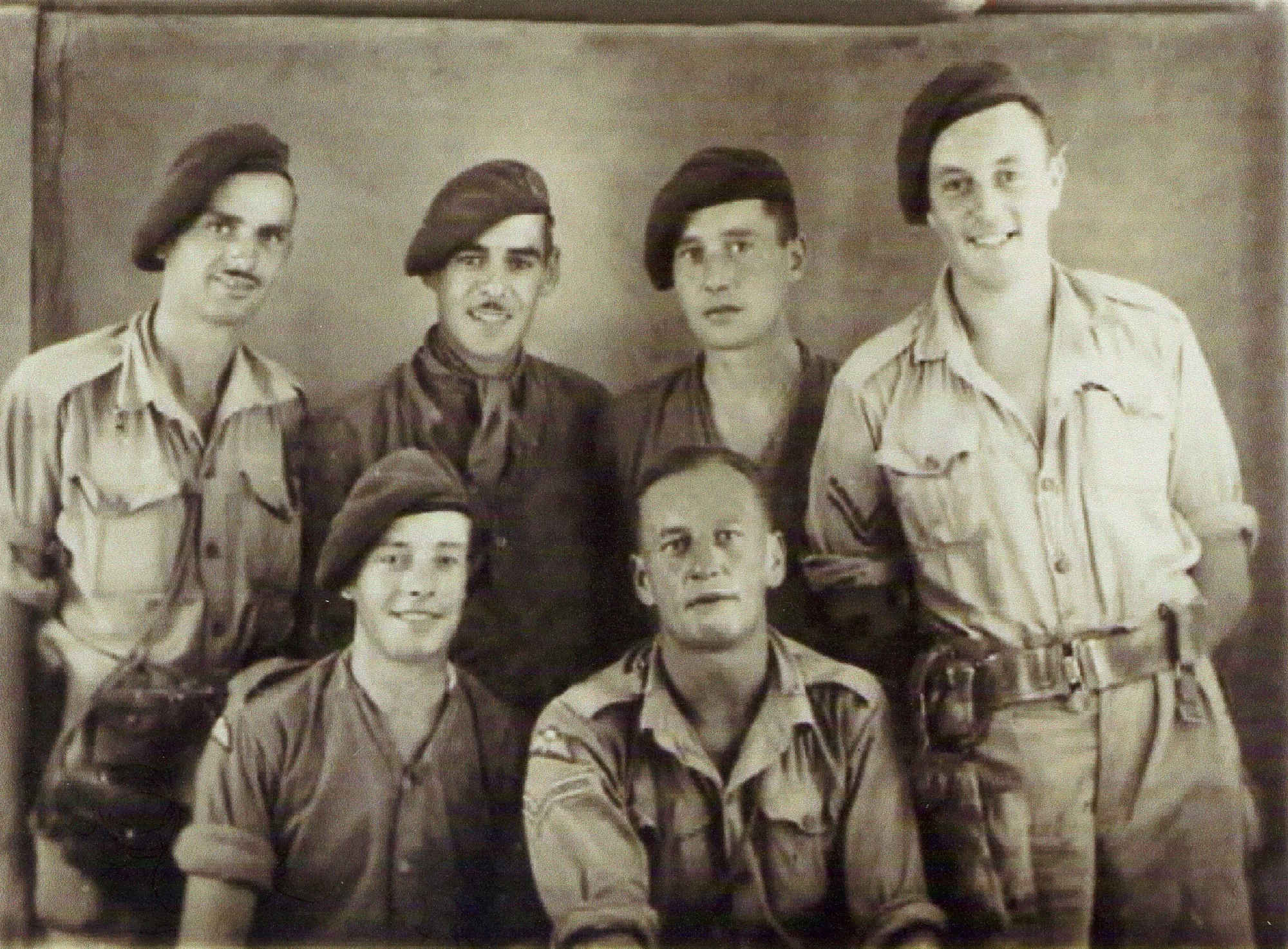
A group of 250th (Airborne) Light Composite Company, R.A.S.C. Italy. September - October 1943. Back row, L-R: Cpl. F. Bater , Dvr. C. Olley, Dvr. W. Mitchell, Cpl. R. Doubleday. Front row, L-R: unknown, Cpl. H.G. Whittet. Courtesy of Frank Bater.
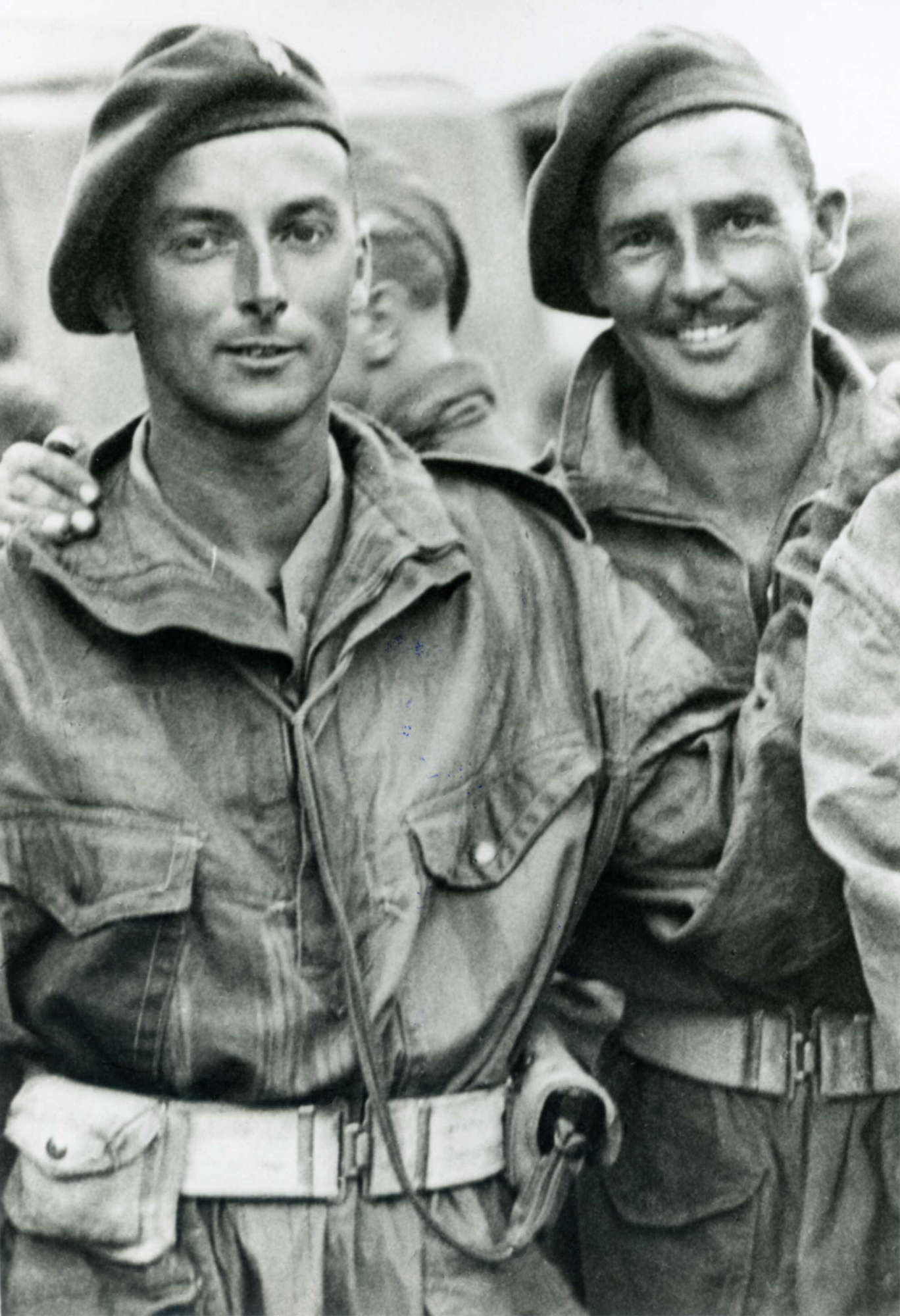
Cpl. Samuel Percy John Staple. On the right his friend 'Jim' (George Nicholson) Edwards. Both would serve in 'D' Transport Platoon. Photo possibly taken in Italy in early 1944. Courtesy Sam Staple.
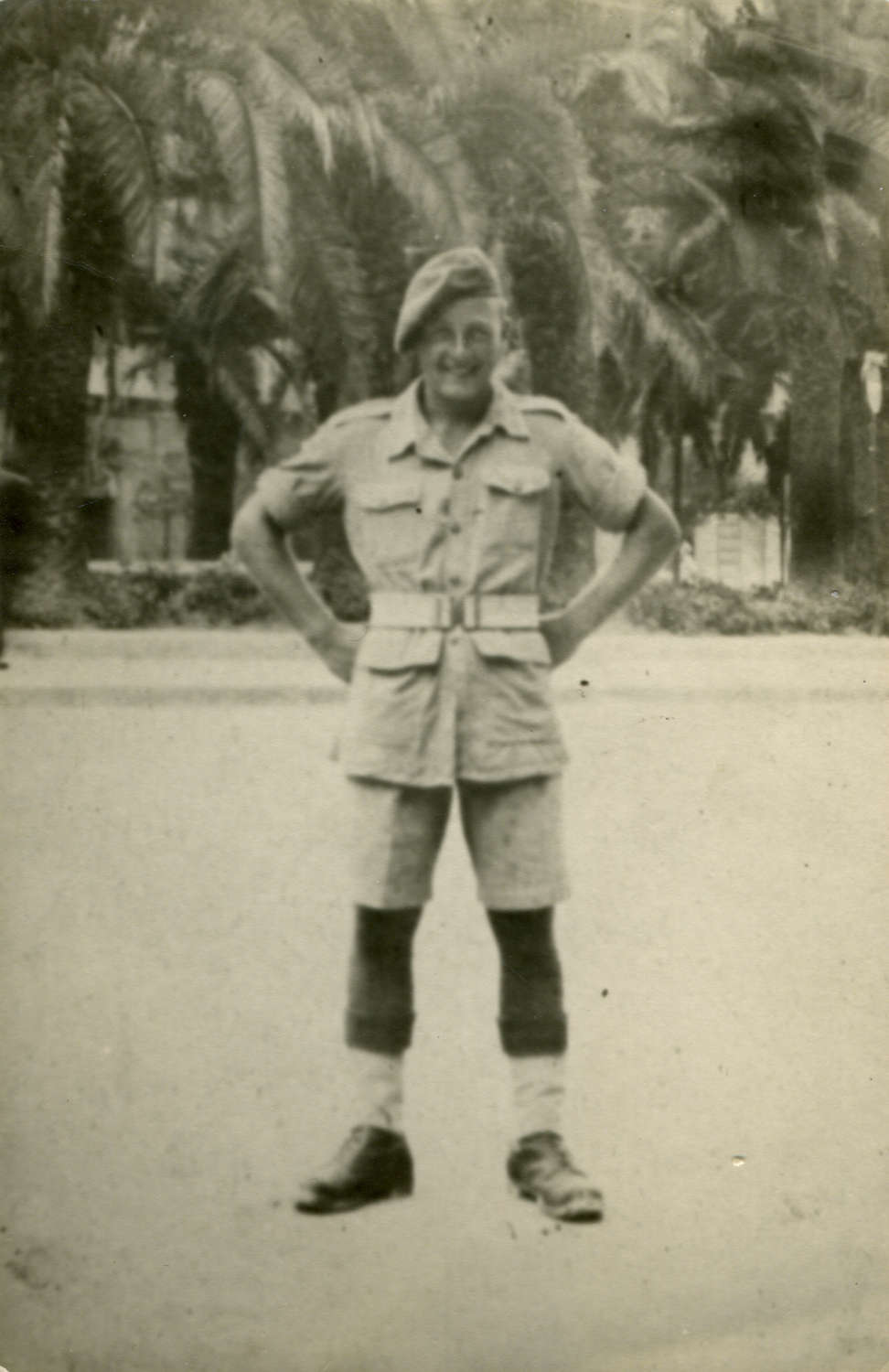
Dvr. 'Ken' Clarke. Italy. September 1943. Courtesy of Ken Clarke.
The overall efforts of the 1st Airborne Division R.A.S.C. is summed up in a report produced by Col. R.F.K. Goldsmith (G.S.O. I.), at Section 6, page 24: The allotment of shipping space for the R.A.S.C. in the first lift allowed for 136 personnel (mostly drivers) 1 jeep and 3 Motor-Cycle's - 3 per cent of the total lift. With this nucleus, the R.A.S.C. maintained the whole Division, including two brigades in the line, until the arrival of W.D. Load carriers (69 lorries) on 21st September with extra personnel of 93 and 253 Composite Company's. This nucleus of 136 men, working in the closest co-operation with R.E.ME. and 9th Field Company, R.E., established a Divisional maintenance area at Taranto. From here, the Division was supplied and maintained by requisitioned vehicles and pack trains run by Royal Engineers.
Very little help was given by the Italians in the early stages. After two hours discussion on the night of 9th September with General Lombardi and the Chief of Staff to the Port Admiral, C.R.A.S.C. [Lt-Col. Jefferies] left with the promise of 45 lorries to be at the docks at 23.00 hrs. Not one lorry turned up. Vehicles were subsequently seized from the streets, and in all, 51 load carriers and 43 cars were requisitioned by R.A.S.C. 25 load carriers and 4 cars were used as an Improvised Transport Company, and the remainder were allotted to Brigades and Divisional Troops. The entire maintenance and supply of the Division was carried out with this small quantity of improvised transport, and in addition, troop moves had often to be carried out at very short notice. Strenuous efforts were made by R.A.S.C. artificers to keep the casualty figures as low as possible, and during the early and most critical period, these did not exceed 10 per cent. Later, however, the continual and over-loading of these somewhat antique vehicles began to take effect, and the figure of vehicles off the road gradually increased towards 30 per cent.
The formation of a Supply and Ammunition Dump involved the handling of about 400 tons of stores a day, during each of the first few days, and resources were augmented by the requisitioning of 13,000 gallons of petrol, without which, the Division would have been completely immobile, as only 400 gallons were received by sea before the arrival of the first coaster from Tunis on 20th September.
Owing to the delayed arrival of this coaster, and to the sinking of H.M.S. Abdiel, units had to be on half rations for two days, but this was supplemented from local sources, and at no time during the operation, did a unit go really short of food. Also, owing to the sinking of the Abdiel, a large portion of the Divisional Ammunition reserve was lost. Small quantities of S.A.A. were provided by H.M.S. Howe, and the last rounds of this amount were being expended by 4th Parachute Brigade in battle North of Mottola when further ammunition arrived with the second lift.
The running of a pack train did much to relieve pressure on M.T. for supply, and when L.S.T's began to arrive full of 3 ton lorries, C.R.A.S.C. might have been pardoned for imagining that his worst problems were over. This, however, was far from being the case. More lorries meant more troops, and the Divisional R.A.S.C. soon found itself being stripped of vehicles on one hand and having its responsibilities increased on the other.
Probably its worst period was when 1st Air Landing Brigade at Foggia and 4th Parachute Brigade at Taranto, both had to be catered for simultaneously, with the rest of the Division scattered more or less evenly between. At various times during this period (21st - 30th September) railheads [R.H's] were manned at Mottola, Gioia, Barletta and Trani, and a F.M.C. was established at Trani.
The overall situation on the 28th September was summed up by a letter to Lt-Col. Jefferies from Maj. Packe: Situation at BARLETTA.
(1). On arrival last night, found move of 2 Para Bde already under way satisfactorily in tpt of 78 Div. No RASC tpt had either arrived or was required. I left NCO to pick up incoming RASC tpt and went off to Tac HQ.
(2). Munday [Lt. W.P. Munday. 253rd Airborne Division Composite Company, R.A.S.C.] later appeared with 8 x 3-ton from 253 and 4 x 3-ton from 93. In addition to these 12 there are also six x 3-ton which were with 2 Bde all day yesterday and are now at CRIGNOLA. Davies [Maj. J.A.E. Davies. D.A.A. & Q.M.G., 2nd Parachute Brigade] promised to send them back from there this morning. The 8 lorries which brought rations forward yesterday had also been collared by 2 Para Bde and taken off to CANOSA to distribute rations to units instead of turning them in at 78 Div F.M.C. Davies also promised to send these straight back too.
This makes a total of 24 lorries tied up needlessly by 2 Para Bde, David Clark [Capt. D. Clark. R.A.S.C. 1st Airborne Division Headquarters] came in at 0330 a.m. to say his rations had been taken off to CANOSA with 2 Para Bde, but that he was drawing from 78 Div and must have tpt to do it in. I gave him 4 lorries on the understanding that they returned to GIOIA by1000 hrs. Preston [Maj. P.H.H.H. Preston. D.A. & Q.M.G. 1st Airborne Division Headquarters] said that 4 other lorries would be required up here for detachment to R.E's. I am arranging this with 4 vehs of 93 Coy. The remaining 4 vehs are returning to you herewith Munday. I shall now
(1). Ensure that 2 Para [Bde] returns tpt as arranged.
(2). Contact Preston and find out what's happening, if he knows.
(3). See Bate [Capt. F.G. Bate. 'E' Platoon, 250th (Airborne) Light Composite Company, R.A.S.C.] and find out what has happened there.
(4). Try and straighten out sup situation as 78 Div do not seem to be doing much about it. The 5000 rations of Compo is required up here - suggest to avoid confusion lorries should report Maj. Preston at ANDRIA on the way up. A/L Bde is now in FOGGIA. I gather that a further move fwd is very unlikely. Should be back by midday.
After the capture of Foggia, the 1st Airborne Division was withdrawn into reserve, starting on the 1st/2nd October, and the advance units of the British 5th Corps, consisting of the 4th Armoured Brigade, the 78th Infantry Division, and the 8th Indian Infantry Division, took over - their 'phasing in' now complete. Sometime during late October, or early November, Lt-Col. Jefferies left the Division, to take up the post of Deputy Director Supplies and Transport at Headquarters Airborne Troops, later to become 1st Airborne Corps Headquarters. In his place, Michael Packe, who had been posted to H.Q., R.A.S.C. as the 2 i/c on the 14th September, was promoted, and he became the 1st Airborne Division C.R.A.S.C. These changes and promotions were made official on the 1st January 1944. Michael Packe took Capt. F.G. Bate with him to H.Q., R.A.S.C.
The achievements of the 250th (Airborne) Light Composite Company, R.A.S.C. on Operation 'Slapstick', were nicely summed up by Maj. Packe: "The airborne landings in Sicily, being safely over in a few hours, involved no R.A.S.C. action. The Taranto excursion in September, 1943, when the Division was suddenly carried across the Mediterranean in seven cruisers, gave the Light Company a sharp idea of what could be achieved by swift and forceful commandeering. Landing without a single vehicle and with practically no equipment, in a short time they acquired, and put into order with requisitioned spares in their workshops, enough Italian transport of all kinds to unload the follow-up supplies at the docks, open D.I.D.s, and carry out forward deliveries and troop-lifts. The Divisional advance northward of nearly a hundred and fifty miles exceeded all expectations." [B]
What of the main part of 250 Company left behind in North Africa.
Normal driving details continued, especially the ferrying of supplies to the various ports being used to re-supply the Division in Italy, and this is when a tragedy occurred to a member of 253 Company. During a driving detail to Bone, on the 13th September, the new vehicle of L/Cpl. F. Beal became involved in an accident at a level crossing near Tunis, and he received fatal injuries. Then, on the 22nd September, Dvr. Montague Millward of 250 Company, who had contracted Malaria, died in the 71st General Hospital. With the end of the offensive operations in Italy, the need for regular supply runs became less frequent, and a more regular training programme was put in place through October and into November 1943.
FOOTNOTE:
[2] T/276294. Lance Corporal. Frank Beal. 253 Airborne Division Composite Company, R.A.S.C. now lies at rest in the Medjez-el-Bab C.W.G.C. Cemetery, 7. H. 4.
During this period, the most exciting occurrence was the order, received on the 2nd October, to prepare for a Supply Dropping Operation, and No 2 Aircrew Platoon were told to prepare themselves. Two days later, Capt. Gifford, Lt. Sibbald and Sgt. Smith, with three Aircrews, took off from No 7 Strip in C47's, with a load consisting of 14 man Compo Rations. They returned on the 10th October, having successfully participated in Operation 'Simcol', which was a small scale parachute mission, carried out by the 1st Parachute Brigade, behind German lines to rescue escaped Allied prisoners. On the 5th November Lt J.G. Sibbald was posted to the 2nd Independent Parachute Brigade Group as the B.R.A.S.C.O. and promoted to the acting rank of Captain.
One of those involved in this small scale operation was L/Cpl. Burnham Blaxley: "It was very soon afterwards my team and I were directed to take our rollers to E Strip and set up the system inside the aircraft, when we had completed this Major Potter appeared. I had known him at the O.T.S at Bournemouth. He seemed pleased to renew our acquaintanceship and told me we had been detailed for a further mission. In Italy this time. He said no further instructions were to be given now, but we were to accept and load 12 baskets which had already been packed and had their parachutes attached. We were told they were very important and our destination would be disclosed on departure. We were joined by the American Air Crew. The usual complement was two Pilots, one Navigator, one Wireless Operator and a Buck Sergeant Flight Engineer. The following day after the usual maintenance checks we took off for Bari in Italy. This was the first time I had experienced a leisurely journey by air. I was asked "have you ever seen a volcano". "No" I had not. " Well you are going to see one today" said the Navigator. We shall be flying around the outer rim of Mt Etna. I looked down at the Mediterranean a freighter was throwing up a brilliant white wake. It looked like a highly coloured advertisement for the whitest wash. I was surprised to see how large an area the crater was. We flew all around it then on to Bari on the Adriatic coast of Italy.
We landed at Bari at the U.S.A.F. Base where we were taken to the Mess for refreshment. We had no particular duties so spent out time in the shade of the wing of the aircraft. We slept in the aircraft quite comfortably. On the morning of the third day the two Pilots visited the aircrafts with a detailed map in their hands. They spread this on the trailing edge of the wing and we were briefed regarding our night time journey. We were to follow the Adriatic Coast to Ankona. There we were to turn in a westerly direction to the foothills of a mountain range. We should then be instructed when to make our drop. The weather forecast was clear skies, Moon three quarters waxing, and the date was 8/9th October 1943. After our take off that night we found it a long haul over the sea, as far as Ankona. Here we turned sharply westward. I stood in the doorway of the aircraft. We were flying at a very low altitude. I saw a group of buildings from which a man suddenly emerged with the light of the doorway behind him. He obviously heard the aircraft because he ran in closing the door behind him. I also saw directly beneath us a railway track with a train travelling North to South. I could see quite clearly the firebox wide open and the stoker shovelling fuel into the boiler. He to must have heard us because he quickly closed the firebox door immediately plunging the cab into darkness. I remembered we had seen on the map the point which we had to make our drop it was where the railway track and the river converged. We must be nearly there by now. At this stage the baskets were lined up in a straight line and I and my crew were standing at our strategic positions. My station was behind the guard rails on the left hand side of the exit with the control of the drop bar on the right hand side. Looking down I could see we were approaching the proposed dropping zone. At the red light I raised the barrier and waited for the green light which did not come on, instead the Pilot realized he had over run the dropping zone he turned the aircraft sharply left tilting it at an angle. We held on to the baskets for our very life, fortunately we were able to control them. He now made another run in from the opposite direction, the green light came on and we were able to exit the baskets on target. This was very important to us because they were already packed on receipt and a notice in Italian was on each basket. One of the aircrew had translated it for us it was: 'ATTENTION ATTENTION. The contents of these baskets are Medical Supplies, clothing food and blankets for very sick men. Please handle with extreme care'. We were pleased to know we had been on a Mercy Mission." [A1]
During the month of October, the Company received three North African veteran re-enforcements. Dvr. John William Robinson, who had enlisted on the 26th March 1942, would go onto complete parachute course 113, and serve with No 1 Parachute Platoon at Arnhem. Dvr's. John Spence Victor Hayward and Albert Taylor, both joined the Company on the 25th October. Hayward, from Sheffield, who had enlisted on the 1st November 1939, was 31 years old, would go on to complete parachute course 101, and serve with 'D' Transport Platoon at Arnhem.
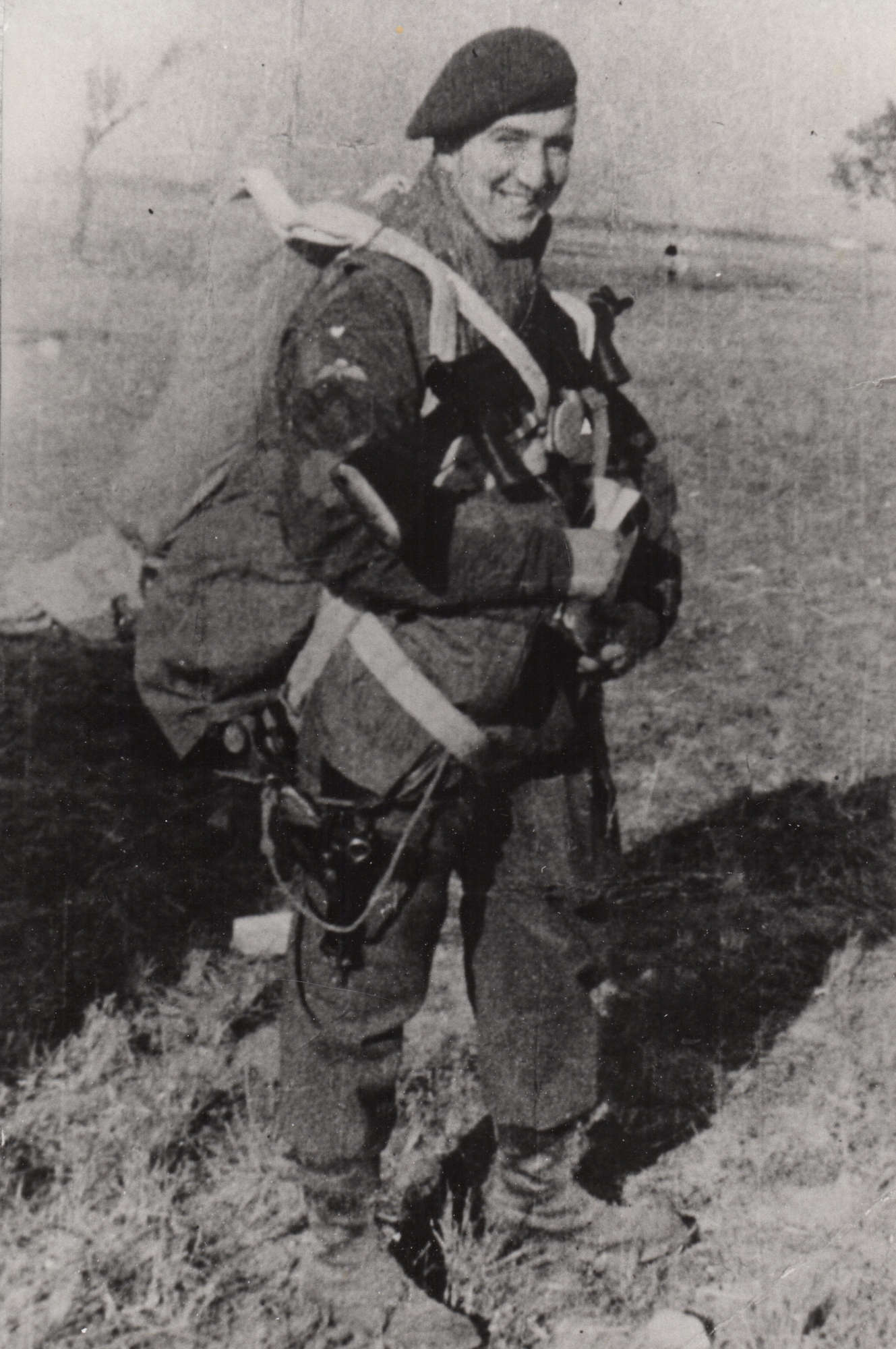
Capt. J.G. Sibbald, R.A.S.C. whilst serving with the 2nd Independent Parachute Brigade Group in Italy in 1944. This photo was taken of him whilst getting ready for the parachute drop in Greece in October 1944. Courtesy of Airborne Assault Museum, Duxford.
At this stage the Company was split into three parts: the Main Body, under Maj. Gifford (who had been in command since the 14th September, but was confirmed as the new O.C. on the 2nd November), was still at M'Saken, and on the 21st November, it received orders to prepare for a move, less No 1 Aircrew Platoon, the Pre-Packed Stores Platoon, three Officers and 83 Other Ranks. The Main Body moved to Algiers, from M'Saken, between the 23rd and 26th November 1943. Here, they embarked on H.M.T. 'Monarch of Bermuda' and set sail for England on the 29th November. However, on the 1st December at 14.15 hrs, they were rammed amidships by H.M.T. 'Duchess of Bedford', and had to put back to Gibraltar for repairs. They remained there until the 15th December, when they set sail again.
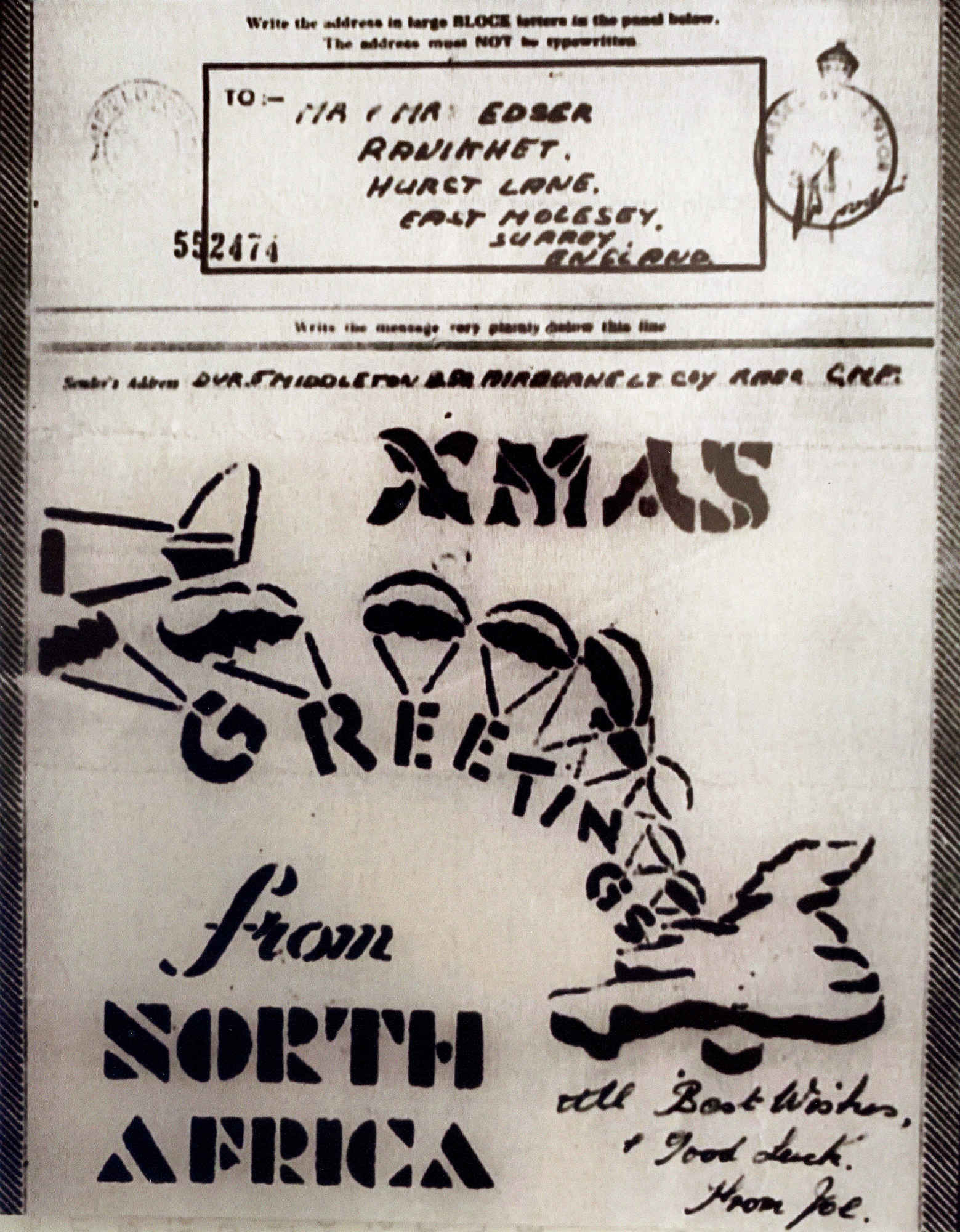
Aerograph from Dvr. J.C. Middleton to Mr & Mrs. Edger, East Molesey, Surrey in 1943. 'Xmas Greetings from North Africa'. All Best Wishes & Good Luck from Joe. Courtesy of Jim Middleton.
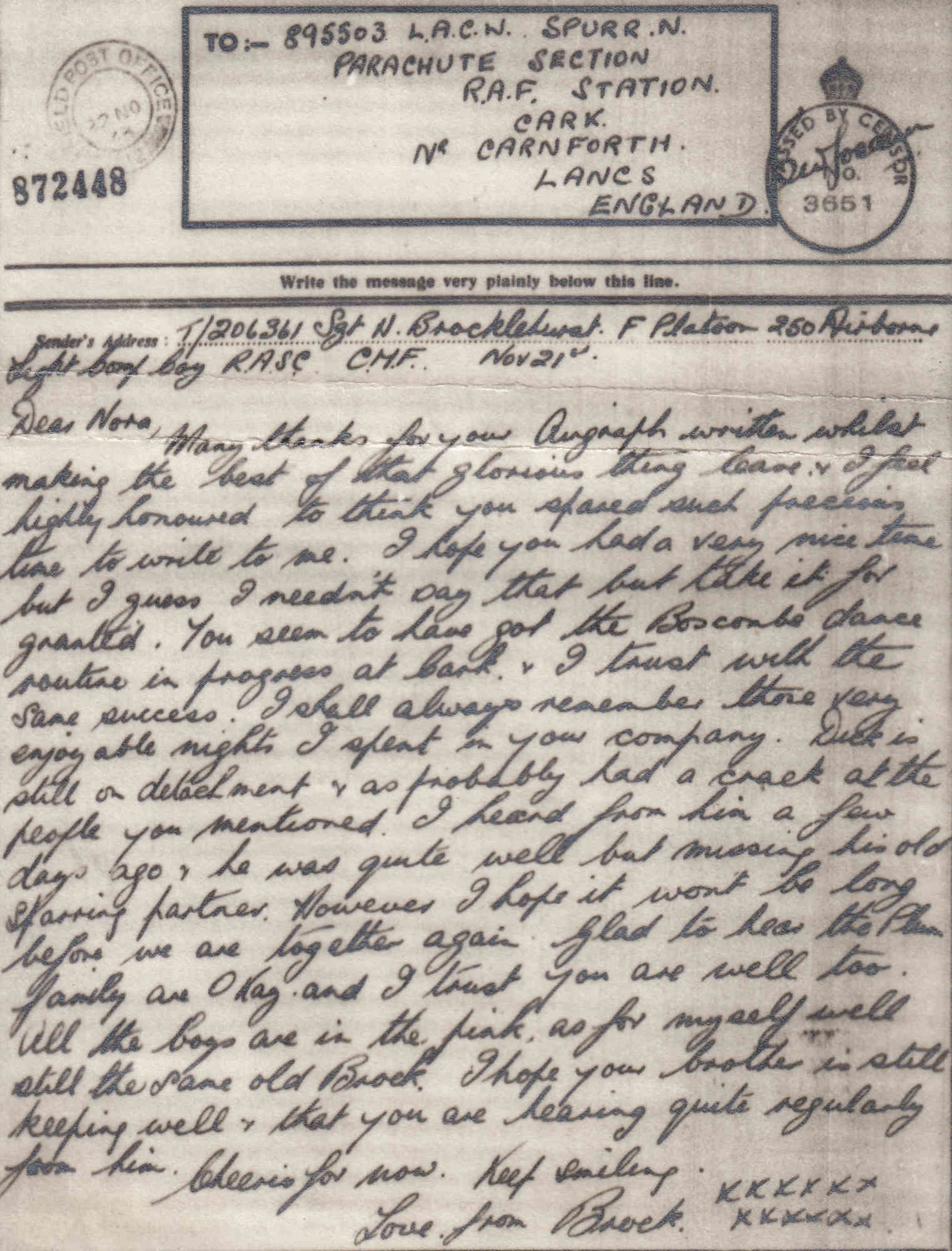
Aerograph from Sgt. Harry Brocklehurst, showing the thoughts that were on the minds of most soldiers, most of the time. TO:- 895503. L.A.C.W. Spurr. N. Parachute Section, R.A.F. Station Cark, Nr Carnforth, LANCS, ENGLAND. Sender's Address: T/206361. Sgt. H. Brocklehurst. F Platoon, 250 Airborne Light Comp Coy, R.A.S.C., C.M.F. Nov 21st. Dear Nora, Many thanks for your Airgraph written whilst making the best of that glorious thing leave & I feel highly honoured to think you spared such precious time to write to me. I hope you had a very nice time, but I guess I needn't say that, but take it for granted. You seem to have got the Boscombe dance routine in progress at Cark & I trust with the same success. I shall always remember those very enjoyable nights I spent in your company. Dick is still on detachment & as probably had a crack at the people you mentioned. I heard from him a few days ago & he was quite well, but missing his old sparring partner. However, I hope it won't be long before we are together again. Glad to hear the Plum family are okay and I trust you are well too. All the boys are in the pink, as for myself, well still the same old Brock. I hope your brother is still keeping well & that you are hearing quite regularly from him. Cheerio for now. Keep smiling. Love from Brock. xxx
The second group, was that which had gone to Italy in September, commanded by the then O.C, Maj. Packe, and consisting of 2 other Officers and 112 Other Ranks. This group embarked with the Divisional Main Group on either the S.S. 'Cuba' or the M.V. 'Staffordshire at Taranto on the 22nd November to sail back to England.
L/Cpl. Burnham Blaxley: "For the past few days we had felt movement was imminent. Equipment was being moved to the docks and vehicles were being handed over to another company. Quite suddenly we received instructions to bring all our personal kit to an assembly point and from there we were transported by lorry to the docks in Taranto. The usual procedure of embarkation took place, stacking in the hold of the ship. We stepped aboard the S.S. Cuba, a Free French troop transporting vessel. There was a crew of both French and English. I immediately asked if I could work as a butcher aboard. I knew this way I should have better accommodation, better food and very little contact with the troop deck which was always so overcrowded." [A1]
The third group is that detailed as a Detachment, on the 23rd November 1943, whilst still in North Africa, under the command of Capt. Jerome, and would not return to the Company until April 1944, which will be detailed below.
Finally, mention must be made of two units that were formed to assist the 2nd Parachute Brigade Group that were being left behind in Italy.
Firstly, the 2nd Parachute Brigade Transport Platoon, R.A.S.C. was created at Adelfia, two miles outside Bari in Southern Italy on the 18th November 1943. It was placed under the command of Capt. H.J.C. Cornish. This formation was accomplished by taking three Officers and ninety Other Ranks from 93rd Airborne Division Composite Company, R.A.S.C. to form the Headquarters, Transport, Composite and Workshop Platoon's, and the 250th (Airborne) Light Composite Company, R.A.S.C. supplied ten Other Ranks to form the Aircrew Section.
The object of its formation was to supply and service the 2nd (Independent) Parachute Brigade Group with stores, rations, ammunition, petrol, oil and lubricants, and transportation.
One of its first tasks, was to provide transport for part of the 1st Airborne Division to its embarkation port between the 21st and 23rd November. The normal routine for the Aircrew Section was to practise and perfect their packing of containers and loading them aboard aircraft for any future air supply operations.
The unit designation was changed to the 2nd Parachute Brigade Composite Company, R.A.S.C. on the 3rd December 1943. At this time, it was completely committed to moving the 2nd Parachute Brigade from the area of Bari to the North of San Severo and into the line on the River Sangro, to protect the left flank of the 2nd New Zealand Infantry Division.
The first chance for the Aircrew Section to put into practice their hard work, came on the 9th December, when they were tasked with dropping supplies to British Prisoners by air. The unit War Diary states: 'Aircrew Section, airborne from Gioia Airfield at 22.00 hrs in a C47. D.Z. = Ancona. Dropping of supplies to British prisoners known to have escaped and concentrated in the D.Z. area. Contents of Panniers dropped = foodstuffs, cigarettes, chocolate, footwear, medical comforts, and a map with route and instructions, to gain contact with our Forces. Operation successful and without incident.'
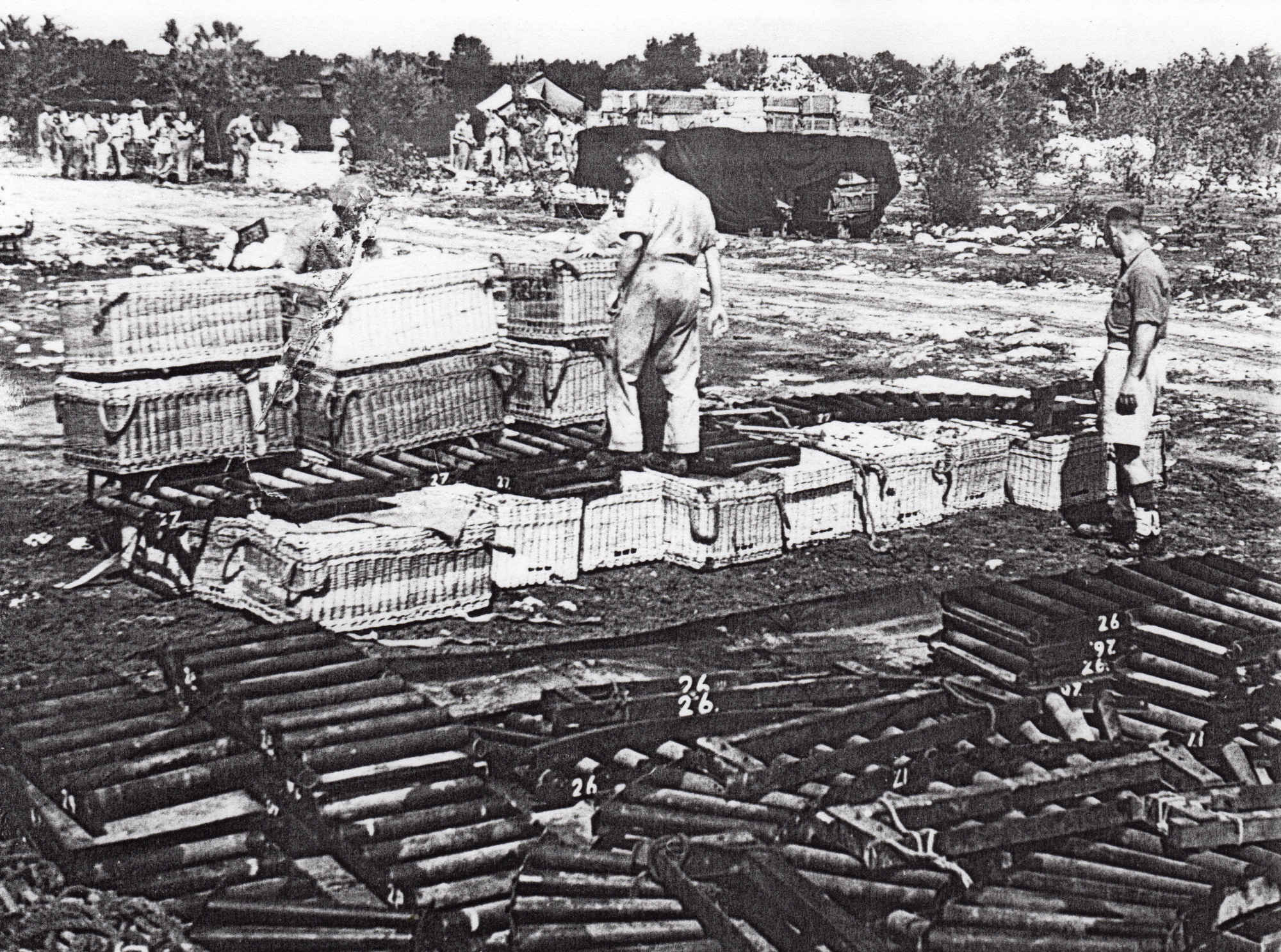
A supply location in Italy, circa 1943 to 1944. In the foreground are sets of roller conveyors, and unpacked panniers. Note that the way the soldier on the left is standing on the pannier will not do it much good! Courtesy of Airborne Assault Museum, Duxford.
Two days later, on the 11th December, the Aircrew Section were airborne again at 22.00 hrs, from Gioia to D.Z. Ancona. 'Operation: Pannier dropping of supplies to British Prisoners. There was a distinct feature in the dropping of some panniers. To assist in 'pin point' location, some of the panniers were wired up with dry batteries and showed a small voltage indication light while dropping. We believe, this is the first instance of panniers being dropped in an operation of this kind with indication lights attached. The operation was successful and without incident. Flying conditions, favourable.'
It is not known which men from the 250th Company formed the Aircrew Section, but it is a credit to their training and dedication, that they were ready to perform their task less than a month after the formation of the unit.
Early in December, the main part of the Transport Platoon was sent from Adelfia to support the 2nd Parachute Brigade in the line. The Main Body of the Company then moved up to join them on the 15th and 16th December, and the new base was established at Casoli Railway Station. This now left only part of the Composite platoon at Gioia Airfield with the Aircrew Section. However the rest of the Composite Platoon moved up to the main Company location at Casoli on Christmas Day. This now left the Aircrew Section, with a small supporting staff, on their own at Gioia Airfield. [3]
FOOTNOTE:
[3] This Units designation was suddenly changed to 'T' Company, R.A.S.C. (Independent Parachute Brigade Group) on the 1st July 1944, and on the 9th July it was announced that "Airborne Pay was forfeited by the whole Unit, w.e.f. 1st July". The change in title was temporary, as some time in August, it was changed again to 751 Company, R.A.S.C. (Independent Parachute Brigade Group). It was now just a Transport Company (with a reduced establishment) and had no parachute or airborne capability at all.
Secondly, a Detachment of 250th (Airborne) Light Composite Company, R.A.S.C. was formed on the 23rd November 1943, under the command of Capt. P. Jerome as the Officer Commanding, when the Main Body of the Company moved to Tunis, and then Algiers, prior to sailing back to England. Under his command, he had Lt. B.C. Winter-Goodwin and 2/Lt. E.T.H. Evans and 87 Other Ranks (including Sgt's. W.H. Chedgey, S.E. Cooper, A. Hoye, C. Watson and L. Whitehead), and they were initially based at M'Saken.
In a letter to the 1st Airborne Reconnaissance Squadron Association, September 1982, 'Pat' Jerome, gave some brief details of his service: "I was neither Recce nor R.A.C. I joined 250 Company, R.A.S.C. in 1st Air Landing Brigade on Newbury racecourse in February 1942, moved with it first to Amesbury Abbey and then to Sousse, spent a period commanding a detached half-company, normally with 2nd Independent Parachute Brigade Group in Italy, but actually engaged in supply-dropping for S.O.E. in the Balkans and returned to H.Q, R.A.S.C, 1st Airborne Division, shortly before D-Day. I was on supply-dropping from the Down Ampney/Fairford area until after Arnhem, when I was appointed Adjutant and followed Divisional H.Q. to Lincolnshire and Norway up to disbandment in December 1945."
This is a typically understated letter, as what he had to do was a lot more than that! First of all, was the move to a new location at Sousse, completed on the 26th November, and the pre-packing of all stores, and the creation of a Stores Dump. Capt. D.T. Kavanagh and 35 men of No 1 Parachute Platoon, 250 Company arrived at their location from Italy, probably as part of a Rear Party, on the 1st December. The organisation of the Detachment was now a small Headquarters Section, a complete Aircrew Platoon, an Airfield Control Section, a Pre-Packed Stores Section, and an attached Parachute Platoon. What exactly were the tasks and duties of this Detachment? These were defined, in a series, of meetings and briefings with Lt-Col. Packe, Maj. R.K. Gordon (Commanding 1st Airborne Division, R.A.S.C. (Base)), and the D.A.Q.M.G. of Sousse Garrison, between the 4th and 7th December.
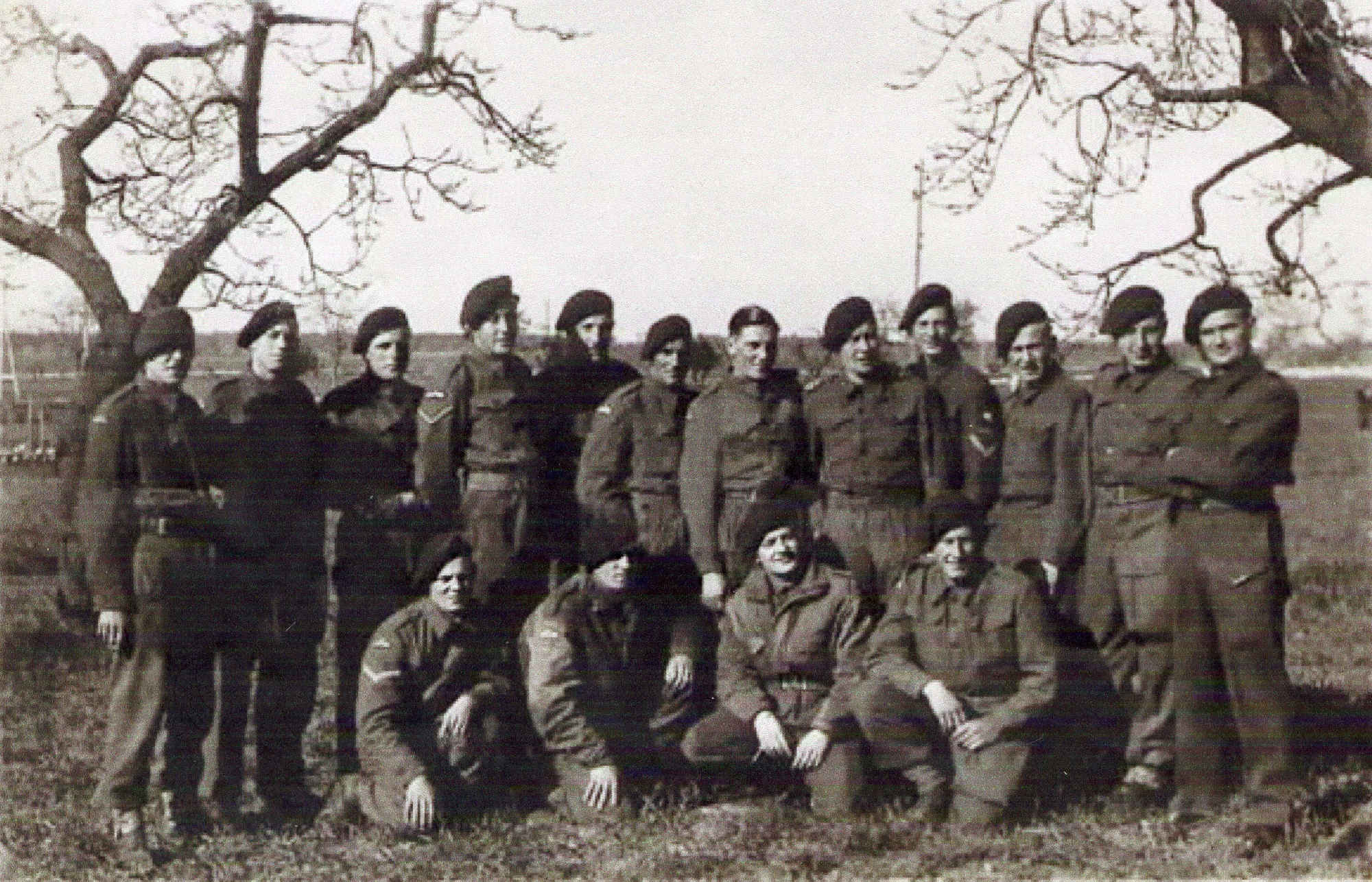
The Detachment in Italy. 1944. Lt. E.T.H. Evans (kneeling 2nd from right) and some of the Other Ranks of his Platoon. Courtesy Miss Jean Myers.
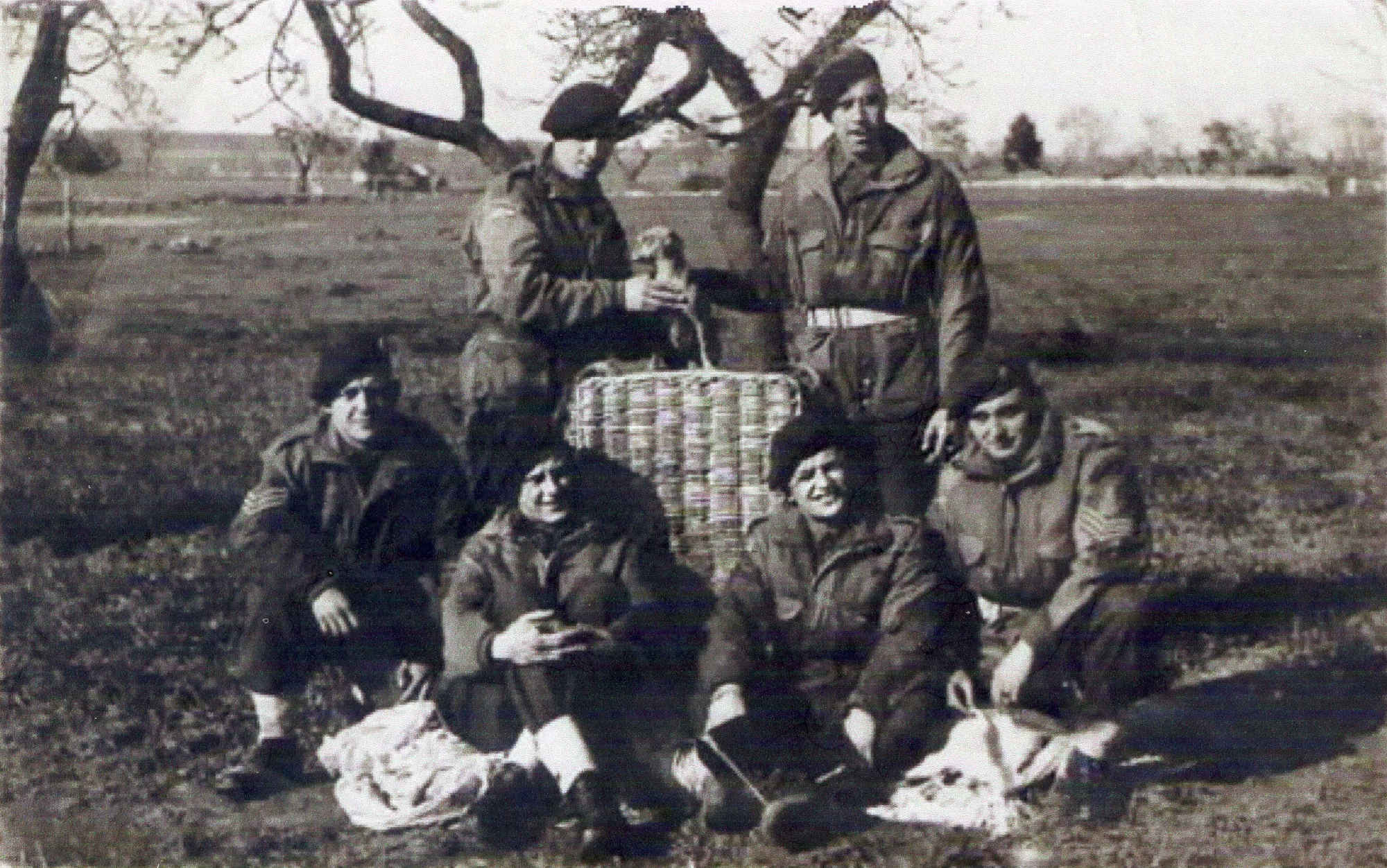
Lt. Evans and the Sgt's of the Detachment. Standing, L-R: ? , ? . Kneeling, L-R: Sgt. W.H. Chedgey, ?, Lt. E.T.H. Evans & Sgt. L. Whitehead. Other possible Sgt's were S.E. Cooper, A. Hoye, & C. Watson. Courtesy Mis Jean Myers.
The Detachment were to be responsible for maintaining a Stores Dump (in all weathers), providing sufficient Aircrews to despatch stores from up to 68 Dakota aircraft, and guarding their own location. Although it was noted that the unit was self-sufficient, it was recognised that if they were 'mobilised' for an operational purpose, then more assistance would be required from Sousse garrison, as the unit had no transport, and a full commitment would over-stretch them. They also did not have the personnel to fully man 68 aircraft. To this end, a series of packing courses were carried out for other units, starting with a three day course for 30 men of the 565 Water Tank Company, R.A.S.C. on the 9th December. On this same day, Lt. G.S. Rogers was attached from 253 Company, and on the 13th December a packing course for 30 of his men began.
Sgt. 'Bill' Chedgey recalled, years later, about his involvement with this task and the return to England: "I do not remember much of comrades in No 2 Parachute Platoon, the reason for this was that I had only just joined them, when the 1st Airborne Division returned to England from Italy, a small Section of 250 Company R.A.S.C. stayed in Italy to set up a school for supply by parachute. I was one of around 120 ranks, we also supplied partisans in Yugoslavia. We returned to England at the end of April 1944, and went on leave, we then rejoined the Company in Lincoln."
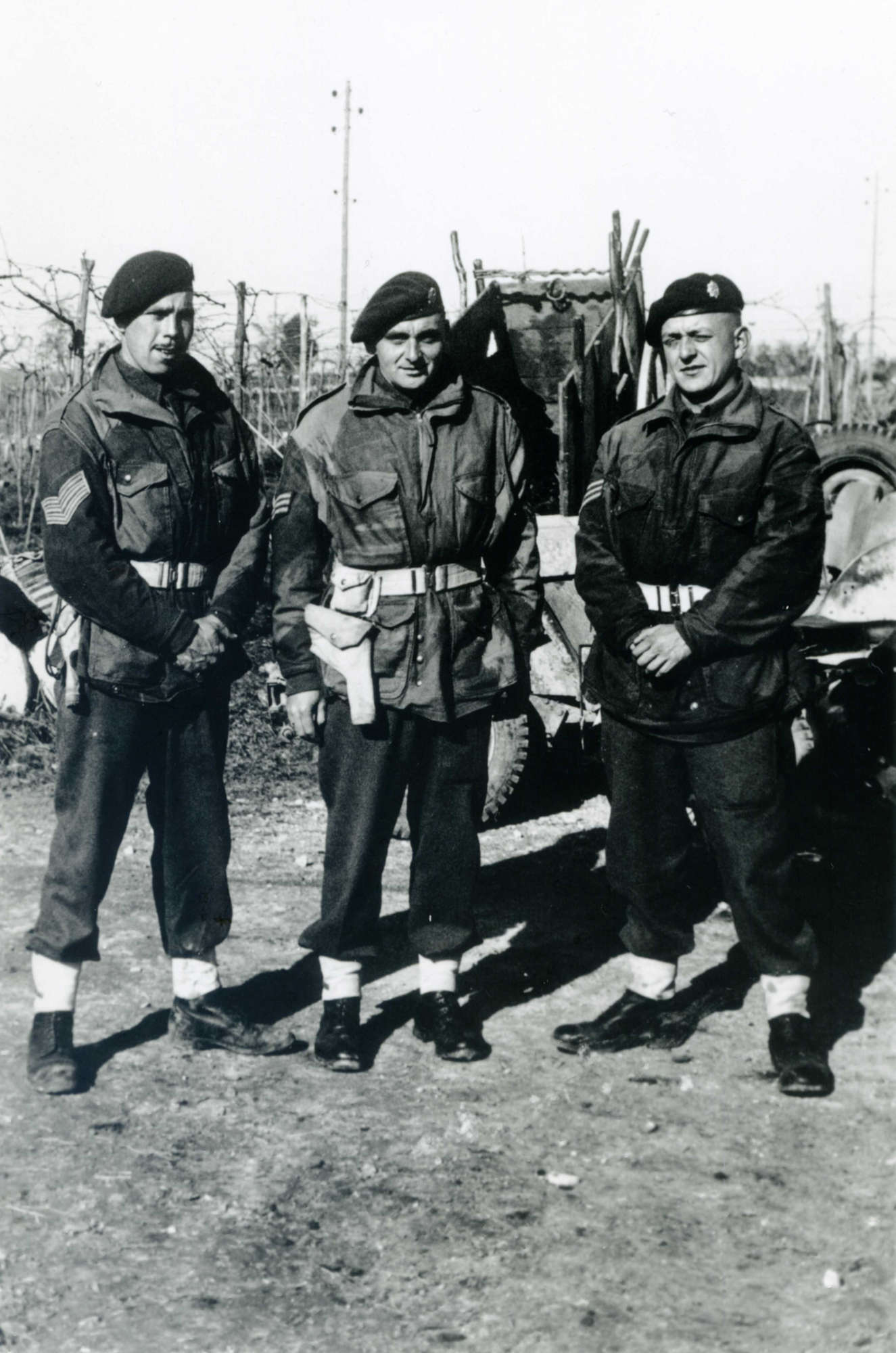
Sgt. 'Bill' Chedgey (on the right), with two fellow Sgt's of the 250th (Airborne) Light Composite Company, R.A.S.C. Detachment. Italy in early 1944. Courtesy Bill Chedgey.
As the weather deteriorated in the area, all training ceased, and the unit concentrated on weather proofing the Stores Dump and equipment, and extra guards were put on. This mundane activity ceased in early January 1944, as orders were received for a move to Italy, which started at 07.00 hrs, 4th January, when the unit moved by road through Enfidaville, Tunis, Medjez-El-Bab, Beja and Souk-El-Kemis, where they arrived at 17.00 hrs, to stage for the night. After refuelling, the journey was resumed at the same time the next morning, and they travelled through Ain Draham, La Calle, Bone and onto Phillipeville, where they arrived at 16.00 hrs, where Movement Control directed the unit to a Transit Camp. Unfortunately, no one there knew they were coming and they had to stay at the roadside, adjacent to the Transit Camp, overnight! Finally, on the 8th January, they boarded H.M.T. 'Hallee' and set sail for Italy. They disembarked at Naples at 12.00 hrs, 11th January, and were taken to a Transit Camp at Albergo Di Poveri.
An Advance Road Party of 11 men, under the command of Lt. B.C. Winter-Goodwin, set out for Gioia del Colle, on the 13th January, and the main body left by train the next day. The party proceeding by train, went via Taranto, Brindisi, Monopoli, and Bari, before finally arriving at Gioia del Colle at 07.30 hrs, 16th January. It had taken almost two weeks to travel to a location that should only have taken three days by the direct route from either Bizerta or Sousse!
Capt. Jerome immediately contacted the Staff Captain at 2nd Parachute Brigade, secured transport and moved his unit into requisitioned buildings - two bungalows and a farmhouse. A granary had also been requisitioned as a pre-packed stores and was already in use by the 2nd Parachute Brigade Air Supply Detachment for this purpose, and arrangements were made to take this over from them. The next day, work commenced on re-establishing a Pre-packed Dump and sorting stores and equipment, much of which had been damaged on the voyage from Sousse, and by having to be unpacked hastily, before the arrival of the Detachment, to send 800 panniers and associated equipment to the Air Supply Base (U.S.A.) at Naples. Capt. Jerome also visited H.Q. 15 Army Group with the Staff Captain, 2nd Parachute Brigade, to discuss the forthcoming Air Supply courses with G.S.O. I (S.D.). It was noted that the weather was fine, but cold. The visit by Capt. Jerome to a higher formation H.Q. was just the first of many, and he would spend a considerable amount of time shuttling between them all in his efforts to properly co-ordinate all that was expected of his 'unique' unit, with it officially coming under command of the 2nd Independent Parachute Brigade Group on the 21st January.
One of the matters under discussion, between the end of January and the beginning of February, was the running of Air Supply Courses by the Detachment for 352 General Transport Company, R.A.S.C. Amidst all the preparations for the Air Supply Courses, there was a chance to carry out some pannier dropping experiments with 8 Squadron, Troop Carrier Company, U.S.A.A.F., to investigate (i) the dropping of a/c load in two sticks; (ii) loading of panniers right forward (beyond forward end of normal roller set) for take-off and flight.
On the 6th February, Capt. D.W. Lindley, Lt. R.V. Jarrett, and 31 Other Rank's of 352 Company, constituting No 1 Course, were attached to 250 Company. They were joined by Maj. P.F. Rodwell, G.S.O. 2 (Air), A.C.M.F., who was also to attend the course. Altogether there were four Air Supply Courses run between 7th February and 3rd April, each one was two weeks long with a short gap (1 or 2 days) between each. This lead to approx. 130 trained personnel from 352 Company. There was also a Course run for 172 Detail Issue Depot, starting on the 28th March.
Lt B.C. Winter-Goodwin and 4 Other Ranks left for Bari airfield to emplane for U.K. on the 13th February, and the next day, 21 Other Ranks of the 250 Company's Aircrew Platoon were attached to 133 Force for operational Aircrew duty. The weather played havoc with both the Air Supply Courses and the operational supply drops, but all were carried out, albeit with some delays. On the 19th February, Capt. D.W. Lindley, having completed his Air Supply Course, was attached to 250 Company, for further training as an Air Supply Control Officer, and Lt. F.J. Hill would join him on the 4th March.
The units transport was finally picked up from Taranto docks on the 23rd February, having only just been shipped from Phillipeville, where they had left it on the 5th January!
By mid March, and an improvement in the weather, The Air Supply Courses were able to carry out practice drops by both day and night. The O.C. visited the Squadron Commander of 267 Squadron, R.A.F. to discuss attachment of Dispatchers to them for operations with 133 Force, on the 16th March. At 23.45 hrs that night and 22.00 hrs the following night, 8 Dispatchers proceeded on operations with them. The use of the trained personnel from 352 Company had already taken place on the 21st February, with a drop of 1000 rations to 8th Army personnel.
Having received orders for a move at the end of March, between the 1st and 6th April, the Company started to hand over their transport to 352 Company, their Air Supply Stores, Pre-packed Dump, accommodation and general stores to 172 D.I.D. and with the return of Lt. Evans and his Detachment from 266 Force and 'N' Section, 'A' Special Force, the 250 Company Detachment of 3 Officers and 113 Other Ranks entrained for Bari at 06.00 hrs, 7th April. On the 3rd April, Capt. D.W. Lindley, Lt. F.J. Hill and 28 Other Ranks from 352 Company, took over the air supply commitment, in conjunction with 172 D.I.D. and came under command of the 2nd Independent Parachute Brigade for operations.
The 250 Company Detachment embarked on H.M.T. C3 at Naples docks, bound for the U.K on the 10th April, and were at sea between the 11th - 22nd April. They docked at Glasgow at 01.00 hrs, 23rd April, boarded a train, and set out for Lincoln.
MY NOTES:
[A1] Letter & account to Bob Hilton from Burnham Blaxley. 9 July 1998.
[A2] The 250 Company Magazine 'For The Cream'. 1947.
[A3] Letter & account of Ron Nutley to Bob Hilton. 8 September 2004.
[B] The Royal Army Service Corps Review Vol. 1, Nr 5. 1952. R.A.S.C. IN THE 1st AIRBORNE DIVISION-- FORMATION AND ACTION AT ARNHEM, by Lieutenant-Colonel M. St. J. PACKE, R.A.S.C.
[1] Letter to Bob Hilton from Raymond Whitwell. 16 October 2015.
[2] Letter to Bob Hilton from Frank Bater. 26 September 1997.


