Chapter 4
Return to United Kingdom, re-organisation and expansion. 1943 - 1944.
"These old country houses get me down, they're so dark and draughty". Capt. John Cranmer-Byng. 1944.
The Main Body of the Company, that had set sail from North Africa, but which had then been delayed at Gibraltar, finally arrived at Liverpool on the 22nd December, and started to disembark at 14.00 hrs the next day. An hour later they were aboard a train which would take them to Dock Camp in Boston, Lincolnshire, arriving there at 23.00 hrs. At this stage, the Company had 5 Officers and 218 Other Ranks. The other part of the Company, 3 Officer's and 76 Other Ranks, sailing from Italy arrived on the 3rd January.
Whilst the Company spent the month of January settling into their new camp, 2/Lt. P.E. Thompson was posted in, along with Dvr's. J.R. Davies, D.A. Edwards and G.A. Hutchinson, all potential parachutists, from 253 Company on the 25th January. Yet another re-organisation took place, and on the 27th January, the Company Order Of Battle was:
Company Headquarters.
1 x Airfield Platoon.
2 x Parachute Platoons.
3 x Transport Platoons.
1 x Workshops & Fitters Platoon.
This did not include the large Detachment that was now in Italy, and constituted approx. a quarter of the Company strength, with its own Headquarters Section, an Aircrew Platoon, a Parachute Platoon, an Airfield Control Section, and Pre-packed Stores Section. At the end of January, planning began for a changeover in locations, with the 1st Air Landing Light Regiment, R.A. being allocated to Dock Camp at Boston.
Dvr. 'Ron' Nutley: "Upon arriving back in England - just before Christmas 1943, I was given 14 days leave. I was then sent to Branston in Lincolnshire. The Para Platoons were stationed at the Smiths Crisps Mansion there - this was a 'holding station', and I was there for a few weeks." [A]
Men who needed to qualify as parachutists departed for Hardwick Hall in January, and then went to R.A.F. Ringway on the 31st on Course 101, which lasted until the 13th February. The following qualified for their parachute wings after completing the long course of eight descents, Sgt. Brain, L/Cpl. Higgs, Dvr's. Alcock, Ashman, Beal, Bond, Coucher, Clarke (508), Cutting, Field, Glenn, Hart, Hayward, Jennings, Prime, Shaw, Spencer, Taylor (352), Willett and Pte. Wood. The policy at R.A.F. Ringway had changed whilst the Company had been overseas. There were no longer 'Short' Courses for Air Landing Brigade personnel, all courses were now 'Long' ones of eight descents.
Dvr. John Alfred Taylor, always known as 'Jack', was born on the 3rd March 1924 and came from Broadwell, Near Moreton-in-Marsh, Gloucestershire. He joined the Home Guard in 1940 at 16, and then enlisted on the 1st October 1942: "In 1942 at the age of 18 years I enlisted in the army, signing on for a period of seven years. I volunteered because I wanted to serve in a tank regiment like my brother. He was in the 17/21st Lancers (The Death or Glory Boys), a cavalry regiment which was part of the Royal Armoured Corps. Initially, I was posted to the Shropshire Light Infantry Regiment at Shrewsbury for assessment and basic training which lasted for six weeks. I was then posted to a Royal Armoured Corps Regiment at Farnborough to undertake tank training. I cannot remember the name of the regiment but I believe it was one of the cavalry regiments, and I subsequently qualified as a Driver/Gunner. (All tank crew members were trained in dual roles). After completing this training I was posted to the Fife and Forfar Yeomanry, a tank regiment which was based at Uckfield in Sussex and was equipped with Covenanter and Crusader tanks. It was sometime in late 1943 when I was in our Orderly Room that I saw a notice asking for volunteers for the Parachute Regiment. At this time I was feeling somewhat frustrated for we were just running about to various parts of the country playing war games when what we all really wanted was to be involved in the real action." [1a]
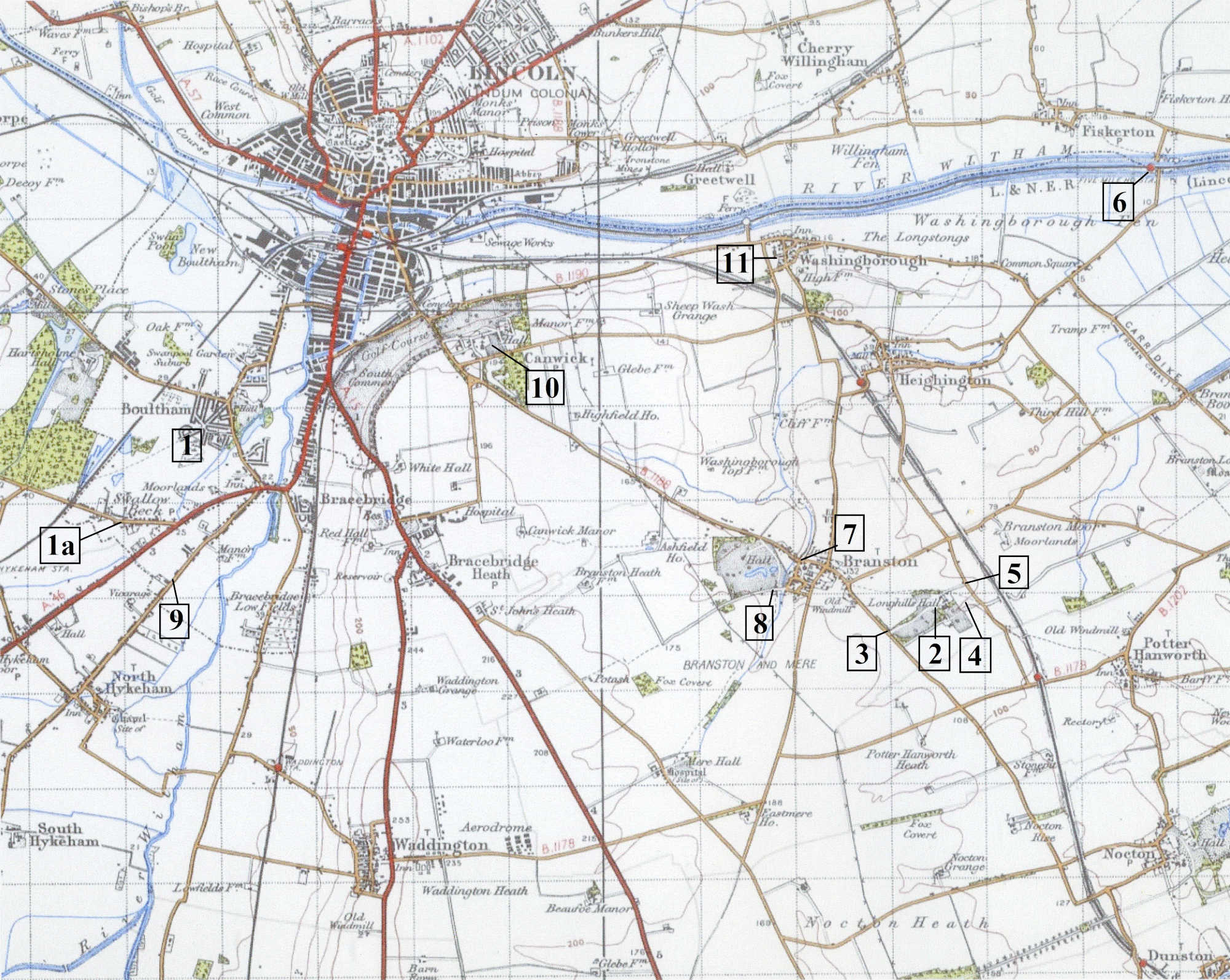
The Advance Party of 250 Company left for the new location on the 7th February, and were followed a day later, by the remainder of the Company. The Headquarters, Transport and Workshops Platoons were to be billeted at the Moorlands Hotel, just off the Newark Road (A46), to the Southwest of Lincoln and the rest of the Company was to be billeted at Longhills Hall, at Branston, approx. 5 - 6 miles to the Southeast of Lincoln, just off the B1188. Just as this move took place, five men from 253 Company, potential parachutists, were posted to the Company, Dvr's. J.E. Cook, C. Cooper, W. Jefferies, W. Nash and S. Walker. After settling in, it was not long before a thorough training programme was started, with route marches, Platoons at a time going to the Field Firing Ranges at Midhope, Sheffield, and to R.A.F. Brize Norton to act as 'live loads', for a week at a time.
MAIN LOCATIONS: 250th (Airborne) Light Composite Company, R.A.S.C. ORDNANCE SURVEY MAP. 1920, WITH CORRECTIONS 1947. 1 = The Moorlands, Newark Road. 250th (Airborne) Light Composite Company, R.A.S.C. Headquarters. 1a = The Bungalow, Doddington Road. 'C' Transport Platoon. 2 = Longhills Hall, Branston. 1, 2 and 3 Parachute Platoon's. 3 = 250th Company Memorial location. 4 = Range/Target practice field. 5 = Peter Scarcliffe cottage. 6 = Five Mile Bridge. 7 = All Saints Parish Church, Branston. 8 = Workshops, Foremans Yard, Hall Lane. 9 = Hykeham Road billets. 10 = Canwick Camp. 250th (Airborne) Light Composite Company, R.A.S.C. Headquarters. 11 = Washingborough Hall. 'A', 'B' and 'C' Parachute Platoon's. Courtesy Ordnance Survey.
253 Airborne Division Composite Company, R.A.S.C. also moved location in February, from Boston to Harlaxton Hall, near Grantham, and 93 Airborne Division Composite Company, R.A.S.C., which had been at Longhills Hall, moved to Hartsholme Hall, near Lincoln.
Whilst this move was taking place, a new officer was posted to the Company, Lt. Richard George Adams, who took over command of 'C' Transport Platoon. Born in Newbury, Berkshire on the 9th May 1920, he was granted a commission, as a 2/Lt in the Royal Army Service Corps on the 30th November 1940. His first posting was to a Petrol Supply Company R.A.S.C. in Northern Ireland, and he was stationed at Langford Lodge near Lough Neagh. He was to be stationed there from early 1941 until mid 1942. Having failed in his first attempt to get a posting to Airborne Forces, Lt. Adams requested an overseas posting and in late July or early August 1942, he was sent to a Holding Depot at Halifax. Eventually, he was sent to Palestine where he would serve in No 2 Petrol Depot near Gaza until late 1943. Whilst awaiting his units re-deployment to the UK he again applied for Airborne Forces, and not long after this sailed in a convoy that spent Christmas 1943 at sea. Upon disembarkation in England, they were sent to Bridgend in South Wales. "A day or two after we got to Bridgend, Captain McLeod [Unit Adjutant] strolled into my billet. 'There's a posting for you, to C.R.A.S.C. 1st Airborne Division. You leave us tomorrow, for Lincolnshire'". [1b]
Lt. Adams was officially posted to the 250th Light Composite Company, R.A.S.C. (Airborne) on the 1st February 1944. "It was January and very cold after the Middle East. I made the usual slow, disagreeable rail journey northwards, and at the end of it, reported to Divisional Headquarters at Fulbeck, some eleven miles south of Lincoln.
With no delay at all, I found myself talking to Lt.-Col. Michael Packe, C. R. A. S. C., 1st Airborne Division. Within a few minutes, I felt that I was breathing a new air. I need only say here that I got on very well with Colonel Packe, then and throughout the next eighteen months. After we had chatted for a time, he said he was going to post me to the Light Company - 250th Light Company, R.A.S.C. (Airborne).
At this point, I had better explain that, in those days at any rate, an Airborne Division's R.A.S.C. (who were divisional troops) consisted of three companies - two heavy and one light. The two heavy companies (each a major's command) were equipped with 3-ton Bedford lorries and did not differ essentially from any motorized R.A.S.C. company. Their job in action was to follow up an airborne attack together with the relieving ground troops, to bring in the division's heavier equipment and then assist it in its ground role.
The Light Company was different in function and kind. It consisted of three parachute platoons and three platoons of glider-borne jeeps. Each parachute platoon was commanded by a captain, with a subaltern 2 i/c: the N.C.O.s and men were all volunteer parachutists. Their role in action, was to drop with the division, and thereupon to have the responsibility for collecting and distributing all subsequently dropped supplies; medical, food, ammunition (and conceivably petrol). They might well find themselves required to fight for possession of these supplies: if, for instance, containers happened to be dropped outside the area controlled by the division, or if the enemy attacked the dropping zone. They were equipped and trained accordingly." [2]
Richard Adams wrote of his impression of some of the Company officers: "John Gifford was at this time, I suppose, about thirty-three or four. He had been an architect in civilian life before the war; and he was a bachelor. He was about five feet nine inches tall and had a rather high colour and black hair. He was pleasant-looking without being spectacularly handsome, and he wore glasses. He moved well and had a quiet, clear voice which he never raised, except when giving commands on parade. He seldom exclaimed and he never swore.
Everything about him was quiet, crisp and unassuming. He was the most unassuming man I have ever known. When giving any of his officers an order he usually said 'Please', 'Would you like to -?' or 'Perhaps you'd better -'. He could be extraordinarily cutting; at least one sensed it like that, because a rebuke from him was so quiet and so rare, and because everyone had such a high regard for him that you felt his slightest reproof very keenly.
He was an excellent organizer. One of his strongly held principles was that it was important to get the right person into the right job, and the wrong person out. This went right down to the level of Private. I had never consciously thought about this principle before ('Anybody can do anything'), but I realized it all right after I had been under John Gifford's command for two or three weeks, when he gently pointed out to me that the reason why my platoon-administration was in such a mess was that Lance-Corporal Tull was entirely the wrong sort of person to be trying to do what I had told him to. Since then I have needed no further telling.
John Gifford was brave in the most self-effacing way. One morning a few months later, when I had learned my way around in the Company and knew what was what, I missed the O.C. at breakfast and, since no one else happened to be nearby, asked the mess waiter, Ringer, if he knew where he was. 'Oh, the Major went out early, sir. He heard last night that some of the gunners were jumping this morning and fixed up to join them.'
No one else knew about this. Jumping is a frightening and unpleasant affair. John Gifford was not in command of a parachute platoon, but he made it his business to do as many jumps as anyone else in the Company and to say nothing about it."
"Captain Paddy Kavanagh was quite another thing. He was about twenty-nine and before the war had been a journalist. He was, of course, Irish, though he had no brogue. Paddy was a sensationalist; by temperament entirely the public's idea of a parachute officer; good-natured, debonair, generous, always in high spirits (I know John Gifford, despite his liking for him - you couldn't not like Paddy - found him a bit much at times), a deviser of dares, afraid of nothing (including jumping), so it seemed. He once jumped with a kit-bag on each leg, to show that it could be done: another time he jumped with a large wireless transmitter. He had a bucko sergeant, McDowell, and the two of them used to get up to some rare old larks.
Once, Kavanagh was going to make his platoon crawl under live fire from a Bren gun, and began by setting them an example. After about a quarter of a minute he called to McDowell, on the gun, to aim closer. Afterwards, they found bullet holes in his airborne smock. Another time, when he had his platoon out on the Derbyshire moors on a bitterly cold day in the winter of early 1944, they came upon a steep-sided reservoir. "Fancy a swim, Sergeant McDowell?" asked Kavanagh. The sergeant looked at him and bit his lip. "I will if you will, sir." So the pair stripped off and plunged into the near-freezing water. Paddy was out first, heaving himself up the shelved walling. But Sergeant McDowell was below middle height, and what with the terrible cold, simply could not pull himself out. Instead of helping him, the platoon stood round laughing at him and he very nearly died in the water before someone gave him an arm. Sometimes Kavanagh and McDowell would take the pin out of a live grenade and toss it between them until one of them ('Cissy!') threw it down the pit or over the wall." [3a]
When Adams wrote his book 'Watership Down', he based one of the characters on John Gifford, that of 'Hazel', and another he based on Lt. 'Paddy' Kavanagh, that of 'Bigwig'. John Gifford; "Richard Adams told me years later that his book "Watership Down", about rabbits migrating, stemmed from the travels of 250 Coy, and that several characters were based on people in the Company." [3b]
At about the same time as Adams was posted to the Company, so was Lt. V.G. Cordery, and Adams makes an interesting observation about how the Commanders of the Airborne units had complete authority over the suitability of officers: "At one time, the Company had wished upon it one Lieutenant Cordery, a big, burly man who before the war had a been a regular soldier in the ranks. Though not yet qualified as a parachutist, he was appointed as subaltern to Captain Kavanagh's platoon. Cordery soon made himself unpopular. He was forever telling the men (he customarily addressed a man as 'sonny') that he was no war-time soldier; that if they thought they were smartly turned out then he, Cordery, could inform them otherwise; that he could show them hills in comparison with which they would call that a valley, etc., etc. 'Oh, they must love him!' remarked Kavanagh one day to John Gifford.
However, after a short sojourn, Cordery was no longer to be found among those present. He had been posted. No one said anything at the time, or during ensuing weeks. At least, I heard nothing. Much later that year, when we were in Normandy, his name came up. 'Oh,' said John Gifford, 'there was nothing wrong with Cordery. He was just too good for us, that's all. He was a soldier: we're not soldiers.'" [4]
On the 21st February No 1 Air Supply Course was started for 48 Other Ranks, mostly from 253 Company, which would mostly be instruction on the packing and loading of panniers. These were to be one week courses, with the 2nd Course starting on the 28th February with 40 Other Ranks from 253 Company.
After the completion of his parachute course, Dvr. 'Jack' Taylor was reporting for duty: "When I first applied to join the Parachute Regiment I anticipated that at the conclusion of the course I would be posted to such a regiment. However, because I had not previously undergone any infantry training I was posted to an R.A.S.C. Airborne Unit. I was content with this and I can say my infantry training was carried out very thoroughly at the Longhills at Branston.
On 24th February, after my leave, I arrived at Lincoln railway station. It did not seem like a very satisfactory introduction as there was no one else at the station and I appeared to be the only posting to 250 Company and there was no transport awaiting my arrival. I made enquiries as to the location of the Moorlands and I made my way there on foot to report my arrival. It was then that I was told that although I had arrived at Company Headquarters, (the C.O. was a Major Gifford) I was at the wrong place and I should be at The Longhills at Branston, and worse still, there was no transport available for me. I was given directions and told to make my own way there and this I did by walking all the way there in full kit including my kit bag. An R.A.S.C. company with no transport? Ridiculous!
Later that day, I arrived at The Longhills and my love story with Lincolnshire began. I was issued with my R.A.S.C. cap badge and shoulder flashes and at first I was billeted in The Longhills Hall. I found there were three parachute platoons at this location, Nos. 1, 2, and 3. and I was posted to No.1 Para Platoon. I should explain here that each platoon consisted of some 30 to 36 men and each platoon had a Platoon Captain in charge, ours being Captain Cranmer-Byng. The defined duties of R.A.S.C. parachutists were to provide logistical support for their formation, both on land and in the air. The Parachute Platoons of 250 Coy had a secondary role as the Defence Platoon of the Brigade to which they would be attached, for which a greater degree of infantry training was required. One of the men also billeted in The Hall was a talented artist named Arthur Sims and he had painted some large murals on two of the walls in the hall which depicted aircraft and paratroopers in action. In the British Army there has always been a degree of friendly rivalry between regiments and in my case, not being a dyed in the wool R.A.S.C. man, I was to begin with, wrongly regarded by some, as being somewhat superior to them because I had come from a tank regiment, so I had to earn their respect. I did have a couple of spats with Sergeant Walsh who was No.1 Para Platoon Sergeant, which resulted in me having to spend a night in the guardroom but we later became good friends and things settled down very well. After a short period in the hall I was moved into the stables to join others located there. All our transport was located at company H.Q. at the Moorlands with just a few vehicles at the Longhills for the use of the officers." [1a]
Capt. Cranmer-Byng left for R.A.F. Ringway to undertake parachute training, and was on Course 103, which ran from the 15th - 28th February. He qualified on the long course of eight descents, along with L/Cpl. Fenwick, who had been injured on Course 101. Capt. Cranmer-Byng's Parachute Instructor reported him to be: "Very good type, good performance, leadership A1". As it turned out, only he and Capt. Kavanagh would actually parachute on an operation.
Whilst Parachute Course 103 was taking place another group of men from the Company arrived at R.A.F. Ringway on the 21st February to undertake Course 104. Qualifying on this were Lt. Gell, Cpl. Black, Cpl. Brookes, Dvr's. Clifford, Hatch, Kennell, Middleton, Ransom, Smith (292), Simpson and Wild. Pte. Johnson (583) was also on this course, but was initially posted to the Airborne Forces Holding Unit, and then later posted to the Company.
For Dvr. 'Jim' Wild this was his second parachute course: "I did two courses, the first a five jump course for basket pushing and the second a full course and passed them both. I did the 12 mile run and march twice, at Hardwick Hall, once on each course. So, before I did any practice drops I had already done 13 jumps!"
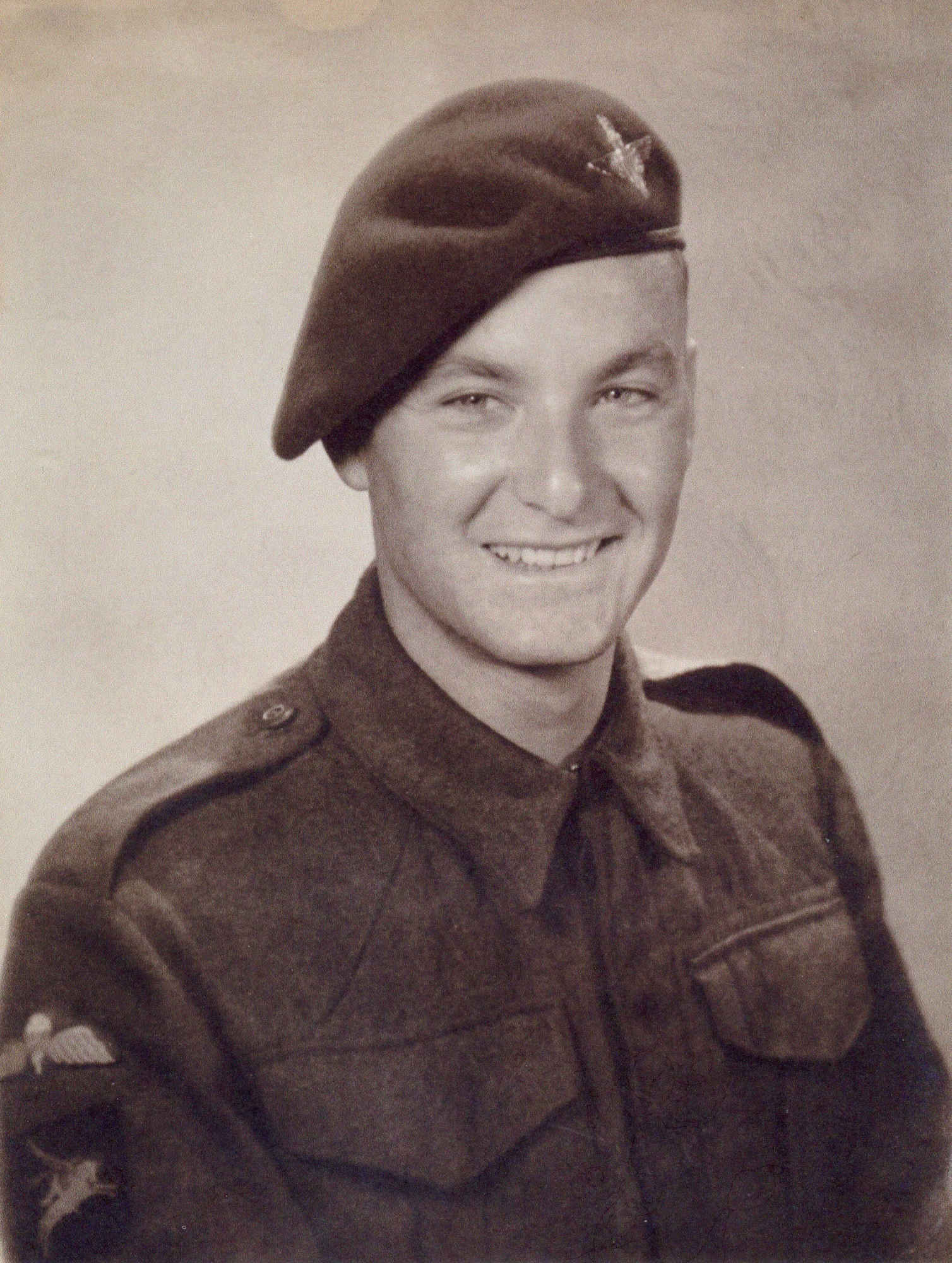
Dvr. John Joseph Kennell. No 2 Parachute Platoon. Having just been awarded his parachutist qualification wings, he is also wearing a Parachute Regiment cap-badge, which were given out to many men at R.A.F. Ringway, regardless of whether they were joining a Parachute Battalion or not! Courtesy of Patric van Aalderen.
Dvr. Jason Leslie Ransom, always known as 'Les', had been born on the 5th April 1922, and came from Hull. When Les heard that the war had broken out, he was working for his brother in Dunswell, near Hull, driving a milk van. His brother couldn't afford to pay him so he started driving for Jacksons as a delivery driver. They couldn't afford to pay him either so he then drove a tractor for his dad. After that, he got a job driving a lorry. He signed up at the recruitment office and was looking for a job driving a lorry. They put him on bomb damage driving a lorry of his own, cleaning out bombed out sites, shifting blocks and various other tasks. He enlisted into the Army on the 26th March 1942 and after volunteering for Airborne Forces, he was posted to the Company on the 9th July 1942. Les got his calling up papers in March 1942, he had to report to Barrhead between Glasgow and Paisley. He was there 6 weeks then got posted to Halifax to a holding company. It was while he was there, that he found out that they wanted volunteers for the Airborne Division. Les volunteered because it was a shilling a day more to fly gliders and 2 shillings a day more to be a parachutist than the pay he was currently on. Les went down to Amesbury in Wilshire and joined the 250 Company. He had a friend there called Charlie Clifford, he had volunteered at the same time as Les and Les knew him from when he was a lorry driver in Hull, Charlie was a lorry driver too and Les even pulled Charlie out of a dyke once down Dunswell Lane. Charlie and Les stuck together from then on, right up until they dropped into Arnhem.
A draft of 20 men arrived from the 9th Armoured Division, and 15 men from 253 Company, between the 1st and 3rd March, and the next day, 20 of them were sent on flying experience. No 3 Air Supply Course started on the 6th March, for 14 Aircrews, and the 'new' G.O.C., Maj-Gen. R.E. Urquhart, visited the Company and saw the Air Supply Course, the Workshops and was introduced to some of the Company Officer's. Then, on the 8th March, the 9th Troop Carrier Company, U.S.A.A.F. carried out a pannier dropping experiment from C-47 Dakota aircraft at Bottesford, using a new modified roller conveyer, to test the stability of the aircraft. Altogether, a stick of ten panniers were dropped, and it was deemed to have been very satisfactory.
No 1 Parachute Platoon took part in a night exercise on the 10th March, where they had to clear three dropping points and form dumps. Under observation from the A.A. & Q.M.G. and the C.R.A.S.C, the Platoon cleared 200 panniers in 1 ½ hours. The next day the Air Supply Course was moved to Harlaxton Hall area, and preparation began for a high profile visit. This turned out to be an inspection by General B.L. Montgomery, the Commander in Chief, 21st Army Group, on the 14th March, which itself, was a precursor for a Royal visit two days later.
Having been posted to the Company in January, Dvr. Donovan Edwards, was detached to Divisional Headquarters, who promptly sent him on Parachute Course 105, at R.A.F. Ringway, which ran from the 1st - 14th March. Having qualified and returned to Divisional Headquarters at Fulbeck Hall, he was soon after, posted back to the Company.
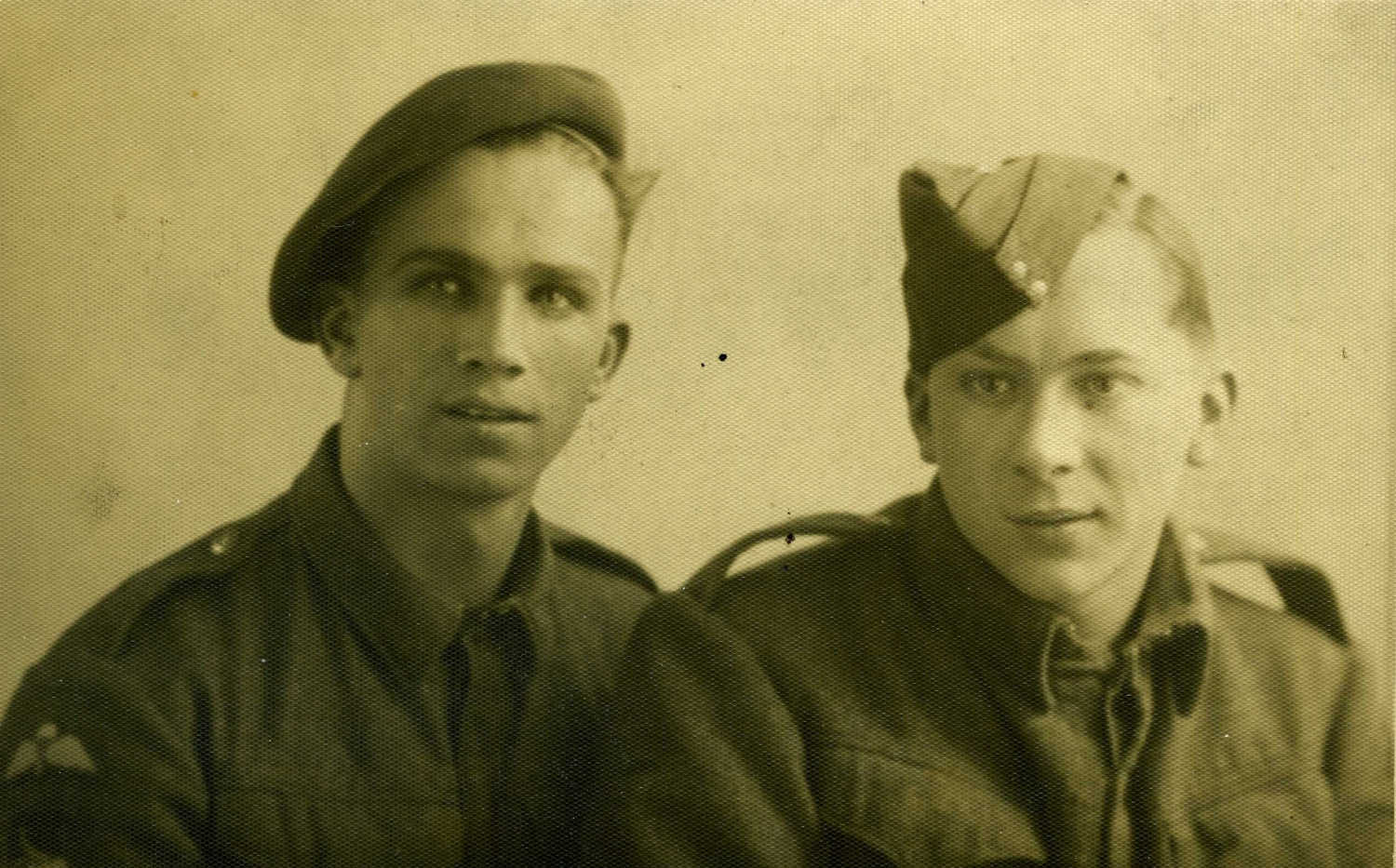
Driver. George Smith, No 3 Parachute Platoon, on the left, and a pal. 14 March 1944. Photo courtesy Mrs. Johanna Legg.
As part of an overall visit to inspect the 1st Airborne Division, on the 16th March, 250 and 253 Companys were on parade at Harlaxton Manor, along with 100 All Ranks of 93 Company, for His Majesty The King, where he arrived at 11.20 hrs. Capt. 'Bill' Gell: "The background to the photos was simply that King George VI came to Lincolnshire to inspect the Airborne Division, shortly before we left for Arnhem, and my Platoon was detailed to represent 250 Company. The senior officers in the background were General Urquhart, blotted out in each photo for security reasons (I could never understand this), and behind the King, wearing a beret is General Browning, and beside him the Chief of the Imperial General Staff, whose name I have forgotten! On the right of the picture is Lt. Col. M. Packe, C.R.A.S.C, looking apprehensive!" [6]
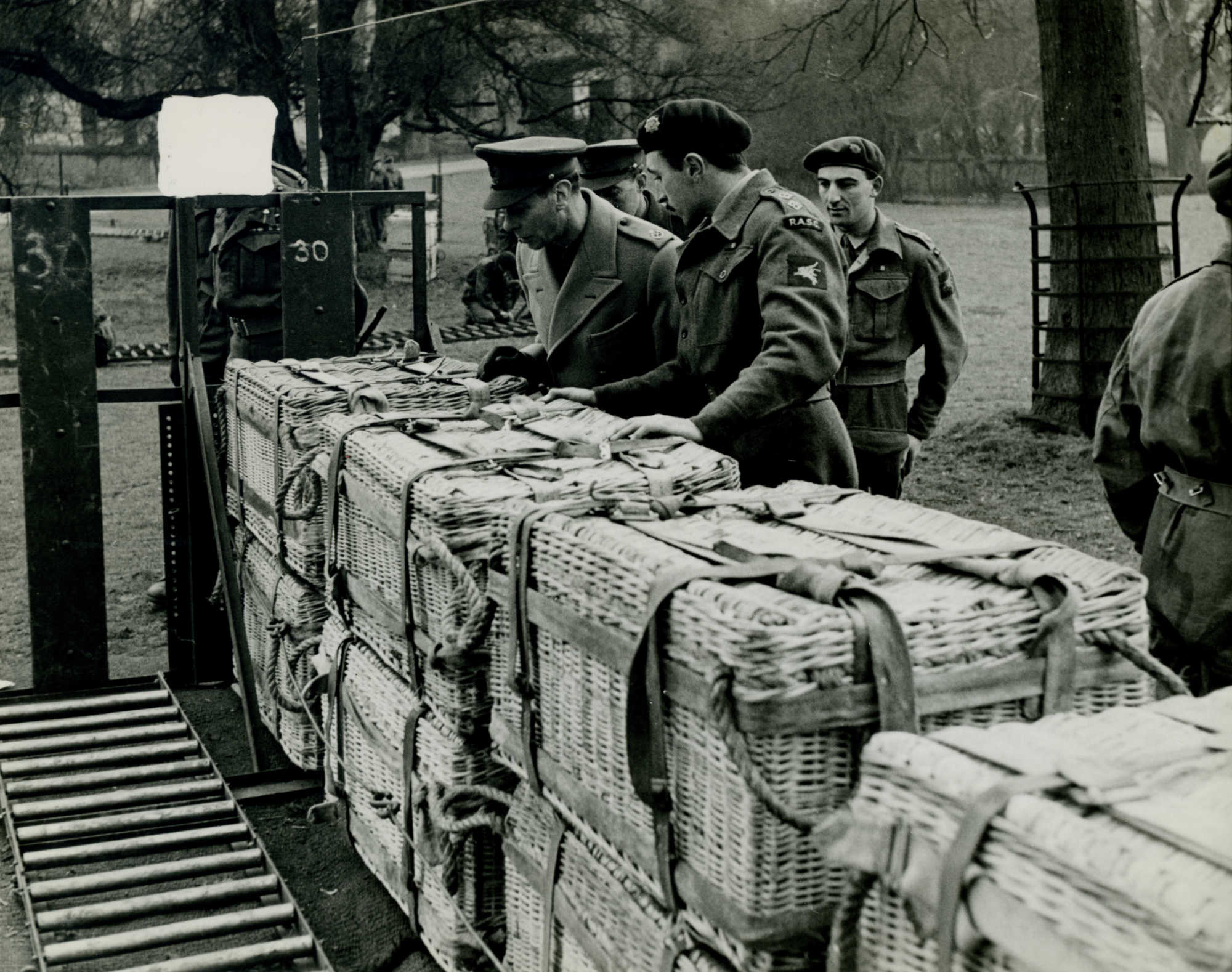
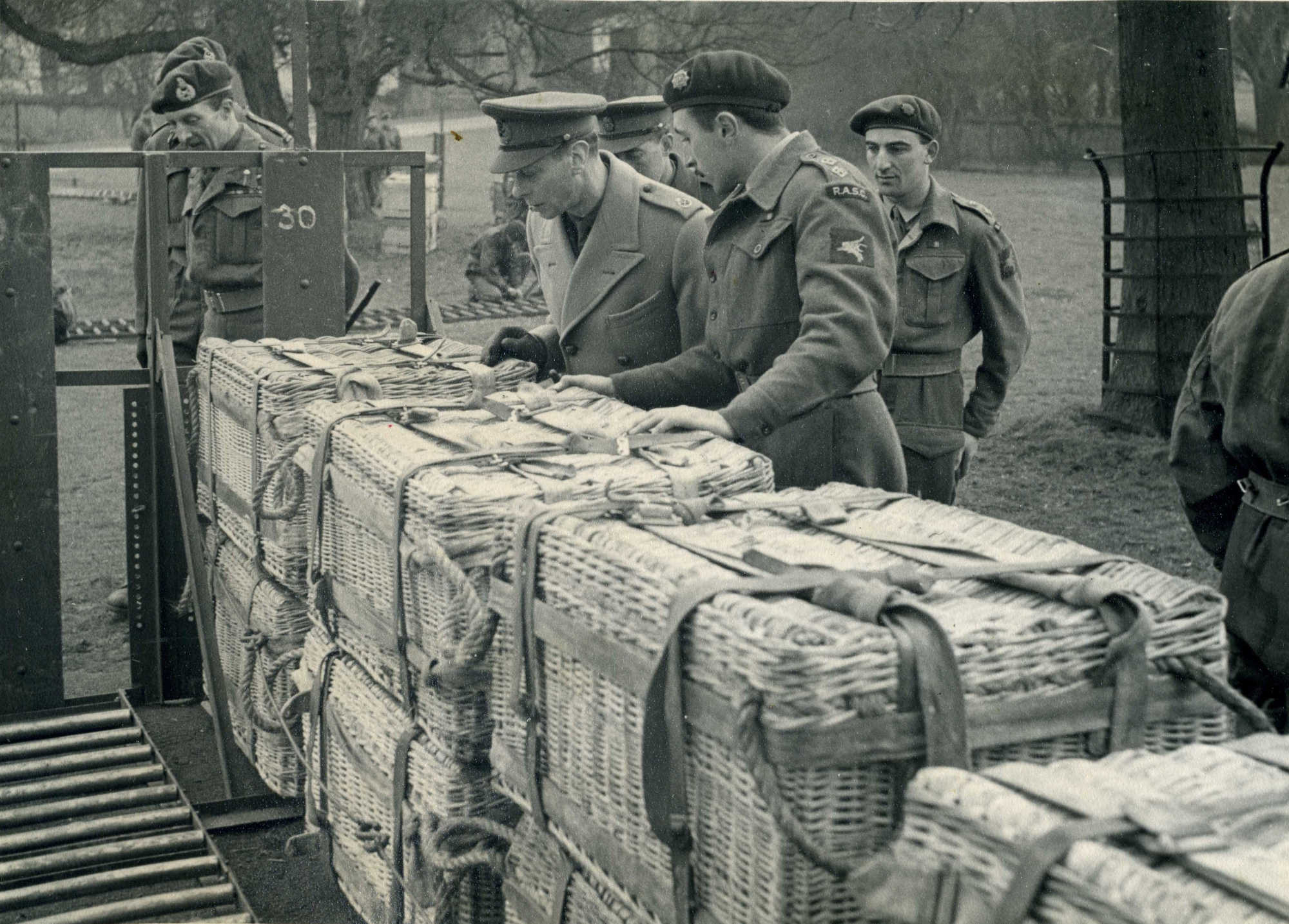
H.M. The King's visit to 250 (Airborne) Light Composite Company, R.A.S.C. Harlaxton Hall, LINCS. 16th March 1944. The King is having the process of dispatching panniers, using a roller-conveyor, from a Dakota, explained by Capt. Gell. "When George VI came to inspect various units of the Division and 250 was included. I was given the job of presenting a demonstration to H.M. of our Company's function." L-R: Maj-Gen. R.E. Urquhart and Lt-Gen. F.A.M. Browning (blotted out for security reasons), H.M. The King, Capt. W. Gell (Commander No 3 Parachute Platoon), Lt-Col. M St J. Packe (C.R.A.S.C). H36714. Courtesy of Bill Gell.
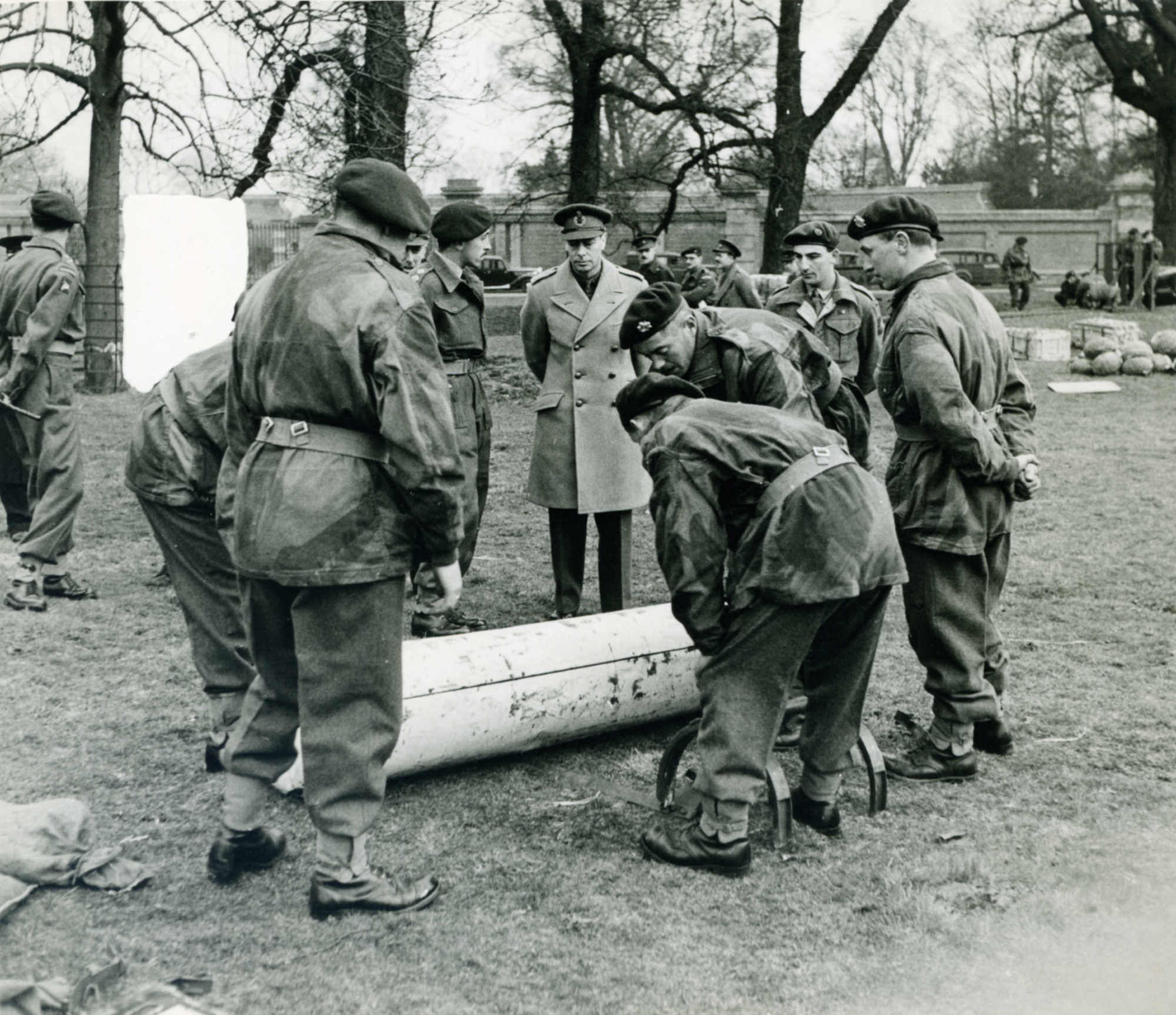
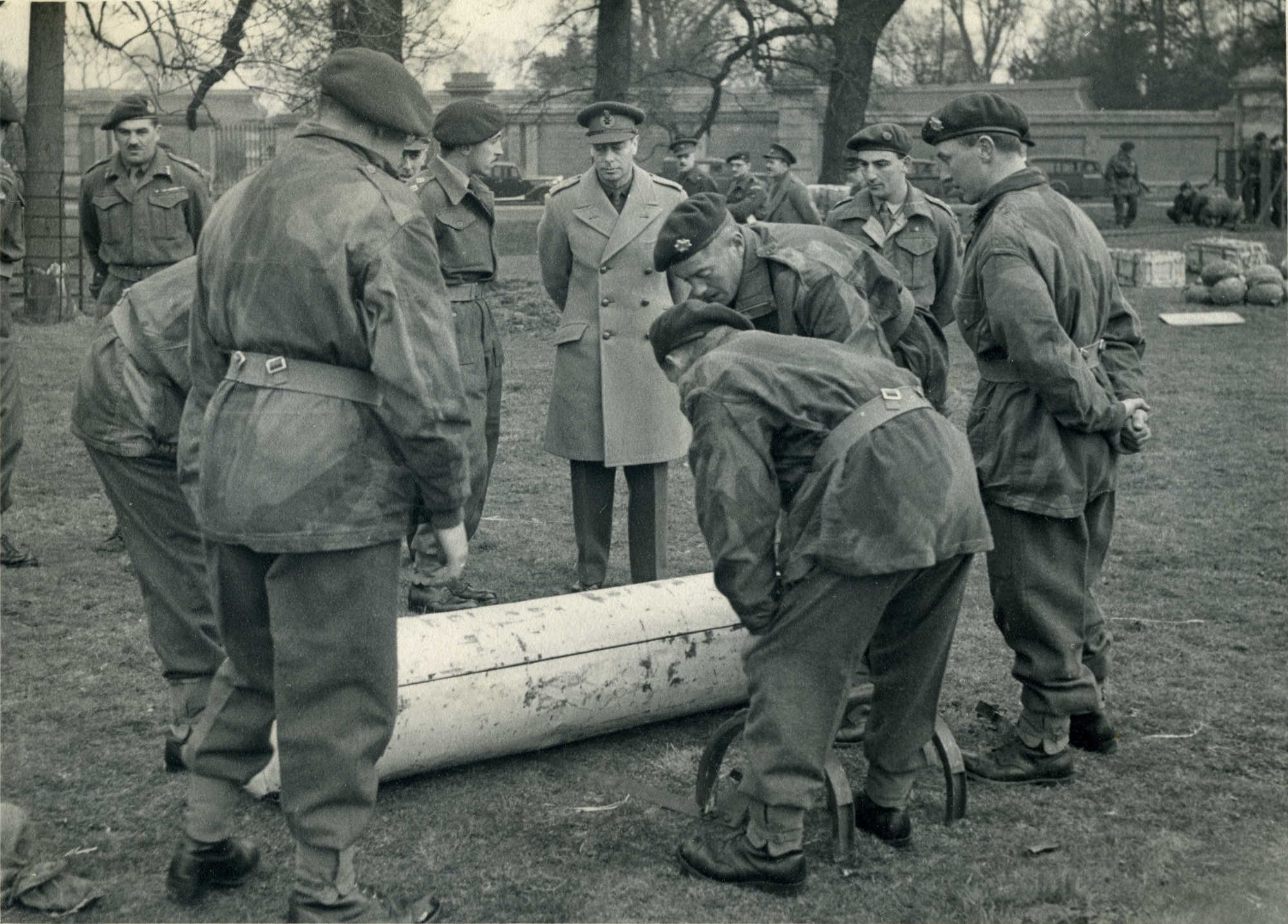
H.M. The King's visit to 250 (Airborne) Light Composite Company, R.A.S.C. Harlaxton Hall, LINCS. 16th March 1944. The King being shown a C.L.E. container. At the rear, L-R: Maj-Gen. R.E. Urquhart (blotted out for security reasons), Capt. W. Gell talking to the King, Lt-Col. M St J. Packe. Around the container, L-R: Back to camera: CSM. W. Gibbs, bending over in front of The King & Capt. Gell: Cpl. C.E. Pickering, hands behind his back: Sgt. A.S. Hoye. H36715. Courtesy of Bill Gell.
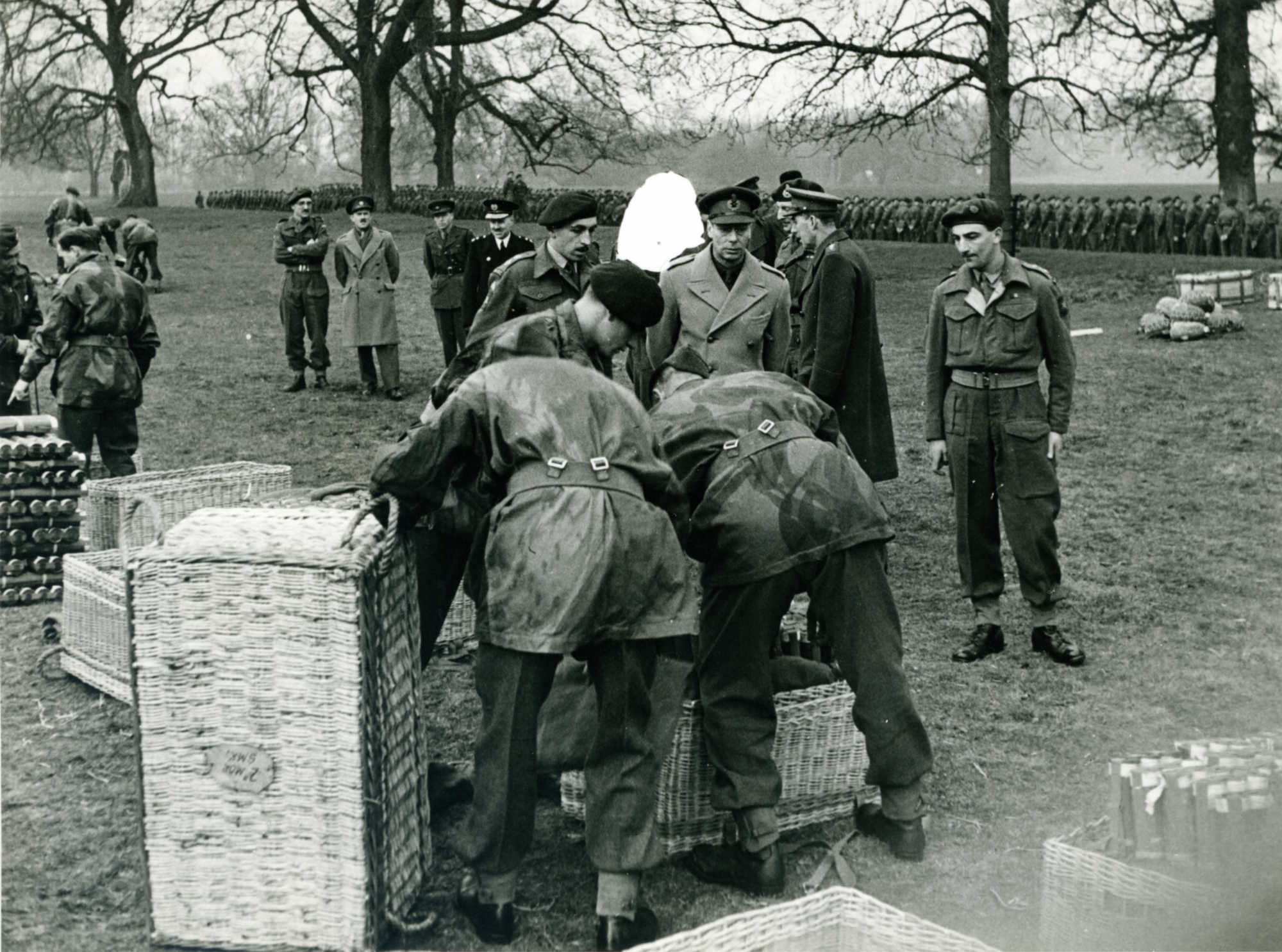
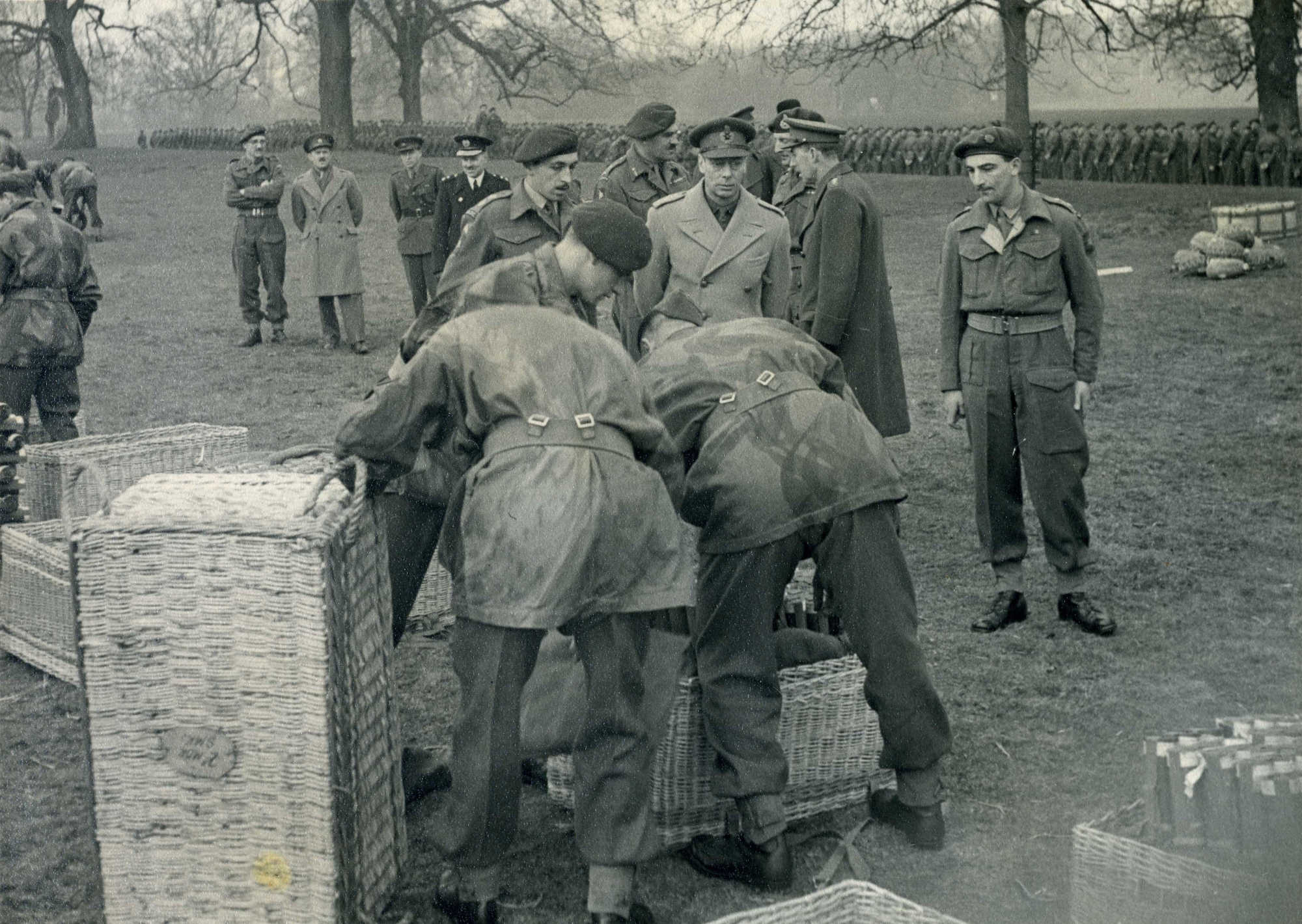
H.M. The King's visit to 250 (Airborne) Light Composite Company, R.A.S.C. Harlaxton Hall, LINCS. 16th March 1944. The King being shown the contents of some of the panniers. On the extreme left and right are stacked the carrying containers for 2" Mortar Bombs, and the pannier on the left has a disc stating '2" Mor, Smk'. L-R: Capt. W. Gell, Maj-Gen. R.E. Urquhart (blotted out), H.M. The King, Lt-Gen. F.A.M. Browning, the C.I.G.S. and Lt-Col. M St J. Packe. H36716. Courtesy of Bill Gell.
No 1 Parachute Platoon, however, were not present with the rest of the Company, as they had been attached to the 1st Parachute Brigade for Exercise 'William'. The air supply part of the exercise was carried out by vehicle, with supply dropping points being cleared, and dumps set up. The following week, on the 21st March, No 2 Parachute Platoon came under command of the 4th Parachute Brigade for Exercise 'SILK'. After some practice, and delays, Exercise 'SILK' eventually took place on the 25th March with the Air Supply phase being carried out by 43 aircraft, from the U.S.A.A.F. at Folkingham airfield, and 250 Company providing 18 of the crews, with the rest being supplied by 253 Company. The drop took place at 10.00 hrs, and collection of the supplies dropped, was carried out by No 2 Parachute Platoon, with the exercise being completed by 15.30 hrs. This was the first time that 253 Company had taken part in a Supply Dropping Exercise, as they now had a total of over 150 trained personnel.
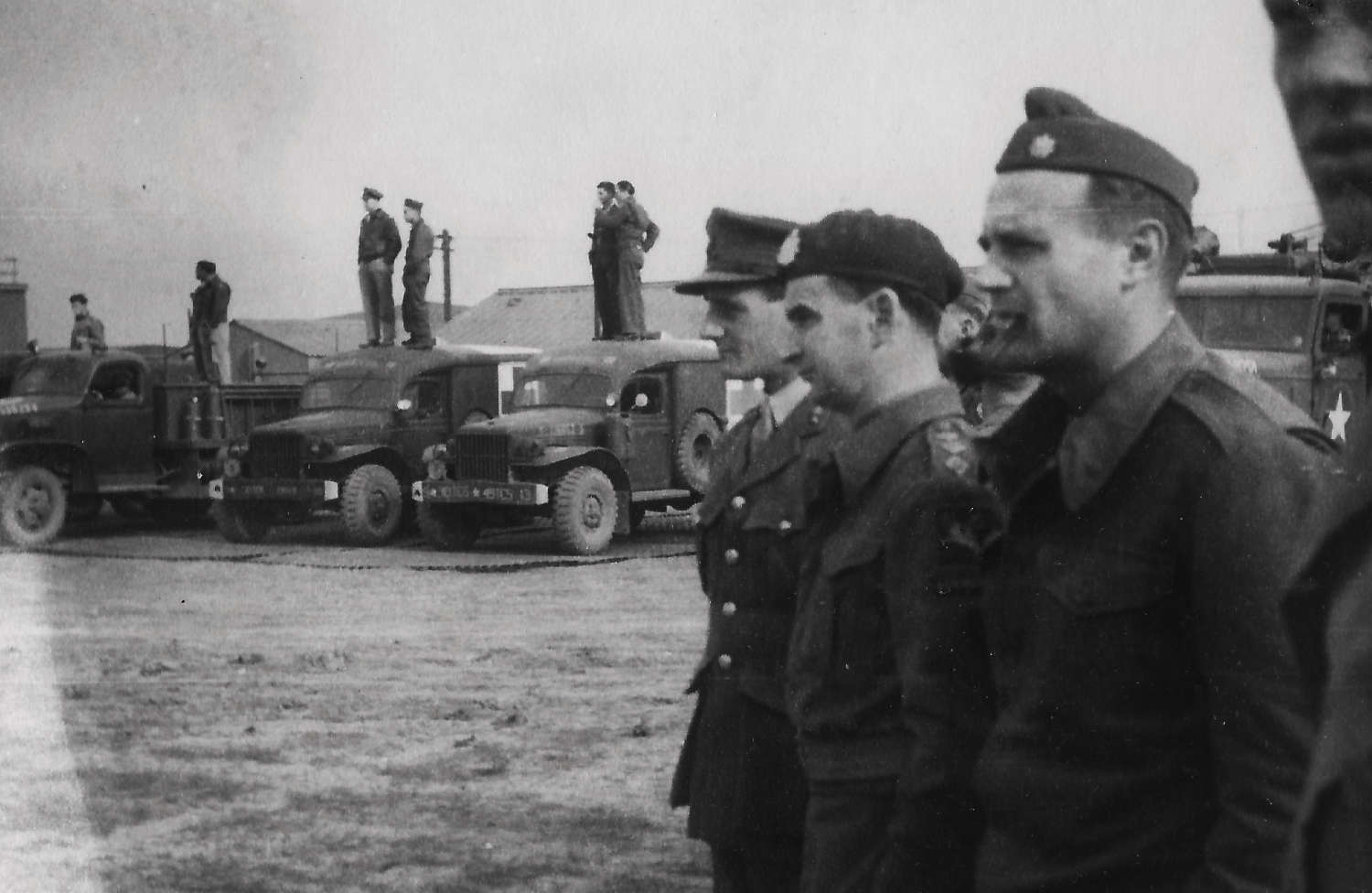
British & American officers watching a supply drop demonstration, Folkingham, March 1944. In the centre, wearing a beret (with the Border Regt cap-badge) and with the Pegasus flash is Capt. E.W.R. Gaff. (1st Abn Bn The Border Regt). The American Officers are from the 313th Troop Carrier Group, U.S.A.A.F. Courtesy of Bob Hilton.
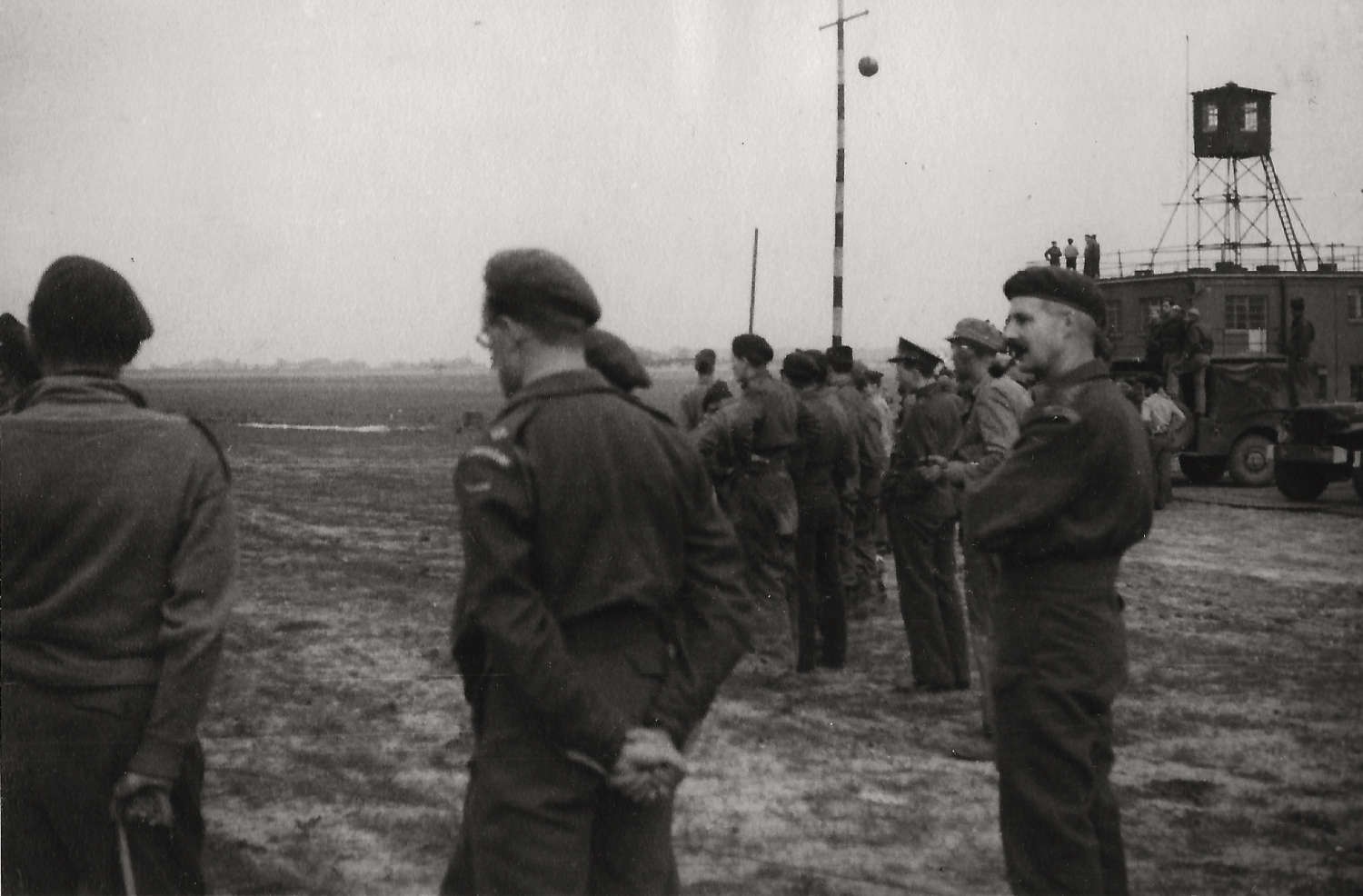
An unidentified group of British Officers (except for Capt. Gaff) with American Officers of the 313th Troop Carrier Group, U.S.A.A.F. Folkingham Aerodrome. March 1944. They are watching out for a demonstration of a supply drop. Courtesy of Bob Hilton.
On the 27th March, forty two men of the Company carried out a parachute drop at Netheravon from C-47 aircraft of No 46 Group, R.A.F. Over the next two days, a total of 135 Jeeps were brought back to the Company from Birkenhead, and the Transport Platoons started their takeover of them. On the last day of the month, 'C' Transport Platoon began taking over accommodation at 'The Bungalow' on Doddington Road, Lincoln.
A group of just three men, from the Company, attended Parachute Course No 108 at R.A.F. Ringway, from the 19th to the 31st March 1944, with Dvr's. Hatton, Hutchinson and Lawes all qualifying.
In the War Diary of the 16th Parachute Field Ambulance, R.A.M.C. is the following entry for the 29th March: 'Representatives from 181 Air Landing Fd Amb and 133 Parachute Field Ambulance, visited Unit and watched a demonstration by Airborne R.A.S.C. Composite Coy personnel of packing panniers containing 2nd Line Supplies.' This was probably carried out by members of 250 Company, and shows how seriously other units were now taking the Air Supply side of their training.
At this time the Company had the following officers present:
|
Major. J.H. Gifford. Capt. J.L. Cranmer-Byng. Capt. D.T. Kavanagh. Capt. R.G.L. Norgate. Capt. K.R.D. Tucker. Capt. P.E. Bushby. Lieut. W.V.A. Gell. Lieut. B.C. Winter-Goodwin. Lieut. R.G. Adams. Lieut. V.G. Cordery. Lieut. P.B. Alsop. 2/Lieut. P.E. Thompson. |
O.C. 2 i/c. Company HQ. Company HQ. Company HQ. Workshops. Platoon Commander. Platoon Commander. Platoon Commander. Platoon Commander. Platoon Commander. Platoon Commander. |
Lieut. Derek Foster, who had only recently been posted to the Company from 253 Company, had been classed with a permanent disability, and downgraded to Medical Category 'B' (which had also meant a temporary reduction in rank from Captain), and was permanently attached to R.A.F. Keevil as a Liaison Officer.
At least one man 'escaped' Major. Gifford's inspection on the 1st April - Dvr. Cook - who was the only man from the Company to be sent on Parachute Course No 110 at R.A.F. Ringway, from the 1st to the 15th April 1944. At this stage, the Company were almost complete to their Establishment for parachute qualified personnel, and from now on, only small groups would be sent to R.A.F. Ringway. The next one being Course No 113, 22nd April to the 9th May, with Lt. Thompson, L/Cpl. Horne, Dvr's. Charsley, Carter, Hinkley, Martin, Robinson, Sparke and Whiting qualifying. Lt. J.I. Tansell was attached to this group from the 93rd Company.
On the 2nd April, the unit underwent another change in designation. They were now to be known as 250th Company R.A.S.C. (Airborne Light Composite). Maybe those in charge thought that it would not have been appropriate to have re-named it the day before!
From the 4th to the 6th April, No 2 Parachute Platoon carried out their preparations to support the 4th Parachute Brigade on Exercise 'Dorothy'. Other Platoons carried on with a variety of training, with 'D' (Transport) Platoon practising loading drills on a Horsa mock-up on the 4th April. On the 5th, the Company Football Team beat the 21st Independent Parachute Company 5 - 1. On the 6th April, HQ and 'C' (Transport) Platoons carried out a route march.
Exercise 'Dorothy' was due to begin on the 7th April, but was postponed for 24 hours, due to the weather, which meant that the re-supply drop was cancelled. However, two 3 ton trucks with drivers from 253 Company had already reported to the Pre-Packed Dump at 09.00 hrs, to meet with Air Despatch Crews of 250 Company, to load up and move to Folkingham airfield, where they commenced to load the aircraft. The message of cancellation, not coming through until late in the afternoon.
It is worth going into some detail of No 2 Parachute Platoon, and its supporting Transport Section on Exercise 'Dorothy', to understand what was involved in the planning and execution of these exercises.
In Section 8, 'Marking of Containers', of the 4th Parachute Brigade Exercise Orders was the following: Containers will be painted white when issued. Units will paint in black the chalk number of the aircraft at the parachute end of each container. The first container on an aircraft should have no other marking except the chalk number, the second container should have the chalk number and one bar, and so on. Then in Section 9, 'Container and Door Load Chute Colours'. Each unit will be issued with container and door load chutes in its unit colour. Units using Bde RV will have Bde colour (Blue).
The only part that concerns No 2 Parachute Platoon here, was the Bde R.V. information, the rest concerns unit containers. Notice the information about the colour of the parachutes, which refer to individual units. No 2 Parachute Platoon was to be transported in two 3-tonners, driven by 93 Company, from their billets to Folkingham aerodrome, where they would join up with the 10th Parachute Battalion. Their vehicles were to have the Chalk Number on them that corresponded to their parachute aircraft. The Platoon was to be flown by the 313th Group of the 52nd Troop Carrier Wing, United States Troop Carrier Command.
Further on in the Exercise Orders at Section 16, 'Action of Brigade Glider Group'.
(a). 2 A/L A-tk Bty RA and 6 L.A.D. who are acting in the exercise in a ground role will report to Bde Tpt RV at rd junc 413273 at 072400B and will move from there to Harbour Areas on orders from Bde.
(b). Instructions for loading, and air movement table for Bde Tpt Gp and vehs of Pl 250 Lt Comp Coy RASC, will be issued when it is known if gliders are available. Should gliders not be available action will be taken as in sub-para (a) above.
If the glider-borne element was able to take part, the R.A.S.C. Platoon were allocated 5 Jeeps and 10 Trailers. They would initially come under the command of the Brigade Staff Captain, then after arrival at the Transport R.V, the B.R.A.S.C.O. would take over.
The exercise would entail the 21st Independent Parachute Company flying in first, with two plane loads of the Brigade as an Advance Group, to be followed by the Main Body, which is the part that No 2 Parachute Platoon was with.
In the Brigade Admin Orders at Section 7, 'Re-supply', were the following instructions ref the R.A.S.C. involvement:
(i) 1 [2] Pl, 250 Lt Comp Coy RASC will drop with Bde HQ Gp on D.Z. 'A' together with the following ammunition: 14 Panniers .303 Mk VIIIZ. 48 Panniers 3" Mortar. This ammunition will be collected as soon as possible and will remain on the SDP.
(ii) Remainder of RASC Pl will land by glider on L.Z. 'B' on evening 7 Apr. They will carry 15 Pannier loads of Mk VIIIZ and 3" Mortar representing 60% 1st Line in 5 Jeeps and 10 Trailers. These vehs will proceed to Bde Tpt RV at rd junc 413274.
(iii) Panniers of all natures, amn, sups, pet, wireless bty's, spares, etc, will be dropped on D.Z. 'B' at 1100 hrs 8 Apr. These will be collected and will form Bde Dump on, or near D.Z. 'B'.
It was further stated that there would be half an hour gap from the Main Body drop and the Glider Group landing, which was to take palace at North Luffenham Airfield
The exercise eventually got under way on the 8th April, and lasted for 24 hours. Thirty six men of No 2 Parachute Platoon took part, jumping successfully onto D.Z. 'A', just to the East of the village of Empingham and Rutland Water. After their initial tasks were complete, they were used in the Brigade Headquarters Defense role. The R.A.S.C. Transport Section came under command of the 21st Independent Parachute Company for part of the exercise, which appears to have gone very well. The only part of supply dropping that did take place, was at 14.30 hrs, when 253 Company carried out a Demonstration Drop from two aircraft at Folkingham airfield in front of their own O.C, Major. Gordon.
However, there were still some arrangements that needed to be worked out in detail with the U.S.A.A.F. Troop Carrier units that carried them. As an example, in Section (f) of the Post Exercise Report, dated 16th April 1944, is the following statement: A Bn Comd reports as follows:- "The O.C. Tpt Gp USAAF arrived at my A/C never having heard of ground signals on the DZ to prevent dropping. He accordingly had to be briefed by me, but had no time to brief the remaining pilots. It was stated that, 'If we don't drop, no one else will, as we are the leading ship'. This method may work by day, but may not by night".
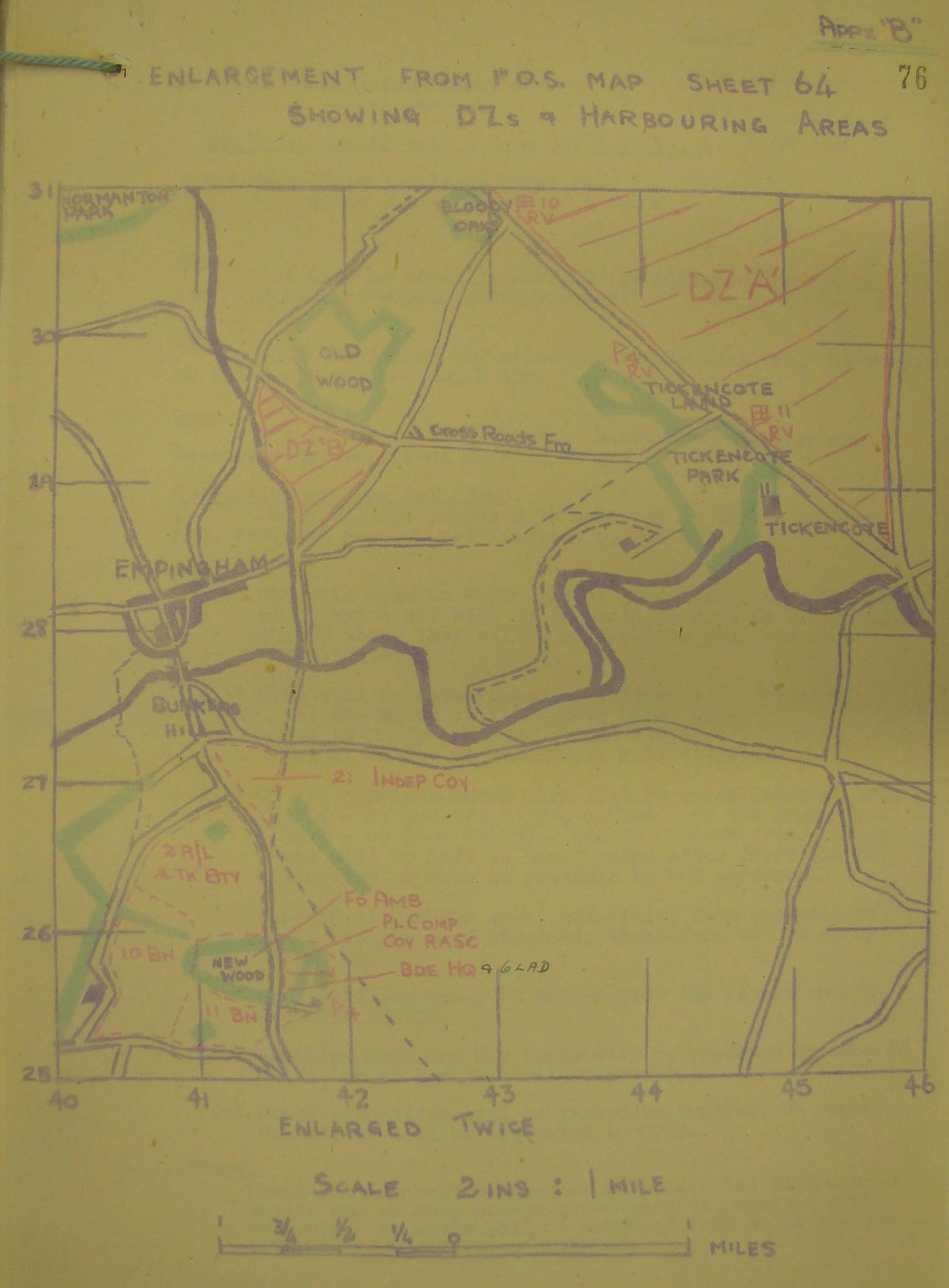
Map 04b. Exercise 'Dorothy'. England. 8th - 9th April 1944. This involved the whole of the 4th Parachute Brigade, including its supporting No 2 Parachute Platoon from the 250th (Airborne) Composite Company, R.A.S.C.
On Easter Sunday, 9th April 1944, the Company held a Service at All Saints Church in Branston, and then had the afternoon as a 'Rest Day'.
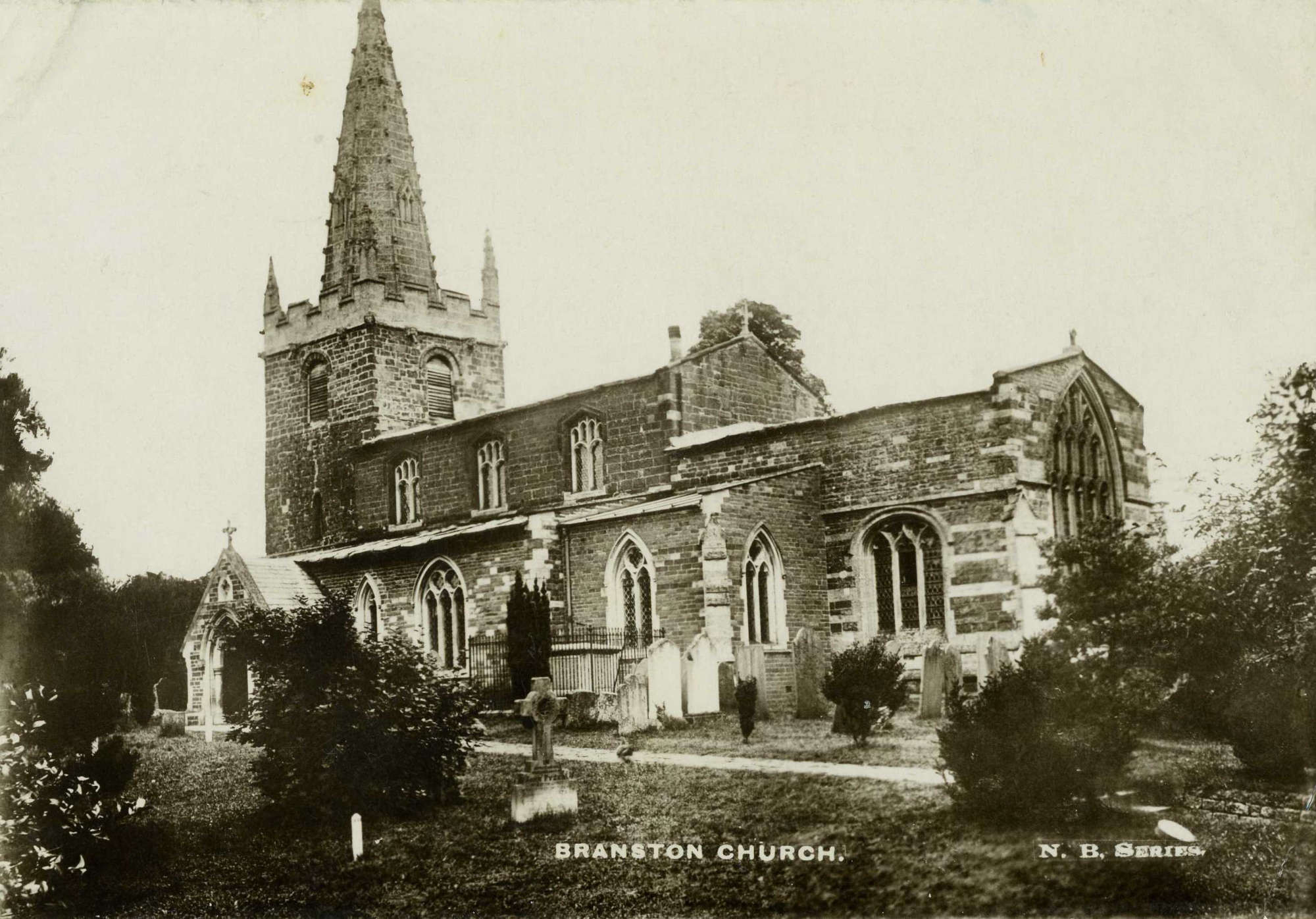
All Saints Church, Branston, Lincolnshire. 1910. Courtesy Bob Hilton Collection.
Dvr. 'Jack' Taylor remembers Branston very well, as after the war, he decided to marry a girl he had met, and then settle there: "As the days passed, there was the normal routine of army life, route marches of several miles which would last for hours and take us through many of the villages. We carried these out by marching for 50 minutes and then resting for 10 minutes. There were other training exercises, physical training, target practice which we carried out at the Longhills and other locations around the country, and we wanted to get to know about the village of Branston and the residents who all made us very welcome. The Salvation Army had turned a house in Silver Street into a little tea room, there were a number of shops, a village hall and a recreation ground. There were also two public houses, The Plough which never seemed very popular, and the Waggon and Horses which seemed rather small with the bar or rather the servery being at the end of a passageway and consisted of some planks of wood resting across two beer barrels. The beer was drawn off from barrels situated at the rear of the server and collected in a large metal measuring jug from which it was poured into your glass. There was a piano in a room off on the right and I am sure that in a week it had more beer poured into it than some of the patrons consumed. The dance in the village hall was the highlight of the week. A man named Frank Harrison was member of the band and his party piece was to place his violin on his head and play it. I later learned he was a painter and decorator and he lived in Johnson Villas at Branston. It was at one of these dances that I first met a lovely lady named Gwen Tindall from the neighbouring village of Potterhanworth. I did not know it at the time but she would eventually become my wife." [1a]
No sooner had No 2 Parachute Platoon and its Transport Section returned to 'Camp', than the planning for an exercise with the 1st Parachute Brigade began, and on the 11th April thirty five men of No 1 Parachute Platoon dropped at Ropsley Heath on Exercise 'Tony'. This was followed the next day at 22.00 hrs, by a supply drop from 48 aircraft from Folkingham, with the Air Despatch Crews being supplied by 253 Company, but the drop was 4 miles from the D.Z, meaning that the collection of stores was not completed until the 13th April.
As part of the preparation for the secondary roll of Defence Platoon's certain NCO's were sent on specialist courses, Cpl. Burnham Blaxley: "At this time a number of N.C.O's were selected to attend a Weapon Training Course at the Northern Command Weapon Training School at Catterick. This comprised of target practice, assault movement, defence and pull back. There was also a test on Field craft which entailed Movement without being observed. All of this I thoroughly enjoyed. The course including travel only lasted about 10 days. It was after this Exercise Mush took place." [1c]
Whilst No 1 and No 2 Parachute Platoon's had been away on their individual exercises, normal work and regular training was being carried out by the rest of the Company with 2 Officers and 55 Other Ranks also carrying out Field Firing on Hardwick Ranges, from the 12th to the 15th April. On the 16th April, twenty Aircrews from the Airfield Platoon went to R.A.F. Broadwell in preparation for Exercise 'Mush'. This was a Corps size exercise and No 1, No 2 and No 3 Parachute Platoons all took part, under command of their respective Brigades, from the 18th April. The next day, the Jeep Sections moved to their airfields, but a tragic accident occurred and Dvr. Harry Swinburne was killed, with two other men being injured, when a Jeep in which they were travelling, overturned.
At an inquest, a verdict of misadventure was returned by the coroner, after hearing evidence from various witnesses, which included that of Flying Officer. Robert Gardiner, an R.A.F. Medical Officer, who was called to the scene. He found Dvr. Swinburne lying on the side of the road dead; and Dvr. Dennis Ward lying unconscious, with Dvr. Neil Bell suffering from shock and facial abrasions. In the case of Swinburne, death was instantaneous, due to a fracture at the base of the skull.
Dvr. Neil Bell, in evidence, stated that he was a passenger in the Jeep and trailer, being driven in convoy along the Stow-Burford Road. The driver was Dvr. Dennis Ward with the other passenger being Dvr. Swinburne. They had stopped at an Inn to purchase some cigarettes and then Ward sped up to catch the convoy. About a mile further on, the Jeep began to sway from side to side. "I don't remember what happened after the jeep had gone onto the grass verge," said Bell.
The speed of the Jeep just before the accident, said Bell, was about 50 miles an hour. The wind screen blew off and the driver braked fiercely. In answer to Mr. D.G. Cox-Howman (representing the Treasury solicitor and on behalf of the War Department and the driver) an officer, Lt. Benjamin Charles Goodwin, said that 50 m.p.h. was not an unusual speed for the jeep.
Exercise 'Mush' went ahead on the 20th April, with No 1 and No 2 Parachute Platoons jumping, and No 3 Parachute Platoon landing by glider, along with all three Jeep Sections. At 17.00 hrs, the re-supply flight took off from R.A.F. Broadwell, and C 47's of 46 Group R.A.F. dropped the loads in the early evening. There were 25 aircraft dropping to the 1st Parachute Brigade, and 25 aircraft dropping to the 4th Parachute Brigade. There was a separate supply drop to the 1st Airlanding Brigade and Divisional Troops by 48 x C 47's of the U.S.A.A.F. flying from Langar airfield, with the Air Despatch Crews being supplied by 253 Company. A mass supply drop from 96 x C 47's was also carried out. The exercise went on until the 22nd April, when all units returned to their respective billets and Camps, with the following day being a 'Rest Day'. This was the day that the Company Detachment returned from North Africa and Italy, and coincided with yet another reorganisation of the Company.
This is how Cpl. Burnham Blaxley remembered this exercise: "The platoons involved moved our transport in advance to strategic places in Oxfordshire. We were then briefed regarding our objective which was to be transported by Glider to recognized Landing Zones (L.Z) where our jeeps had already been parked. The Glider Pilots were British and the Tugs were to be American. Reveille was at 11.59 hrs when we made our way to the parked Gliders off the runway. There were approximately 28 men per Glider including Officers. In due time we took off and flew in close formation in a repeated circle until dawn. When the sun came up the clouds below us were completely silver and it was quite cold. When a signal was given we were cast off, we were below the clouds by then and could see quite clearly the layout of the fields below. Our pilots found a spot which seemed suitable and headed for it in a steep dive, giving themselves as much room as possible across this quite small field. We finished up draped over a hedge at the far end of the field. This taught us many things one of them being to ascertain all loose equipment was adequately secured on take off as flying pieces of equipment can be quite destructive. We were minus one wing which was laying nearby but the large side door was intact which allowed us easy exit. The officers and planners were experimenting as well, this was new to all of us." [1c]
The designation of the unit was changed to the 250th Company R.A.S.C. (Airborne Light) in accordance with the new War Establishment 1/286/3, effective as of the 24th April 1944. Apart from giving the personnel who had taken part in exercise 'Mush' the day off, the kit checks began immediately.
The new organisation was as follows:
Company Headquarters.
No 1 Parachute Platoon.
No 2 Parachute Platoon.
No 3 Parachute Platoon.
C Transport Platoon.
D Transport Platoon.
G Transport Platoon.
Relief Driver Increment.
Workshop Platoon.
See Appendix IX for the full War Establishment.
The O.C, 2 i/c and Adjt, would now be busier than ever drafting the Part I & II Orders necessary for the reorganisation of the Company, especially as it meant that the Airfield Platoons were to be disbanded and spread out to the other Platoons. However, the real responsibility for seeing that this all got done, was left to the C.S.M. and the C.Q.M.S.
C.S.M. Walter Gibbs was 33 years old and had been in the Army since the 26th October 1928, having enlisted as soon as he was 18 years old. He had joined the Company upon its formation, and had been an early volunteer to carry out a parachute course, but injured himself on ground training and was considered unfit to carry on. C/Sgt. Alec Smallwood was born on the 10th March 1917 and had enlisted on the 1st March 1940, and was another early member of the Company having joined it in September 1940.
Lt. Richard Adams had the following memories of these two key men: 'Sgt-Maj. Gibbs was like a sergeant-major in a music-hall sketch. Almost illiterate himself, he was a veritable scourge on parade and would bawl out his victims mercilessly, until they, standing to attention before him, were deeply relieved to receive at last his customary conclusion: "Right! On yer way, on yer way! Outa me sight! Yer idle, yer idle." I remember John Gifford once telling Sgt-Maj. Gibbs that he should communicate something or other in a letter to Div. H.Q. "Me, sir?" said Gibbs. "Write a letter, sir? Got 'ighly trained staff to do that, sir."'
'Everyone in the Company was an individual, known by name and ability to the O.C. I remember now, particularly, the Quartermaster Sergeant. Smallwood was a personality in the Company, gentlemanly, light-hearted, buoyant and amusing, extremely good at his job, with a wheelbarrow full of surprises (as any good quartermaster should have) and his own little coterie of assistants, including L/Cpl. Goodfield. Goodfield, amongst other things, was a brilliant pianist and, together with Smallwood, splendid company in a pub. Particularly memorable was their dual rendering, prestissimo, of "Susie, Susie, sitting in the shoe-shine shop, she sits and shines and shines and sits and sits all over the shop." (Anyone who got it wrong had to buy a pint.)'
Another man who remembered Sgt Maj. Gibbs, was Dvr. 'Jack' Taylor: "The normal routine of army life continued and one day we had a visit from Sergeant Major Gibbs from Company Headquarters. He told us that our fitness levels were dropping and so we would be starting early morning training runs commencing at 6 am. Now with him being somewhat obese (some said he was a fat so and so) we insisted that he came with us. He agreed and he said he would be right behind us. And he was, on a pedal cycle!" [1a]
This was not the only occasion that he was noted for accompanying the Company on a bike on physical training, as he had also done it in North Africa on a folding bike, whilst they were on a cross country run! The rest of April was spent in the reorganisation, normal work, training, route marches, a C.R.A.S.C. Conference for the Company Commanders, and on the last day of the month, Sunday, 30th April, there was a Church Parade and Service at Branston Church.
The 1st May began with the introduction of Unit Censorship. In practical terms, this meant that the Other Ranks letters home now had to be read, and 'vetted' by the officers, a task which most of them did not enjoy! A four day Waterproofing Course for four N.C.O's of the Company, with 93 Company, was completed on the 3rd May. That same day, the Company Boxing Team took part in a match held at Waddington Airfield in competition with the R.A.F and the U.S.A.A.F. The Company won by 5 bouts to 2.
Between the 4th and the 8th May, conferences and preparations for Exercise 'RAGS' took place, with 49 trailers of Compo being loaded on the 7th May, and preparations completed and vehicles 'lined' up on the 8th. This was a Divisional Exercise, of the ground element, of which the object was to practice the Division in the role of an advance after the initial airborne phase has been completed, and contact had been established between the seaborne and airborne elements. Nearly the whole of the HQ, R.A.S.C, 93 Company (with over a hundred 3-tonners), and 250 Company with 135 Jeeps, and 120 Trailers, would take part. Company Headquarters, 'D' Transport Platoon and the Workshops moved to the area of West Ella (just to the north of Hull) in Yorkshire, on the 9th May, and participated in Exercise 'RAGS' until the 14th, when they returned to Camp. During this period, the Parachute Platoons had been carrying out other training, and 'C' Platoon had been detached to a Transit Camp.
Cpl. Burnham Blaxley remembers this exercise: "An intensive course on the Yorkshire moors followed this. All live ammunition was used with a 10 degree aim off. As we moved from site to site we had to invent casualties which could them be dealt with on site by the Medics. We continued with this for a number of days living rough with just a groundsheet nothing more. Eventually we occupied an old mill at Holmefirth which became our base. This training really hardened us off." [1c]
Capt. R.G.L. Norgate and 2/Lt. L.E.D. Daniells (who had been posted to the Company on the 27th April, and took over command of the 1st Re-enforcements), attended Parachute Course No 116 at R.A.F. Ringway, from the 13th to the 28th May, along with Dvr's. Law and Simcox. All passed the course of eights descents, which consisted of two jumps from a balloon in daylight, five from aircraft and a night balloon jump. Unusually there were quite lengthy reports written about the officers performance; "Capt. Norgate. This officer is a good parachutist. He has worked really hard throughout all training. He has been an example to the rest of the stick and his instructor speaks very highly of him. He is cool, alert and determined when in the aircraft or balloon. He has always been smart and punctual. He has been a good example in his stick, he is popular and is a good mixer. He is a good leader. 2/Lt. Daniells. This officer is only a medium parachutist. He worked hard on G.T. [Ground Training] In the balloon he was a little nervous. He gives the impression that he is tough and with more parachuting experience should make a good parachuting leader. He was an example to the rest of the stick, asked plenty of questions on parachuting, and seemed to enjoy the jumps after the first two balloon descents."
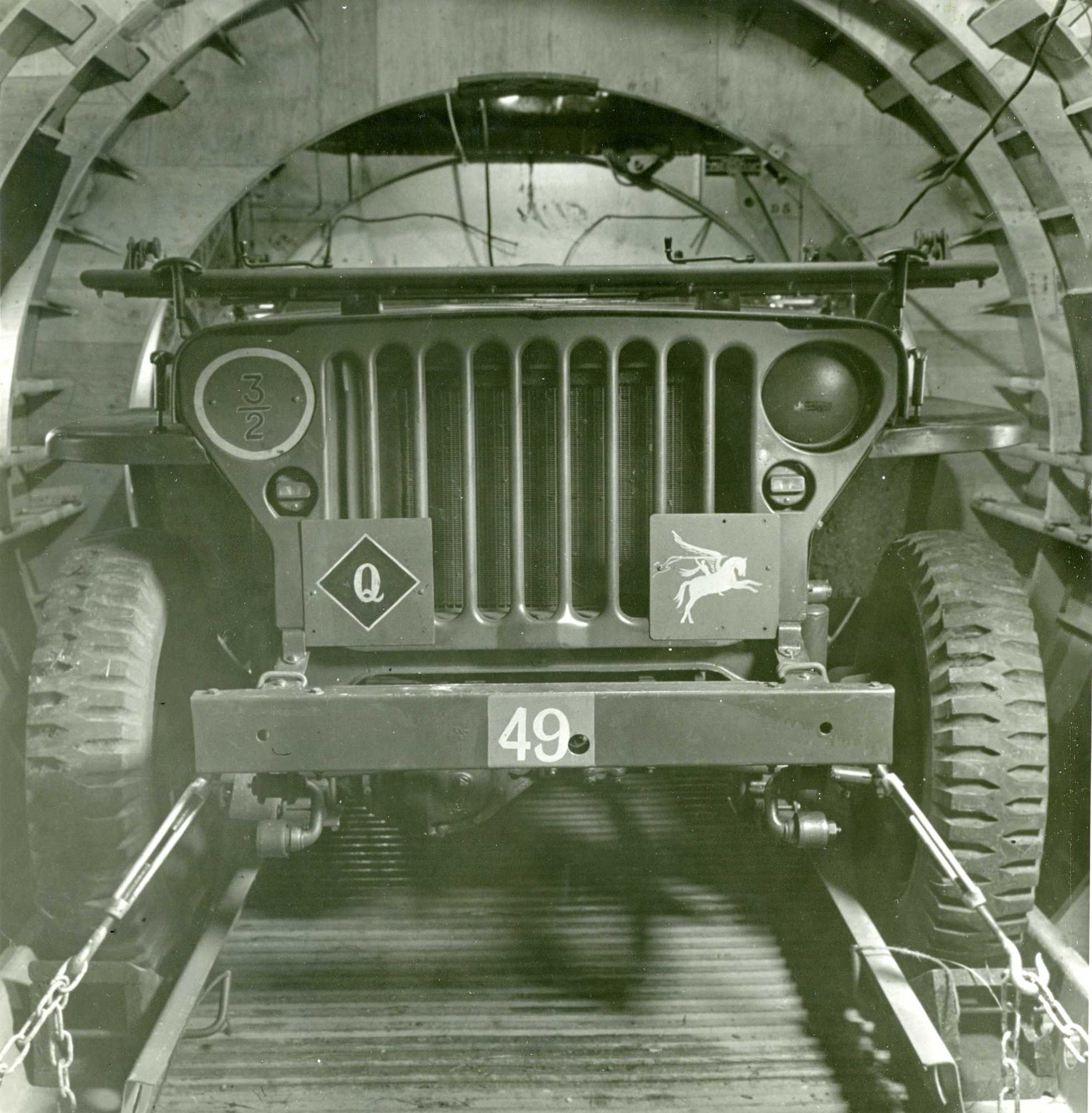
A Jeep fully shackled in place, inside a Horsa glider. Part of a series trials, at the A.F.D.C. showing the different configurations of loads inside the glider. The Jeep has been borrowed from 249th (Airborne) Field Company, R.E. May 1944. Courtesy of Airborne Assault Museum, Duxford.
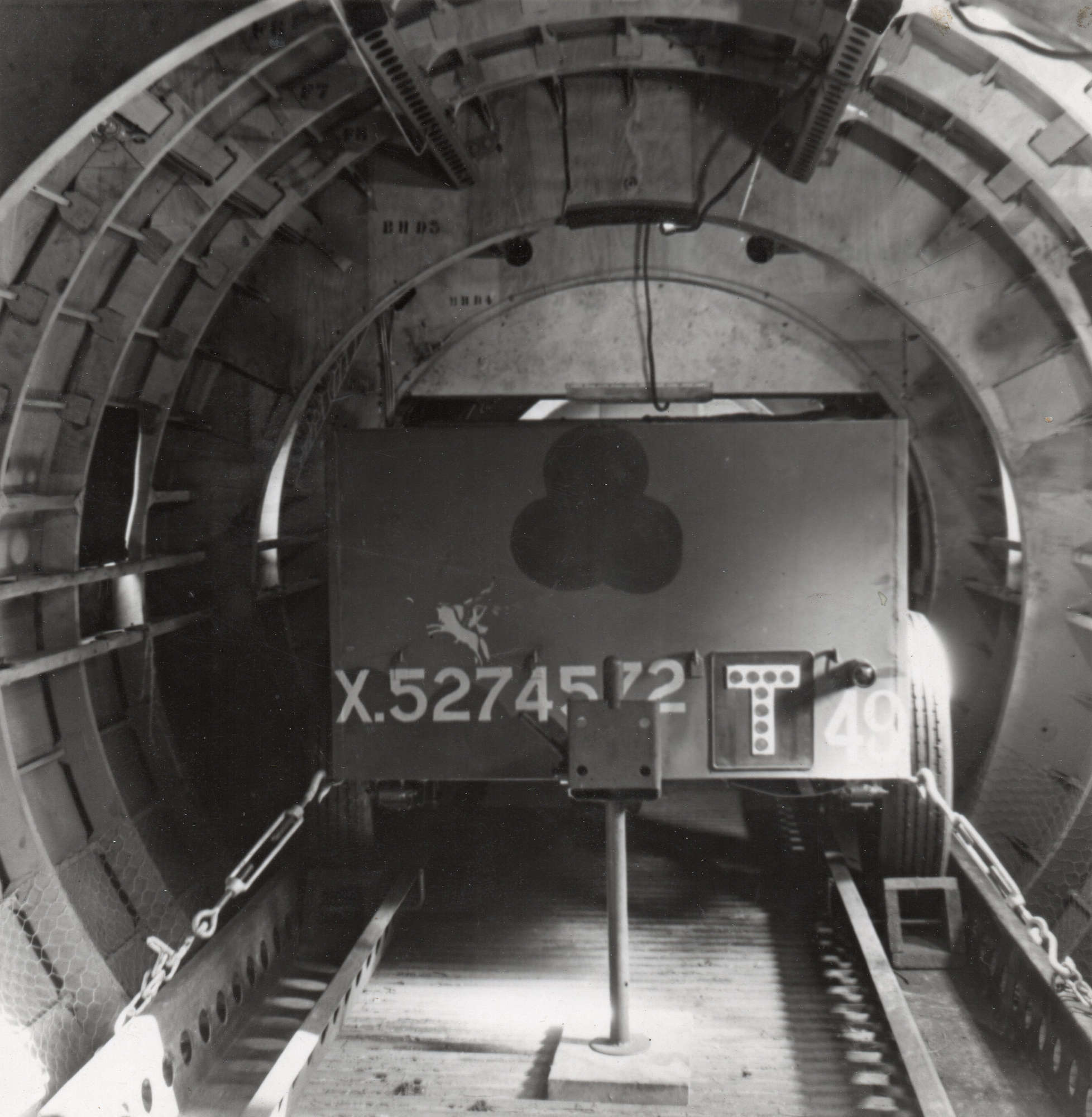
An Airborne Trailer fully shackled in place, inside a Horsa glider. Part of a series trials, at the A.F.D.C. showing the different configurations of loads inside the glider. May 1944. Courtesy of Airborne Assault Museum, Duxford.
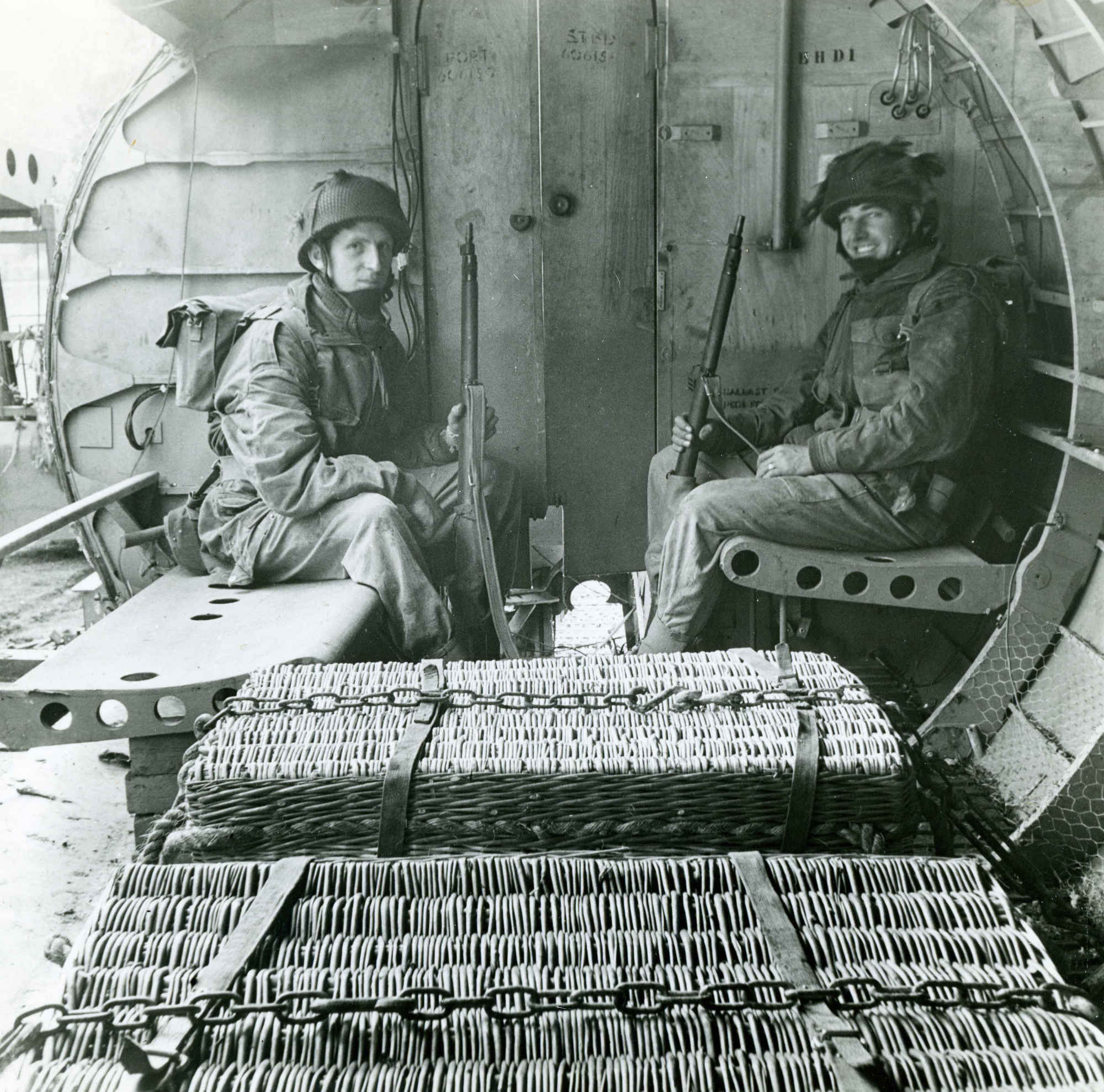
Looking forward inside a Horsa glider, showing the seats and positions for troops, when equipment is shackled in place, in the main part of the glider - in this case panniers. Part of a series trials, at the A.F.D.C. showing the different configurations of loads inside the glider. May 1944. Courtesy of Airborne Assault Museum, Duxford.
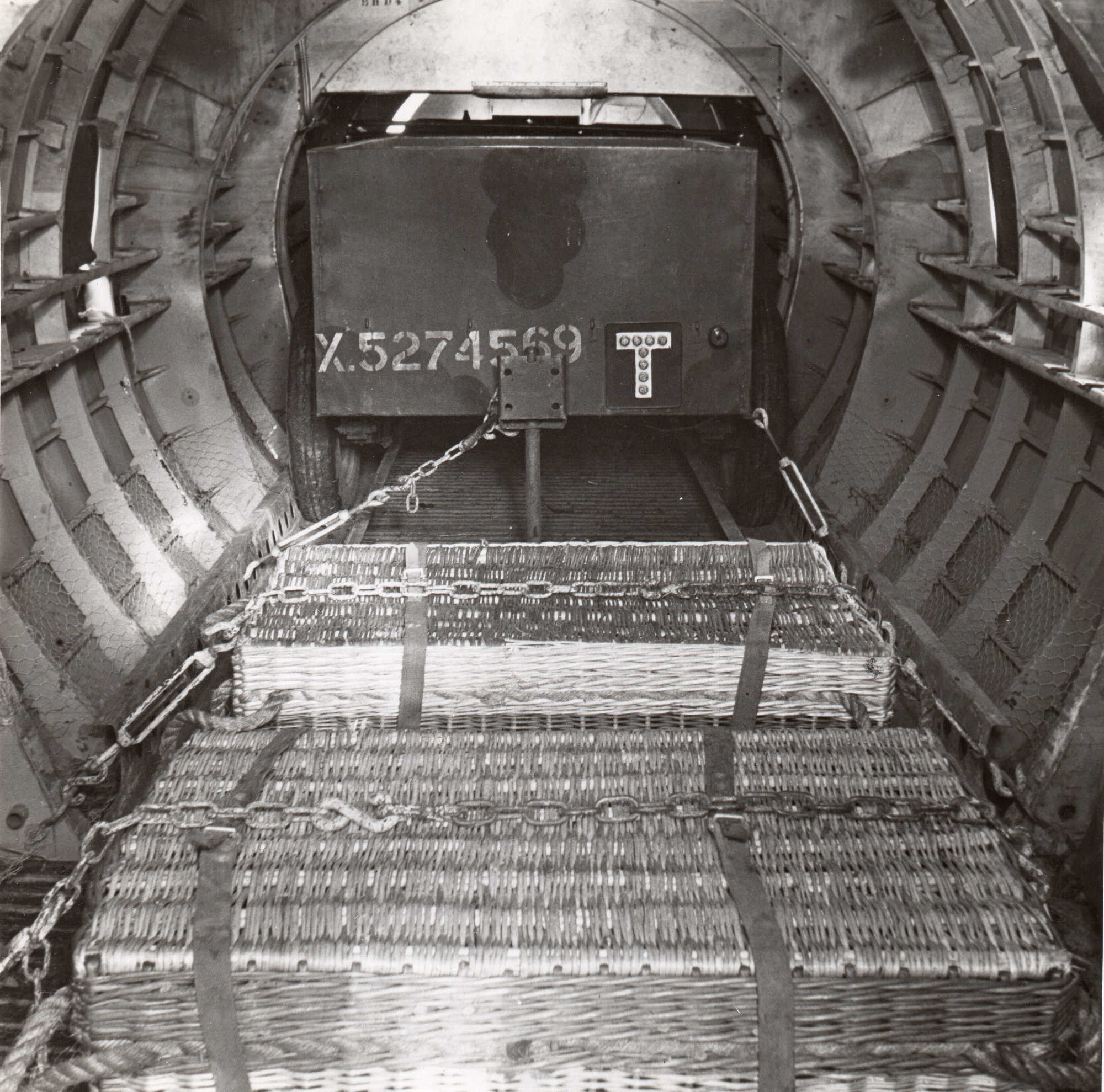
Looking towards the rear of a Horsa glider, showing two panniers and an Airborne Trailer shackled in place. Part of a series trials, at the A.F.D.C. showing the different configurations of loads inside the glider. May 1944. Courtesy of Airborne Assault Museum, Duxford.
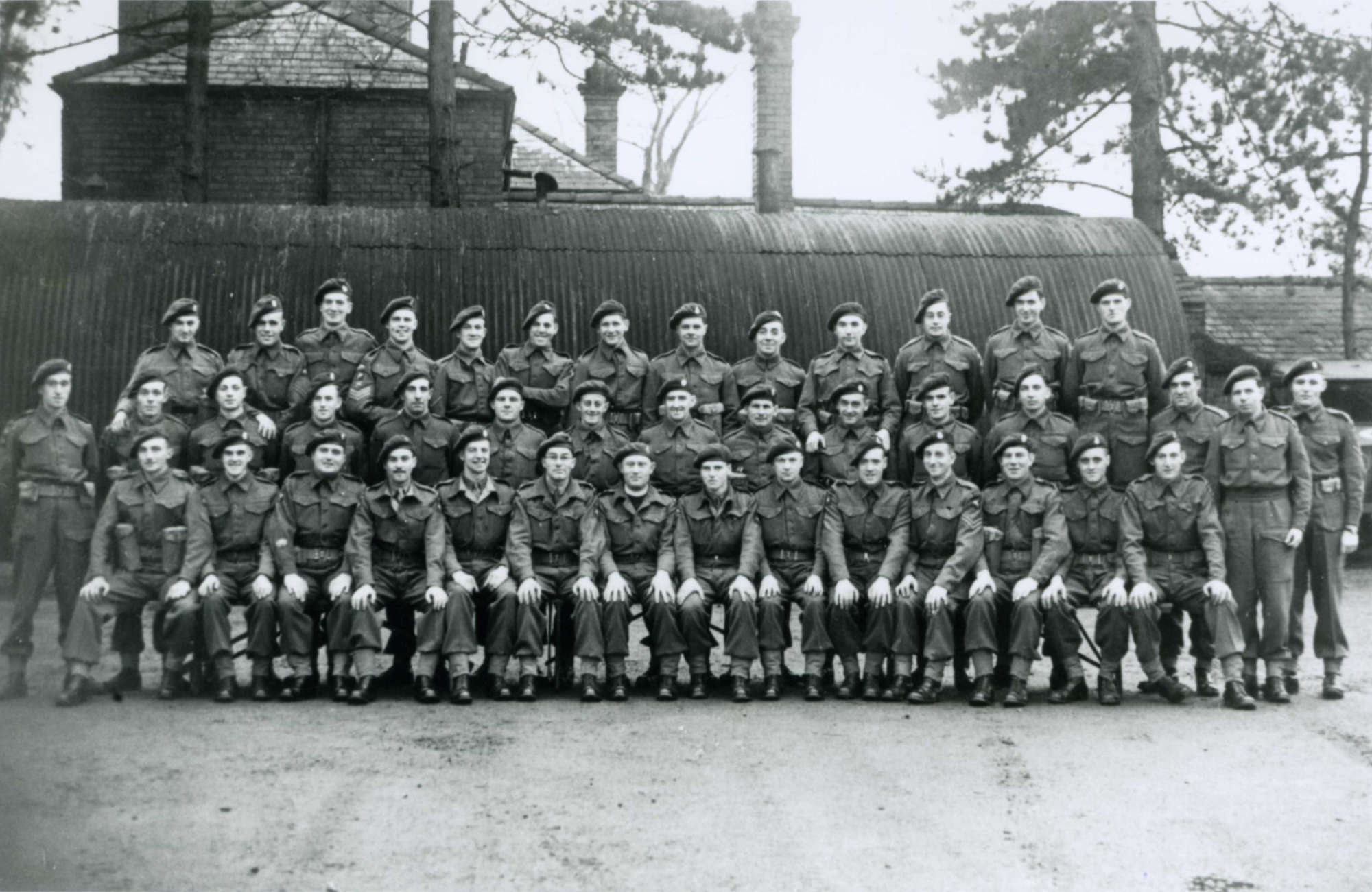
Headquarters Platoon, 250th (Airborne) Light Composite Company, R.A.S.C. Moorlands Hotel, Newark Road, Lincoln. 1944. Rear rank, L-R: Cpl's. P.K.F. Tull, J.W. Tennant, ? , S/Sgt. G. Myers (APTC), L/Cpl. T. Rae, Dvr's. G. Gadsby, W.G. Bullock, ? , ? , L/Cpl. H.G. Scurlock, ? , Dvr's. P. Prescott, W. Knowles. Middle rank, L-R: Sgt. W.C. O'Dell, ? , ? , Dvr's. R. Warrington, C.E. Sheppard, A. Tompkins, ? , L/Cpl. K.R. Thomas, ? , Dvr. R.R. Nielson, ? , ? , Dvr. R. Kimber, ? , Cpl. K. Morrey, L/Cpl. C.A. Goodfield. Front rank, L-R: ? , L/Cpl. N. Plumb, C.S.M: W. Gibbs, Lt. J. Grice, Capt. R.G.L Norgate, Maj. J. Gifford, Rev. H.L. Stapley (RA Ch D), Capt. J. Lawson (RAMC), C.Q.M.S: A. Smallwood, Dvr. T.L. Perry, Cpl. N. Howarth, Dvr's. G.E. Snow, G.R. Lambert, ? . Courtesy of Airborne Assault Museum, Duxford.
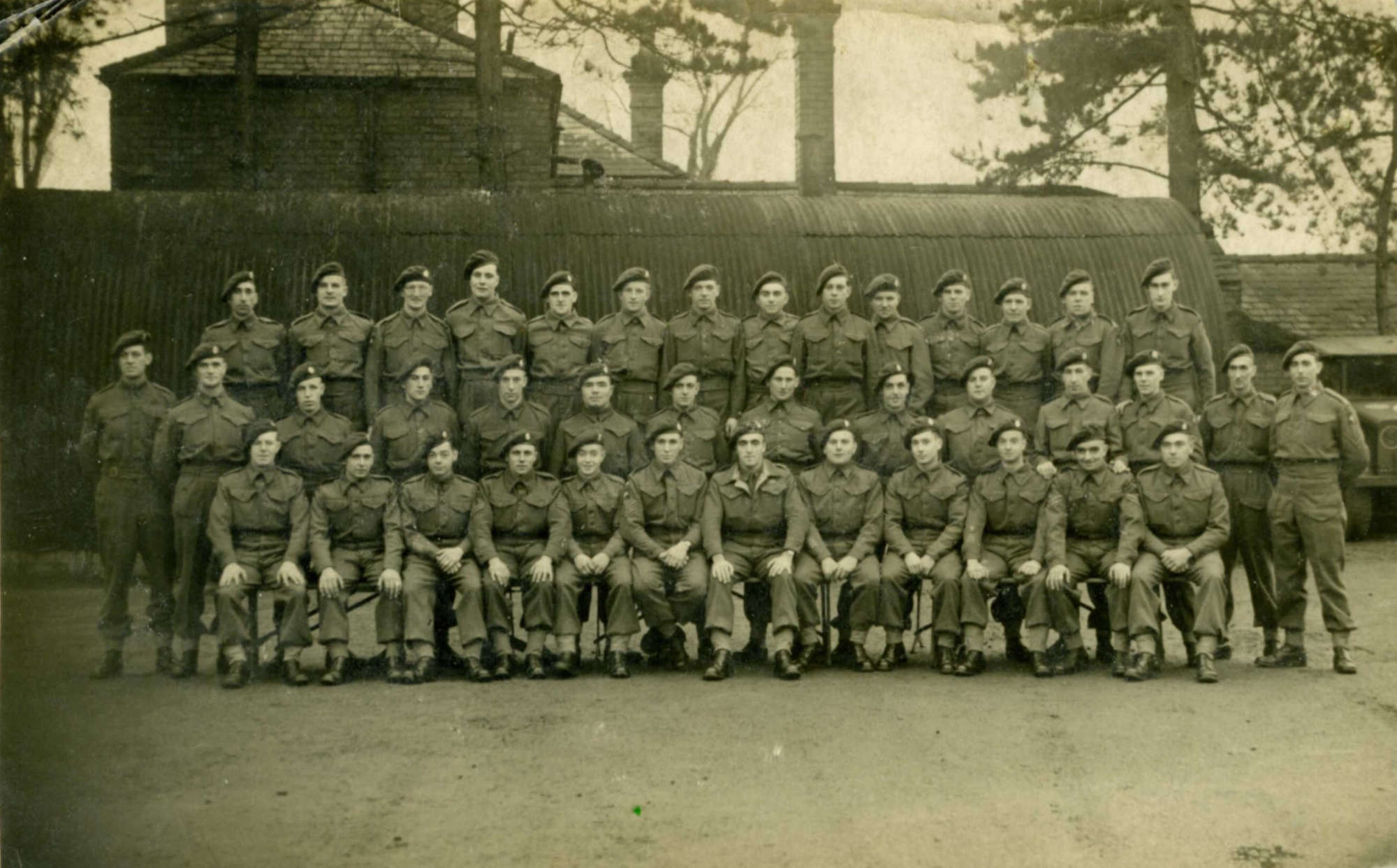
'G' Transport Platoon, 250th (Airborne) Light Composite Company, R.A.S.C. Moorlands Hotel, Newark Road, Lincoln. 1944. Courtesy of Airborne Assault Museum, Duxford.
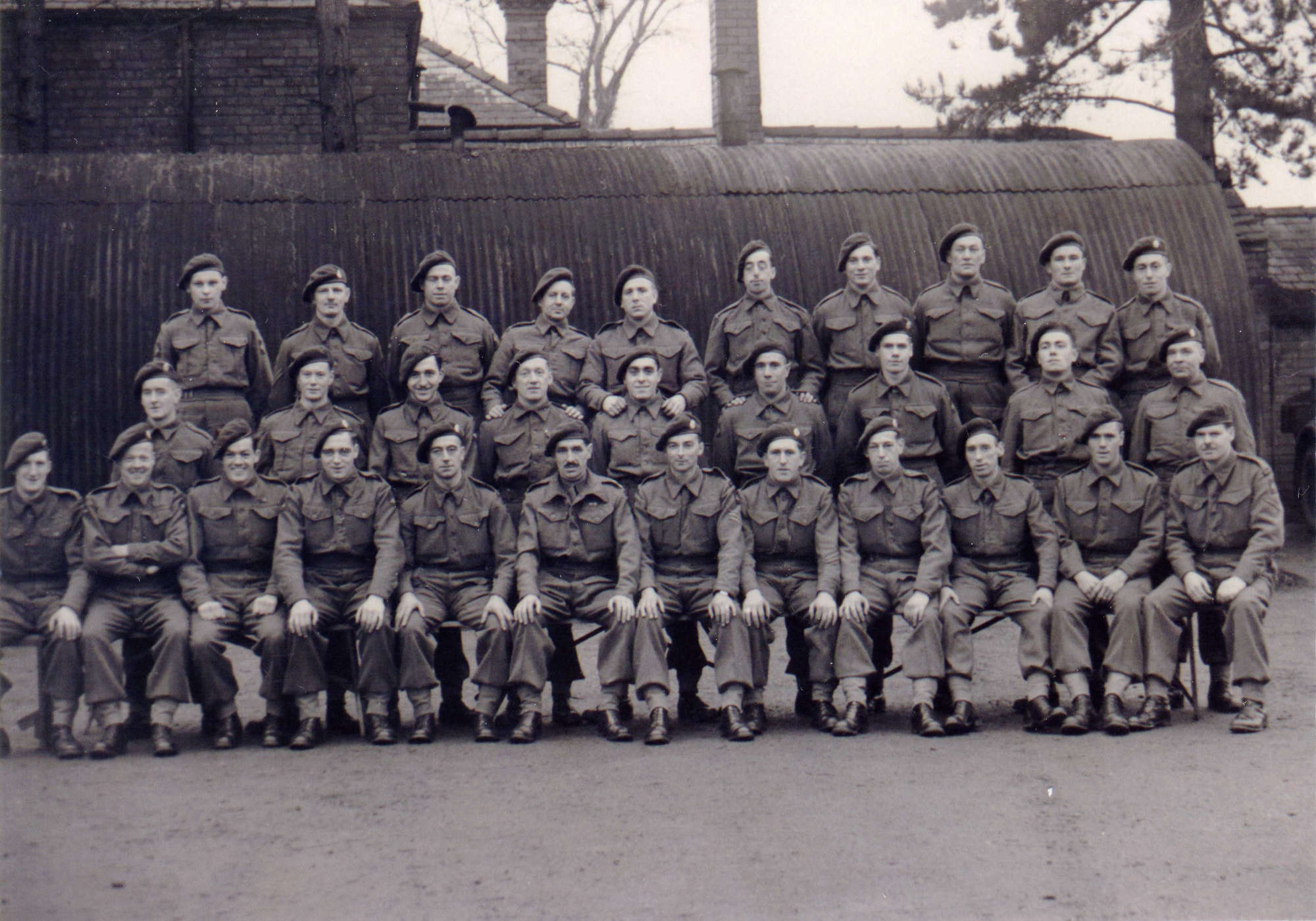
'F' Workshops Platoon, 250th (Airborne) Light Composite Company, R.A.S.C. Moorlands Hotel, Newark Road, Lincoln. 1944. Courtesy of Peter Scarcliffe.
From the 15th to the 25th May, normal training, field firing, vehicle maintenance and glider experience were carried out, with short periods of leave for some of the Company. On the 26th and 27th May, a signals exercise was undertaken. This period of normal activity was interrupted on the 28th May, when a message was received from the C.R.A.S.C. to send the Parachute Platoons to their respective Brigades. The next day kit was issued, and then on the 30th May, an inspection of the whole Company was carried out by the C.R.A.S.C. at 09.00 hrs, after which, at 15.00 hrs, the Parachute Platoons moved off to their Brigade locations.
The rest of the Company spent the 1st June clearing up after the departure of the Parachute Platoons, 'D' Transport Platoon and the Workshops completed their move to Moorlands at 18.00 hrs the next day. On the 3rd June, forty Other Ranks from across the Parachute Platoons were able to carry out a practice parachute drop. On the 4th June, a Church Service was conducted at Company H.Q. The next day, preparations were made for a move, and then on the 6th June, 'D' Day - Operation 'Overlord' - was announced. Eight 3 tonners were sent to the A.F.D.C. to collect parachutes, further equipment was also collected, and the Company was ready to move at 18.00 hrs.
Meanwhile, in Normandy, elements of the 6th Airborne Division's R.A.S.C. units were in action. Detachments of the 716th (Airborne) Light Composite Company had taken part in the airborne assault, and had already set up a D.MA. by the 7th June, which was re-enforced by Seaborne Parties shortly afterwards. The 398th Heavy Composite Company were scheduled to land, across the beaches, on D+4 (10th June), and they would be further supported by the 63rd Airborne Division Composite Company (Air Despatch) carrying out supply dropping.
The way in which the 6th Airborne Division deployed its R.A.S.C. assets would be almost the same manner in which the 1st Airborne Division would deploy its R.A.S.C. assets in any future airborne operation.
63 Company received an order from the D.D.S.T. on the 5th June that thirty aircraft were to be prepared for a re-supply mission - Operation 'Rob Roy'- flying from R.A.F. Blakehill Farm. This was amended on the 6th June to include a further twenty aircraft with ten flying from R.A.F. Down Ampney, and ten flying from R.A.F. Broadwell. The three separate parties reported to the airfields and the planes were loaded by 18.00 hrs. All aircraft set out at 22.30 hrs. The objective was attained, and the surviving aircraft were back by 02.20 hrs on the 7th June. Three aircraft and crews were reported missing from Blakehill Farm, with a further two aircraft and crews reported missing from Broadwell. The losses in Air Despatch Crews were made up from 398 and 716 Companys the next day.
It is worth putting in here the full report on Operation 'Rob Roy':
TOP SECRET.
APPX 'D'.
Copy No 4.
REPORT. SUPPLY DROP - 6/7 June 44.
1). AIRCRAFT AVAILABLE.
The following aircraft were placed at Airborne Troops disposal for Supply by Air on night 6/7 June 44:-
|
BLAKEHILL FARM. DOWN AMPNEY BROADWELL |
- 30 Dakota A/C. - 10 " - 10 " |
The Aircraft at Blakehill Farm were known to be available the day before the drop was due to take place; and loading was commenced on evening 5 June. However, this did not prove to be a saving of time as the loading list issued was not in accordance with the requirements of 6 Airborne Div, and had to be changed.
The necessary alterations to loads were made on the morning of June 6, and vehicles arrived at BLAKEHILL FARM by 11.00 hrs. Loading of vehicles for the other two Airfields, proceeded well. There was a last minute alteration to the Aircraft loads for DOWN AMPNEY, but this was successfully dealt with.
2). AIRFIELD LIAISON SECTIONS.
Sections were set up as follows:-
63 Coy - BLAKEHILL FARM and DOWN AMPNEY.
253 Coy - BROADWELL.
All sections had routes well sign-posted, and were well established. Messing arrangements were quite satisfactory, and all despatch crews carried a thermos flask of tea in the Aircraft with them. Parking of vehicles on Airfields was satisfactory, but if permission could be obtained from the appropriate authorities for vehicles to be parked close to Aircraft Dispersal Bays: much time would be saved on return. This is because in nearly all cases, a member of the Despatch Crew, is also the Driver of the vehicle.
De-briefing after the flight was greatly held up, because of this parking. No vehicles are allowed on the perimeter track until all aircraft have returned: although this is a rule which is not carried out by the R.A.F, as the Aircrews themselves were collected very soon after these aircraft came in. De-briefing can be, and will be speeded up by having more than one officer on the job.
3) AIRCRAFT EQUIPMENT. Roller conveyors were already fitted to aircraft before arrival of R.A.S.C. vehicles. Therefore several minor deficiencies in equipment at DOWN AMPNEY which were made up before aircraft were loaded. Static lines were not attached to the centre strong point in the majority of cases. The changing over does not entail much work, but the R.A.F. prefer to do it themselves, and this can entail a delay if the personnel are not available.
4) DESPATCHING OF LOADS. Interrogation reports have already been forwarded, giving details from each Despatch Crew. Free drop bundles caused a certain amount of difficulty in a number of cases. This is to be overcome by packing them in panniers. The panniers will not be harnessed, but will be free dropped method of despatching from Aircraft and will be by daisy chaining, a free drop pannier to a harnessed one. This will, of course, reduce the Aircraft load, as previously the bundles were carried in excess of the 16 panniers.
5) GENERAL. Considering that this was the first occasion on which a supply drop on this scale has ever been attempted in action, it went very well. The fact that five Aircraft with all their Crew and Despatchers are missing, is deeply regretted, and from all accounts, it seems that they never reached the D.Z. One Aircraft was badly hit and made a forced landing on the South Coast. The Crew, however, despatched their load over the D.Z. One of them (Dvr. LYTHE), having been already wounded in the thigh.
The confidence and morale of all Despatchers was very high: both before and after the flight.
(Sgd) D.J. Bradley.
Major, R.A.S.C. O.C. 63 Coy, R.A.S.C. (Airborne Div Comp).
A.P.O. England.
8 June 44.
Note that this was considered the first supply drop on this scale and involved ten Air Despatch Crews from 253 Company flying out of Broadwell. From now on both 63 and 253 Company would be involved in regular supply drops, not just to the 6th Airborne Division, but to other forces operating in France as well.
Dvr. 'Ron' Clancy, from 63 Company, who would later be involved in re-supply operations at Arnhem, has left a vivid description of his part in Operation 'Rob Roy': "About eleven at night, we were ready to go. Wonder of wonders, they actually briefed us. The only trouble was, it was all bloody lies! For they said, and I quote, "You will only briefly fly a couple of miles over the coast, all of it friendly territory". Of course, we believed them, well we wanted to anyway.
Oh, if only we had, had the benefit of a camera replay, for I saw a sight never to be repeated again. Of all the thousands of troops who took part in "OPERATION OVERLORD", the ones that saw it from the air, would never forget the sight of the whole surface of the sea, one of the largest group of ships, ever seen, made up the mighty armada of every kind of ship imaginable, and they stretched from horizon to horizon. It was such a tremendous sight, it made me forget what was to come. As we neared the French coast, so I became aware of streams of tracer bullets flying upwards. Remembering that we had been told, that there would be no ack-ack, I said to 'Bill', "Cor, somebodies getting some stick ain't they?" "Yes, you daft sod", he said, "and in a few minutes it will be us that gets it, as well".
We wore our plimsolls, as you could slip in hobnailed boots. We had parachutes (called Observer type), which hung on our hips, and so that we did not get them caught up [we left them off], it was too dangerous to wear them.
On flying over the coast everything was as bright as day, with the light of burning farms and houses. Our Number Four man was being ill on the floor, and had been for most of the flight, so far. As we stood to, and watched the red light, and waited for the green one, when it came, I dropped the quick release. Eight baskets went out like greased velvet. I was struggling with the Port side. 'Big' Thomas left his post, to run to the back and push, in place of poor Harold. In the heat of the moment, he forgot his main task, that was to change the points of the conveyor over. This was a section of rollers that folded back on themselves - our baskets were stuck two feet from the door - I think that I was the only one who knew why. The harder Thomas pushed the more they stuck. Without hesitating or thinking, I stood in the open doorway, bent double, with my head in the slipstream and managed to free the obstacle, and I had to step a bit 'smart-ish', before I was shoved out of the door.
Whilst all this was going on, a member of the aircrew, stood at the Pilots compartment, as our load went out, so up went his thumb, and he shouted "Okay", that Dakota climbed straight up like a fighter plane. I climbed the rollers as if I was climbing a ladder. As I went I felt a cold wave of fear, as I realised how lucky I had been, that plane was ducking and diving. As we gained height to get above the ack-ack, that was when one of us noticed a bundle of wireless aerials bound in green felt, and what we called Free Drops. We were turning as they got thrown out, the slipstream promptly blew them back in again. So, out they went again. By this time we were miles from the D.Z., with a bit of luck we might have hit some Jerry on the head with them!
By now, I was all of a tremble, as I realised how I stood crouched at the open doorway, with my head nearly out of the aircraft. One bit of evasive action, and I would have gone out, without a 'chute on. I reckoned I had earned a medal, but I never bloody well got one, or even, a thank you, from our Corporal, who all the time had been safe behind his barrier. He must have seen what I had done, as far as I can remember, he never mentioned it.
I must tell, at this time, of how we wore simple Body Armour. It certainly helped to give me a bit of confidence. It was nothing like as good as what the Yankee aircrews wore, still their grub and equipment was always far superior to ours. I have read in a library book, recently, that this armour was not widely issued, and never saw action. I can report that this night [it did].
The Germans meant business. As far as I could tell our plane did not get any hits at all. As tiredly we flew home, I was elated, I was more than that, I was dead 'chuffed', as I had been under fire, and had survived. The sky had been full of flashing lights, and fires burning. I didn't have time to be frightened. I think our Company losses had been about fifteen [13 x KIA, 7 x POW]. Just as long as I wasn't one of them. I never did find out the true numbers. It was just something that you did not dwell upon. My thoughts were, "Where's that Bleeder", that said, he wouldn't get shot at, I bet he hadn't flown where we just had.
Much later, we had something to eat, and a few hours sleep. Then it was chaos unlimited, as back to the dumps we went, and we loaded up, and then we unloaded, and then loaded something different. Back and forth we went, like headless chickens."
It is also of interest to note that life for the R.A.S.C. inside the 6th Airborne Division bridgehead was not at all easy. On the 9th June the following reports were filed in the War Diaries: 398th Composite Company, R.A.S.C. 09.00 hrs. Supply Drop on Divisional D.Z. at Ranville. 2 x 3 ton vehicles destroyed in Divisional H.Q. Vehicle Park by enemy action. 18.30 hrs. D.M.A. under heavy enemy mortar fire, 3/4 mile North of Ranville. 716 (Airborne) Light Composite Company, R.A.S.C. In location at D.M.A. digging in completed, Dumps established. Two O.R's wounded. Part of this drop was flown from R.A.F. Tarrant Rushton and had as its re-supply load six Jeeps and six 6 pounder anti-tank guns for the Airlanding Anti-Tank Battery's of the 6th Airborne Division.
It is apparent from this that the first supply drops were from pre-planned stores Dumps, and that the drop on the 9th was after a specific request from the Headquarters 6th Airborne Division, made via a secure communications link, something they were able to rely on for the entire Normandy campaign.
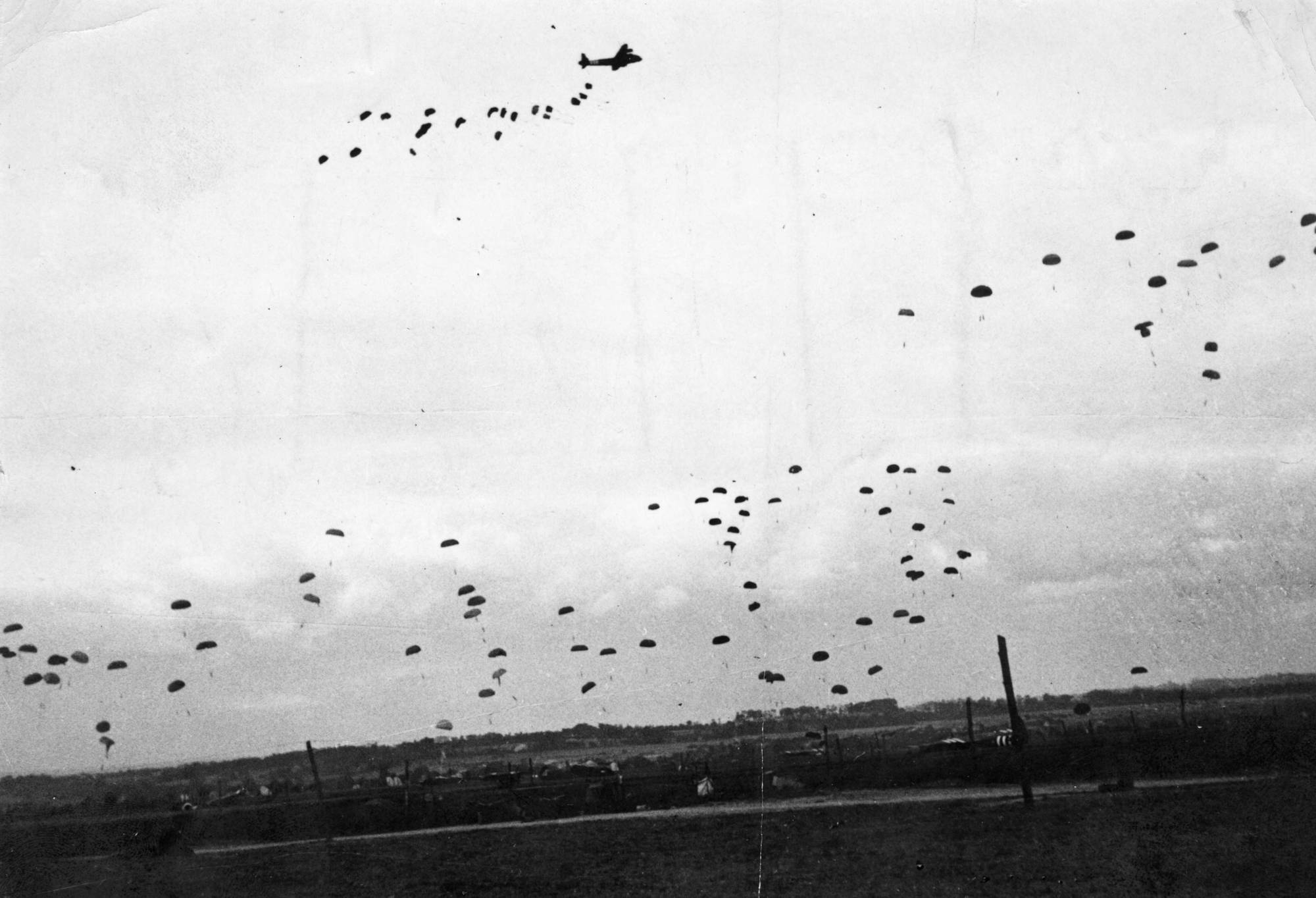
Resupply drop by eighteen Stirling aircraft, flying from R.A.F. Keevil, with Air Dispatch Crews of 253 Company, R.A.S.C. Operation 'Actulite', Normandy. 23rd June 1944. Courtesy I.W.M. B5880.
Finally, 250 Company got the order to mobilise and moved in convoy, less the Parachute Platoons to Down Ampney Transit Camp on the 8th June, arriving there at 17.00 hrs. The H.Q. element included Maj. Gifford, Capt. Norgate, and C.S.M. Gibbs with 36 Other Ranks. 'D' Transport Platoon was then commanded by Lt. Alsop and had 32 Other Ranks. 'F' Workshops Platoon was commanded by Capt. Bushby and had 31 Other Ranks. They were joined by the C.R.A.S.C., his 2 i/c and 4 Other Ranks. Within three hours, they had received their allotment of gliders and Airfields, and manifests were prepared. The next day lashing equipment was drawn from the A.D.O.S. at Larkhill, and loading commenced at 15.00 hrs.
The gliders were loaded to Scale 'X' as follows:
R.A.F. Down Ampney = 3.
R.A.F. Broadwell = 3.
R.A.F. Brize Norton = 7.
R.A.F. Tarrant Rushton = 12.
R.A.F. Keevil = 4.
In addition No's 1, 2 and 3 Parachute Platoons each had 5 gliders loaded at R.A.F's Broadwell, Down Ampney and Greenham Common.
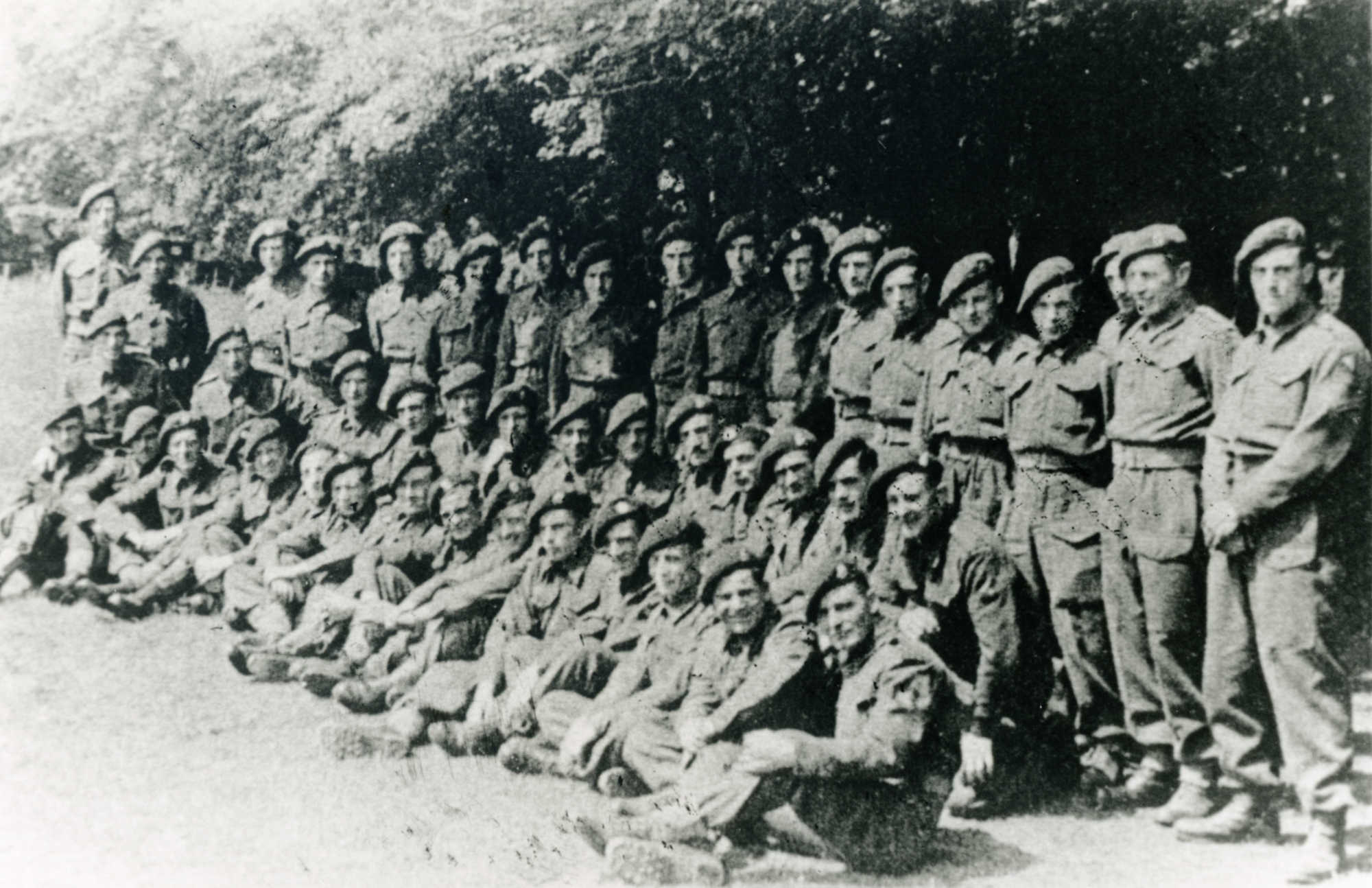
No 2 Parachute Platoon in the grounds of Longhills Hall, Lincolnshire. 1944. Capt. Kavanagh is standing in the centre (10th from the right). Courtesy of Airborne Assault Museum, Duxford.
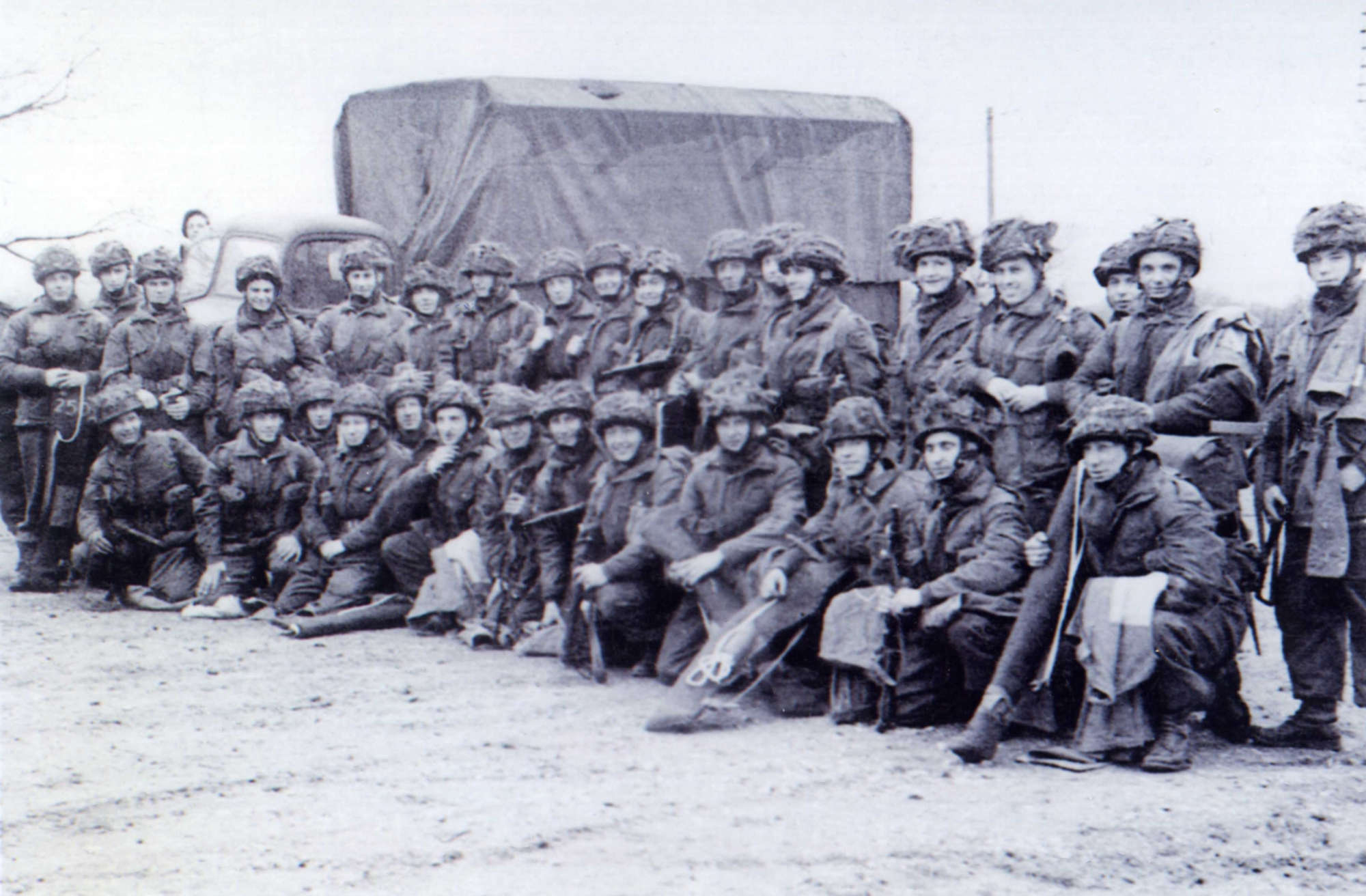
No 2 Parachute Platoon preparing for a parachute exercise from an airfield in Lincolnshire. Summer 1944. Courtesy Frank Steer Collection.
This was all done in connection with the HQ, R.A.S.C. Administration Instruction No. 3, dated the 1st June 1944. It was based on the information available to Lt-Col. Packe at the time, and under the heading COMMITMENTS, it stated:
(a) Divisional RASC has the following certain commitments -
(i) To carry Division to Airfields, transit camps and billets in the South and to provide the Admin services necessary to launch the airborne element to the Division.
(ii) To provide a full airborne element from HQ RASC and from 250 Lt Coy to accompany the Division on Scale 'A', which has clearly been practised on exercises.
(iii) To provide the maximum number of Aircrews for air supply base from 253 Comp Coy and 250 Lt Coy, plus a small detachment for DDST's HQ, Air Supply Base.
(b). In addition, Divisional RASC has the following possible but uncertain commitments -
(iv) To provide a seaborne element consisting of balance of HQ RASC, 93 Comp Coy complete, and 250 Lt Coy, less two aircrew platoons and airborne element already committed above. This seaborne element would not be required to embark until some time after the departure of the airborne element, and would include 47 vehicles from 253 Comp Coy to supplement unit 1st line transport up to Scale 'A'.
(v) If a/c in excess of Scale 'A' are available to fly in the balance of 250 Lt Coy as detailed in (iv) above up to the maximum availability of aircraft.
The lashing down of loads in the gliders was completed on the 10th June, although, alterations had to be made to the contents of trailers. Meanwhile the Divisional planning team had flown to Normandy, for a conference at Headquarters, 2nd Army, who outlined the role of the Division in support of the British 7th Armoured and 51st (Highland) Infantry Division's. A further conference was held at the Headquarters of 30 Corps, to decide upon the detailed plan, after which they flew back to England, and the G.O.C. gave his Orders at 23.00 hrs that night.
All this feverish activity was part of a planned operation - 'Wild Oats'- to land the 1st Airborne Division, on the 13th June, in the area of Evrecy, Bougy, Gavrus, Baron and Esquay, to the South-West of Caen in Normandy to prevent a German retreat from Caen. Instructions were received on the 11th June, to off-load to Scale 'Y', with the gliders at Tarrant Rushton and Keevil only, to remain loaded. This was completed by 15.00 hrs. The Company, and indeed the entire 1st Airborne Division continued standing by for Operations 'Wild Oats', which was postponed for 24 hours the next day. This was the start of a period of intense frustration for the Company, and the 1st Airborne Division.
Dvr. 'Ron' Nutley: "I did a lot of training exercises in Glossop, the Pennine Ranges, Yorkshire Moors and Derbyshire. After this training was completed, I was moved down to Cirencester to prepare for a parachute drop into France. My mates and I waited several days there before the drop was finally cancelled. I returned to Branston and continued training for several weeks doing parachute drops night and day." [A1]
It was during this period that, Lt. John Grice was posted into the Company, and was put in charge of the Transport Section allocated to No 1 Parachute Platoon. Commissioned as a 2/Lt on the 1st August 1942, he had been posted to the 2nd Bn, The South Staffordshire Regiment, and had been a Replacement Officer held in 'R' Company in North Africa. After Sicily, he was posted into 'B' Company under the command of Maj. R. Cain as a replacement. He had completed parachute course No 26 at R.A.F. Ringway in September 1942.
There was an element of the Company involved in active operations, as noted in the War Diary of 253 Company: '12th June 1944. 13.00 hrs. 10 Air Despatcher Crews and 10 vehicles under command Lt. Adams, 250 Coy, RASC (Airborne Lt) report to S.A.S. Regt Dump for loading of vehicles, and proceed to R.A.F. Fairford Airfield for bombing up a/c with containers.'
Richard Adams describes this activity: "Part of the Allied plan was to keep supplying the Resistance with arms, ammunition, explosives, medical gear and so on. All this stuff used to be dropped, by night and parachute, at pre-arranged places and times. Keeping these appointments was difficult and demanding for our pilots. They flew and navigated, of course, in darkness and could expect only the briefest and least conspicuous of signals from the ground.
The supplies were packed in strapped and lidded laundry baskets, since these were cheap, convenient to handle, drop and open, and could stand a lot of rough treatment. (Even in the event of a 'Roman candle' - a parachute not opening - the contents often turned out to be serviceable.) It was 1st Airborne R. A. S.C.'s job to pack these baskets, fit each with a parachute, load them on the planes, fly with them and push them out when the pilot said. Along the floor inside each plane, was fixed a line of metal rollers. On these rollers the baskets were strapped in tandem: when the straps were released, they were free to be shoved down the plane, through a right angle and out of the port rear door. The only possible danger was that a despatcher might somehow or other get his own equipment or belt tangled up with a basket's straps and go out with it. I never heard of it actually happening, but I once or twice knew it almost to happen.
The supplies were kept out of doors, widely dispersed in quite small dumps (smaller than an average drawing-room) in the area north of Fairford in Gloucester - the valleys of the Leach and Coln. It was to this area that 'C' Platoon were sent, southward from Lincoln, to come temporarily under the command of one of the division's heavy R. A.S.C. companies. Naturally, the loading job was principally one for lorries, but the heavy company also needed more sheer manpower than they could muster on their own. We brought our Jeeps, of course, and they often came in handy. We were camped in tents in a big field at a village called Southrop, about three miles north-east of Fairford. The dumps were all over the place, along the lanes round villages with beautiful names such as Quenington, Hatherop, Coln St Aldwyn, Eastleach St Martin and Fyfield. The planes usually flew from the airfields at Down Ampney and South Cerney.
I rather missed John Gifford, Paddy Kavanagh and other friends of 250 Company mess: I even quite missed the bawling of Sergeant-Major Gibbs. On the other hand, as everyone knows who has ever been a junior officer, there were great advantages to being on detachment. The Air Despatch Company's Commanding Officer, a Scot called Major Gordon, known as 'The Jontleman' ("Noo, jontlemen, theer's warrk to be done"), was a perfectly reasonable person to deal with, even if he lacked the charisma of John Gifford, and treated his visitors considerately. 'C' Platoon enjoyed a considerable degree of autonomy: I can't recall that Major Gordon ever inspected our camp or ourselves. The men knew we were doing essential and important work and were in good spirits and full of energy. We didn't fly every night, and this meant that there were a few evenings to spend in local pubs. My own favourite pub, for a quiet evening was a place called the Hill Oak at Ampney St Mary, which no longer exists. Some of the locals sang authentic folk songs and a friend of mine called 'Pat' Jerome and I would find ourselves listening to versions of things like 'John Barleycorn' and 'As I Roved Out One Morning Fair'. This was rural south Gloucestershire in 1944.
I flew over France several times with the laundry baskets, until I became satisfied that there was no real danger and none of the men was likely to say (or think) that I was keeping out. German night fighters seemed non-existent, and although we sometimes encountered a little flak, it was sporadic and short-lived, for we by-passed towns and our dropping zones were always in lonely, rural places. Being inside the aircraft, I never saw a ground-to-air signal, but pilots told me that they were momentary, a mere flash of a torch. The Resistance men could see and recognize the aircraft, of course, and needed to signal only once as it came overhead." [5]
Operation 'Wild Oats' would quite literally, like the weather, turn into a wash out, and after several postponements, was cancelled. After spending the 16th and 17th June standing by, the Company was given a 'Rest Day' on the 18th, and then the next day the Warning Order was received to return to the Lincoln area. The party at Tarrant Rushton concentrated at Down Ampney Transit Camp and then on the 20th, the whole Company moved in convoy back to Moorlands.
The rest of June and into July, was spent on normal training, with the Parachute Platoons rotating through periods at Edale on Exercise 'Alpine'. Whilst all this had been taking place, three men from the Company had been on Parachute Course No 119 at R.A.F. Ringway, 3rd to 22nd June 1944. Dvr's. Barrett, Moon and Wraight all qualified as operational parachutists.
July continued with Exercises 'Stopgap I', 'Stopgap II' and 'Stopgap III', which was to practise the glider-borne element of the Company in actual glider flying, usually from Barkston. On the 7th July, forty men from No's 1, 2 and 3 Parachute Platoon's carried out parachute jumps, without casualties or loss of equipment, with No 2 Platoon jumping with a full stick of 20, all with kit-bags. Another jump of forty men took place on the 11th July. On the 19th July, 'C' and 'G' Transport Platoons practised glider loading, and the next day, 100 men from these two Platoons went up in Horsa gliders, for flight experience. On this same day a conference was convened by the C.R.A.S.C. to give details of Exercise 'Bones'. Whilst Exercise 'Stopgap III' was taking place on the 21st July, 4 aircraft took off with 72 men of the Company, plus the C.R.A.S.C., his Adjt, Supply Officer and S.S.M., to carry out a parachute descent onto Ropsley Heath. Unfortunately, this resulted in the death of Dvr. John Beal, when his parachute became entangled with a container, which struck and killed him. A Guard of Honour, comprising an officer and 14 Other Ranks proceeded to St Michael's Church, Camberley in Surrey for the funeral on the 26th July.
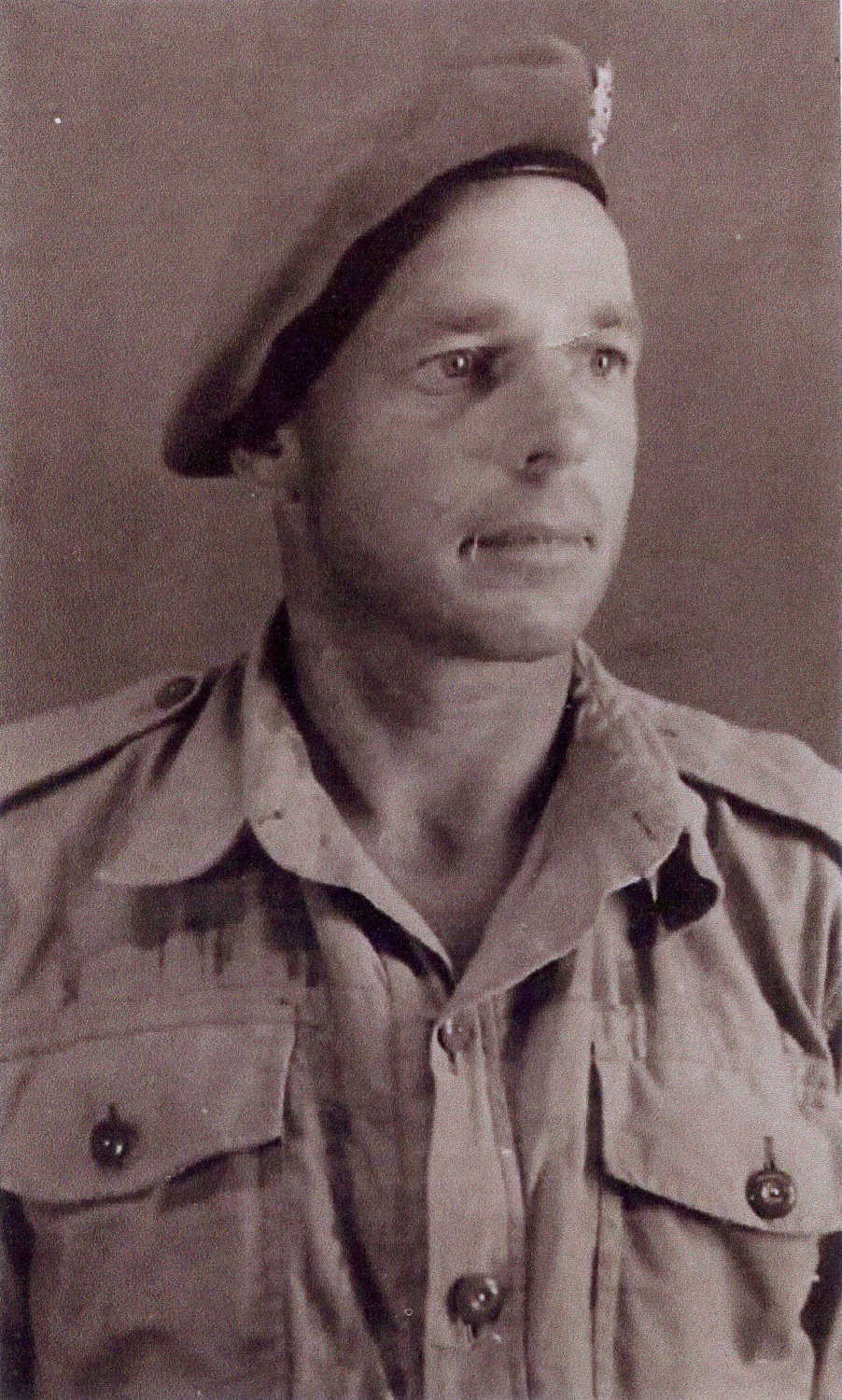
Dvr. John Beal. On the reverse of the photo he wrote: This is terrible Darling, but it can't be helped, as I was in such a hell of a hurry & was all hot & bothered. I had this taken on Bert's Birthday, still it will cause a laugh, what do you think? I'll look like I've grown a beard, ha, ha, ha! Tripoli. Love John. 22/9/43. Courtesy of Airborne Assault Museum, Duxford.
Richard Adams: "An airfield, ready-cleared, makes an excellent dropping zone (D.Z.). A morning's activity for a platoon - nothing in it, really, as long as it's not you. Someone had mentioned to me that Paddy and Co, were jumping, but I hadn't given it much attention, being too busy with 'C' Platoon's rifles. We'd just been told that all rifles which weren't accurate in the aim were to be handed in. About mid-day I had come down to Company H.Q. to talk to C. Q. M. S. Smallwood about this matter, when I ran into Sergeant-Major Gibbs. "You 'eard, sir - we 'ad a man killed this morning? Private Beal." The way he said it, it sounded like 'Private Bill'; almost like a joke. It was no joke, however, but, like all fatal accidents, a horrible business. What had happened was this. There were at this time, two methods of jumping; one standing up, from the port rear door of a Dakota (C.47), and the other - the first-devised, original way - sitting down and propelling yourself feet forward through an aperture in the middle of the floor of a Whitley bomber. (Jumping through the hole, as it was called.) Twenty men could jump from a Dakota, but the complement for a Whitley was only eight. For a 'stick' of eight men to jump correctly required cool heads and accurate counting off. Sitting sideways on the floor and inching forward, each man in turn had to swing his legs and body through a right angle into the hole, and then push himself off to drop through it. There was a song (to the tune of 'Knees Up, Mother Brown'):
'Jumping through the hole,
Whatever may befall,
We'll always keep our trousers clean
When jumping through the hole.'
I have never jumped through the hole, but John Gifford told me once that, in comparison with a Dakota, you got a much more frightening view of the ground rushing past below. Normally two containers, each with its own parachute and filled with arms, ammunition, etc., were fastened under the body of the plane and released by the pilot to drop in the middle of the stick (to ensure the best possible accessibility on landing). When the green light came on, the whole stick used to shout aloud as they jumped: 'One, two, three, four, container, container, five, six, seven, eight!' With number eight out, the despatcher would shout to the pilot 'Stick gone!' This is why old airborne soldiers still sometimes talk about a 'container-container' when they mean a container (e.g., in Marks and Spencer's or somewhere like that).
A man on a parachute has, as many people today have seen for themselves, a good deal of directional control. Containers, being inanimate, exercise none. What had happened was that poor Beal, jumping number four, had had a container dropped immediately after him (and therefore above him). The container, oscillating on its parachute, had bumped into Beal's canopy and collapsed it, and he had fallen to his death. The incident cast a gloom over the company for several days." [5b]
After the Divisional R.A.S.C. Church Parade on Sunday, 23rd July, the Parties for Exercise 'Bones' proceeded to Grimsby. However, this would not include Maj. Gifford, as originally planned, as he had been admitted to Hospital with mumps. Command of the Company was temporarily taken over by Capt. Cranmer-Byng. Exercise 'Bones' was to practise the Company in the requisitioning of transport and dealing with captured enemy stores. This was a 'token' exercise, where the procedures would be followed, but no actual vehicles or stores would be 'requisitioned'. It also meant only a token force would deploy on the exercise, and not the whole Company. Those participating were as follows:
To represent No 1 Para Pl.
|
Lt. P.E. Thompson. Dvr. Jackson. C. Dvr. Bricker. D.. Dvr. Whiting. R. Cpl. Symmons. H. Dvr. Sims. S.A. Dvr. Dawson. E.. |
- Jeep. - Jeep & 1 Trailer.
- Signaller 46 set - " - M/Cyclist. |
To represent No 2 Para Pl.
|
Capt. D.T. Kavanagh, RASC. Dvr. Smith. E.C.D. Cpl. Blaxley. B. Dvr. Bradshaw. H. L/Cpl. Higgs. R. Dvr. Cutting. D. Hayward. J.S.V. |
- Jeep. - Jeep & 1 Trailer.
- Signaller 46 set. - " - M/Cyclist. |
To represent No 3 Para Pl.
|
Capt. R.G.L. Norgate, RASC. Dvr. Young. G.E.V. Dvr. Burns. J. L/Cpl. Horne. W. Dvr. Preston. W. Dvr. Smith. G.H. |
- Jeep. - Jeep & Trailer. - Signaller 46 set. - " - M/Cyclist. |
To represent H.Q.
|
Maj. J.H. Gifford, RASC. Sgt. Whitehead. L. Cpl. Morrey. K. L/Cpl. Inglis. W. Pte. Barraclough. W. Cpl. Howarth. N. Dvr. Snow. G. L/Cpl. Scurlock. H. Cpl. Lister. B. Dvr. Schneider. V. Dvr. Peacock. L. Dvr. Thomas. R.J. Dvr. Griffiths. C. Dvr. Buckley. D. Dvr. Mappin. G. Dvr. Batsford. P. Dvr. Beresford-Jones. W. Dvr. Gibbs. W. Dvr. Lauder. H. L/Cpl. Syme. J. Dvr. Tripp. W. Dvr. Smith. G.W. Dvr. Taylor. H. L/Cpl. Clay. W. Dvr. Cowcher. G. L/Cpl. Dean. L. Pte. Lee. J.H. Pte. Swinhoe. G.A. |
(Did not go, hospital) - A/C.S.M. - Admin. - " - Supply. - M/Cyclist - Regtl Duties. - M/Cyclist. - Jeep. - Jeep & Trailer. - " " - " " - " " - " " - " " - " " - " " - Signaller 22 set - " " - " " - " " - " " - " " - " " - " " - " " - " " |
Parade at H.Q. Moorlands, 13.45 hrs, Sunday [23/07/44] in respective sections.
This exercise list shows the wireless /radio allocation to the Company and those men who were trained operators. The exercise continued until the 25th July, and the Company element returned to Lincolnshire at mid-day. The O.C. was visited in hospital during this time to observe his progress.
Amongst the instructions from other units was the following interesting part for the 16th Parachute Field Ambulance, R.A.M.C.: 7). Re-Supply. All ranks should be warned that they must send the location of all panniers or containers marked with a Red Cross to the nearest H.Q. Essential medical supplies are contained in these panniers. They will be ruined by inexpert handling. There is no Brandy and there are no cigarettes in any pannier dropped. [7]
The field firing practices being carried out saw the Company put 230 men through its paces in a week, culminating on the 29th July on Glossop Moors. On this same day the Divisional Sports Meeting took place at Cranwell, and the Company gained a creditable sixth place overall. During this month, four men of the Company had been on their parachute courses to R.A.F. Ringway. L/Cpl. Barrow, Dvr's. Sawyer and Smith (74) qualified on Parachute Course 124, 8th to 21st July. And, 2/Lt. Osborne qualified on Parachute Course 125, 17th to 28th July. Dvr. George William Smith would have been considered one of the 'old men' of the Company at 24-years-old. Born in February 1920 he had enlisted into the R.A.S.C. on the 17th October 1938 and had gone to France with the B.E.F. Rescued from Dunkirk in 1940 he had gone on to serve in North Africa and Italy, and then had volunteered for Airborne Forces, being posted to the Company in January 1944.
The granting of short periods of leave was recommenced on the 1st August, and on the same day Lt. B.C. Winter-Goodwin was promoted to Captain and attached to H.Q., R.A.S.C. 1st Airborne Division. No's 1 and 2 Parachute Platoons went out that night to carry out Infantry Training. This was followed two nights later by 'D' Transport Platoon going on a night exercise to practise, night convoy driving, harbouring and map reading. Whilst the other two Parachute Platoons underwent efficiency tests, No 3 Parachute Platoon, lead by Capt. Gell, left for Wooler in Roxburgshire (now Northumberland), on the 4th August, to start a 200 mile cross country march, which would end at Edale. By the 9th they had reached Malham, 8 miles Northwest of Leeds, and the next morning set off for the final 50 miles. Capt. Gell: "Overall, a great deal of emphasis was placed on physical fitness, my Platoon once marched 35 miles a day, for six consecutive days, straight down the Pennines from Scotland [Northumberland] to Edale." [8]
The emphasis on rigorous training, is corroborated by Dvr. 'Jim' Wild: "Our Platoon did the Pennine Way as an exercise in 1944, before there was a proper footpath. We slept under the stars, in our sleeping bags, and averaged 30 miles per day. However, due to the way the invasion was going, we had to pack up on the Friday night and return to Branston in Lincs. The three para platoons (I was in No 3) did field firing, both up in Yorkshire and on the Pennines in Derbyshire. We also used Salisbury Plain for rough riding with the Jeeps and motor-cycles, as well as the field firing ranges.We also practised river crossings, as well as night fighting, and forced marching. We had to be able to drive a Bren Carrier, also fire any gun up to a 6 pounder anti-tank gun - just in case. We were taught how to use plastic explosive to make Gammon bombs, and how to find your way around on a dark night, after having been dropped in the middle of a corn field or a wood." [9]
On the 7th August, the Company, along with the rest of 1st Airborne Division, were given the Warning Order for 'Stand To'. This was in response to the planned Operation 'Transfigure', and the next day an officer from the Company was employed on making load tables for Hamilcar gliders.
PHOTO SEQUENCE.
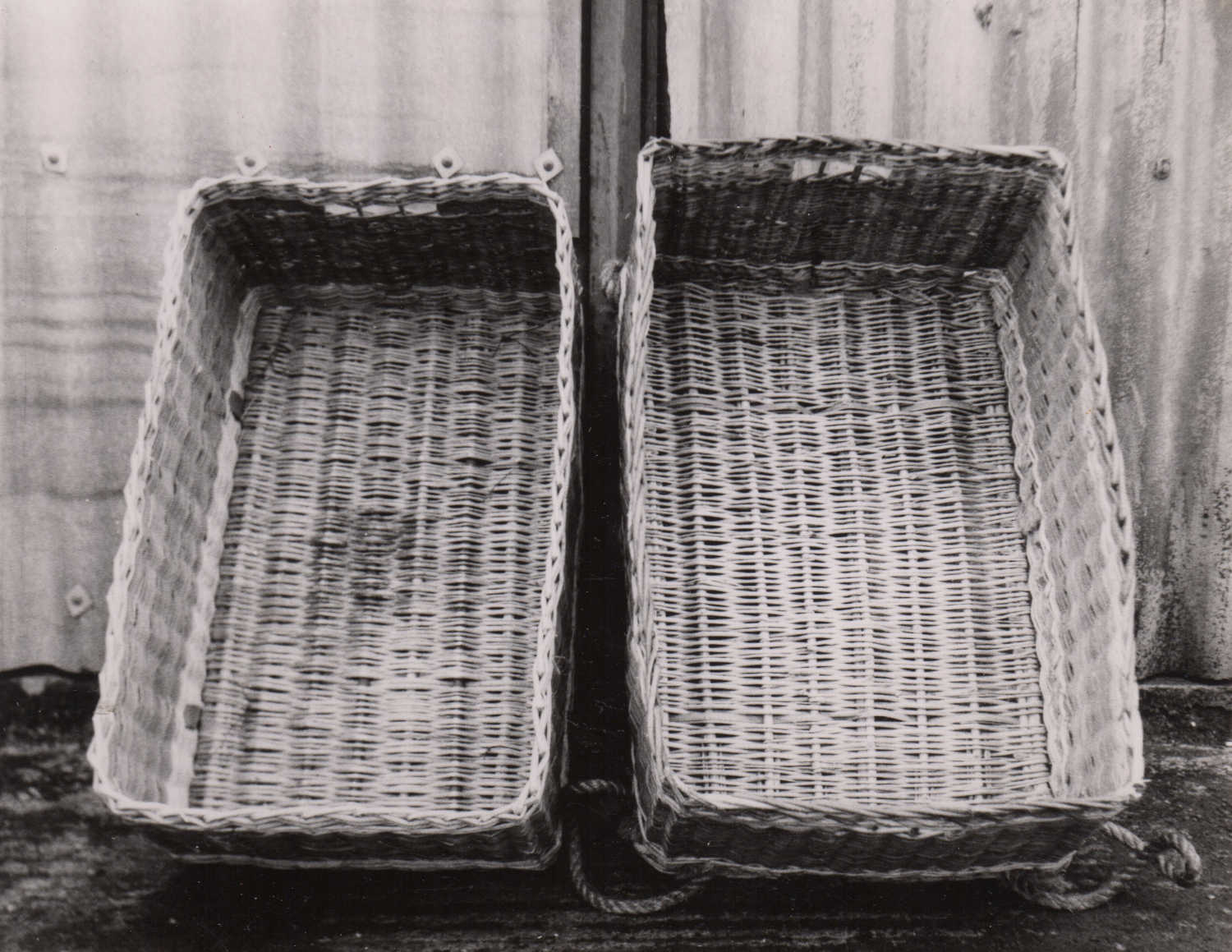
The two parts of a 'Wicker Pannier' or Supply Basket, before packing and attaching the straps and parachute. A.F.D.C. 1943-44. Courtesy of Airborne Assault Museum, Duxford.
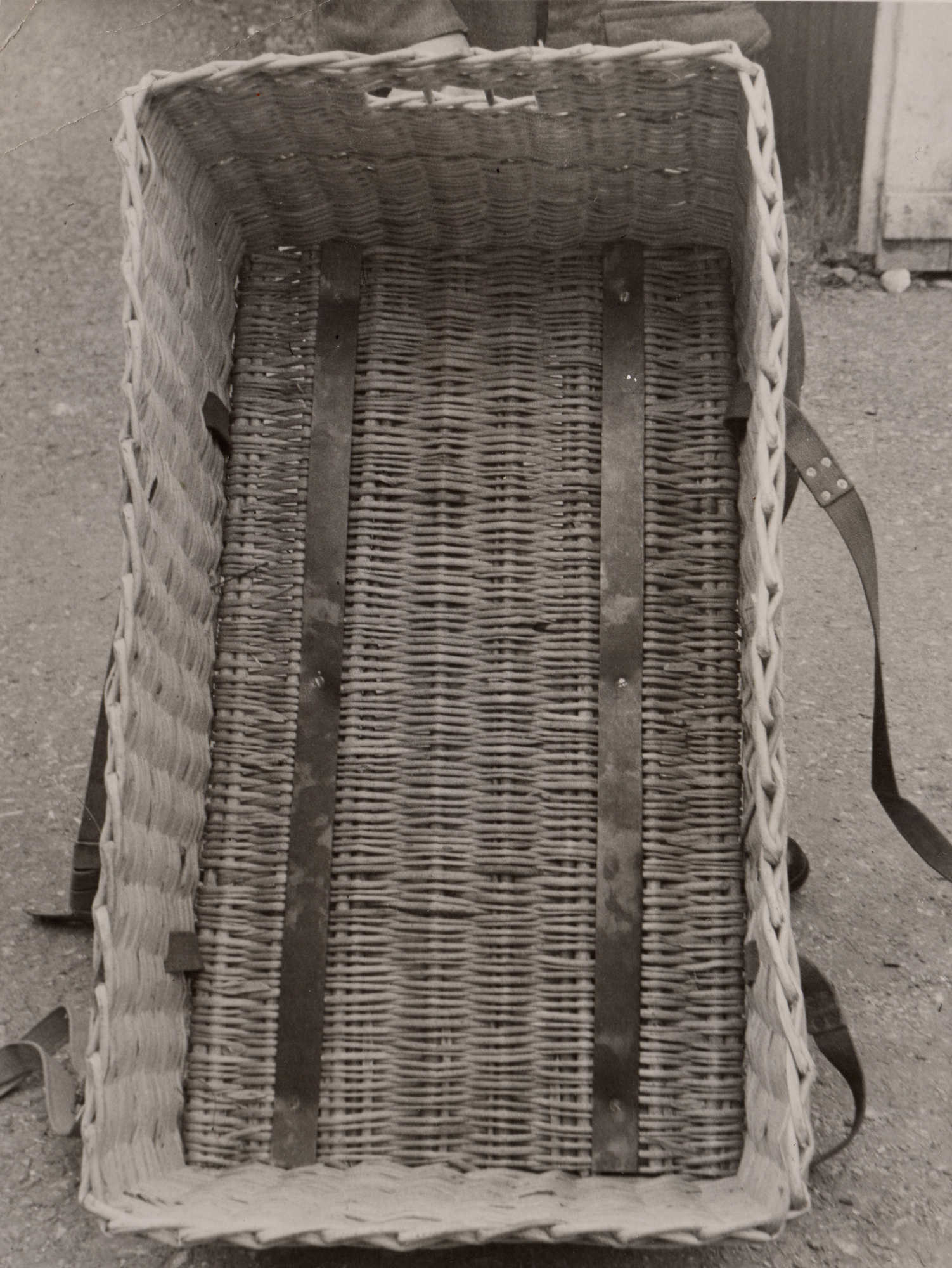
A later production 'Wicker Pannier' with reinforcing strips inside, and fixed straps on the outside. A.F.D.C. 8th August 1944. Courtesy of Airborne Assault Museum, Duxford.
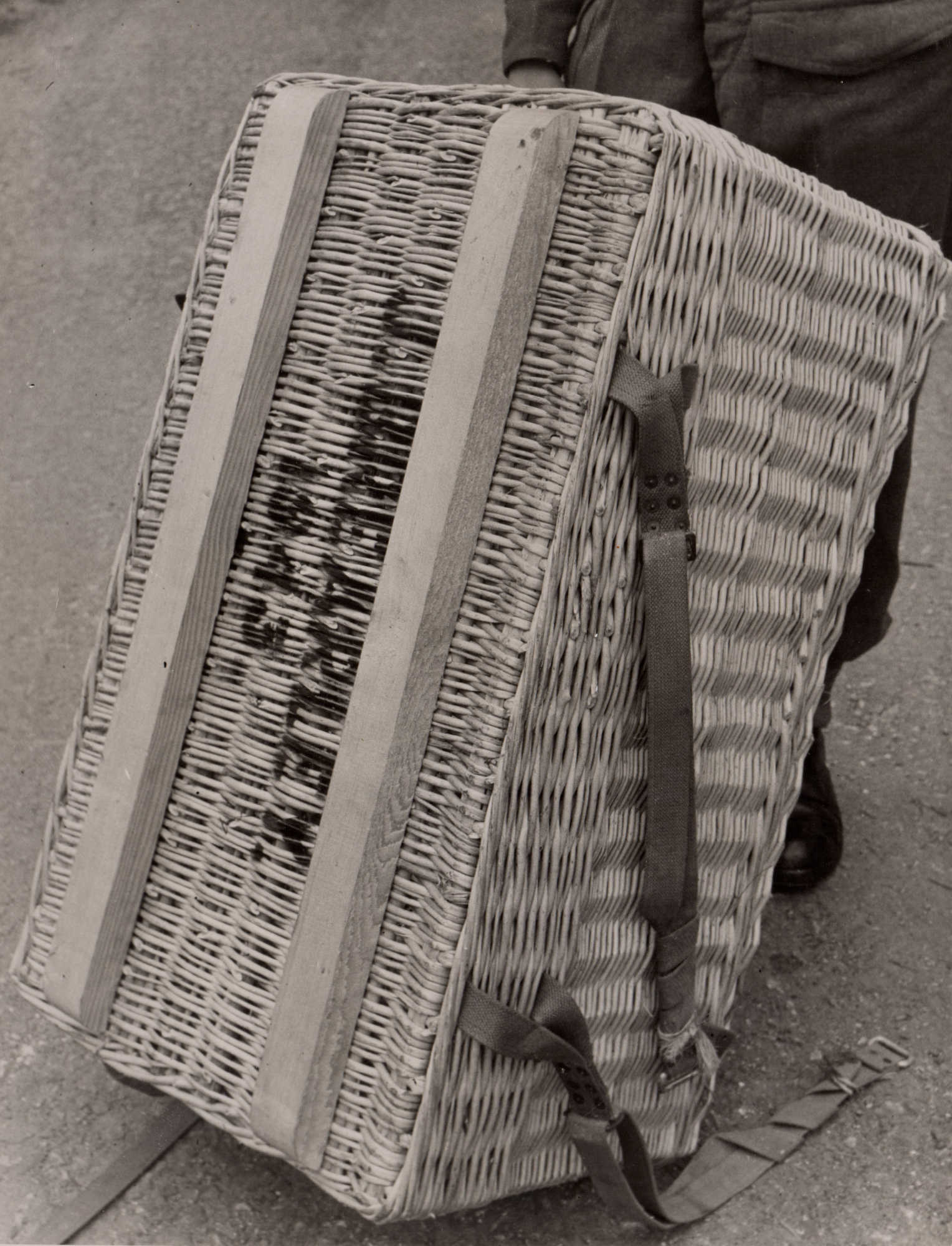
A view of the bottom of the 'Wicker Pannier', which shows the fixing straps, the reinforcing 'runners' on the bottom, and the manufacturers details. A.F.D.C. 8th August 1944. Courtesy of Airborne Assault Museum, Duxford.
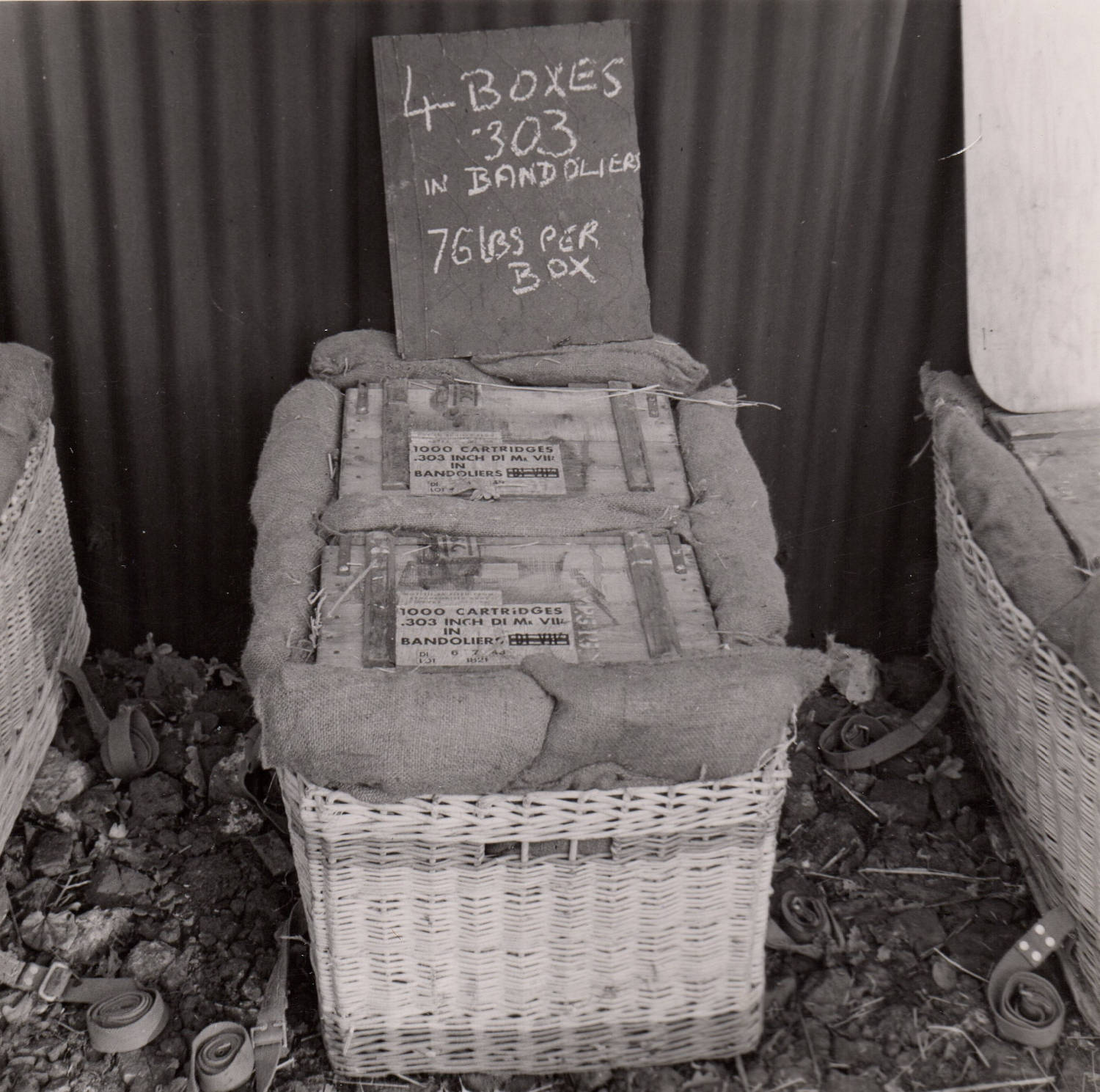
A Pannier packed with 4 x boxes of .303 rifle ammunition in bandoliers. 76 lbs per box. A.F.D.C. 22nd April 1944. Courtesy of Airborne Assault Museum, Duxford.
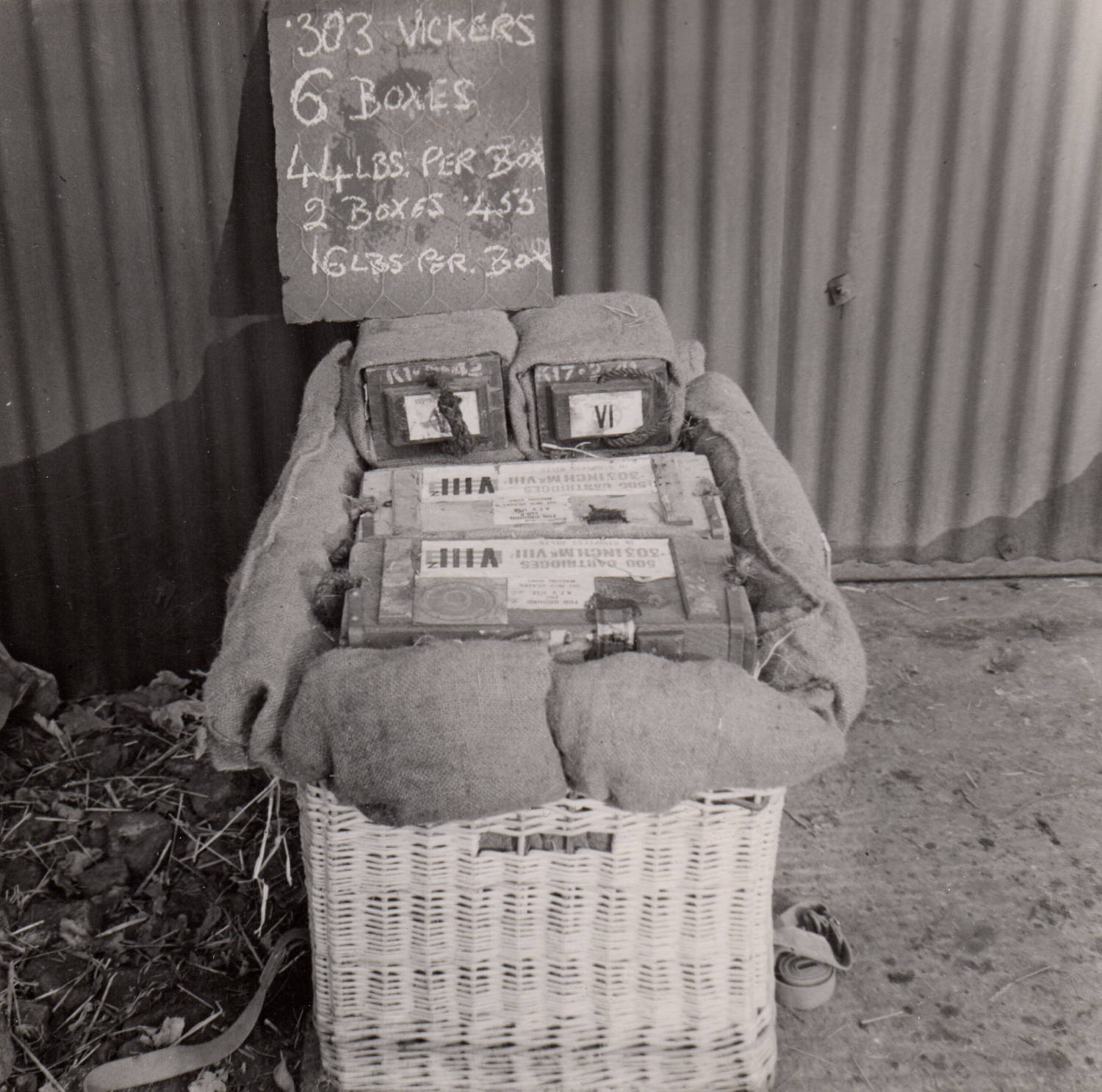
A Pannier packed with 6 x boxes of .303 Vickers M.M.G. ammunition. 44 lbs per box. And 2 x boxes of .45 ammunition at 16 lbs per box. A.F.D.C. 22nd April 1944. Courtesy of Airborne Assault Museum, Duxford.
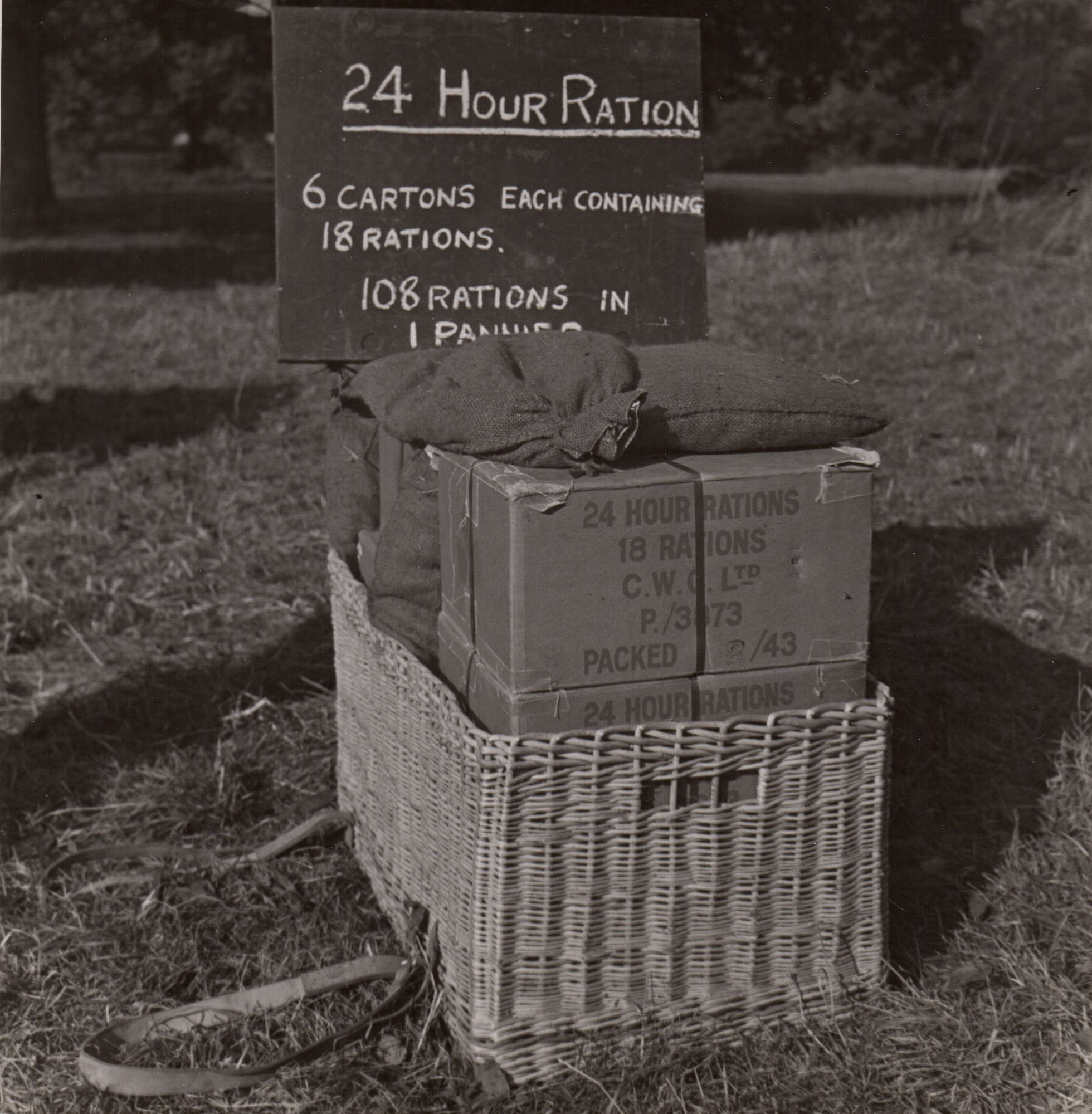
A Pannier packed with rations. 6 x cartons, each containing 18 x rations. Total = 108 rations in a Pannier. A.F.D.C. 5th April 1944. Courtesy of Airborne Assault Museum, Duxford.
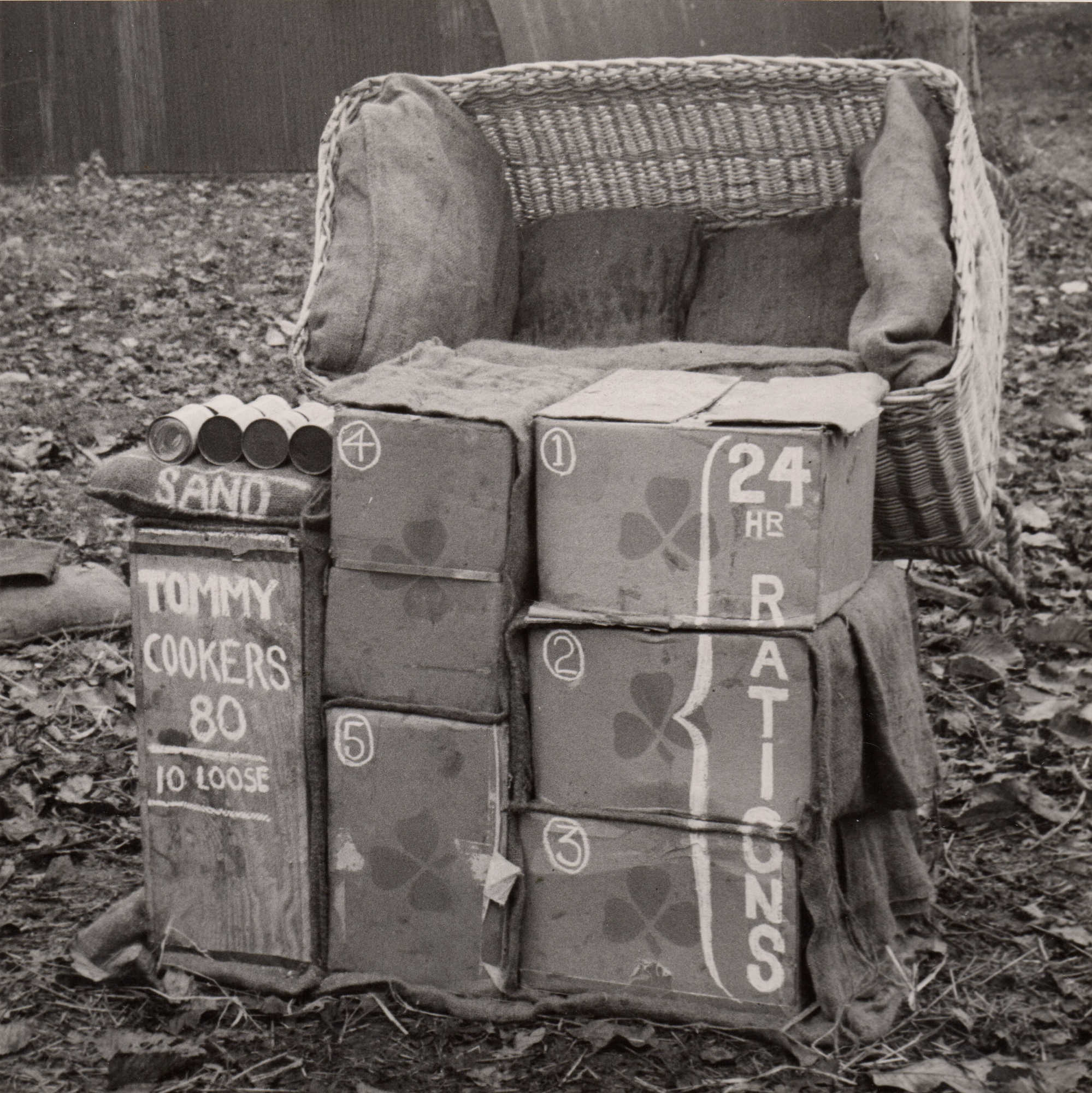
A stack of rations, and 'Tommy Cookers', before being packed in a Pannier. A.F.D.C. 5th April 1944. Courtesy of Airborne Assault Museum, Duxford.
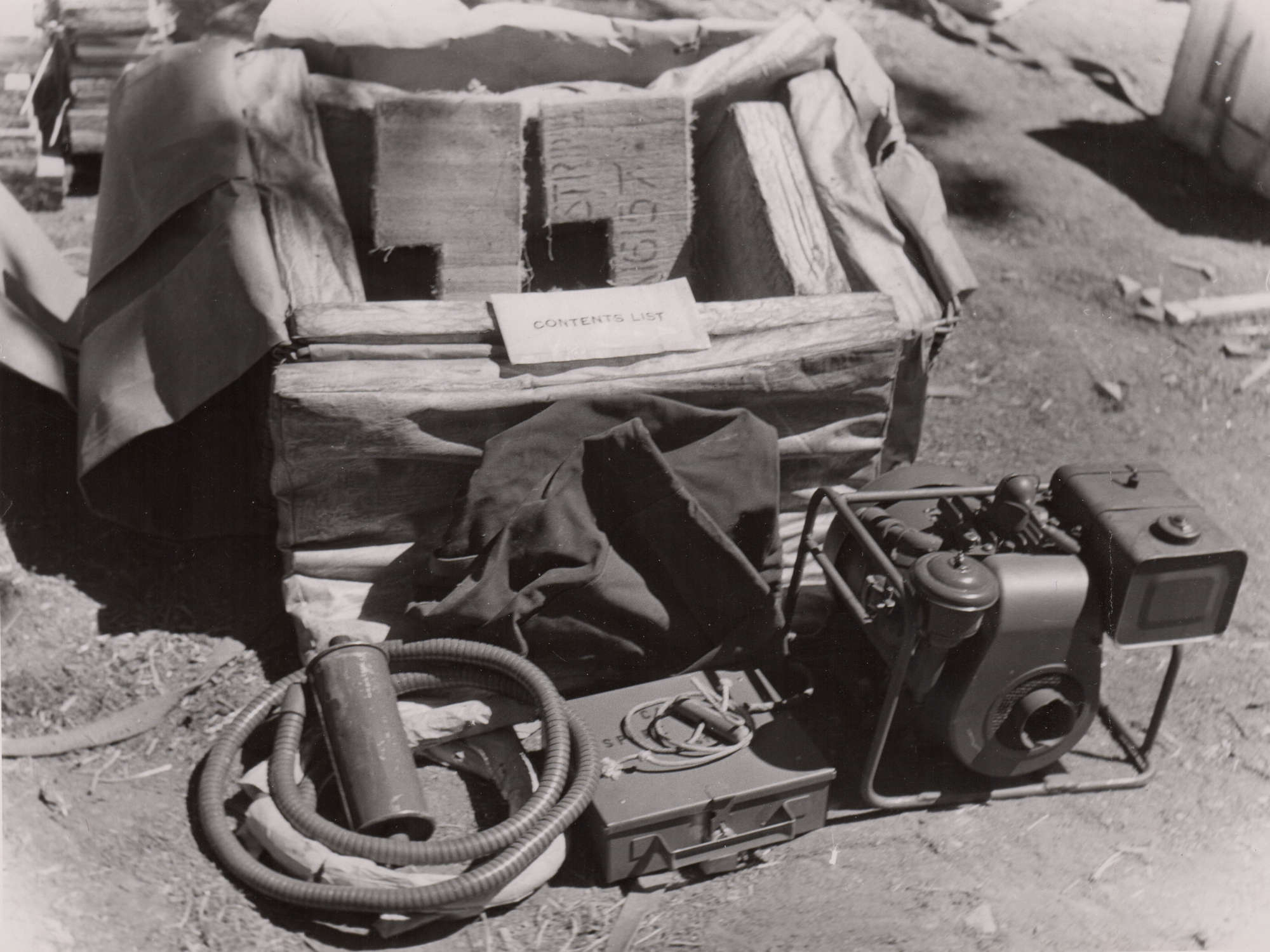
A generator and ancillaries, before being packed into a Pannier. A.F.D.C. 5th April 1944. Courtesy of Airborne Assault Museum, Duxford.
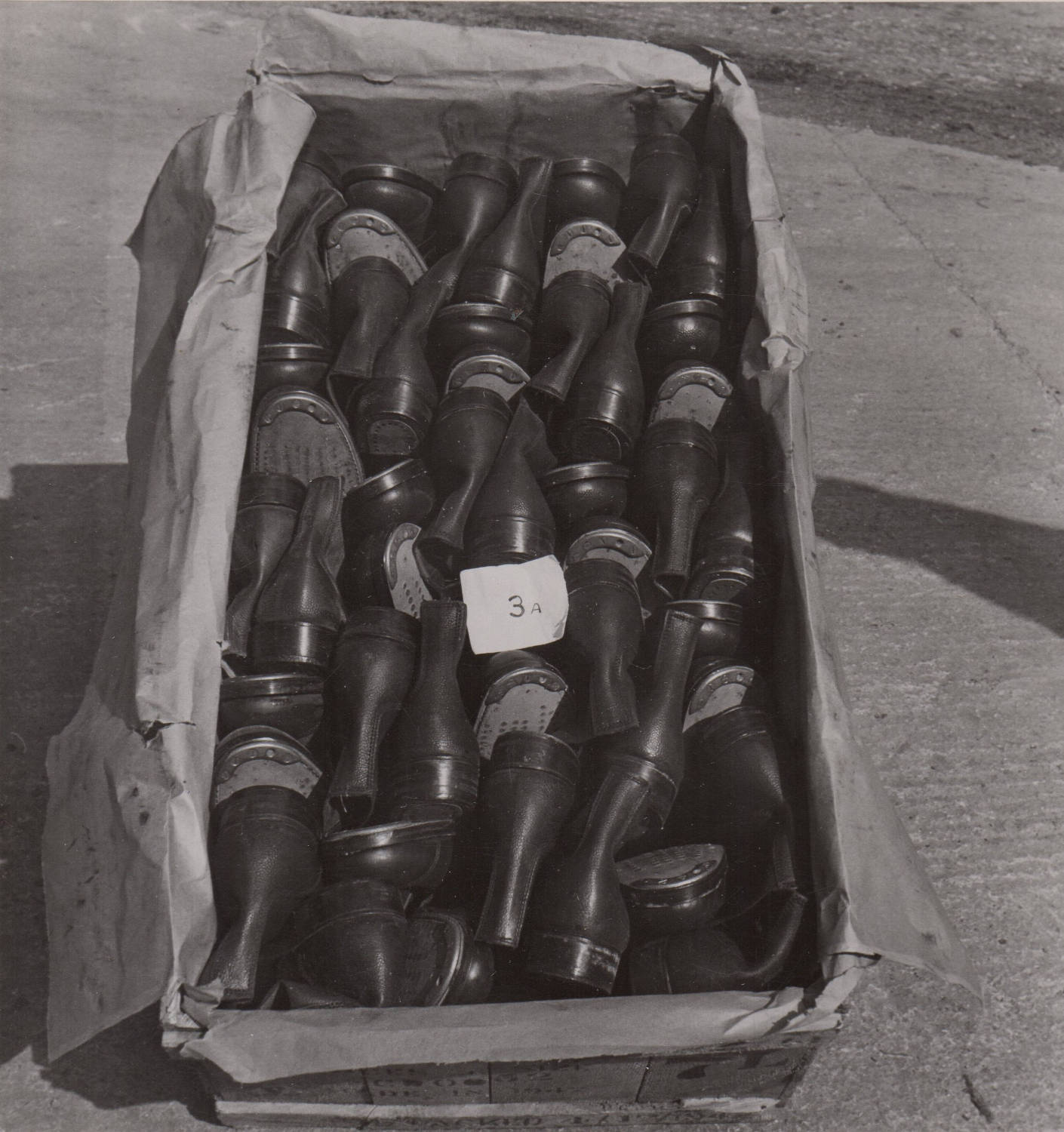
A Pannier full of British Army issue boots! A.F.D.C. 3rd September 1944. Courtesy of Airborne Assault Museum, Duxford.
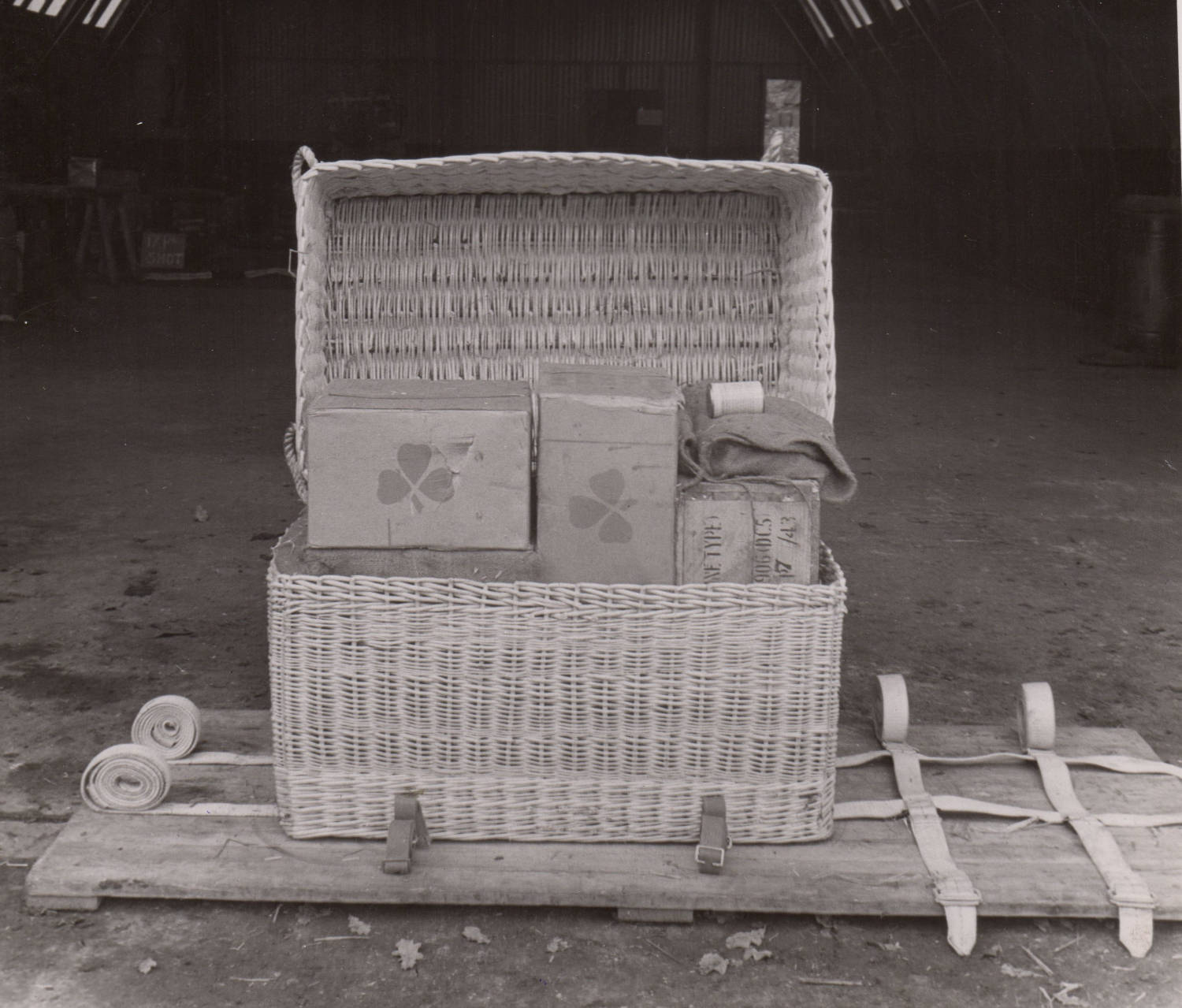
The method and sequence of packing a 'Wicker Pannier'. First lay out the set out the bottom half (preferably on a 'packing board' or hard clean surface), with the straps laid out, and then pack with the supplies. A.F.D.C. 17th November 1943. Courtesy of Airborne Assault Museum, Duxford.
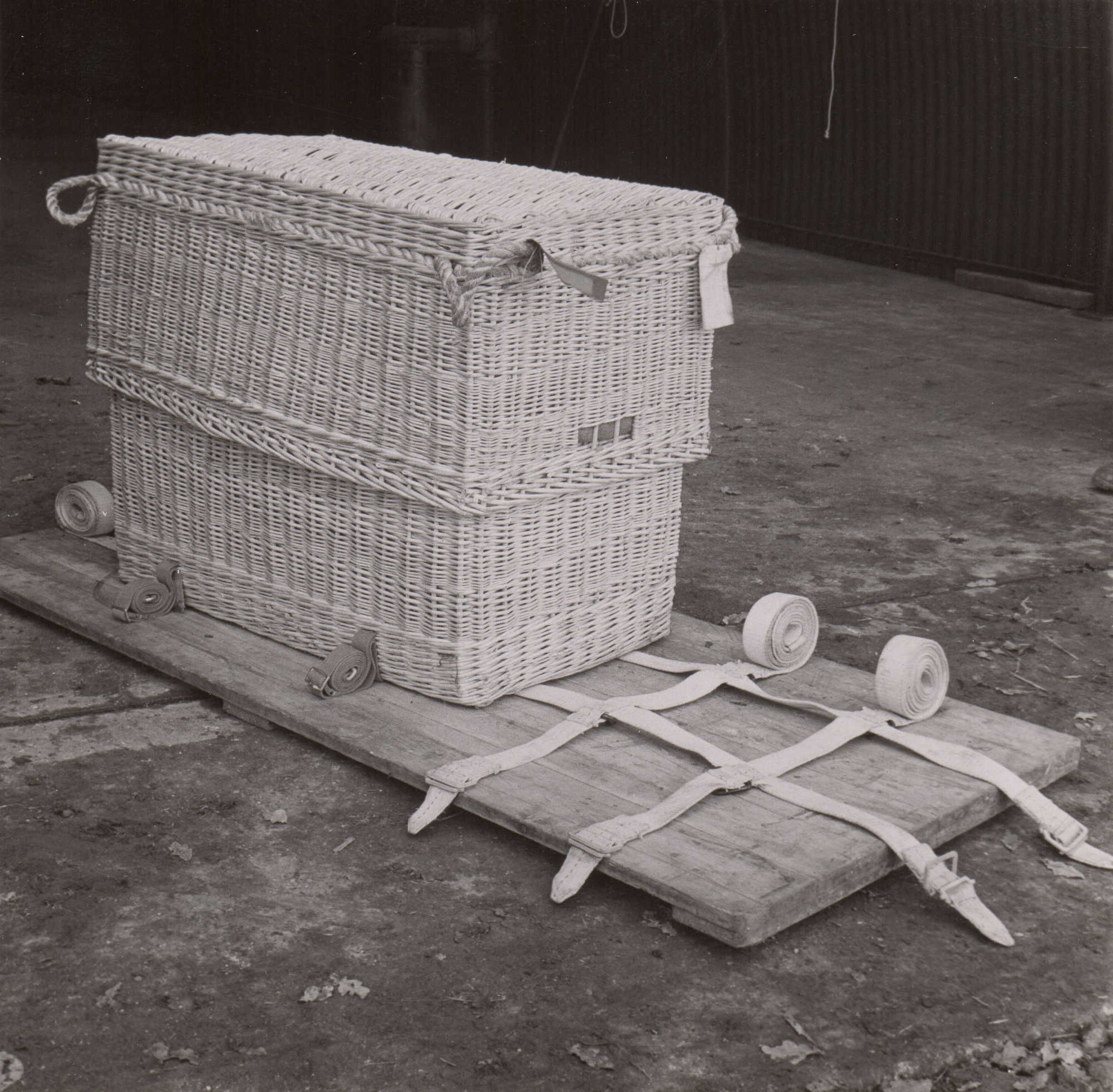
The Pannier is now packed and the top half has been put in place. This view shows exactly how all the straps are laid out. A.F.D.C. 17th November 1943. Courtesy of Airborne Assault Museum, Duxford.
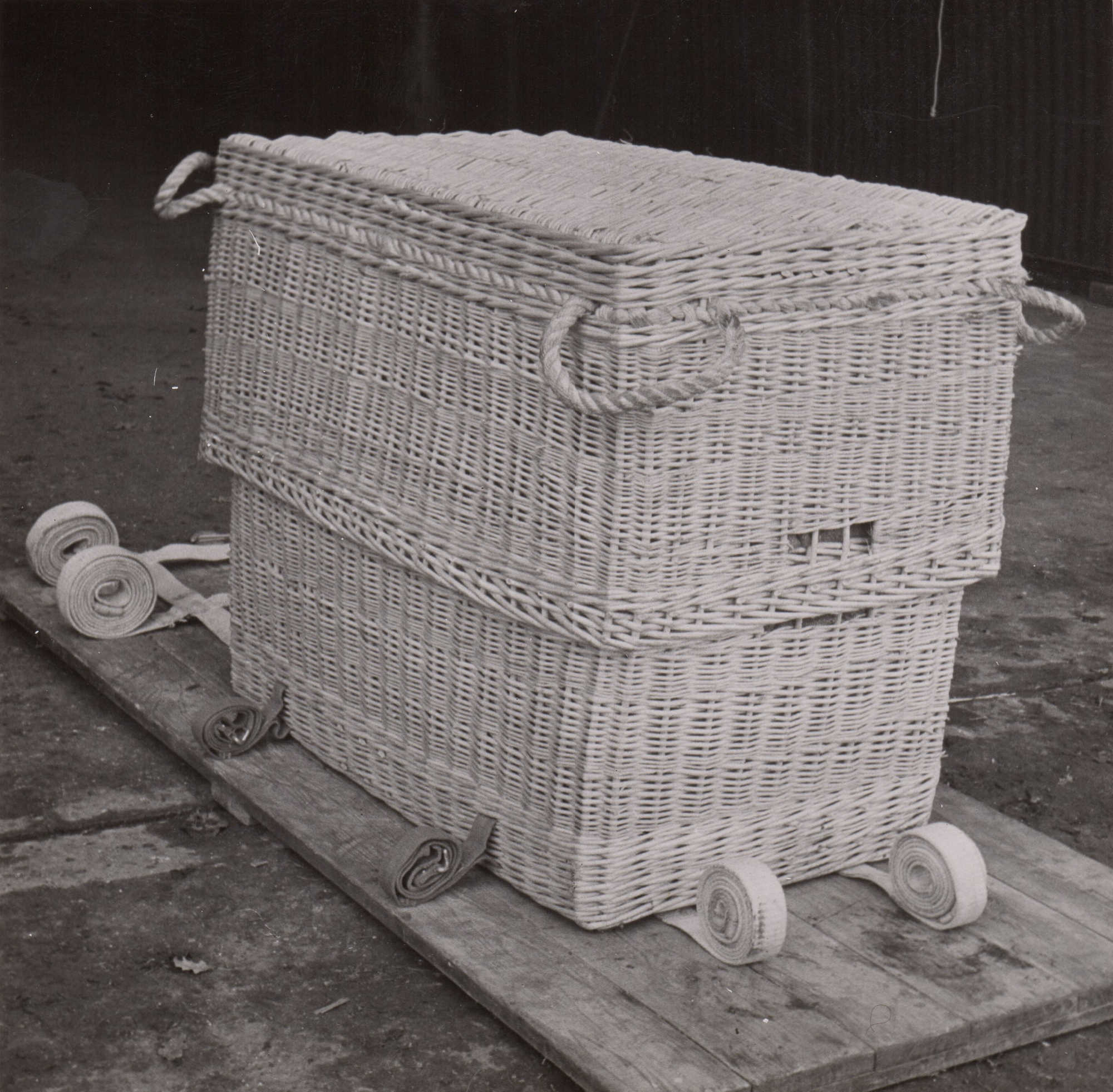
A view of the other side of the packed Pannier, showing the straps laid out. A.F.D.C. 17th November 1943. Courtesy of Airborne Assault Museum, Duxford.
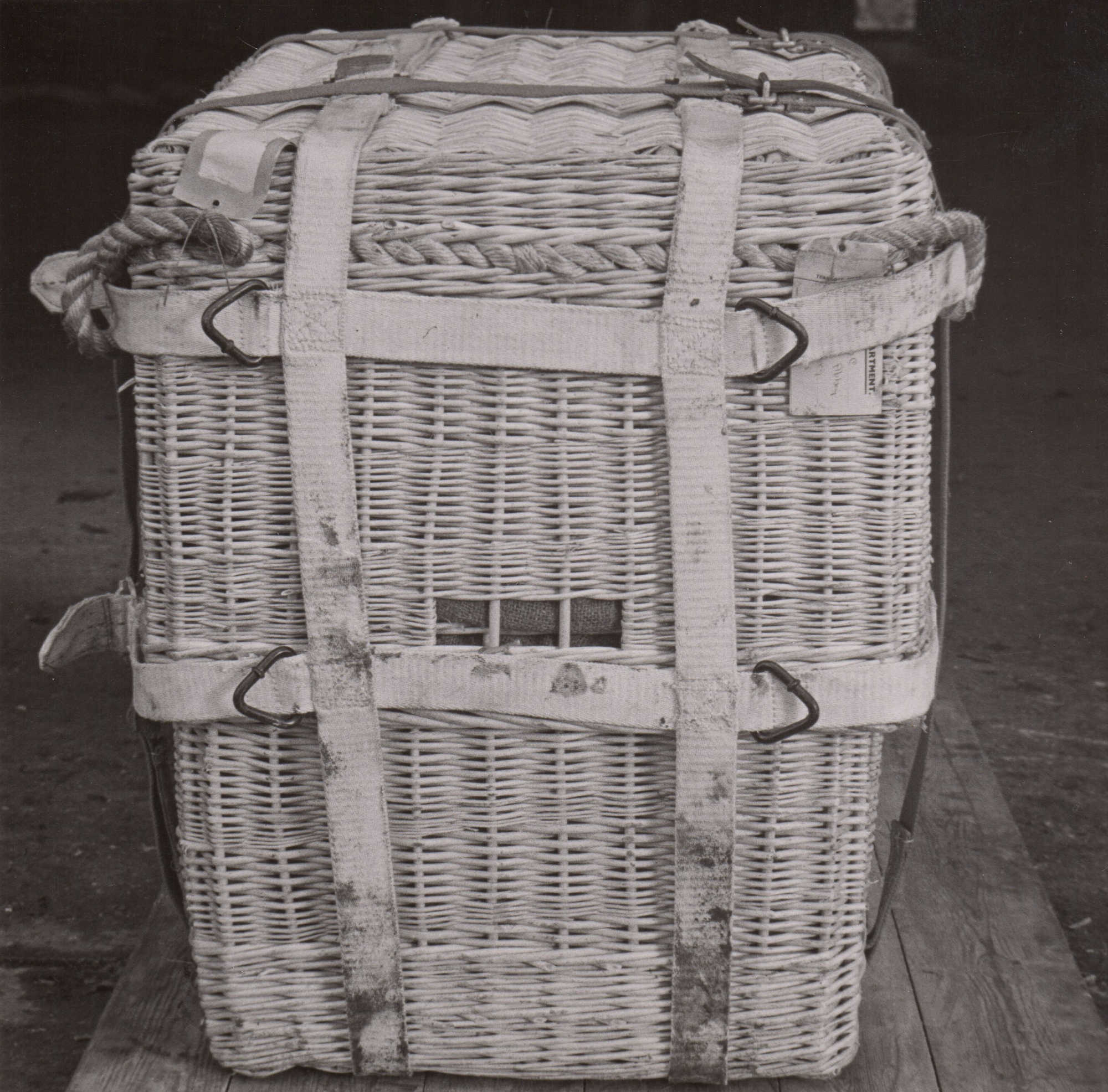
The Pannier showing all the 'quick release' straps done up, and the 'D' rings, just before fitting the parachute. A.F.D.C. 17th November 1943. Courtesy of Airborne Assault Museum, Duxford.
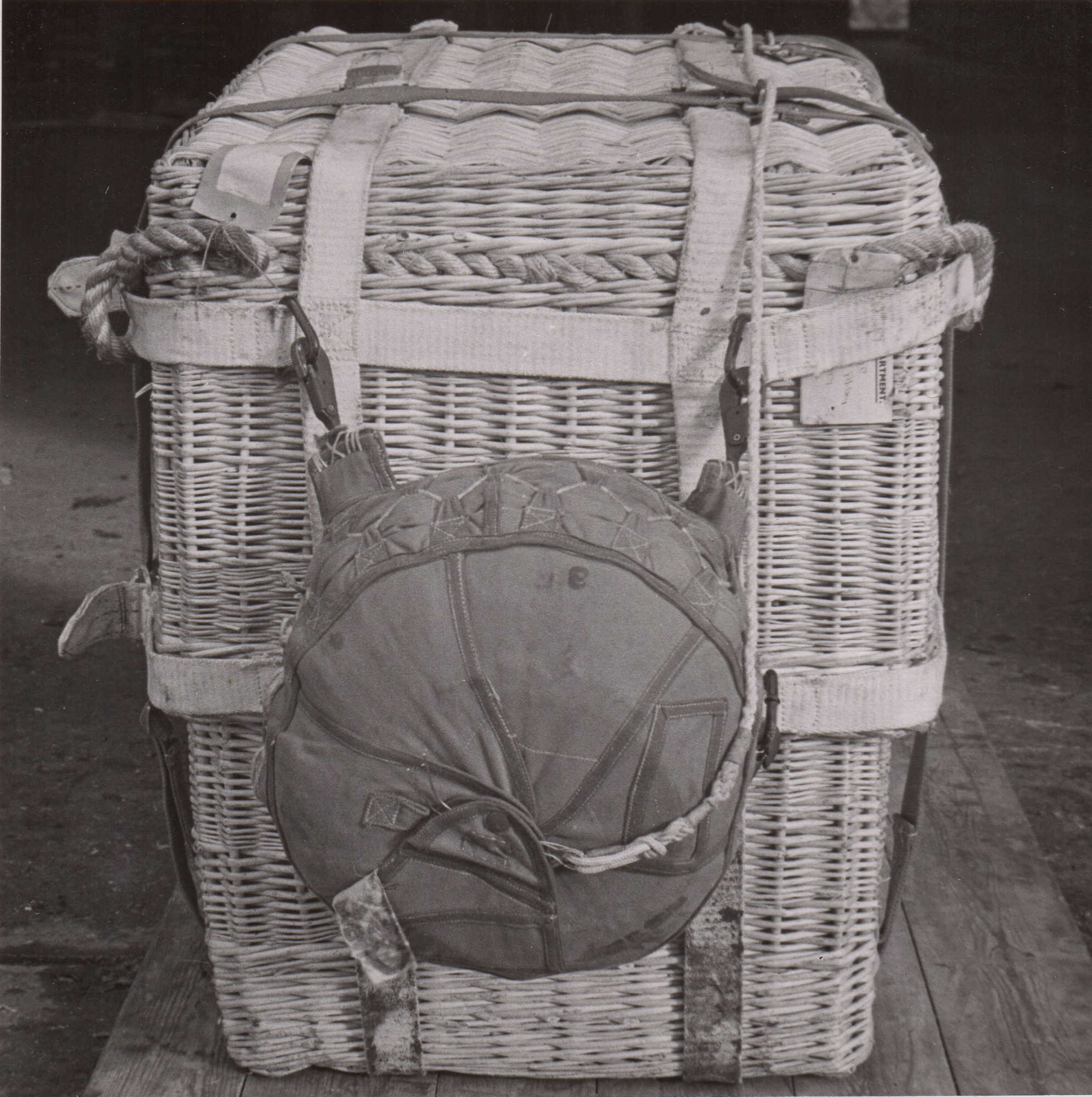
The supply parachute fitted to the 'D' rings of the packed Pannier. A.F.D.C. 17th November 1943. Courtesy of Airborne Assault Museum, Duxford.
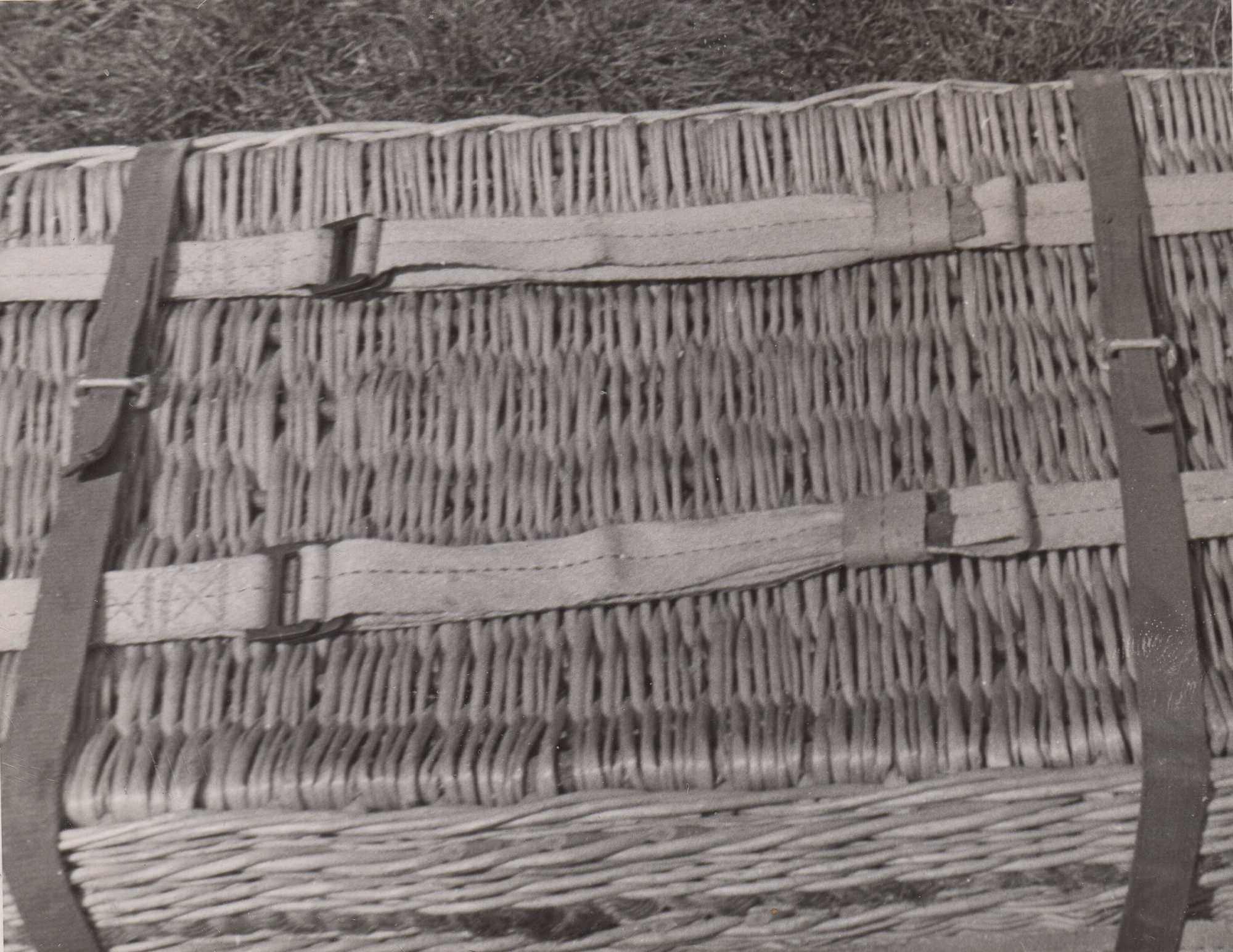
A close up of the pannier showing the securing straps and how they go over the harness straps, with their quick release buckles. A.F.D.C. 30th September 1944. Courtesy of Airborne Assault Museum, Duxford.
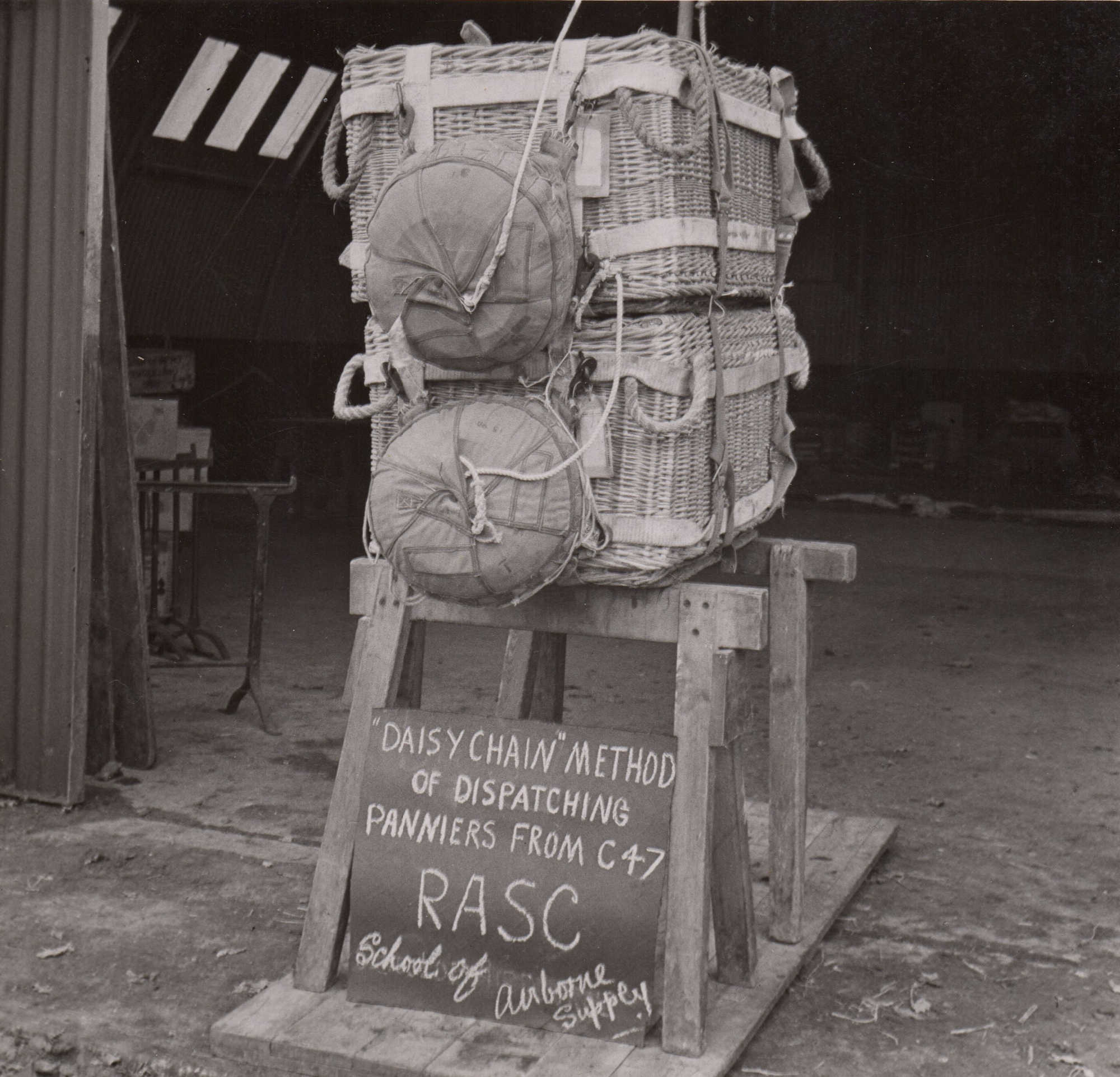
PHOTO #04-18. A 'Daisy Chain' mock up to show how two panniers at once could be despatched from a Dakota. A.F.D.C. 17th November 1943. Courtesy of Airborne Assault Museum, Duxford.
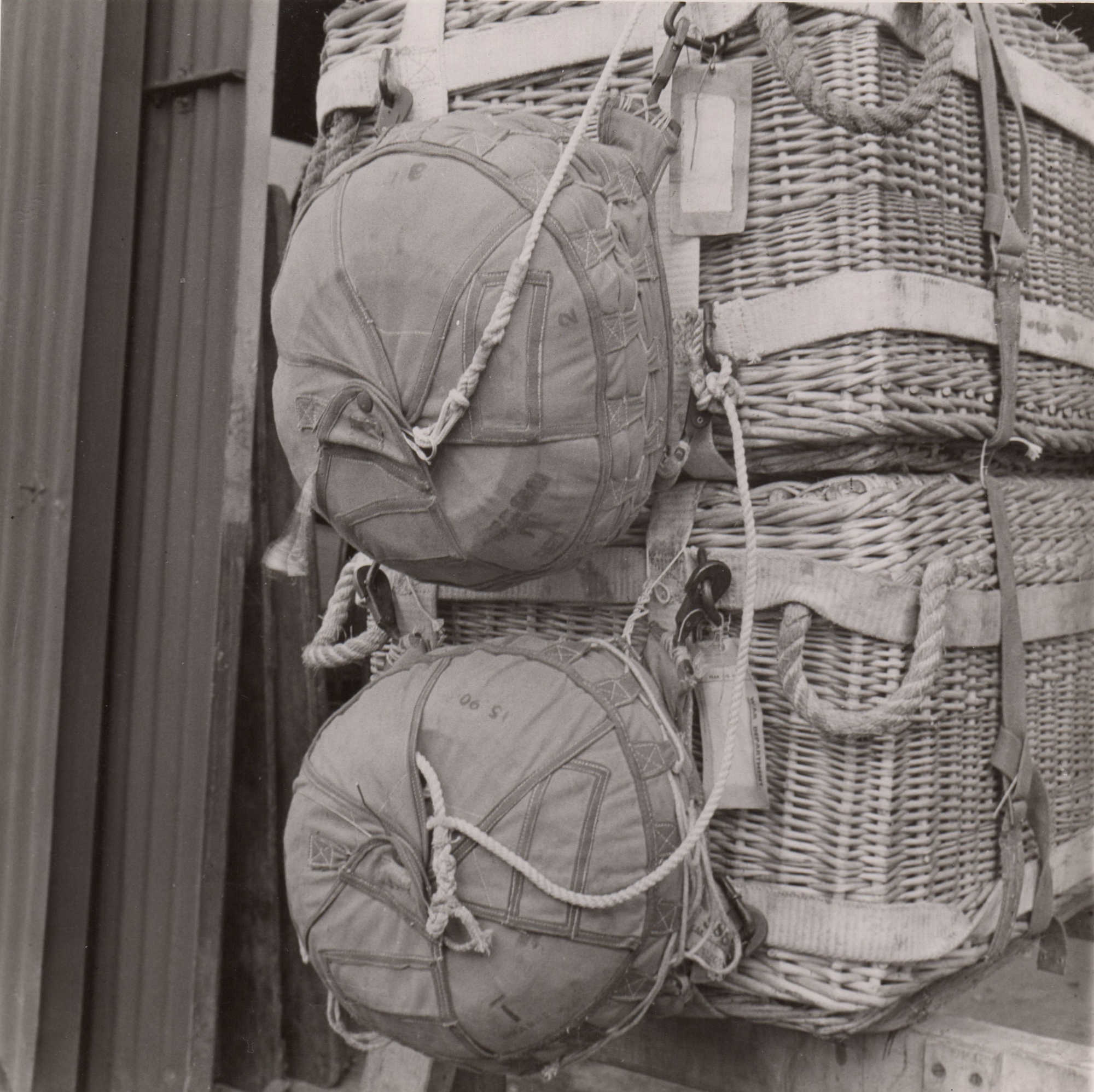
A close up of the parachutes fitted to the 'Daisy Chain' mock up. A.F.D.C. 17th November 1943. Courtesy of Airborne Assault Museum, Duxford.
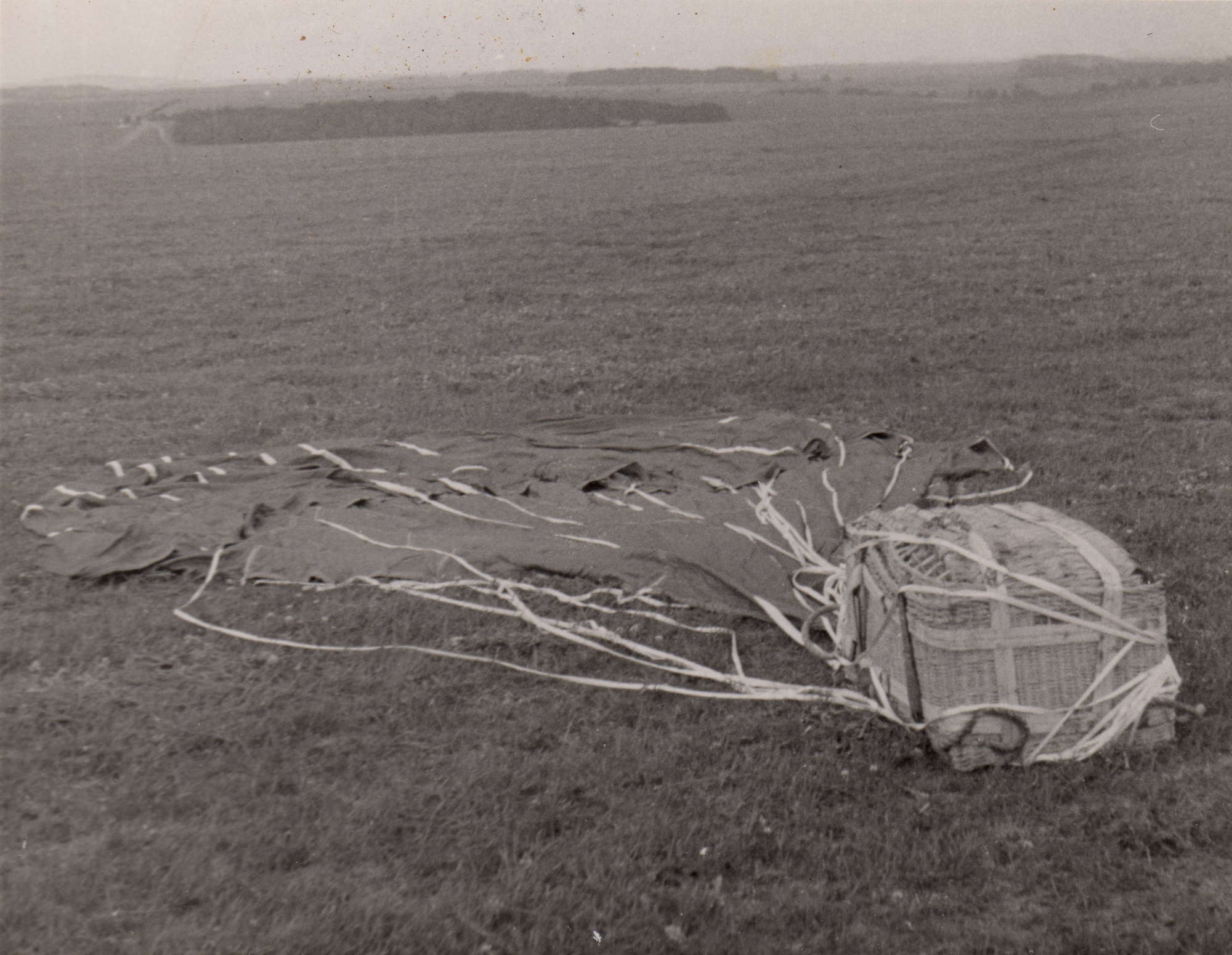
A practice drop with a pannier on Salisbury Plain. A.F.D.C. 23rd June 1944. Courtesy of Airborne Assault Museum, Duxford.
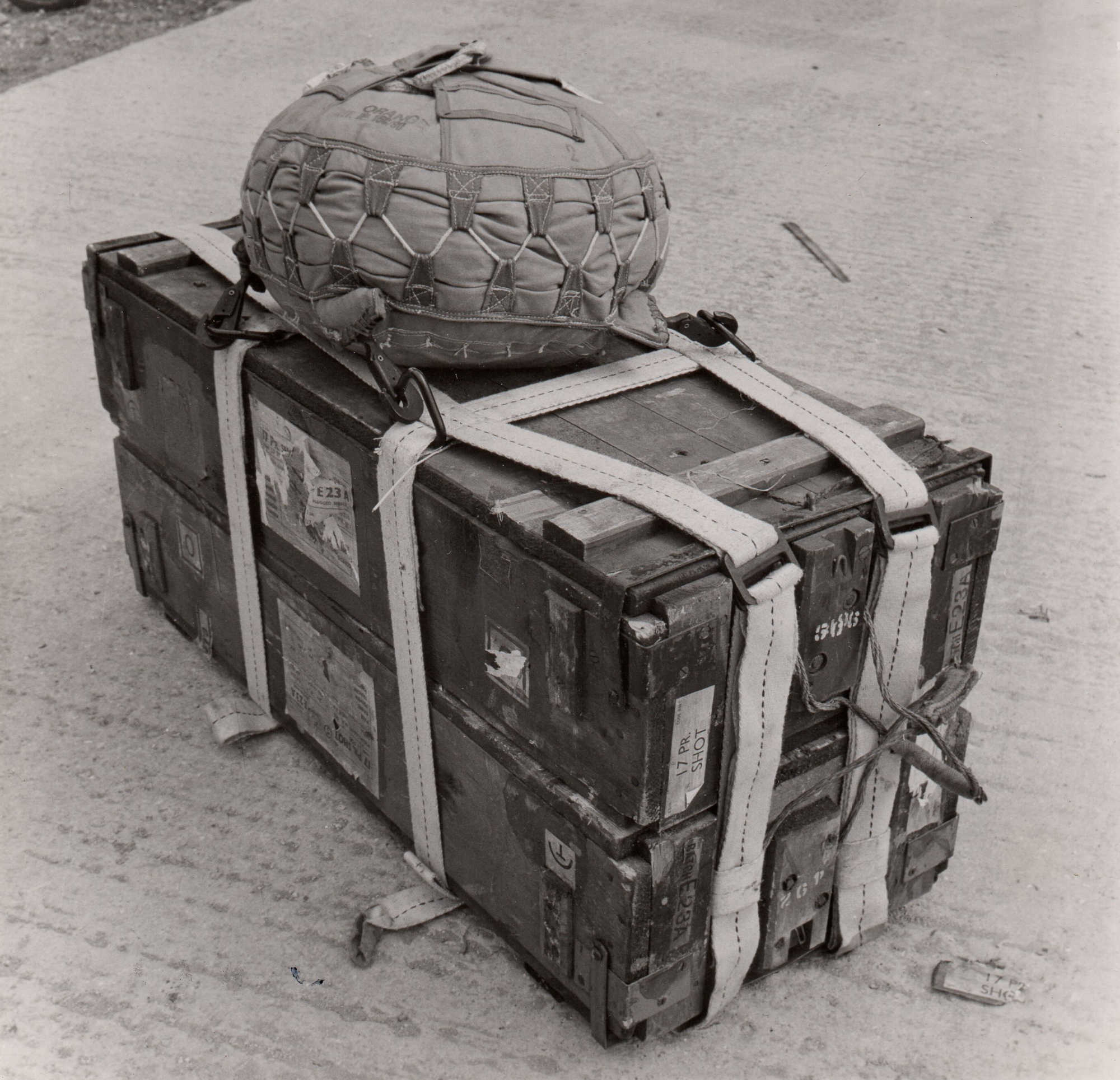
17 pounder ammunition crated and fitted with a pannier harness and parachute - version one. A.F.D.C. 5th June 1944. Courtesy of Airborne Assault Museum, Duxford.
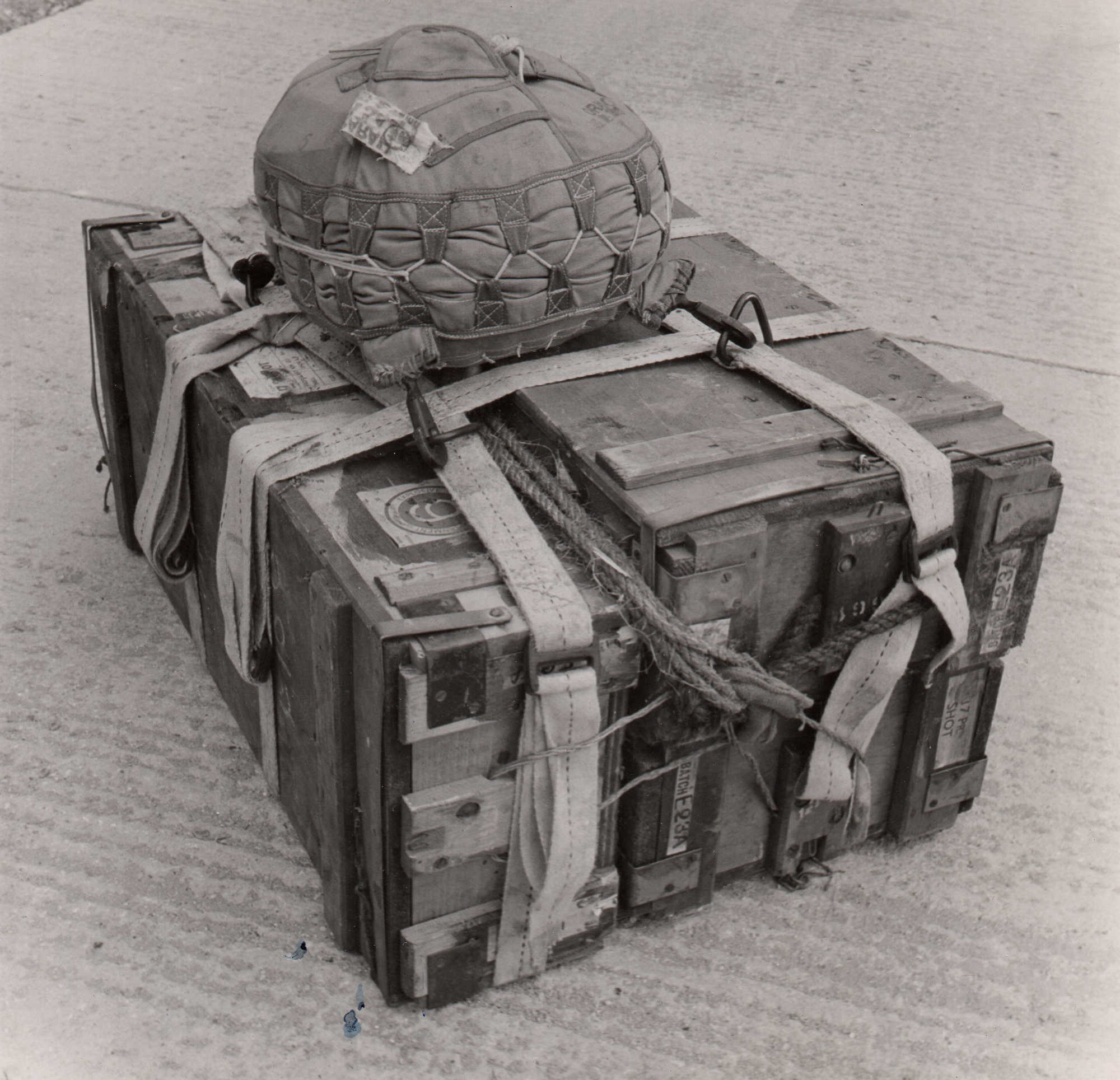
17 pounder ammunition crated and fitted with a pannier harness and parachute - version two. A.F.D.C. 5th June 1944. Courtesy of Airborne Assault Museum, Duxford.
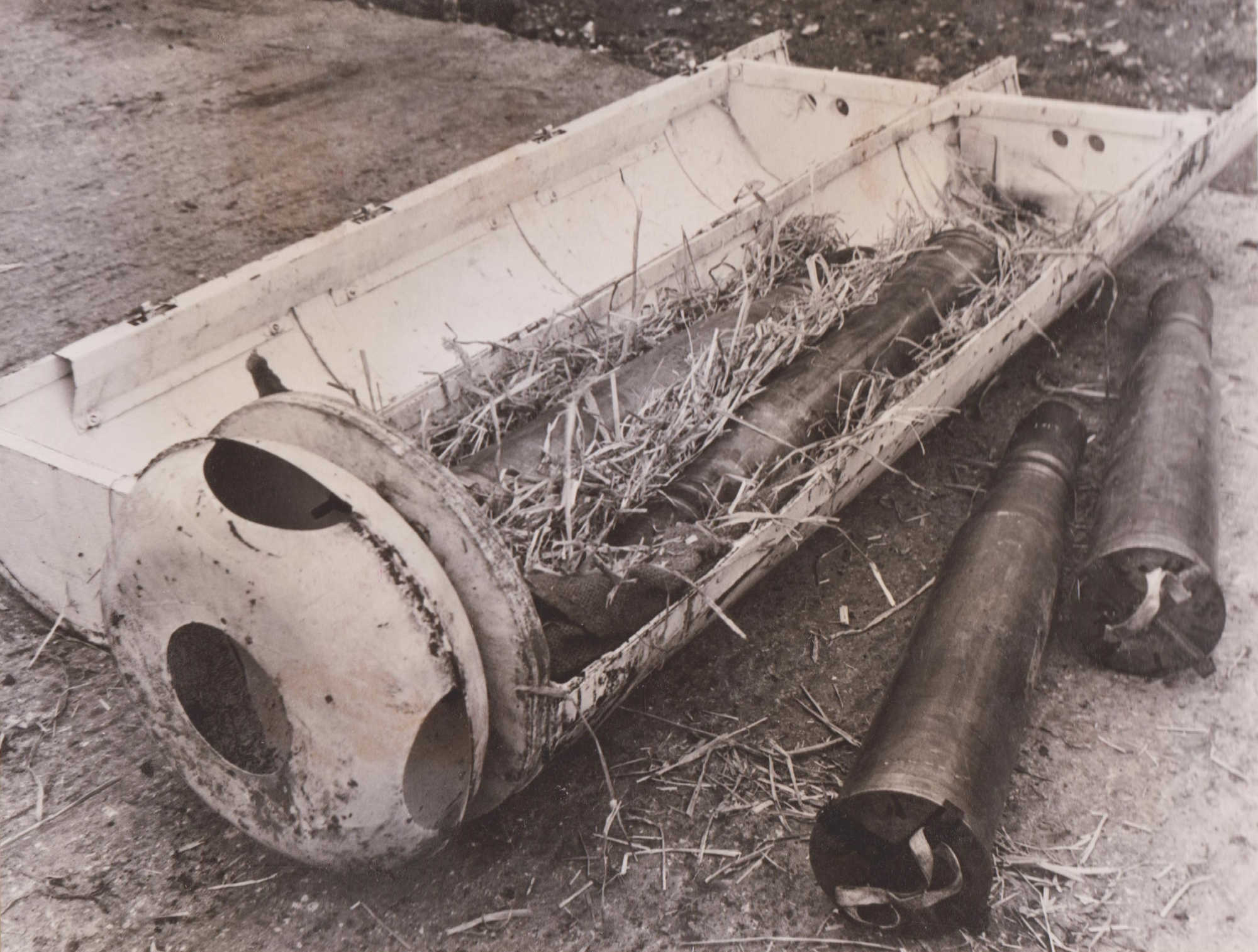
The usual means for dropping 17 pounder ammunition - a C.L.E. Container. A.F.D.C. October 1944. Courtesy of Airborne Assault Museum, Duxford.
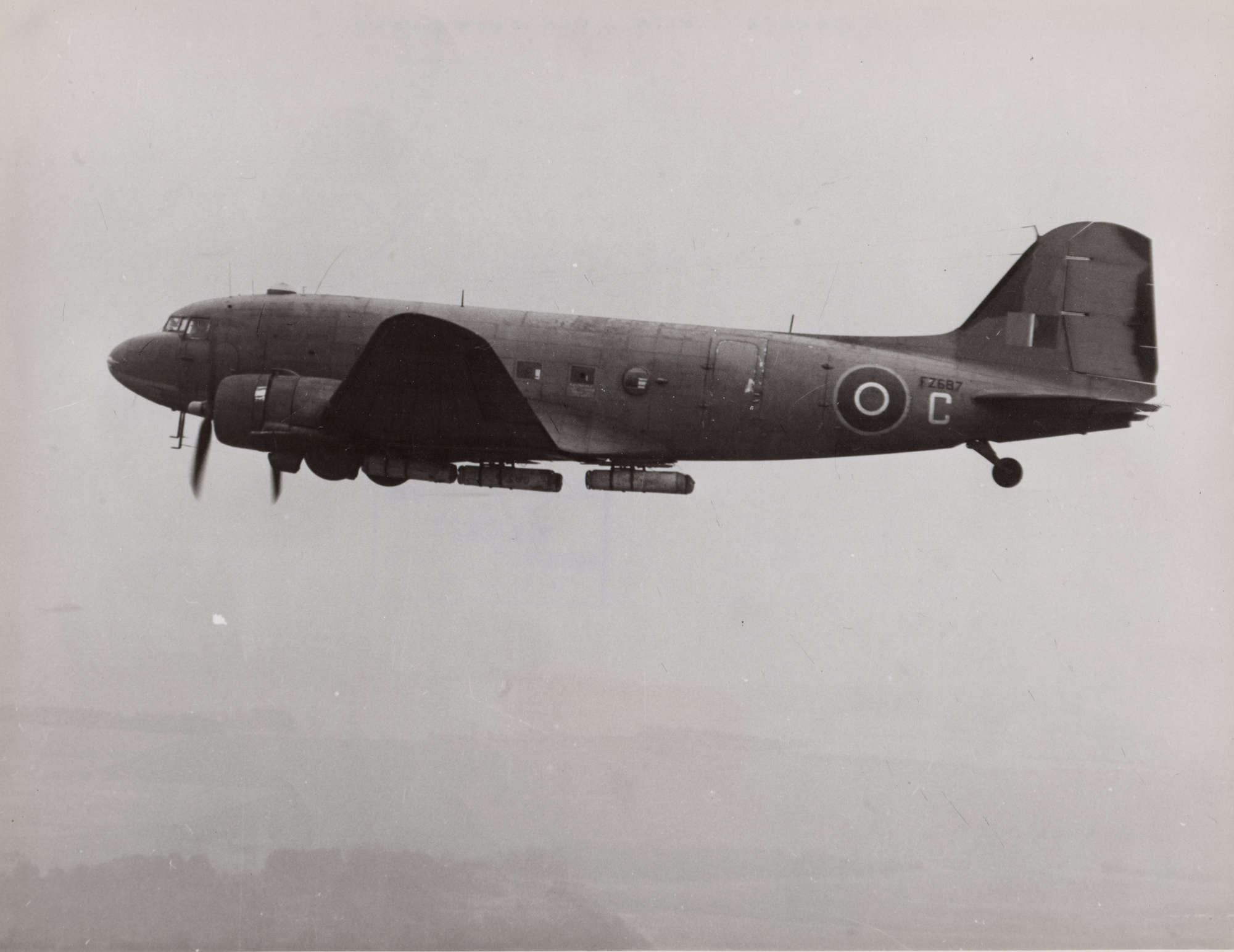
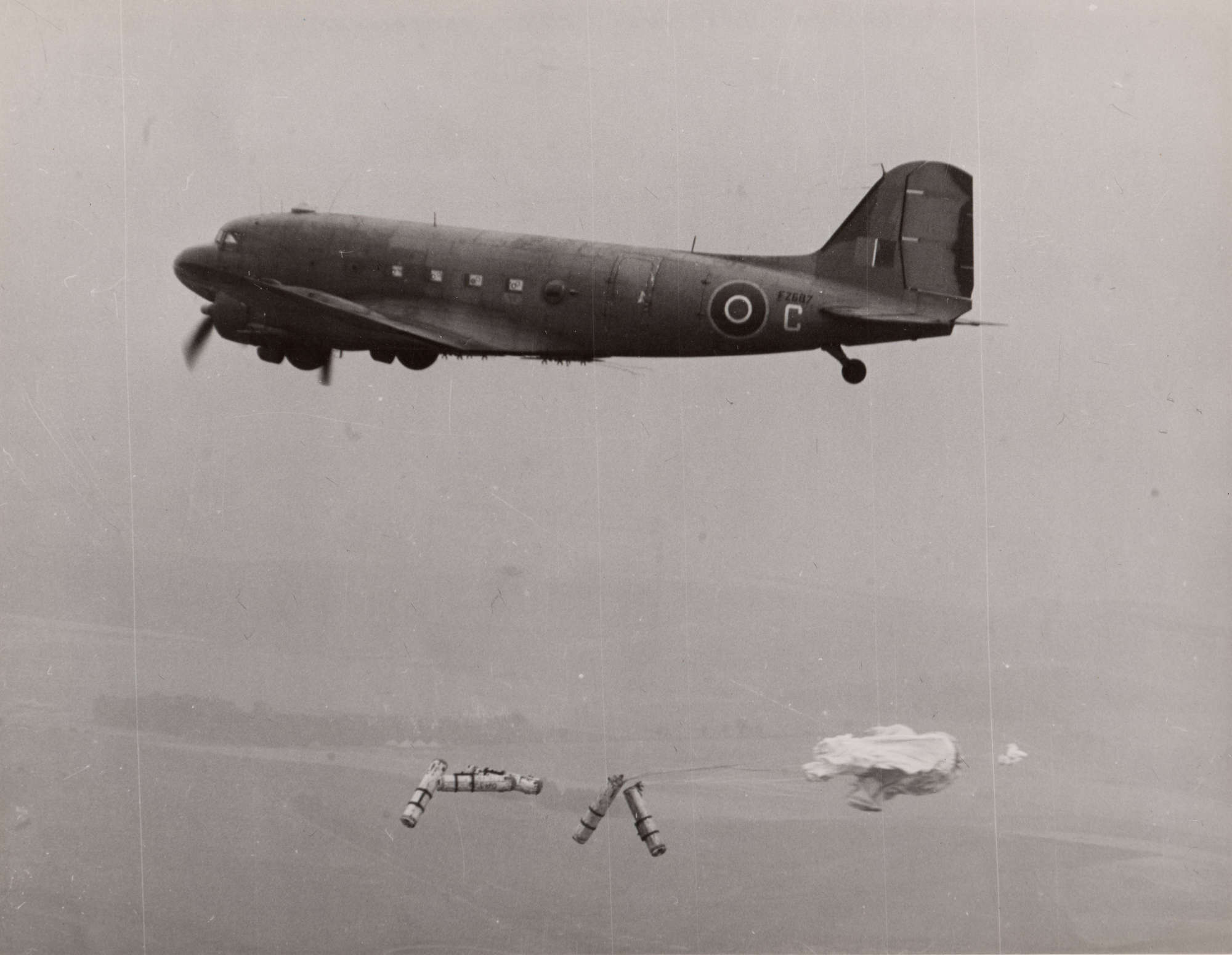
A Dakota aircraft showing the C.L.E. Containers fitted to the underneath, and then being released. 17th October 1946. Courtesy of Airborne Assault Museum, Duxford.
NOTES:
[A] & [A1] Letter & account of Ron Nutley to Bob Hilton. 8 September 2004.
[1a] From Jack Taylor to Bob Hilton. 28 September 1995.
[1b], [2], [3a], [4], [5] & [5b] 'The Day Gone By', Richard Adams. 1990.
[1c] Letter & account to Bob Hilton from Burnham Blaxley. 9 July 1998.
[6] Letter from Bill Gell. 1990's.
[3b] Letter from John Gifford to Frank Steer. 8 February 1999.
[7] 16 PFA, RAMC. Ex Bones Instructions. 21 Jul 1944.
[8] Letter from Bill Gell to Frank Steer. 11 January 1999.
[9] Letter from Jim Wild to Frank Steer. 1990's.


