Chapter 5
The Administrative Plan. August - September 1944.
"All England had become a humming arsenal, bursting with expectancy". Michael Packe, 'First Airborne'. 1948.
At 08.30 hrs on the 11th August, Lt-Col. Packe held a conference to deal with the move of the 1st Seaborne Lift, and his written orders were distributed just over an hour later (see Appendix XII). Maj. Gifford returned from hospital, as preparations for the departure of the main body of the Company were being carried out. "As Officer Commanding 250 Airborne Light Company I had under command HQ Platoon, 'C' Platoon (Lt. R.G. Adams) and Workshops (Capt. P. Bushby). In fact, I was most disappointed not to have been travelling by air; I would have done had the 'D' Day support operation, which involved 1st Airborne Division, in a landing near Caen not been cancelled. Subsequently, I developed mumps and lost my place in an aircraft. In fact, with the three Parachute Platoons attached to the three Brigades, there would have been no role for me at Arnhem." [1a]
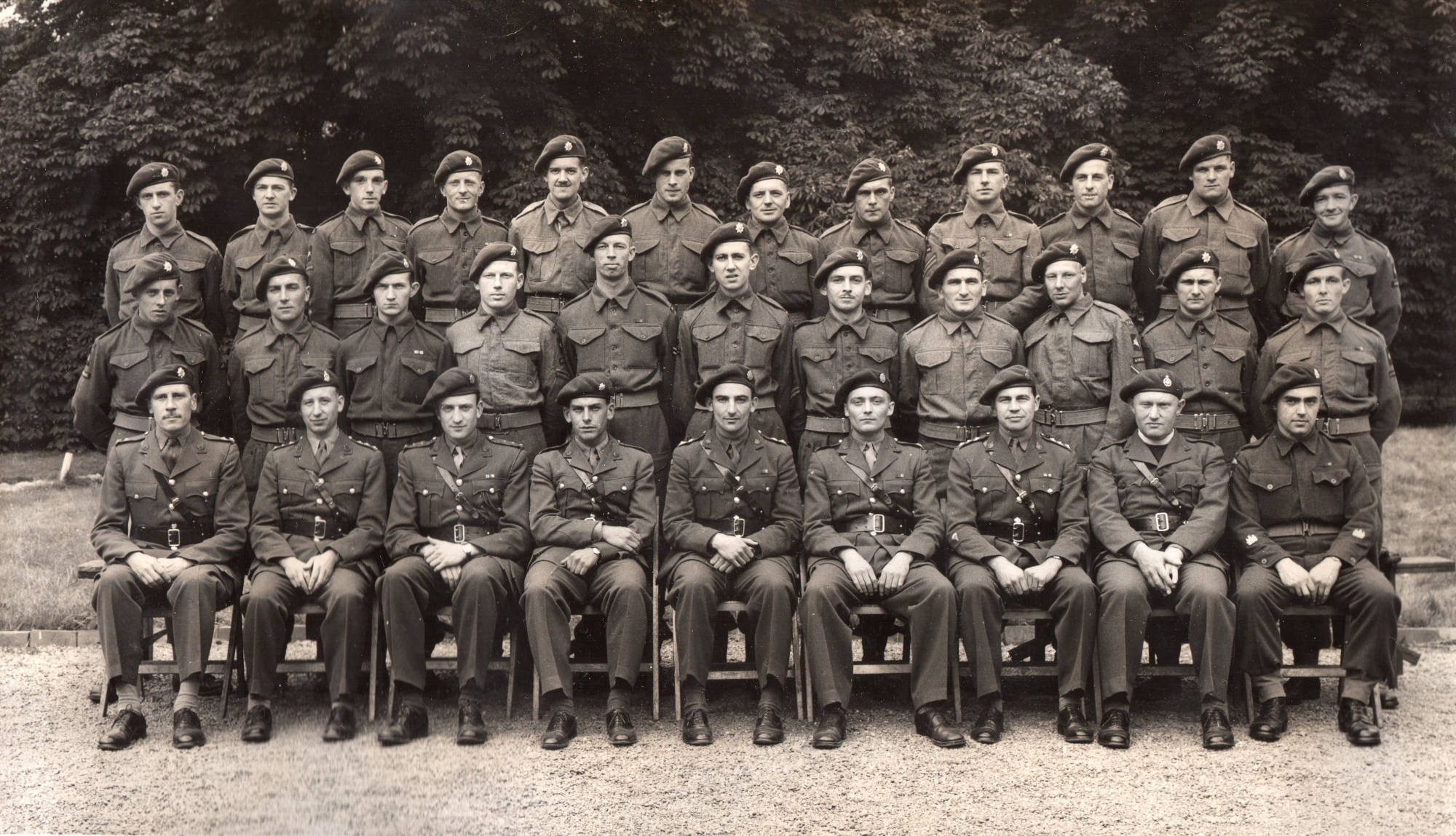
Headquarters Royal Army Service Corps, 1st Airborne Division. Fulbeck Hall, Lincolnshire. July 1944. Back Row, L-R: Dvr. N. Bell, Cpl. Ellerington, Dvr's. R. Whitwell, D.A. Duckett, Pte. Harwood, Dvr. Allen, L/Cpl. W. Low, Dvr. J.T. Bennett, Cpl. A.J. Lander, Dvr's. Baldwin, J.F. Edmonds & Pte. A.H. McNaught. Middle Row, L-R: Dvr. L.D. Jones, Pte's. Piper, Ward, Cpl's. T.F. Owen, C.T. Taylor, Dvr. Evans, Cpl's. F.C. Cope, Housden, L/Cpl. E. Gough, Dvr's. Davies & ? . Front Row, L-R: Lt. L.H. Drake, Capt. C.W.K. Willard (RAMC), Capt. J.S.D. Naylor, Maj. D.G. Clark, Lt-Col. M.St.J. Packe, Maj. J.R. Halls, Capt. R.E. Bunzly (ACC), Rev. H.L. Stapley (RAChd), S.S.M: F.E. Jackson. Photograph by Walter Lee, Grantham. Courtesy of Airborne Assault Museum, Duxford.
Even more frustrating for some, were those recalled from Parachute Course 128, which had started on the 6th August. Returning on the 11th August were Lt. Adams, L/Cpl. White (02), L/Cpl. Young (47), Dvr's. Arkell, Evans (23) and Rhydderch. Richard Adams: "250 Company were, inevitably, a little vague about how we were likely to find ourselves split up when the division went into action. At first, we supposed that, naturally, all our parachute and glider-borne platoons would be airborne, while the remainder of the Company - Workshops, Quartermaster's Team, the Orderly Room and so on - would follow up with the so-called 'seaborne tail' in a ground role, as would the heavy R.A.S.C. Company. However, in the event things didn't work out like that. It must have been some time during July [August] that we learned that, although the three parachute platoons would remain in England as part of the striking force of the division, ready to fly from home airfields, the rest of 250 Company, including the glider-borne jeep platoons, were to embark for Normandy. I dare say it was thought that in the event there wouldn't be sufficient gliders or aircraft available for jeep platoons, but things turned out differently, as will be told." [2a]
Just as frustrating for this small party was the knowledge that two men remained on the Course. Dvr's. Mills and Pearce both qualified as operational parachutists on the 21st August.
Dvr. 'Jack' Taylor: "In August we left Branston and went to Barkston Hall where we were under canvas to get ready for operations, many of which were planned and then for whatever reason they were quickly cancelled. All this only added to the frustration we felt concerning our lack of involvement in any real action. At this time each R.A.S.C. Para Platoon was attached to an individual Parachute Battalion in readiness for deployment. At this location we were camped next to the lake so we did a bit of fishing with explosives and there was fish on the menu for the next few days. Next, we were moved into the stable block at the village pub for a while and then into Nissen huts on the outskirts of the village.
During the few weeks we were at Barkston my mate 'Tojo' Spencer and I would sneak out of camp to go and see our girlfriends. He had a girlfriend that lived in Lincoln and my Gwen was at Potterhanworth. We would try to hitch a lift but it was hopeless as there was hardly any traffic so we would walk the whole distance together to Lincoln and I would go on to Potterhanworth. For the return in the late or early hours I would walk back to Lincoln, meet 'Tojo' and then we would both make our way back to camp by alternately running and walking short distances. We did this at least a couple of times a week but on one occasion we suffered for it. We arrived back at about 5.30am, went to bed for a short while, then got up to find that we were going on a route march. Of course we had no option but to comply and go on it. Sometime during the march 'Tojo' and I, Sergeant Walsh, and one or two others were having a discussion, and I happened to mention that my feet were a bit sweaty and sore. Sergeant Walsh then said that I must be going soft, so to let him know that I was not I told him about our walk to Lincoln and back the previous evening. Now shortly after this he must have related to Captain Cranmer-Byng what we had been up to, for he called us into his office but rather than giving 'Tojo' and me a rocket he said to us, "Bloody good show, but next time you do it come and see me and I will excuse you from the route march". This was heartening news but we never put his promise to the test to see if he really would excuse us." [2b]
By the 12th August, the 45 trailers of the Company had been loaded with ammunition, and preparations for departure were complete by 19.00 hrs, and the next day the Company moved to a Transit Camp at East Ham, London. At 10.00 hrs the next day the Company loaded its transport onto the Transport Ships T/298 and T/299, at the West India Docks, and then sailed down river to Southend at 18.00 hrs. On the 15th August, at 17.30 hrs, they left Southend and joined a convoy bound for France. As well as those mentioned by Maj. Gifford, he would also have with him his Adjutant, Capt. R.G.L. Norgate, and Lt. E.T.H. Evans, who would command 'G' Transport Platoon.
Whilst this activity for the Company's Seaborne Lift had been taking place, the glider-borne element had been preparing to move, and did so on the 15th August, to Transit Camps in the South of England, near to their take-off airfields. No 3 Parachute Platoon, with its Jeep Section, and a small Detachment from H.Q. went to Harwell Transit Camp. They were joined there by 'D' Transport Platoon. No 1 Parachute Platoon accompanied the 1st Parachute Brigade to their Transit Camp at Broadwell. No 2 Parachute Platoon remained in Leicestershire, co-located with 4th Parachute Brigade, who were not required to move - yet. On the 16th, the glider elements moved to their respective airfields and loaded the gliders.
Trying to keep track of the rapidly changing situations, was a trying time for the officers, but they were well served by their Senior N.C.O's, who had a good grasp of what was going on. Sgt. 'Bill' Chedgey: "In action, approx. 28 - 36 (including Captain and one Sergeant) to travel by para or glider. 20 to travel in gliders with 5 Jeeps and 10 x Trailers to meet up at the D.Z./L.Z. The whole would be seen as Brigade H.Q. defence until re-supply was required. The remainder of the Company would not fly and proceeded to France to meet up after the battle." [2c]
Cpl. Burnham Blaxley: "We eventually occupied a tented camp at Harwell. Five gliders were selected and I was put in charge of them. These were duly loaded with our jeeps and trailers which had in turn been loaded with 3 inch mortar shells and strapped down ready for take off. The remaining jeeps contained either 303 ammunition in clips or 9mm Sten gun ammunition, in magazines. Then came the period of waiting, having in the past weeks had so many false alarms we hoped this would not be another one." [2d]
Operation 'Transfigure' was to use the 1st Airborne Division, 1st Polish Parachute Brigade, 101st U.S. Airborne Division and attached American Airborne Units, to land and capture an area around Rambouillet, 25 miles south-west of Paris. The 52nd (Lowland) Infantry Division would then fly in, and together they would close the gap between Paris and Orleans, 65 miles to the south to cut off the enemies retreat. They would also provide a base from which Allied armour would launch a drive on Paris.
Just as with Operation 'Wild Oats', this came to nothing and 'Transfigure' was cancelled on the 17th August. Whilst some elements of the Division moved back to their Billets in Lincolnshire, others remained at their Transit Camps. Thus, 250 Company were now split into several parts. The Main Body, approximately 50% of its strength, was in Normandy, No 1 and No 2 Parachute Platoons were in their billets in Lincolnshire, and No 3 Parachute Platoon, and the various glider parties, were at their Transit Camps in the South of England. All were now awaiting further orders.
What of the Administrative Plan for any future airborne operation?
The logistics plan was based on the Division being able to fight for two days with the ammunition they took in with them, and then being re-supplied with a further two to three days stocks from Dumps (that had been created over the past few months). By which time, it was hoped, ground forces should have linked up with them.
The responsibility for the Administrative Plan was that of Lt-Col. Philip Henry Herbert Hulton Preston, the Assistant Adjutant and Quartermaster General of the 1st Airborne Division. Starting as a Captain in the 2nd Parachute Brigade on the 15th July 1942, as the Deputy Assistant Adjutant & Quartermaster General, he had risen to his present post on the 23rd October 1943. Advising him, and indeed working as a 'team' he had Lt-Col. Packe, dealing with all matters Supply and Transport. Lt-Col. G.A. Mobbs on the Ordnance aspects, Lt-Col. J. Kinvig on the electrical and mechanical aspects, and Col. G.M. Warrack on the medical side.
All of these officers had regular meetings with Col. Jefferies, now the D.D.S.T. at 1st Airborne Corps Headquarters, about further support, that would be needed outside of the Division.
By March 1944, the Division had settled into its new locations, been re-equipped and was starting 'refresher' training, and absorbing reinforcements. It was now that Maj-Gen. Urquhart could conduct an exercise, codenamed 'Cinderella', to test his staff, at all levels, within the Division. The covering letter for this exercise was sent out on the 17th March, and it listed the subjects to be dealt with as: 1 (a) Administration problems in connection with preparation and launching of an Airborne Operation, and 1 (b) Administration problems when engaged in an Airborne Operation including re-supply.
The 'problems' were sent out to the various Commanders and Staff on the 18th March, and the actual exercise, as 'Syndicates', would take place at the Village Hall, Fulbeck on the 29th March 1944. The Director of the exercise would be Maj-Gen. R.E. Urquhart (G.O.C.), and his Assistant Directors would be Col. M.A. Rea (Acting A.D.M.S.), Lt. Col. R.F.K. Goldsmith (G.S.O.I (Ops),* and Lt. Col. P.H.H.H. Preston.
The 'Syndicates' would be as follows:-
Div HQ. Syndicate.
Lt. Col. W.T. Campbell. G.S.O.I (Air)*
Major E.R. Hodges. D.A. & Q.M.G.
Major L.K. Hardman. D.A.A.G.
Capt. The Hon J.B. Coventry. Clerk of Works.*
Lt. Col. R.G. Loder-Symonds. C.R.A.
Lt. Col. M.C.A. Henniker. C.R.E.*
Lt. Col. M. St J. Packe. C.R.A.S.C.
Lt. Col. A.L. Work. Acting C.R.E.M.E.*
Lt. Col. G.A. Mobbs. A.D.O.S.
Lt. Col. T.G.V. Stephenson. C.R. Sigs.
Major O.P. Haig. A.P.M.
Revd. A.W.H. Harlow. Senior Padre.
Major J.E. Miller. D.A.D.M.S.
Syndicate No 1.
Brigadier. G.W. Lathbury. Commander.
Major C.D. Byng-Maddick. D.A.A. & Q.M.G.
Capt. B.W. Briggs. Staff Captain.
Capt. D.G. Mortlock. B.R.A.S.C.O.
Lt. Col. P. Cleasby-Thompson. C.O: 1st Para Bn.*
Lt. Col. J.D. Frost. C.O: 2nd Para Bn.
Lt. Col. E.C. Yeldham. C.O: 3rd Para Bn.*
Lt. Col. P.R. Wheatley. C.O: 16 Para Fd Amb.*
Major D.C. Murray. O.C: 1st Para Sqn, R.E.
Major W.F. Arnold. B.C: 1st A/L A-Tk Bty, R.A.
Major C.F.H. Gough, MC. O.C: 1st Airborne Recce Sqn.
Syndicate No 2.
Brigadier. J.W. Hackett. Commander.
Major W.T. Williams. D.A.A. & Q.M.G.*
Capt. H.B. Booty. Staff Captain.
Capt. C.R. Harkness. B.R.A.S.C.O.
Lt. Col. Sir. W.R. de B. Des Voeux Bart. C.O: 156 Para Bn.
Lt. Col. K.B.I. Smyth. C.O: 10th Para Bn.
Lt. Col. R.M.C. Thomas. C.O: 11th Para Bn.*
Lt. Col. W.C. Alford. C.O: 133rd Para Fd Amb.
Major R.E.H. Finch. O.C: 4th Para Sqn, R.E.*
Major A.F. Haynes. B.C: 2nd A/L A-Tk Bty, R.A.
Major B.A. Wilson. O.C: 21st Ind Para Coy.
Syndicate No 3.
Brigadier P.H.W. Hicks. Commander.
Col. H.N. Barlow. Deputy Commander.
Major. W.E. Balmer. D.A.A. & Q.M.G.*
Capt. E.A. Moy-Thomas. Staff Captain.
Capt. L.A.G. Lockyer. B.R.A.S.C.O.
Lt. Col. R. Payton-Reid. C.O: 7th Bn, K.O.S.B.
Lt. Col. T. Haddon. C.O: 1st Bn, Borders.
Lt. Col. W.D.H. McCardie. C.O: 2nd Bn, South Staffs.
Lt. Col. G.M. Warrack. C.O: 181 A/L Fd Amb.
Major R.A. McNeille. O.C: 9th Airborne Fd Coy, R.E.*
Lt. Col. W.F.K. Thompson. C.O: 1st A/L Lt Regt, R.A.
Note that those marked * were not with the Division, or in that post, by the time of Operation 'Market'.
In setting the scene for the logistical problems that were to be discussed, Serial 4 stated that the 6th Airborne Division would: "drop and land on D day and seize certain objectives near Dieppe to assist in capturing a beach-head", and that the 1st Airborne Division would: "Stand-by on airfields, with effect from 'D' day, either to reinforce the Bridgehead or to be used in 'Opportunity' role". Which means, that when it was announced on the 6th June that their sister Division had spear-headed the invasion, instead of them, it may have been a surprise to the more junior officers and men, but not to those who had been on Exercise 'Cinderella'!
As well as laying out the situation, reference Camps that would be needed (indeed work parties from throughout the Division would soon be on their way to construct Transit Camps for 1,000 men each), at Down Ampney, Fairford and Harwell. There was information on the mounting Airfields, the allocation of parachute aircraft and gliders. Also asked was, what kit would the men be expected to carry on them, and what kit would be expected to be taken on the Seaborne transport. Of particular note to Lt-Col. Packe was the 'problems' set out referring to the arrangements that must be made for move of Formations and Units to Airfields, and the full details of the arrangements necessary for the daily re-supply of the Division. As a side issue, for the Brigade Syndicates, there was the following question: "Assuming that a Brigade Group consists of either a Parachute or Air Landing Brigade with an A/Tk Bty, Lt Bty, Fd Sqn and Fd Amb, and that 50 Dakota aircraft are available for re-supply, what stores would you hope to receive on any one night?" The answers to all the 'problems' that were set, were to be sent to Divisional H.Q., in note form, by the 26th March.
Lt-Col. Packe was lucky in that he was well served at each Brigade by experienced B.R.A.S.C.O's. The 1st Parachute Brigade had Capt. Douglas Gerald Mortlock. Born in 1920, he had been granted an emergency commission in the R.A.S.C. on the 11th October 1941, after having served in the ranks for seven months. He was posted to the Headquarters, 1st Airborne Division R.A.S.C, as it was being formed, and took up the post of Supply Officer, on the 24th March 1943. In North Africa, he served for a while with 93 Company, and took part in Operation 'Slapstick' in Italy. He was posted as B.R.A.S.C.O. to the 1st Parachute Brigade on the 24th January 1944.
Capt. Colin Reid Harkess, was granted an emergency commission into the R.A.S.C. on the 13th December 1941, and had initially started his Airborne Forces service with the Air Landing Brigade in 1942, and had done Parachute Course 12, at R.A.F. Ringway, 20th April to 1st May 1942. He reported for duty with the 4th Parachute Brigade, at Kabrit in the Middle East, on the 3rd January 1943.
Leslie Arthur George Lockyer was born in 1913, and was granted an emergency commission in the R.A.S.C. on the 16th January 1943. By September 1943 he was serving in 93 Company and in command of 'B' Platoon. For Operation 'Slapstick' he commanded a Composite Platoon in Italy. It was whilst he was in Italy, on the 19th October, that he was posted as B.R.A.S.C.O. to the 1st Air Landing Brigade.
From the discussion group, Lt-Col. Packe would have been able to advise all the Formation and Unit Commanders what his force was capable of, and at the same time, they would have been able to tell him what they expected from his force, in the way of re-supply. From now on, there would be clear direction on future training and exercises. By the end of May, the Divisional Administrative set-up was well practiced.
Whilst this had been going on, an expansion of the Air Re-supply organization had taken place. Whilst Lt-Col. Packe retained direct command of 250 and 93 Company, 253 Company was detached to No 49 Air Despatch Column, R.A.S.C., where along with the 63rd Company, R.A.S.C. (Airborne Division Composite), and 720 General Transport Company, R.A.S.C. they would provide support to the Airborne Division's. No 49 Column was set up in July 1944, under the command of Lt-Col. C.M. Sinclair, R.A.S.C., with its Headquarters at The Piggeries, Down Ampney. On the 28th July Lt-Col. R.K. Gordon R.A.S.C. assumed the appointment of C.R.A.S.C. on posting from 253 Company R.A.S.C. (Airborne Division Composite).
A certain amount of cross postings occurred with No 48 Air Despatch Column, R.A.S.C. which had formed slightly earlier in July, from No 36 Line of Communication Column. It was commanded by Lt-Col. S.W. Walsh, R.A.S.C. and had under command No's 223, 799 and 800 Company R.A.S.C. (Air Despatch), 271 Petrol Depot, R.A.S.C. and the 50th War Office Transport Column. For labour purposes only, there was 389 Company Pioneer Corps, and seven sections of 207 Company Pioneer Corps. Its Headquarters was located at Ashton Keynes, near Down Ampney. (Lt. Col. A.J.F. Kingsmill took over as C.R.A.S.C. on the 31st August 1944). This formation had been formed at the express order of 21st Army Group, and was under the control of the War Office, not Airborne Forces.
However, in any large scale operation, of the kind now being planned, as the Allies broke-out of the constrictive bridgehead of Normandy, both Columns could be used to support an airborne assault deep behind enemy lines. It must have been with a sense of satisfaction that Lt-Col. Packe saw this organization taking shape, when a little over two years before, he had been tussling with the idea of how to drop supplies, safely, in good quantity, using old, and obsolete bombers.
250 Company were now freed from the task of re-supply - indeed, they had more than passed the torch to others - and could now concentrate on their main task. The three parachute platoons had practised their roles thoroughly with each of the Brigades, and were well drilled in dropping or landing with them, where the first task was to gather in all the supply containers that would have been dropped. They would be assisted in this, by the Transport Section allotted to each from 'D' Transport Platoon, with five Jeeps and ten trailers each. At a point designated by the C.R.A.S.C. and his small staff, a Divisional Maintenance Area would be set up, and all supplies would be ferried to that location. This area would be controlled by the C.R.A.O.C., Lt-Col. G.A. Mobbs, and the running of it was down to Maj. C.C. Chidgey and his Ordnance Field Park. They would be responsible for sorting the delivered stores, and then reallocating them for transport to the respective Brigade's by the Transport Sections. A further transport allocation had been made, through the increased number of Horsa gliders, so that supplies could also be delivered to units outside of the Brigade's, such as the 1st Airlanding Light Regiment, R.A., the 1st Airborne Divisional Workshops, R.E.M.E. and the Medical facilities being run by the Field Ambulances. The Parachute Platoons were also thoroughly trained in their secondary role of extra Brigade Headquarters Defence.
The various elements of 250 Company at their Transit Camps did not have to wait long before the planning for the next airborne mission took place at Moor Park, just eleven days later on the 28th August, it would be code-named Operation 'LINNET', which was to be a landing in the Lille - Tournai area to capture crossings over the River Escaut. This latest mission showed that the R.A.S.C. plan still needed refining and on the 29th August, Maj. J.R. Halls in charge of the Motor Transport part of the Divisional Seaborne Echelon, then located near La Mine in Normandy, was ordered to provide a party from H.Q., R.A.S.C, plus 25 Jeeps and 25 trailers, with their crews, and some specialists from 250 Company, totalling 34 All Ranks, and return to England under the command of Capt. J.D. Naylor. They embarked the next day.
Below is table No 1, showing the allotment of Admin Units to gliders and airfields for Operation 'Linnet':
Table No 1.
|
Sub-Unit |
Lift |
No of gliders or A/C |
A/C & Glider No |
Airfield |
Load |
Transit Camp |
|
1 Para Pl |
1st |
2 Para A/C |
48, 84 |
Saltby |
18 men |
- |
|
1 Para Pl Jeep Sect |
1st |
5 Horsa's |
514-518 |
Keevil |
3 men, 1 jeep, 2 trlrs |
Blakehill Farm |
|
3 Para Pl |
1st |
1 Horsa |
290 |
Down Ampney |
29 men |
Blakehill Farm |
|
3 Para Pl Jeep Sect |
1st |
4 Horsa's |
376-379 |
Tarrant Rushton |
5 men, 1 jeep, 2 trlrs |
Tarrant Rushton |
|
2 Para Pl |
2nd |
2 Para A/C |
635, 636 |
Saltby |
18 men |
- |
|
2 Para Pl Jeep Sect |
2nd |
5 Horsa's |
984-988 |
Fairford |
4 men, 1 jeep, 2 trlrs |
Blakehill Farm |
|
A.D.O.S. RAOC. |
2nd |
5 Horsa's |
816-820 |
Broadwell |
4 men, 1 jeep, 2 trlrs |
Blakehill Farm |
|
C.R.E.M.E. |
2nd |
4 Horsa's |
942-945 |
Fairford |
4 men, 1 jeep, 2 trlrs |
Blakehill Farm |
|
Hamilcars |
2nd |
3 Hamilcar |
881-883 |
Tarrant Rushton |
50 Panniers, 4 men |
Tarrant Rushton |
|
C.R.A.S.C. |
2nd |
(1) Horsa |
'T' [1] |
Fairford |
1 jeep, trlr, 5 men |
Blakehill Farm |
|
C.R.A.S.C. |
2nd |
1 Horsa |
996 |
Fairford |
2 jeeps, 4 men [2] |
Blakehill Farm |
|
250 Lt Coy |
1st |
1 Horsa |
266 |
Broadwell |
1 jeep, 2 trlrs, 3 men |
Blakehill Farm |
|
250 Lt Coy |
1st |
1 Horsa |
493 |
Fairford |
1 jeep, 2 trlrs, 4 men |
Blakehill Farm |
|
250 Lt Coy |
2nd |
1 Horsa |
821 |
Broadwell |
1 jeep, 2 trlrs, 2 men |
Blakehill Farm |
|
250 Lt Coy |
2nd |
1 Horsa |
946 |
Fairford |
1 jeep, 2 trlrs, 3 men |
Blakehill Farm |
|
250 Lt Coy |
2nd |
11 Horsa |
989-995, 997-1000 |
Fairford |
1 jeep, 2 trlrs, 2 or 3 men |
Blakehill Farm |
REMARKS:
[1] In Divisional Allotment.
[2] One jeep from 250 Lt Coy.
It is worth going through the first part of this in some detail, to show the deployment of the Parachute Platoons;
1 Para Platoon. 1st Lift, 2 para a/c (No's 48, 84) from Saltby = 18 men each a/c. Total = 36 men. Located at Longhills Hall, LINCS.
1 Para Platoon Jeep Section. 1st Lift, 5 gliders (No's 514 - 518) from Keevil = 3 men, 1 Jeep, 2 trailers to each glider. Total = 15 men, 5 Jeeps, 10 trailers. Located at Blakehill Farm Transit Camp.
3 Para Platoon. 1st Lift, 1 glider (No 290) from Down Ampney = 29 men. Located at Blakehill Farm Transit Camp.
3 Para Platoon Jeep Section. 1st Lift, 4 gliders (No's 376 - 379) from Tarrant Rushton = 5 men, 1 Jeep 2 trailers to each glider. Total = 20 men, 4 Jeeps, 8 trailers. Located at Tarrant Rushton Transit Camp.
2 Para Platoon. 2nd Lift, 2 para a/c (No's 635, 636) from Saltby = 18 men each a/c. Total = 36 men. Located at Longhills Hall, LINCS.
2 Para Platoon Jeep Section. 2nd Lift, 5 gliders (No's 984 - 988) from Fairford = 4 men, 1 Jeep, 2 trailers to each glider. Total = 20 men, 5 Jeeps, 10 trailers. Located at Blakehill Farm Transit Camp.
It can already be seen that a plan was formulated as early as August that the 1st Parachute Brigade would lead the way in any operation, supported by the 1st Air Landing Brigade, and the 4th Parachute Brigade to follow-up on a 2nd Lift. The conclusion being that the deployment of the formations to their airfields was always going to affect the operational plan!
The vehicles and personnel that had returned from the 1st Seaborne Lift, moved to Blakehill Farm Transit Camp on the 31st August, and were disposed as follows:
H.Q, R.A.S.C:, Adjutant, and 3 O.R's and one Jeep - to comprise glider load for Horsa No. 996 at Fairford, in conjunction with one Jeep provided by Capt. Winter-Goodwin.
250 Light Company:-
- (a) 5 Artificers to be included as passengers in the four extra gliders.
- (b) 25 Jeeps and trailers with drivers, who will be distributed to units as under for inclusion in airborne lift:-
HQ 1 Para Bde - 4 report to Keevil Transit Camp.
HQ 4 Para Bde - 4 report to Keevil Transit Camp.
1 Para Sqn RE - 2 report to Keevil Transit Camp.
4 Para Sqn RE - 2 report to Keevil Transit Camp.
16 Fd Amb - 3 report to Keevil Transit Camp.
181 Fd Amb - 2 report to Brize Norton Transit Camp.
133 Fd Amb - 3 report to Keevil Transit Camp.
Phantom (Recce) - 2 report to Tarrant Rushton Transit Camp.
Total = 22 Jeeps, trailers and drivers.
The remaining 3 were to stay at Blakehill Farm under command of Capt. Winter-Goodwin pending further instructions.
At this time the detailed ORDER OF BATTLE for the 250th Company, R.A.S.C. (Airborne Light), was:
Officer Commanding: Major. J.H. Gifford, and acting as his Second in Command was Captain. B.C. Winter-Goodwin, with the Adjutant being Captain. R.G.L. Norgate. The Headquarters consisted of these three Officers and 57 x Other Ranks.
No 1 Parachute Platoon was commanded by Captain. J.L. Cranmer-Byng and had 34 x Other Ranks. The Transport Section was commanded by Lieut. J. Grice.
No 2 Parachute Platoon was commanded by Captain. D.T. Kavanagh and had 34 x Other Ranks. The Transport Section was commanded by Lieut. G. Osborne.
No 3 Parachute Platoon were commanded by Captain. W.V.A. Gell and had 34 x Other Ranks. The Transport Section was commanded by Lieut. L.E.D. Daniels.
Residual Driver Increment = 31 x Other Ranks (usually split between the Transport Platoons).
'C' Transport Platoon was commanded by Lieut. R.G. Adams, and had 70 x Other Ranks.
'D' Transport Platoon was commanded by Lieut. P.B. Alsop, and had 70 x Other Ranks.
'G' Transport Platoon was commanded by Lieut. E.T.H. Evans, and had 70 x Other Ranks.
The Workshops & Fitters ('F') Platoon was commanded by Captain. P. Bushby. 40 x Other Ranks.
93 Company had also received instructions to send an element back to U.K. on the 29th August, and accordingly, part of 'B' Light Platoon, under, Lt. E.I. Lyon (not long posted in from 253 Company), 56 Other Ranks and two vehicles, left their base in Normandy at 17.00. They arrived back in the U.K. on the 1st September and were attached to 165 Company, R.A.S.C. (Air Composite) at Lechlade.
Operation 'LINNET' was rapidly abandoned, on the 3rd September, as the planning for Operation 'LINNET II' had started on the 1st September, which envisaged a landing in the Liege - Maastricht area, to seize crossings over the River Meuse in support of the United States 1st Army. This too was abandoned the following day, as the ground forces over-ran the objectives.
Planning for Operation 'COMET' started immediately and the R.A.S.C. and Administrative plan, is shown at table No 2. The major change here, from Operation 'LINNET', was that both Parachute Brigades and the Airlanding Brigade were going in on the First lift, and their supporting R.A.S.C Platoons were going with them. However, as there were not enough airlift, elements of the Jeep Transport Sections would have to fly in on the Second Lift. The plan was to seize river crossings in the Grave - Nijmegen - Arnhem area's of Holland.
Below is the table showing the allotment of Admin Units to gliders and airfields for Operation 'Comet':
Table No 2.
|
Sub-Unit |
Lift |
No of gliders or A/C |
Chalk No's |
Take off Airfield |
Time Emplaned |
Time Down & DZ/LZ. |
|
1 Para Pl |
1st |
2 Para A/C |
48, 84 |
Folkingham |
0445 |
0800. X |
|
1 Para Pl Jeep Sect |
2nd |
5 |
1061-1065 |
Tarrant Rushton |
1500 |
1850. U |
|
3 Para Pl |
1st |
1 |
290 |
Down Ampney |
0430 |
0728. Z |
|
3 Para Pl Jeep Sect |
1st |
2 |
378-379 |
Tarrant Rushton |
0500 |
0742. U |
|
3 Para Pl Jeep Sect |
2nd |
2 |
883A & B |
Tarrant Rushton |
1430 |
1829. L |
|
2 Para Pl |
2nd |
2 Para A/C |
636, 672 |
Saltby |
0445 |
0820. Y |
|
2 Para Pl Jeep Sect |
2nd |
5 |
984-988 |
Fairford |
1500 |
1847. U |
|
A.D.O.S. RAOC. |
2nd |
5 |
816-820 |
Broadwell |
1430 |
1820. Z. |
|
C.R.E.M.E. |
2nd |
4 |
942-945 |
Fairford |
1500 |
1838. U |
|
Hamilcars |
2nd |
3 |
881-883 |
Tarrant Rushton |
1430 |
1829. L |
|
C.R.A.S.C. |
2nd |
(1) |
938 |
Fairford |
1500 |
1838. U [1] |
|
HQ, R.A.S.C. |
2nd |
1 |
996 |
Fairford |
1500 |
1847. U |
|
250 Lt Coy |
1st |
1 |
226 |
Broadwell |
0430 |
0724. Z |
|
250 Lt Coy |
1st |
1 |
493 |
Fairford |
0500 |
0758. U |
|
250 Lt Coy |
2nd |
1 |
821 |
Broadwell |
1430 |
1820. Z |
|
250 Lt Coy |
2nd |
1 |
946 |
Fairford |
1500 |
1838. U |
|
250 Lt Coy |
2nd |
11 |
989-995, 997-1000 |
Fairford |
1500 |
1847. U |
TOTAL 1st Lift:- 4 x Parachute A/C, 5x HORSA's
TOTAL 2nd Lift:- 35 x HORSA's, 3 x HAMILCAR's.
GRAND TOTAL= 4 x Parachute A/C, 40 x HORSA's, 3 x HAMILCAR's.
NOTES:
[1] From Divisional allotment.
Postponed on the 7th and 8th September, Operation 'COMET' was finally cancelled on the 10th September, just as a new mission was being planned. Operation 'MARKET' was an enlargement of 'COMET' with the British 1st Airborne Division, supported by the 1st Polish Parachute Brigade being assigned the task of securing a crossing over the Lower Rhine at Arnhem. The United States 82nd (All American) Airborne Division were assigned the task of securing crossings in the Grave and Nijmegen area, and the United States 101st (Screaming Eagles) Airborne Division the task of securing crossings in the area between Eindhoven and Veghel.
Again, there was not enough airlift to get all these units into action on the first day, in fact it was to be spread over three days.
Table No 3 shows the R.A.S.C. and Administrative plan for Operation 'MARKET'. It varies only slightly from the previous two plans, with a couple of subtle differences, which have lead to confusion ever since!
Table No 3.
|
Sub-Unit |
Lift |
No of gliders or A/C |
Chalk No's |
Take off airfield |
Time Down. DZ/LZ. |
|
1 Para Pl |
1st |
2 Para A/C |
48, 84 |
SALTBY |
H+0045, "X". |
|
1 Para Pl Jeep Sect |
2nd |
5 Horsa's |
919-923 |
TARRANT RUSHTON |
X+0043, "X". |
|
3 Para Pl |
1st |
1 Horsa |
519 |
KEEVIL |
H+0043, "Z". |
|
3 Para Pl Jeep Sect |
1st |
2 Horsa's |
379-380 |
TARRANT RUSHTON |
H+0025, "Z". |
|
3 Para Pl Jeep Sect |
1st |
2 Horsa's |
479-480 [2] |
KEEVIL |
H+0037, "Z". |
|
250 Lt Comp Coy |
1st |
2 Horsa's |
264-265 |
BROADWELL |
H+0010, "S". |
|
2 Para Pl |
2nd |
2 Para A/C |
635, 636 |
SALTBY |
X hr, "Y". |
|
2 Para Pl Jeep Sect |
2nd |
5 Horsa's |
970-974 |
HARWELL |
X+0052, "X". |
|
A.D.O.S. RAOC. |
2nd |
5 Horsa's |
811-815 |
DOWN AMPNEY |
X+0023, "S". |
|
C.R.E.M.E. |
2nd |
4 Horsa's |
849-852 |
DOWN AMPNEY |
X+0032, "X". |
|
C.R.A.S.C. |
2nd |
1 Horsa |
941 (Div HQ) |
FAIRFORD |
X+0046, "X". |
|
HQ, R.A.S.C. |
2nd |
1 Horsa |
793 |
BLAKEHILL FARM |
X+0020, "X". |
|
Hamilcars |
2nd |
3 Hamilcar |
913-915 |
TARRANT RUSHTON |
X+0040, "X". |
|
250 Lt Comp Coy |
2nd |
6 Horsa's |
924-929 |
TARRANT RUSHTON |
X+0045, "X". |
|
250 Lt Comp Coy |
2nd |
1 Hora |
835 |
BROADWELL |
X+0029, "X". |
|
250 Lt Comp Coy |
2nd |
6 Horsa's |
853-858 |
DOWN AMPNEY |
X+0032, "X". |
|
Re-Supply |
2nd |
15 Stirlings |
975-989 |
HARWELL |
X+0101, "L". |
|
Re-Supply |
2nd |
20 Stirlings |
1030-1049 |
HARWELL |
X+0106, "L". |
ADDED LATER.
|
93 Coy. |
2nd |
4 Horsa's |
974A, B, C+D |
HARWELL |
X+00??, "X". |
|
250 Lt Comp Coy. |
2nd |
2 Horsa's |
836-836* [3] |
BROADWELL |
?????. "X". |
NOTES:
[1] This was the glider carrying the 28 men of the 3rd Parachute Platoon - and was swapped to KEEVIL.
[2] The load of one of these gliders (Jeep, 2 x trailers & 2 men) were substituted for that at FAIRFORD.
[3] These had been 'unallotted', and were allocated to the 250th Airborne Light Company at the last minute.
On the third line down, 3 Para Pl, FAIRFORD is crossed out and KEEVIL has been penned in. This was a last minute adjustment ordered by Headquarters, R.A.S.C. on the 15th September, which 'swapped' over two of the sub-units within No 3 Parachute Platoon. The main part of the Platoon, Capt. Gell and his 28 men, had been using Blakehill Farm Transit Camp and travelling to R.A.F. Fairford every time they were 'stood-to' for an operation, and one of the Jeeps and its two trailers, of the Transport section, was at Tarrant Rushton and having to drive to Keevil. They were now moved, so that the Platoon were at Keevil Transit Camp and would take off from R.A.F. Keevil, and the Transport Section Jeep, two trailers and crew would be at Blakehill Farm Transit Camp and only have to travel a short distance to R.A.F. Fairford. See figure #04.
The stopping of all this unnecessary travelling was probably as a result of a serious road accident on the 10th September, involving three officers from the Company, Capt. W.V.A. Gell, Lt. P.B. Alsop and Lt. P.E. Thompson, when the Jeep they were in was involved in a crash with a U.S. Army lorry on the Cirencester to Cricklade road. Capt. Gell survived the crash without serious injury, but Lt. Thompson died of his injuries the next day in No 56 R.A.F. Mobile Field Hospital at Down Ampney.
Lt. Alsop was seriously injured and was not able to take part in Operation 'MARKET'. "Alsop and Thompson were involved in a Jeep which had a serious accident with a heavy U.S. Army lorry, just a few days before the Arnhem Lift. Thompson died of his injuries and Alsop suffered a broken arm and collar bone." [3]
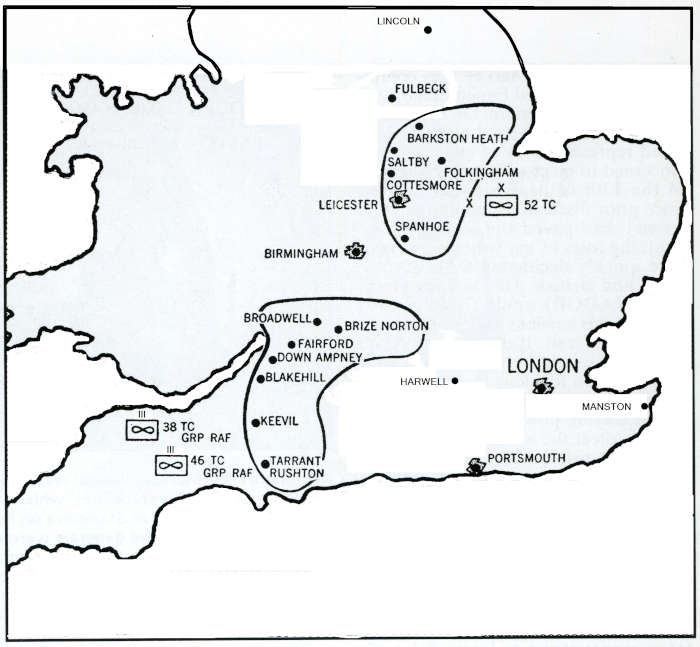
The airfields in England used for Operation 'Market'. In the north were those of the 52nd Troop Carrier Command, U.S.A.A.F. and in the south those of No 38 and No 46 Groups, R.A.F. September 1944.
No 3 Parachute Platoon now looked like this:-
From R.A.F. Keevil, C/N: 479 and 480. Twenty eight men in one glider, and a Jeep, 2 x trailers + 3 men in the other.
From R.A.F. Fairford, C/N: 519. Jeep, 2 x trailers + 3 men.
From R.A.F. Tarrant Rushton, C/N: 379 and 380. 2 x Jeeps, 4 x trailers + 5 men.
From R.A.F. Broadwell, C/N: 264 and 265. Glider 264 had a Jeep, 2 x trailers + 3-6 men from 250 Company and the HQ, RASC 2 i/c, Maj. Clark, on board.
Glider 265 had its load swapped at the last minute.
No 1 Parachute Platoon were allocated two Dakota aircraft from the 314th Troop Carrier Group, U.S.A.A.F., Chalk No's 48 and 84, and they would fly from Saltby aerodrome. Aircraft No 48 was at the end of the serial, flying in with the 2nd Parachute Battalion, and No 84 was also at the end of the serial flying in with the 3rd Parachute Battalion. Both were to drop their personnel on D.Z.'X'.
Dvr. 'Ron' Nutley: "Then on 15th September, I was told to kit up I was to do an 'Operation Drop'. We were taken to a village not far from Grantham. Shortly before our eventual take off from Grantham we were told the drop was going to be Arnhem, The Netherlands. We took off in a U.S. Airforce C47 Dakota." [4]
To co-ordinate all the R.A.S.C. matters on the airborne part of the operation, the C.R.A.S.C., Lt-Col. Packe was going with a small staff, that included his 2 i/c, Maj. David Graham Clark, and his Adjutant, Capt. John Denis Naylor. They would have two jeeps and trailers, and 9 men with them. Lt-Col. Packe: "The other composite company [253], now under Airborne Corps control together with the equivalent company of 6th Airborne Division [63], stood by its dumps down in Wiltshire. Supply drops of a predetermined composition had been planned for particular days of the operation. Further lists, known by agreed code names, were ready on call if wanted. The despatching crews were trained and ready. The lift of the Division to the transit camps attached to the airfields, ranging from Lincolnshire to Wiltshire and often a hundred miles or more from home stations, was carried out, as it had been several times already in that weary summer, by C.R.A.S.C. with the aid of G.T. companies borrowed for the purpose from Command H.Q's. He would probably have been better spared this extra duty since, with his head full of operational concerns, he felt rather as though he were trying to pull up a drawbridge on which he was still standing!
The R.A.S.C. plan which had been brought down to a formula during the summer, was for a parachute platoon of the Light Company to fly in the first lift attached to each of the three brigades, under the command of the Brigade H.Q. represented by the B.R.A.S.C.O. Once. the Immediate objectives had been gained and the large quantities of first line ammunition carried in the gliders collected and handed over, they were to return to the second-in-command on a preselected supply dropping point (S.D.P.) which should by that time have been captured and consolidated. This, they were to lay-out and prepare. The second-in-command was also to employ them for requisitioning, by force when necessary, all types of supplies and especially transport in the captured town, in the hope of repeating the very successful results achieved at Taranto. It will be noticed that, from first to last, the R.A.S.C. had to endure a very wide decentralisation, or even dispersal. It was indeed inevitable; and it was because of thi,s that the careful training and complete reliability of every officer was so very necessary.
In the second lift the following day, C.R.A.S.C. with his skeleton H.Q. and the remainder of the Light Company, their jeeps and trailers fully loaded, would arrive, and, ferrying extra supplies from the abandoned gliders and parachute containers, would begin to stock a Divisional Maintenance Area (D.M.A.) - a well-concealed and dispersed site immediately accessible to the S.D.P.
On the third day, the first [large] supply drop would come in, and thereafter, collection and issue to units at the D.M.A. would follow a normal routine until the land forces arrived, and the reserve stores carried by the seaborne party were available for use. The D.M.A., which was run exclusively by the R.A.S.C., and for which C.R.A.S.C. was responsible to the Q staff, handled all sorts of commodities, Ordnance, Medical, R.E.M.E., and R.E. stores, being included." [5]
At 12.00 hrs on the 16th September, Lt-Col. Packe briefed the R.A.S.C. officers of the airborne lift, and at 18.00 hrs, Maj. Clark briefed the Other Ranks, and then the Camp was sealed.
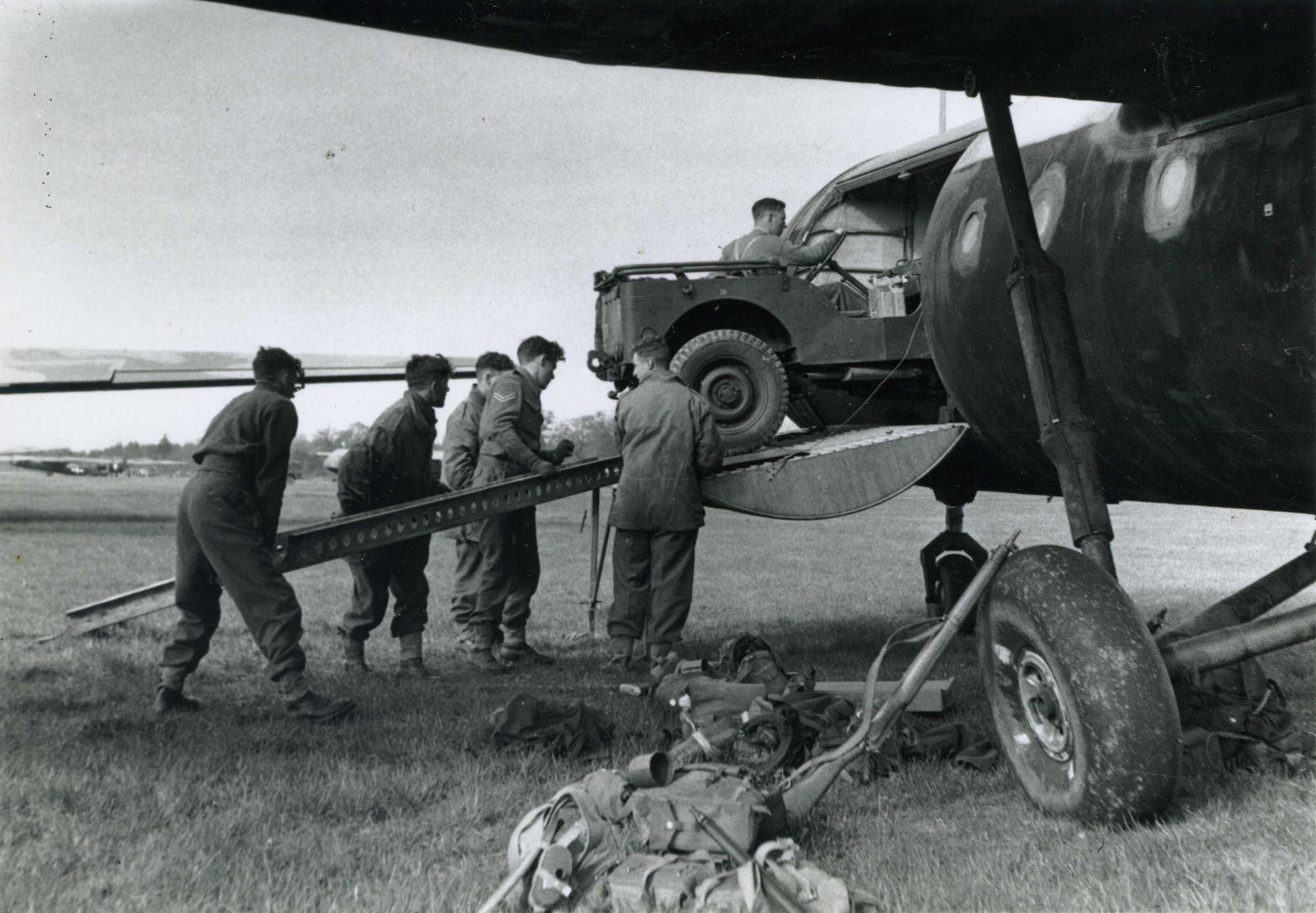
A Jeep being loaded aboard a Horsa glider for Exercise 'Mush'. 20th April 1944. Courtesy I.W.M. H37693.
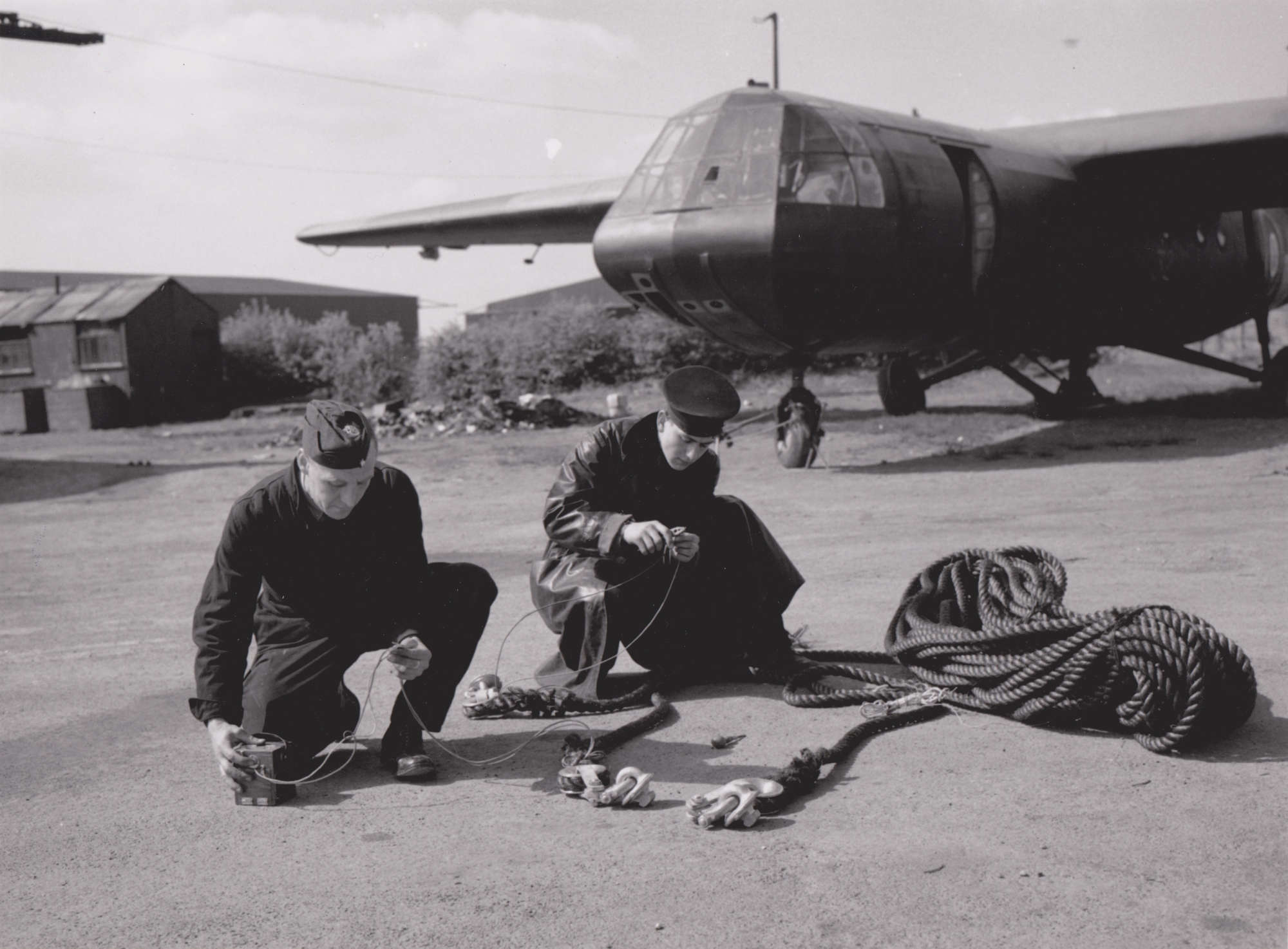
A member of the R.A.F. Ground Crew and a Naval rating preparing a Horsa glider tow-rope and communication chord. 1944 Courtesy I.W.M. H18822.
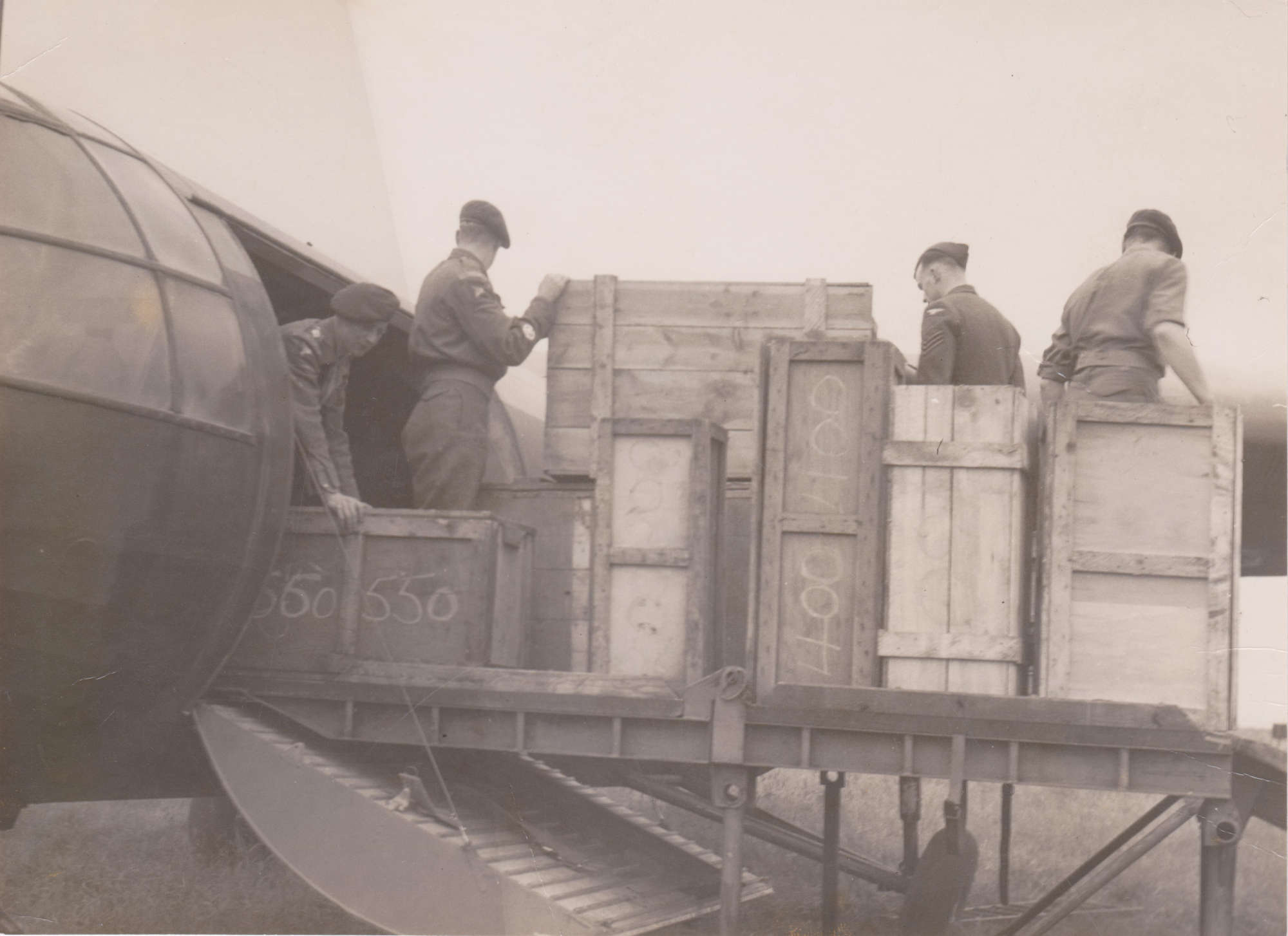
A Horsa glider being loaded by Airborne R.A.S.C. and R.A.F. personnel with 'bulk' stores. A.F.D.C. Circa 1944. Courtesy of Airborne Assault Museum, Duxford.
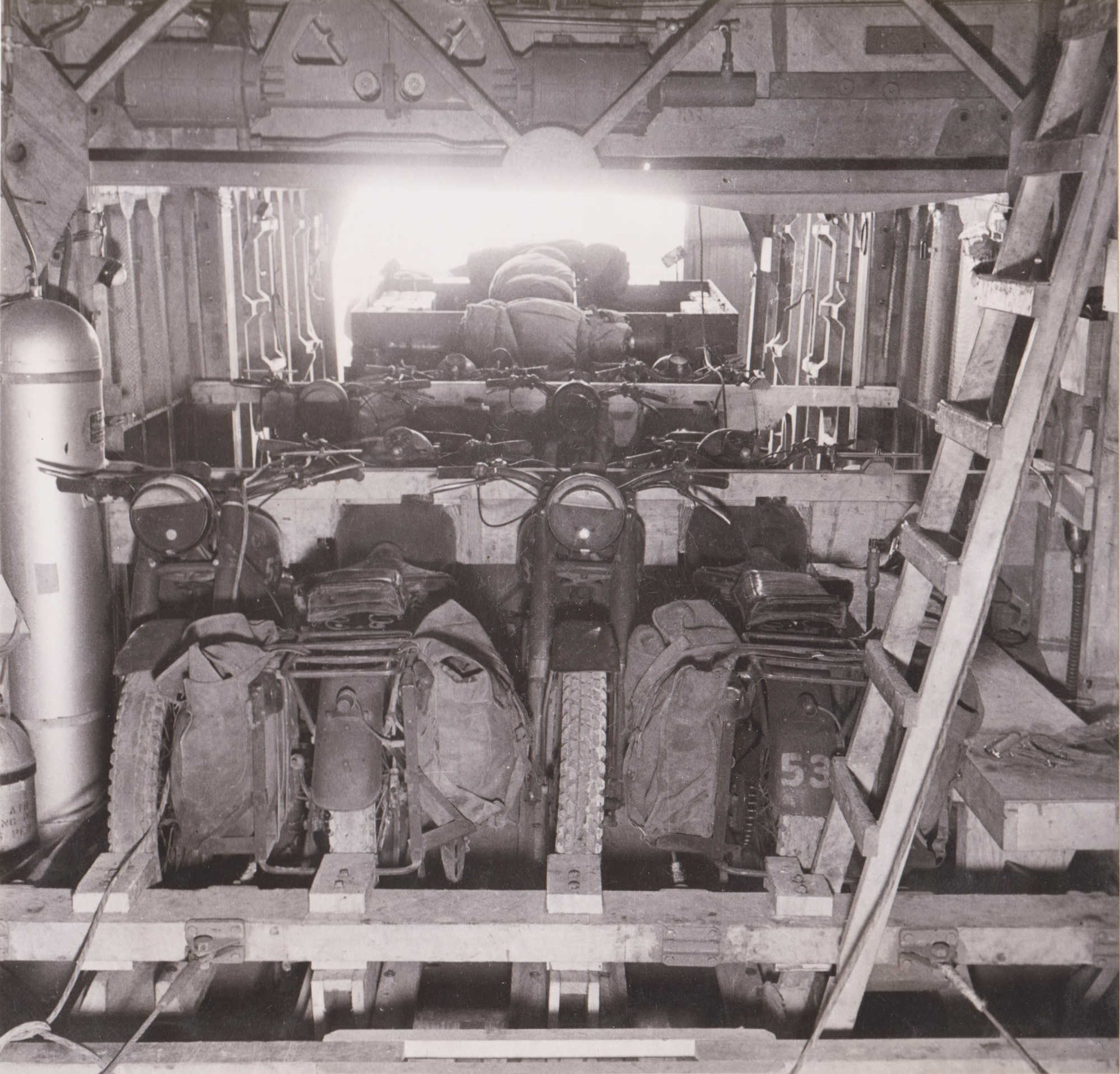
A Hamilcar glider fully loaded with a Universal (Bren) Carrier, sevaral motor-cycles, and other assorted stores, showing how much could be fitted in it. A.F.D.C. Circa 1944. Courtesy of Airborne Assault Museum, Duxford.
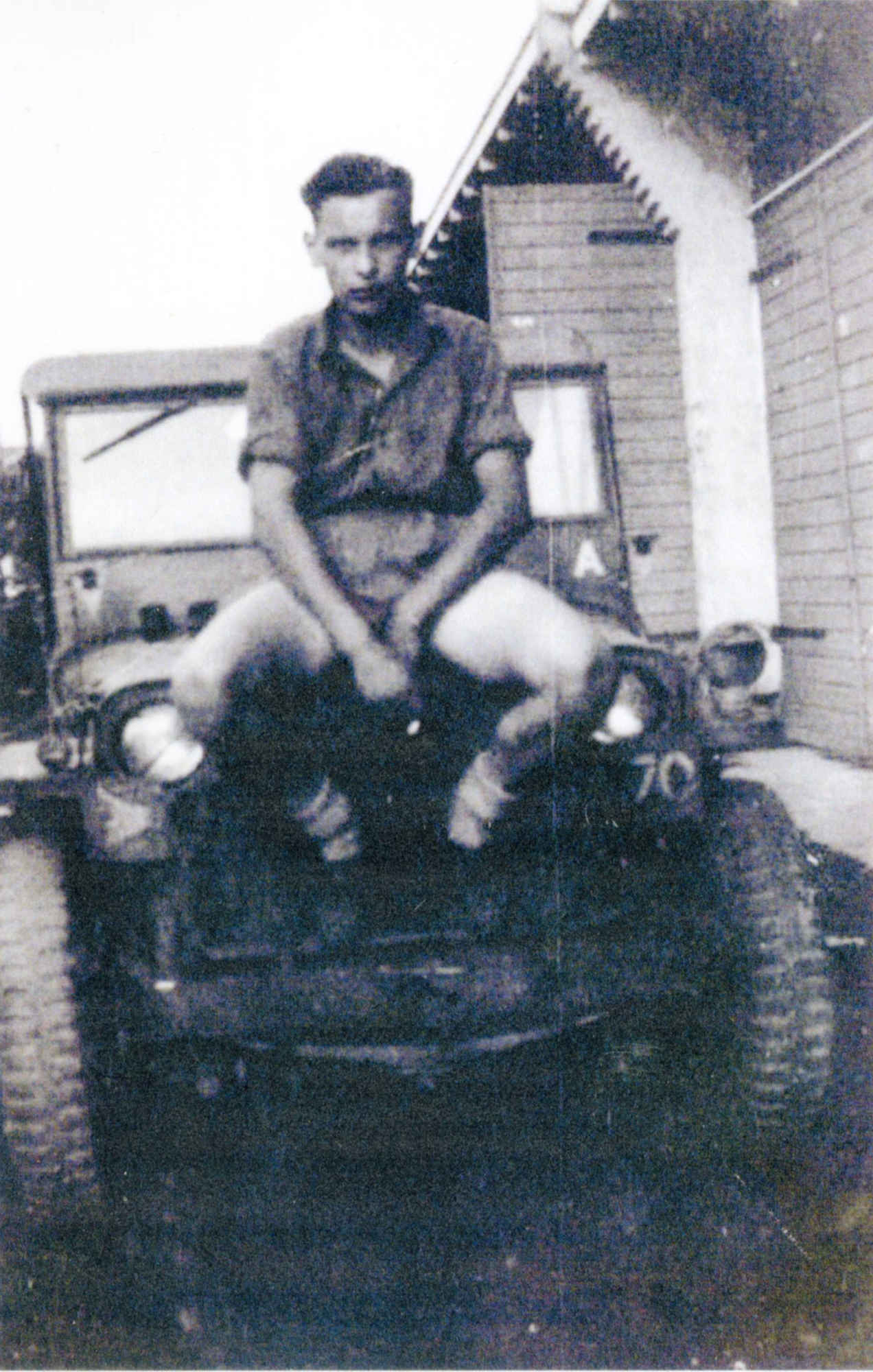
Dvr. Jack Taylor, who served in No 1 Parachute Platoon, sitting on the bonnet of a 250 Company Jeep in his football kit. Lincolnshire. 1944. Courtesy Jack Taylor.
FOOTNOTE: By September 1944 there were only 34 men still with the Company, that had been with it when it was created, as a Transport Unit, in July 1940. However, there were still 175 men with the unit from when it was converted to the Airborne role in December 1941.
NOTES:
[1a] Letter from John Gifford to Frank Steer. 8 February 1999.
[2a] 'The Day Gone By', Richard Adams. 1990.
[2b] From Jack Taylor to Bob Hilton. 28 September 1995.
[2c] Letter from Bill Chedgey to Bob Hilton. 28 September 1997.
[2d] Letter & account to Bob Hilton from Burnham Blaxley. 9 July 1998.
[3] Letter from Bill Gell to Bob Hilton. 12 September 1997.
[4] Letter & account of Ron Nutley to Bob Hilton. 8 September 2004.
[5] The Royal Army Service Corps Review Vol. 1, Nr 5. 1952. R.A.S.C. IN THE 1st AIRBORNE DIVISION-- FORMATION AND ACTION AT ARNHEM, by Lieutenant-Colonel M. St. J. PACKE, R.A.S.C.


