Appendix VII.
Supply By Air. January 1944.
APPENDIX 'A' to H.Q. Airborne Troops, War Diary for January 1944.
The American Supply Dropping and Glider Landing Exercise at Ramsbury Airfield was attended by D.D.S.T. This Exercise demonstrated the practical ability on dropping supplies from 40 x C.47 Aircraft flying in formation. It also demonstrated the fact that without Roller Conveyors the dropping zone cannot fail to be a suitable size and that under these conditions subsequent recovery would be protracted and may be hazardous. Date 7 Jan 44.
INDEX.
|
Organisation 1 Drill for Organisation at a Bde SDP Drill for RASC Org at a Base Supply Airfield Organisation of an Aircrew Platoon RASC Organisation and Duties of a Pre-Packed Stores Platoon Organisation and Duties of a Transport Platoon Appendix 'A' - Loading panniers into Aircraft Appendix 'B' - (i) Roller Equipment (ii) Procedure for fitting Roller Equipment (iii) Dress for Aircrew (iv) Emergency Container (v) Diagram Appendix 'C' - Timetable Appendix 'D'- Aircrews Report |
Page. 1 1 - 10 10 - 13 13 - 15 16 - 23 23 - 25 26 - 30 31 - 32 32 - 33 33 34 35 36 37 |
Page 1.
ORGANISATION.
1). These instructions cover in detail the method in which a Light Company would carry out its war role of Supply by Air.
2). It is based on a proposed new War Establishment. Pending the implementation of this, the Light Company will be organised in this form for all operations and as far as possible for training.
3). These instructions will be regarded as the text book for training for the Light Company and will be religiously complied with in all training and in action.
4). Every Officer will possess a copy which he will study carefully. Officers should ensure that each man under their command knows thoroughly and understands these instructions relating to his own particular task and as much as possible of the remainder.
5). Amendments will be distributed as experience dictates and all copies will be correctly amended up to date. There will be no unauthorised alterations.
DRILL FOR ORGANISATION AT A BRIGADE S.D.P.
1). The normal RSC organisation at a SDP is taken as being under:-
O.C. Para Platoon (OC. Det)
_____________1____________
1 _ 1
2 i/c & HQ Para Pln. Officer or & NCO i/c Tpt Sec.
_______1_______ _______1_______
1 1 1 Sec Airborne Tpt Pln.
Sec Sec (5 Jeeps & Trailers).
Page 2.
It may be that owing t allocation of a/c or other causes, it is not possible to take a complete Section of Airborne Transport Platoon by air. In which case, balance of tpt must be made up by the Bde concerned. It is however desirable if possible to have drivers who have had experience in this class of work and in any case 5 Jeeps is taken as being the desirable minimum tpt required.
2). On confirmation being received that Supply Dropping is to take place, Bde HQ must send for O.C. Para Platoon and arrange for Para Platoon and Transport Sections to be relieved of other duties, such as attachment to Bde Defence Platoon on which they may have been employed up to the stage of operations. This action must be taken at least three hours before the time that supply dropping is scheduled to take place.
3). O.C. Para Platoon will require the following information from Bde HQ:-
(a) Exact limit of D.Z.
(b) Information concerning the tactical situation around the D.Z. Owing to the very limited manpower, the responsibility for defending the area of S.D.P. must rest with Bde HQ's, as R.A.S.C. Det will not be prepared to provide more than a few solitary sentries.
(c) Time of drop.
(d) Number of aircraft dropping.
(e) Number of panniers per aircraft and any information there may be concerning the contents of each.
(f) Line of flight for the run in. This will presumably correspond to the direction of the wind.
(g) Height of release.
4). O.C. Para Platoon will then move off with the Para Platoon moving in tpt of Transport Section. He will find a suitable spot in the vicinity of SDP in which Det can
Page 3.
lie up and will go forward himself to recce the SDP. He will find a suitable area adjoining the SDP where there is cover, plenty of room for traffic circuits and easy access to any tracks or roads running from SDP to Bde HQ and to unit location. He will select this area as the site for his Dumps and will establish his Control Point there; he will bring in the remainder of his personnel to lie up there as soon as possible and will send a message back to Bde HQ stating exact location.
Selection of SDP.
5). The ideal conditions for an S.D.P. are as follows:-
(i) An area 1000 yards square, flat level ground, devoid of trees or any other obstacles, with a firm smooth surface on which transport can move confidently in the dark without fear of falling into potholes.
(ii) An area easily identified from the air, by means of some prominent landmark close to the S.D.P. on the line of flight.
(iii) Proximity of a suitable location for dumps and control point.
(iv) Easy accessibility by means of road or tracks.
(v) An area well within Bde Perimeter and if possible out of range of shell fire. It is seldom probable that all these conditions will be available.
Distribution of available man-power.
RASC Det will be organized as follows:-
Page 4.
|
(a) Total available -
(b) On each vehicle a crew of four, incl dvr - (c) Spotters, who also operate landing lights - (d) Loaders on dumps (e) Control light - (f) Runner - (g) Sentries. - - |
Para Pl - 2 Officers, 33 O.R's (incl 2 sgts) Tpt Sec - 1 Officer or Sgt, 3 Spare men, 5 Dvrs i/c. TOTAL - 3 Officers, 41 O.R's. 20 O.R's (incl NCO) 5 O.R's (incl NCO) 12 O.R's (incl Sgt) 1 O.R. 1 O.R. 2 O.R's. 41 O.R's. |
7). Recce.
It is most desirable that whenever possible the whole RASC Det should thoroughly recce SDP in daylight prior to drop.
8). Setting out of Dropping Lights.
(a) The siting of the dropping lights should be decided well beforehand by the O.C. Det, but the lights should be put out only 15 minutes before the drop is scheduled to take place. Any changes in the wind up to that time will be taken into account when siting the lights. Any subsequent change of wind will be ignored.
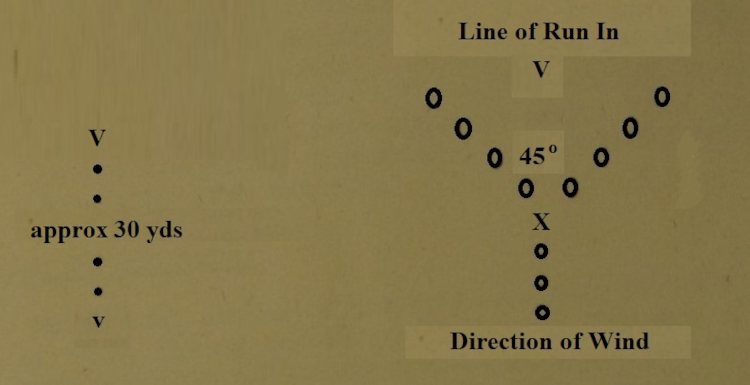
(b) The lights will be set out in the form of a 'Y'. The tail of the 'Y' will point in the direction from which the wind is blowing, the mouth of the 'Y' will therefore be pointing in the direction from which the aircraft are expected to make their run in.
Page 5.
(c) The 'Y' will be set out by the spotters prior to taking up their stations. They will be operated by the N.C.O. i/c Spotters, who will establish his control of that point. They will be taken in by him when it seems certain that all aircraft have dropped their loads.
(d) In the event of the line of approach not corresponding to the direction of the wind, the mouth of the 'Y' will still point towards the line of approach, and the tail will not therefore be pointing into wind.
(e) Each arm of the 'Y' will be composed of three "glims" situated five yards apart. Five yards beyond each of the two arms forming the mouth of the 'Y' a "glare" will be situated and will be flickered on and off as long as the sound of the aircraft engine is heard. The lights will therefore appear diagrammatically as under:-
(f) The position of the dropping lights on the ground is a matter which must be very clearly defined, so that both pilots of aircraft and the men on the ground know exactly what they trying to do. In view of the fact
Page 6.
that the pilot has no means of judging drift from wind it seems easier that the men on the ground should attempt to calculate the drift and place the lights accordingly. The lights should be set out so that the pilot of the aircraft has nothing to do but fly in between the glares into the mouth of the 'Y', and when approaching the radial point of the 'Y' (Marked 'x' in the diagram) operate his release switch with a view to straddling that point with his load. Thus, in theory, if there were no wind at all, the third pair of panniers would land somewhere on the tail of the 'Y' and the remainder of the stick would fall in a straight line from that point on either side. The men on the ground when setting out the lights must therefore first plot the point at which it is desired that the third pair of panniers shall finish up. They must then make a mental judgement taking into account the line of flight, the speed of the wind and the height of release, and then walk to the point on the ground above which they calculate the panniers should be released in order to land at that place. This point will then be taken to form the centre of the 'Y'. They must take into account the possibility that aircraft may make their run in, in any direction other than the one expected. At all times the 'Y' must be laid out so as to be easily visible from the air even from some distance away. The glares should be slightly tilted in the direction from which it is expected that the aircraft will approach, e.g: away from the 'Y'.
9). Placing of Spotters. The actual siting of the spotters must be left to the judgement of the N.C.O. in charge of them, having regard to the local features of the ground, so as to give the best possible all round view. In general terms, the four spotters should be placed one at each corner of the S.D.P. Their principle task is to observe and mark any panniers which fall outside the boundaries of the S.D.P., and to report
Page 7.
to Control exact locations of such panniers and if necessary lead the Jeeps up to them. It may be assumed that panniers falling within the S.D.P. will be easily located without the aid of spotters; in the event of no panniers missing the mark, they may then assist the Jeeps in in locating panniers within the limits of the S.D.P. N.CO. i/c must keep Control clearly informed of the exact position of his spotters, whom he will visit immediately after the drop to ascertain the exact location of stray panniers.
Spotters must not leave their appointed place for any purpose until ordered to do so.
10). Calculation of the time factor.
O.C. Det must, as soon after arrival at the SDP as possible, notify Bde HQ of the time by which, in his opinion, the SDP can be cleared of the bulk of the panniers. Bde HQ will realise that any demands in this period will delay the collection and may thus delay other deliveries later on; they will not therefore pass demands during this close period unless they are of great importance. The calculation must be based on deviation from ideal conditions, and can of course only be a very rough estimate.
Under the best possible conditions, it is anticipated that a SDP can be cleared and ready for delivery 3 hrs after the time of drop. This however envisages:-
(a) Bright moonlight.
(b) Completely level surface to the SDP.
(c) All a/c releasing at the right point.
(a) and (b) can be calculated before the drop takes place; (c) must remain largely an unknown quantity. Immediately after the drop, however, O.C. Det should be able to render a reasonably accurate estimate.
11). Process of collection.
As soon as the bulk of the loads have landed, O.C. Det will authorise
Page 8.
Collection of panniers to commence.
There are two possible drills for this.
(a) The 'Whorl' System. In this method the five Jeeps follow each other right round the perimeter of the SDP, collecting from the outer limits first, and proceeding inwards towards the centre in ever decreasing circles.
(b) The Sector System. In this method, the SDP is divided into five equal sectors from the local point at Control, and each Jeep is allotted one sector to clear.
It is thought that the first system will probably generally prove to be the more satisfactory of the two. In any case the policy should be to clear all panniers from the SDP itself before going off to collect those marked by spotters.
12). Procedure at Dumps.
The sites of Dumps should be determined before the drop according to the number of types of stores expected. Dumps should be close enough together to avoid undue handling of panniers on the ground, and far enough apart to enable each stack to be easily distinguished. Dumps should be sited under cover.
A traffic circuit will be devised and carefully explained to all drivers. A control light to guide returning Jeeps will be set up at the entrance to the circuit. No other lights will be shown. In view of the shortage of tpt available, it is important that Jeeps and Trailers should be delayed as little as possible. They will therefore make no attempt to deliver their loads to the appropriate Dump, but will effect off loading as quickly as possible at a central point in front of the Dumps. The
Page 9.
loaders on the Dumps will be responsible for identifying the panniers and for moving them to their appropriate Dumps, in what time the Jeeps and Trailers are out collecting a further load from the SDP. A state must be maintained continually by types and numbers of panniers delivered to the Dumps, in order that the Bde HQ may be informed of the exact position at any time. As soon as the state reaches the 'target figure' (if known) or gets as near to it as is likely for some time, Bde HQ must be informed, and SDP will be considered ready to make deliveries.
13). SIGNALS.
(a) Bde HQ will provide SDP with one 68 set and necessary signallers, to work throughout direct with a similar set at Bde HQ.
(b) It is considered that it would be a great advantage if each spotter were to be provided with a "Walky-Talky" set, by means of which he could converse direct with a Control Set at SDP Control. This would entail the provision of 6 sets per SDP. These would drop with the men to avoid loss in transit.
14). GENERAL.
The following points which are the outcome of recent experiments are also recorded.
(a) Trolleys airborne are more of a liability than an asset if used at the Dump. It is far quicker to drag or carry the panniers over a very short distance. It is considered that they would be of more value, if used in the collection of panniers which have fallen in inaccessible places. For this purpose, they would be carried one in each Jeep.
Page 10.
(b) The speed at which dumping and sorting can be effected is dependent on the clarity of the markings on the panniers. The contents of each must be clearly marked on all four sides in bold letters, instead of on one side only.
(c) As the 'glims' are absolutely essential to the operations no risk of their loss can be incurred, and they must be carried one per man and must drop with them. A satisfactory method for carrying the 'glare' has yet to be decided as these are too bulky to drop with the men.
(d) There is a natural tendency to manhandle the panniers extremely roughly. This must be discouraged, as certain types [of ammunition], especially mortar, may become dangerous to fire if dropped heavily.
(e) The provision of lighting sets for panniers would vastly simplify the task of spotters and would generally sped up collection of panniers which would otherwise be extremely difficult except in bright moonlight.
DRILL FOR RASC ORGANISATION AT A BASE SUPPLY AIRFIELD.
1). Airfield Control Section.
On a Base Airfield during operations there is normally an Airfield Control Officer (Major) and an ALO appointed by the Airborne Division concerned. To this must be added, for purpose of Supply by Air, an RASC Section as under:-
1 - Capt - Airfield Officer (RASC).
1 - S/Sgt (Supply)
Page 11.
1 - Pte Clerk (Supply)
3 - Drivers (to include one batman/driver with Jeep, and two men to act as traffic control and runners).
2 - M/Cyclists.
1 - Corporal.
2 - Cooks.
2). Duties.
(a) Airfield Officer (RASC).
He will make a previous recce of the airfield which he is to supervise during the operation. He will contact A.C.O. and A.L.O. on airfield, and liaise with them. He will earmark a suitable site for his own H.Q. on the edge of the airfield and close to the A.L.O. He will also select a suitable [space/field] adjacent to the airfield in which the Aircrew Platoon may bivouac while waiting for the take-off. It will also be necessary to choose a point on the approaches to the airfield at which incoming supply vehicles may rendezvous.
He will satisfy himself that the arrangements for communication between the airfield and P.P.D. are foolproof. If the telephone is to be used, the length of time taken to get a call through must be checked. All D.R's from the Pre-Packed Stores Section must make a recce, and understand clearly where they are to report with message and vehicles.
He will find out from the A.L.O. the serial No's and parking places of the aircraft to be used for supply dropping.
He will set up a T.C.P. from which vehicles can be directed to their correct aircraft or to his H.Q. as required.
He will attend the pilots briefing conference, and will make certain that the following points are agreed and fully understood:-
(i) Height at which panniers or containers are to be released.
Page 12.
(ii) Signals to be given in aircraft to indicate "stand to" and "drop".
(iii) Whether two "run ins" will be made if the load is not all released on first run.
(iv) Signal to be given if dropping is to cease.
(v) The interval between the showing of the red and green lights.
(vi) System of ground markings in use on the S.D.P. Line of approach to S.D.P., ground signals at S.D.P. for cancellation of drop.
He will remain near the aircraft from the commencement of loading until the take-off, and will be prepared to carry out any orders given by the A.L.O. concerning the Aircrews. He will issue all necessary orders to O i/c Aircrew Platoon when he arrives at the airfield. On return of Aircrews from the operation, he will organize their reassembly and receive their reports according to the specimen questionnaire at Appx 'D'.
(b) S/Sgt.
He will remain at A.S.C. Headquarters, and will deputise for the Airfield Officer there, in his absence.
(c) Cpl.
He will be responsible for all admin arrangements for the Aircrews and the HQ Section. He will organize all such matters as camping area, latrines, ablutions, water, rations, cooking, guards, etc.
(d) Pte Clerk.
Will remain at Section HQ and carry out the following duties:-
Page 13.
(i) Make out manifest, and dispatch by D.R. to Crew Commanders for checking and signature. He will ensure that each proper authority duly receives its copy and that ALL personnel who leave the ground have their No, Rank and Name entered on the manifest.
(ii) He will keep a complete log of all events as they occur, including times of arrival, loading, take-off, return, etc, as per specimen log at App 'C'. He will take down reports of Crew Commanders on their return as per App 'B' and will attach this to his log. (iii) Receive, act on and file all messages, under direction of S/Sgt.
(e) M/Cyclists.
One will accompany the Airfield Officer (RASC) at all times. The other will remain with the S/Sgt at Platoon HQ.
ORGANISATION OF AN AIRCREW PLATOON RASC.
1). General.
An Aircrew Platoon is designed to handle the despatch of supply panniers from C.47 a/c. It is of sufficient size to man 15 a/c at a time. There will normally be one or more Aircrew Platoon's to operate from each Base Supply Airfield. When supply dropping is anticipated, Aircrew Platoon's will be formed from:-
(a) Tpt Pl's of Lt Coy not already scheduled for the op.
(b) Available trained personnel of the Heavy Coy's.
(c) The balance from outside the Div.
Page 14.
2). Organisation.
|
Pl HQ |
- 1 Subaltern. - 1 Sgt. - Pte Clerk (Supply) |
15 Aircrews each 1 Cpl or L/Cpl (Aircrew Comd) and 3 men.
3). Duties of Platoon Officer and Sgt.
(a) To issue crews with correct equipment before leaving for the airfield.
(b) To report to Airfield Officer on arrival there, and received detailed instructions.
(c) To ensure that all Crew Commanders are properly briefed.
(d) To ensure that each crew has found its correct aircraft before loading.
(e) To ensure that all planes are correctly loaded, that all rollers and panniers are carefully checked, and that any last minute changes are known.
(f) To check over each crew and its equipment as soon as possible after an operation.
(g) Generally to ensure that each crew is self contained and properly trained for emergency, including emergency drill while in the air. While on an airfield, to be responsible to the Airfield Officer R.A.S.C. for all
Page 15.
the aircrews.
4). Duties of Crew Commanders.
(a) They are personally responsible for the fitting of roller equipment in their aircraft, and for the loading, lashing and efficient dispatch of their load.
(b) They are responsible for seeing that their crew is in possession of all equipment necessary for an operation, and for maintaining it in instant readiness between operations.
(c) They will liaise closely with the pilots of the aircraft before the take-off.
(d) They are responsible for the efficiency and discipline of their crew, and for ensuring that each man knows all that it is necessary for him to know.
(e) They will ensure that the emergency container is properly packed, and that it is released if the "Abandon Aircraft" signal is given. In this event, they will be the last member of the crew to leave the aircraft, and will assume command of the crew on the ground, with the sole object of rejoining Allied Forces as soon as possible.
5). It is probable that aircrews will be standing by at the Airfield as much as 48 hrs before the take-off. On the other hand, they may not leave camp until it is time to start loading the a/c. There must therefore be close liaison between OIC Aircrew Platoon and his immediate superior, the Airfield Officer R.A.S.C. in any event, each crew will move as a separate party, and will take with it all items of equipment required for the Operation.
6). Further detailed and more tech duties of the aircrews are included at Appx 'A' and 'B'.
Page 16.
ORGANISATION AND DUTIES OF A PREPACKED STORES PLATOON.
1). Establishment.
1 Subaltern
1 S/Sgt (Clerk)
1 Cpl Clerk (States)
1 Pte Clerk
18 Dvrs (2 Cpls) Incl 6 Storemen Supplies.
2 M/Cyclists - 2 M/C's.
Att RAOC - 1 Cpl AE.
2). General Function.
(a) To supervise the packing and harnessing of panniers with all the stores required for a resupply by air whether to the Airborne Div or to other formations, or to both at once.
(b) To arrange the dumping of such panniers, and to carry out the maintenance necessary to keep both panniers and contents in a serviceable condition and up to the scale laid down for however long may be necessary.
(c) Also to supervise the packing, collection and maintenance of any other containers or stores which may be prepacked for resupply by air by any other arm.
(d) To maintain an accurate state showing at any given moment the number of panniers etc, and total quantities by types of various stores held in
Page 17.
each dump ready for immediate dispatch.
(f) To ensure that all demands received from Base Control are promptly met, and that a/c loads are correctly made up as ordered. To ensure that all such loads reach the appointed place at the correct airfield in the shortest possible time.
3). Individual Duties.
(a). Subaltern i/c.
He is responsible for the general administration of the dump, including all the duties listed at (4) above. He will also require to have expert knowledge in all matters of panniers and container packing, concerning which, information is given at Appendix 'A'. The idea should be that he is conversant with every known type of load, and is also able after experiment rapidly to devise new loads for new types of stores never previously attempted.
(b). S/Sgt.
He, together with Cpl and Pte clerk working with him, is responsible for the clerical side of the pre-packed Stores Dump. He will be responsible, while packing is in progress or during static periods, for maintaining an accurate state for each dump, showing numbers of panniers or containers packed, and total quantities of stores held. He is also responsible for all routine correspondence concerning the platoon. Similarly a ledger will be accurately kept of all equipment for airborne supply held on charge by the platoon. During operations, he will receive, file and the necessary action on all incoming messages and correspondence. He will be prepared to act in all respects on behalf of O i/c, in the event of the latter being called away from the dumps at any time. He will also maintain a complete log,
Page 18.
ruled as under, of all events occurring during the operation:
|
Serial No. |
Time |
Event |
Action Take |
Remarks |
|
|
|
|
|
|
(c). Motor Cyclists.
They are for liaison work and carrying messages from pre-packed stores dumps to airfield concerned, and to C.R.A.S.C. at Base Control. As the time factor may be of vital importance, it is essential that they should know the way, beforehand, to each of these places, and should know not only exactly where they are to deliver their message, but should be able to recognize the particular Officer concerned.
(d). Loaders.
These eighteen men, including two Corporals and six Storemen Supplies, are the staff for actual duty on the dumps. In the static period, they will be required to move dumps as required, examine stores and effect turnover when necessary in the case of pet "leakers", or warranty expired compo packs. They must be expert pannier or container packers, fully able to supervise the activities of labour supplied by Aircrew Platoons to assist in the pre-packing. During operations, they have the responsible task of ensuring that each vehicle is loaded with its appropriate aircraft load of panniers as directed in the message issued by Base Control. They must therefore be familiar with the layout of the dumps so that they can locate any given nature rapidly either by day or night. The Corporals are therefore necessary for control; the Storemen Supplies provide the technical knowledge necessary for the sorting and turnover of the contents
Page 19.
of supply and petrol panniers. R.A.O.C. Cpl A.E. performs a similar function in respect of ammunition.
6). GENERAL NOTES ON DUTIES OF PRE-PACKED STORES PLATOON.
(a) Pannier Packing. Very briefly, the problem is to pack the maximum quantity of any one item into a pannier in such a way that the net weight does not vary from the fixed figure (300 lbs) by more than 10%, and so that the contents receive the maximum protection from damage during their fall. This involves separate experiment in the case of each type of stores to be dropped. Straw filled sand bags are used for packing and protection. Other natures of ammunition, other than the main item to be packed may require to be included as a make weight, and decision requires to be taken in the case of most types of ammunition, as to whether it should be packed in its original packing, or whether the outer casing can be dispensed with.
Nearly every conceivable type of commodity has been tested, and a consolidated packing table produced as a result. No further drill can be laid down, as the whole question is entirely a matter of practice and experience, and the cultivation of an eye for what is required.
If packing is well carried out, it is sometimes even possible to drop panniers without parachutes, without serious damage to the contents.
Special loads of Med, Sigs and RE stores have also been devised by the arm of the service concerned, and typical loads are included in the packing tables.
(b) Harnessing.
It is essential that harnessing is carried out efficiently in order that
Page 20.
when panniers are dropped they land squarely and not on the corners, which would be likely to cause damage to the contents.
Method of harnessing is as follows:- Lay out the harness on the ground and place pannier squarely in centre, standing on its heavier end, so that the four 'D' rings of the harness which are the points of attachment to the parachute fall centrally over the lighter end, with the two buckles on the top of the pannier. Having strapped up the harness tightly in this position, all loose ends must be tucked in on the top and sides, in order to ensure that they cannot become entangled in the roller conveyor or in the rigging lines of the parachute. The bottom of the pannier must be kept free of all loose ends, if possible, a sheet of plywood should be wired to the bottom as this considerably increases the freedom of movement of panniers on the rollers.
(c). Labelling.
All panniers will be labelled by means of a tin label wired to each of the four sides of the pannier. These labels will be boldly painted in contrasting colours (RED or BUFF is very effective), and will indicate the precise nature of the contents (e.g. ".303 Mk VIIIz").
(d) Storage.
(i) Stacking. When packed and harnessed, panniers should be stacked not more than two high, and with a gap of about 15 yards between stacks in all directions, so that vehicles can be backed onto any required stack. Each nature of ammunition should be stacked separately, even when only
Page 21.
a few panniers of any nature are held. This is necessary partly as a safety precaution, but especially in order to avoid confusion when vehicles are being loaded in the dark. In order to facilitate the identification of stacks, it is often useful to paint the initial letter of each item on the end of the outside panniers on each stack (e.g. 'G' for Grenade, 'M' for Mortar, ETC). When the dump is likely to be of a fairly permanent nature, signs denoting the contents of each stack will be useful. It should be borne in mind that in some climates dunnage would be necessary for use in the normal way.
(ii). Layout.
Each stack should be built as far as possible under trees, both as protection against the direct rays of the sun, and as a protection against observation from the air. It is seldom likely that camouflage nets will be available, and camouflage painting of the panniers themselves is out of the question, as it is essential that they should be easily visible in the dark on the S.D.P. A traffic circuit must be designed, and must be strictly enforced. In certain climates, the question of hard approaches and loading ground for vehicles will be of importance. A Report Centre then must be established near the entrance and the exit, at which drivers of vehicles report in and out and have their loads checked. This must be in a prominent position, and a lighted sign should be used during the hours of darkness.
(iii). Safety Precautions.
Stacks should be as well dispersed as is consistent with
Page 22.
efficiency. As many fire points as possible must be maintained throughout the dump, and must include large capacity foam extinguishers. A fire piquet and guard must be maintained at all times. All loose grass, etc must be removed from the area, and NO SMOKING signs will be prominently displayed. As far as possible, stacks of a dangerous nature should be kept well apart from each other, and interspersed with stacks of a safe nature (e.g. S.A.A.). Explosives should be stacked on their own and well away from all other stacks.
(iv). Inspections.
These must be carried out at frequent intervals. Not only are the contents of panniers rendered unserviceable and in some cases highly dangerous by the climate, but the harnesses are continuously becoming loose, owing to shrinkage of the panniers or excessive handling.
(v). Equipment.
Apart from fire-fighting apparatus mentioned above, little special equipment is required by the Pl. Among the essential items are a typewriter, office equipment and stick book, platform scales up to 400 lbs; a number of porters flat luggage trolleys for towing behind a Jeep would also be of tremendous assistance. Panniers harnesses, packing materials, etc would all presumably be provided under Staff arrangements. During operations, O i/c Pl will also be responsible for drawing and storing the necessary number of container parachutes.
5). Issues
During an Operation. Below is listed in chronological sequence the action to be taken on receipt
Page 23.
of an order to issue to an airfield during operations.
(a) Ack message to Base Control.
(b) Assemble necessary number of vehicles, and mark each with the serial No; of the aircraft whose load it is to carry.
(c) Ensure that each vehicle is in fact loaded in accordance with the list of aircraft loads received from Base Control.
(d) Use discretion regarding dispatch of all or part of vehicles to appropriate airfield R.V. as soon as loaded.
(e) As a final check, each driver should have a loading list showing the number of his aircraft and particulars of his load.
(f) Notify Base Control of time vehicles dispatch.
(g) Record all events in log.
ORGANISATION AND DUTIES OF A TRANSPORT PLATOON.
1). ORGANISATION.
Three Transport Platoon's each consisting of:
Platoon HQ.
1 Subaltern.
2 Sgts - 1 Sgt for def.
2 Cpls } 1 L/Cpl } - Def.
1 Clerk.
1 Batman Dvr.
2 M/Cyclists.
17 Dvrs (Def).
7 Sections, each.
1 Cpl.
1 L/Cpl.
4 Dvrs i/c.
2). DUTIES.
Equipped with 40 Jeeps, 37 Trailers, and 9 M/C's, the Transport Platoon is light and mobile. It must be flexible to carry out its main duties which may include:-
(i) Sections det under comd of a Para Pl, having been airlanded, for the purpose of clearing a SDP.
(ii) A seaborne landing as a Light Tpt Pl.
(iii) Unloading supplies from a/c or glider, and speedy delivery over difficult country.
(iv) Its own protection at all times when employed as a Pl.
(v) Finding a proportion of operational parachutists if required to fill vacancies in the two Para Pl's.
Page 25.
(vi) The remainder of the Pl must be capable of becoming aircrews. For this purpose, reorganization as per the establishment of an Aircrew Pl as laid down in the pamphlet will be necessary, in order to carry out the duties as set on page 14.
(vii) The Defence Section of Pl HQ consists of
1 Sgt
2 Cpls
1 L/Cpl and
17 Dvrs.
This Section should be trained as a team, and yet be capable of functioning if split in half or detached.
Page 26.
APPENDIX 'A'.
(1) LOADING PANNIERS INTO AIRCRAFT. For the purpose of loading, the vehicle containing panniers can be backed to within a few inches of the door of the aircraft. Seats will be folded against the sides of the plane before loading commences. Care will be taken when pulling baskets into aircraft to ensure that the 'D' rings on the basket harness are in front, so that when pushing out, the parachute is at the rear of the basket.
PROCEDURE.
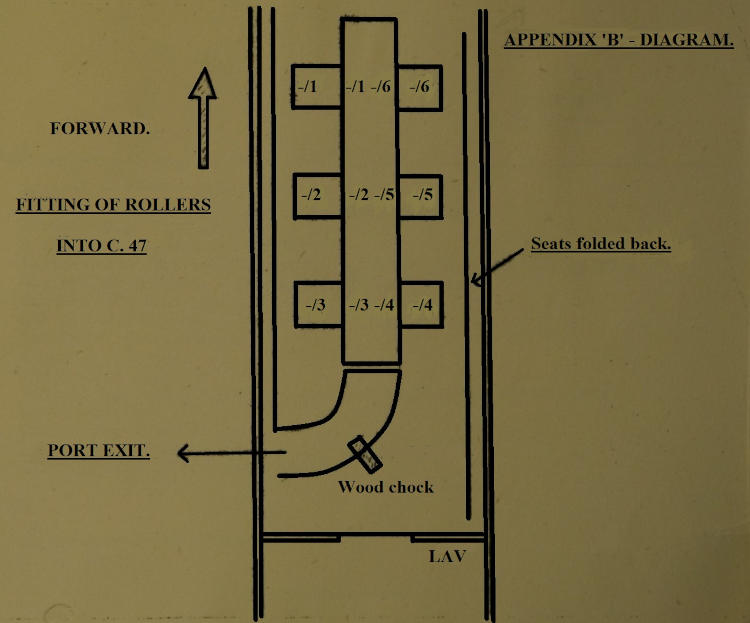
(a) The first basket will be pulled up to one of the forward side pieces (either -/1 or -/6). The second basket will be pulled up and placed (see diagram at App B) squarely on top of the first one. The two baskets will be tied together by means of 100 lb breaking strain silk chord, which will be placed through the bottom of the strap of the top basket and the top of the strap of the bottom basket and securely tied. These ties will be made at all four points where the straps meet.
(b) Pack parachutes will be affixed to the 'D' rings on the baskets harness. Care will be taken to ensure that the 'T' printed on the Pack Parachute is at the top when the parachute is affixed. A static line extension will be affixed to the static line of the top parachute. The static line of the bottom parachute will be securely affixed to the rope handle of the top basket.
(c) The second pair of baskets will be placed on the opposite side piece to
Page 27.
the first pair, and the same procedure carried out. The third pair will be pulled to the top of the straight length, in between the first and second pairs. The fourth and fifth pairs will be placed on side pieces -/2 and -/5. Six pairs normally constitute a 'one-run' plane load.
After the first three pairs are in position:-
(i) A wood chock will be put in the rollers in front of the centre pair to prevent it rolling back.
(ii) Lashings will be affixed through the strong point on the side of the plane and will be taken across in front of the three pairs of baskets and securely tied to the strong point on the opposite side of the plane, thus holding the three pairs firmly in position. The same procedure will also be carried out for the next two pairs.
(d) When all baskets are in position, the static line of the top baskets (with extension pieces affixed) will be tied by means of a 'running slip knot' to the strong point running along the top of the plane. Care will be taken to ensure that the static lines are tied in their correct order for pushing out. The last pair fixed in the plane will be the first to be pushed out, therefore the static line of this pair will be tied aft of the strong point. The static line of the next pair (5th in - 2nd out) will be tied next, and so on with the other four pairs.
NOTE: When the panniers have been fixed in position, it is extremely difficult for
Page 28.
the Pilot and crew of the a/c to climb forward to the controls, and may upset the fixing of panniers. This should be explained to Pilots at the Briefing Conference by the Airfield Officer (RASC). An arrangement should be made whereby the Pilot and crew are in their places before the final pair of panniers is loaded.
(2) Procedure for Take-off. When all panniers are in position, Crew Commander will ensure that all spanners, wire, tying chord and any other odds and ends used in the lashing and fixing of roller equipment and baskets are moved aft of the plane, and that they are not left lying around the rollers. Liaise with the pilots of the aircraft and arrange necessary signals. Ensure that the crew are properly dressed and equipped, that the personal container is properly packed and fitted to the bomb rack, and that 'X' Type Parachutes are correctly adjusted and fitted (see Appx 'B') Final check of rollers and load. Aircraft is now ready for take-off. No 3 and 4 of the crew will take up position between the two rows of baskets, and No 1 and 2 will take up positions in front of the aft row. As the plane commences to take-off all four of the crew will lean against their respective pairs of baskets - "di their heels in" - and take the strain. (When taking-off there is a tendency for the baskets to run back, and the strain is usually quite considerable).
Page 29.
When the plane is airborne the crew can relax their effort and commence to get the baskets ready for pushing out, procedure for which is as follows:-
(i) Untie the lashing wire which is tied in front of both the rows of baskets and take away the wood chock from in front of the centre pair of the forward row. Place these items up forward of the plane so that they will be well out of the way.
(ii) Pull the first pair off the side piece onto the main roller and push it to the door (making sure the gate is in the closed position). Follow on with the second pair and similarly with the others until all five pairs are on the main roller (five pairs will just fit on the main roller). Crew Commander will again check and ensure that the static lines are in the correct order for pushing out. Great care must be taken to ensure, when all panniers are in the action stations position, that they are all placed squarely and centrally on the main roller. The least divergence may result in the panniers sticking in the doorway, thus spoiling the stick and damaging the aircraft.
(iii) Crew will now take up their positions as follows:- No 1 will stand beside the door (aft) holding the rope attached to the gate ready to pull it up when the green light appears. No 2 will stand with his back to the starboard side of the plane directly opposite the door. No's 1 and 2 will then hook the static lines of their personal 'chutes to the straps on the side of the plane opposite the door. No 3 will take up his position on the port side of the plane by the
Page 30.
second pair of baskets and No 4 will take up position on the starboard side opposite No 3. No's 3 and 4 need not hook themselves up, except in case of emergency.
NOTE: Owing to the weight of the panniers, it is difficult to push them from the side-piece on to the centre of the roller, unless a plywood sheet is fixed to the bottom pannier. If this is not available, wooden laths should be used in lieu.
(3) Procedure for Pushing Out.
1). Directly the red light appears No 1 will pull up the gate. At the same time No 2 will hold on to the first pair of baskets to prevent it from rolling out before the green light comes on. No 3 and 4 will stand ready to push up the second pair.
2). On the green light signal, No's 1 and 2 will push the first pair through the door, No's 3 and 4 will push up the second pair which will be directed through the door by No's 1 and 2 - and so on with the remaining pairs. All members of the crew must ensure that when pushing, the pairs are always pushed by the bottom basket, as any strain on the top basket is liable to break the ties.
3). When all baskets are gone No 1 will place the gate to the closed position, and will also pull the static lines back into the plane, untie them from the strong point and place them with the rest of the equipment ready for unloading.
Page 31.
APPENDIX 'B'.
(1) ROLLER EQUIPMENT.
BEFORE COMMENCING FITTING OF ROLLERS IN AIRCRAFT:-
Crew Commander will ensure that he has the following items:-
Complete set of roller equipment (with necessary spanners).
Wire for lashing roller equipment in aircraft.
Lengths of wire for lashing baskets to strong point of aircraft for take-off.
Static line extensions.
100 lb breaking strain silk chord.
6 Wood chocks.
Pack Parachutes (one for each pannier).
4 'X' Type parachutes.
Roller equipment will be checked over and will comprise the following component parts:-
1 - Long straight piece.
1 - Short straight piece.
1 - Curved piece.
6 - Side pieces (numbered with prefix No. /1-6).
1 - Gate (with rope attached).
Page 32.
4 - Clamping pieces for bolting straight and curved lengths together.
12 - Nuts and bolts for bolting side pieces.
8 - Nuts and bolts for bolting main lengths together. (using clamping pieces).
2 - Nuts and bolts for bolting gate to curved piece.
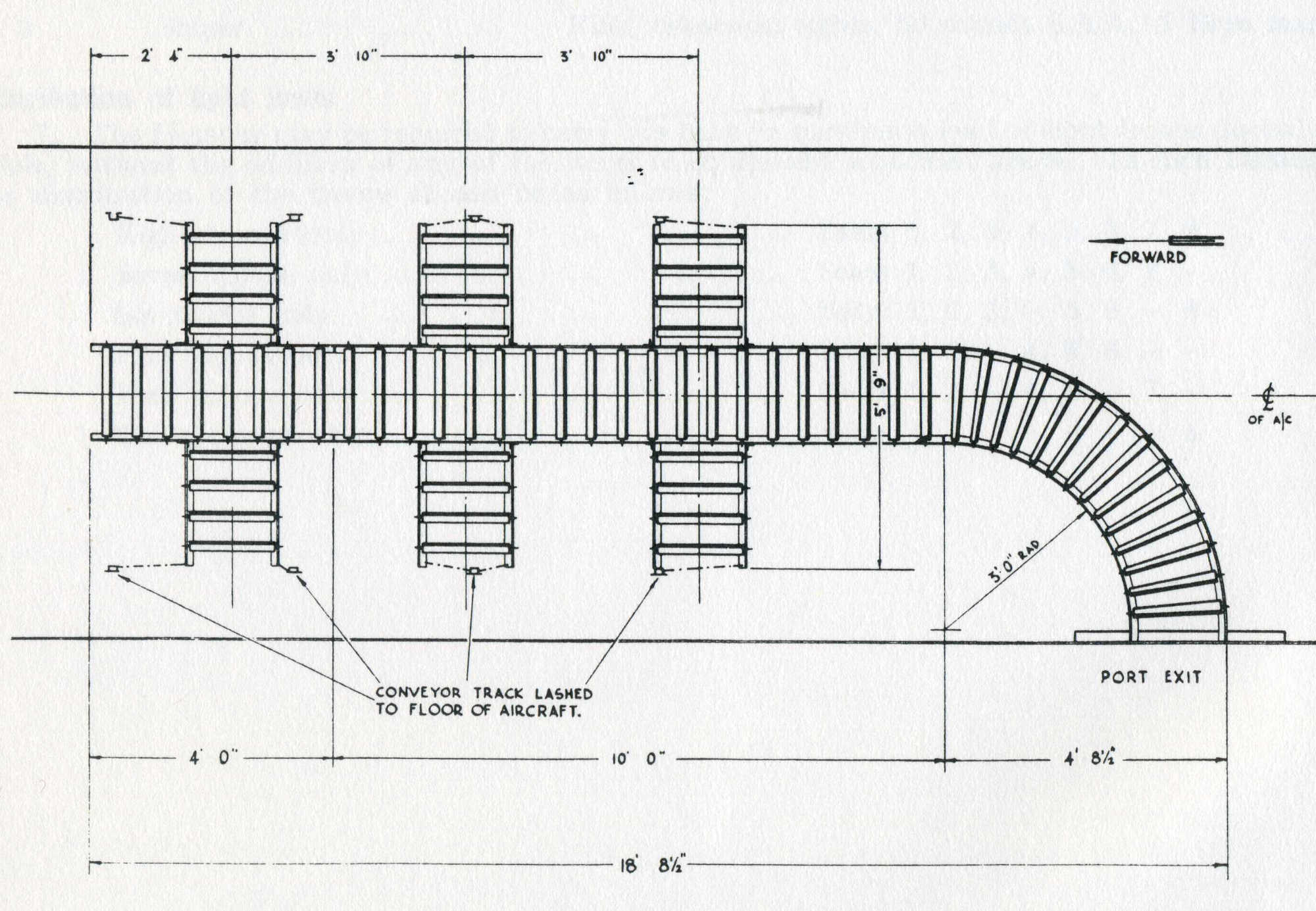
All parts should have a corresponding prefix number. It has been found necessary to devise a modification to the Roller Conveyor to prevent panniers from fouling the aft side of the door when rounding the corner and making their exit. This takes the form of a double metal rail which extends right round the curved portion of the Roller and up as far as the door. The modification is now being put into production and will form an integral part of the Roller Conveyor equipment.
(2) PROCEDURE FOR FITTING ROLLER EQUIPMENT IN AIRCRAFT.
Put into position in the a/c (commencing forward):-
(i) Small straight length.
(ii) Long straight length.
(iii) Curved piece.
The correct way of putting in the straight lengths can be gauged by the No's painted on the side of the Rollers. The small side pieces are numbered and should be fitted to the corresponding No on the straight pieces. When fitted the Roller should be as on the attached diagram.
Page 33.
One of the wooden chocks should be placed under the outside of the curved piece. This banks the roller and thus facilitates ease of handling of baskets on the turn. When roller equipment and gate are bolted into position, lashing wire will be passed through the rings on the outside of the side piece and through the 'D' hooks (strong points) in the aircraft, and tied securely.
(3) DRESS FOR AIRCREW.
Dress for Aircrew.
Smocks, airborne.
Denims.
Pumps.
Beret.
'X' Type Parachute (to be worn at all times by No's 1, and 2).
Mae West.
The following will be carried:-
Filled water bottles.
Water sterilizing tablets.
Emergency ration.
First Field Dressing.
A.B. 64, Identity discs.
No letters or written instructions.
Crew Commander will have a torch
Page 34.
(4) EMERGENCY CONTAINER.
Emergency Container. The container will be filled with the following:-
4 Rifles.
8 Bandoliers.
4 Small packs. #
8 Grenades M.36.
# to include:- rations for 48 hrs. Ground sheet. Mess tins. Small kit. Extra water bottle. Flares.
Page 35.
Page 36.
APPENDIX 'C'.
|
30 Jan 44. 1600 1616 1715 1800 1830 1900 1956 2014 2129 2145 2157 2200 2209 2309 2334 2350
31 Jan 44. 0010 |
TIMETABLE. Arrival of Airfield Control HQ. Message giving details of S.D.P. etc, arrived by D.R. (attached) Arrival of parachutists. Arrival of Aircrews and panniers. Parachutists departed for airfield. Last crew began loading rollers. All rollers in position. Loading of panniers began. Parachutists take-off. All panniers loaded. Return of parachutists. Aircrews emplane. First plane took off. Rear HQ 2 Para Bde notified that parachutists had not dropped. Last plane took off. First plane returned. Last plane returned. Interrogation of Crew Comds began.
31 Jan 44. Aircrews ready to return to location. |
APPENDIX 'D'
|
Crew No |
Crew Comd |
Checking |
Take Off |
Sigs |
Time Out |
Failures |
Pannier Lighting |
Remarks |
|
1 |
Sgt Watson |
OK |
OK |
OK |
10 Secs |
No 3 delayed owing to stiff roller, gap between 4 & 5 baskets. |
NOT SEEN |
NIL |
|
2 |
Cpl Otter |
OK |
OK |
OK |
10 Secs |
NIL |
OK |
Two crew sick, suspect before emplaning |
|
3 |
Cpl Pickering |
OK |
OK |
OK |
10 Secs |
NIL |
No lights on own loads |
NIL |
|
4 |
Cpl Lister |
OK |
OK |
OK |
15 Secs |
No 3 delayed. Damaged basket caught on rollers |
NOT SEEN |
Panniers badly packed. Top on slant. |
|
5 |
Cpl Hordman |
OK |
OK |
OK |
10 Secs |
NIL |
NOT SEEN |
NIL |
|
6 |
Cpl Thompson |
OK |
OK |
OK |
5 Secs |
NIL |
OK |
One of crew sick |
|
7 |
L/Cpl Whittet |
OK |
OK |
OK |
14 Secs |
Last pannier central on rollers. Jammed and caused slight delay. |
NOT SEEN |
NIL |
|
8 |
L/Cpl Perrin |
Lights need attention |
OK |
Long Red |
7 Secs |
NIL |
NOT SEEN |
NIL |
|
9 |
L/Cpl Higgs |
OK |
OK |
OK |
8 Secs |
No 3 Static Line Broke |
OK |
NIL |
|
10 |
L/Cpl Edwards |
OK |
OK |
Long |
10 Secs |
NIL |
OK |
One of crew sick |
|
11 |
L/Cpl Jones |
OK |
OK |
OK |
15 Secs |
Loose harness on last pannier caught on rollers, slight delay |
OK |
NIL |
|
12 |
L/Cpl Lawrence |
OK |
OK |
OK |
7 Secs |
NIL |
Wires broken |
Two crew sick |
|
13 |
Cpl Simmons |
OK |
OK |
Long Red |
- |
Pannier ties loose. One pair chutes not open (last pannier broke door) |
OK |
Two runs. 1st pannier caught. Crew Comd and one of crew sick |
|
14 |
Cpl Howarth |
OK |
OK |
OK |
20 Secs |
Last pannier caught on door hinge |
OK |
Panniers very big. |
|
15 |
Cpl Blaxley |
OK |
OK |
OK |
7 Secs |
NIL |
OK |
One lashing wire snapped during take-off. |
Conveyor track diagram.
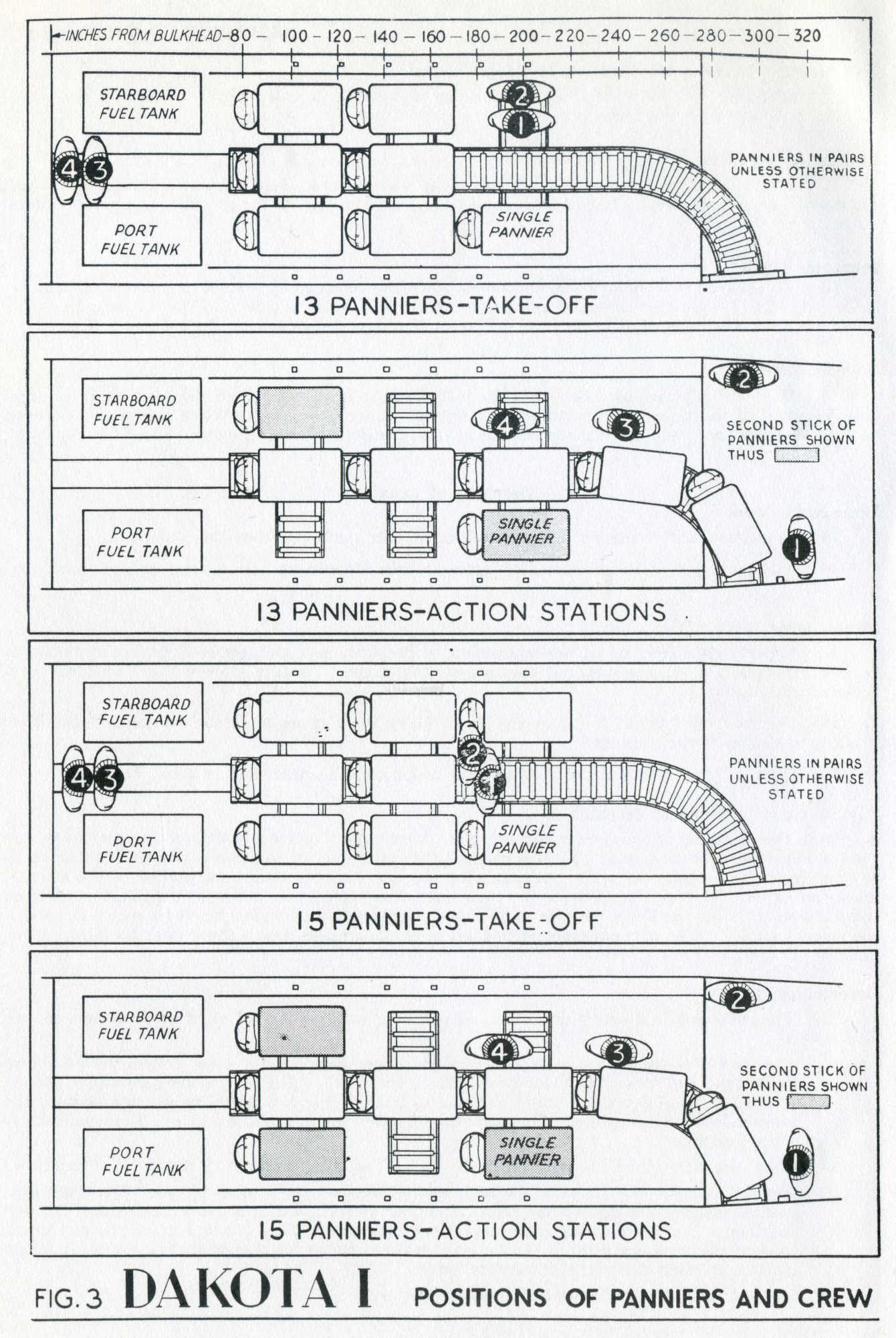
Fig 3. DAKOTA I. Positions of panniers and crew.
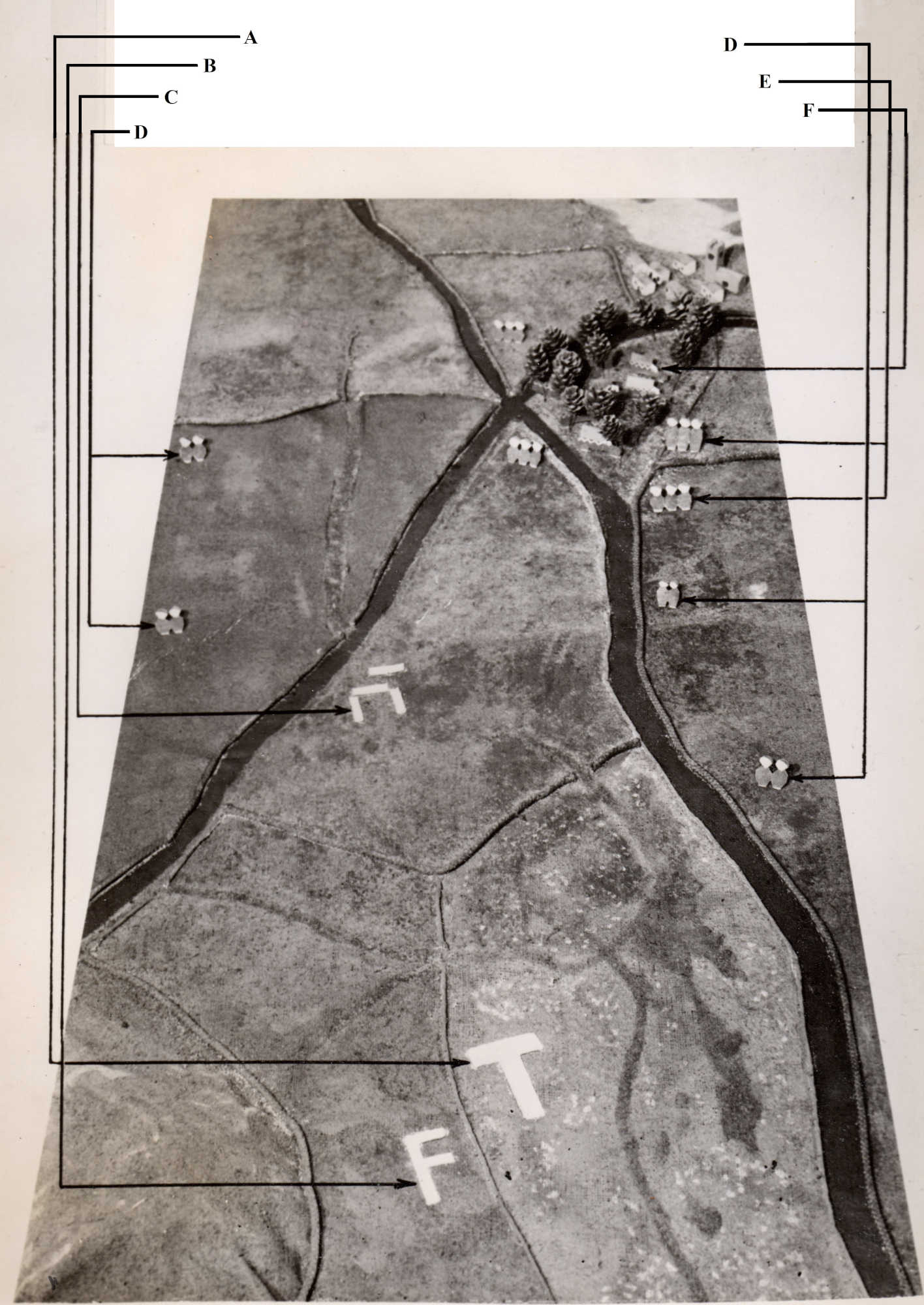
Model of a Layout for European Supply Dropping Zone. Height of Supply Drop = 500 feet. Dimensions of Dropping Zone = 1000 yards long x 200 yards wide.
A. Identification letters. White Ground Strips.
B. Tee Sign. Aircraft commence supply drop when immediately above this sign. White Ground Strips.
C. O.K. to drop sign. White Ground Strips laid out with mouth of sign pointing towards Tee sign and the track of the approaching aircraft.
D. Spotters. Trained men used for sorting and stacking Stores on Dropping Zone. They are also trained in the retrieving and re-packing of parachutes.
E. Loaders. Trained men used for sorting and stacking Stores on the Dropping Zone. They are also trained in the retrieving and re-packing of parachutes.
F. M.T. Kept in a concealed area to one side of the Dropping Zone. Motor Transport is used for the clearance of the Dropping Zone and for dispatching the stores retrieved to Stores Dumps.
G. Night Layout. At night fires or flares can be substituted for ground strips. Courtesy of Airborne Assault Museum, Duxford.
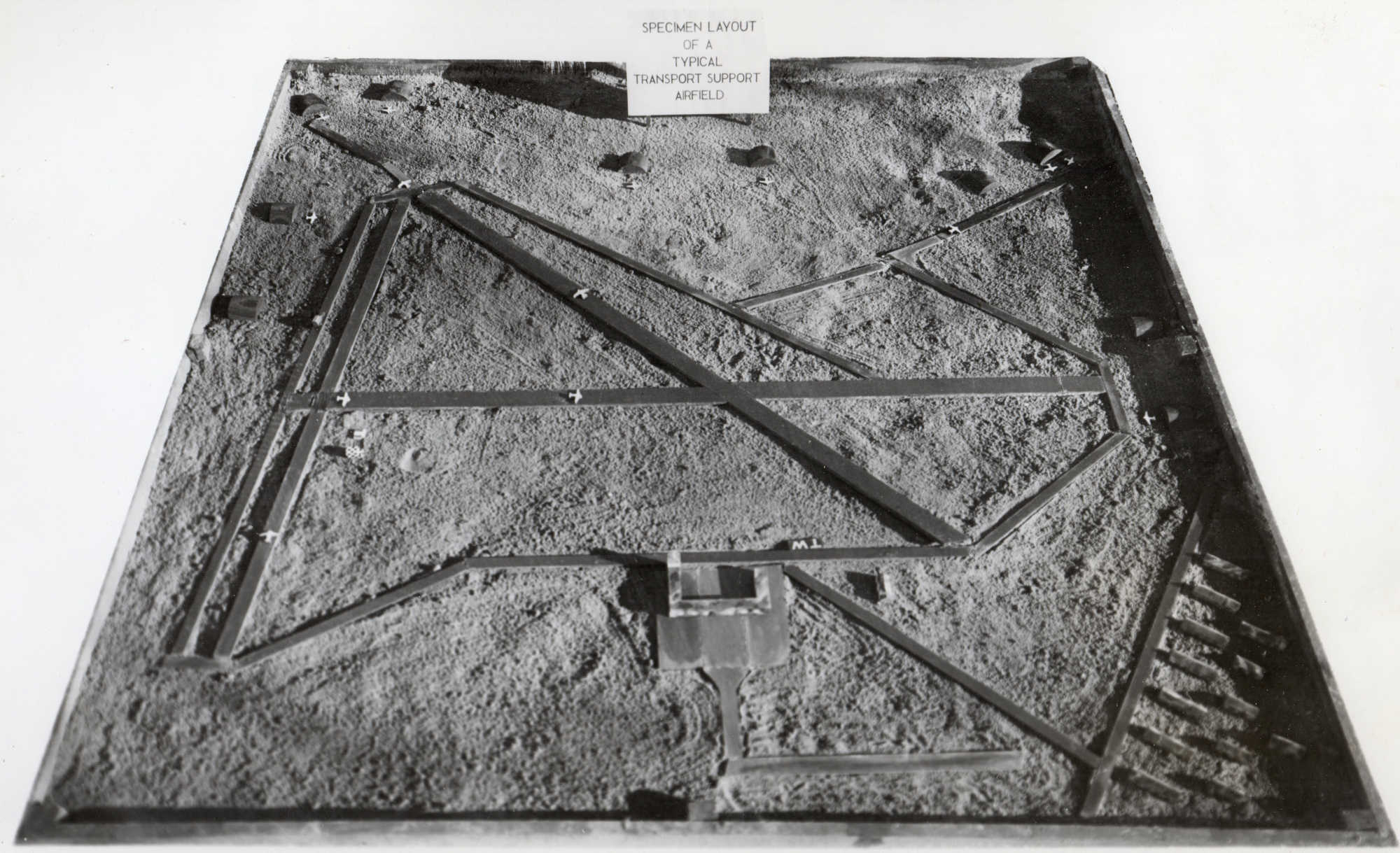
Model of a Specimen Layout of a typical Transport Support Airfield. Courtesy of Airborne Assault Museum, Duxford.
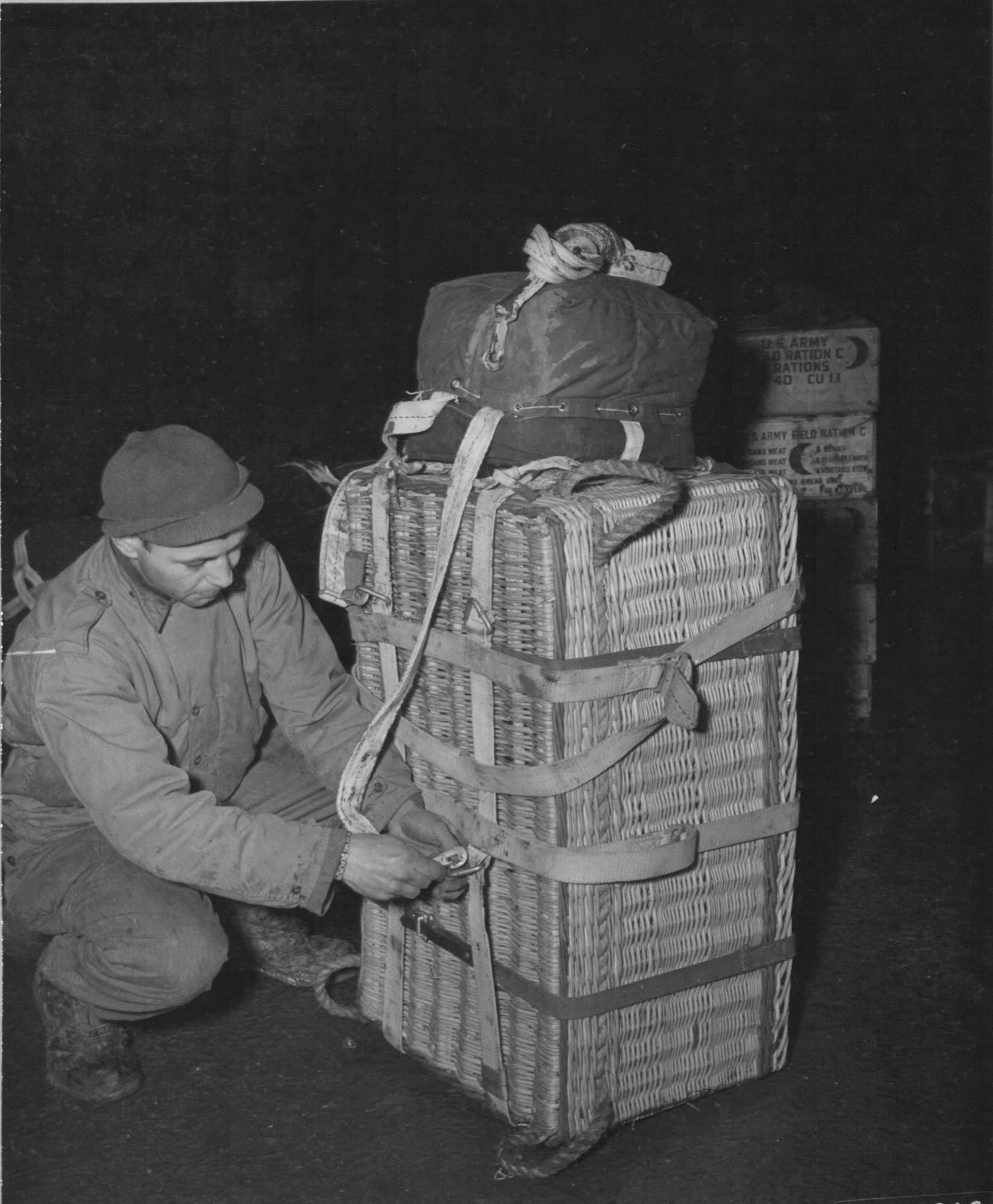
Quartermaster troops of the American 490th Quartermaster Depot and the 101st Airborne Division try out the British pannier basket for delivering supplies to troops on the ground. Here, an airman attaches the harness and parachute to a loaded basket before placing it in the plane. Berkshire, England. 14 January 1944. Courtesy of Bob Gerritsen.
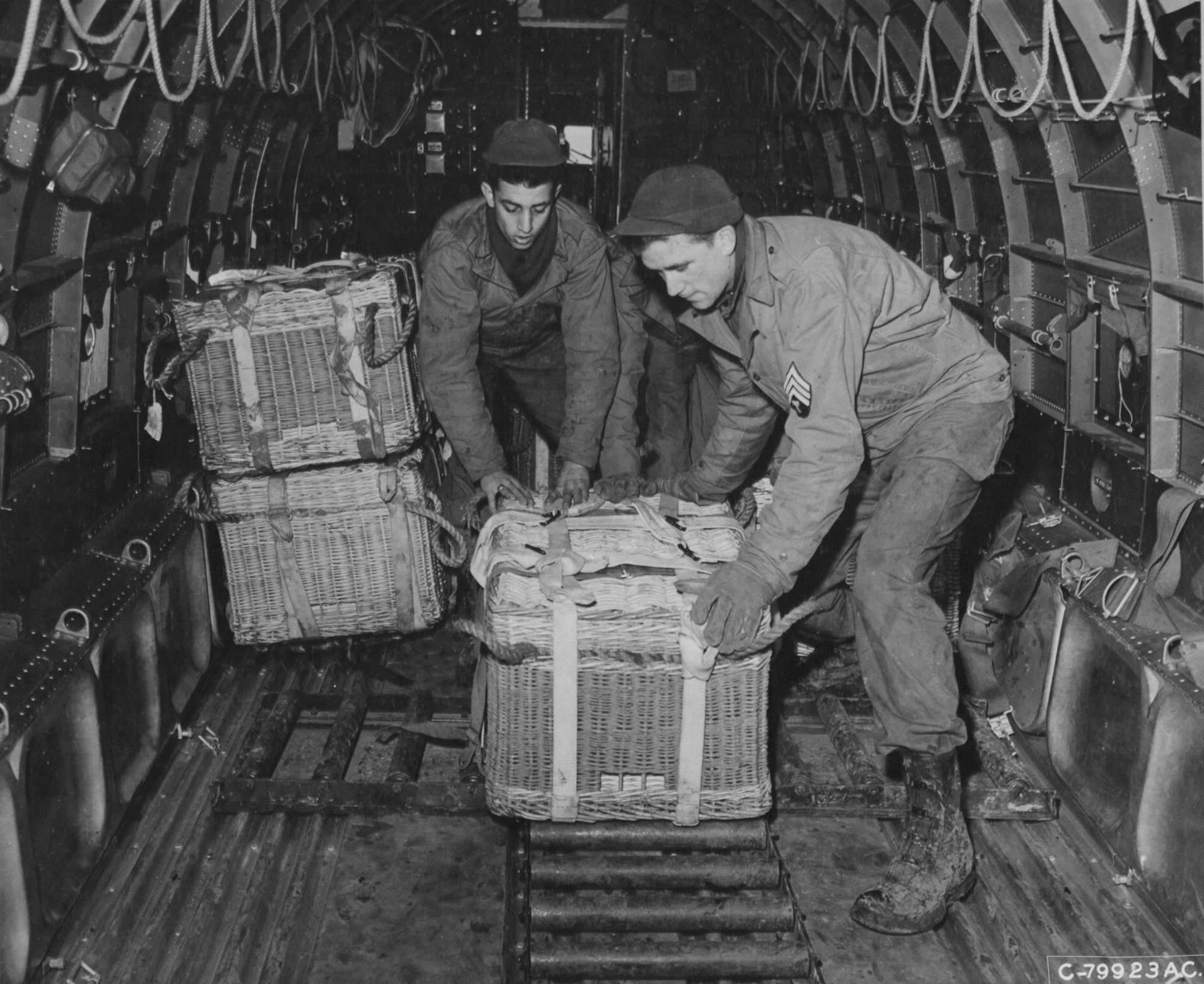
Quartermaster troops of the American 490th Quartermaster Depot and the 101st Airborne Division try out the British pannier basket for delivering supplies to troops on the ground. Here, men push a basket over the roller conveyor inside the plane towards the door, where it will start its descent.. Berkshire, England. 14 January 1944. Courtesy of Bob Gerritsen.
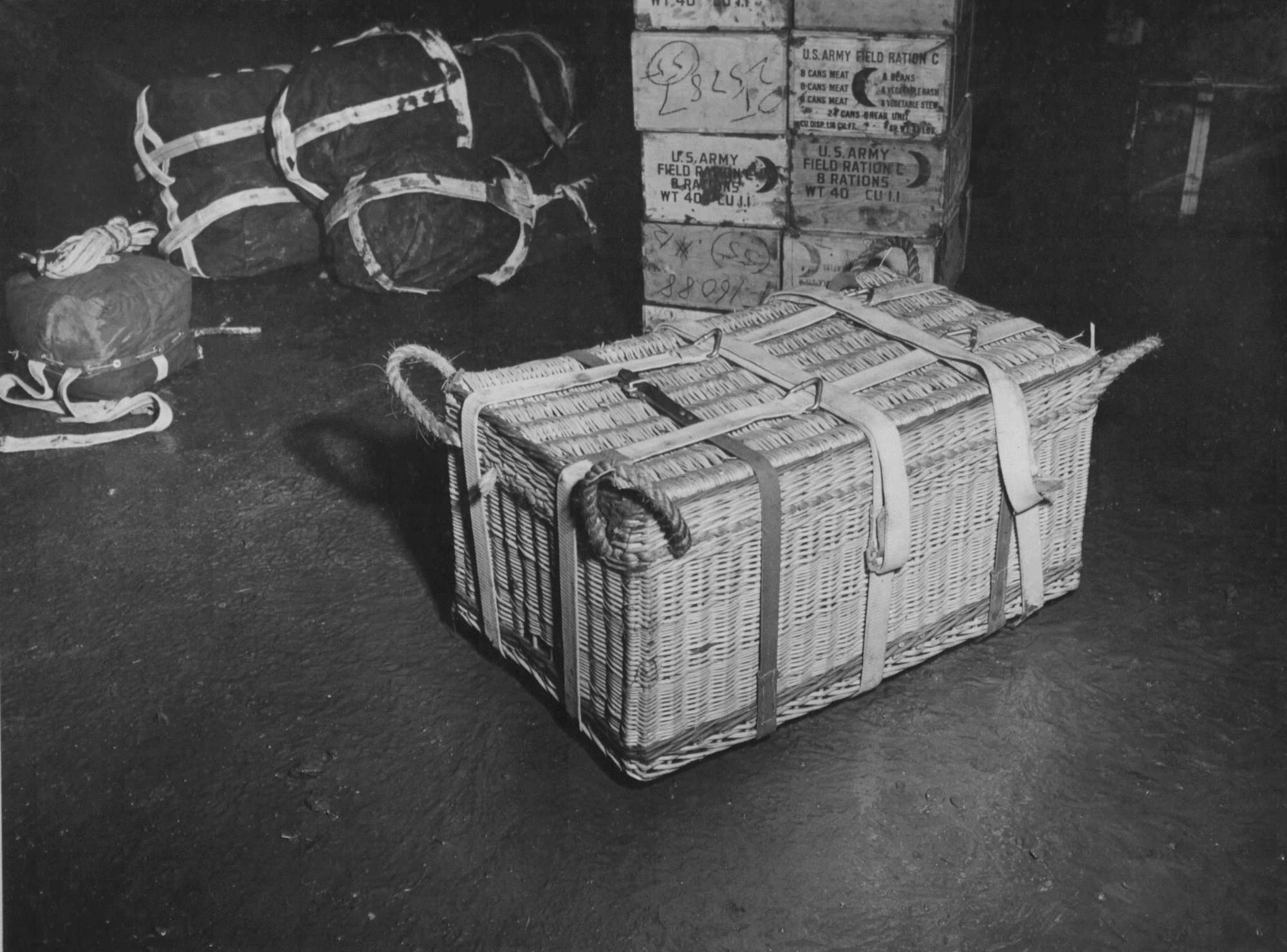
Quartermaster troops of the American 490th Quartermaster Depot and the 101st Airborne Division try out the British pannier basket for delivering supplies to troops on the ground. This photo shows a loaded pannier basket with its harness ready for attaching the parachute. Berkshire, England. 14 January 1944. Courtesy of Bob Gerritsen.
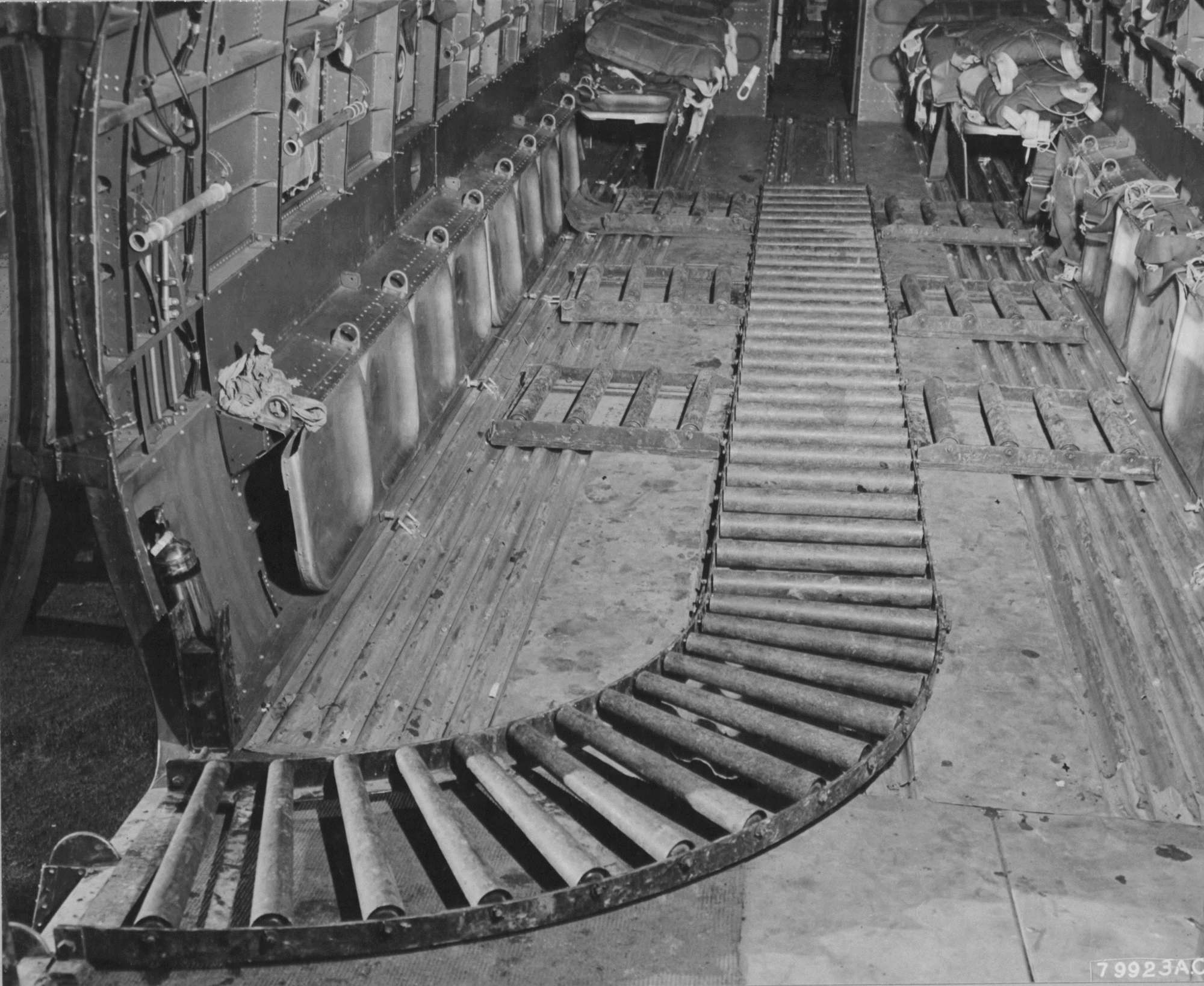
Quartermaster troops of the American 490th Quartermaster Depot and the 101st Airborne Division try out the British pannier basket for delivering supplies to troops on the ground. This photo shows the interior of a Douglas C-47 equipped with nine sections of roller conveyor, which facilitates moving the loaded baskets to the door of the plane. Berkshire, England. 14 January 1944. Courtesy of Bob Gerritsen.


