Appendix II.
Honours and Awards.
Although not a member of the 250th (Airborne) Light Composite Company, R.A.S.C. Sergeant Major Rowe was the first member of Britain's Airborne Forces, who was a member of the R.A.S.C. and serving in such a capacity to receive a bravery award.
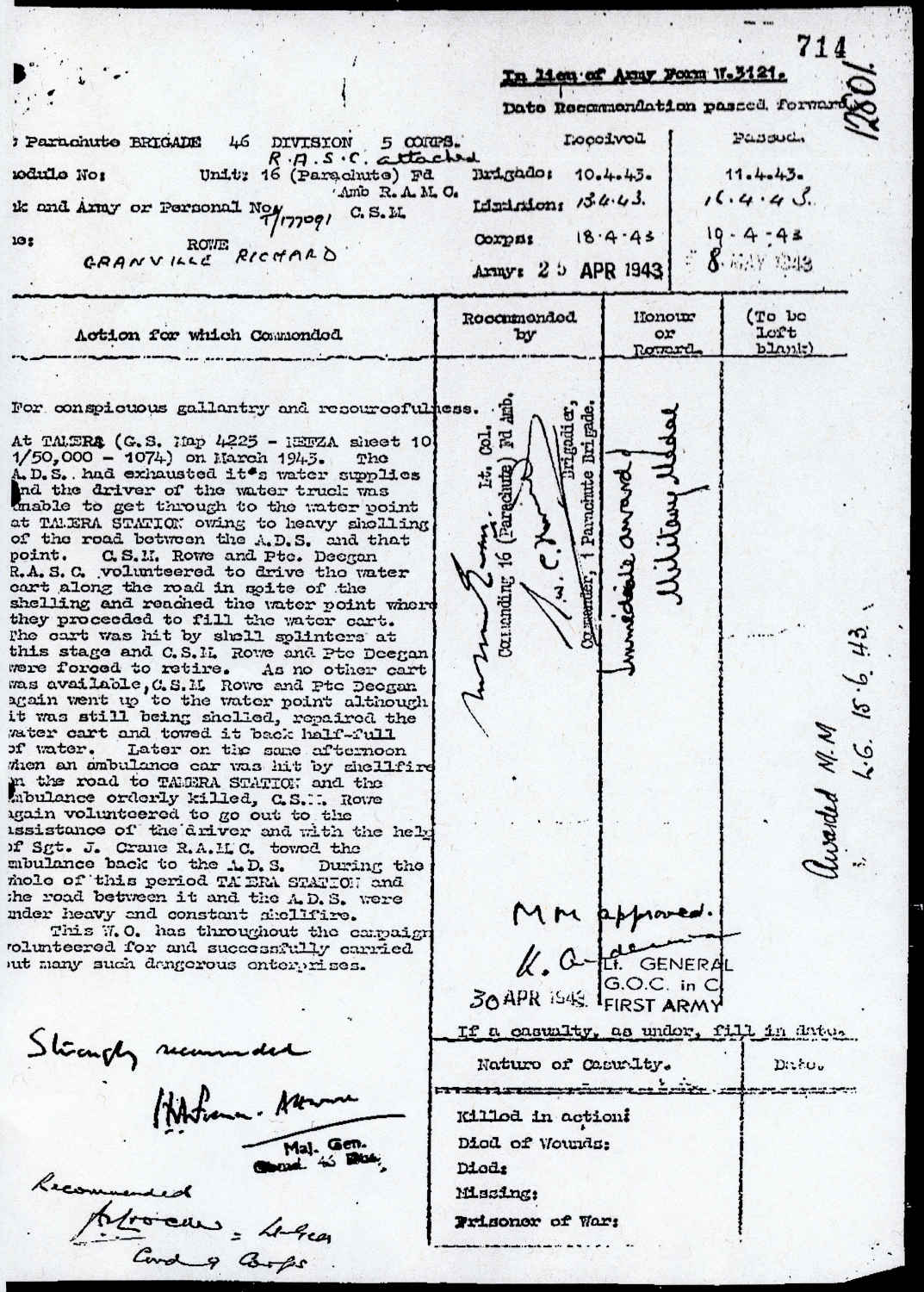
T/177091. C.S.M. Granville Richard ROWE.
16 (Parachute) Field Ambulance, R.A.M.C. (R.A.S.C. attached)
From: 1 Parachute Brigade, 46 Division, 5 Corps.
|
Formation. Brigade: Division: Corps: Army: |
Received. 10.4.43 13.4.43 18.4.43 25.5.43 |
Passed. 11.4.43 16.4.43 19.4.43 8.5.43 |
Action for which Commended.
For Conspicuous gallantry and resourcefulness.
At TAMERA (G.S. Map 4225 - NEFZA, sheet 10, 1/50,000 - 1074) on March 1943. The A.D.S. had exhausted it's water supplies and the driver of the water truck was unable to get through to the water point at TAMERA STATION owing to heavy shelling of the road between the A.D.S. and that point. C.S.M. Rowe and Pte. Deegan R.A.S.C. volunteered to drive the water cart along the road in spite of the shelling and reached the water point where they proceeded to fill the water cart.
The cart was hit by shell splinters at this stage and C.S.M. Rowe and Pte. Deegan were forced to retire. As no other cart was available, C.S.M. Rowe and Pte. Deegan again went to the water point although it was still being shelled, repaired the water cart and towed it back half-full of water. Later on the same afternoon when an ambulance car was hit by shellfire on the road to TAMERA STATION and the ambulance orderly killed, C.S.M. Rowe again volunteered to go out to the assistance of the driver and with the help of Sgt. J. Crane R.A.M.C. towed the ambulance back to the A.D.S. During the whole of this period TAMERA STATION and the road between it and the A.D.S. were under heavy and constant shellfire.
This W.O. has throughout the campaign volunteered for and successfully carried out many such dangerous enterprises.
Recommended by:
M. MacEwan. Lt - Col. Commanding 16 (Parachute) Field Ambulance.
E.W.C. Flavell. Brigadier, Commander, 1 Parachute Brigade.
H.A. Freeman-Attwood: Maj-Gen. Commanding 46 Division.
J.T. Crocker: Lt-Gen. Commander 9 Corps.
K. Anderson. Lt - General. G.O.C. in C, First Army. 30 APR 1943.
Honour or Reward.
Immediate award Military Medal. Approved. London Gazette 15. 6. 43.
Copy of the London Gazette entry for C.S.M. Granville Richard Rowe. R.A.S.C. attached 16th Parachute Field Ambulance, R.A.M.C. Courtesy of Mrs Donna Davis.
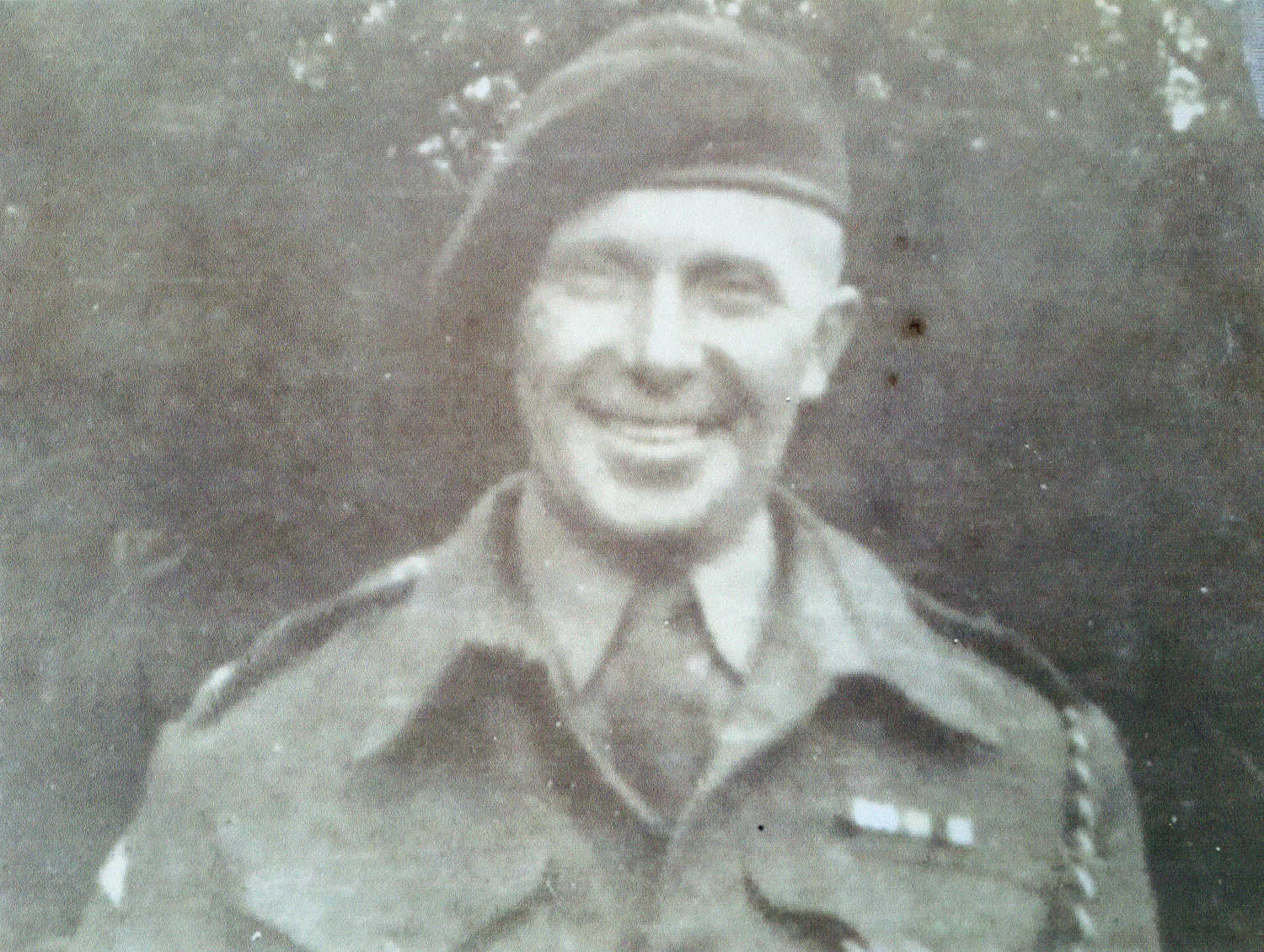
Lieutenant. G.R. Rowe, Military Medal. This photo was taken in England in 1944, after he had been commissioned, and was now the Motor Transport Officer, 16th Parachute Field Ambulance, R.A.M.C. Courtesy of Mrs Donna Davis.
Sergeant Major Rowe would go on to take part in the parachute operation in Sicily in July 1943, and would later be commissioned. Remaining with the 16th Parachute Field Ambulance, he commanded the Seaborne Echelon for Operation 'Market-Garden'.
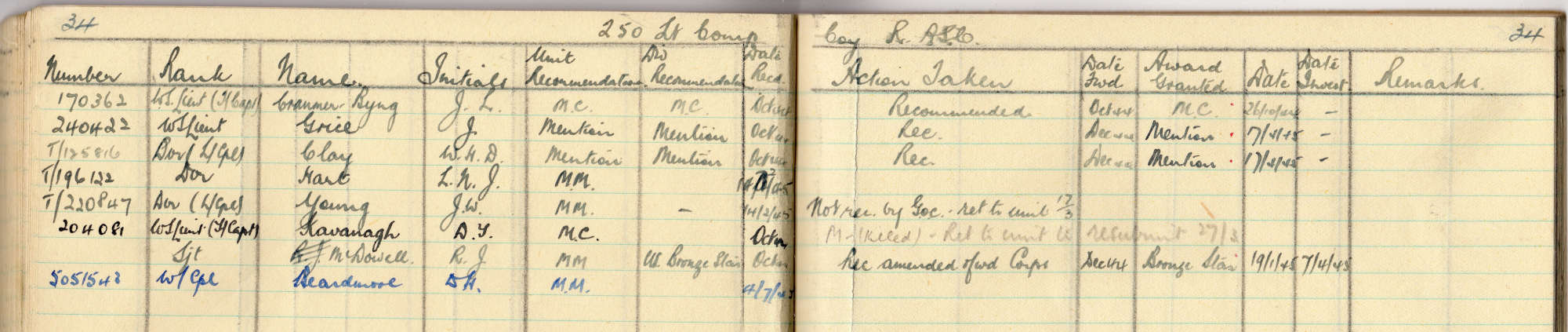
The list of awards put forward for the 250th (Airborne) Light Composite Company, R.A.S.C. following the Battle of Arnhem. Courtesy of Airborne Assault Museum, Duxford.
THE BATTLE OF ARNHEM.
Lieutenant-Colonel. Michael St John Packe (66968). Dutch Bronze Cross. 31 July 1945.
This officer was Commander Royal Army Service Corps of the Division during the battle of Arnhem, 17th-25th September. The Division was resupplied from the air during this period and, owing to enemy action and the confined area in which the Division was fighting, the collection of these supplies was a very hazardous business. Colonel Packe so directed and organised the collection that, in spite of very heavy enemy fire and the extremely difficult conditions, the majority of the supplies which dropped within or near the Divisional area were brought in and distributed.
This officer was constantly under fire. His cheerful demeanour and his determination to carry out his task in spite of appalling difficulties was stirring example to those under his command.
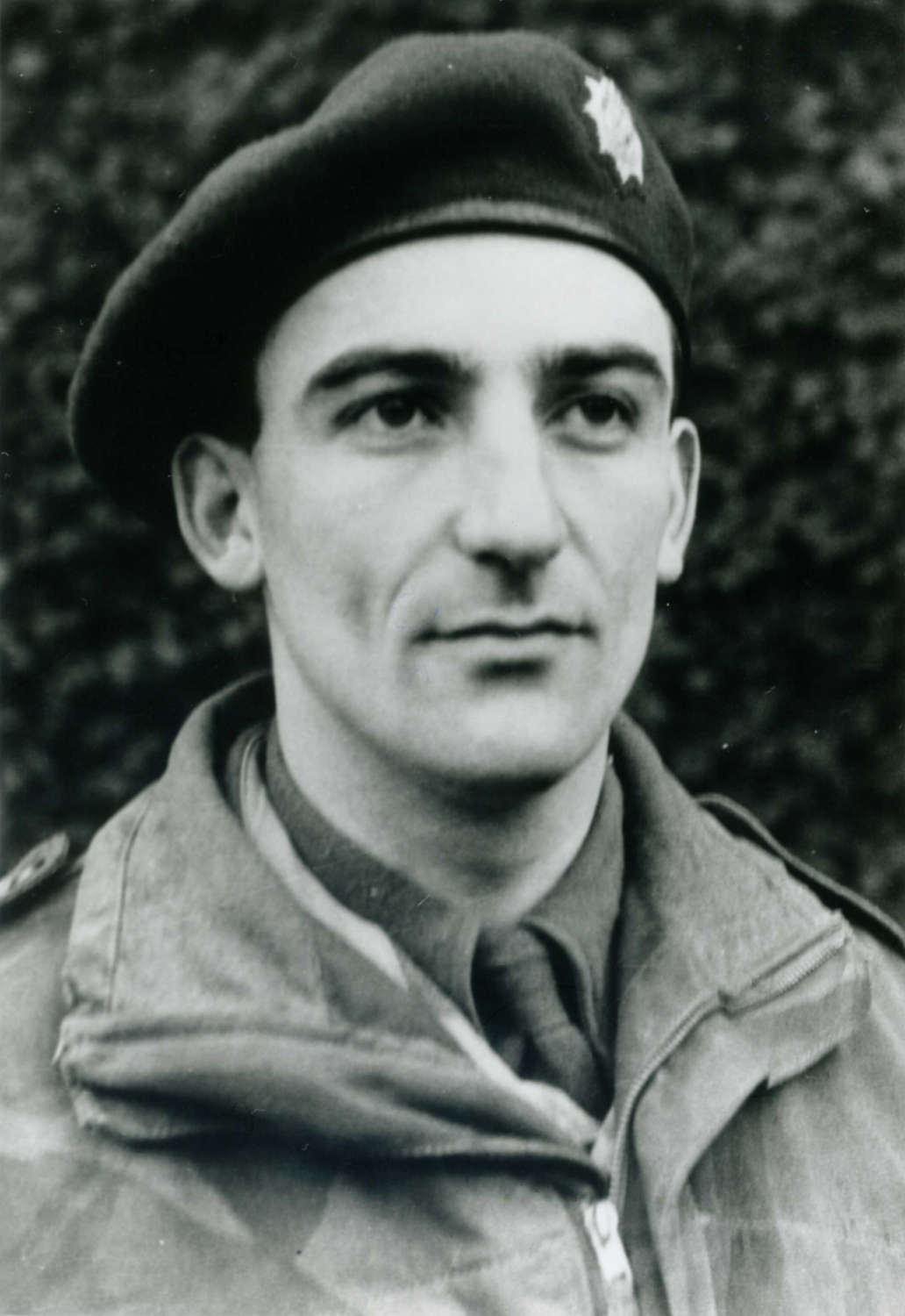
Lt-Col. M. St J. Packe. C.R.A.S.C., 1st Airborne Division. October 1944. Courtesy of Airborne Assault Museum, Duxford.
Captain. John Launcelot Cranmer-Byng (170362). The Military Cross. 26 October 1944.
At ARNHEM on the 20th September, Captain Cranmer-Byng was ordered to take an RASC party under cover of darkness and to take over a sector of the perimeter at a point where there was danger of enemy infiltration in the houses flanking the 4th Parachute Brigade position. This movement was successfully accomplished and the line was held, and at one time advanced, for four days in spite of heavy fighting and frequent attacks by mortar, self-propelled guns and single tanks.
Captain Cranmer-Byng was in command of the party throughout and was in much of the heaviest fighting. On one occasion, despite a slight wound in the hand, he shot an enemy sniper dead. On another occasion he took a party of men out with a PIAT and managed to drive off a self-propelled gun which was attacking the position at short range.
Subsequently, Captain Cranmer-Byng successfully disengaged his party, and led them down in the darkness through the enemy lines to cross the river to safety.
It was largely due to the inspiring leadership and coolness displayed by Captain Cranmer-Byng that the RASC sector held out against very considerable pressure, without food or sleep, and that the party was subsequently able to withdraw to safety when ordered to do so.
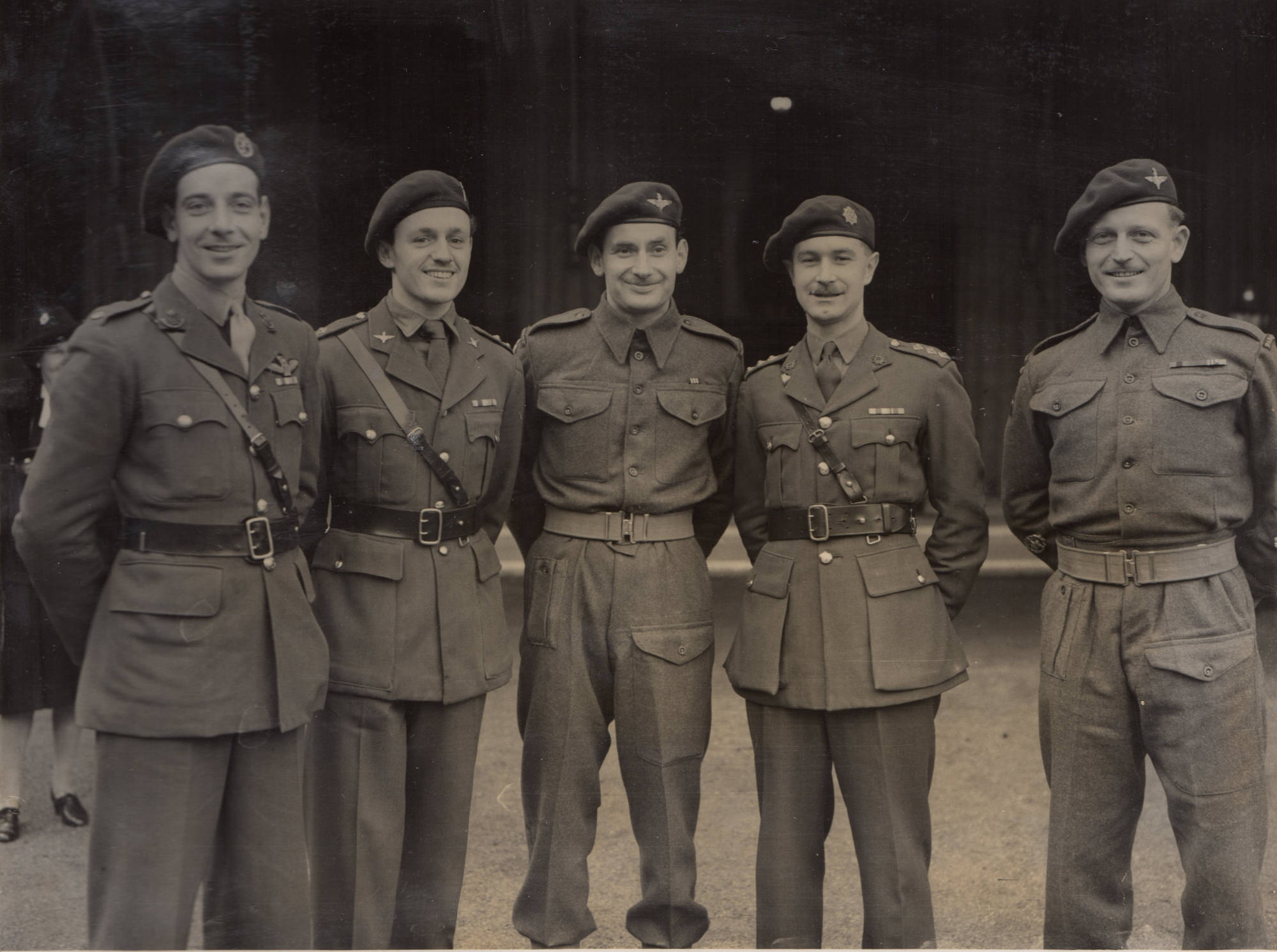
The Special Investiture by H.M. The King at Buckingham Palace. 6th December 1944. L-R: Maj. A. Murray MC (GPR), Lt. N.H.H. Ashmore MC (21 I.P.C), Sjt. N. Binnick MM (21 I.P.C.), Capt. J.L. Crammer-Byng MC (R.A.S.C.) and C.S.M. J. Steward DCM (21 I.P.C.). Courtesy of Airborne Assault Museum, Duxford.
Lieutenant. John Derek Grice (240422). Mention in Despatches. 17 April 1945.
T/144600. Sergeant. Ronald James McDowell. U.S. Bronze Star. 14 November 1947. He had been recommended for the Military Medal, and although the date of 14 November 1947 is the official date, he was awarded the U.S. Bronze Star on the 7 April 1945.
At Arnhem, on the second day of the battle, 18th [19th] September 1944, Sergeant McDowell led the bulk of his Platoon back from an ambush in which his Platoon Officer and several other men became missing, believed killed. Having reported the facts, he then volunteered to accompany a relieving force with a 6-pounder Gun to the scene of the ambush in an unavailing attempt to rescue the remainder of the Platoon. On the following day, he took command of the Platoon, and was ordered to hold some houses in an exposed part of the perimeter, and this he did with great success until the end of the battle. It was due to his resourceful leadership and inspiring example that this part of the perimeter was never penetrated by the enemy.
Finally, when ordered to withdraw, he brought back the remainder of his Platoon in good order across the river, having displayed throughout the whole action leadership far higher than that normally consistent with his rank.
T/125816. Lance Corporal. William Henry Dennis Clay. Mention in Despatches. 17 April 1945.
NOT RECOMMENDED OR AWARDED.
Captain. Desmond Thomas Kavanagh. (Commander No 2 Parachute Platoon). Military Cross.
T/5051542. Corporal. Douglas Haigh Beardmore. (No 3 Parachute Platoon). Military Medal.
T/220847. Lance Corporal. James Walker Young. ('D' Transport Platoon, attached to No 2 Parachute Platoon). Military Medal.
T/196122. Driver. Lionel Norman Jack Hart. (No 1 Parachute Platoon). Military Medal.
One of the reasons for the lack of Citations, especially for those from No 3 Parachute Platoon who had fought so gallantly in Arnhem itself, being put forward was that there were no Officers available to write them. Capt. 'Bill' Gell: "After my release from being a P.O.W. I tried to make a recommendation for an award or decoration for Sergeant Brookes and Corporal Beardmore. I was told that all awards for the Arnhem operation had been allocated. I then wrote to the Secretary of State for War and requested an interview. I was seen by a desk bound warrior in Whitehall who told me I was wasting everybody's time and that was the end of it!" [1]
NORWAY.
H.Q., R.A.S.C.
Major. Jack Reginald Halls (155128). The King Haakon VII Liberty Medal. 17 October 1946.
Major. John Denis Naylor (143651). The King Haakon VII Liberty Medal. 17 October 1946??
250th (Airborne) Light Composite Company, R.A.S.C.
Major. John Hamilton Gifford (121782). The King Haakon VII Liberty Medal.
London Gazette. 19 March 1948.
Captain. Philip Evans Bushby (194014). The King Haakon VII Liberty Medal.
London Gazette. 19 March 1948.
PERIODIC AWARDS.
Lieutenant-Colonel. Michael St John Packe (66968). Mention in Despatches. London Gazette. 24th August 1944.
T/198768. Sergeant. Charles Edmond Pickering. ('C' Transport Platoon). British Empire Medal.
Recommended by Lt-Col. M. St J. Packe, C.R.A.S.C. 1st Airborne Division. 31 July 1945. Endorsed by Major-General. R.E. Urquhart, Commander 1st Airborne Division. 1 September 1945. London Gazette. 9 January 1946.
This NCO landed at GARDEMOEN Airfield on 11 May 1945. He was put in charge of a party who were to check and stack air freight of all types, and containers collected from the DZ. In addition, he was put in command of forty infantryman each day, and had to teach them the work.
Sgt. Pickering worked untiringly, and showed great initiative and devotion to duty, and he was instrumental in making a success of the project of maintaining the Force by air for the first ten days in NORWAY.
He was employed on the clearance of cargoes from the docks to various depots later, and due to a shortage of Officers was put in complete control of the unloading of petrol from LST's. Despite his inexperience of this type of work, and the difficulties of co-ordinating Norwegian dock labour and German-driven transport, the task was successfully carried out.
During the last two days, Sgt. Pickering suffered considerably from pain in his back, but he insisted on carrying on until the job was finished.
There was one other award to a member of the R.A.S.C. that was not recommended.
Lieutenant-Colonel. Michael St John Packe (66968).
On the 31 August 1945, Lieut-Colonel. T.J. Black, A.A. & Q.M.G., 1st Airborne Division, recommended the Order of the British Empire.
Major-General. R.E. Urquhart, Commander 1st Airborne Division, agreed it on the 1 September 1945, but it was not recommended by 1st British Airborne Corps.
Lieutenant-Colonel Packe took over command of the Divisional RASC in November 1943 and was responsible for the reorganisation on the present airborne War Establishment. He has at all times maintained the highest possible standard in his work. This work was tried out to the full during the many moves entailed by some fifteen operations during 1944 which were planned and not executed before that on Arnhem. During the Arnhem operation his arrangements for maintenance were excellent and the fullest use was made of the stores received. Despite the conditions and of the enemy fire, Colonel Packe was indefatigable in his efforts to keep the Force supplied. Owing to the heavy losses during this operation, Lieutenant-Colonel Packe had once again to reform, reorganise and train the whole Divisional RASC. However, he was undeterred by the many difficulties that existed, and with untiring enthusiasm he succeeded in bringing his units up to the standard of efficiency required in Airborne Forces. On 6th May 1945 the Division was given 48 hours notice to move to Norway emplaning from aerodromes in Southern, Eastern and Northern Commands and landing in Oslo and Stavanger. Once again this called for the highest standard of work and efficiency from the RASC in the movement of personnel to the very scattered airfields with limited resources in transport and preparing the maintenance and resupply plan at two places in Norway. Once again this was entirely successful. On arrival in Norway he performed the duties of DDST for the first three weeks, which entailed the maintenance of all Allied Forces in Norway, the laying out of base supply installations and reception bulk supplies and POL from the first two convoys, all of which were done with the skeleton HQ RASC and the Light Composite Company RASC which came by air, supplemented by German transport. Lieutenant-Colonel Packe's outstanding work, cheerful spirit and his abounding energy in both battle and preparation for operations has at all times earned him the respect of both his superiors and subordinates.
NOTES:
[1] Letter from Bill Gell to Bob Hilton. 31 October 1997.


