Chapter 12
Rebuilding, Norway, and disbandment. 1944 - 1946.
"I was asked by John Gifford to take over command of what was left of Paddy's Parachute Platoon. I didn't fancy the job." Captain. Richard Adams.
The Airborne Contingent of the Company returned from survivor's leave on the 19th October 1944, and the Seaborne Echelon on the 23rd October. They all spent the next week sorting out their billets, carrying out kit checks - after being re-kitted - inspections and re-organising. The two evaders, L/Cpl. Barnard and Dvr. Eggleton returned on the 31st October 1944. During the month, three replacement officers were posted into the Company, Lt's. R.V. Dale, E. Hygate and A.D. Etherington, and Lt. J.I. Tansell was attached, pending his official posting. 2/Lt. N.H. Finill who had been attached to the Company since September, but had remained in U.K. was now posted in officially as the HQ Subaltern, and was on an M.T. Course. Lt. J. Grice was detached to the 1st Parachute Brigade, pending a posting to H.Q., R.A.S.C. The Company was still short of 159 Other Ranks by the end of October.
On the 1st November, new billets were taken over on the Hykeham Road, which was less than half a mile away from 'C' Transport Platoon's old billets on Doddington Road, which were handed over on the 20th February 1945. A training programme and routine was now established, as well as sports fixtures, as the Company went about absorbing replacements, including eight volunteers from 253 Company on the 4th November. Vehicles were received from 93 Company and other units to replace those lost on operations. Then on the 11th November, the first men from the Company, since returning from the Continent, arrived at R.A.F. Ringway to undergo parachute training. Dvr's. Brown (034), Cartmell, Knowles and Marvill qualified on Course B142, between 13th and the 25th November.
As if there was not enough bad news to have to pass on to next of kin, another tragedy befell the Company on the 12th November, when Dvr. Hector Parke of 'C' Transport Platoon died in a Jeep accident. He had been with the Company for over a year and a half, and had been on the Rear Party.
The month of November continued with low level training, regular visits to the ranges, swimming instruction, vehicle maintenance and inspections, fitness training and visits from the C.R.A.S.C. On the 25th November two officers and 12 O.R's departed for Hardwick Hall to undergo preliminary parachute training. At the same time, two men arrived at R.A.F. Ringway to undergo Parachute Course B 144, and Cpl. Reid and Dvr. O'Donnell qualified as operational parachutists on the 17th December. The other groups moved to R.A.F. Ringway on the 12th December and were put onto Parachute Course B146, where 9 men qualified - Cpl's. Cox and Sloan, Pte. Egerton, and Dvr's. Brock, Hotham, Pudge, Reed, Rodden and Rowlands. Unfortunately, Lt. Alsop's injury, from the Jeep accident in September, was still causing him problems and he only completed two days ground training before being sent back to the Company.
Preparations were also started for the visit and inspection by the C.I.M.T. later in the month. The Company had received a total of 25 men as replacements, and were now 134 short of their full complement. Conferences were also held by the new D.D.S.T. Airborne Troops - Col. G.A. Bond - and the C.R.A.S.C. of both the 1st and 6th Airborne Division's about the composition of the Light Company's.
On the 1st December, Maj. Gifford, proceeded on a Senior Officers Course for the R.A.S.C. Command of the Company was assumed by Maj. J.R. Halls, for the duration of the Course. The D.D.S.T, Col. Bond, recently qualified on a parachute course, inspected 210 members of the Company on a parade on the 4th December, and then carried out an inspection of training, billets and the Workshops. A new Battle Efficiency Test was completed by the majority of the Company on the 8th, with a 2 mile run being completed in 18 minutes. The 10th December was a Rest Day after the Church Parade at 9 o'clock, which was a good job, because the following week was going to be hectic.
11th December. Visit of C.R.A.S.C. Taking over of Canwick Camp and move of Advance Parties of 'C', 'D' and 'G' Platoons.
12th December. Preparation of Canwick Camp by Advance Parties. Command of Company handed over to Capt. J.L. Cranmer-Byng, M.C.
13th December . Clearing up of old Camps. Lecture on "Dumbarton Oaks Conference" by Mr. McLean. 14.00 hrs. Hockey: Company versus Cranwell.
14th December. Move of 'C', 'D' and 'G' Platoon's to Canwick Camp. Unit Education Officer at all day course on "The White Paper on Social Insurance".
15th December. Reconstruction of new Camp. Clearing up of old Camps. Physical Efficiency Tests (Agility).
16th December. Camp reconstruction. Physical Efficiency Tests continued. 11.30 hrs. Discussion period on "Japan". Officers Conference.
The 17th was another Rest Day, after the voluntary Church Parade, and then on the Monday the work continued: 18th December. Camp reconstruction. Map Reading Exercise Para Platoon.
19th December. Camp reconstruction. River Crossing under fire, Para Platoon.
20th December. Workshop Officers inspection of Platoon's maintenance. Efficiency Tests. 14.00 hrs. Talk "Housing After The War", Capt R.G.L. Norgate.
21st December. Misty nearly all day. O.C's inspection of 'D' Platoon vehicles. 14.00 hrs. Talk on M.T. by Workshops Officer. Padre's Hour.
22nd December. 14.00 hrs. O.C's parade at Canwick. Preparation for Christmas Festivities. Misty and mild.
23rd December. Vehicle maintenance. Talk and discussion on "Government White Paper on National Insurance". Football: Divisional League Match. Misty.
Notice how during this week, there was only a mention of a 'Para Platoon', this meant that there was only one - the other two not having been fully reformed. This was due to lack of overall replacements, lack of para trained personnel and the unknown factor of another re-organisation.
The 24th December was a Sunday, but this time the Church Parade, which was compulsory, was left until 11.00 hrs. Christmas Day Dinner was served to 210 x O.R's at Canwick Camp by the Officers - as was tradition - which included Maj. Gifford, who had returned from his Course. This day and the following day were relaxed with only the minimum of duties being carried out, but from the 27th it was back to the training programme and routine, with the Para Platoon carrying out a route march, in weather that was very cold! Field firing was also carried out and the end of the months 5 mile cross country run was won by 'C' Transport Platoon. There were only 4 replacements posted to the Company during December, which meant the Company was still short of its full complement by 130.
Capt. Richard Adams would not have taken part in this final week, as he had departed for R.A.F. Ringway, where he would finally complete his parachute course. He arrived there on the 30th December, with Pte. Sydes, to do Parachute Course 147. Both of them completed it on the 21st January and returned to the Company two days later. This was the first course in which all aircraft descents were made from a Dakota aircraft. Capt. Adams: "Now, at last, there was time and opportunity to send me on a parachuting course at Ringway. Jumping I found frightening - most people do - but I was fortunate in having a first-class stick commander, John Warwick-Pengelly of the Devons - the Bloody Eleventh. Our despatcher, Jimmy Blyth, was also first-rate. John Warwick-Pengelly joked and clowned and set us all an example we couldn't not follow. Jumping is really a matter of group morale. You feel you can't let the others down. How people jump alone I've never understood. The Ringway training people found me out all right. When I got back to Lincoln, John Gifford - who, like Gallio, cared for none of these things - gave me my confidential report to keep. "This officer was of a nervous disposition, although he assumed a pose which suggested confidence. He was always bright and cheerful, and kept the spirits of his stick high by being "the life of the party". Rather nervous but jumped without hesitation.' The course of eight jumps included a night jump. This is supposed to be in darkness, so that you don't know when you're going to hit the ground. Ours took place in brilliant, full moonlight, with snow lying. As I floated down from eight hundred feet, there was a superb view of the shining, niveous landscape stretching away to disappear into the far distance. The completion of our course was delayed by something like three weeks by bad weather, too windy and stormy for jumping. When at last the weather let up, we still had three jumps to go. The authorities wanted our lot out of Ringway: we were gumming up the works, staying there. We did those three jumps in one and the same day. I wonder whether any other course has ever done three jumps in one day?" [1]
For the rest of the Company, the New Year of 1945 started with the construction of roads and works on the Camp at Canwick, a P.T. road run and then the monthly barrack inspection, followed the next day by a 7 mile route march for the Transport Platoon's at 08.30 hrs! On this same day, the new War Establishment was announced and the unit began re-organising immediately, it would now consist of:
Company Headquarters.
Residual Driver Increment Platoon.
No 1 Parachute Platoon.
No 2 Parachute Platoon.
No 3 Parachute Platoon.
'C' Transport Platoon.
'G' Transport Platoon.
'F' (Workshops) Platoon.
The transfer of vehicles from the disbanded 'D' Platoon to the other two Transport Platoon's was carried out, as was the forming of No 3 Parachute Platoon, but No1 and No 2 were not yet created, but were operating as a Composite Platoon.
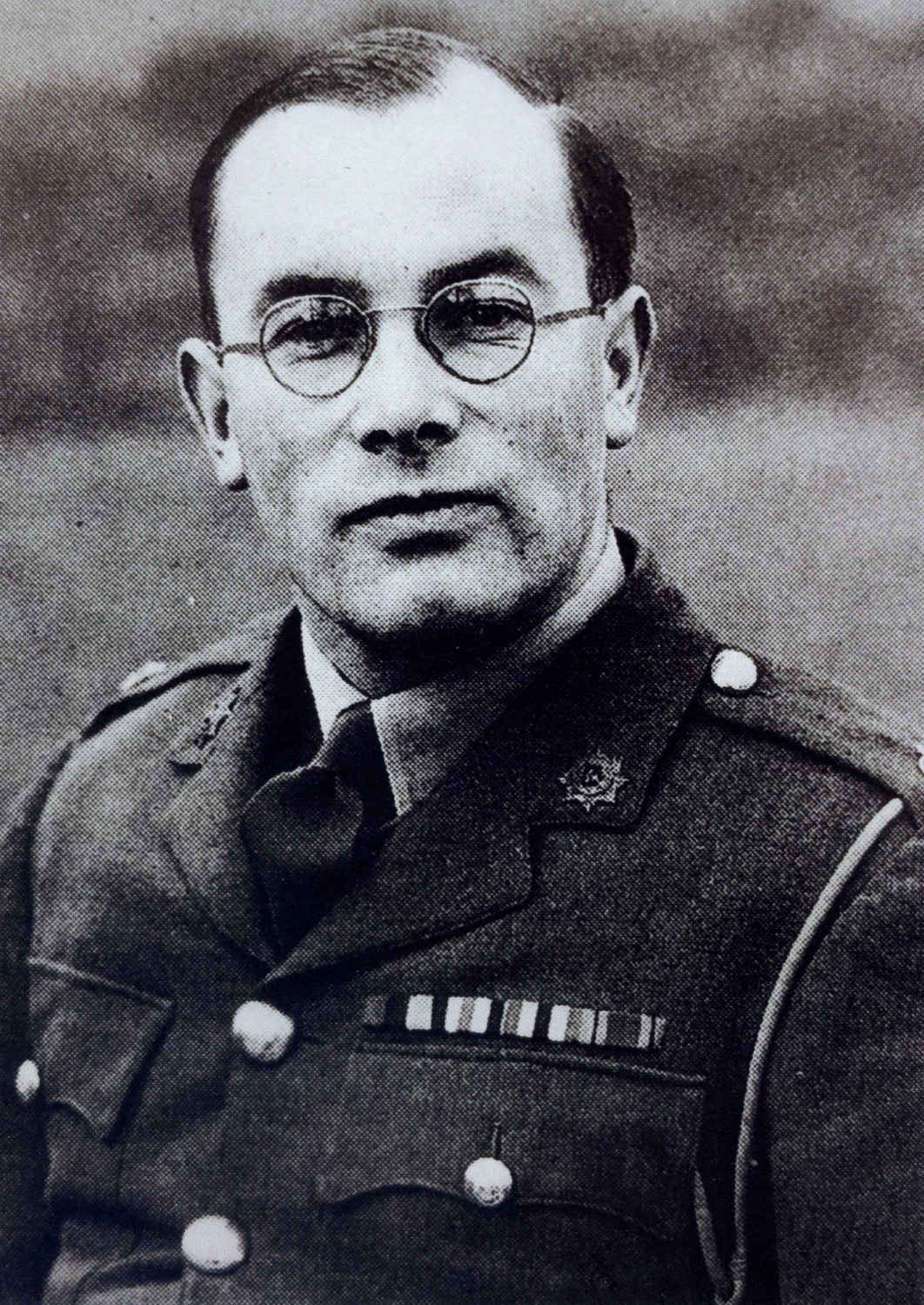
Major. John Gifford. 1945. Courtesy of Richard Adams.
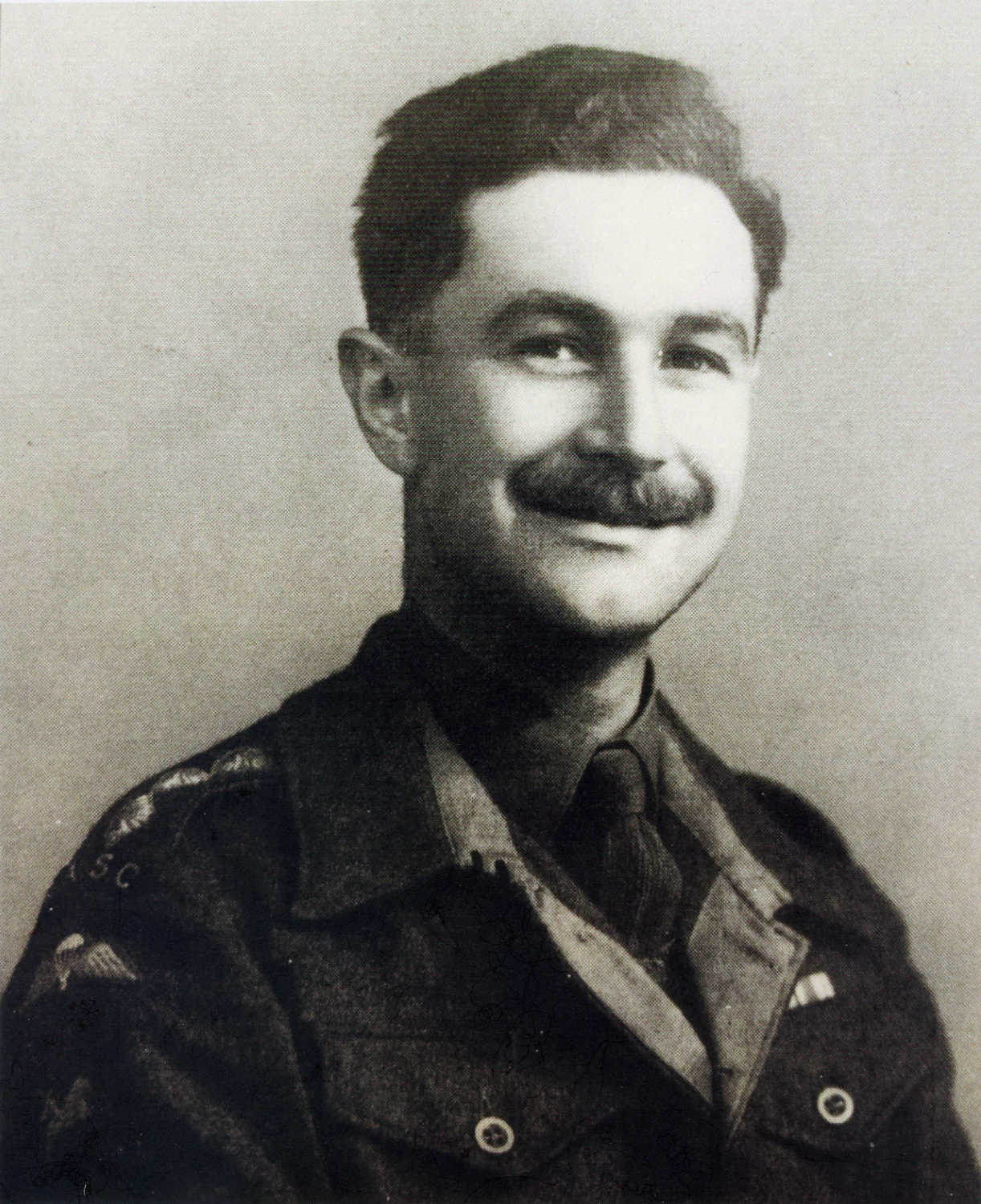
Capt. John Cranmer-Byng. 1945. Courtesy of Richard Adams.
Maj-Gen R.E. Urquhart, CB, DSO paid an informal visit to the Company on the 3rd January, and carried out an inspection of Canwick Camp. The following day, letters and cash were sent to the next of kin of those personnel who had been taken prisoner at Arnhem, money had been raised at a dance in aid of the of the Airborne PW Fund on the 13th November. Amidst the continued training routine, the most notable happenings in January were a demonstration supply drop - with the assistance of radar - at Amebury, on the 8th, and a further demonstration at Barkston Heath on the 17th, this time using unburstable bags and the dispatch of numerous small parcels and loads dropped on helicopter principle, which was considered partially successful. On the 16th, the C.R.A.S.C. visited to discuss the training of the Parachute Platoons, and then on the 30th January, No 1 and No 2 Parachute Platoon's were formed from the available parachutists. This was at the same time as 30 replacements arrived.
The Company were still not getting many men onto the available parachute courses, with only three men attending Course B149, 14th January to 5th February, and two men on Course B150, 22nd January to 9th February. Dvr's. Brodway, Driscoll and Lovell qualified on the first and Dvr's. Burns and Wainman on the second. The end of January saw the Company only 51 men short, of their full complement.
With the formation of all three Parachute Platoons, commanders were needed. Capt. Adams: "Having returned from Ringway, with wings if not halo, I was asked by John Gifford to take over command of what was left of Paddy's Parachute Platoon. I didn't fancy the job; it was like being asked to drive a large, fast car that you know you're not really up to. And anyway, how the hell was I supposed to step into the shoes of Paddy? The men, like children under a stress they are not altogether conscious of, were more difficult than they knew or intended. I don't blame them, either. Without setting out to be, they were sullen and resentful. What on earth were we all supposed to be doing, anyway? Training? But they were already trained, and who if not they? And in all their minds hung the unspoken question "Are we going to be sent on something like that again?" (To which the answer was "Quite probably, yes.") And were they, who had been at Arnhem, supposed to have the faith in me that they had had in Paddy? The long and short of it was that I couldn't really succeed in getting that job off the ground; and frankly, I'd like to have seen the man who could (though I suppose somebody must have, eventually). John - "the right man in the right job" - could see how things were going, but there wasn't another appointment for a Captain in the Company. And at this very time the appointment fell vacant for a Brigade R.A.S.C. Officer (they called it 'BRASCO') at 1st Parachute Brigade Headquarters. A BRASCO's job was liaison between the divisional R.A.S.C. and the units of the Brigade - getting them what they wanted or, alternatively, telling them that they couldn't have it; and in general, ironing out problems between the Battalions on the one side and Colonel Packe and his people, on the other. It was hard to leave 250 Company and John Gifford, after what had turned out the most eventful year of my life. John and I parted in his usual way: he said he thought I'd done very well with 'C' Platoon (I hadn't been one of those who'd quietly disappeared, anyway) and wished me luck for the future. I thanked him very sincerely 'for everything', saluted and went away. I was also, of course, rewound and pointed in my new direction by Colonel Packe." [2]
The role of 'C' Transport Platoon was temporarily changed, and starting on the 3rd February they took possession of 33 x 3-ton vehicles from 165 Company, R.A.S.C., together with all the tools and accessories, whilst their Jeeps and trailers were laid up in charge of a maintenance squad. 5 Officers and 13 O.R's were sent to Hardwick Hall for preliminary parachute training, with 2 Officers and 9 O.R's continuing onto R.A.F. Ringway to do Parachute Course B153, 10th to 26th February. Lt. Hygate and 2/Lt. Hale, plus Dvr's. Bettaney, Berridge, Branker, Crane, Duncan, Hutchinson, Johnson, Murray and Phillips (543) all qualified as parachutists.
The three Parachute Platoons moved into a new billet at Washingborough Hall, on the 6th February. This was approx. 2 miles North of Longhills Hall, and only just over a mile away from Canwick Camp. The training programme was now beginning to reflect the Company being back at almost full strength, with the Transport Platoons practising cross-country driving, whilst the Parachute Platoons practised infantry section work, including routine in defence and digging-in. The Company Signallers were being taught on P68 Sets, and carrying out regular exercises. And all members of the Company were undergoing regular battle efficiency tests. The officers had carried out TEWT's in the Newark area to see how the Light Company operated in supplying the Division during an airborne invasion. On the 17th February, the Company received 30 more personnel to reinforce the Parachute and Transport Platoons including eight potential parachutists.
There was a demonstration of a S.D.P. clearance drill, on the 21st February, with panniers and harnesses being supplied by 253 Company, for this training, with the Parachute Platoons carrying out a practice with their respective Jeep Sections on the 23rd. In this same week, 96 men of the Company were undergoing air experience in Waco gliders, flying from Barkston Heath aerodrome. On the 19th February, 3 Officers and 6 O.R's went to R.A.F. Ringway on parachute course B154, qualifying on the 9th March. They were Lt. Evans, Lt. Etherington, 2/Lt. Finill, Dvr's. Blount, Drury, Johnson (985), Powell, Smith (132) and Weatherer. Before this course was complete, 3 more O.R's went on parachute course B155, which ran from the 26th February to the 13th March, with Dvr's. Hope, Watts and Wilson qualifying.
At this time, HQ was still at Moorlands, with the Workshops now located close by. The Transport Platoons were at Canwick Camp, and the Parachute Platoon's were at Washingborough Hall. The Company strength stood at thirteen, with two attached - Capt. J.H. Lawson, R.A.M.C., for admin purposes, and Lt. D.C.S. Ball, R.A.S.C. for training. The War Establishment had now been reduced, with the reorganisation, and should now be 389 O.R's - at the end of February they had 376 - and 95 Jeeps.
The latest intakes of replacements received driving instruction on Jeeps during March, with the Parachute Platoons continuing with their infantry training and the attached Jeep Sections, practising their drills. On the 3rd March a warning order was received for Exercise 'Glass', which was to take place between the 12th and 14th March. Before then there was plenty to prepare:
6th March. 11.00 hrs. Practice parachute jump from two aircraft at Ropsley Heath. One refusal to jump - Court Martial pending. New intake posted to Platoons.
7th March. 10.30 hrs. Lecture by Lord Vansittart to representatives of Company. Trial run for Divisional Cross Country Championship.
8th March. Exercise 'Samson' for the Parachute Platoons, to practice clearance of S.D.P's.
9th March. Preparation for Exercise 'Glass'. Packing of 750 panniers for supply dropping. O.C's parade at Canwick.
10th March. Briefing conference at H.Q, R.A.S.C. for Exercise 'Glass'. All unit officers briefed in afternoon. Equipment packed and loaded.
11th March. Full parade of men and equipment for Exercise 'Glass'. Troops briefed.
At 08.30 hrs, 12th March, 49 Jeeps towing a total of 74 trailers, moved into the exercise area, and a token landing took place at 12.00 hrs, and radio contact was established. By 22.00 hrs the next day a D.M.A. was opened and the S.D.P had been cleared, with supplies issued to Division from the Dump. A link up with the Seaborne Echelon was established on the edge of the Divisional Perimeter. The whole exercise concluded at 15.00 hrs, 14th March, and the Company returned to their base locations.
On the 16th March there was a Presentation of the Commander in Chief's Certificates to three men, who unfortunately, were not named. Then on the 19th, Sgt. McDowell was awarded the American Bronze Star for his actions at Arnhem.
Whilst the three Parachute Platoons and their attached Transport Section went to Big Moor Ranges to carry out field firing exercise and battle inoculation, 22nd - 25th March, the Transport Platoons carried out a series of range firing practices. At 10.30 hrs, 27th March, the Mobilization Order was received, and any deficiencies had to be submitted, with another new War Establishment being reverted to, and 24 O.R's were sent to the 3rd ('E') Transport Platoon. At the end of the month, two drafts of replacements were received, 11 O.R's from No 1 R.A.S.C. Mobilisation Centre on the 29th and a further 24 O.R's on the 30th.
During the month of April, several groups of men from the Company completed parachute courses at R.A.F. Ringway, B156/157, which ran from 11th March to 6th April, saw Dvr's. Anthony, Brown (887), Cassidy, Cobbins, Gardner, Jeffcote, Peebles and Potter (799) qualify as parachutists. Capt. D. Ball was also attached to this course and qualified. Course B158, 17th March to 10th April saw Dvr's. Bewley, Cochrane, Campbell and Cooper (282) qualify. The day after this, groups arrival back at Lincoln saw a group of 9 men depart for Course 160A, where Dvr's. Bryson, Ledger, Herring, Creek, Long, McCardie, Callison, Rowe and Wardell qualified on the 25th April. Only one man attended Course B161, and this was Dvr. Manderson, who qualified on the 1st May. Cpl's. Smith and Wilkins, and Dvr's. Berry, Beswick, Broad, Cooper (791), Cotton, Hicks, Hughes (865), Hughes (937), Lovell, Lucas, McCormick and Storey qualified on Course B162, which took place between the 28th April and 11th May.
From November 1944 to May 1945, a total of 7 Officers and 80 O.R's had become qualified as operational parachutists, and now fully replaced the losses at Arnhem. The new War Establishment saw the total numbers of O.R's rise to 455.
The month of April saw the handing over of 56 old Jeeps for replacements, and the collection of 60 trailers from the Airlanding Brigade to re-equip the reconstituted 'E' Transport Platoon. With glider loading tests by the Transport Platoon's then being carried out on a Horsa mock up. There was another fatality during this month, when Dvr. Bernard Ayre was found dead in his billet on the 19th April 1945, having apparently shot himself.
On the 24th April, a practice parachute drop took place at Ropsley Heath with 76 men from the Company taking part, having taken off rom Leicester East airfield. In preparation for Exercise 'Amber' the glider-borne element, representing two Transport Platoons and Company H.Q. moved to Tarrant Rushton Transit Camp on the 28th April. This exercise began on the 1st May in the Sudbury area, with supply drops on a selected S.D.P, and two of the Parachute Platoons and their attached Jeep Sections, carrying out the clearance to set up a D.M.A. The next day, the Transport Platoons moved to the Epping Forest area, and Company H.Q. moved to Long Melford in Suffolk, whilst the Parachute Platoons and their Jeep Sections carried out the clearance and delivery of containers. This continued in to the 3rd and 4th May, but then on the 5th, the Exercise was cancelled - as Operation 'Doomsday' was now pending - which was as a result of the German unconditional surrender.
On the 6th May, groups were detailed to stand-by for operations in Norway, and Advance Parties moved to their airfields. The 1st Airborne Division were flying into Norway to control the internment of Germans surrendering throughout the country. All troops were confined to camp pending the operation. The next day the Company was divided into No 1 and No 2 airlifts and two seaborne echelons. The 8th May was declared as 'VE' Day (Victory in Europe), the various groups moved to their airfields, but emplaning was cancelled due to the weather. They finally emplaned on the 9th May, at Tarrant Rushton, Earls Colne, Rivenhall and Great Dunmow airfields and flew into Norway, where no opposition was encountered and parades were conducted in both Oslo and Stavanger on the 10th. A party was detached to Kristiansand on the 11th May, and the O.C. moved his H.Q. to Oslo. The majority of the Jeep transport was also flown across to Norway.
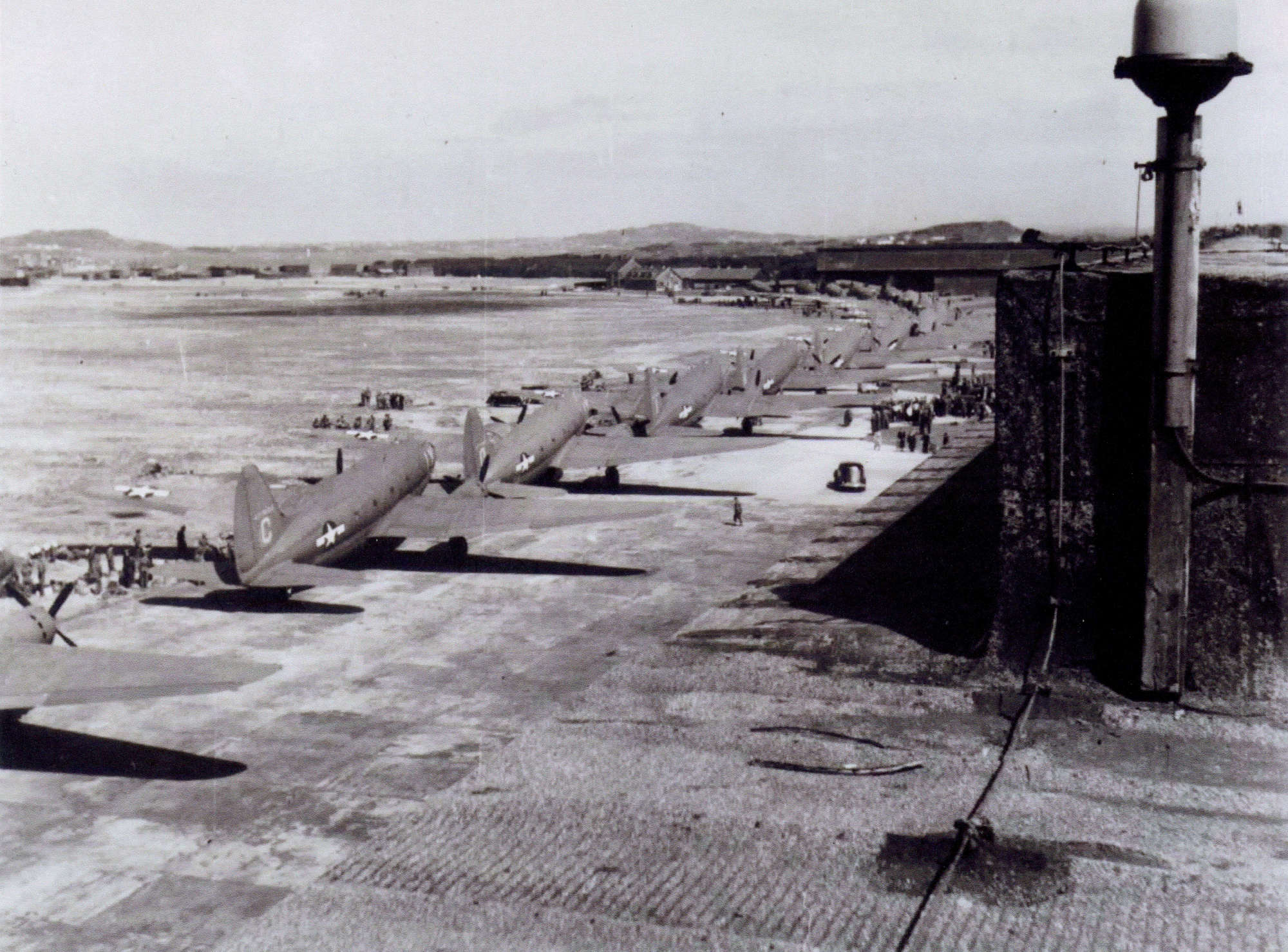
Curtiss C-46 Commando aircraft of the 314th Troop Carrier Squadron, 349th Troop Carrier Group, U.S.A.A.F., flying from Barkston Heath, land at Sola Airfield, at Stavanger, Norway. 10th May 1945. Courtesy of Airborne Assault Museum, Duxford.
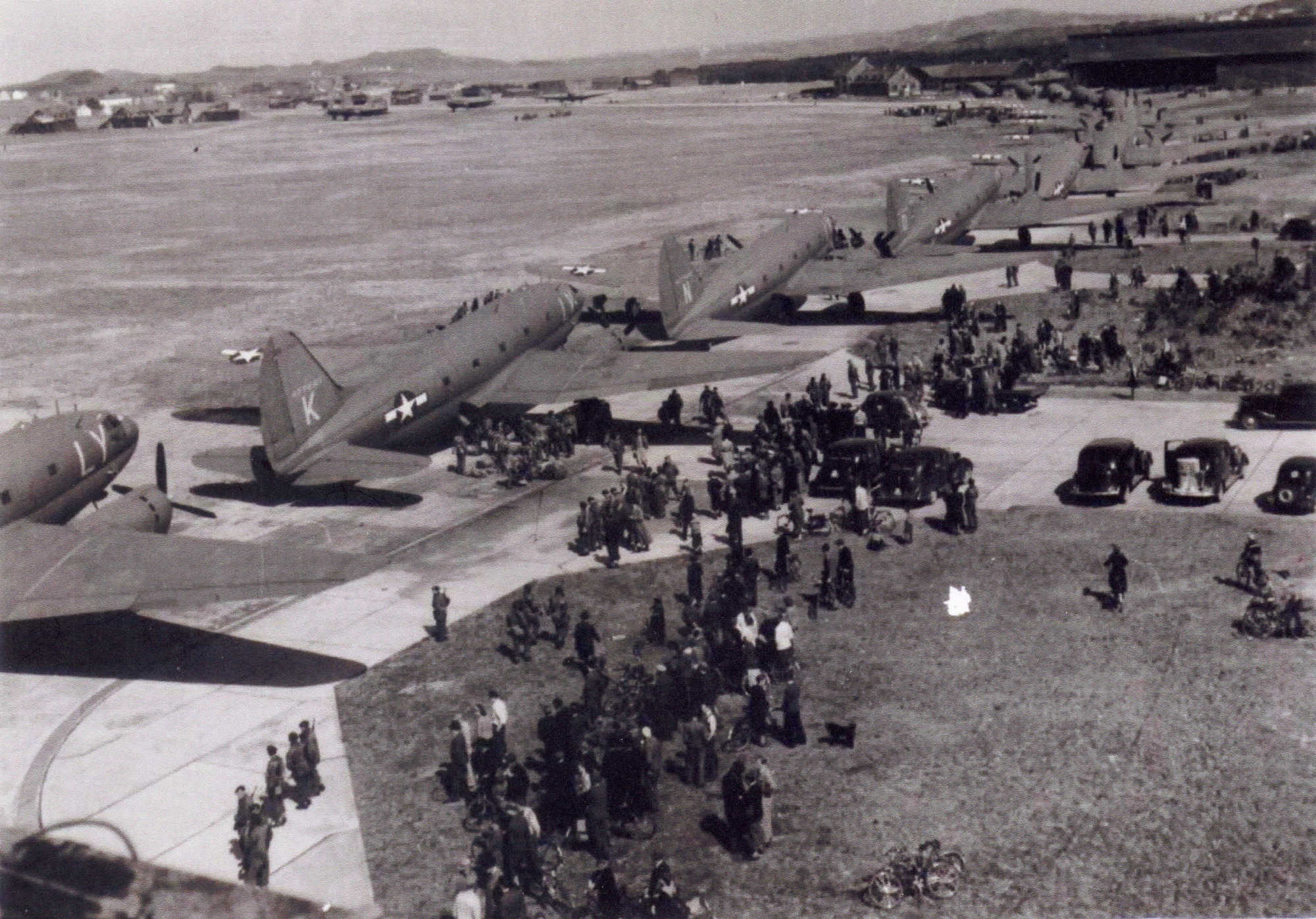
Curtis C-46 Commando aircraft of the 314th Troop Carrier Squadron, 349th Troop Carrier Group, U.S.A.A.F., flying from Barkston Heath, land at Sola Airfield, at Stavanger, Norway. 10th May 1945. The troops from each aircraft have formed up to one side, whilst hundreds of civilians have started to arrive to see them. Courtesy of Airborne Assault Museum, Duxford.
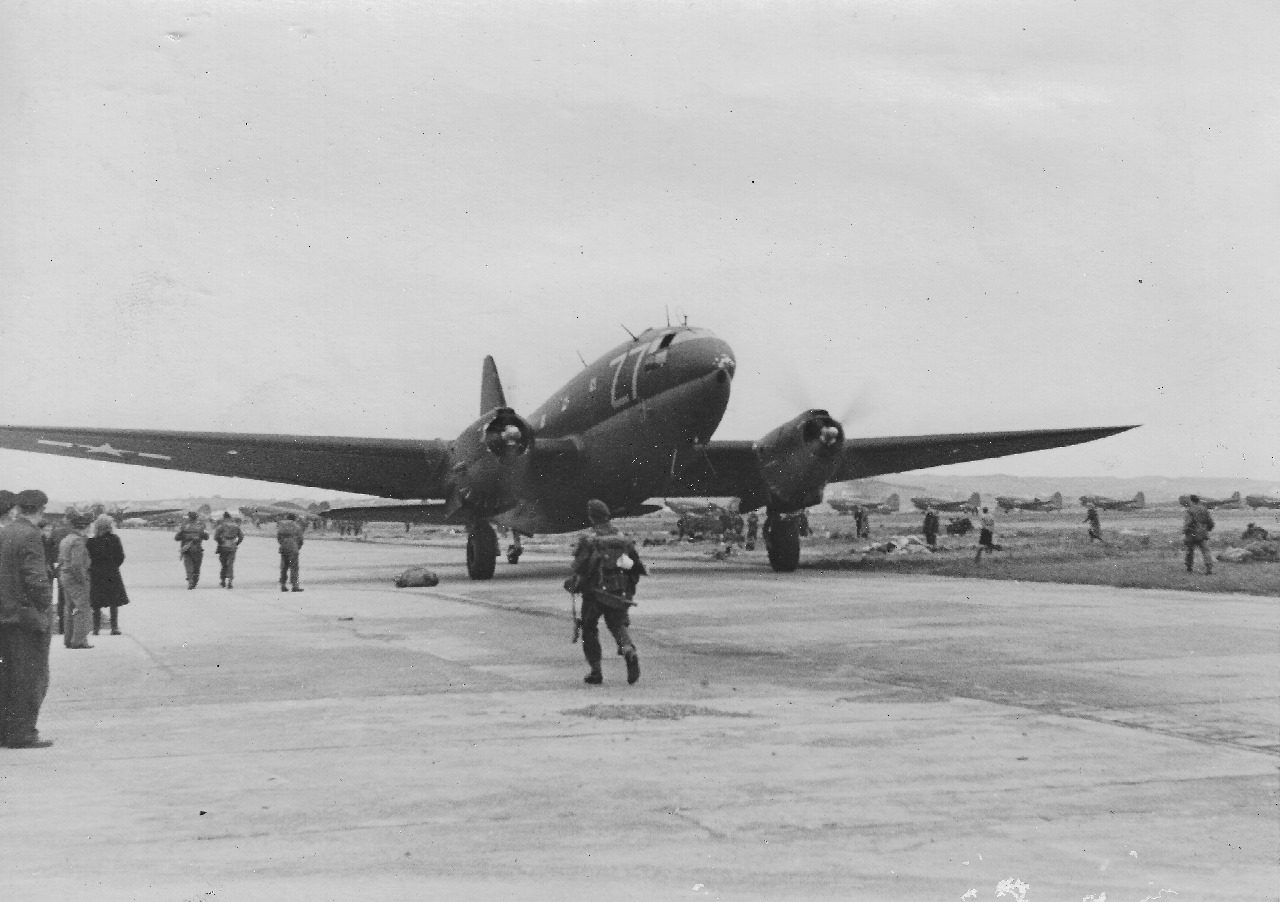
A Curtis C-46 Commando aircraft of the 48th Troop Carrier Squadron, 349th Troop Carrier Group, U.S.A.A.F., flying from Barkston Heath, land at Sola Airfield, at Stavanger, Norway. 10th May 1945. Courtesy of Richard Chancellor.
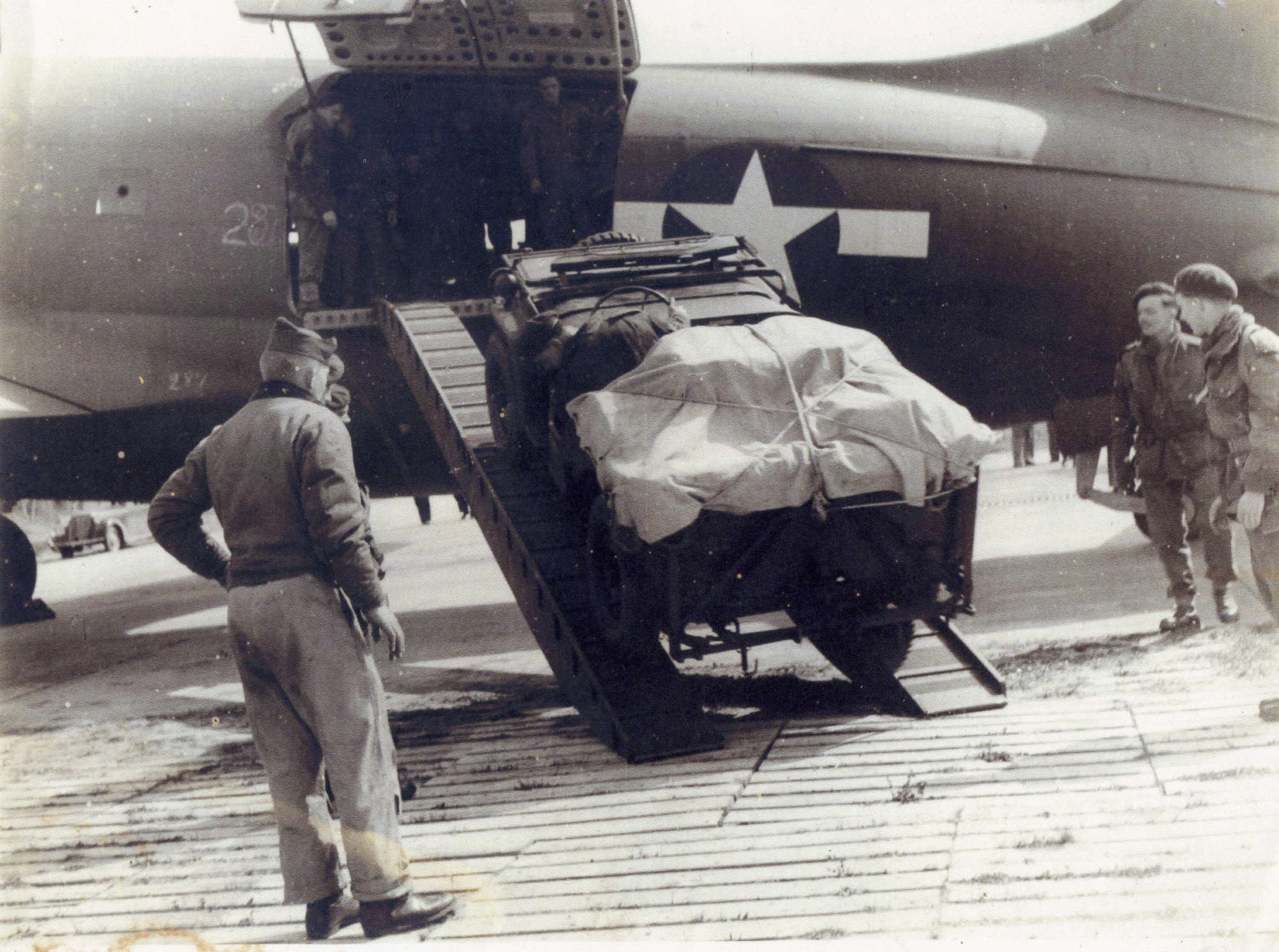
Unloading a Jeep from a Curtiss C-46 Commando aircraft. Sola Airfield, Stavanger, Norway. 10th May 1945. Courtesy of Airborne Assault Museum, Duxford.
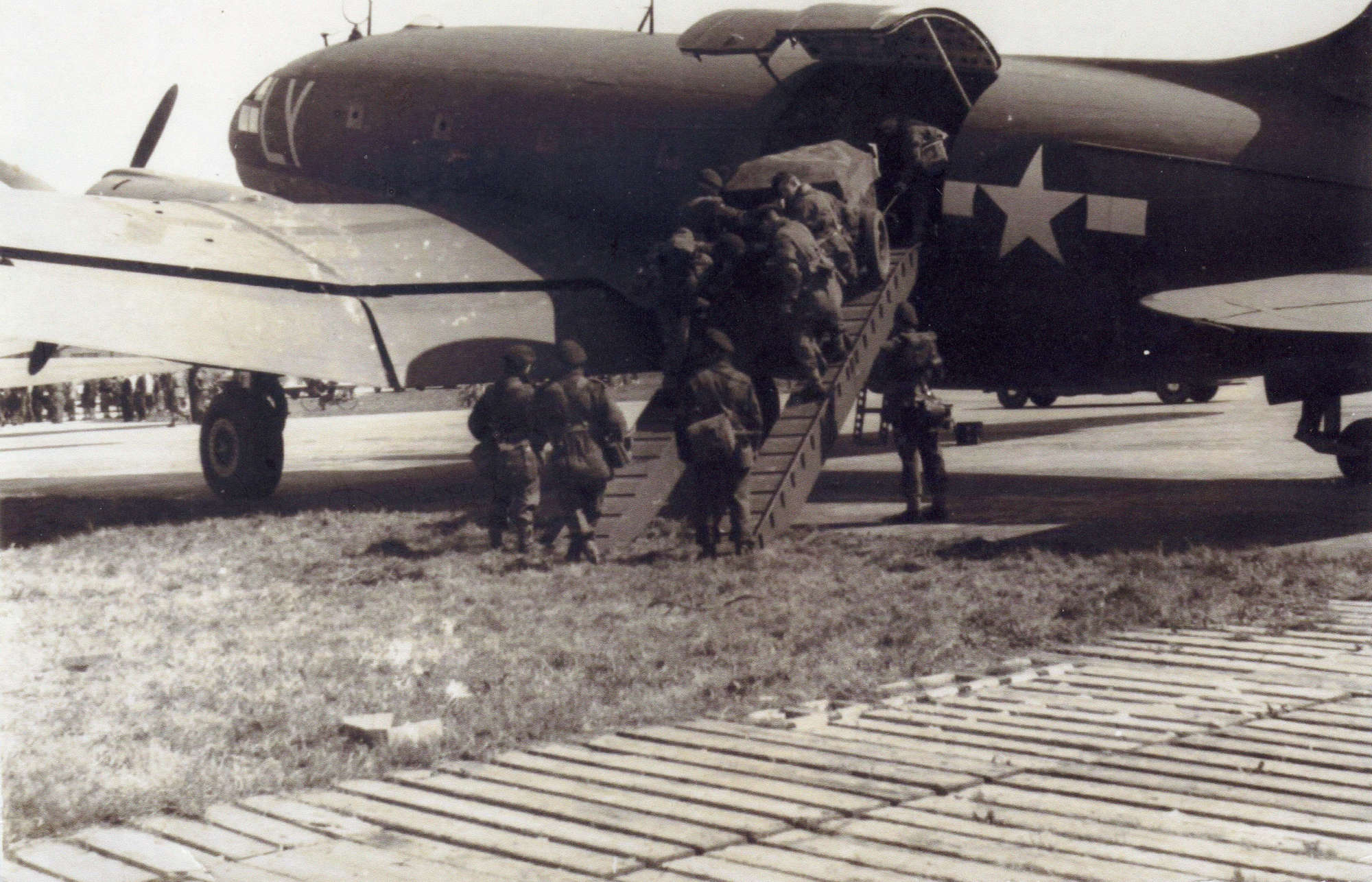
Unloading a trailer from a Curtiss C-46 Commando aircraft. Sola Airfield, Stavanger, Norway. 10th May 1945. Courtesy of Airborne Assault Museum, Duxford.
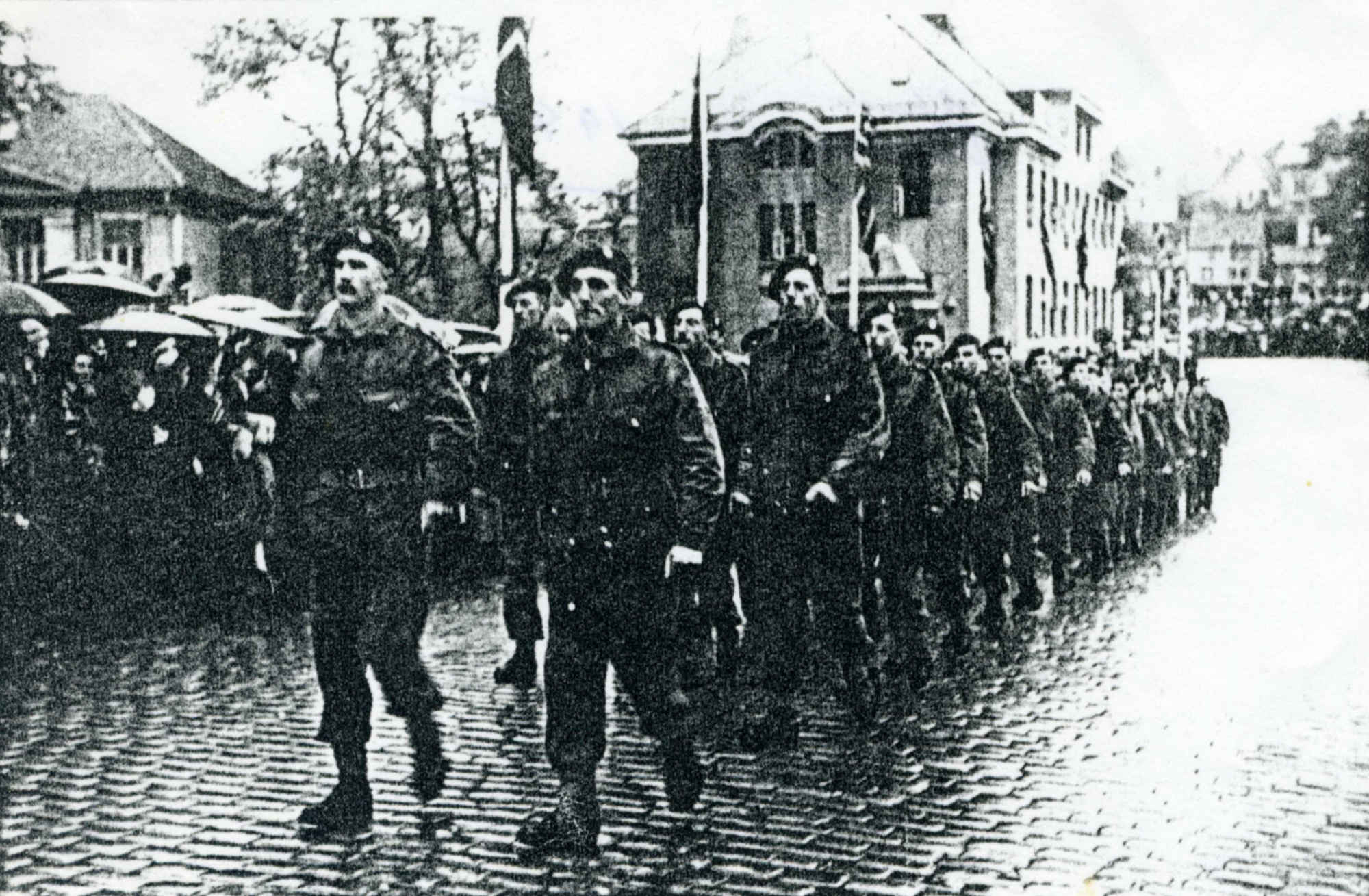
Capt. J.L. Cranmer-Byng, MC, leads a parade of the Company through Stavanger. 1945. Courtesy of Airborne Assault Museum, Duxford.
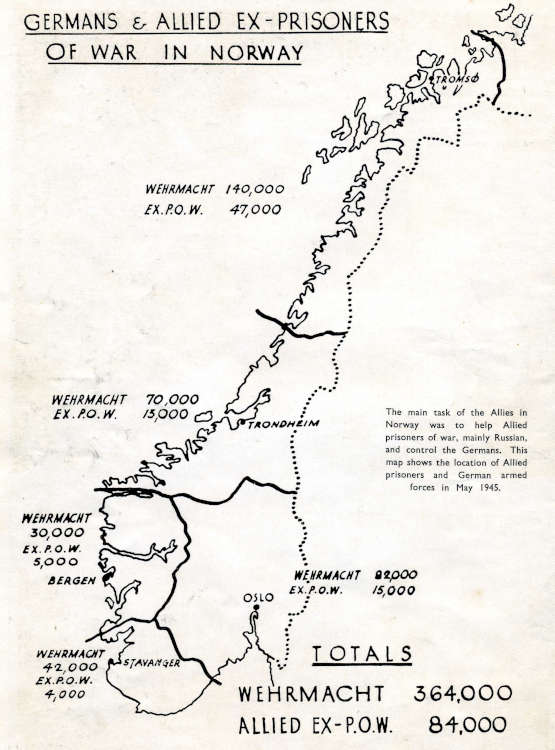
This map is from a booklet - 'The Allies In Norway' - it graphically illustrates the enormity of the undertaking, reference the number of Germans in the country that had to be dealt with.
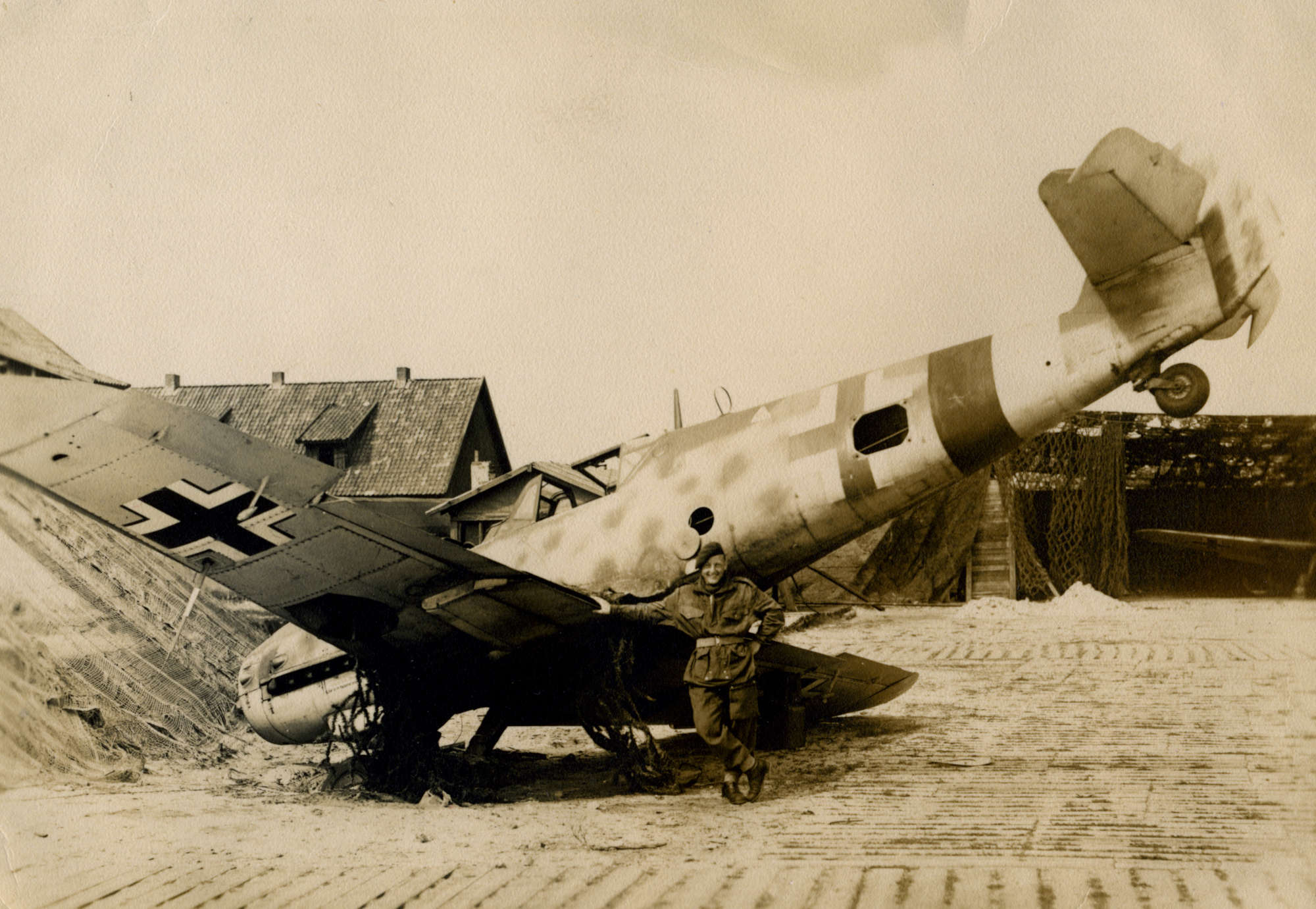
Cpl. 'Ken' Clarke, posing next to wrecked German ME 109 fighter aircraft. Norway. May 1945. Courtesy of Ken Clarke.
The Company ORDER OF BATTLE at this time was:
Officer Commanding: Major. J.H. Gifford.
Second in Command: Capt. J.C. Cranmer-Byng.
Adjutant: Capt. R.G.L. Norgate.
HQ Subaltern: Lieut. N.H. Finill.
R.M.O: Capt. J.H. Lomas. R.A.M.C. (attached from H.Q., R.A.S.C.)
'A' Parachute Platoon. Commander: Capt. J. Grice.
Second in Command: Lieut. A.D. Etherington.
'B' Parachute Platoon. Commander: Capt. P.B. Alsop.
Second in Command: Lieut. G. Osborne.
'D' Parachute Platoon. Commander: Capt. E. Hygate.
Second in Command: 2/Lieut. C.L.G. Hale.
'C' Transport Platoon. Commander: Lieut. R.S. Crisp.
'E' Transport Platoon. Commander: Lieut. D.C.S. Ball. (attached)
'G' Transport Platoon. Commander: Lieut. E.T.H. Evans.
'F' Workshops Platoon. Commander: Capt. P.E. Bushby.
Rear Party. Commander: Lieut. W.G.S. Penny.
Deploying to Oslo, Norway initially were:
Maj. Gifford, O.C.
Capt. Bushby, W/S.
Capt. Hygate, O.C. 'E' Para Pln.
Lt. Hale, 2 i/c, 'E' Para Pln.
Lt. Crisp, O.C. 'C' Tpt Pln.
Capt. Miller, att'd for Supply Duties.
On the follow-up Lifts:
Capt. Norgate, Adjt.
Lt. Finill, HQ Subaltern.
Capt. Cranmer-Byng, 2 i/c - Stavanger.
Capt. Alsop, O.C. 'B' Para Pln - Stavanger.
Lt. Evans, O.C. 'G' Tpt Pln - Stavanger.
Lt. Osborne, 2 i/c, 'B' Para Pln - Kristiansand.
Capt. Grice, O.C. 'A' Para Pln. Denmark. 1st Para Bde.
Lt. Etherington, 2 i/c, 'A' Para Pln. Denmark, 1st Para Bde.
Lt. Ball was returned to H.Q., R.A.S.C. and the S.N.C.O. for 'E' Pln took over.
The following Report summarises the 1st Airborne Division's R.A.S.C. activities in Norway in the first month:
WAR DIARY. G2.
Account of the activities of RASC 1 Airborne Division in
Connection with operations 'DOOMSDAY' and 'APOSTLE'.
1). MOUNTING.
(a) At the time of the capitulation of GERMANY, 1 Airborne Division was engaged in an Airborne Corps Ground and Air Exercise. They were warned for Operation DOOMSDAY on 6 May and the First Lift was airborne on 9 May; the second airlift, after one postponement, flew in on 11 May, followed by the remainder of the air lift on the days immediately following.
The Division therefore, entered the operation without any detailed knowledge of the maintenance plan. Briefing was confined purely to the immediate task in view, which was to seize and occupy OSLO, STAVANGER and KRISTIANSAND, to be prepared to operate without support for 14 days, and to exist by means of supply dropping and air freight at the two main bases during this period. There was no clear indication as to what the reaction of the 300, 000 odd Germans in NORWAY, who had never been committed in battle, was likely to be to this plan.
(b) The 'G' Branch allocation of the air lift was more favourable than usual to maintenance troops, and briefly the plan was to fly in 250 Lt Coy less one Para Pl which had flown to COPENHAGEN with 1 Para Bde, and the necessary Dets of HQ, RASC in the various air lifts, followed by 3 Tpt Pls in the first sea lift (DOOMSDAY I) and by remaining Dets of all Coys in second sea lift (DOOMSDAY II).
(c) CRASC 1 Airborne Div appreciated that maintenance arrangements at OSLO and STAVANGER must be entirely self-contained, and therefore divided the air lift into two identical parties. He took command of the OSLO lift, and the 2 i/c was put in command of the STAVANGER lift. As the occupation of KRISTIANSAND was undertaken from STAVANGER, it was decided that its maintenance should also be based on STAVANGER.
The allocation of the main air lift was therefore as follows:-
|
OSLO Det HQ, RASC. Det HQ 250 Lt Coy. 2 Para Pl. 1 Lt Tpt Pl (with crated Jeeps but NO trailers ½ Comp Pl 93 Coy. Det W/S 250 Lt Coy. |
STAVANGER Det HQ, RASC. Det HQ 250 Lt Coy. 3 Para Pl. 1 Lt Tpt Pl with 30 Jeeps and trailers ½ Comp Pl 253 Coy. Det W/S 250 Lt Coy. |
(d) It was further appreciated that S & T difficulties were likely to be greater at OSLO than at STAVANGER although the latter were responsible for the supply of KRISTIANSAND for the following reasons:-
(i) The larger force was at OSLO.
(ii) Freight for STAVANGER was by C.46 Transport A/C only, which meant both that Jeeps and trailers could be flown in together and that all supps could be bulk loaded; whereas at OSLO freight would be by bombers which could carry only crated jeeps without trailers, and also had to drop a proportion of their supplies and stores by parachute on an SDP.
(iii) The distance from airfield to town was greater in the case of OSLO (40 miles) than at STAVANGER (9 miles).
It was therefore decided to allot the 1st sea lift on the basis of 2 Tpt Pls 93 Coy to OSLO and one Tpt Pl 253 Coy to STAVANGER, the whole party under comd Major i/c Tpt
The second sea lift was under comd O.C. 253 Coy and would include the whole balance of his Coy proceeding to STAVANGER, and all remnants of HQ, RASC, 250 Lt Coy, 93 Comp Coy routed to OSLO.
The dates for the departure of the sea lifts were cancelled and amended on numerous occasions, and the whole mounting of the air lift was jeopardized when the 1st lift were ordered to part before take-off. But, eventually things turned out much as above. Loads for the vehs of the sea lifts were laid down by Q and included unit stores, Ord stores, NAAFI packs, barrack and miscellaneous items for 1 Airborne Div.
2). ACTION OF ADV PARTIES.
One Officer, a batman and a clerk were sent in at OSLO and STAVANGER in the advanced lift on 9 May. They were to provide essential tpt from GERMAN or NORWEGIAN sources to ferry Inf Tpt arriving in the main lift from airfields to operational stations, and also to clear sups and unit stores dropped and flown in with the main air lift before any RASC tpt or personnel were available to cope with this task.
This they did, and met their respective Commanders on arrival in the main air lift with up to the moment infm of the situation.
3). ACTION OF MAIN AIR LIFT & SUPPLY BY AIR.
(a) OSLO.
On landing, 250 Lt Coy was established on GARDEMOEN Airfield; they took over a Platoon of German tpt the same day, and used this to clear containers of unit equipment and RASC supplies to a temporary depot in a hangar; this work was delayed because priority on tpt requirements was given to the ferrying of troops which came in in the various airlifts. The airfield was however kept clear of freighted supplies, and after two days, work on the SDP had caught up with the rate of dropping.
HQ, RASC moved into OSLO with Div HQ, and the Comp Pl of 93 Coy recce'd a Supply Point in KAMPEN SKOLE, from which they issued compo and POL ferried down from the airfield by 250 Lt Coy on the first day. Bakery arrangements were made, and on arrival by air of flour and ingredients, bread became part of the ration on the third day. A German cold storage depot was also taken over, and the contents, frozen beef and pork, became a part of the ration on the same day, until the 'beef' was found to be horse, when this was discontinued.
By the end of the week, all stocks of sups, POL and barrack items had been ferried from the airfield and taken on charge at the Supply Pt, and the airlift was cleared as a daily routine whenever it came in. Parachutes and containers were evacuated to UK by returning a/c as salvage.
With the completion of the air supply on 23 May, 250 Lt Coy moved from the airfield to a new location nearer OSLO.
Air Supply was on the whole a great success; not only were all tps in OSLO supplied with their immediate requirements, but a fourteen day build up of all commodities including POL was achieved for the strength then being fed. Three points of criticism should however be made. First, the practice of packing compo rations loose inside containers is both wasteful and inconvenient; attractive items such as cigarettes are open to pilferage at all stages from the initial packing until they reach the consumer; also, the Composite Platoon, already overworked, was very hard put to it to sorting balanced rations for the daily issue out of a growing mountain of tins; and even now, the balance has not yet been completely sorted; and owing to the frequent handling, the loose tins have in most cases become so badly battered and unidentifiable as to be useless for issue as proper rations. As part of the a/c load was freighted and part dropped, repeated signals were sent requesting that the compo be freighted and the POL dropped, but this produced no alteration what-ever.
Secondly, it seemed that there was a preponderance of F type packs over all other types. Thirdly, the changeover of responsibility for supply of the force from Air Despatch to Scofor resulted in a temporary shortage of breadmaking ingredients, despite frequent demands; this resulted in the Force resorting to biscuit once more for a matter of two days.
Recce's were carried out for the Base Installations; a temporary Petrol Depot was selected, and a location for HQ 11 CRASC and 305 GT Coy was found. An excellent BSD site was chosen for DID and BIS, with sufficient storage to accommodate civil affairs consignments from mixed cargoes; the Germans were made to evacuate this site. A very large quantity of German wines and NAAFI goods were found there, and on instructions from HQ Norway Command, issues were made to all units, first on a free, and then on a repayment basis. For lack of other resources, the Composite Platoon took on this task also, until it assumed such a large proportion that an ad hoc staff was appointed under Q arrangements.
250 Lt Coy played a large part, with REME, in the inspection, selection and repair of German heavy tpt and cars, and their Light Workshops which was flown in, paid a tremendous dividend once they obtained German spares.
(b) STAVANGER.
All air lifts of personnel and vehicles landed without incident and in accordance with the schedule.
In view of the short distance from the airfield (SOLA) to STAVANGER and the intended concentration of tps, the maintenance of the force was based on the airfield for the initial phase. With this in view, the first RASC Det flying in on the 10th May recce'd and allocated accommodation at SOLA airfield.
The difficulties met with during the re-supply at OSLO did not apply at STAVANGER as (a) aircraft were C.46's and landed with stores intact (b) the distance from airfield to maintenance area was measured in yards rather than miles.
In fact, throughout, the supply by air was a complete success and the build-up, together with immediate maintenance, carried out extremely smoothly.
Points of interest concerning the supply by air are:-
(i) After arrangements for baking bread had been made on 12 May, a message was sent to Corps by wireless in the afternoon requesting flour, yeast, and salt. This arrived with the resupply on the afternoon of the next day, 13 May.
(ii) An RASC officer from Air Despatch accompanied planes (requested by RASC at STAVANGER) Brought list of stores with him and cleared up any possible queries on the spot.
(iii) On request, the C.46's used the perimeter track passing the hangar used as a DID. The planes stopped outside, were unloaded in a matter of minutes by Jeeps and trailers and then carried on round to the main runway. They appeared to be as easily maneuverable as 3 ton lorries and are undoubtedly ideal for the purpose.
During this time all units came to the airfield to draw their requirements with the exception of a troop of RE who were garrisoning an island 40 miles to the north of STAVANGER. This troop was supplied by sea in a launch requisitioned from the seaplane base and manned and navigated by the RASC.
On 13 May elements of the SAS Bde moved off to KRISTIANSAND. An RASC Det was made available and travelled by road with the Bde loaded with Compo, bread and POL.
After sending down further sups, etc to them by Jeep convoy, it was decided to arrange to provision this force by rail as the distance involved and the road surfaces, did not make road travel a sound proposition.
This pack train was used thereafter until sups arrived direct to KRISTIANSAND by sea and was most dependable throughout.
RASC duties at this stage were extremely varied and included:-
Supply by air.
Supply by sea.
Supply by road.
Supply by rail.
Troop carrying.
Requisitioning transport.
Requisitioning supplies.
Refuelling aircraft.
Unditching aircraft.
Vehicles repairs.
Marine repairs.
Guarding food dumps.
Guarding 27 x 2 man submarines.
Issuing wines and spirits taken over.
Controlling all local purchase for the force.
As soon as air supply had finished the RASC moved to the outskirts of STAVANGER and took over accommodation required for the maintenance personnel following.
These units were met, moved to their areas (already allotted by Div RASC) and accommodated. Eventually these units took over their commitments and the whole lay-out handed over to the Comd RASC appointed for STAVANGER and the Div RASC began on the 10 Jun to assemble by road, rail, sea and air in OSLO in accordance with DDST Norway Command instructions.
4). ARRIVAL OF CONVOYS DOOMSDAY I & II.
In view of the fact that no RASC Supply Units or Port and Dock Operating Units had arrived, Div RASC undertook all arrangements for the receipt of the above convoys on 18 and 30 May at OSLO, STAVANGER and KRISTIANSAND.
This included:-
The meeting and installation of RASC Units.
Tpt for marching personnel and equipment.
Clearance of all RASC and Ord stores to BSD, Pet Depot & BOD.
The depot sites had already been selected in all zones, and skeleton staffs from Comp Pls were provided to receive the stores in each. A German Tpt Coln of 100 vehs, working under the direction of Officers and NCO's of 250 Lt Coy, was detailed to provided for unloading the ships and stacking in the depots.
This operation went smoothly on the whole in all Zones, all LST's being cleared in 72 hrs on each occasion. This, in spite of the fact that in OSLO the national celebrations on 17 May followed by Whitsun holidays, made movement of MT a matter of some difficulty and rendered the civilian labour, which was always extremely slow and unreliable, almost totally useless.
RAF accepted delivery of their own stores in the first convoy, but responsibility for receipt of aviation spirit and RAF amn was passed to RASC at short notice before the second lift, under an authority arranged during planning of which, Norway Command was unaware. At OSLO, the only possible arrangement was to move the aviation spirit by rail to warehouses in the BSD and to leave it there as a temporary measure.
5). REDISTRIBUTION OF DIVISIONAL RASC TO MEET APOSTLE LIFTS.
(a) On 22 May, the decision that 1 Airborne Div was to assume responsibility for the whole of Norway Command instead of 52 Div who were now not coming was notified.
The first news was thus obtained of the Divisional Staff Increment, and after many enquiries, infm was obtained regarding the provision of RASC units from BLA and UK. Although this infm was extremely broad and unreliable in detail, it gradually clarified, and Div RASC obtained their first picture of the APOSTLE plan.
(b) It became clear that the various Zones, for which a G Order of Battle was in course of production, were to be supplied independently by sea from UK, and that sufficient RASC units to deal with the situation in each ZONE would ultimately be available, but that there was a likely to be a dangerous interim between the arrival of Inf fmns and RASC stores, and the arrival of RASC and NAAFI units to deal with them.
(c) On 23 May, one Pl 93 Coy with a Captain and small staff from that Coy to act as O.C. RASC and a Det of an already overburdened Comp Pl, were despatched to KRISTIANSAND by road and thence to BERGEN by sea, where they were to supervise the arrival of [the] SAS Bde.
On 28 May, a Major from HQ, RASC 1 Airborne Div and a Captain from 250 Lt Coy, each with a skeleton staff, were despatched by road and rail respectively, to assume temporary appointments as CRASC TRONDHEIM and OC, RASC TROMSO. 2 i/c RASC was appointed CRASC STAVANGER, and in turn, appointed his HQ Capt as OC, RASC KRISTIANSAND. CRASC 1 Airborne Div, with two Captains and two clerks assumed the appointment of DDST Norway Command and CRASC OSLO Zone in addition to his own.
(d). Thus, by 30 May, the RASC Order of Battle in Norway was as sfollows:-
OSLO - DDST and CRASC OSLO Zone - CRASC 1 Airborne Div 93 Comp Coy HQ, 1 Tpt Pl, Comp Pl and Sec Wksps 250 Lt Coy HQ, 1 German Tpt Pl, 1 Para Pl, 1 Lt Tpt Pl, Wksps.
STAVANGER - CRASC - 2 i/c RASC 1 Airborne Div 253 Comp Coy - 1 Tpt Pl, 1 Comp Pl less Det. 250 Lt Coy - Det Coy HQ, 1 German Tpt Pl, 1 Lt Tpt Pl, Det Wksps.
KRISTIANSAND - OC, RASC - HQ Capt, RASC 1 Airborne Div Det Tpt Pl 253 Coy Det Comp Pl 253 Coy plus 437 Sup Pl which arrived 30 May
BERGEN - OC, RASC - HQ Capts 93 Comp Coy RASC 1 Tpt Pl 93 Comp Coy ½ Comp Pl 253 Comp Coy 1 Sec Jeeps and trailers 250 Lt Coy
TRONDHEIM - CRASC - Major i/c Tpt, HQ, RASC 1 Airborne Division With one clerk, one batman and 2 dvrs
TROMSO - OC, RASC - HQ Capt 250 Lt Coy With one clerk, one batman and 2 dvrs
(e) The orders to the officers assuming these appointments were as follows:-
(i) To recce and allot accn in their zones for RASC units and installations coming in by sea, and to meet and install them on arrival.
(ii) Arrange unloading, clearance and storage of RASC stores arriving at their ports.
(iii) To investigate and report on the situation regarding maintenance of the German Army, and maintenance by the latter of RUSSIAN Ex PW.
(iv) To investigate and report on facilities for cold storage and bulk petrol.
(v) To clarify arrangements for maintaining Norwegian units ex UK, and those which were nominally being maintained from SWEDEN.
(vi) To est telephone contact with DDST and render sitreps and sup status daily.
(vii) To hand over and return to OSLO on arrival of RASC units in ZONES.
(viii) Est facilities for issue of bread, meat, potatoes and German NAAFI goods as soon as possible after arrival of their formations.
At TRONDHEIM and TROMSO, the CRASC and OC, RASC who had minimum staffs and no operating units were to arrange tpt from GERMAN sources, and to form a cadre of an RASC Unit composed of Inf tps by arrangement with the Zone Commander on arrival.
(f) At OSLO, the position was complicated by the arrival of the US Convoys 'NIGHTLIGHT', and arrangements were made to provide them with POL, bread, meat, potatoes and German NAAFI goods as a temporary measure, and with British rations on an exchange basis in the event of non-arrival of their own sups. Tpt was also provided for them as required.
(g) Information regarding incoming convoys and as far as possible, the break-down of RASC stores was passed to Zones by telephone as they become known. The arrival of an RAF Officer with some knowledge of the broad outline of the maintenance plan, was of great assistance in this respect. Signals were bad, and DDST's instructions which clarified the whole position did not arrive until too late.
(h) The RASC Units from BLA and UK duly arrived in their correct zones, except that the DID's and BIS for BERGEN and TRONDHEIM arrived at OSLO and had to be routed onwards. Units were installed, and took over the depots which had been started.
(j) On 5 Jun, the process of handing over was well under way in all Zones, and as a matter of policy it was decided to re-concentrate the whole of 1 Airborne Div RASC in OSLO Zone, to form a Command Reserve for DDST. Necessary arrangements for the various moves were made with Movements, and this process is now nearing completion.
(k) It was also decided to move 437 Sup Pl from KRISTIANSAND where, after arrival of DID they were no longer required, to OSLO where the ration strength of 20,000 sub-divided into 76 Units was proving too much of a strain for one Composite Platoon. This was done.
(l) On 9 Jun, CRASC, OSLO Zone took over from CRASC 1 Airborne Div, command of all non-Divisional RASC Units and the adm of the Zone. DDST Norway Command arrived 6 Jun and, on arrival of part of his staff, finally took over from CRASC 1 Airborne Div on 11 Jun.
(m) The above arrangements were not eased by the decision that 14 officers and 250 OR's of 1 Airborne Div RASC, who were distributed between UK, COPENHAGEN, and the five Zones of NORWAY, were to be assembled at OSLO and exchanged with equivalent personnel of 6 Airborne Div, who were ineligible for SEAC. This process is now half completed.
M. St J. Packe. Lt. Col. Comd RASC 1 Airborne Division. Zone L, BLA. 15 Jun 45.
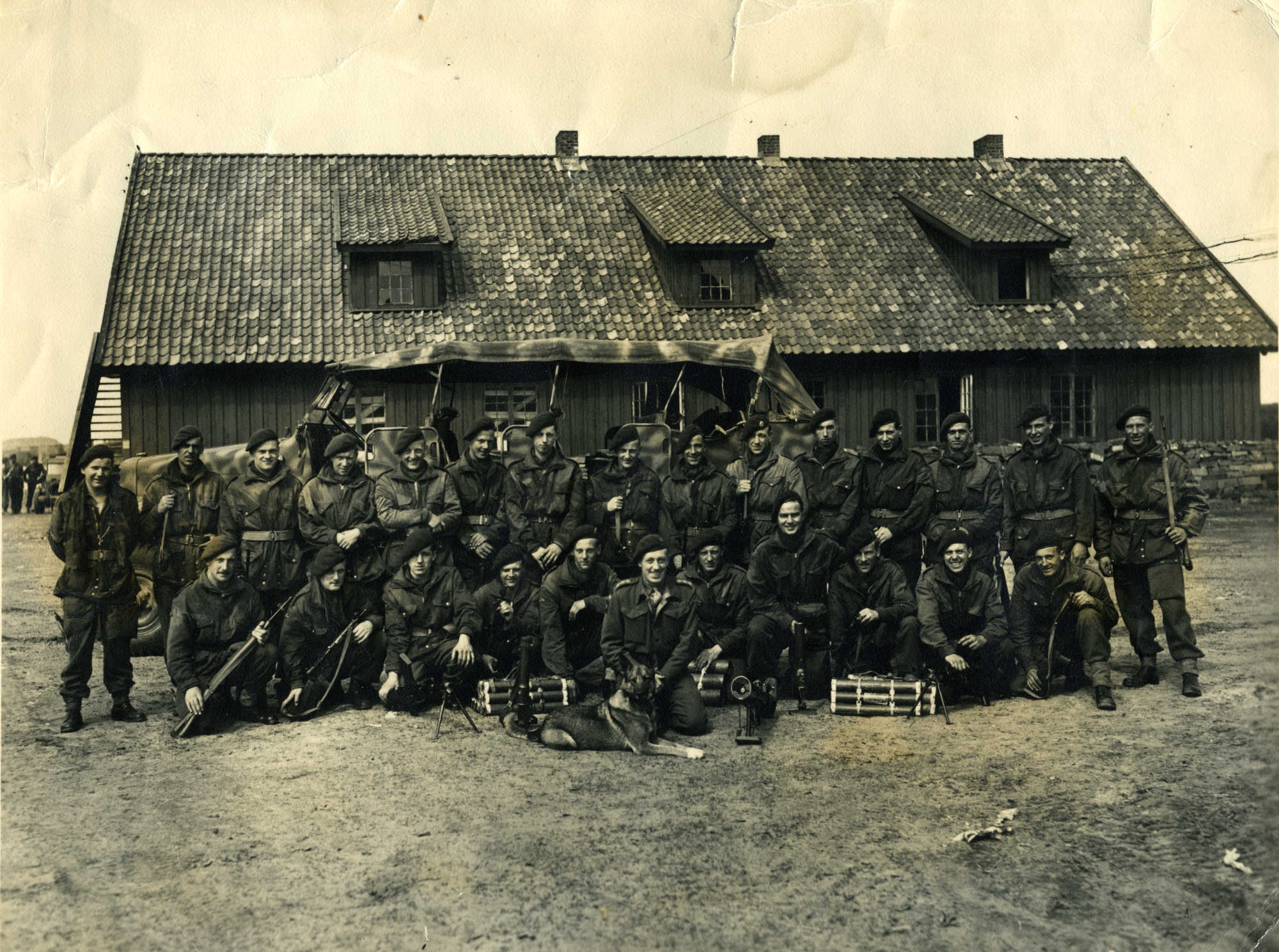
'E' Parachute Platoon, 250th (Airborne) Light Composite Company, R.A.S.C. at Gardemoen Airfield, Oslo, Norway. May. 1945. Notice the German artillery towing vehicle behind them. Cpl. 'Ken' Clarke, standing 5th from left. Courtesy of Airborne Assault Museum, Duxford.
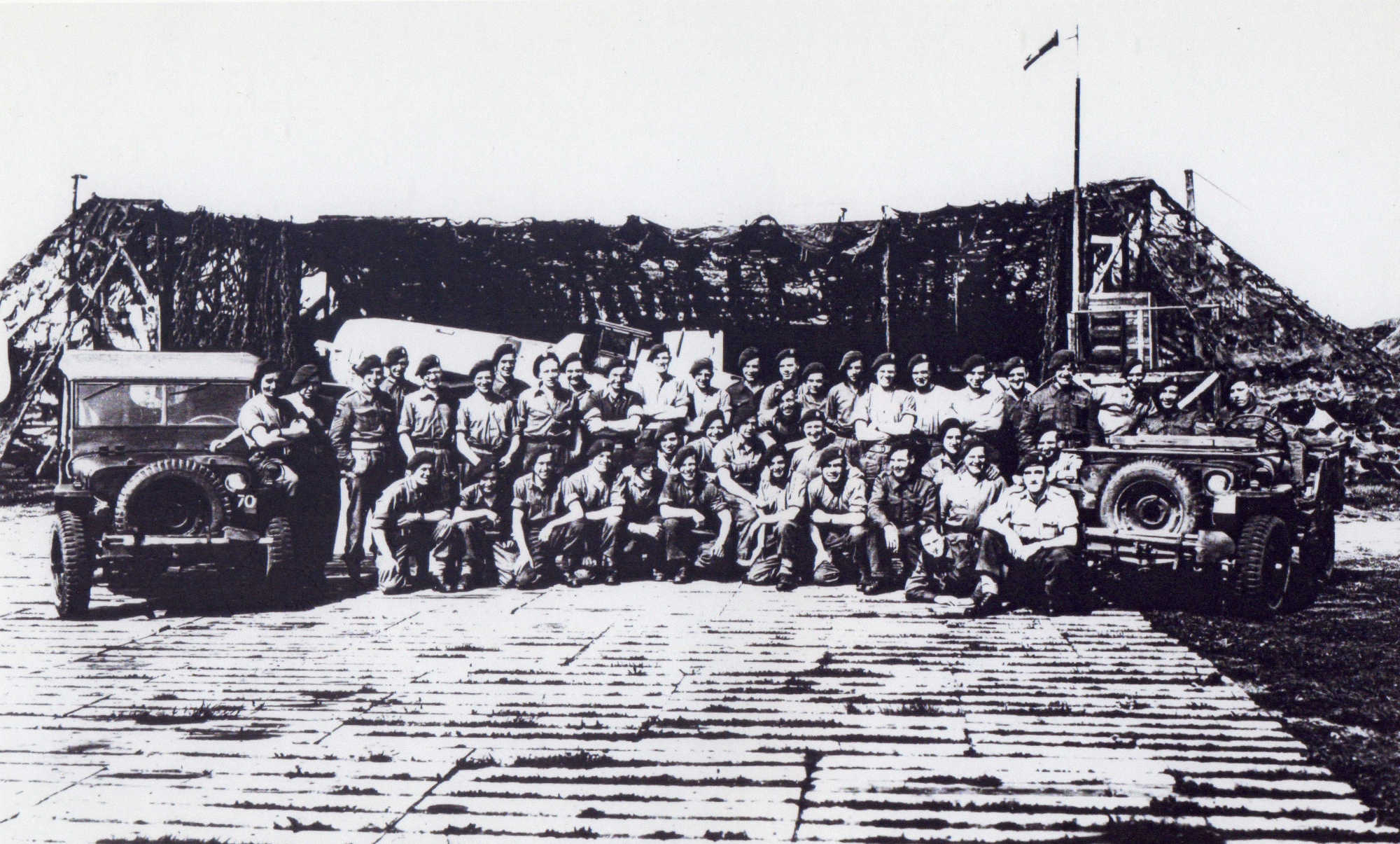
'C' Transport Platoon, 250th (Airborne) Light Composite Company, R.A.S.C. at Gardemoen Airfield, Oslo, Norway. May. 1945. Notice the camouflaged aircraft dispersal bay and aircraft behind them. Courtesy of Airborne Assault Museum, Duxford.
Throughout the rest of June the driving details continued, and detachments were deployed all over Southern Norway, at various times. Gradually, however, these commitments were reduced and by mid-July, the emphasis had shifted to a training schedule. As part of the 'exchange programme' with the 6th Airborne Division, on the 14th June Capt. Cranmer-Byng was promoted to Major and posted to H.Q., R.A.S.C. 6th Airborne Division. His place was taken by Capt. S. Sutherland-Waite. This was not the only change, Capt. R. Beetham came in to replace Capt. P.B. Alsop, and Lt. J.B. Roberts replaced Lt. E.T.H. Evans. A few days later, Capt C.R. Harkess replaced Capt J. Grice. The appointment of Capt. R. Beetham did not last long, as on the 19th June he swapped with Capt. A.K. Sears as the B.R.A.S.C.O. at 1st Airlanding Brigade H.Q.
One man who definitely enjoyed his time in Norway was Dvr. Albert Roffey from 'D' Transport Platoon. He was attached to the 'Pegasus Club' at Fevik (approx. a 4 hour drive south from Oslo), along with a Jeep, on loan from the Company, he acted as driver for Capt. Arnsby and Q.M.S.I. Cecil Peck, the senior AP.T.C. Instructors for the Division. The 'Pegasus Club' was a Rest & Recreation Centre for the 1st Airborne Division.
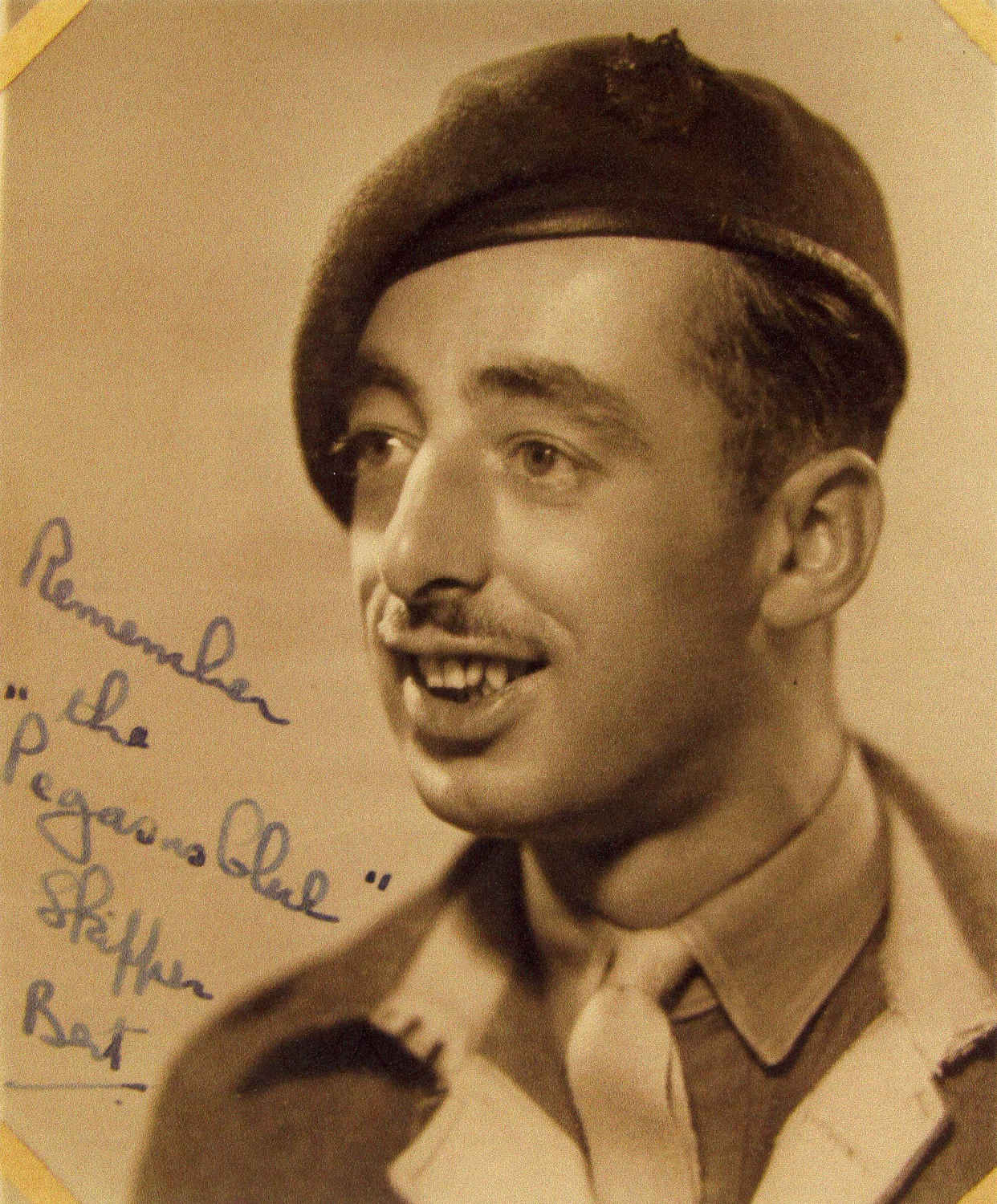
Dvr. Albert Roffey. 'D' Transport Platoon. He had remained as Home Detail during Operation 'Market'. He had served with 250 Company since 17th July 1940. Courtesy of Airborne Assault Museum, Duxford.
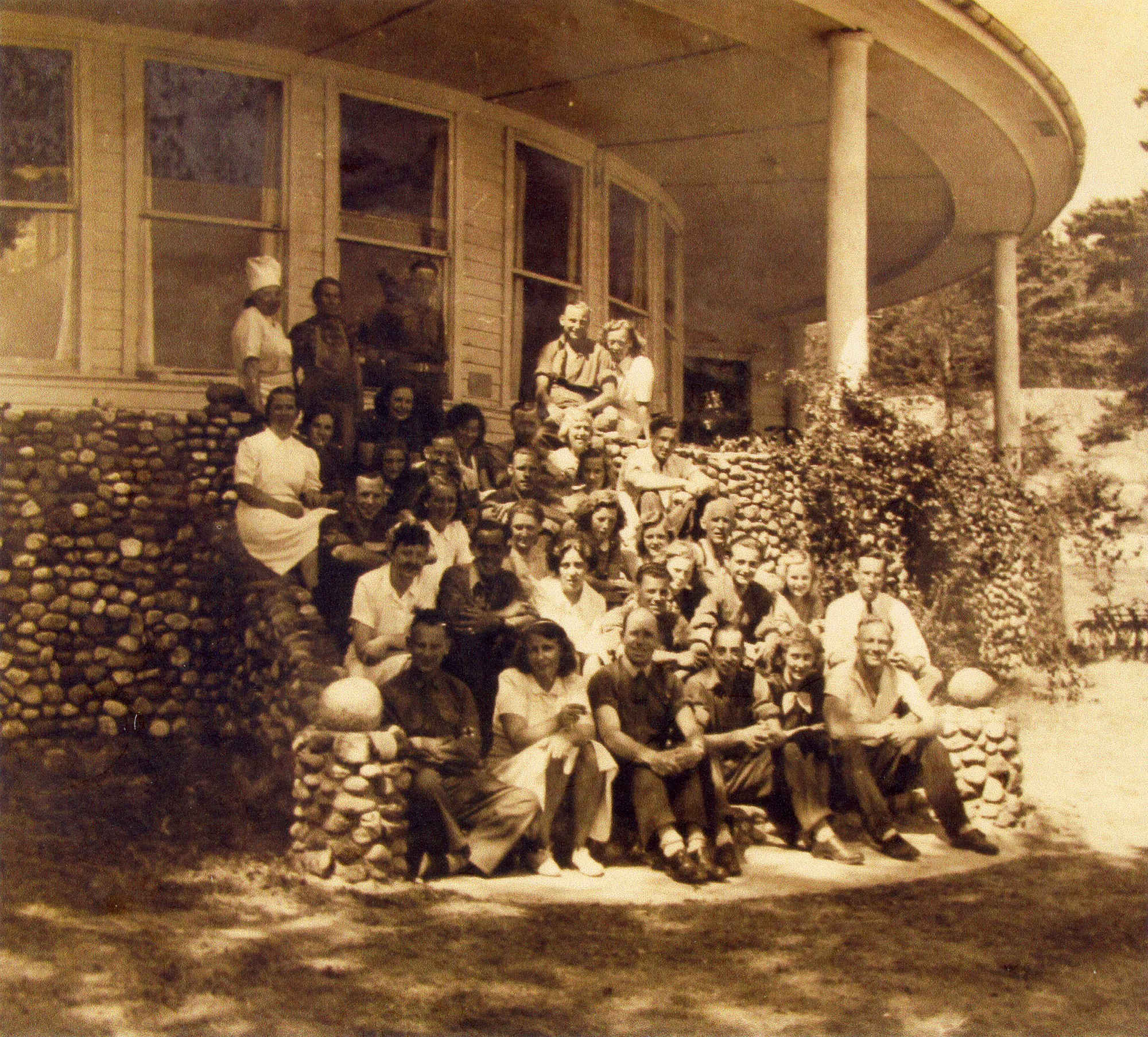
The 'Pegasus Club' & Staff, Fevik, Norway. June 1945. Dvr. A.F. Roffey is sat at the front, 4th from left, and Q.M.S.I. Cecil Peck (A.P.T.C.) is sat at the front, far right. Courtesy of Airborne Assault Museum, Duxford.
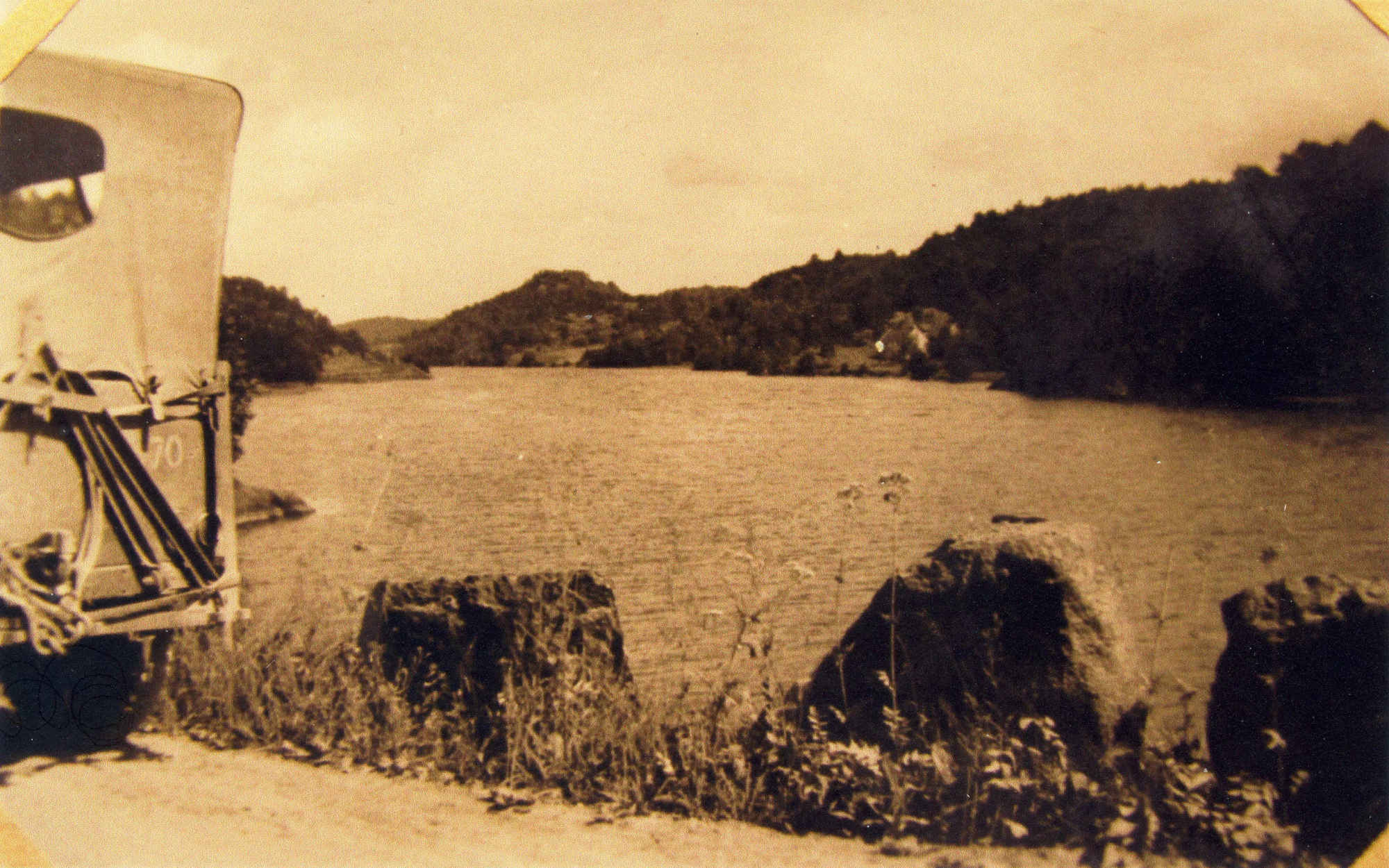
The Jeep loaned to Q.M.S.I. Peck, with his driver, Albert Roffey, somewhere on the road between Fevik and Mandal, Norway. June - July 1945. Note the unit marking '70' on the rear right of the vehicle. Courtesy of Airborne Assault Museum, Duxford.
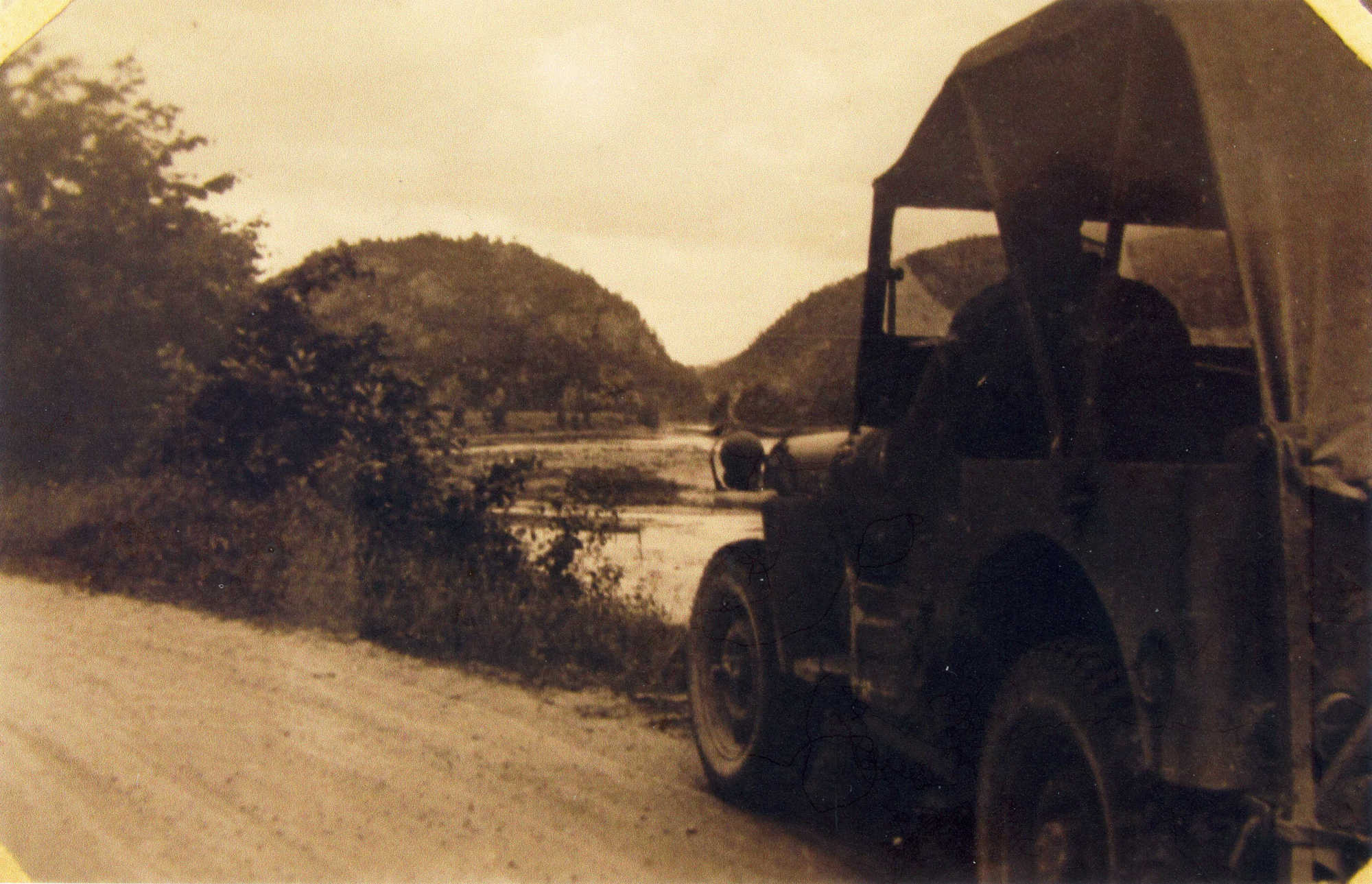
Dvr. Albert Roffey photographed at the wheel of the Jeep whilst stopped somewhere between Fevik and Mandal, Norway. June - July 1945. Courtesy of Airborne Assault Museum, Duxford.
The Detachment in Denmark, attached to the 1st Parachute Brigade, returned to their base in the U.K. between the 23rd and 30th July. As part of the staff for the Brigade was Capt. Adams: "During March and April, a certain anxiety was felt among the Allies that some of the hard-core Nazi forces might make a kind of fortress out of Denmark and, as part of the process, set up a defence line along the Kiel Canal. 1st Airborne were at one time put into preparation to fly from England and drop to prevent this. None of the men were told: they could hardly have been expected to take to the idea, just as the war was ending. I myself never learned any details - they were too secret to get down as far as a mere B.R.A.S.C.O. - but I do very well recall waiting among others on the tarmac at Barkston Heath airfield, parachutes on, all ready to emplane. As a stick commander I had been given an envelope of sealed orders 'not to be opened until airborne'. (We had been told that it was 'an airborne exercise'.) In the event these sealed orders were re-collected by Captain 'Shirley' Temple, our G.3 Ops., before take-off. Nazi Denmark, like everywhere else in Europe, had capitulated. Copenhagen, therefore, needed to be occupied forthwith. Since 1st Parachute Brigade were now all set for take-off, they were obviously the most convenient lot to send. We flew in to Kastrop airport and landed among scenes of rejoicing no less wild than those which had taken place in Brussels eight months earlier." [3]
Like the main task in Norway, the main task in Denmark was to process the Germans and then get them back to Germany as quickly as possible, Capt. Adams: "The reaction of the Danes to the departing Germans was noteworthy. The Germans had been ordered to lay down their arms, surrender their transport and then to proceed home on foot. As they marched along the streets, the Danes on the pavements stood still, fell silent, turned towards them and stared. Mile by mile, as they went on, the silence continued. The buses and taxis switched off their engines, the cyclists dismounted and stood waiting while they passed. This the Germans found demoralizing. Here and there a group might try to sing, but it soon petered out and all that could be heard was the clump of boots - those boots which had stamped all over the faces of Europe. I hope they wore out well before the German frontier." [4]
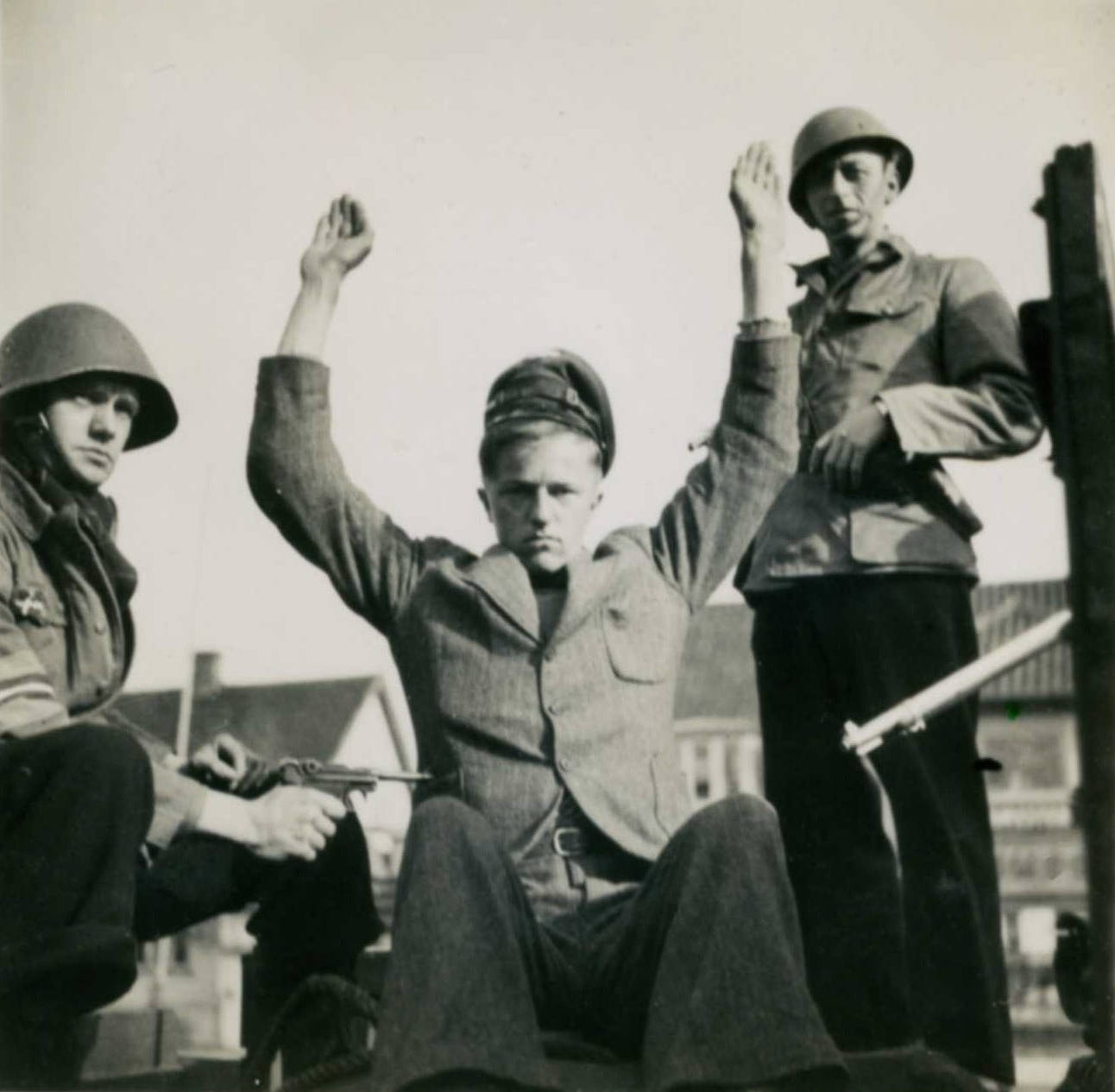
PHOTO #12-11. A 'collaborator' is held at gun-point by loyal Danish Patriots in Copenhagen. May 1945. Photo taken by L/Cpl. Geoffrey Gelsthorpe, now serving with 'A' Parachute Platoon. Courtesy of Philip Pringle
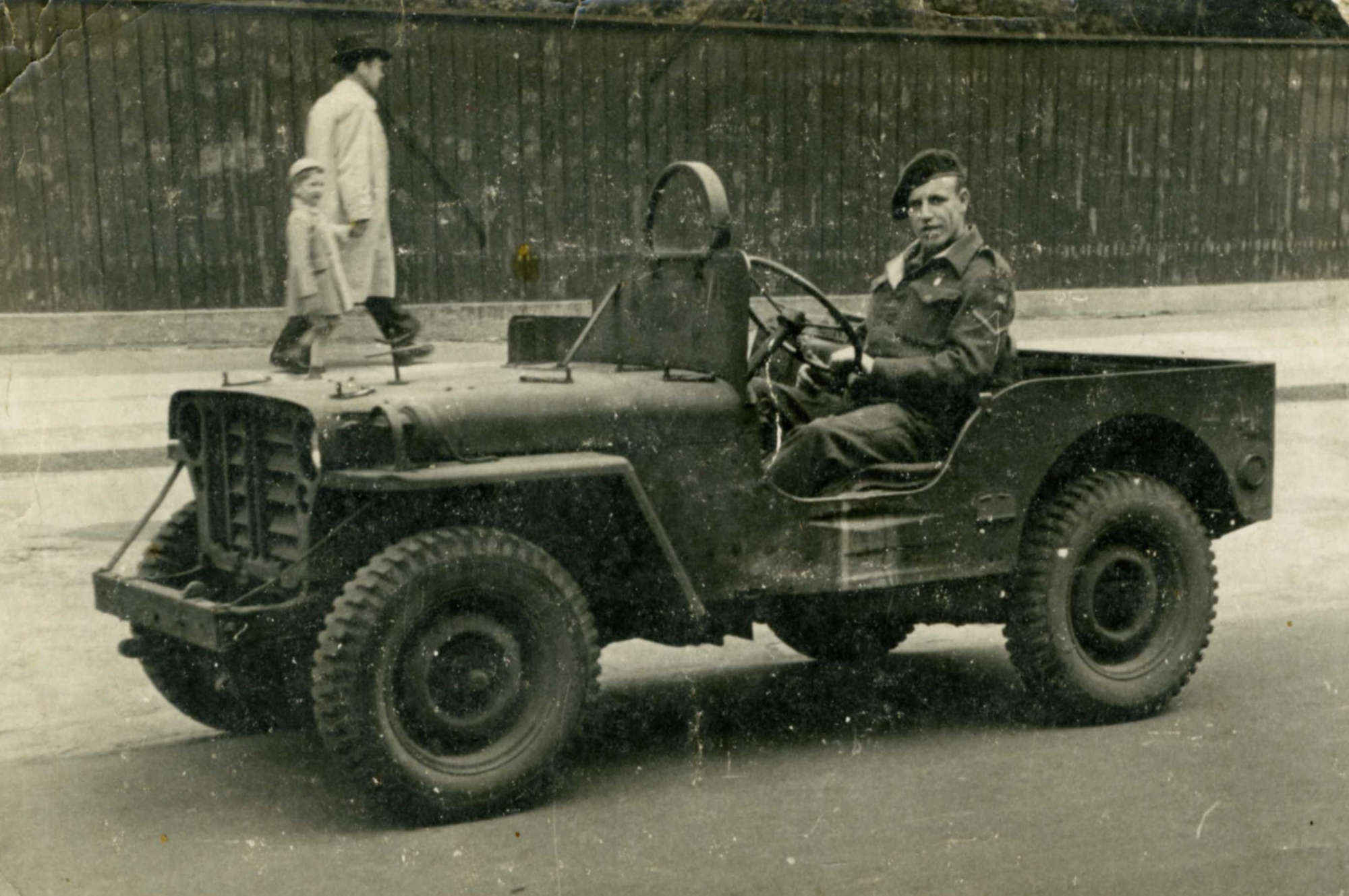
L/Cpl. Geoffrey Gelsthorpe seated in an S.A.S. pattern Jeep. Copenhagen. May - June 1945. Courtesy of Philip Pringle.
250 Company sailed back to the U.K. between the 3rd and 6th September, docking at Liverpool. It is probable that only the Officers of the Company, at this stage, knew about the disbandment of the 1st Airborne Division - the official date of which was the 31st August 1945 - as it had been decided that only the 6th Airborne Division was going to be retained. Some units from the 1st Airborne Division would 'cross-deck' to the 6th Airborne, and it would be a frustrating wait before the Company would find out whether it would one of them.
The Company disembarked at 04.15 hrs, 7th September, loaded their baggage onto a train, boarded it themselves and then set off for Grimdicth Camp, Coombe Bissett, near Salisbury. A few weeks after having settled in, on the 24th September, twenty O.R's were sent over to Arnhem to attend the first anniversary of the battle. This was followed just over two weeks later by Maj. Gifford and Capt. Gell flying to Arnhem, from R.A.F. Tarrant Rushton, no doubt for Capt. Gell to participate in the filming of 'Theirs Is The Glory'. The final connection the existing unit would have with Arnhem was on the 8th December, when four Jeeps with drivers returned to the unit from the 'Arnhem Film Unit'.
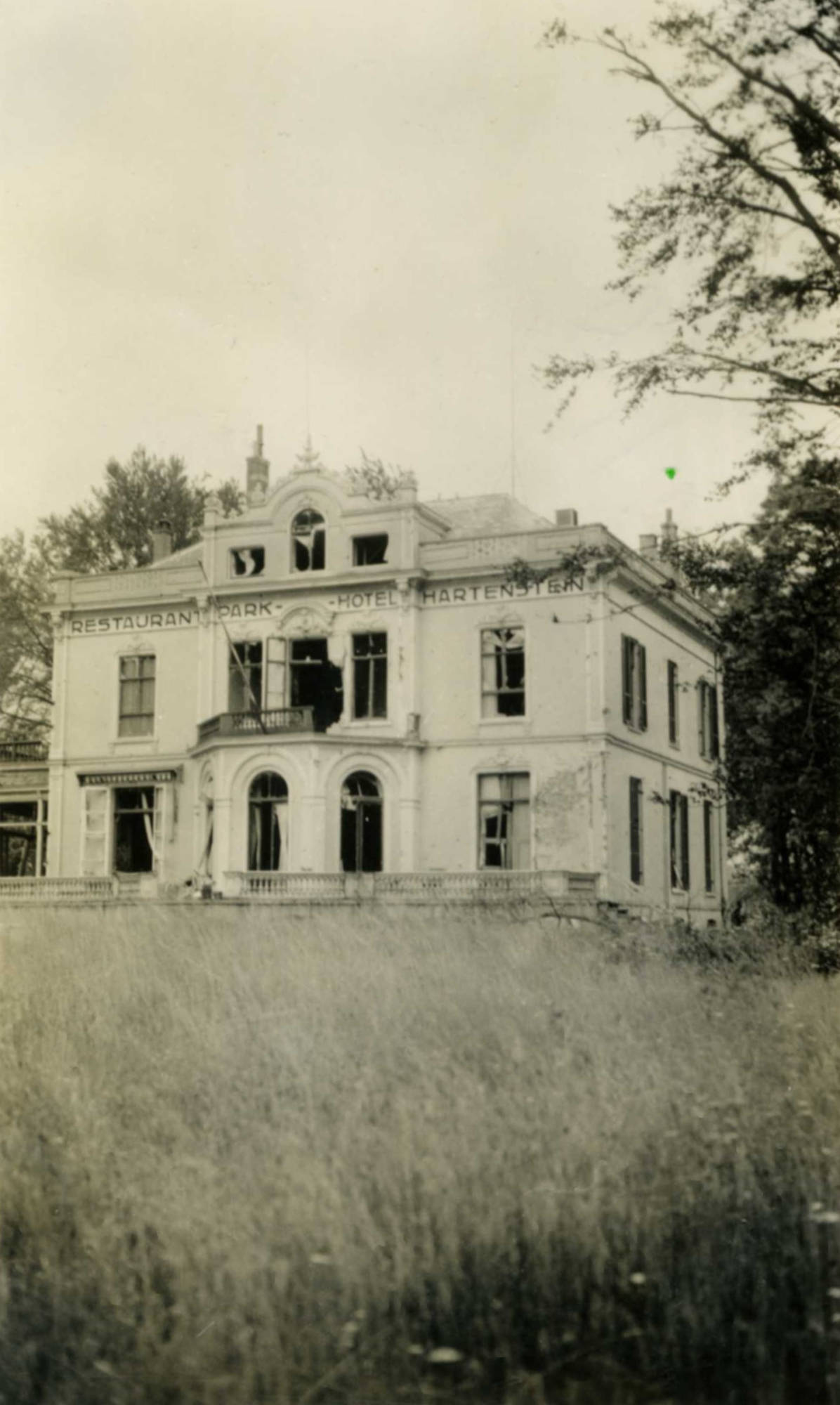 .
The Hartenstein Hotel in September 1945. Dug-in nearby were elements of 'F' Workshops and 'G' Transport Platoon's during most of the battle. This photo was in the collection of Dvr. G. Gelshtorpe. Courtesy of Airborne Assault Museum, Duxford.
The news that all had been waiting for fell in mid-October, the Company would not be going to the 6th Airborne Division, and worst of all - for some - would not be retained as an Airborne unit. A farewell parade was to be organised for the 25th October, with a visit by the G.O.C: Maj-Gen. Urquhart, but on the day it had to be cancelled, as the weather was so bad, although he did give a Farewell speech. The next day there was a Farewell service in Salisbury Cathedral, which two Officers and eighty O.R's of the Company attended.
In November the Company moved to Brockley Camp, near Frome, Bristol, and in the process, began handing over their Jeeps and Airborne trailers for heavy vehicles - they would now come under Command of South West District. It was during this period (10th November 1945) that Dvr. Edward Mundy was unfortunately killed, whilst on convoy duty.
Although the unit 'soldiered' on for a few more months, it was finally disbanded in late February 1946 - one of the last to be posted out was Capt. Bushby on the 20th February 1946.
The final word is appropriately left to the man most responsible for the Company's achievements:
SPECIAL ORDER OF THE DAY
BY
LT. COL. M. ST. J. PACKE, R.A.S.C.
COMMANDER R.A.S.C.
1 AIRBORNE DIVISION.
On leaving the Division, I wish to congratulate and thank all members of the R.A.S.C. for what they have done.
This is the end of a long journey which we have taken together, and the road has lain through many lands, and many different conditions and fortunes. But in all circumstances, we have kept to our course most steadfastly, and now we have come at last to our destination. You all have a right to feel that you have done your share in the fight for human freedom.
In this time, I have had to call for many big efforts, and my confidence in your response has always been fully justified. Whether you were among those who went by air to battle, or whether you flew through a hail of metal in order to deliver the goods, or whether your job took you driving through the night on journeys which seemed endless and without reward, you have all faced your tasks with the same spirit of unity and determination, so that now I can only say "well done".
I believe that difficult days may lie ahead of everyone, because wars as great as tis has been can only be won at the cost of a crippling effort. But if you will face the future as you have faced the past, there is no cause to doubt that the challenge will be met and overcome.
My best wishes go with you in your new work, and after that when you come to start again in civilian life. And I hope that in years to come you will remember with pride, as I shall do, the days when we kept the wheels turning in the First Airborne Division.
M. St. J. Packe.
9 Nov 1945.
NOTES:
[1], [2], [3] & [4] 'The Day Gone By'. Richard Adams.


