Chapter 13
Addendum.
During the years since I completed the main manuscript for this book I have received a lot more information and photo's. To try and fit it into the existing text would mean a major re-write, so I have decided on this 'Extra Chapter', with references as where it would fit with the main story of the 250th (Airborne) Light Composite Company, R.A.S.C.
Chapter 6. Sunday, 17th September 1944.
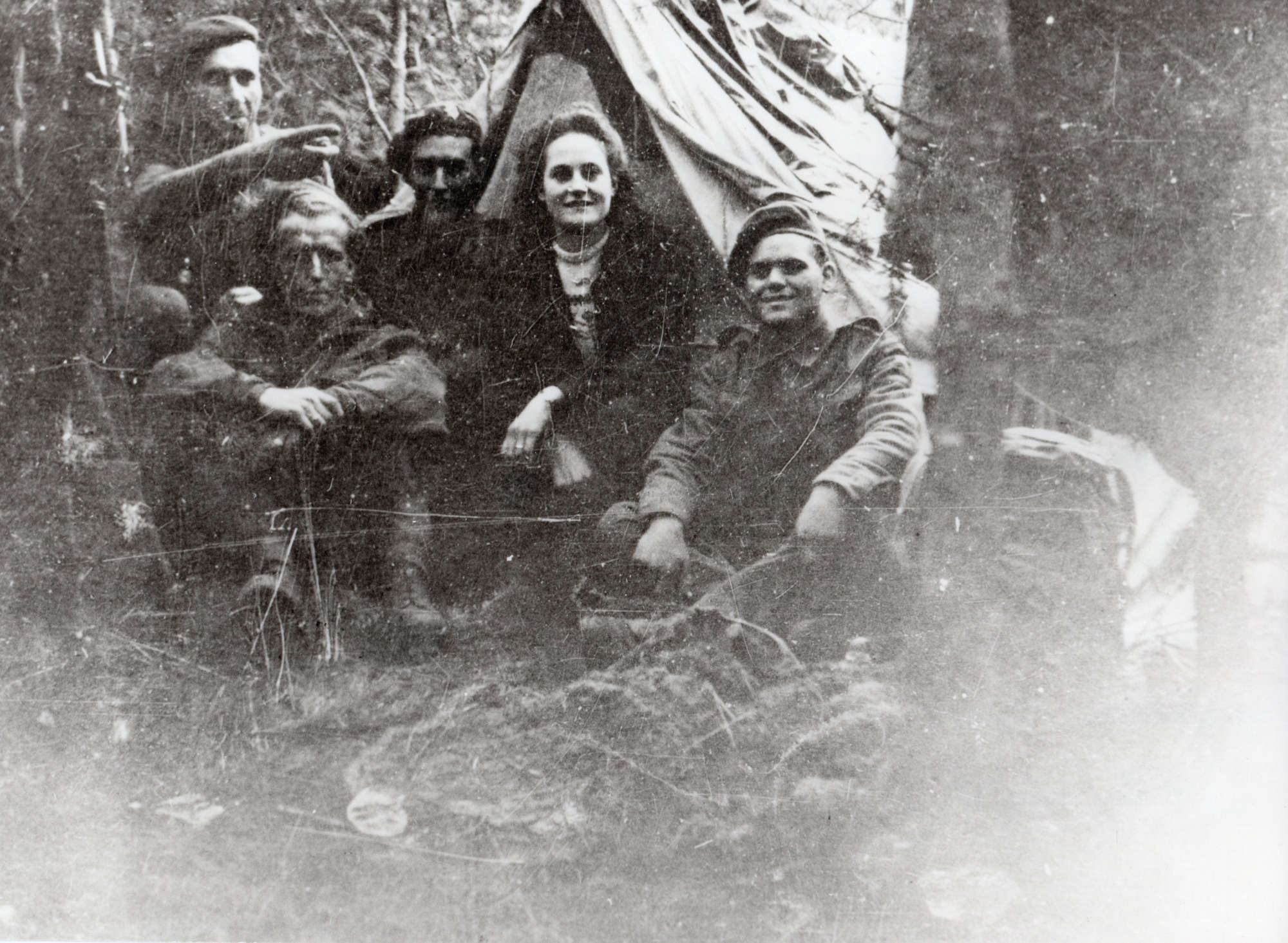
Horsa glider, C/N: 478, came down short near the villages of Udenhout/Biezenmortel, seven kilometres north east of the town of Tilburg. Amongst those on board were L/Cpl. Kenneth Barnard and Dvr. Horace William 'Bill' Eggleton.
A small group of evaders pose in front of a small tent in the camp at Huisvennen. L-R: Sgt. Klaas Luitweiler (Dutch Commando) (pointing his finger), Sgt. James Whitehead (GPR), L/Cpl. K.H. Barnard (RASC), Miss Zus van Zeeland (Dutch Underground) and Dvr. H.W. Eggleton (RASC). Courtesy of the Dekker family.
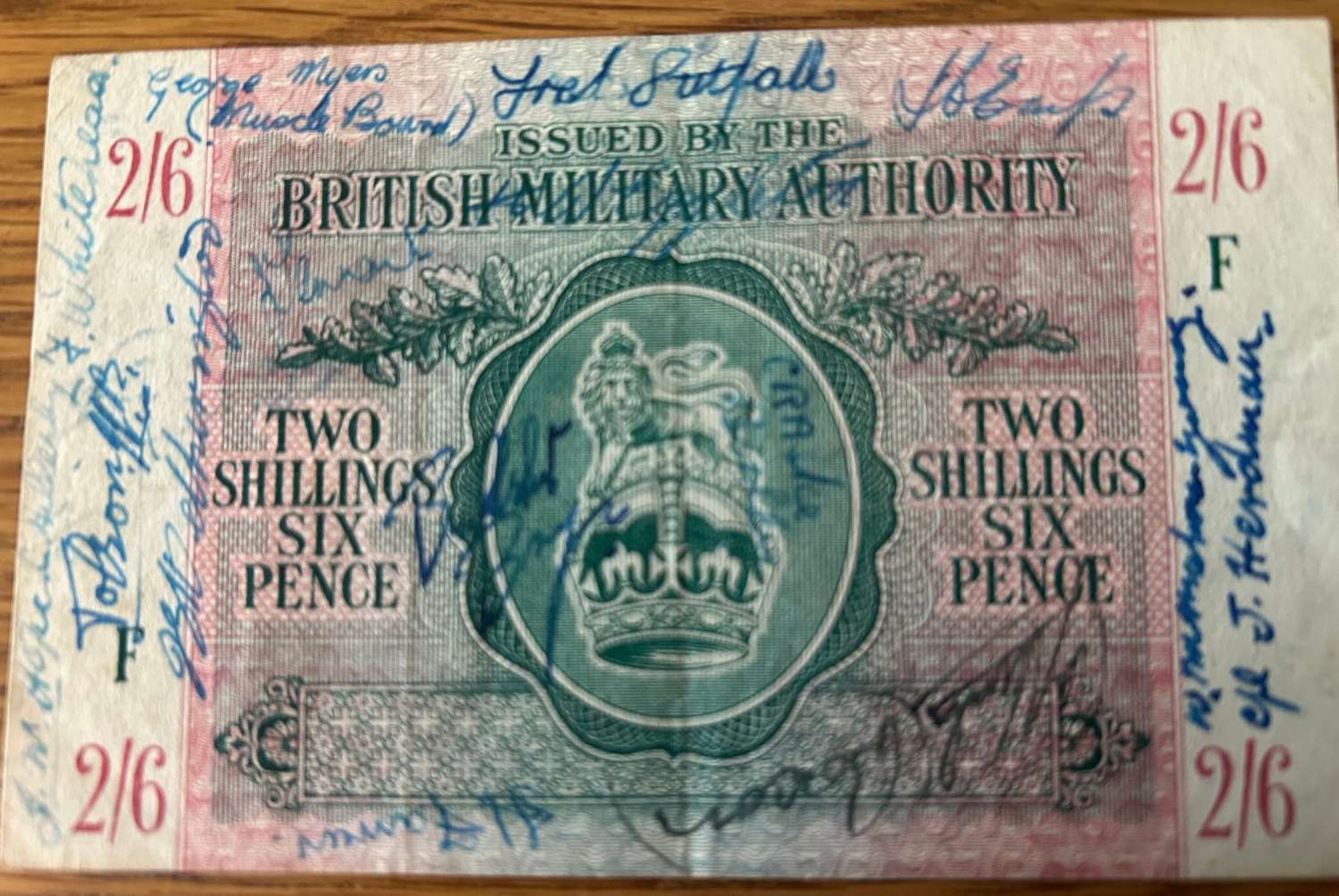
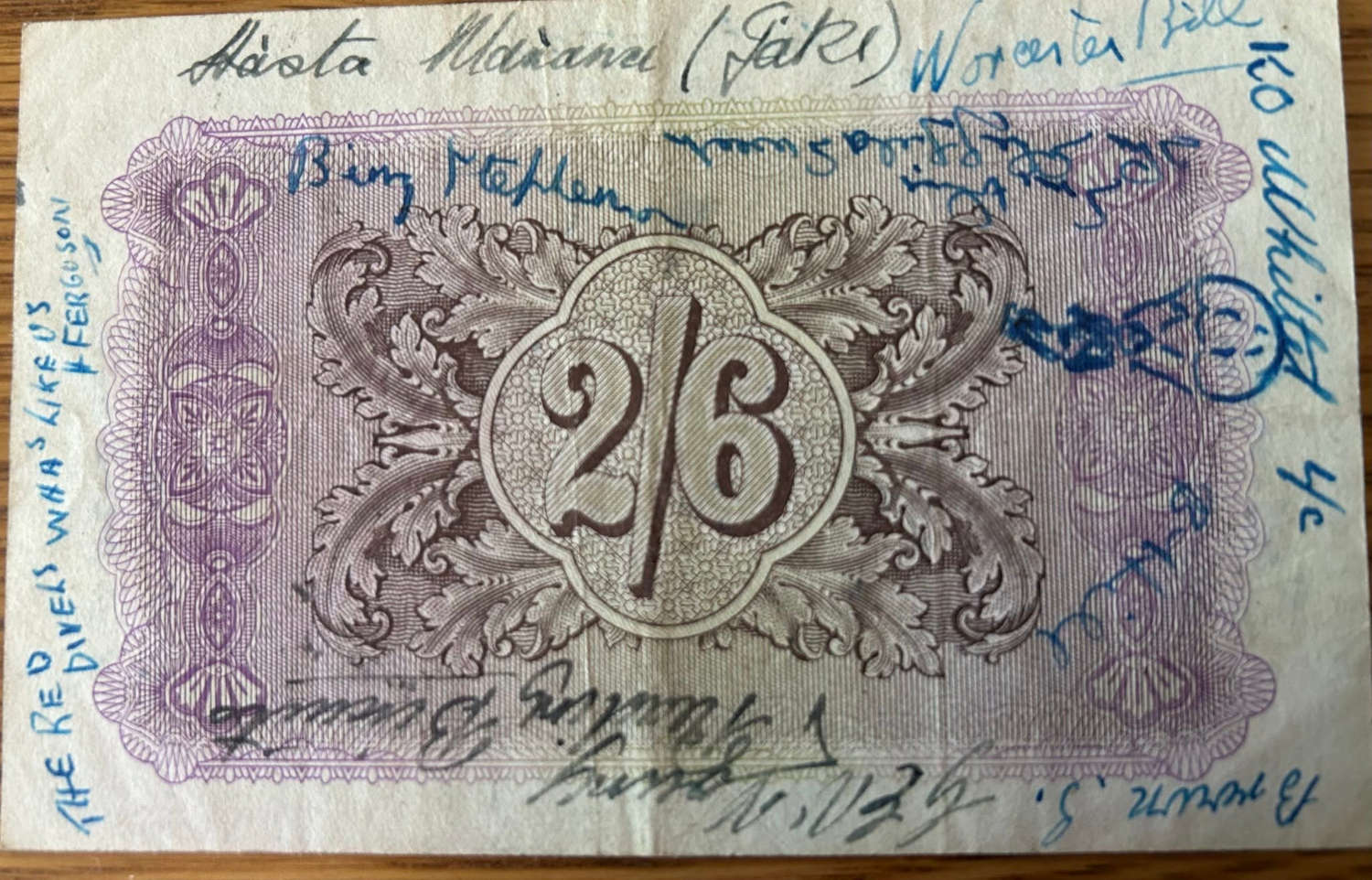
Dvr. 'Bill' Eggleton had kept some bank notes that he had signed by various members of his unit, most of which have been identified as follows:
|
Bank Note 1a) F. Whitehead. George Myers. Fred Stitfall W. McMahon Young. Cpl. J. Herdman. G.E. Farmer. Craske. |
Details. Dvr. 'C' Transport Platoon. A.P.T.C. Sgt. HQ-Platoon. Dvr. 'C' Transport Platoon. Dvr. 'G' Transport Platoon. Sect Comd. 'C' Transport Platoon. Dvr. 'G' Transport Platoon, attached 'C' Transport Platoon. Dvr. 'G' Transport Platoon. |
|
Bank Note 1b) Bing Stephenson. H. Ferguson. K.O. Whittet. B. Hill. Brown. S. G.E.V. Young. |
Details. 2 x possibilities. Dvr. 3 Parachute Platoon. L/C. Cpl. 'D' Transport Platoon, attached 2 Parachute Platoon. Dvr. 1 Parachute Platoon. Dvr. 1 Parachute Platoon. Dvr. HQ-Platoon. |
Chapter 7. Monday, 18th September 1944.
There was a seven man patrol that commandeered a local bus to move supplies which was ambushed by the Germans, and L/Cpl. Lenoard Plant was killed.
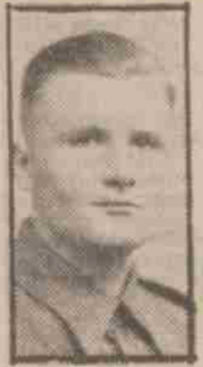
Lance Corporal Leonard Plant. This is one of 18 photo's that appeared in the Birmingham Evening Despatch, Tuesday, 17 October 1944.
'These Midland men have been reported missing in recent operations, and their relatives would welcome any news of them.'
Amongst those of 'D' Transport Platoon, attached to No 1 Parachute Platoon as their Jeep Section, landing in Horsa gliders, C/N's: 919 to 923, on this day was Dvr. David Buckley. David Buckley was born on the 1st January 1922 and came from Thornton Heath Surrey. Before he joined the Army he worked as a slater & tiler. He enlisted into the Royal Army Service Corps on the 18th September 1941, and was posted to the 250th Divisional Airborne Light Composite Company, R.A.S.C. on the 9th July 1942, where he was assigned as a Driver to 'D' Transport Platoon. His glider was hit by machine gun fire upon landing and he was hit in the right arm. He was able to make his way to an Aid Station, where later he was taken prisoner, on the 24th September 1944. He was initially sent to the temporary 'Airborne' hospital, in the King Wilhelm Barracks, at Apeldoorn, but then left there on the 26th September 1944, with a party of walking wounded. He was sent to Stalag 11B, at Falingbostel in Germany, arriving there on the 28th September 1944, and given the POW No. 117834. Stalag 11B was liberated, by advancing British Army Forces, on the 16th April 1945.
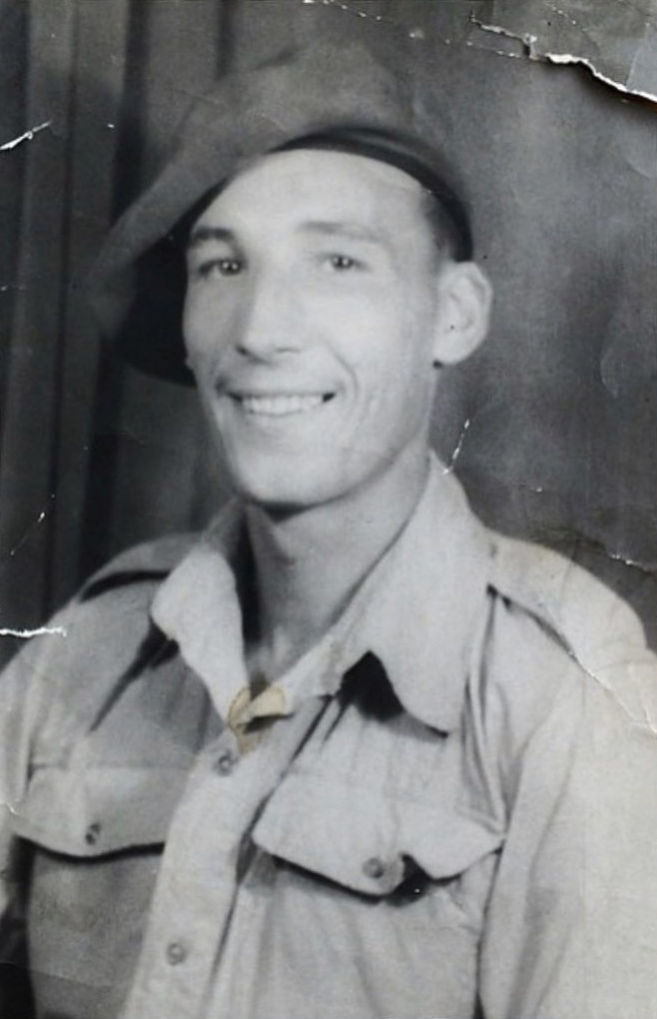
Dvr. David Buckley in North Africa 1943. Courtesy of the Airborne Assault Museum, Duxford.
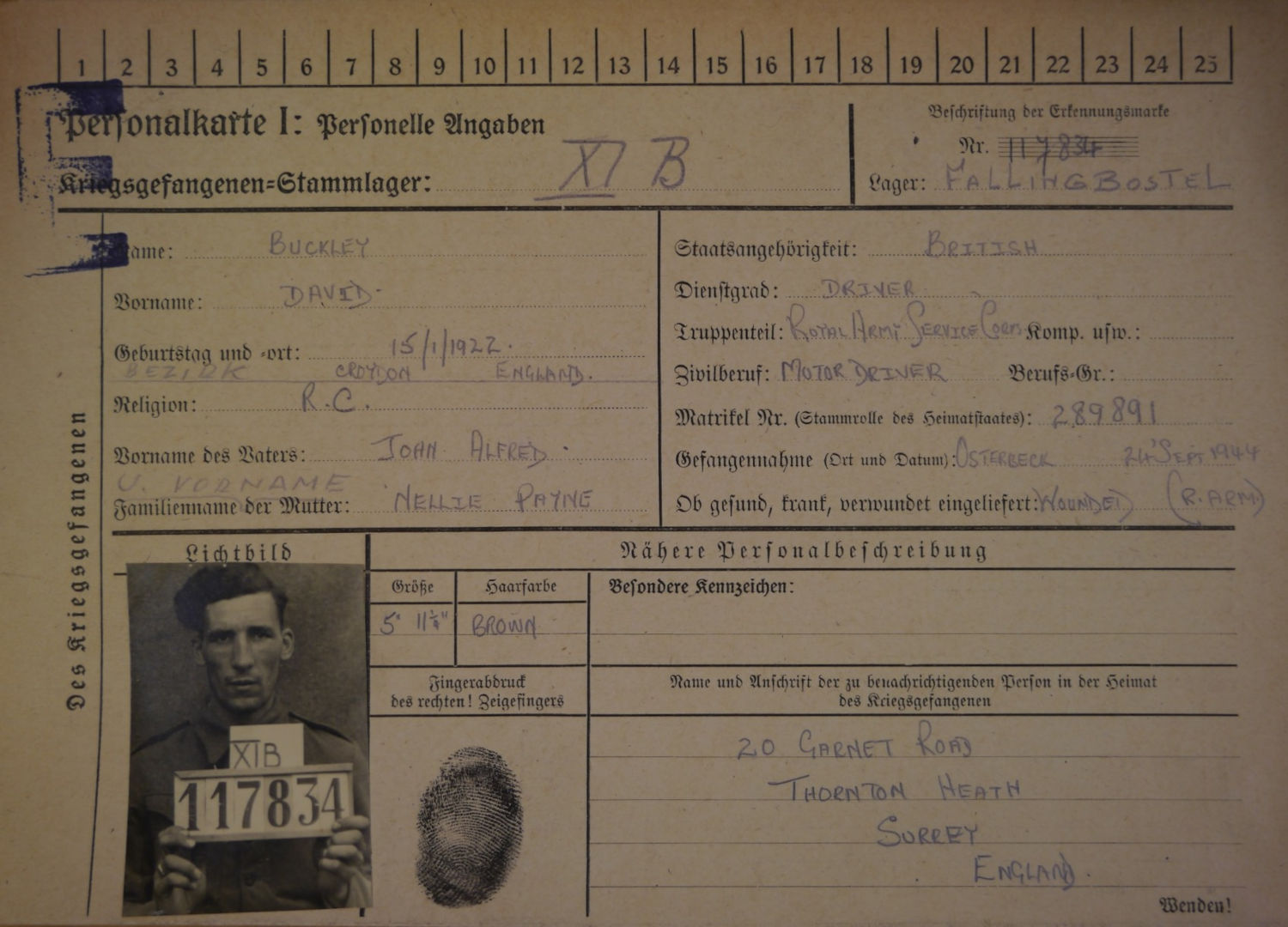
The POW card of Dvr. David Buckley at Stalag 11B, Falingbostel in Germany. September 1944. Courtesy of John Howes.
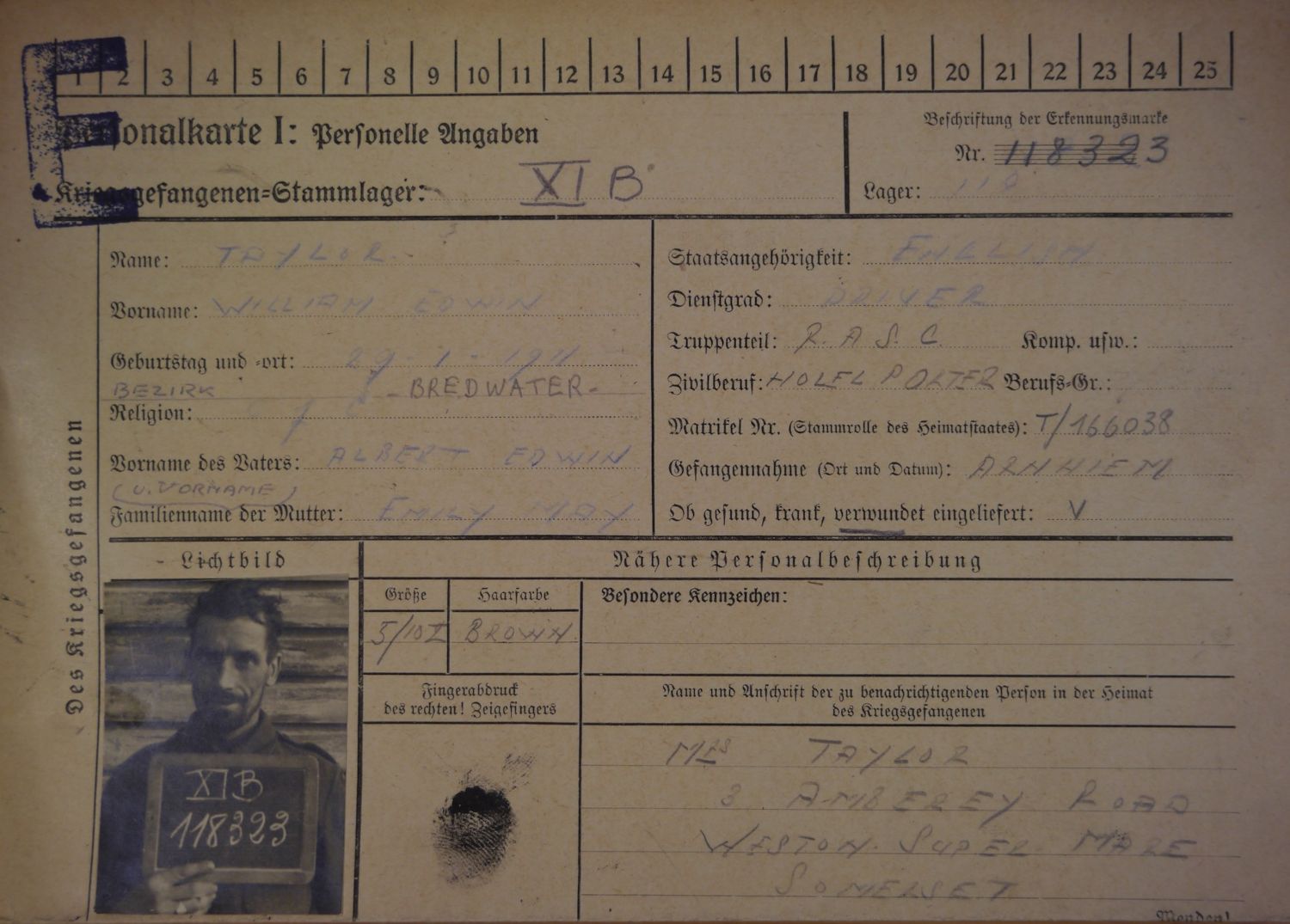
The POW card of Dvr. William Edwin Taylor at Stalag 11B, Falingbostel in Germany. September 1944. Courtesy of John Howes.
Dvr. William Edwin Taylor was born on the 29th January 1911, and worked as a hotel porter be he enlisted, which was on the 1st March 1940. He was posted to the newly formed 250th Transport Company, R.A.S.C. on the 16th July 1940, thus becoming one of its very first members. He went on to do shortened Parachute Course 19 at R.A.F. Ringway, 20th - 27th July 1942. As of August 1944 he was a member of 'G' Transport Platoon based at Harwell Transit Camp. For Operation 'Market-Garden' he was attached to 'D' Transport Platoon. He to Arnhem on the 2nd Lift, Monday, 18th September 1944, in Horsa glider C/N: 927. This glider was hit by flak and Dvr. Taylor received shrapnel wounds to his right leg. The glider came down short of the L.Z. near Wageningen. Others on his glider were Cpl. West (POW) and Dvr. Geere (DOW: 20/09/44).
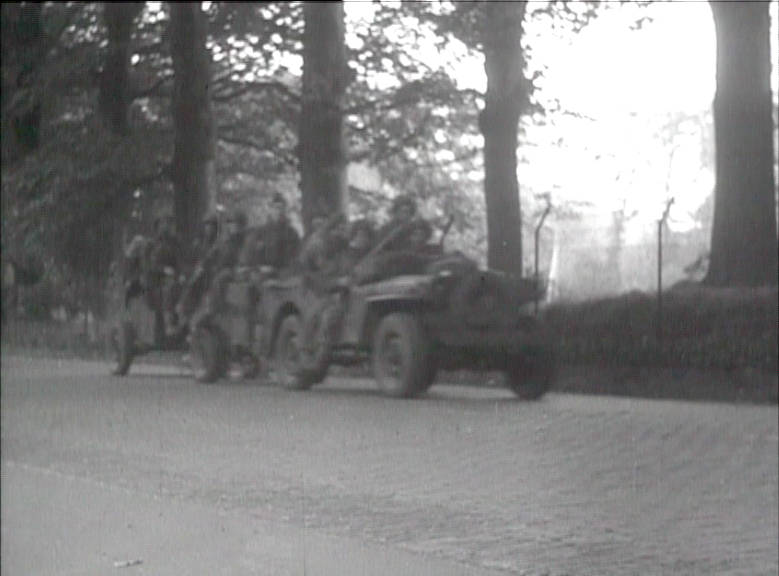
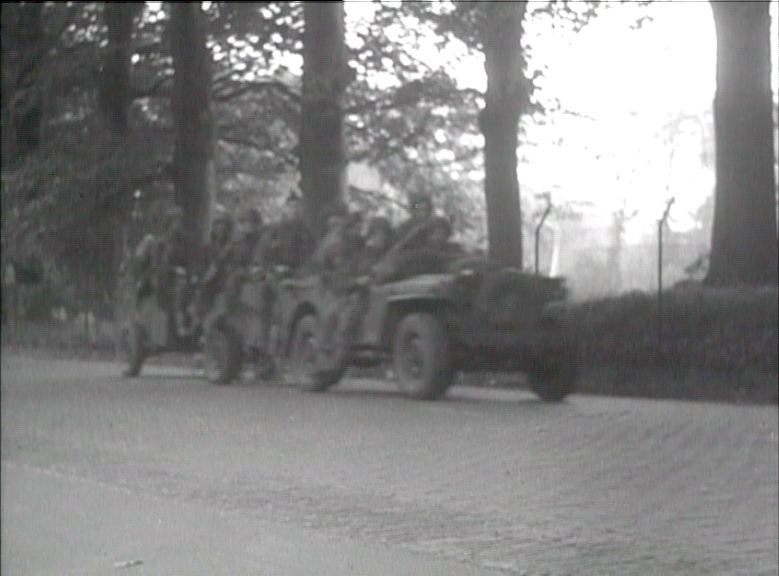
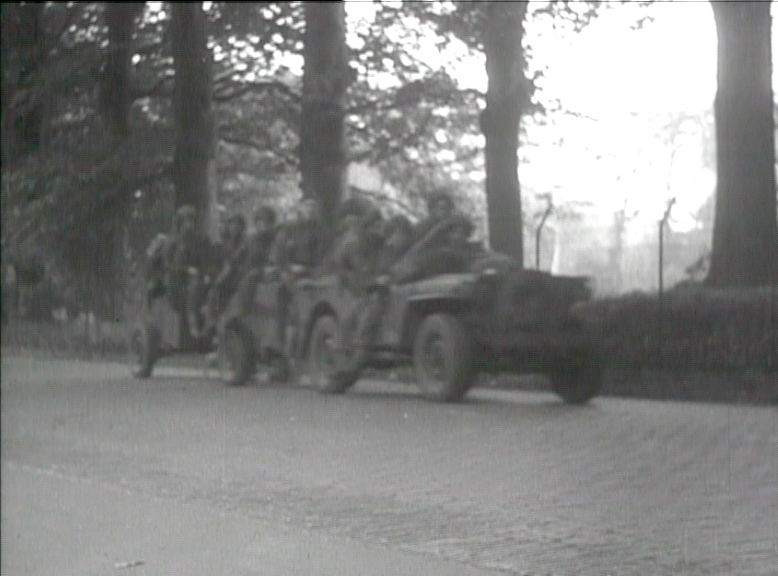
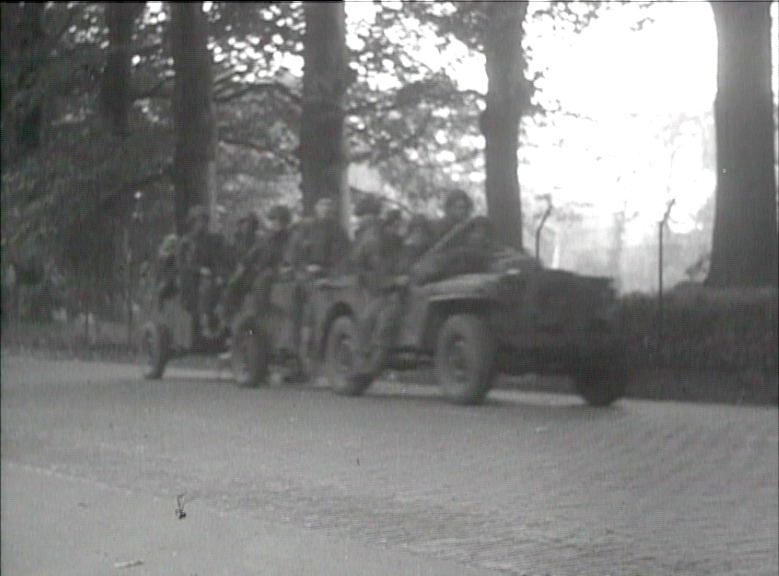
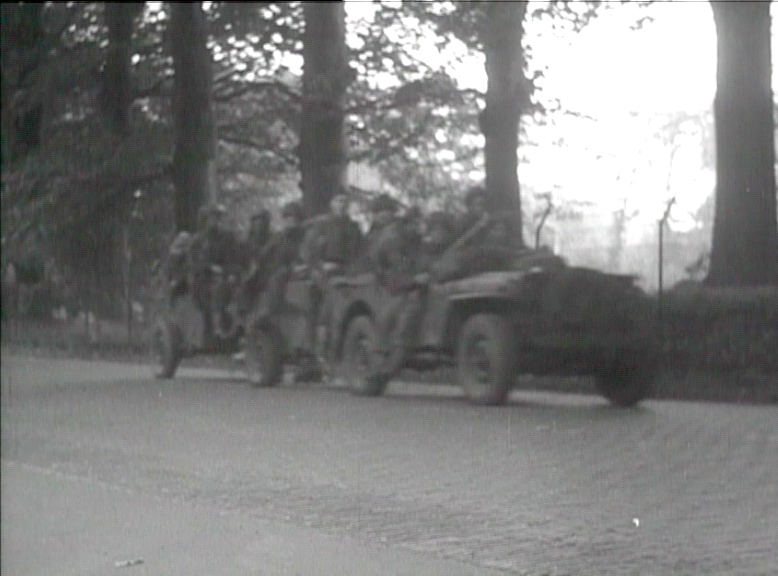
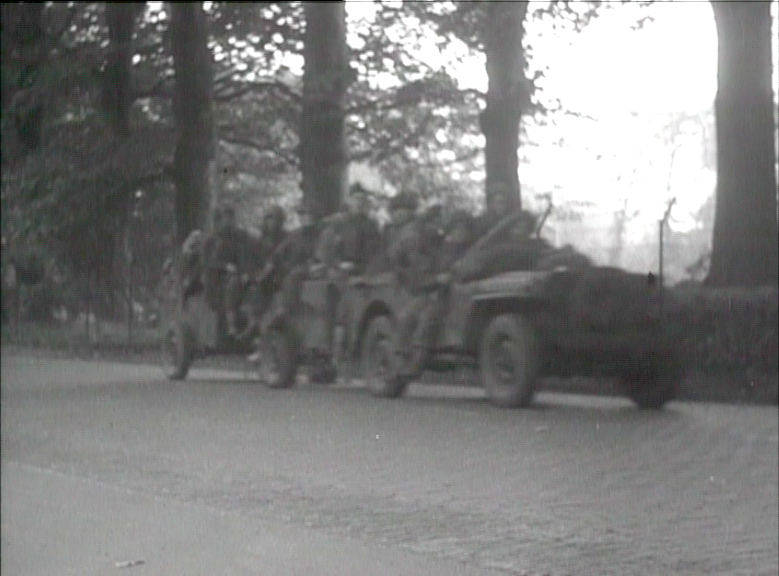
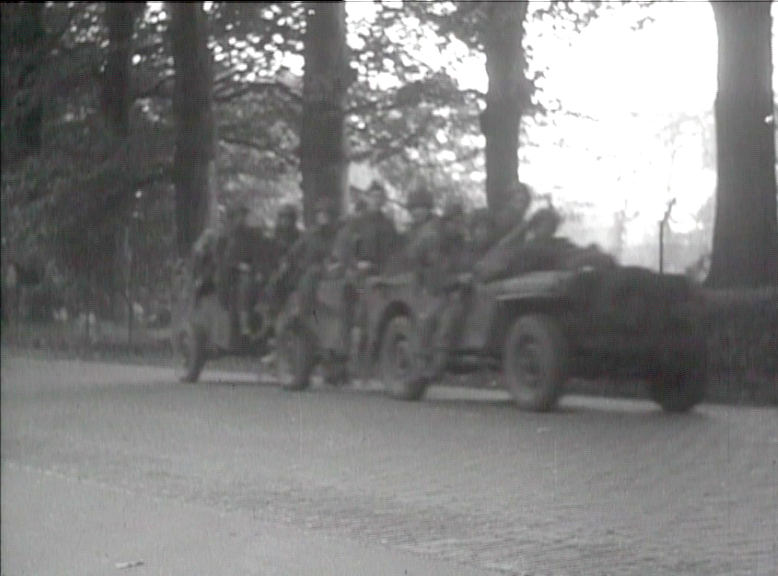
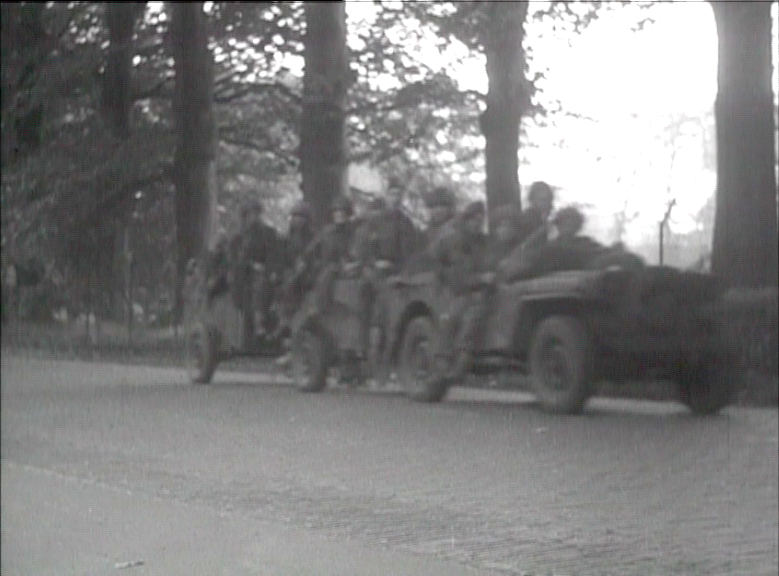
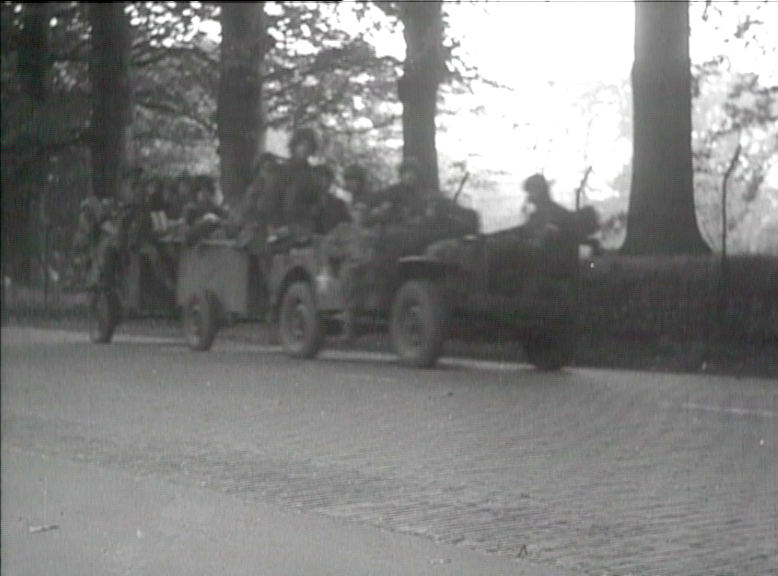
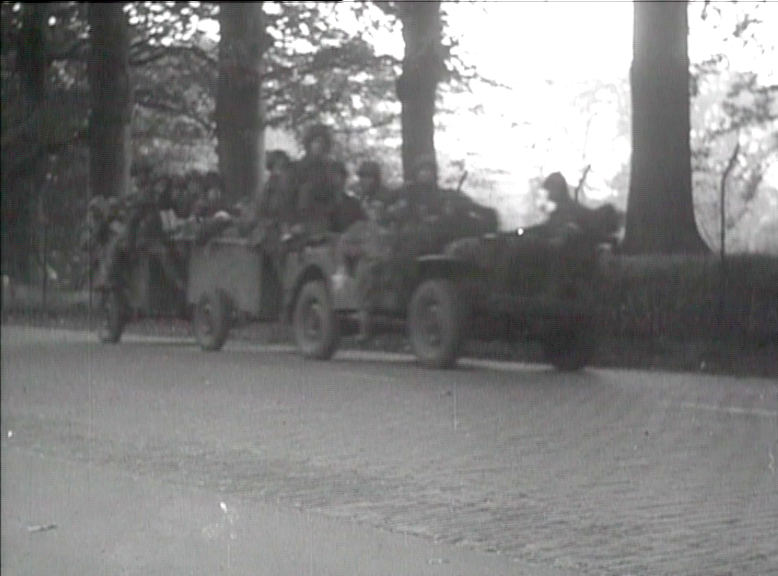
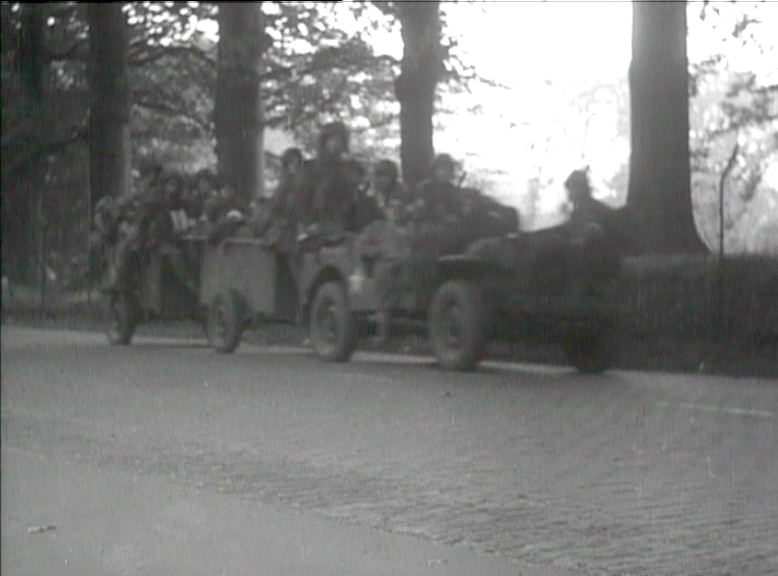
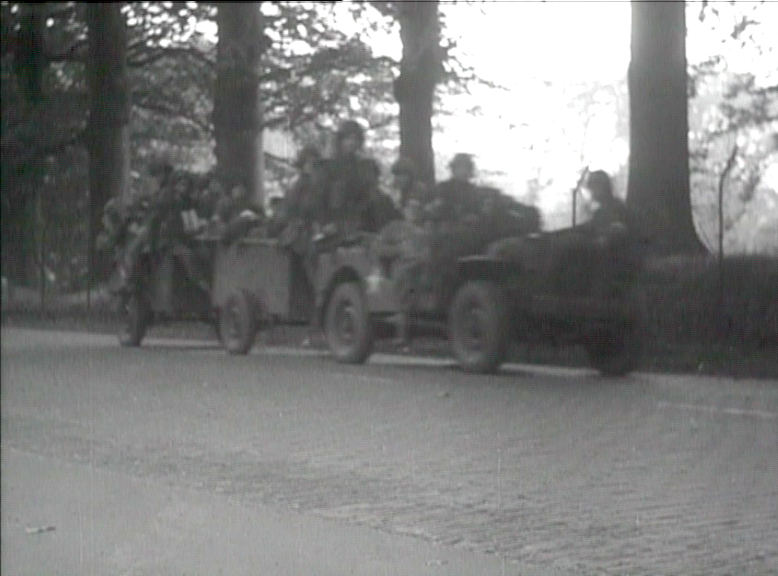
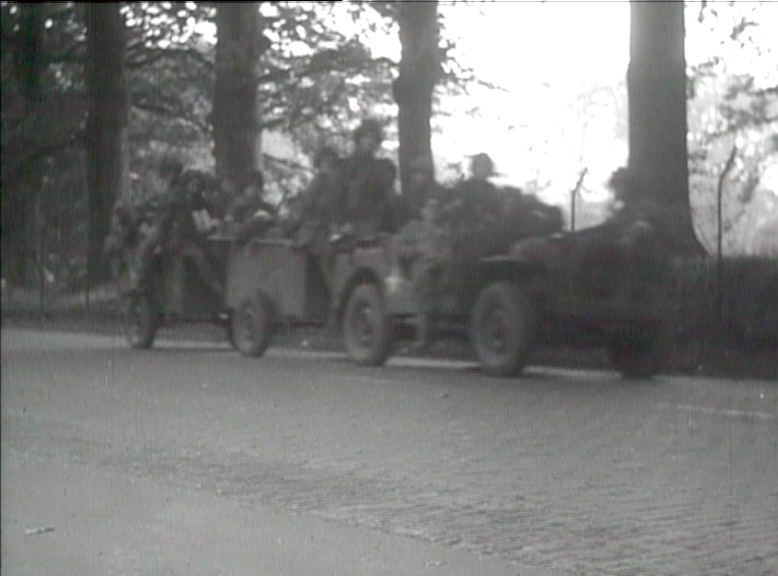
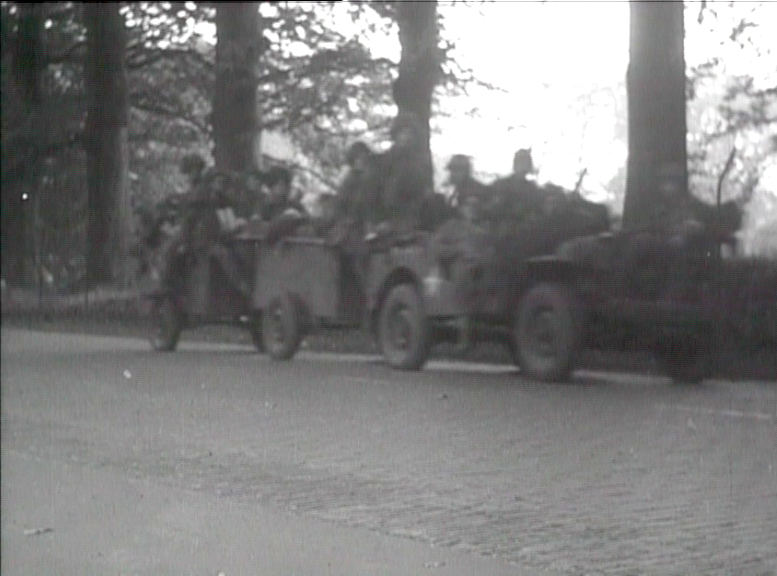
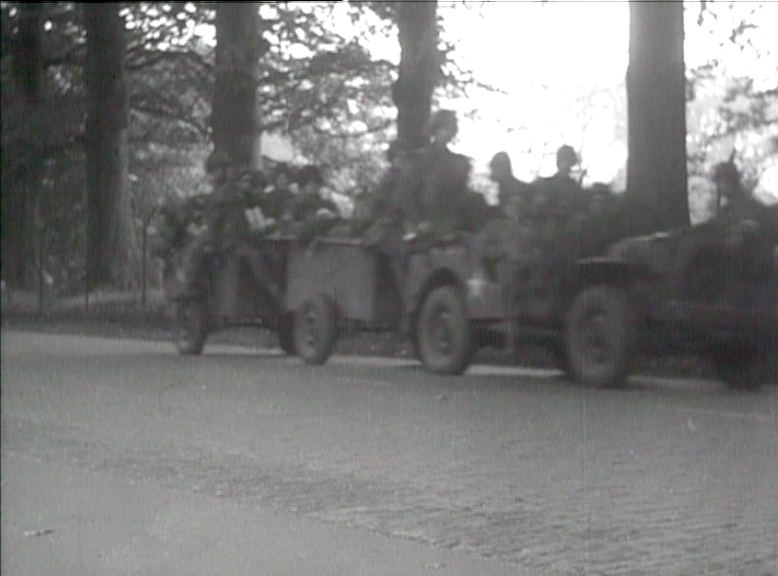
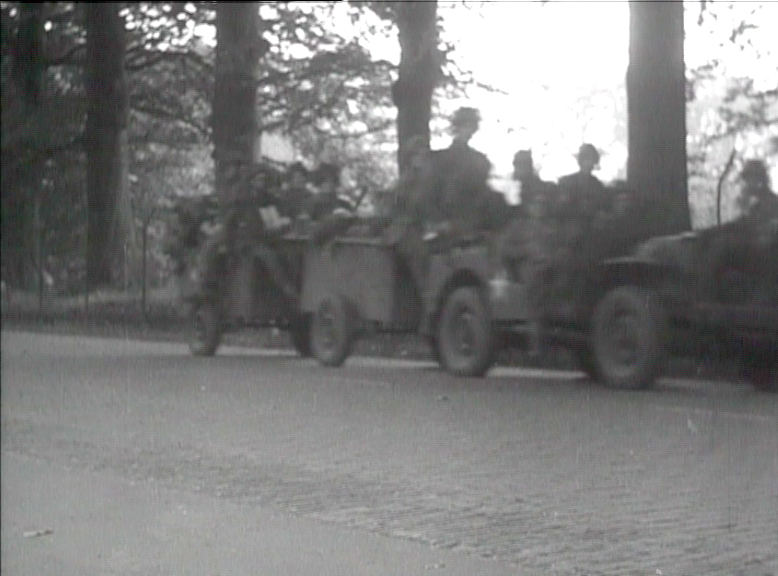
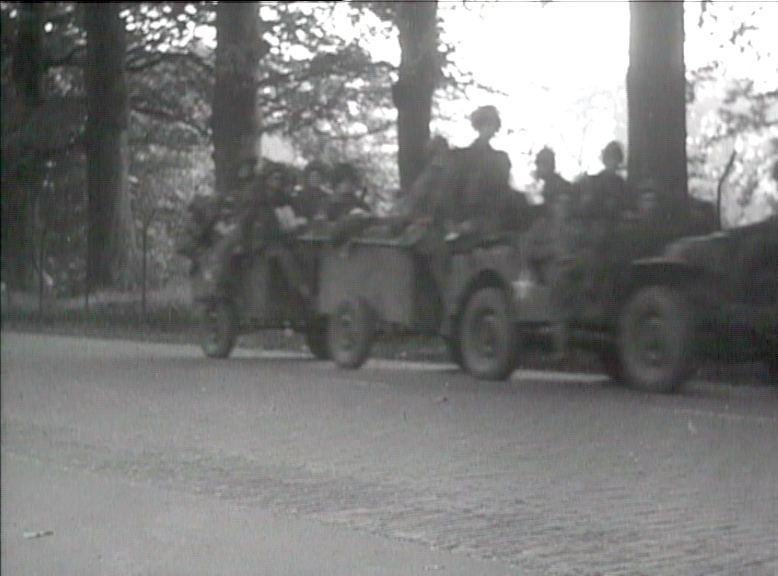
Sgt. Gordon Walker of the A.F.P.U., took a twenty second clip of film of Jeeps, with trailers and motor-cyclists, moving along the Utrechtseweg, near the western side of Oosterbeek, on Monday 18th September 1944. Some of the jeeps he filmed belonged to the 250th Airborne Light Composite Company, R.A.S.C., as they are towing two trailers. This is a sequence of stills of two of the jeeps with the trailers in 'tandem'.
Chapter 9. Wednesday, 20th September 1944.
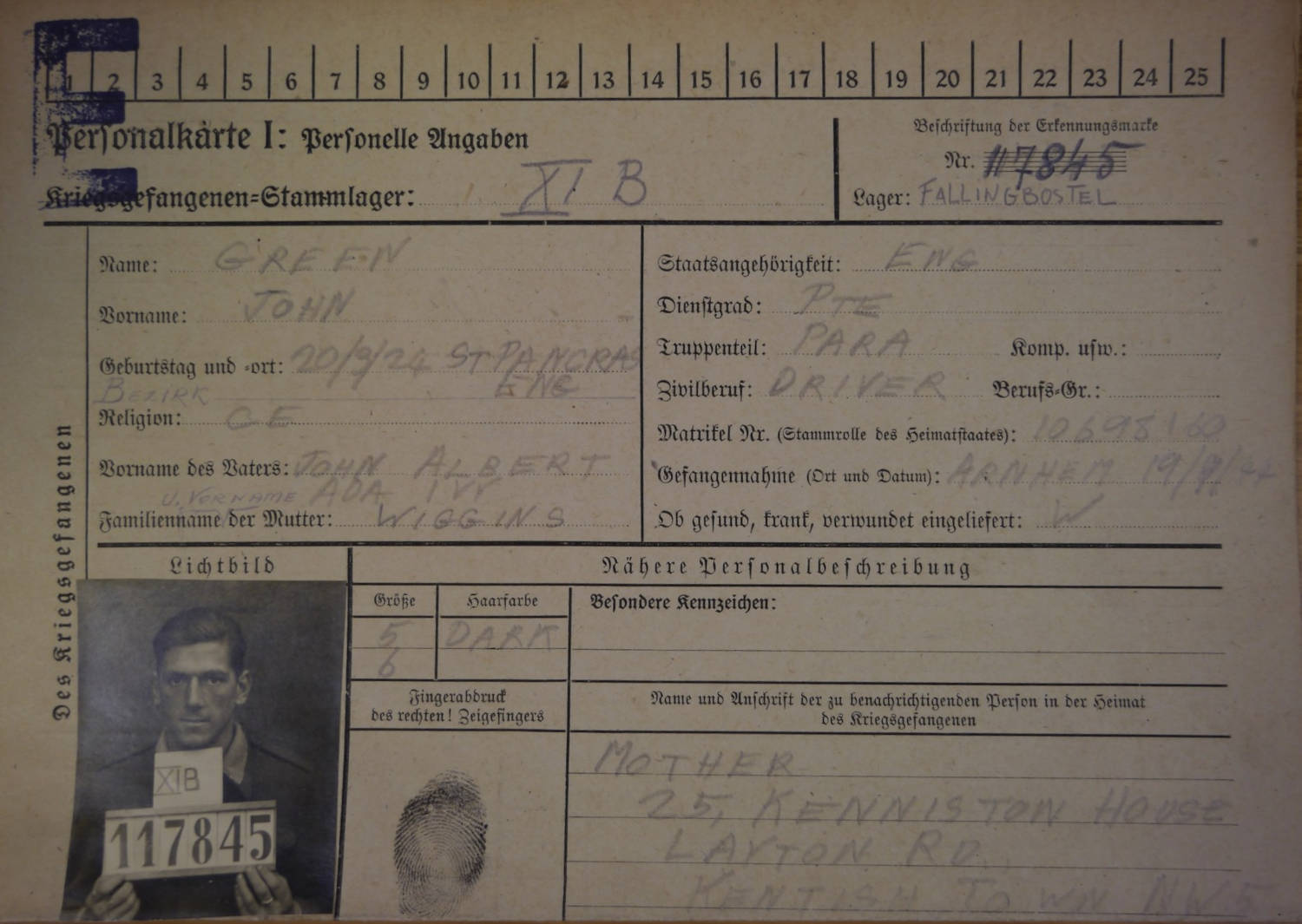
The POW card of Dvr. John Green at Stalag 11B, Falingbostel in Germany. September 1944. Courtesy of John Howes.
Although his POW card states that he was taken prisoner on the '19/9/44', this is not strictly correct. He was in the Schoonoord on the 20th September, and would have been one of those taken away in the temporary cease-fire to evacuate the wounded on the same day.
John Green was born on the 20th March 01923, and came from Kentish Town, London and was a Driver before the war. He enlisted into the Royal Army Service Corps on the 23rd April 1942, and then joined 250 Company on the 10th July 1942, initially serving in 'B' (MT) Platoon. He volunteered to become a parachutist and did Parachute Course 43 at R.A.F. Ringway, 20th December 1942 to 2nd January 1943. His Parachute Instructors comments: 'Jumped well and worked hard'.
He was transported to the temporary 'Airborne' Hospital at the Willem III Barracks in Apeldoorn. He left there as walking wounded on 26th September 1944, and was sent to Stalag 11B, at Falingbostel in Germany, POW No. 117845. He was there from 1st - 21st October 1944. He was then sent to a Working Camp at Bad Grund, working as a miner, 25th October 1944 to 8th April 1945. In April he was part of a forced march, but decided to escape: "Escaped from column while we were marching. We heard that our tanks were nearby, so we deserted, and took cover in a civilian house, for two hours. Then we were relieved by the Americans."
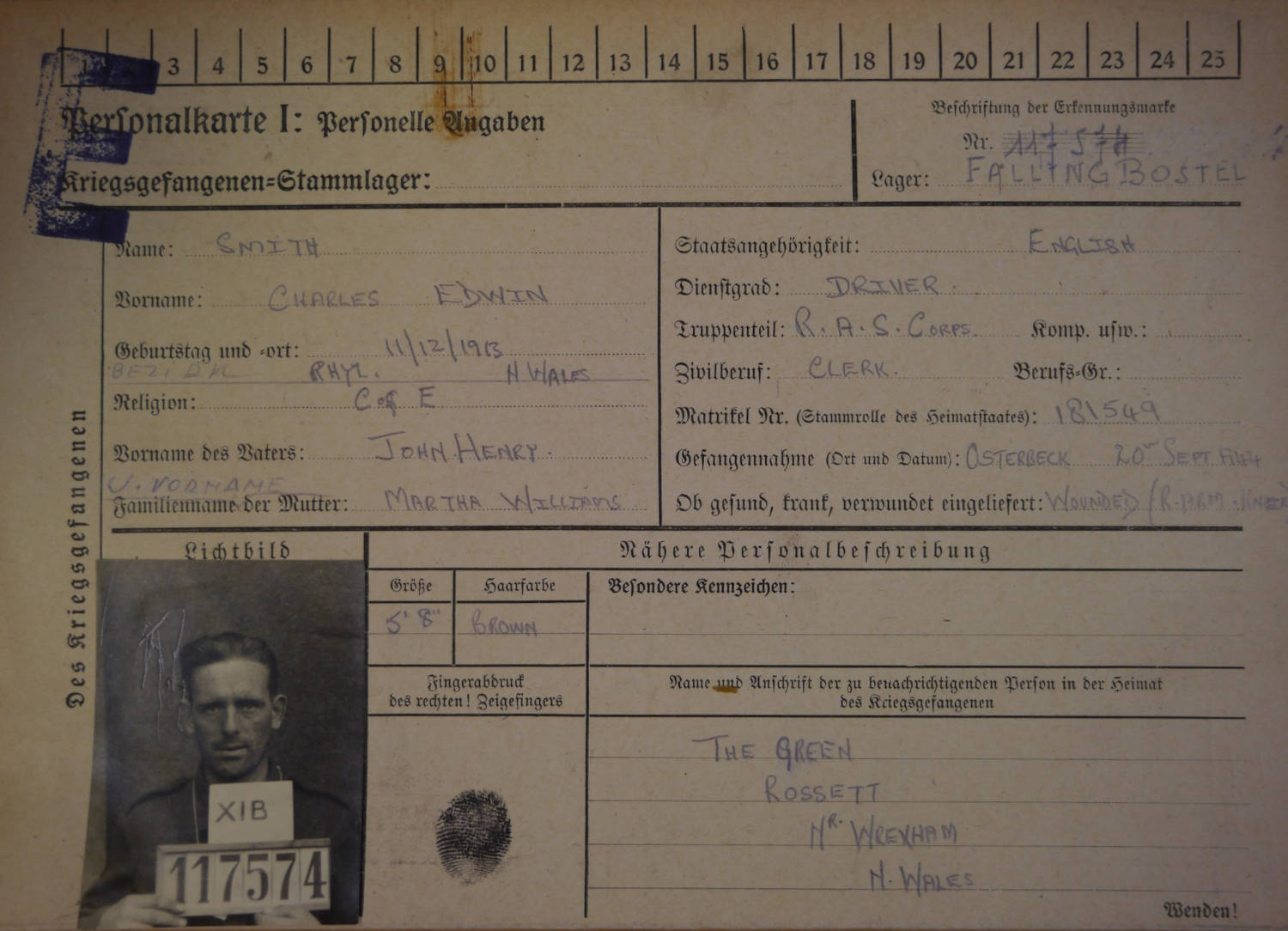
The POW card of Dvr. Charles Edwin Smith at Stalag 11B, Falingbostel in Germany. September 1944. Courtesy of John Howes.
Dvr. Charles Smith was probably another one who was taken prisoner by the Germans at the M.D.S. cross-roads area on the 20th September.
He was born on the 11th December 1913, and came from Rossett near Wrexham, North Wales, and worked as a clerk before the war. He enlisted into the Royal Army Service Corps on the 2nd May 1940, and volunteered for Airborne Forces, being posted to the 250 Divisional Airborne Light Composite Company, R.A.S.C., on the 16th June 1942. He volunteered to become a parachutist and did Parachute Course 55 at R.A.F. Ringway, 15th - 22nd March 1943. His Parachute Instructors comments: 'Not so good on Ground Training, but improved a lot for jumping'.
On Monday, 18th September 1944, he took off in a Horsa glider on the 2nd Lift of Operation 'Market-Garden', destined for L.Z. 'X', near Heelsum in Holland. By now he was serving in 'G' Transport Platoon and was attached to the 4th Parachute Brigade. He was wounded in the right arm and knee in the fighting near Oosterbeek, and taken prisoner. He was sent to Stalag 11B at Falingbostel in Germany, arriving there on the 28th September. Here he was given the POW No. 117574. His wound did not prevent the Germans from sending him to a Work Camp at Hallendorf, on the 8th October 1944. However, he either he was taken ill or his wounds were still troubling him as a he was admitted to the Lazarette (Hospital) at Wolfenbuttel on the 29th November 1944.
Chapter 10. 21st - 26th September 1944.
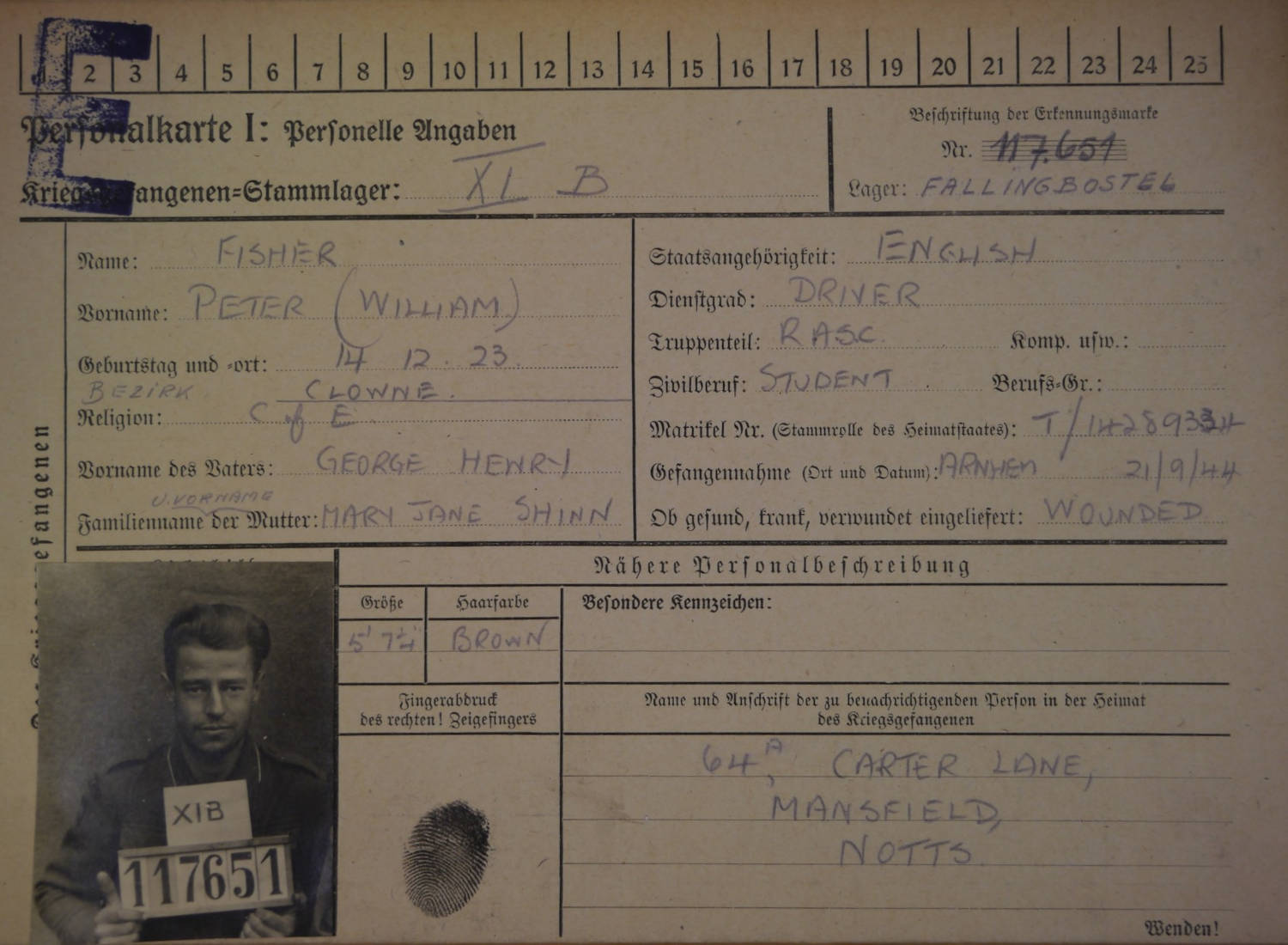
The POW card of Dvr. Peter William Fisher at Stalag 11B, Falingbostel in Germany. September 1944. Courtesy of John Howes.
Dvr. Peter William Fisher was born on the 14th December 1942, and came from Mansfield, Nottinghamshire, and before enlisting he was a student. He enlisted into the Royal Army Service Corps on the 17th September 1942, and volunteered for Airborne Forces in 1943, being posted to the 250th Divisional Airborne Light Composite Company R.A.S.C. on the 9th May 1943. This would have been just in time to sail with the Company to North Africa. He was assigned to 'C' Transport Platoon.
Back in England he volunteered to become a parachutist and did Parachute Course 104, at R.A.F. Ringway, 21st February to 2nd March 1944. However, he only completed the two balloon and two aircraft descents before requesting to be returned to his unit. The Report states: 'Refused to jump from 3rd A/C, stated he had lost his nerve'.
He landed in a glider on the 2nd Lift, Monday, 18th September 1944, at L.Z. 'X', near Heelsum in Holland, and was wounded and taken prisoner on the 21st September 1944, and was sent to Stalag 11B, at Falingbostel, Germany, arriving there on the 28th September. His wound did not prevent the Germans from sending him to a Work Camp at Bad Grund, on the 23rd October
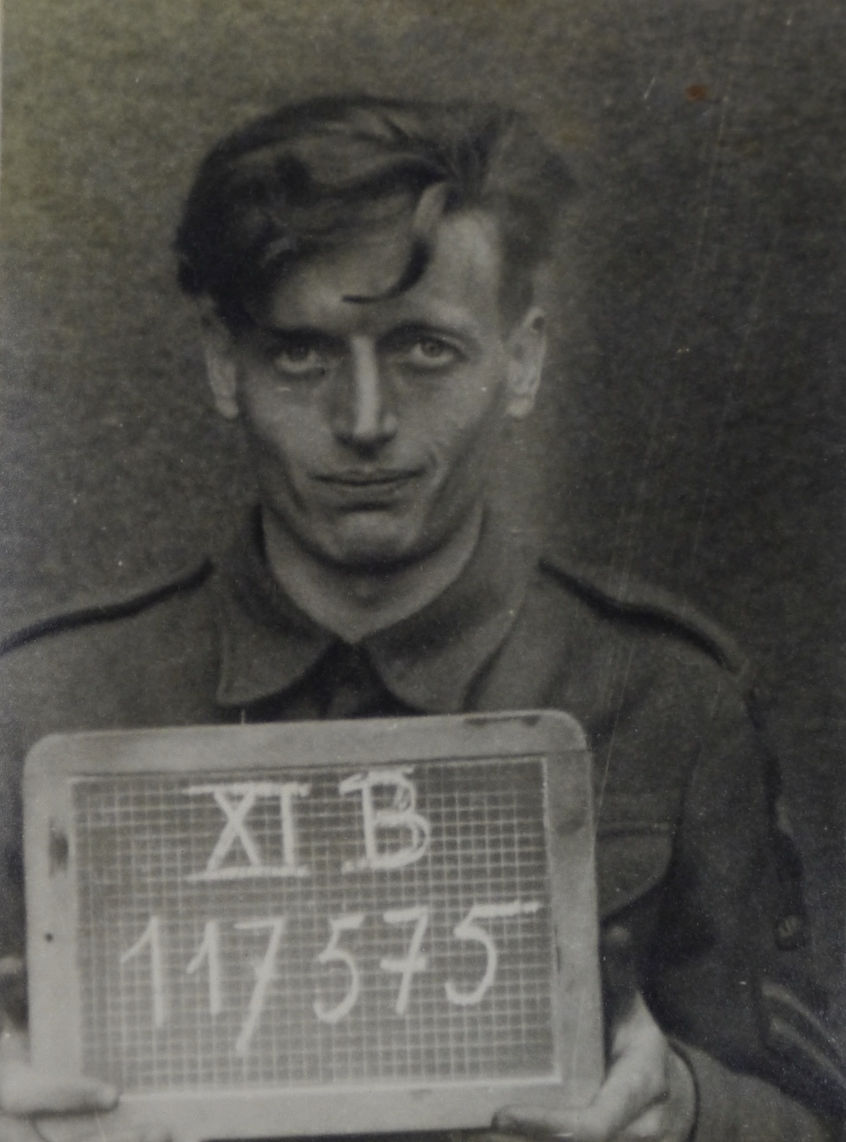
The POW photo of Cpl. William Henry Perrin at Stalag 11B, Falingbostel in Germany. September 1944. Courtesy of John Howes.
Cpl. William Henry Perrin was born on the 21st April 1916, and came from Taunton in Somerset, and worked as a driver before the war. He enlisted on the 1st March 1940, and was originally posted to 4 G.H.Q. Company on the 26th June 1940. He remained with the unit as it became 250 Transport Company, R.A.S.C. He would have served with the Company in North Africa in 1943. By 1944 he was serving in 'D' Transport Platoon and was a Corporal.
He flew to L.Z. 'X', near Heelsum, in Holland, on the 2nd Lift of Operation 'Market-Garden', Monday, 18th September 1944. He was wounded and taken prisoner on the 24th September 1944, and was initially sent to the temporary Airborne Hospital set up in Apeldoorn. He left there on the 26th September, as walking wounded, and was sent to Stalag 11B at Fallingbostel, where he arrived on the 28th September. Here he was allocated the POW No. 117575. On the 24th October 1944 he was sent to Stalag 8C at Sagan in Poland.
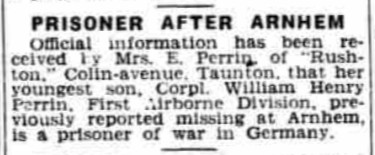
On Saturday, the 2nd December 1944 a small notice appeared in the Somerset County Herald: PRISONER AFTER ARNHEM. Official information has been received by Mrs. E. Perrin, of 'Rushton', Colin-avenue, Taunton, that her youngest son, Corpl. William Henry Perrin, First Airborne Division, previously reported missing at Arnhem, is a prisoner of war in Germany.
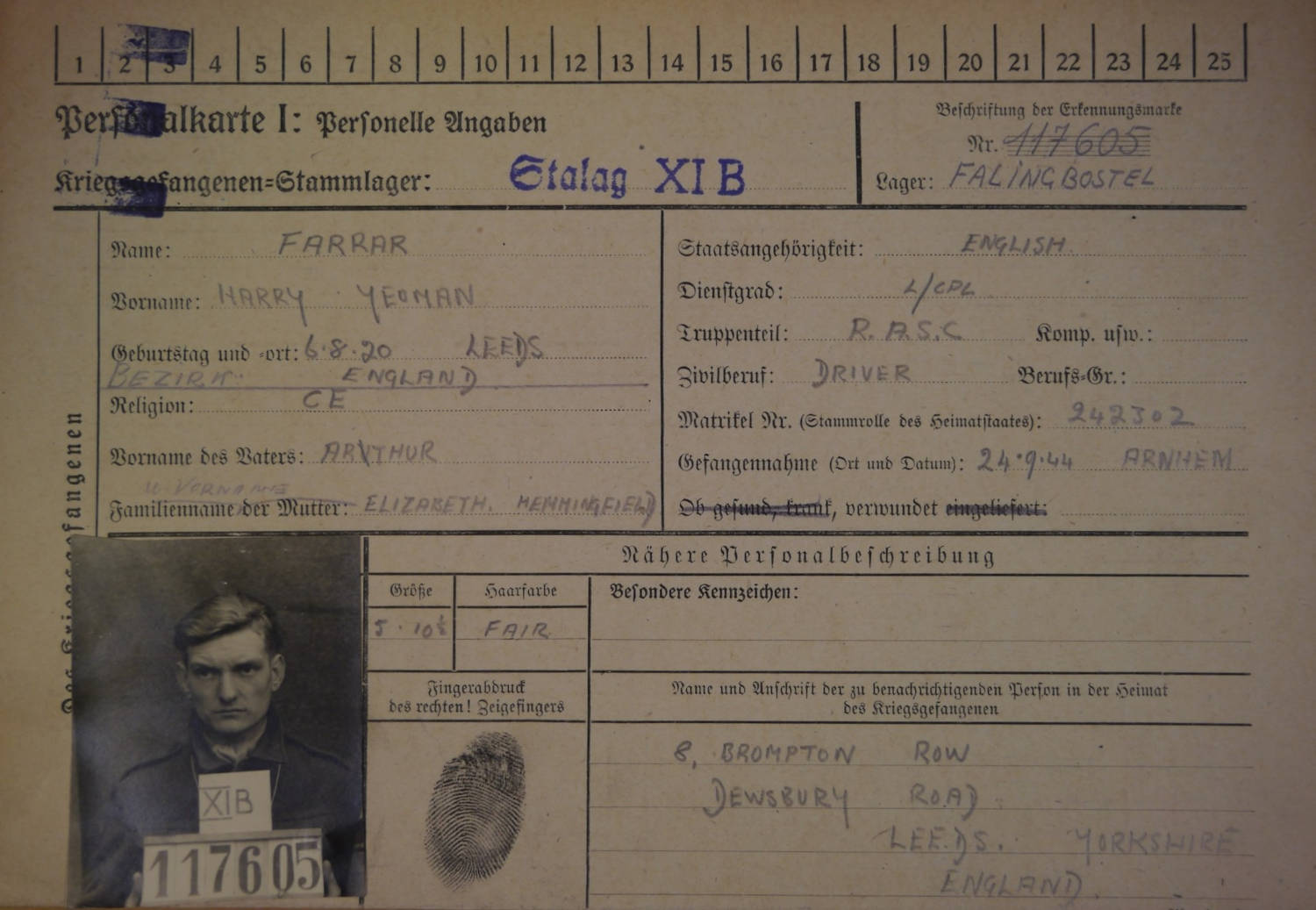
The POW card of L/Cpl. Harry Yeoman Farrar at Stalag 11B, Falingbostel in Germany. September 1944. Courtesy of John Howes.
L/Cpl. Harry Yeoman Farrar was born on the 6th August 1920, and came from Leeds in Yorkshire, and worked as a driver in peacetime. He enlisted into the Royal Army Service Corps on the 9th January 1941. He was posted to 250 Company on the 7th March 1941, and allocated to 'E' Platoon, which later became No 3 Parachute Platoon.
For operation 'Market-Garden' L/Cpl. Farrar was allocated to a transport glider for No 3 Parachute Platoon, and either did not make it to the R.V. or was aboard one of the gliders that failed to arrive on the First Lift, so did not make it to Arnhem Bridge with the rest of his platoon. He was wounded and captured on the 24th September 1944, and sent to the temporary Airborne Hospital set up in Apeldoorn. He left there on the 26th September, as walking wounded, and was sent to Stalag 11B at Fallingbostel, where he arrived on the 28th September. His wound did not prevent the Germans from sending him to a Work Camp at Bad Grund, on the 23rd October.
He was listed in 'The Yorkshire Post', Leeds, on Monday, 16th October 1944, as being amongst the wounded: 'L-Cpl. Harry Farrar (24), Brompton Row, Dewsbury Road, Leeds.'
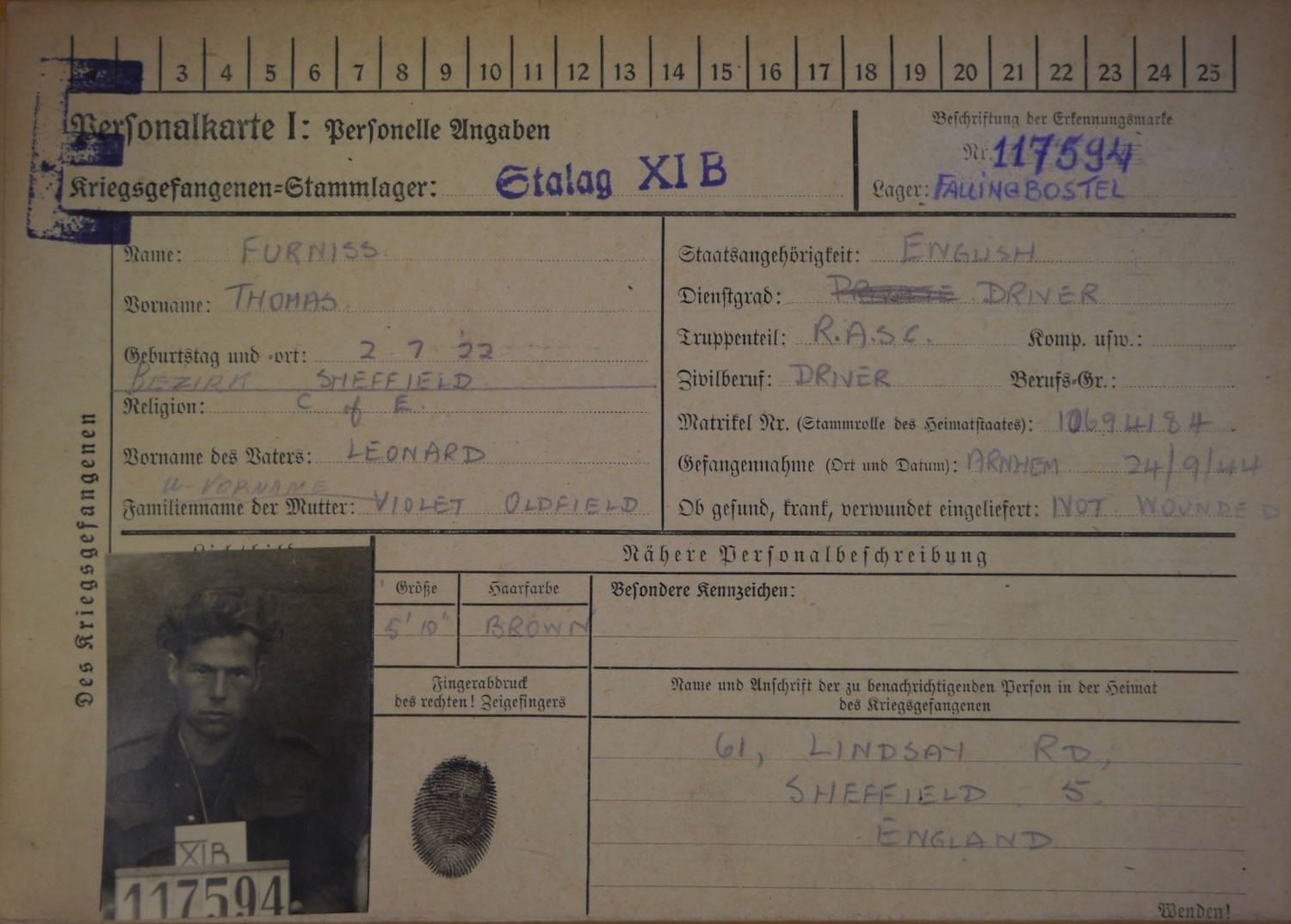
The POW card of Dvr. Thomas Furniss at Stalag 11B, Falingbostel in Germany. September 1944. Courtesy of John Howes.
Thomas Furniss was born on the 2nd July 1922, and came from Sheffield, and before enlisting he worked as a lorry driver. He enlisted into the Royal Army Service Corps on the 26th March 1942, and having volunteered for Airborne Forces, was posted to the 250th Divisional Airborne Light Composite Company, R.A.S.C. on the 9th July 1942. He was assigned to 'D' Transport Platoon, and was part of the Section attached to No 3 Parachute Platoon.
For operation 'Market-Garden' he was allocated to a transport glider for No 3 Parachute Platoon, and either did not make it to the R.V. or was aboard one of the gliders that failed to arrive on the First Lift, so did not make it to Arnhem Bridge with the rest of his platoon. He was wounded and sent to a Medical Aid Post, where he was captured on the 24th September 1944, and sent to the temporary Airborne Hospital set up in Apeldoorn. He left there on the 26th September, as walking wounded, and was sent to Stalag 11B at Fallingbostel, where he arrived on the 28th September. His wound did not prevent the Germans from sending him to a Work Camp at Bad Grund, on the 25th October, where he worked as a miner in a lead mine, until April 1945.
During the time he worked at the mine he managed to carry out a minor act of sabotage: 'Pushed wagon down shaft in the mine on the 6. 2. 45, stopped production for 1 hour'. He was able to escape from his Work Party: 'On the 10th of April 45, while we were marching in a column, we heard our tanks were very near, so we disorganised the column and took cover in the civilian houses, for two hours. Then we were relieved by the Americans'.
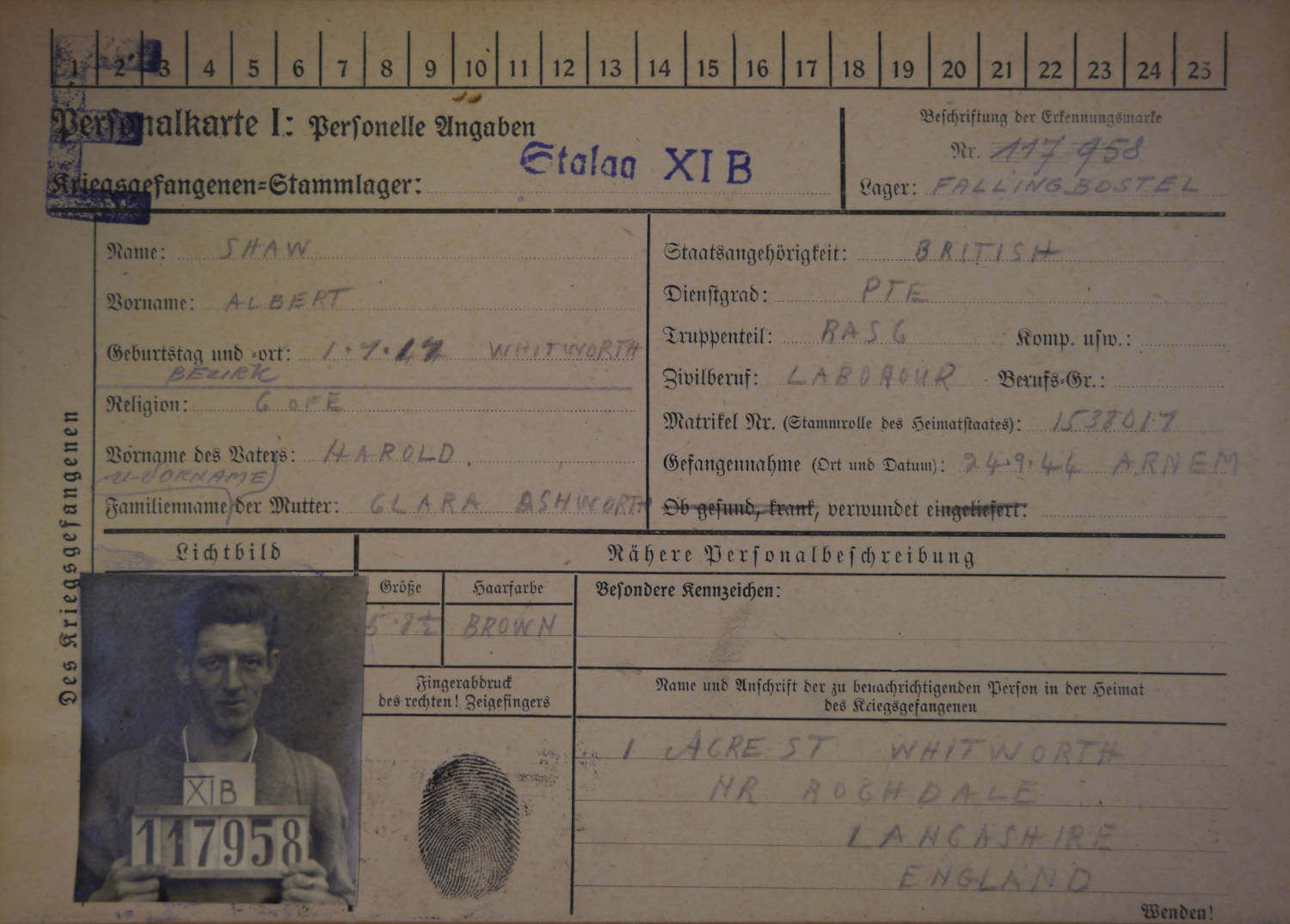
The POW card of Dvr. Albert Shaw at Stalag 11B, Falingbostel in Germany. September 1944. Courtesy of John Howes.
Albert Shaw was born on the 1st August 1917, and came from Whitworth, near Rochdale, Lancashire, and he worked as a labourer before the war. He enlisted into the Royal Army Service Corps on the 15th March 1940. He volunteered for Airborne Forces and did Parachute Course 101 at R.A.F. Ringway, 31st January to 13th February 1944. His Parachute Instructors comments: 'Average, good stick man'.
He was then posted to the 250th Airborne Light Composite Company, R.A.S.C. on the 14th February 1944, where he was then assigned to No 2 Parachute Platoon, and took off from Saltby aerodrome aboard a Dakota aircraft of the 314th Troop Carrier Group, U.S.A.A.F., on the 2nd Lift of Operation 'Market-Garden', Monday, 18th September 1944, destined for D.Z. 'Y' at Ginkel Heath in Holland.
He was wounded and captured on the 24th September 1944, and sent to the temporary Airborne Hospital set up in Apeldoorn. He left there on the 26th September, as walking wounded, and was sent to Stalag 11B at Fallingbostel, where he arrived on the 28th September. He was another whose wound did not prevent the Germans from sending him to a Work Camp at Bad Grund, on the 23rd October.
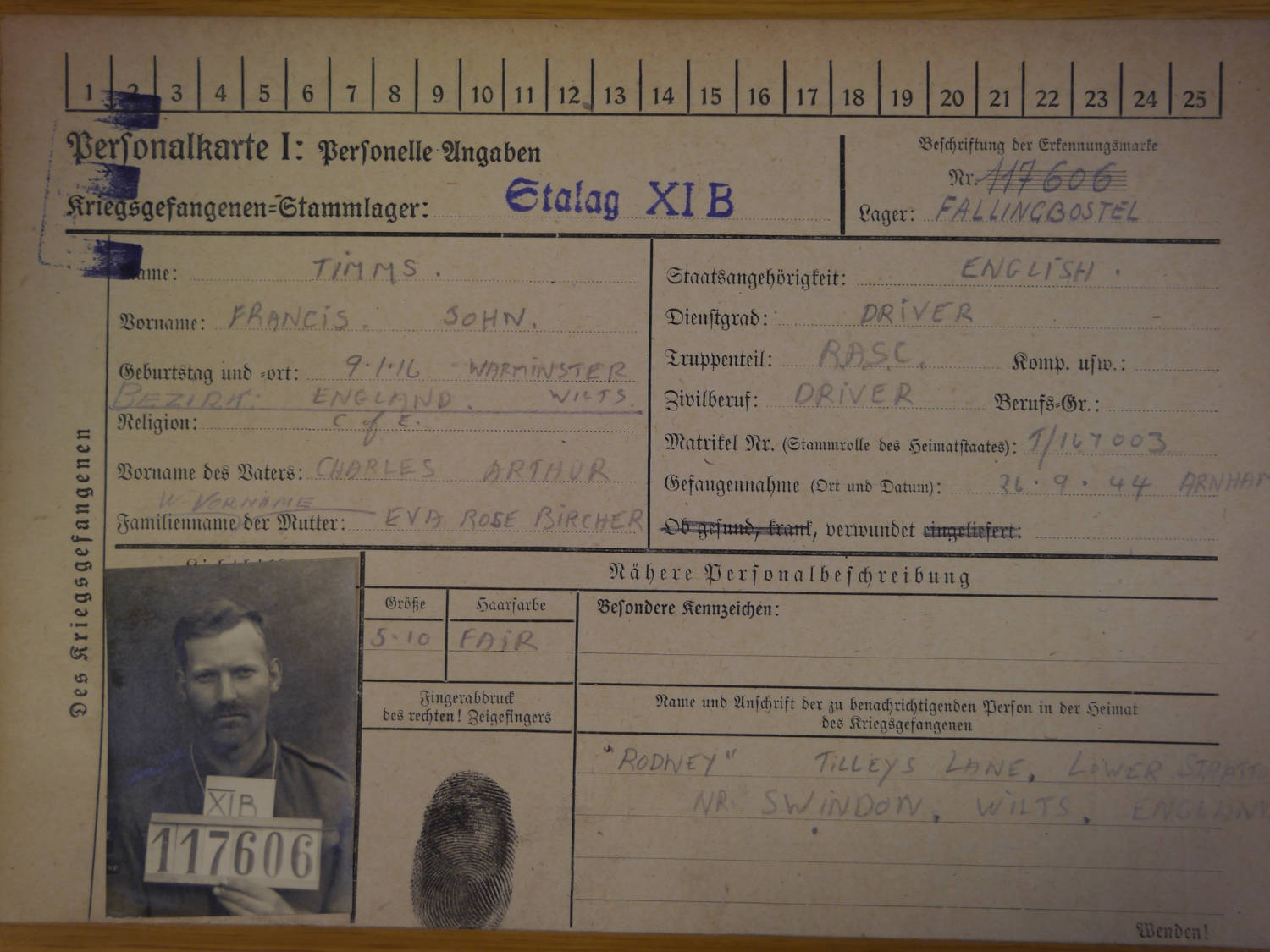
The POW card of Dvr. Francis John Timms at Stalag 11B, Falingbostel in Germany. September 1944. Courtesy of John Howes.
Dvr. Francis John Timms was born on the 9th January 1916, and came from Swindon, Wiltshire, and he worked as a driver before the war. He enlisted into the Royal Army Service Corps on the 1st March 1940, and was then posted to the newly formed 250th Transport Company, R.A.S.C. on the 17th July 1940, thus becoming one of its very first members. He possibly did a shortened Parachute Course at R.A.F. Ringway, in August 1942, and by 1944 he was serving in 'D' Transport Platoon.
For Operation 'Market-Garden' he was attached to the staff of the C.R.A.S.C., and he flew in a Horsa glider to L.Z. 'X', near Heelsum, in Holland, as part of the 2nd Lift, Monday, 18th September 1944. He was taken prisoner on the 26th September, and was sent to Stalag 11B at Falingbostel, Germany, arriving there on the 28th September. He was also sent to a Working Camp at Bad Grund on the 23rd October 1944.
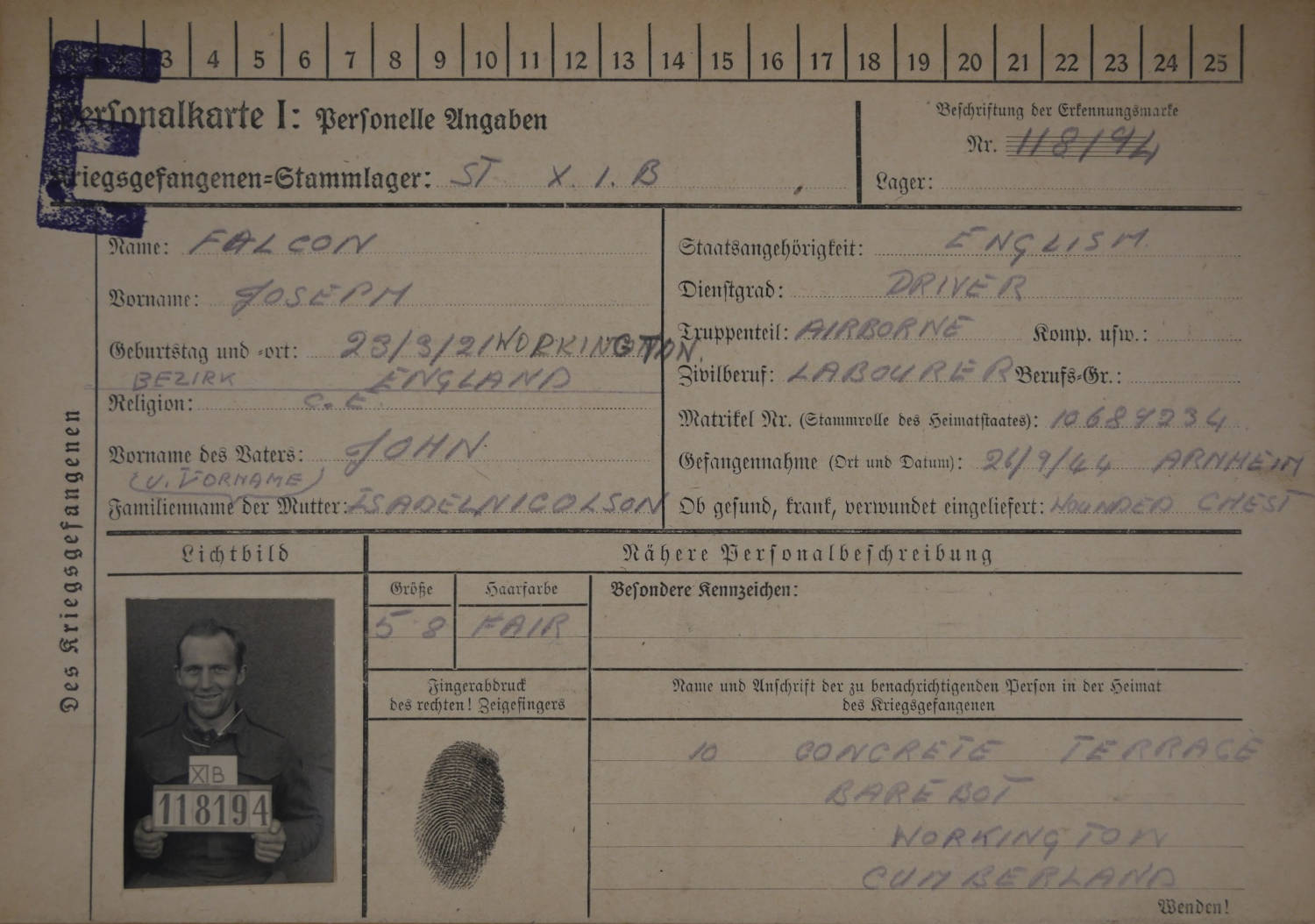
The POW card of Dvr. Joseph Falcon at Stalag 11B, Falingbostel in Germany. September 1944. Courtesy of John Howes.
Dvr. Joseph Falcon was born on the 23rd March 1921, and came from Workington, Cumberland, AND worked as a bricklayer before enlisting. He enlisted into the Royal Army Service Corps on the 26th February 1942, and volunteered for Airborne Forces in 1944, being posted to the 250th (Airborne) Light Composite Company, R.A.S.C. on the 8th February 1944.
He was assigned as an extra driver to No1 Parachute Platoon and took off for Operation 'Market- Garden' on the 2nd Lift, Monday, 18th September 1944. He was wounded in the chest, during the battle of the Oosterbeek perimeter, and taken prisoner in one of the Medical Posts on the 26th September 1944. He was initially sent to the temporary 'Airborne' Hospital at the Willem III Barracks in Apeldoorn. He left there as walking wounded on the 3rd October, and was sent to Stalag 11B, at Falingbostel in Germany, arriving there on the 6th October 1944. He was another one whose wound did not prevent the Germans from sending him to a Work Camp at Bad Grund, on the 23rd October.
Chapter 11. Aftermath, and life as a POW. 1944 - 1945.
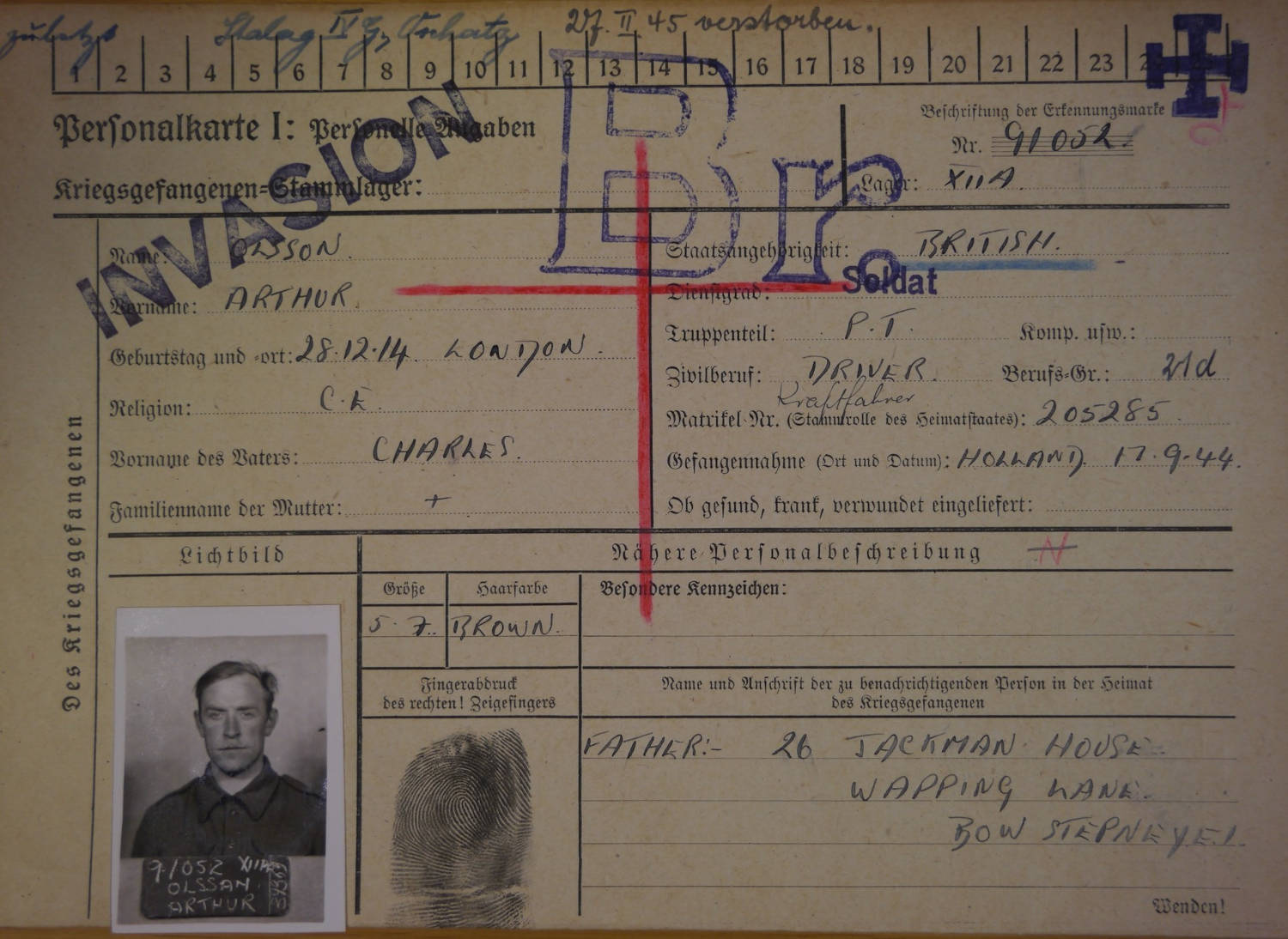
The POW card of Dvr. Arthur Olaf Olsson at Stalag 12A, lIMBURG in Germany. September 1944. Courtesy of John Howes.
On his POW card the date of capture is given as '17/.9.44', but is more likely to be when the No 3 Parachute Platoon was overrun at Arnhem Bridge on Thursday, 21st September. It is not know where he was held between the 22nd September and 14th October, but possibly in solitary confinement undergoing interrogation. He was sent to Stalag 12A, at Limburg in Germany on the 15th October, and then onto Stalag 4B at Mühlberg in Germany. He was killed in an Allied bombing raid whilst a Prisoner Of War in Stalag 4B, on the 27th February 1945, and was initially buried at the Leipzig East Cemetery, X9. H. 11.
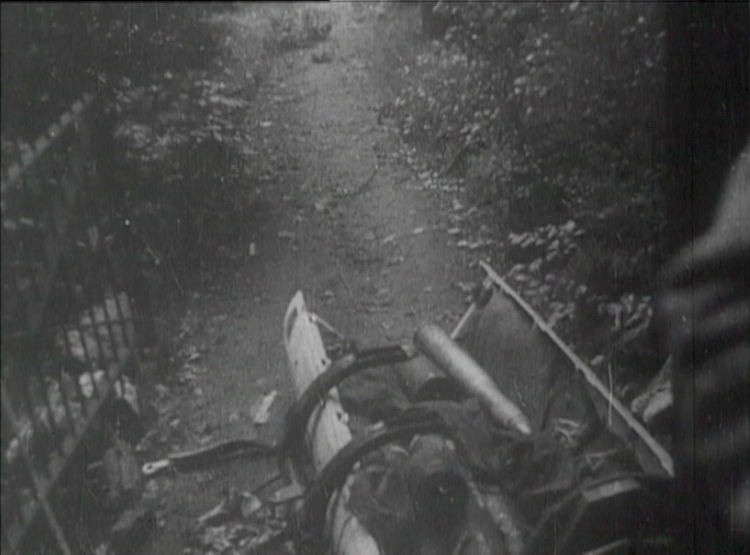
German film Oosterbeek area. Sep 1944 (1). A British CLE supply container with an anti-tank round. This has landed in the garden of a small house on the junction of Fangmanweg/Zweiersdal, Oosterbeek. 26th September 1944. This is a still from The Wochenschau, a German propaganda publication. Courtesy Bob Gerritsen.
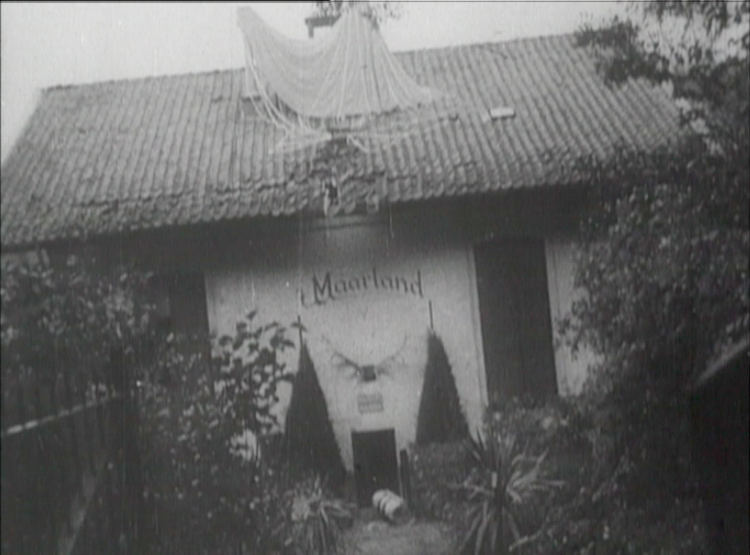
German film Oosterbeek area. Sep 1944 (2). A British CLE supply container has landed on the roof of the building 'Maarland', then crashed in to the garden, in the Oosterbeek area. 26th September 1944. This is a still from The Wochenschau, a German propaganda publication. Courtesy Bob Gerritsen.
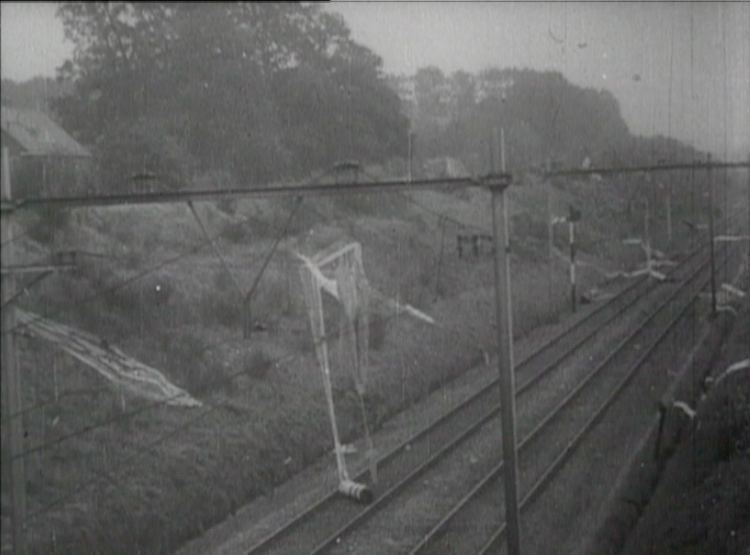
German film Oosterbeek area. Sep 1944 (3). British CLE supply containers scattered across the railway line at Oosterbeek railway station. 26th September 1944. This is a still from The Wochenschau, a German propaganda publication. Courtesy Bob Gerritsen.


