Chapter 11
Aftermath, and life as a POW. 1944 - 1945.
"During the last war, eighty percent of our problems were of a logistical nature". Field Marshall Bernard Law Montgomery.
The War Diary for the Seaborne Echelon of 250 Company has the following entry for the 26th September 1944: 'Assist in evacuation of Polish Para Brigade to Grave. Only 2 officers + 62 Other Rank's came back from Arnhem. 20 jeep + trailers attached to Polish Brigade.'
To get to this point had been a tedious and frustrating process for the Seaborne Echelon, both physically and mentally.
Lt. Richard Adams, Commander 'C' Transport Platoon: "We pussy-footed our jeeps to the Normandy beach, and soon after found ourselves in camp not far from Bayeux. Although there was as yet not a lot to do and not a lot to see except for the partly-tidied-up wreckage of the early battle-fields, we were all strung up to a pitch of excitement which even the coolness of John Gifford couldn't altogether dispel. The division was going into action at last! We had grown tired of khaki-bereted louts outside pubs at closing time shouting "Yah! Airborne - stillborn!" and similar witticisms. 6th Division had been the flower of the invasion; we felt sure we were to be the flower of the final victory." [1]
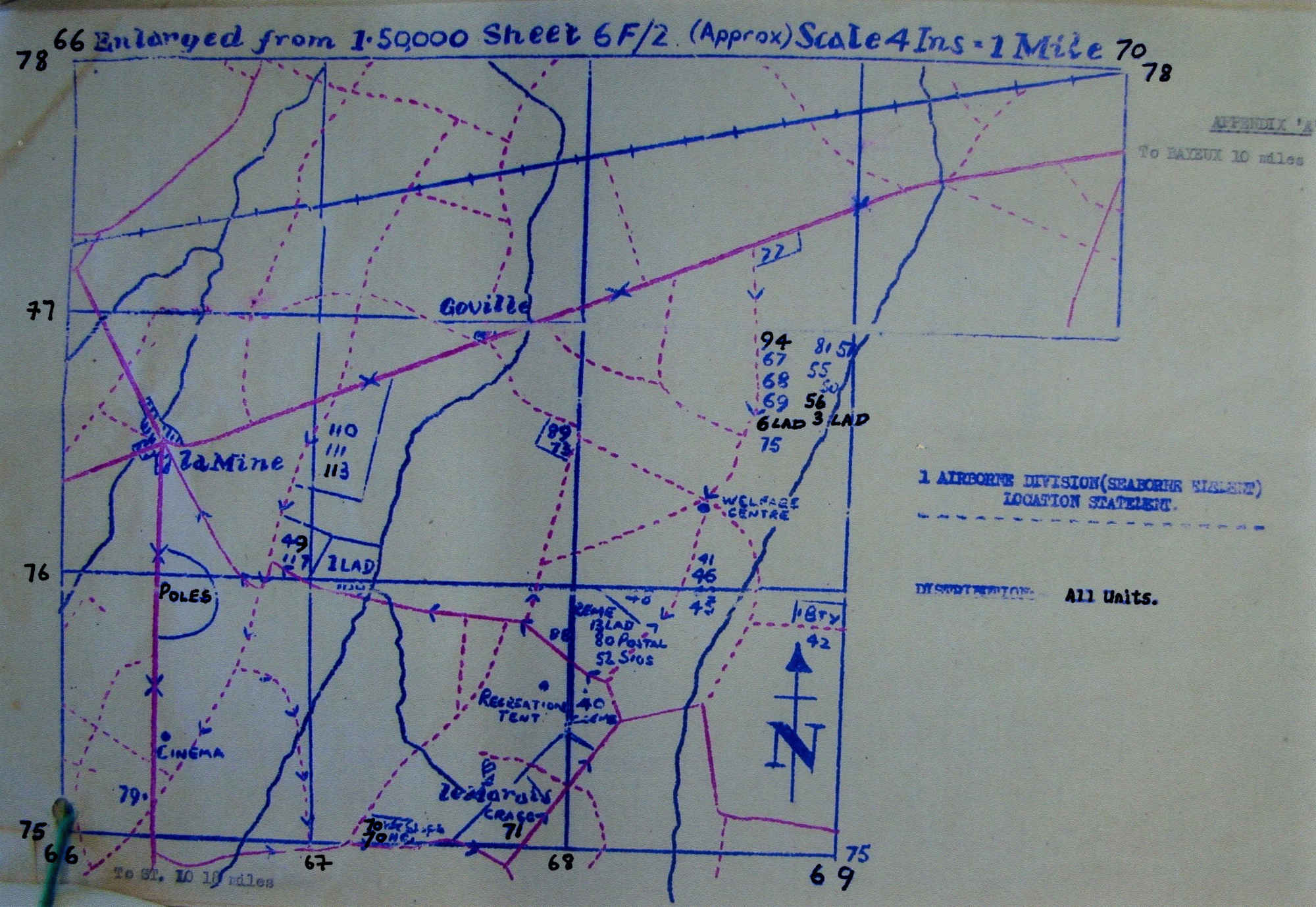
Sketch map of the 1st Airborne Division's Seaborne Echelon position sin Normandy. August-September 1944. Near the bottom, between grid lines 67 and 68 are the R.A.S.C. 70 = 250 Company (Platoon's, Workshops and HQ). 71 = 93 Company CRASC = HQ, RASC. Courtesy of John Howes.
They had arrived off the coast of Normandy, at Courselles, at 19.00 hrs, on the 16th August, but had not started to off-load their vehicles until 09.00 hrs the next morning. They were ferried ashore at 'JUNO' Beach, which was the original Canadian landing area, and moved forward to an area between La Mine and Le Marais, which was approx. 4 miles south-west of Bayeux. They were complete in this position by 22.30 hrs. As they were moving into this position, word came through that the operation they were preparing for - 'Transfigure' - was cancelled.
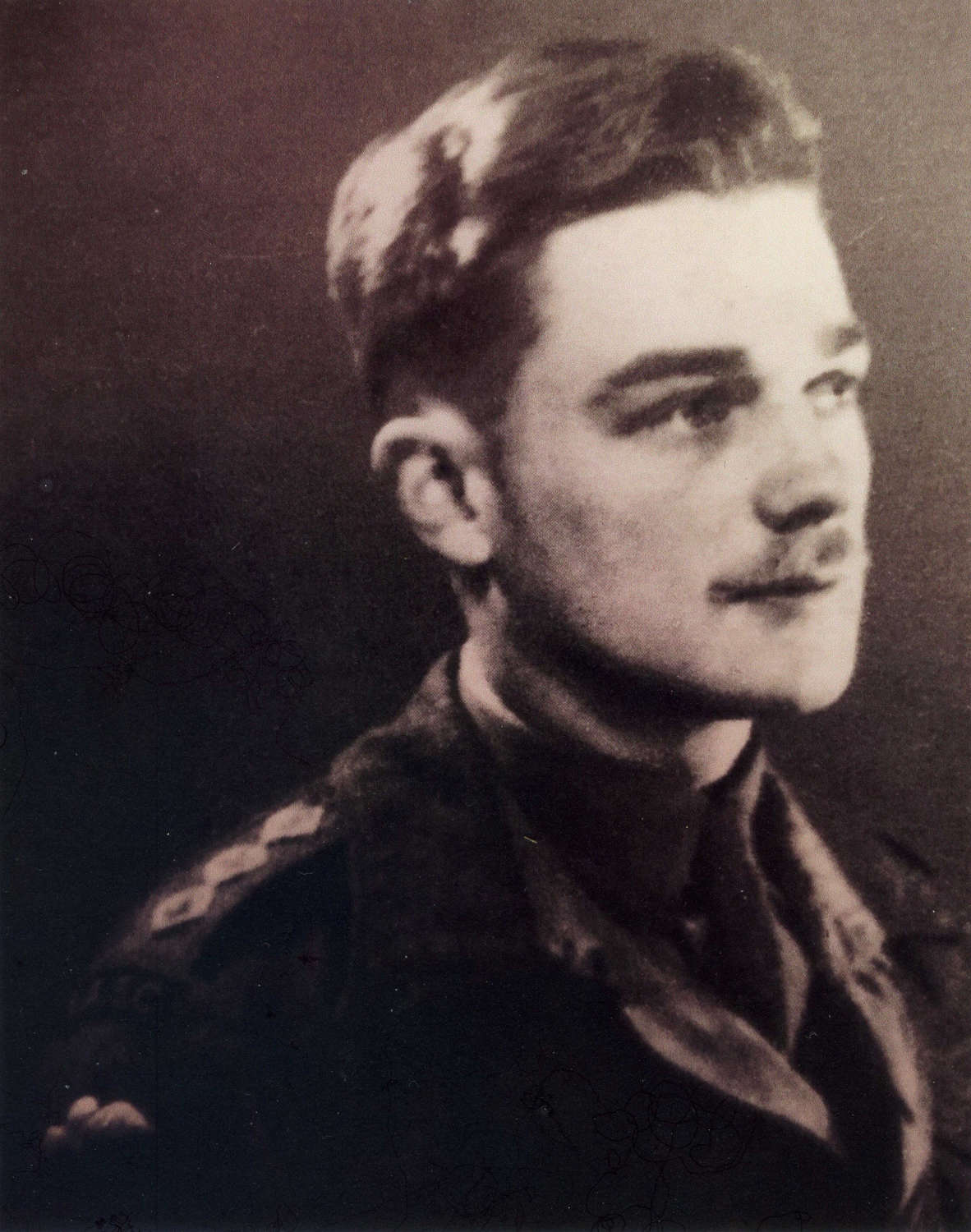
Richard Adams, after he had been promoted to Captain, and gained his 'wings', in 1945. Courtesy of Richard Adams.
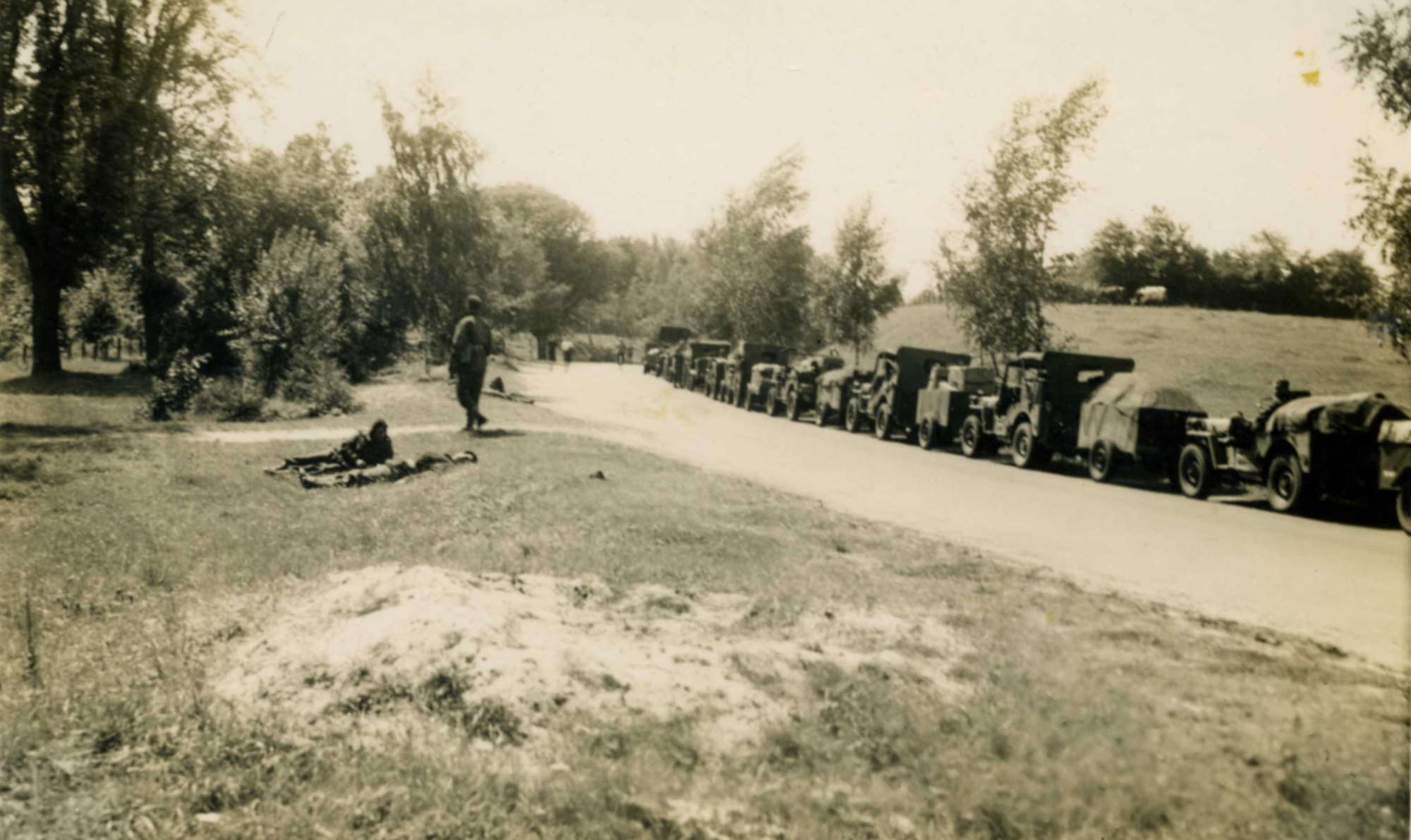
250 Company's Jeeps and heavily laden trailers moving up to their Camp area La Mine, Normandy. 16th August 1944. The photo was taken by Dvr. G. Gelsthorpe. Courtesy of Philip Pringle.
Lt. Adams: "I had quite a bit of swanning around to do - locating supply points and so on. I recall my driver, Farley, soundest and steadiest of Worcestershire swede-bashers, staring rather doubtfully at a crossroads Calvary, and asking "That s'posed to be Jesus Christ on the cross?" "Yes," I said. "They have them like that here. We'll be seeing a lot more." We were on our way to Saint-Lo. When we came in sight of it I felt bewildered and overcome. There was nothing to be seen which could be called a town or even the ruins of a town. There was no longer anything, anywhere, recognizable as a building. Saint-Lo, many, many acres in extent, was nothing but a locality strewn with wreckage and fragments. There were no soldiers there, either. General Patton's tanks were already far to the south, forty miles away near Avranches." [2]
The continuing frustration of further operations being planned, and then just as quickly cancelled did not stop, Lt. Adams: "But as fast as these various plans were made, the military situation would overtake them. John Gifford and [Maj. R. Tompkins, O.C: 93 Company] never knew where they were from day to day. The plans came so thick and fast that we couldn't help feeling some of them must be a bit half-baked. We were to find out that they certainly were." [3]
The Commander of 'F' Platoon (Workshops), was Capt. Philip Bushby. From Skipton in Yorkshire, he had just turned 27 years of age when he was posted to the Airborne Division on the 30th April 1943. He had originally enlisted as an Other Rank in the R.A.M.C., but on the 27th February 1941 he was sent to an O.C.T.U. of the R.A.S.C. and was then granted an Emergency Commission, as a 2/Lt on the 21st June 1941. Before volunteering for Airborne Forces he had been posted to eight different units! He was to command the Workshops Platoon throughout his service with the Company. In his Platoon he had twin brothers, Dvr's. Arthur William and Reginald Sidney, King, from Luton in Bedfordshire. Born on the 15th November 1920, both of them had enlisted on the 24th April 1939, and then been posted to the Company on the 1st March 1944.
The unit would remain in and around the area near Bayeux, carrying out tasks as Line of Communication troops, until the 2nd September, when they finally started to move forward, after being delayed several times. Setting off at 05.00 hrs the convoy moved in wet weather, to Gisors, crossing the Seine at Vernon, before bivouacking for the night. The next day's move was postponed until 16.30 hrs, and then they set off for Croissy, which was just to the South-west of Amiens. A Conference was attended at Divisional H.Q. (Main), whilst the ammunition was off-loaded from the 3 tonners. There was then an enforced rest and maintenance day, before the convoy set off at 13.00 hrs, 6th September for La Vieville (3 miles West of Albert). Twelve of the 3 tonners were off-loaded and used to collect 20,000 gallons of petrol in two shifts, and a Petrol Point was set up. Three German prisoners were taken during the course of the day.
Lt. Adams: "Well, then it came time to follow up, along with 2nd Army's pursuit. And, my God, did we move? 1st Airborne might drop at any time - only the High Command knew when - and its seaborne tail was required to be in the van, close behind our tanks and infantry. We crossed the Seine on a Bailey bridge at Vernon, and after that it was simply a question of keeping going night and day. Sleep when you can, eat when you can. I got so sick of spam that I could be really hungry and still unable to face another plate of it. The cheering villagers were generous with their apples. Gisors, Beauvais, Breteuil, Amiens, Doullens, Arras, Tournai in Belgium and still never a German. About 150 miles - no real distance today, of course, but hard going in the stop-start conditions of thousands of vehicles on a narrow axis of advance. The columns threw up such dust as I'd never seen since my infancy before tarred roads. As you sat waiting, with engine idling, to go forward, motor-cyclists riding the other way would flash up out of the dust and be gone three feet from your elbow. We were just getting over this when suddenly Driver Farley said (just like a policeman) "'Ullo, 'ullo, what's this?" He had seen quicker than I. Three figures in uniform were approaching us down the slope of a field. They were Germans, evidently bent on surrender. We pulled up and I gestured to them to come up to me. One was Luftwaffe. He looked like a veteran and turned out to be one, for I found in his pocket an Iron Cross (made of plastic) which bore the date '1939'. He also had a picquet pack which I've still got. The second was an infantry officer in jackboots, a mere child who looked about seventeen. The third was a Korporal, black-haired and dour. I motioned them into the jeep and, when we came to the next small town, handed them over to the Maquis, in accordance with standing orders. That was the last we saw of them." [4]
At 07.30 hrs on the 7th September the Company convoy, less H.Q, moved to Loth (South-west of Brussels, via Albert, Arras, Douai, Tournai, Enghien and Hall - reminiscent of their fathers over twenty years before - with all vehicles being into the location by 20.30 hrs. The next day was another move, which began at 08.50 hrs, and went via Brussels to Neerysche near Louvain, where they bivouacked. They would remain in this location until the 14th September, at 6 hours notice to move.
During this time the men were required to carry out some tasks, other than that of their normal duties, Dvr. Robert Neilson was a driver with Company H.Q. He was 30 years old, had enlisted on the 21st November 1940, and had been with the Company since March 1941: "In the beginning of September we arrived in the area of Louvain. We were encamped in a Monastery. On one morning, together with a few others we had to go to a nearby farm, to help with the salvage of a crashed Allied bomber. The plane had exploded in mid-air so the debris was scattered over a great distance and was unrecognisable." [4b]
At 07.00 hrs on 15th September the Company moved through Louvain to Bourg Leopold, not far from the Belgian - Dutch border, via Diest and Beeringen. Here the vehicles were sorted in 'A' Echelon - which comprised Company H.Q. and the ammunition vehicles, and 'B' Echelon - which comprised the remainder of the Company.
The 16th September was a rest day for the men, whilst the officers got the orders for the forthcoming operation - Operation 'Market-Garden' - (see Appendix XIV for full details), and then briefed their respective groups. Lt. Adams: "The following morning, 17 September 1944, John Gifford told his officers what was going to happen. We were on the threshold of a major operation code-named Market Garden. 'Market' was the airborne part and 'Garden' was the land offensive. The intention was to get the Allied 2nd Army, in one blow, across the Rhine and into northern Holland. This was expected to finish the war before the end of the year. The operation would begin early that same afternoon, soon after one o'clock (13.00 hrs), when the first lift of parachute and glider-borne troops would arrive from England." [5]
There were two further briefings on the 17th September, at 30 Corps Rear H.Q, the first at 10.00 hrs, and the next at 17.30 hrs, when Lt-Col. Curtis gave verbal orders. In the meantime, it was announced that the airborne element of the 1st Airborne Division had begun landing at 13.00 hrs. However throughout the 18th and 19th September there was no move. Then at 06.00 hrs, 20th September, 'A' Echelon, comprising all the ammunition carrying vehicles moved forward into Holland, crossing the Escaut Canal at 09.00 hrs. They had to halt 9 miles south of Eindhoven, to allow the 43rd (Wessex) Infantry Division to pass. It was not until 20.00 hrs the next day that they were able to move again, following on behind the tail end of the 43rd Division. Their convoy, moving at speed during the night passed through Eindhoven, Veghel and Uden, without incident, except for one damaged motor-cycle.
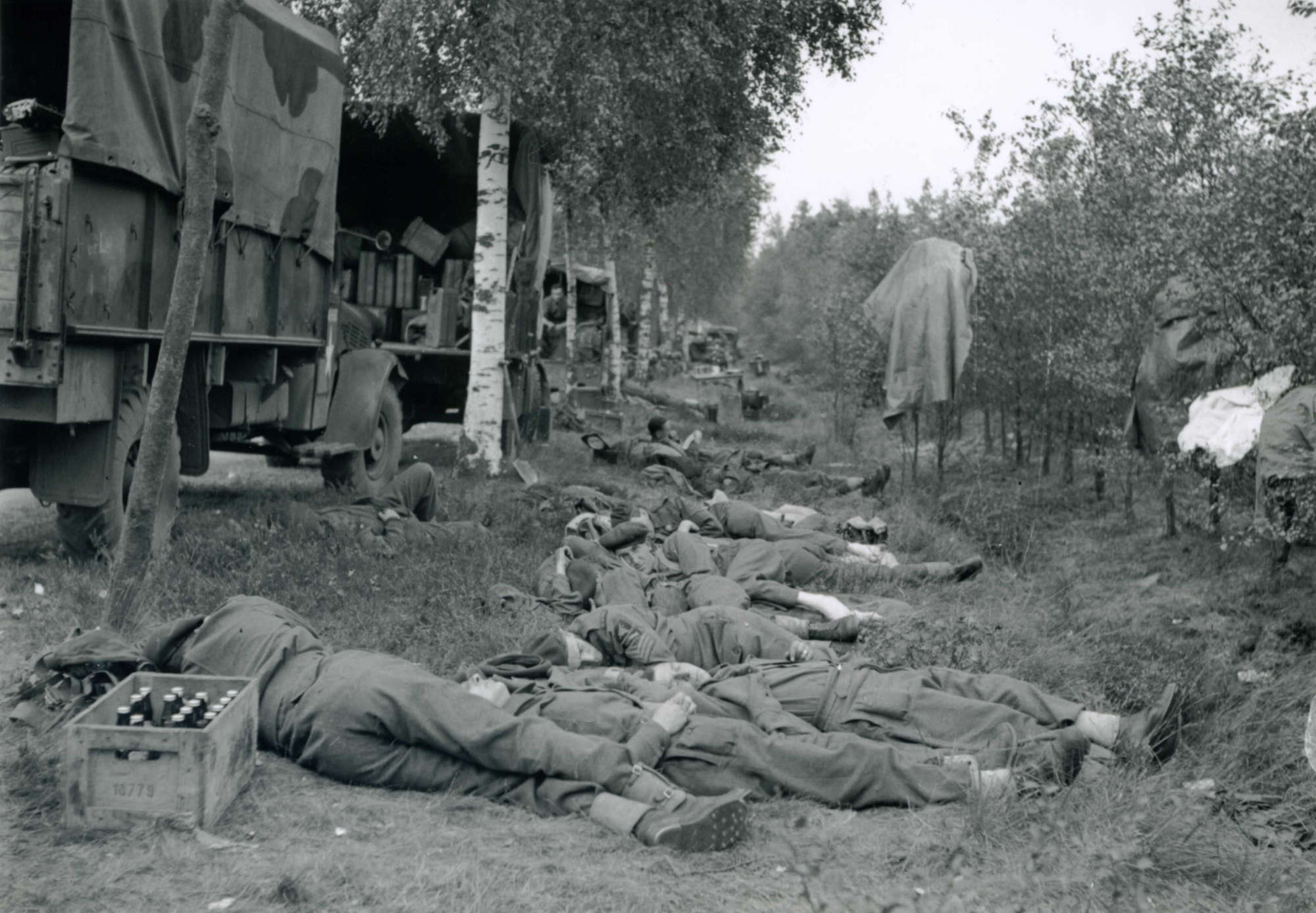
Men of 93 Company, R.A.S.C. take a an opportunity for a rest, before moving up 'Hells Highway', 9 miles south of Eindhoven. 20/21 September 1944. Like all good soldiers they have made sure they have some 'creature comforts' for the campaign ahead. BU10157. Courtesy of the I.W.M.
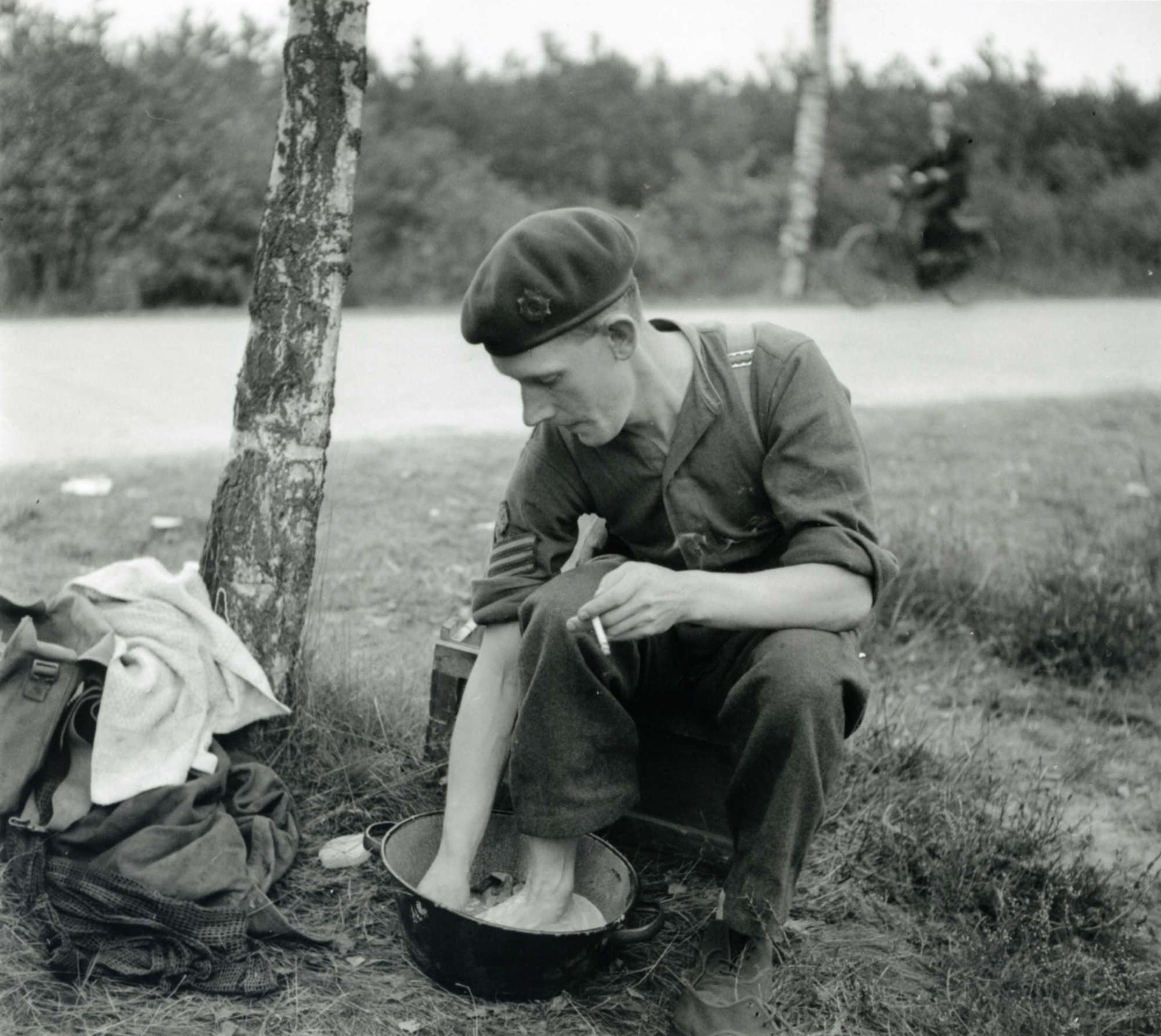
A Staff Sergeant of 93 Company, R.A.S.C. takes an opportunity to carry out some very personal admin during a halt on the advance up 'Hells Highway. 9 miles south of Eindhoven, 20/21 September 1944. BU10159. Courtesy of the I.W.M.
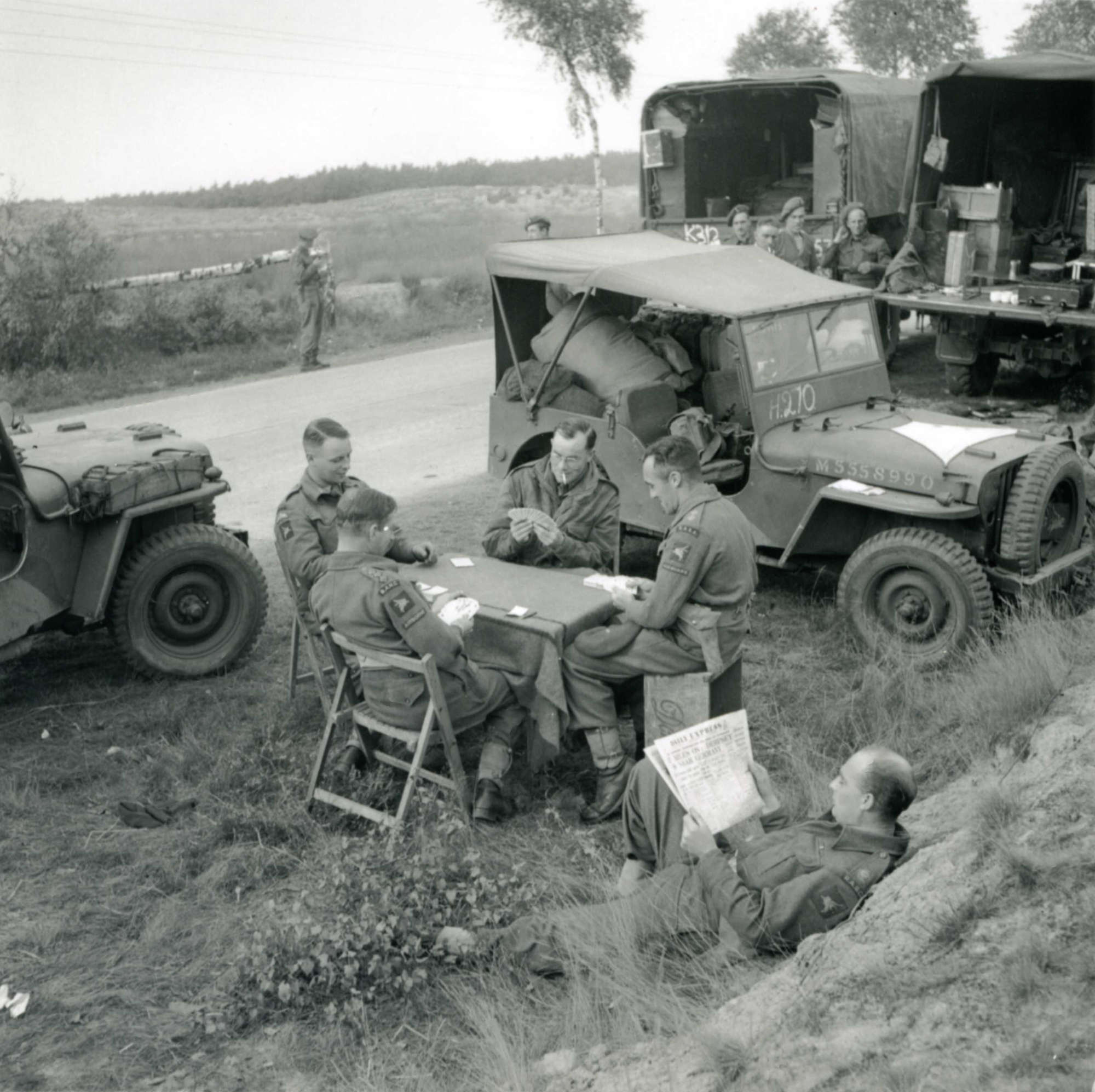
Officers of 250th (Airborne) Light Composite Company, R.A.S.C, part of 1st Airborne Division's 'Seaborne Tail', playing cards and reading beside their Jeeps during the advance of 30 Corps, 9 miles south of Eindhoven. 20/21 September 1944. Major J.R. Halls RASC is lying on the bank reading the Daily Express. Major J. Gifford, the O.C, is wearing the glasses and smoking, with Lieutenant E.T. Evans RASC sitting to his left on the beer crate. The officer with his back to the camera is Capt. C.W.K. Willard (RA.C). The name of the other officer is not known. The other officer is possibly Capt. P. Bushby. BU10160. Courtesy of the I.W.M.
Lt. Adams describes what it was like to play cards whilst artillery was being fired nearby: "That night, we in 250 Company were all waiting for the order to join the advance to Arnhem and the bridge. As we waited, John Gifford characteristically sat his officers down to a four of bridge. I'm afraid I didn't play very well. "But, Dick, we could have made four spades." (Bang!) "Sorry, sir." (Bang!)"
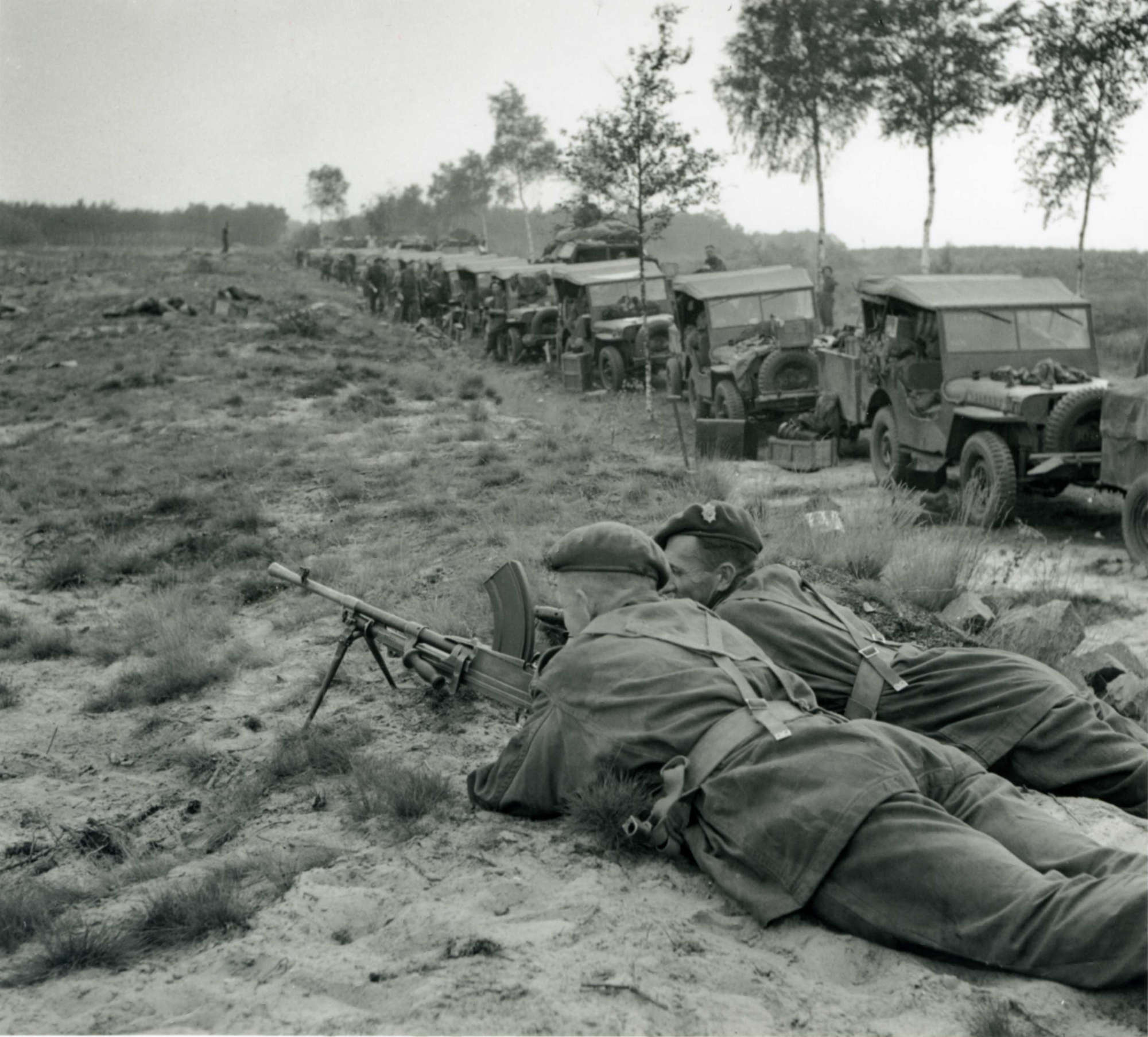
A Bren gun team of 250 Light Company, R.A.S.C. deploys to the side of the column, whilst halted on 'Hells Highway', 9 miles south of Eindhoven. 20/21 September 1944. BU10161. Courtesy of the I.W.M.
=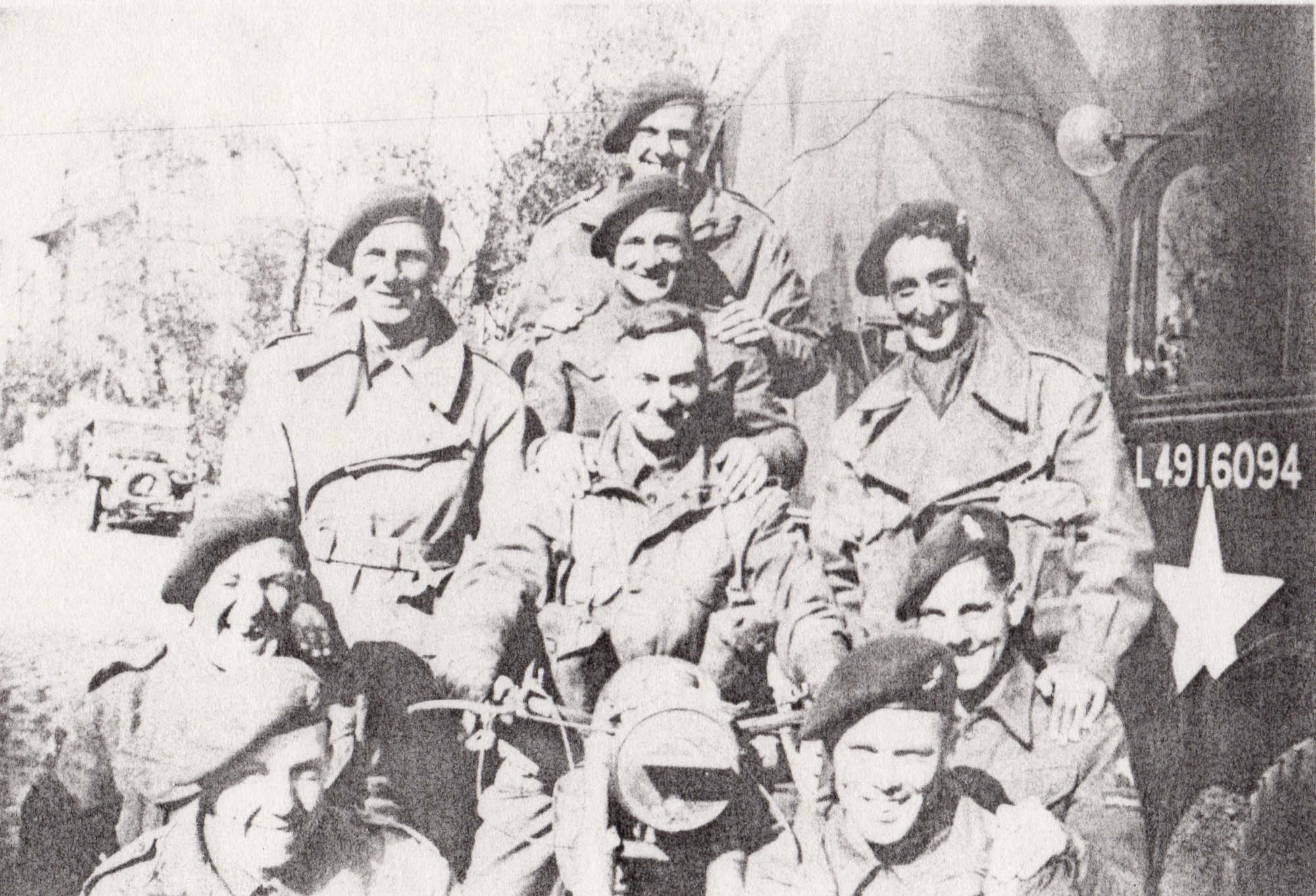
A group from the 1st Seaborne Echelon, pose for a photo next a 3-tonner. France/Belgium. August/September 1944. Front right is Sgt. George Myers, the Company P.T. Instructor. Courtesy Miss Jean Myers.
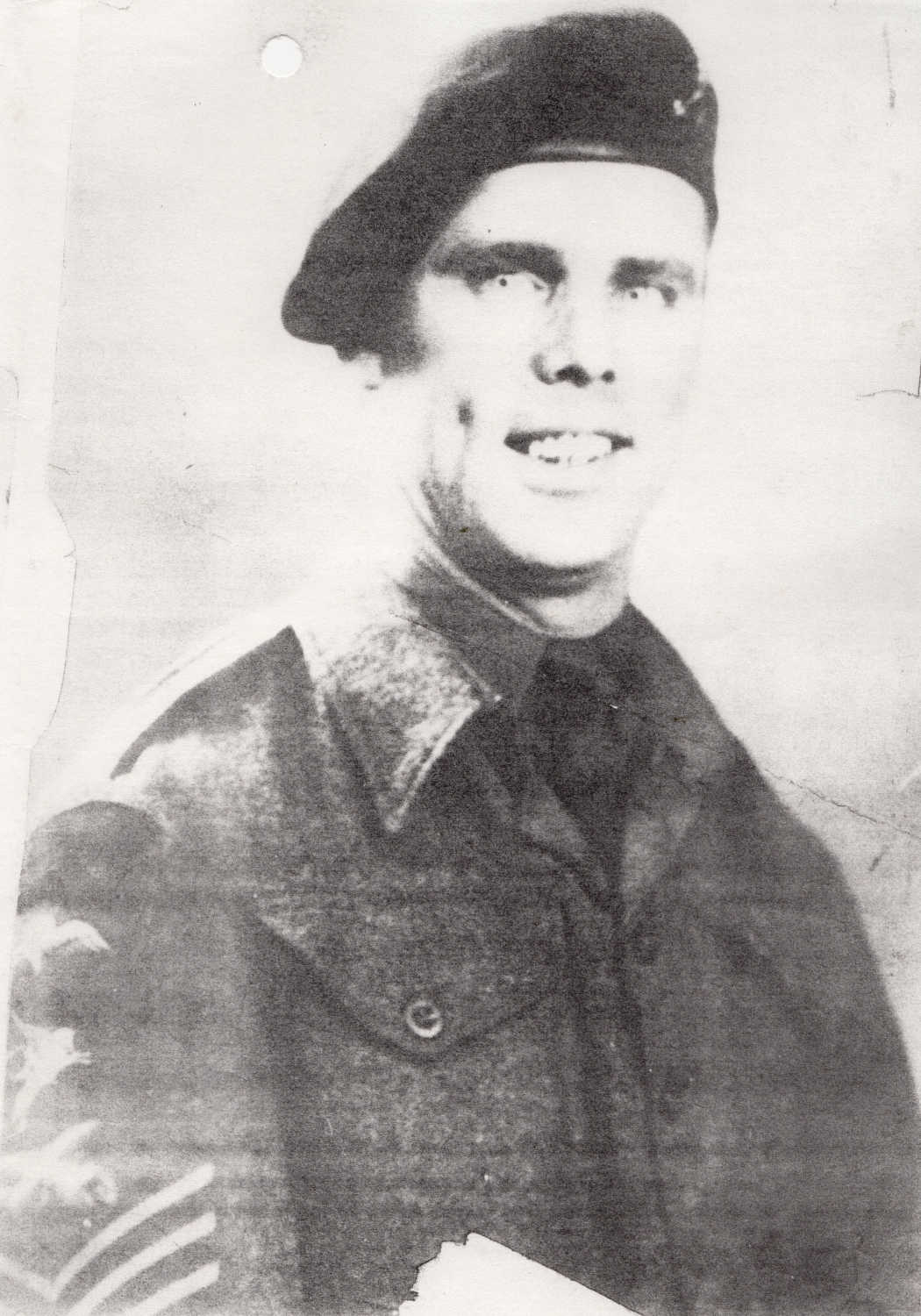
Sgt. George Myers, A.P.T.C. Born on the 1st June 1916, he had enlisted into The Duke of Wellington's Regiment on the 24th June 1940. It is not known when he transferred to the Army Physical Training Corps, but he was attached to 250 Company in 1942, and then was officially posted to the Company on the 29th may 1944. Courtesy Miss Jean Myers.
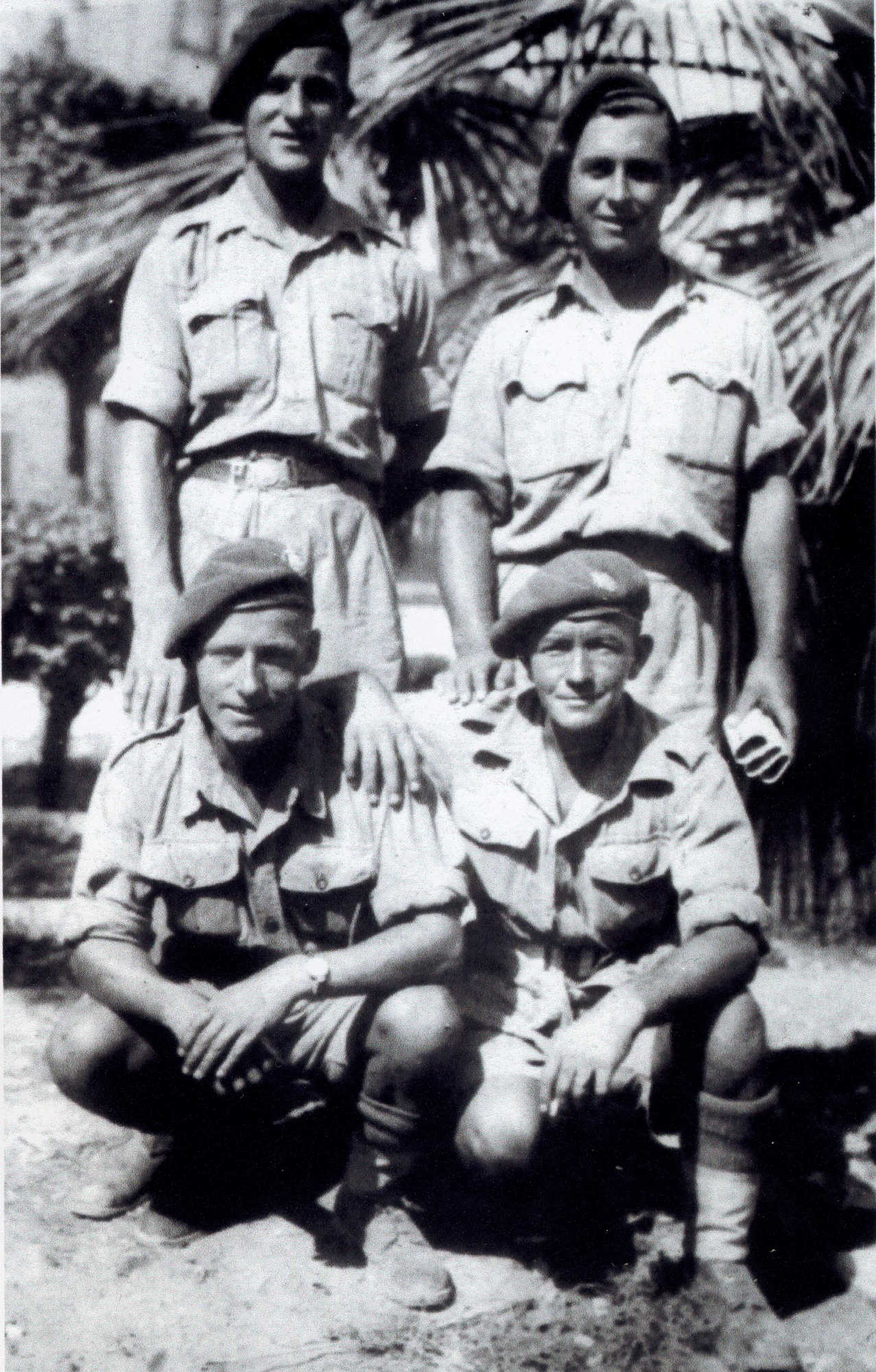
Pte. Archibald McNaught - front right. Born on the 28th November 1911, he enlisted into The Queen's Royal Regiment on the 16th July 1940, and was posted to H.Q. 1st Airborne Division on the 14th February 1942, and later to H.Q. R.A.S.C. Served in North Africa, Italy, and was on the 1st Seaborne Echelon in August 1944. Photo taken in Tunisia in 1943. Courtesy Airborne Assault Museum Archives.
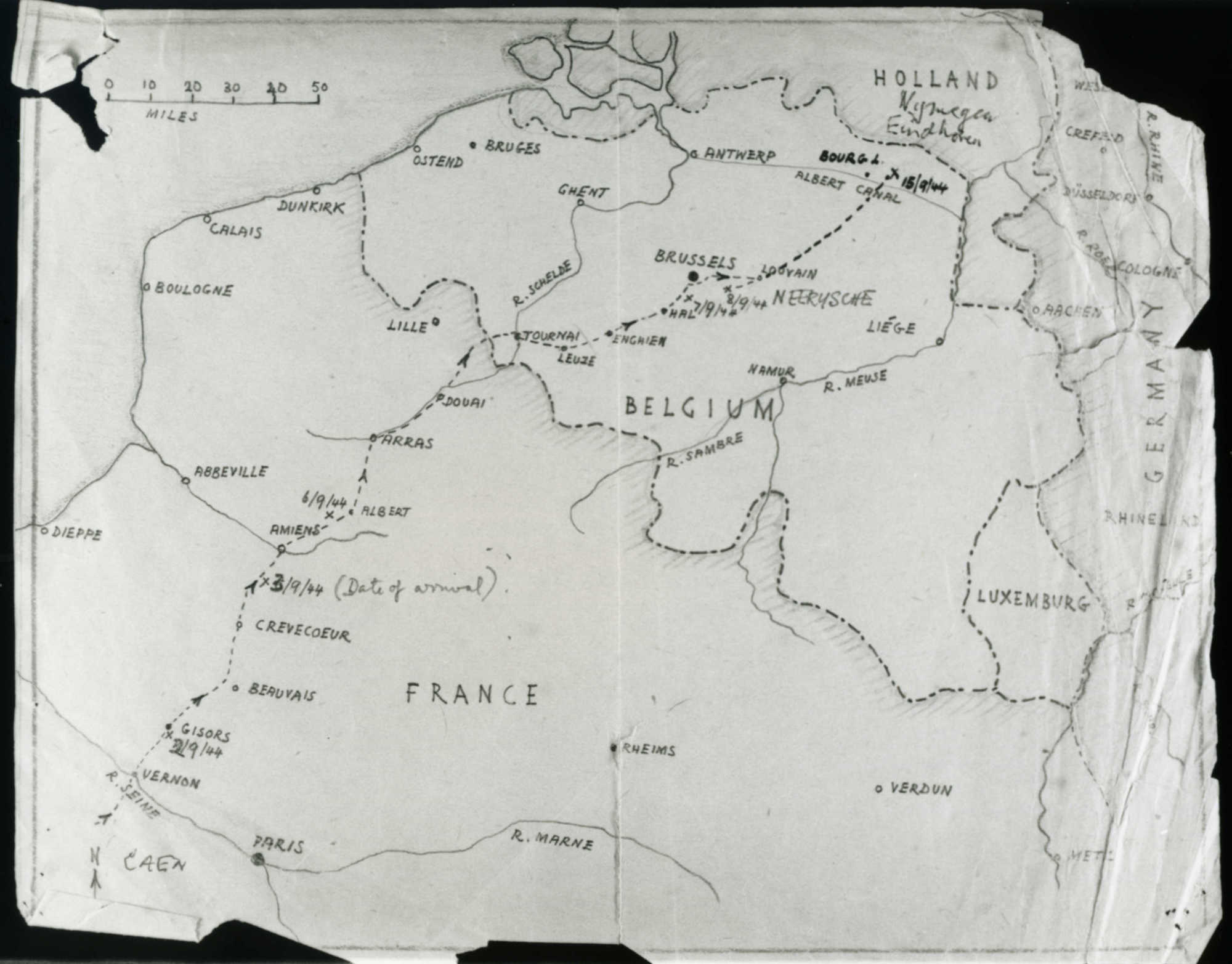
Sketch map of the route taken by the 1st Seaborne Echelon, from Normandy to the Dutch border, as drawn by Maj. John Gifford. Courtesy of John Gifford.
Lt. Adams: "It was Wednesday afternoon - a nasty, wet day - before we went into what had become known as 'The Corridor'. We had seen great numbers of tanks and lorried infantry go past us, and no end of sappers with loads of bridging materials; and we had watched grubby bands of German prisoners being shepherded to the rear. More gliders and parachute aircraft - the second lift - had flown over us during the previous day. We had not the least idea that anything might be wrong. Very likely, we supposed, XXX Corps were even now making whoopee at Arnhem with General Urquhart and the boys. All the time there was gunfire and throughout the nights there had been continuous noise and movement of vehicles. We were all sleepless. Still, that didn't matter: now we were on the way. I have only vague recollections of our journey up the Corridor to Nijmegen: about sixty to seventy miles. The extraordinary thing is that all the way we never saw a German and never came under fire. It was slow going, as usual. Along the road were signs, put up by the Sappers, warning against leaving the road, the verges not yet having been cleared of mines. In the little town of Veghel we waited a long time in the dark and the men quite rightly went to sleep. There were rumours of a German counter-attack and of The Corridor having been cut, but nothing happened. At length we were told to get moving again, and the whole place came to life with a great deal of noise - shouting and movement - in the midst of which an outraged voice yelled "Here, cut it out, all the damn' row! We've got to stay here!" [6]
Dvr. Neilson: "I think it was about the 19th September we got the orders to prepare to move, because an Armoured Division had forced a two mile wide corridor towards Nijmegen. On the 20th our journey towards Nijmegen started. It was a nightmare of a journey, we were stopped twice on our trip and along the road troops lay dead and in the fields lay dead cattle killed by stray gun fire or shrapnel. Our Company vehicles were mainly jeeps and trailers, but in the Workshop and HQ Platoons we had some heavy vehicles. I was in H.Q. Platoon and driving a 3 ton Bedford lorry. With me in the lorry was Staff Sergeant Smallwood, the Quarter Master Sergeant. Our load consisted mostly of clothing and rations." [6b]
The convoy arrived at Grave at 05.00 hrs, 22nd September, but heard that the route behind them, at Uden had been cut by enemy forces, and a 'stand-to' was ordered at 15.00 hrs. At 15.30 hrs they moved over Grave Bridge, and a recce was carried out of an area 4 miles south of Nijmegen, which was moved into at 18.00 hrs.
The O.C, Maj. Gifford, and the D.D.S.T. Col. Jefferies, carried out a recce of captured Supply Depots in the Nijmegen area on the 23rd September. It was reported that a Dvr. Jones. T, arrived back with the Company after having forced landed in a glider near Hertogenbosch on 'D' Day, and found his way through enemy lines. This is likely to have been T/255891. Dvr. Trevor Jones. At 13.00 hrs the next day there was a supply drop to the south-west of Grave by seventeen C47's, carrying 16 panniers each, with 237 being recovered. The captured Depot was taken over by the Company, and the stores checked. 'B' Echelon finally arrived in the Company location at Nijmegen. Lt. Adams was with 'B' Echelon: "I suppose it must have been very early on Sunday morning that we crossed the Maas on the captured bridge at Grave. It was all high girders, and stuck between two ribs thereof was an unexploded shell. That shell looked distinctly wobbly. From Grave it was only about seven or eight miles to Nijmegen, where fighting was going on near the bridge and along the south bank of the 400 yard-wide river. By this time we had all become more or less aware that the original scheme couldn't have gone according to schedule; never-the-less, we were still in no doubt that we would soon get to Arnhem, where the 1st Division would be in possession of the bridge. 250 Company was ordered to camp in a field on the southern outskirts of Nijmegen, right next to two batteries of 25-pounder guns which were firing in support of the troops advancing northwards from Nijmegen. I'd never felt so tired or sleepless in my life. And still it rained and rained." [7]
The expected supply drop on the 25th September, did not take place, and then the Seaborne Echelon were informed of the withdrawal from North of the River that night. Lt. Adams: "At some time in the early evening of Tuesday, the 26th, I was sent down to the centre of Nijmegen to ask the Divisional Camp Commandant, Major Newton-Dunn (generally known in 1st Airborne as 'Hoo Flung Dung'), about certain arrangements made for 250 Company. I asked him whether, as the survivors had come in during the night, he had happened to see Jack Cranmer-Byng. 'Hoo Flung' replied that he hadn't been able to notice any one particular person more than another. Then he said "And if you like I'll show you why." He guided me a short distance to a huge building - I think it must have been a gymnasium - with a wooden floor and no tables, chairs or any other furniture in it at all. That's all I can recall about it. It was all in twilight, so you couldn't see much anyway. As we approached the open door, Hoo Flung laid a finger to his lips. Inside, those who had got back from Oosterbeek were lying on the floor, huddled asleep under grey army blankets. The majority had not slept for a week. At Driel, during the previous night, they had been given a light, hot meal (they had been starving for about five days) and then, having got to Nijmegen, been put in the gym to sleep. On account of the dim light in the big building, visibility was limited. The grey rows of unconscious, motionless shapes stretched away until they blurred and you couldn't make out the far end." [8]
Dvr. Neilson: "We crossed the bridge of Grave, and we made camp in a field a few miles south of Nijmegen. We went to sleep in the back of our lorry, but we were suddenly awakened by Allied artillery, which went on firing all night long. One morning I got the order to go together with Sergeant Major Gibbs to the River. I drove along some roads in an area of which I had no idea where it was until I was stopped short of the River to pick up those who had managed to escape. 'John' Staple of our Company was the first one I saw and brought him back to Nijmegen. After the evacuation of the troops in Oosterbeek we went back to Louvain and from there to the ferry in Ostend. Arriving back in Lincoln, the Moorlands Hotel, I went on disembarkation leave." [8b]
On the 27th September, the evacuated personnel were refitted with clean uniforms and kit, the Depot was handed over to ground forces, and preparations were made for a move. The next day the whole Company, including the survivors from the Airborne Contingent, left Nijmegen at 07.30 hrs, and travelled in convoy to Louvain, being shelled as they moved down the 'corridor' - now known as 'Hells Highway'. The Airborne Party had to wait another day, but on the 30th September they were flown back to England aboard C47's from Brussels airport. Meanwhile, the Seaborne Echelon moved back to Neerysche, where they carried out collections of Supplies and Petrol, and then set up Supply Points and Petrol Points for the Division. [1]
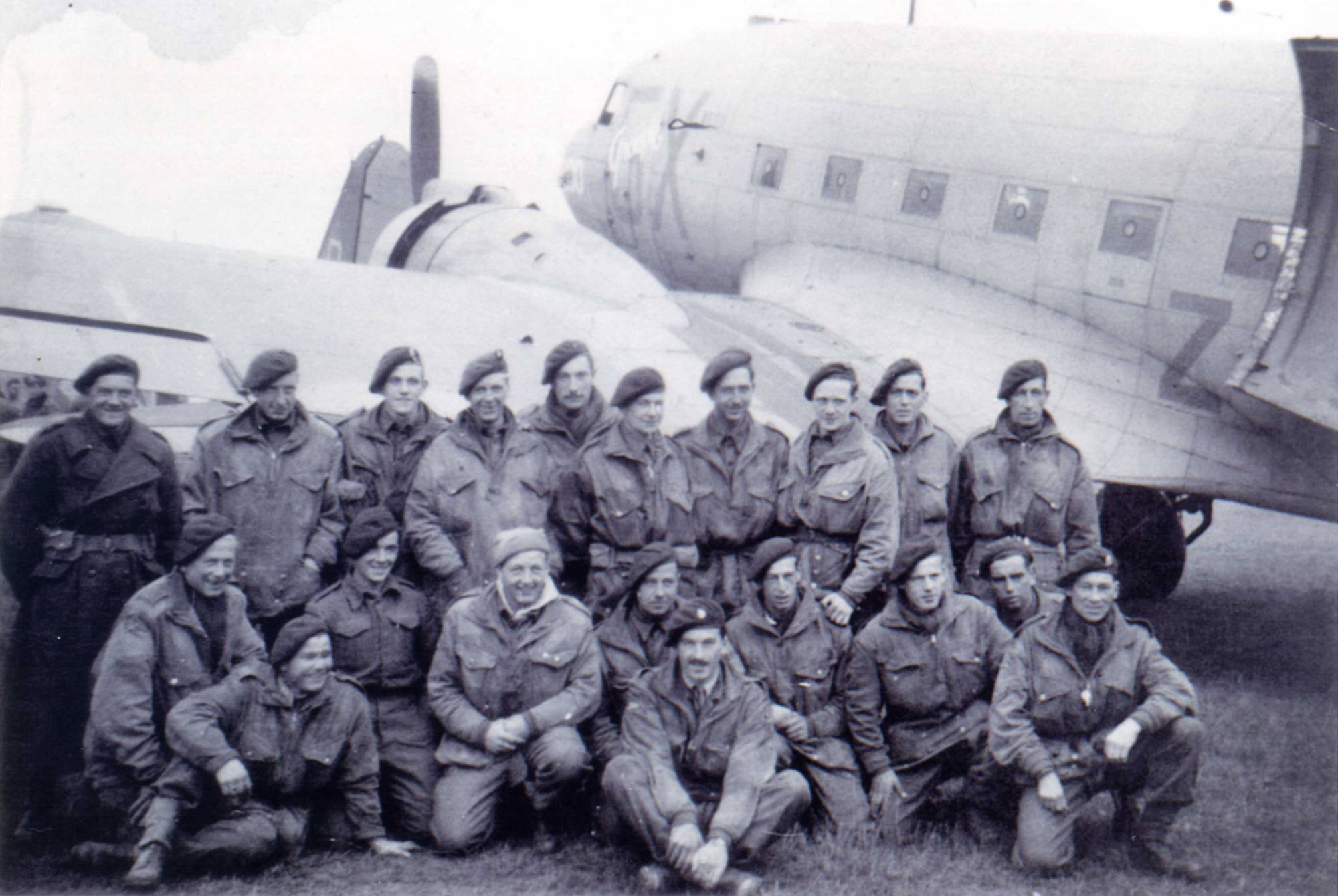
Survivors of No 2 Parachute Platoon, and their attached Transport Section, including those from the failed glider C/N: 974. However, they have been joined by Lt. J. Grice, sat at the front centre. Brussels Airport, shortly before boarding their aircraft to fly back to England. 30th September 1944. Dvr. K.W. Clarke is kneeling centre, wearing a cap comforter. Courtesy of Ken Clarke.
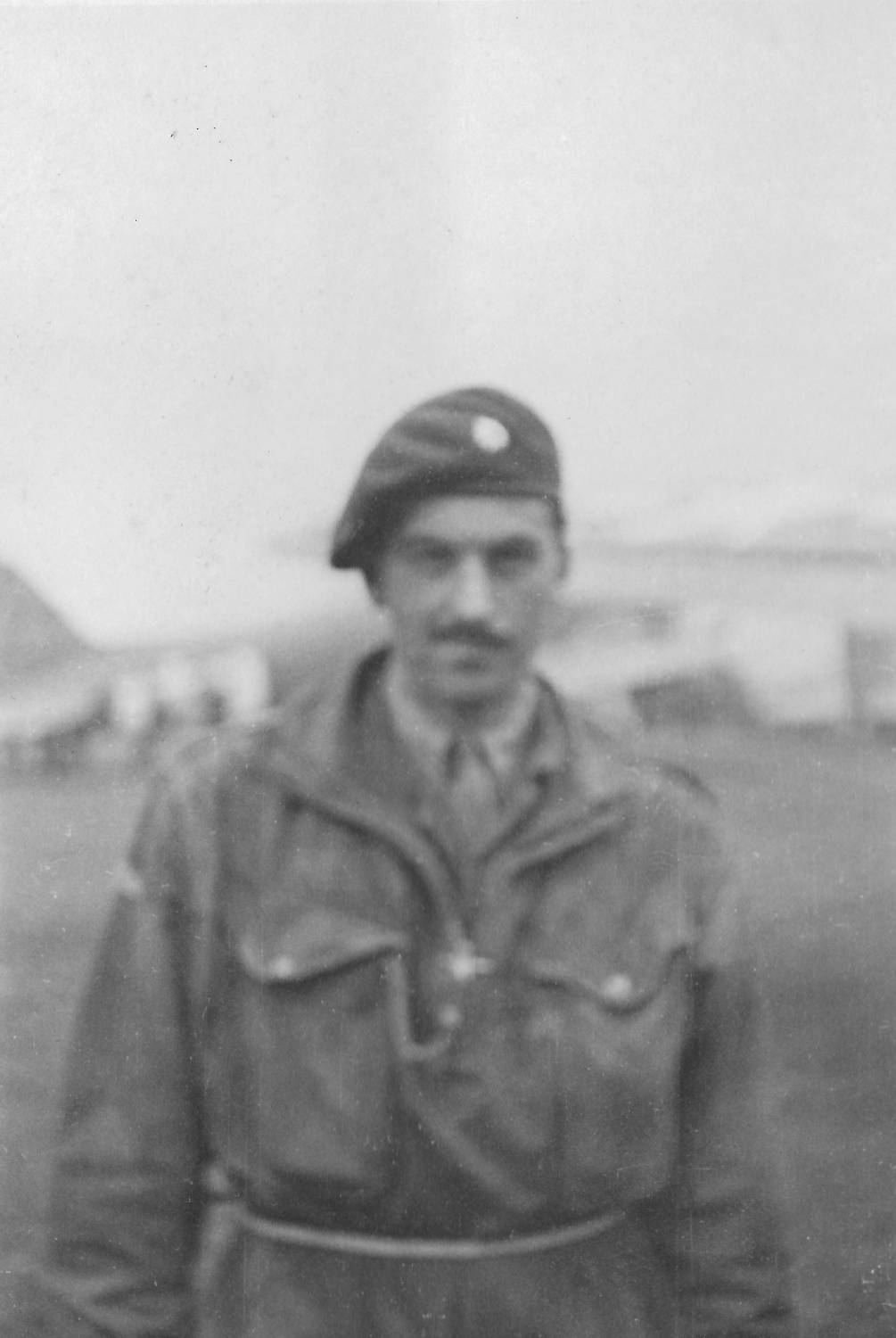
Lt. John Grice back at Folkingham Aerodrome. 30th September 1944. Courtesy of Richard Chancellor.
At 09.30 hrs, 2nd October, the Seaborne Echelon moved to Ostend, and loaded onto two L.S.T's at 19.00 hrs, 3rd October, but full loading was not complete until 20.00 hrs on the 4th October. They set sail the next day and landed at Southend at 09.00 hrs, 6th October, moving into a Transit Camp at Tilbury for the night. They moved back to their location at Moorlands Hotel, Lincoln on the 7th October, where the Seaborne Echelon were then sent on 14 days leave.
FOOTNOTE. [1] See Appendix XVI for details of 93 Company during September 1944.
Lt. Adams: "We were flown back to England and in due course, returned to our old location at Lincoln. Here John Gifford told a friend of mine, Peter Allsop, and myself that we were both promoted to Captain. We still had no reliable news about any of my missing N.C.O.s and men, and one of my first jobs was to write - as best I could - to the next of kin. Thank God all 'C' Platoon's missing eventually turned out to be prisoners." [9]
Maj. John Gifford remembered this whole period thus: "Really the journey through France, Belgium and Holland became a pleasant diversion and we were never less than three days behind the battle. I certainly recall the damaged German armour in the Falaise Gap, also participating in the liberation of Brussels - also our camp at Neerysche, where we played cricket and drank German stocks of Cointreau from tumblers! Then a night convoy without lights over the Dutch border, through Eindhoven to Nijmegen, and subsequently back the same way and home to Lincoln via Ostend." [10]
What about those left behind? The first large capture of men from the Company were those from No 3 Parachute Platoon, early on the morning of 21st September, near Arnhem Bridge. After rounding them up, searching and initial processing, they started the long journey to POW Camps in Germany. This process was under way for the officers - after they had undergone some questioning at a temporary holding area and house in Velp - and on the late afternoon of the 23rd September, a truck full of them, including Capt. 'Bill' Gell, were being driven towards Germany. In the village of Brummen, the truck slowed down to negotiate a bend in the road, and two officers, Maj. D. Mumford (B.C: No 3 Battery, 1st Airlanding Light Regiment, R.A.) and Maj. J.A. Hibbert (B.M: 1st Parachute Brigade), jumped from the back and ran off. Whilst Maj. Hibbert evaded capture, Maj. Mumford was quite quickly recaptured. However, it was the actions of one of the German guards that was to have the greatest effect on those who remained in the back of the truck, as he opened fire on them with his Machine Pistol, killing four men straight away, and wounding several others, two of whom died later. Capt. Gell narrowly avoided being hit: "We tried to hole up in a bombed out building, but we were probed out by the Germans not long after first light. As a P.O.W. I was involved in an unfortunate incident en route to Germany, in which a number of our men were killed, together with one of our German guards. Eventually I reached Oflag 79, where I was stuck until April 1945 and my war had ended. On my return to the U.K. I discovered that the remnant of 250 Company had been moved to Norway, and I made no further contact, and was demobilised." [11]
Of the many men who were wounded, and left behind twenty-nine ended up being sent to the 'Airborne' Hospital at Apeldoorn, these were: Sgt. Chedgey, Edmonds, Cpl's. Bater, Fairweather, E.G. Johnson, L.J.G. Judd (who died of his wounds), Perrin, D. Stephenson, Stone, L/Cpl. G.N. Edwards, Farrar, Syme, Dvr's. Arkell, Batsford, Bricker, Buckley, Cave, Falcon, Foster, Furniss, Gant, J.A. Green, Ineson, Jennings, McAndrew, O'Donnell (att'd), Potter, A. Shaw, and Pte. J.S. Jones.
Wounded and taken prisoner, Dvr. William Preston, 'D' Transport Platoon, was taken to the St. Joseph Psychiatric Hospital at Apeldoorn, where unfortunately he succumbed to his wounds on the 1st October 1944. He was buried in the adjacent cemetery.
One of the men in for a shock was Dvr. Geoffrey Gelsthorpe, 'G' Transport Platoon, who was back home on survivors leave, when his wife received an official notice that he was missing!
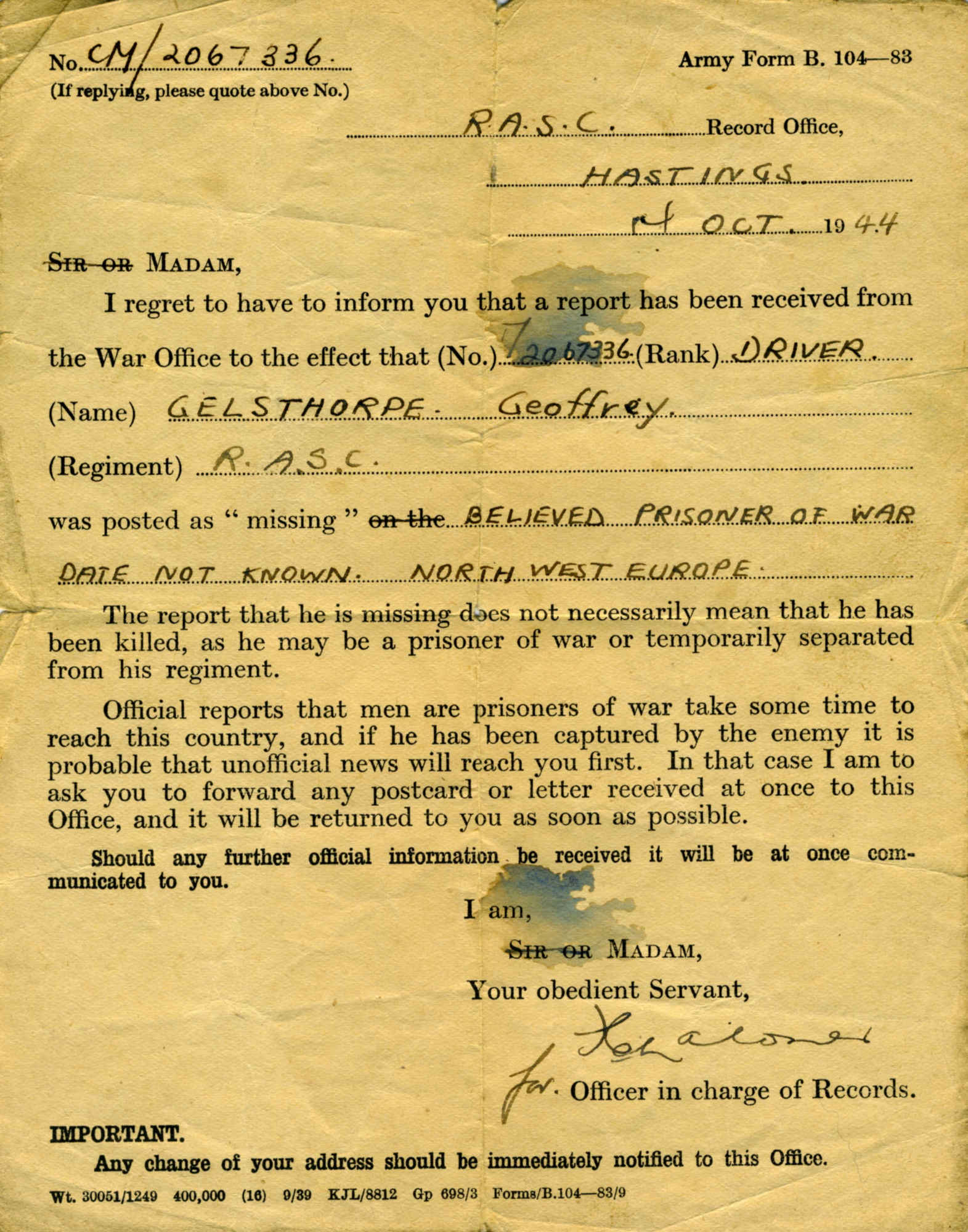
The letter to Mrs. Gelsthorpe declaring that her husband is 'Missing', dated 14 October 1944. Courtesy of Philip Pringle.
Dvr. Geoffrey Gelsthorpe was posted to 250 Company on the 16th June 1942, and served with it in North Africa, where it is likely that he did his parachute course in August 1943, and went onto serve with the Detachment in Italy, returning to the U.K in April 1944. He was one of those sent on the Seaborne Tail to France, but then returned to U.K as the airlift allotment was increased. Somehow, he became separated from the main Body of the Company at Nijmegen and was missed off the Roll Call. The mistake was not properly cleared up until November 1944.
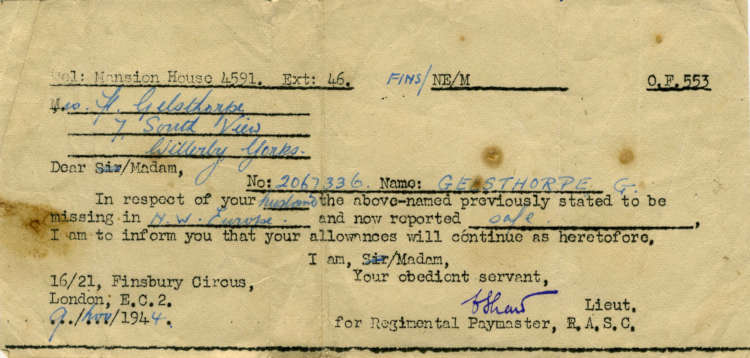
The official notification that Dvr. G. Gelsthorpe was no longer 'missing', dated 9 November 1944. Courtesy of Philip Pringle.
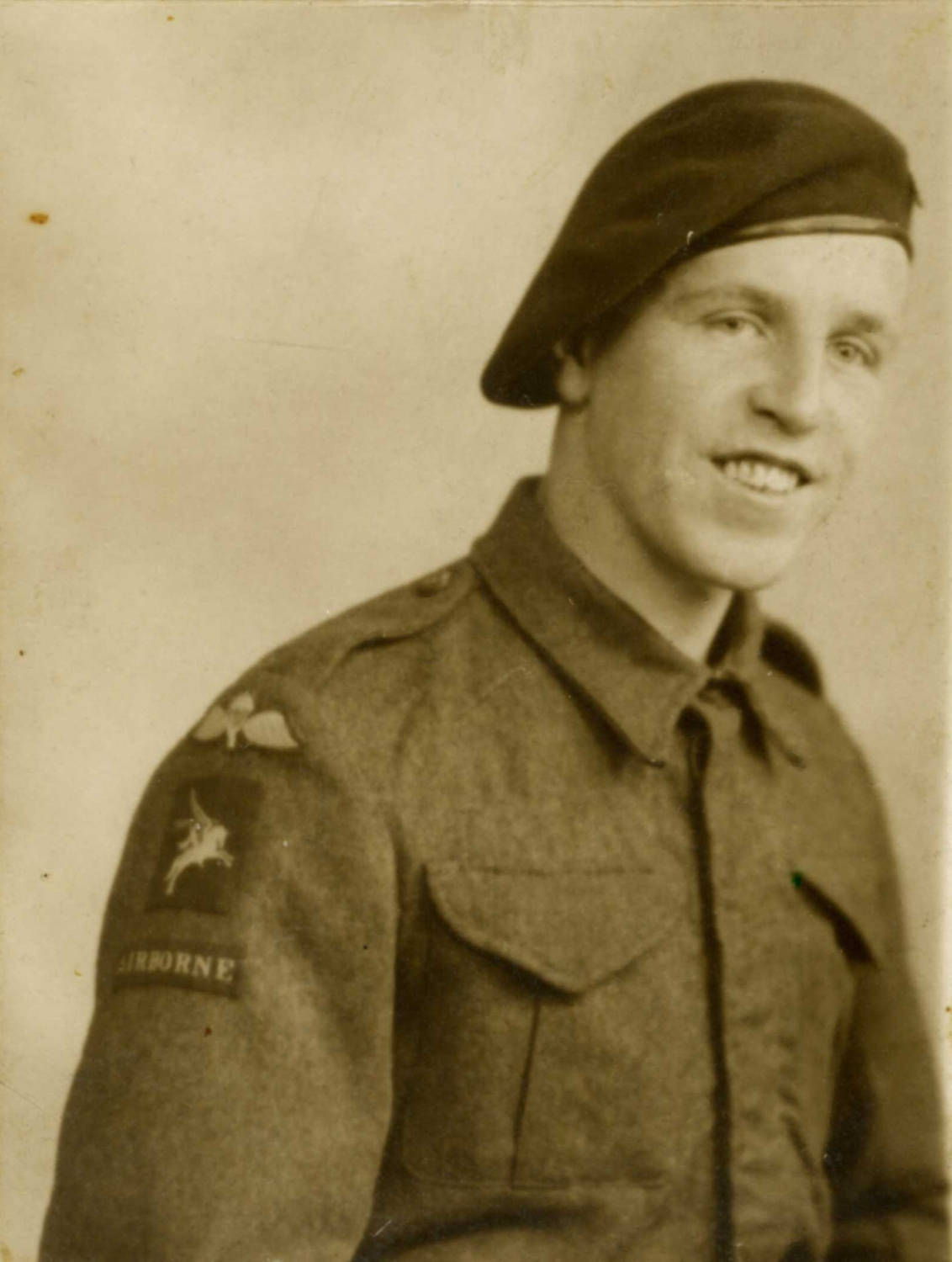
Dvr. Geoffrey Gelsthorpe. 'G' Transport Platoon. 1943/44. Courtesy of Philip Pringle.
Another who got back across the river was Cpl. Cyril 'Charlie' Rushton, also from 'G' Transport Platoon, he had been on the 1st Seaborne Tail to France, but had returned to take part in the extra air-lift. Born on the 31st October 1905, he had been a Van Driver before the War. He had enlisted on the 2nd January 1941, and then been posted to the Company on the 7th March 1941.
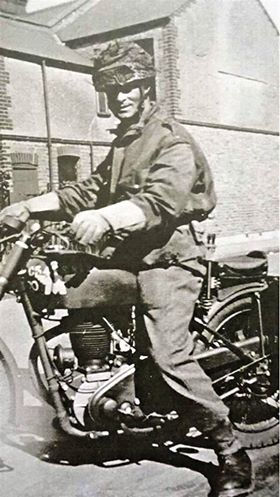
Cpl. 'Charlie' Rushton. 'G' Transport Platoon. 16th September 1944. The photo was taken by his wife (Irene), on the junction of Park Gate Road and Buckingham Road, Watford, where he had stopped on his way to the mounting airfield! Courtesy of Alex Junier.
Lt-Col. Packe wrote to Mr. Kavanagh (senior) on the 3rd October 1944. Here are some extracts:
'Dear Mr Kavanagh,
I am writing to give you all information possible about your son Capt D.T. Kavanagh, or "Paddy" as he was always known to us.
I am afraid that he is officially reported "missing" as a result of the recent airborne operation at Arnhem.
The rest escaped, and continued to fight nobly for the rest of the battle, and some of them have now rejoined us in this country.
There is no doubt, but for Paddy's presence of mind and fearless courage, none of the platoon would have escaped, and by his gallantry he saved the lives of a large number of his own men.
There is no evidence whatever to suppose that he is anything but missing. He may have been taken prisoner, in which case you will hear as soon as the Germans announce the names, but the opinion of the men who where there is that the fire was so intense and the ground so exposed that it would be almost miraculous if he were not killed or at least wounded. I have known Paddy since he joined my Company at Amesbury two years ago. I am truly proud to say that he was a personal friend of mine. Even before this battle I had long been of the opinion that he was the finest officer I had ever known, without any exception, and that in addition he was a first rate sportsman and gentleman. This last action of his was, unfortunately, just the sort of thing which one would have expected him to do. Sgt McDowell and the men of his platoon, and everyone in the Company are very badly upset; his charm was enormous and his gaiety infectious. He was a young man whom the British race can ill afford to lose. I can only begin to imagine your feelings through my own sense of loss. You and all who were fond of him have my very deepest sympathy.
Had he wished, Paddy could probably have obtained promotion before now, but his Parachute Platoon were his pride and joy and he did not wish to leave them. They were an exceptionally fine body of men, who compared favourably with any other troops in this rather exceptional Division. They did a fine job in action both while under Paddy and later after his inspiring influence had been removed. Those that have now come back will attempt to rebuild what he originally made.
Please accept from me, and from all Officers and men of the Divisional RAS.C. our very sincere sympathy and lasting regret and our very earnest hope that you may soon receive good news of him.
Yours very sincerely, (Sgd) Michael Packe.'
Dvr. Joseph Burns, 'D' Transport platoon attached to No 2 Parachute Platoon, had died of his wounds at the Tafelberg on the 21/09/44. He was initially reported missing in the Evening Chronicle, a North Tyneside Newspaper on Thursday, 19 October 1944. Then, five days later, there was further bad news for the family, as reported in The Evening News, 24 October:
'Bad News For New York Family. BROTHERS MISSING SAME DAY.
The news that two brothers have been posted as missing on the same day while serving with their respective Divisions in the North-West European theatre of war was recently received by their mother, Mrs. J. Turnbull, of 93 Brookland Terrace, New York.
The brothers are Driver Joseph D. Burns, R.A.S.C. serving with an Airborne Division, and aged 22; and Paratrooper George W. Burns with the R.A.M.C., aged 24. [2] Both were posted missing on September 25.
They are the sons of Mrs. Turnbull and the late Mr. George Burns, and were both born in New York, Shiremoor. Educated at New York Council School, George was a miner until he reached the age of 19, when he joined the Regular Army, while Joseph worked at Parson's Engineering Works until he had to join the Army.
Both had had previous over-seas service before going to Normandy with the invasion forces. They have one elder brother, Driver Charles Alfred Burns, who is with the R.A.S.C. in Italy.'
Confirmation of his death probably took until several months after the area was liberated in April 1945.
FOOTNOTE. [2] This was 2061133. Pte. G.W. Burns. 133 Parachute Field Ambulance, R.A.M.C. Evader/Pegasus I.
There was considerable effort by a lot of people to establish what had happened to the men that were posted as 'Missing'. One example is that of Cpl. Stanley West, the correspondence with his wife Doreen (who he had married on the 11th September 1936), and the sometimes unofficial channels that appeared to provide information before the official ones. Even so, it was many weeks, and sometimes months before any definitive information became available.
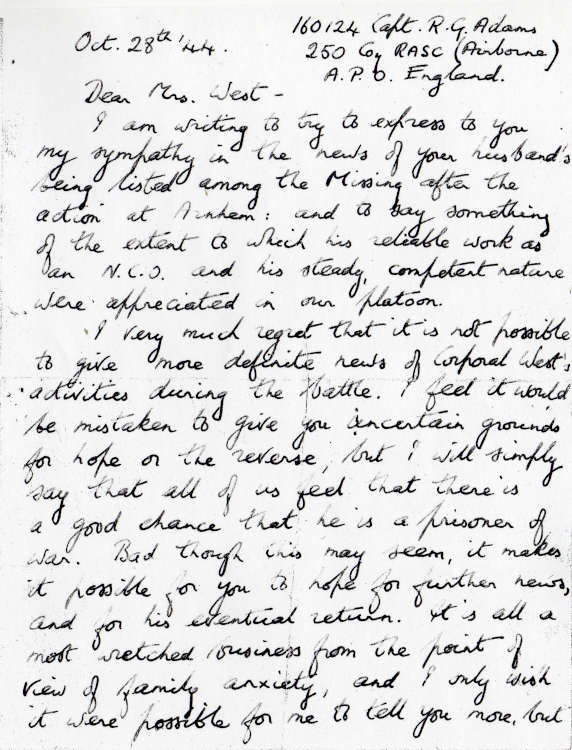
First letter, page 1.
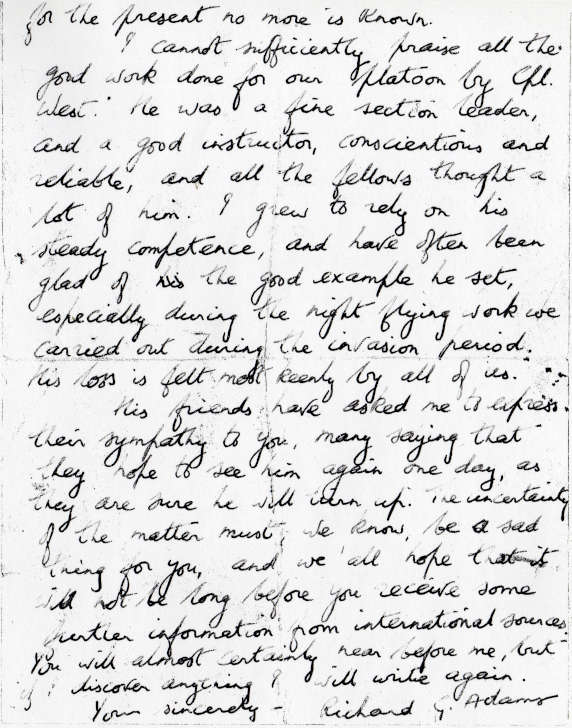
First letter, page 2.
160124. Capt. R.G. Adams.
250 Coy RASC (Airborne)
A.P.O. England.
Oct 28th, 44.
Dear Mrs West,
I am writing to try to express to you my sympathy in the news of your husband's being listed among the Missing after the action at Arnhem: and to say something of the extent to which his reliable work as an N.C.O. and his steady, competent nature were appreciated in our Platoon.
I very much regret that it is not possible to give more definite news of Corporal West's activities during the Battle. I feel it would be mistaken to give you uncertain grounds for hope or the reverse, but I will simply say that all of us feel that there is a good chance that he is a prisoner of war. Bad though this may seem, it makes it possible for you to hope for further news, and for his eventual return. It is all a most wretched business from the point of view of family anxiety, and I only wish it were possible for me to tell you more, but for the present, no more is known.
I cannot sufficiently praise all the good work done for our Platoon by Cpl. West. He was a fine Section leader, and a good Instructor, conscientious and reliable, and all the fellows thought a lot of him. I grew to rely on his steady competence, and have often been glad of the good example he set, especially during the night flying work we carried out during the invasion period. His loss is felt most keenly by all of us.
His friends have asked me to express their sympathy to you, many saying that they hope to see him again one day, as they are sure he will turn up. The uncertainty of the matter must, we know, be a sad thing for you, and we all hope that it will not be long before you receive some better information from International sources. You will almost certainly hear before me, but if I discover anything I will write again.
Yours Sincerely, Richard G. Adams.
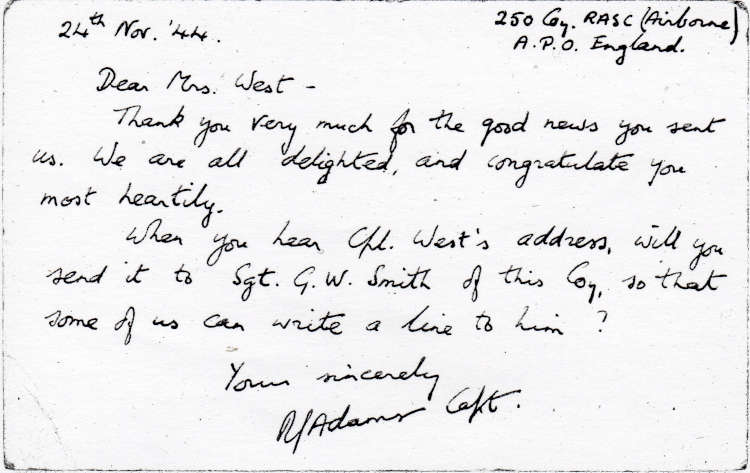
Second letter.
250 Coy, RASC (Airborne)
A.P.O. England.
24th Nov, 44.
Dear Mrs West,
Thank you very much for the good news you sent us. We are all delighted, and congratulate you most heartily.
When you hear Cpl. West's address, will you send it to Sgt. G.W. Smith of this Coy, so that some of us can write a line to him?
Yours Sincerely,
R.G. Adams, Capt.
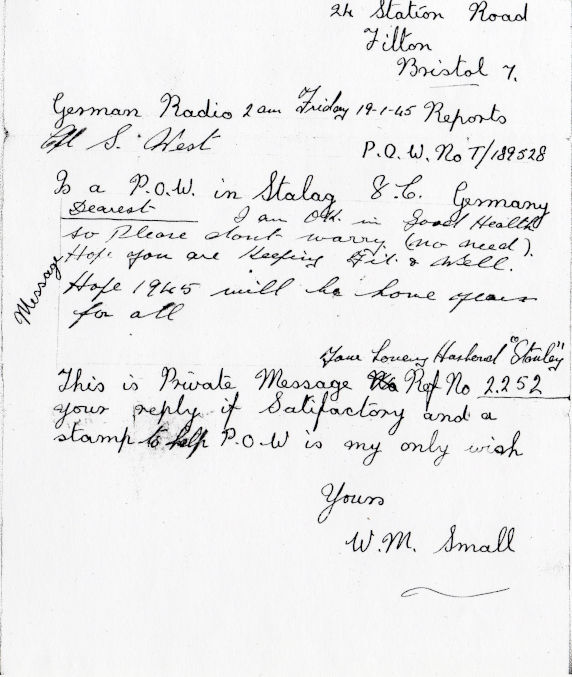
Third letter.
24 Station Road,
Filton,
Bristol 7.
German Radio 2 am Friday 19-1-45 Reports Cpl. S. West. P.O.W. No T/189528 as a P.WO.W. in Stalag 8.C. Germany.
Message. Dearest, I am O.K. in good health, so please don't worry (no need). Hope you are keeping fit & well. Hope 1945 will be home years for all. Your loving husband Stanley.
This is Private Message Ref No 2.252 your reply if satisfactory and a stamp to help P.O.W. is my only wish.
Yours W.M. Small.
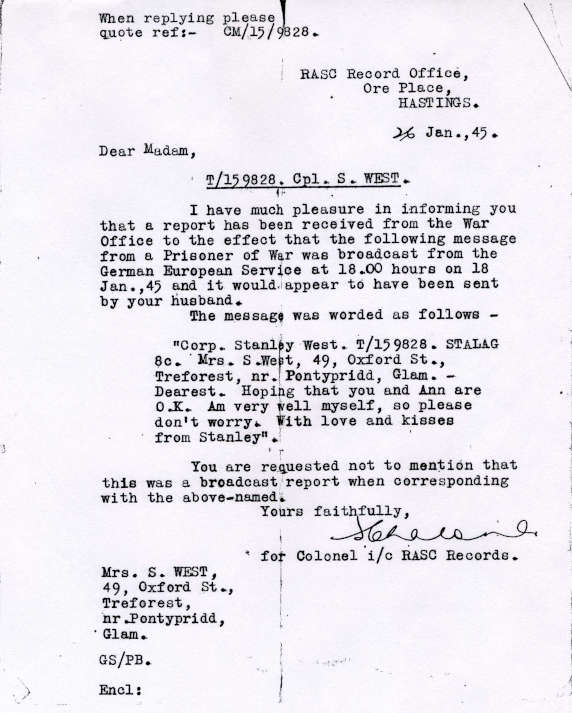
Fourth letter.
When replying please quote ref:- CM/15/9828.
RASC Record Office,
Ore Place,
HASTINGS.
26 Jan, 45.
Dear Madam,
T/159828. Cpl. S. West.
I have much pleasure in informing you that a report has been received from the War Office to the effect that the following message from a Prisoner of war was broadcast from the German European Service at 18.00 hours on 18 Jan, 45 and it would appear to have been sent by your husband. The message was worded as follows -
"Corp. Stanley West. T/159828. STALAG 8c. Mrs. S. West, 49 Oxford St, Treforest, nr. Pontypridd, Glam. - Dearest. Hoping that you and Ann are O.K. Am very well myself, so please don't worry. With love and kisses from Stanley".
You are requested not to mention that this was broadcast report when corresponding with the above named.
Yours faithfully,
For Colonel i/c RASC Records.
A letter was sent to Mrs. Annie Bennett by an officer of the Company. The name signed at the end is Lt. J. Green, but no such officer served with 250 Company. The survivors of No 2 Para Platoon were commanded by Lt. J. Grice, and as the letter is typed, it is thought a clerk was given the task of re-typing the hand-written letters and made a mistake - the date must also be a mistake, as they did not get back until 30th September, and it was early October when letters were written and sent out.
Lieut. J. Green
250 Airborne R.A.S.C.
Airborne Light,
A.P.O.
September 1944.
Dear Mrs. Bennett,
By now the War Office should have notified [you] about your husband, but I thought that some first hand information might seem a little more personal. Your husband Dvr. Bennett was involved in a very gallant action at the height of the Battle of Arnhem. The platoon he was with were caught by machine gun fire, and along with an officer and a few comrades, he assaulted the guns to enable the rest of the platoon to get away. On the action of those gallant few some fifteen lives were saved. From that time no news has been received by us about any of those with your husband, but we all hope and pray that they were only captured. Those who came out asked us to pass on to you their indebtedness for the action of your husband took part in and their hopes, as well as my own, that there will reassuring news of him before very long.
I am yours sincerely,
J. GREEN.
Lt. John Grice did not, at this stage know that Dvr. Wilfred Bennett had died of his wounds.
Maj. John Gifford wrote to the next of kin as soon as he had any confirmation of the fate of his men, one such was the widow of L/Cpl. Archibald Docherty:
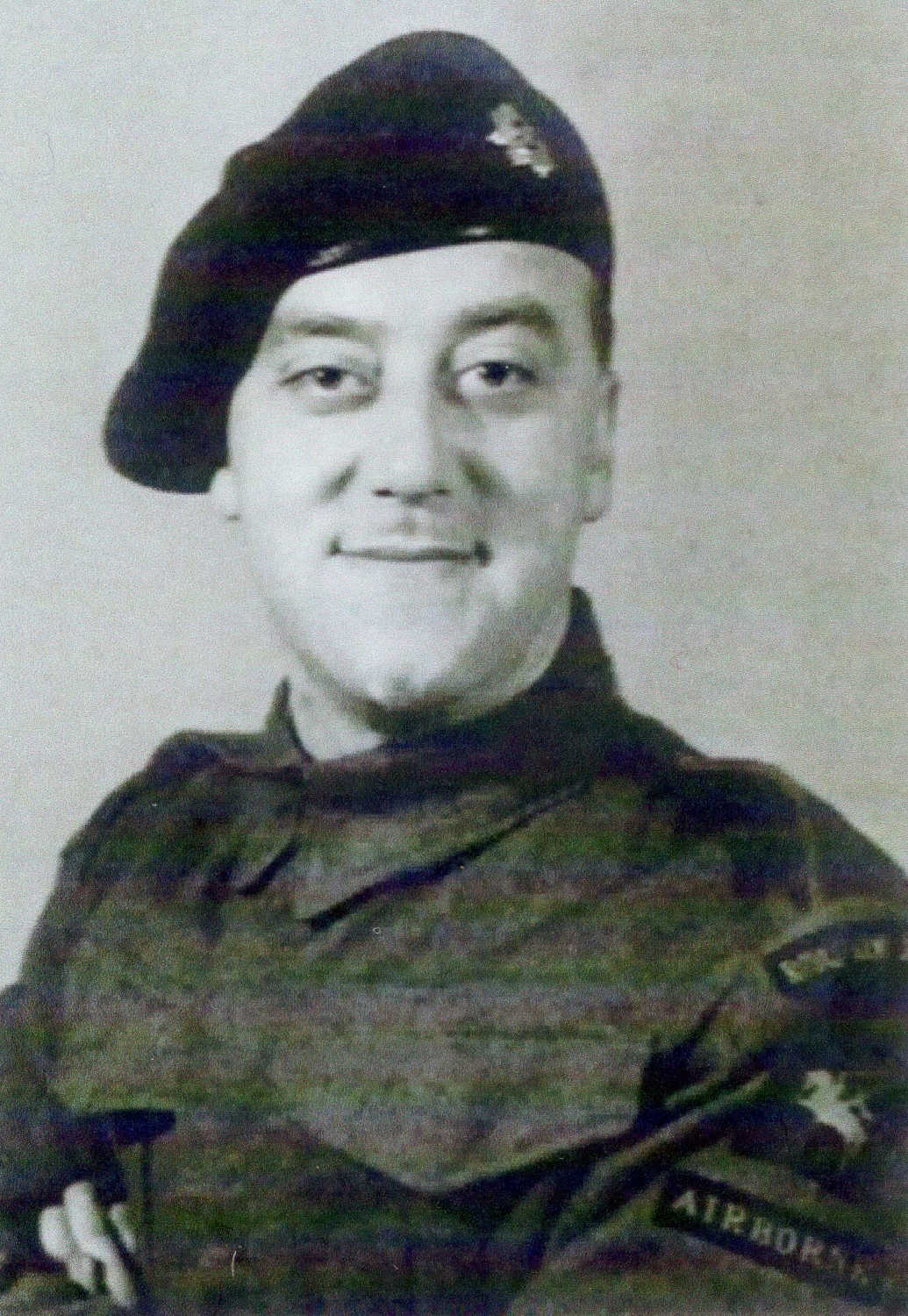
L/Cpl. Archibald Docherty. 'D' Transport Platoon, attached to No 2 Parachute Platoon. Courtesy of Patric van Aalderen.
Major J.H. Gifford R.A.S.C.
250 Coy R.A.S.C. (Airborne Lt).
APO England.
26/10/44.
Dear Mrs Docherty,
I am writing to express my very deepest sympathy to you in your great loss. I have known your husband ever since he joined this unit, and I can assure you that he was greatly respected by officers and men alike, and that we shall miss him very much.
His death at Arnhem in action, in company with so many of his comrades, is I know a very great blow, but I hope you will not feel that he died in vain.
Please let me know if there is anything I can do.
Yours very sincerely,
JH. Gifford.
In some cases it took longer to track down the next of kin to write to them, by which time, they had probably had official notification of the death, but the officers felt a deep sense of responsibility towards their men. Thus Capt. Carnmer-Byng wrote to Mr and Mrs Walsh on the 23rd September 1947. Here are some extracts from that letter:
'At last I have found your address, and can write to you about your son - Sergeant J. Walsh of 'A' Para Platoon, 250 Company RASC (Airborne Light). I have just returned from this year's pilgrimage to Arnhem, where I was able to visit his grave.
My name is Capt. Cranmer-Byng, and I joined 250 Company as a very junior officer at the very beginning of 1941. Your son was then a Cpl, and I was given the Platoon in which he served. From then onwards, we often served in the same Platoon, and finally at the beginning of 1944 when the Parachute Platoons were formed, I asked especially to have "Jock" (as he was affectionately called in the Company), as my Platoon Sergeant. From then until Sept 17th of the same year, we were constantly together, training the Platoon, taking part in parachute exercises, and getting ready for countless operations that never came off.
During the long period of waiting from D-Day until Sept 17th, your son was splendid. Although always firm in matters of discipline, he was very popular with the men of the Platoon, and did more than anyone to keep up their morale during the months of waiting. His one anxiety during those months was that we might be prevented by some mischance from taking part in the fighting. After that, the battle got very fierce and A Para platoon held the middle of the Divisional perimeter from Sept 21st until the evacuation across the Rhine. During those days, the Platoon fought with great determination and skill and I knew that the years of hard training that Jock had carried out with the men, were having their reward. Eventually, I brought out about 15 men, nearly half the Platoon, across the Rhine. Of the others, five were killed and the remainder prisoners of war.
When we returned to England, I immediately wrote to the Next of Kin of men missing from my platoon. Unfortunately, I did not have your address, but only that of Jock's wife and although I wrote her a long letter and told her what a splendid Sergeant he had been and what a gallant end he made; she did not reply. I had known for some time before we went to Arnhem that Jock was having domestic trouble and I used to give him all the leave possible.
Also on my return, I recommended several of my platoon for awards, but unfortunately, they were not granted. Instead as platoon officer, I was awarded the MC in recognition of the splendid work of my platoon and their well-trained and soldierly bearing. It is not often that the RASC have to fight, but these men certainly did. I only wish that Jock had been alive to see me receive the MC from the King, for it was as much Jock's as mine and in any case, he always treated me as a father and looked after my interests.
On Sept 17th of this year, I went to the service at the cemetery which was attended by thousands of Dutch people and at least 600 English. It was a very touching service, ending with the Last Post and Reveille. Then hundreds of Dutch children with bunches of flowers placed them on the graves that they cared for. After that, the next of kin placed their flowers and then the cemetery was open to the public. I went in and finally found Jock's grave but not until I had parted aside a lovely bunch of red flowers - called gladioli I think and read his name. His grave is beautifully cared for and these lovely flowers had only just been placed on it. I found out who cares for his grave and visited them. Finally, before I left Arnhem, I took a bunch of flowers to the cemetery myself and placed them on Jock's grave, with an inscription which read as follows: -
In proud memory of Sergeant. J. Walsh. From his friends in 250 Company RASC 1st Airborne Division. ALWAYS REMEMBERED.
J. L. Cranmer-Byng, Capt, 'A' Para Platoon.
When I finally left the cemetery it as brilliant with flowers and looking very lovely and peaceful in the bright sunlight. And so I said farewell to my Platoon Sergeant and my friend. Please forgive me for not writing to you before, but this is the first real opportunity I've had. I am now out of the Army and back in civilian life.
With very best wishes to you both,
Yours very sincerely,
J. L. Cranmer-Byng.
Amongst those taken prisoner from No 3 Parachute Platoon at Arnhem Bridge was Cpl. George Fenwick. He, like most of the others, was sent initially to Stalag 12A at Limburg. This was a temporary holding and sorting camp, and the amount of time spent there varied. In the case of Cpl. Fenwick, he was sent on to Stalag 2A at Neubrandenburg, arriving there on the 7th October 1944, and remaining there until being liberated on the 4th May 1945.
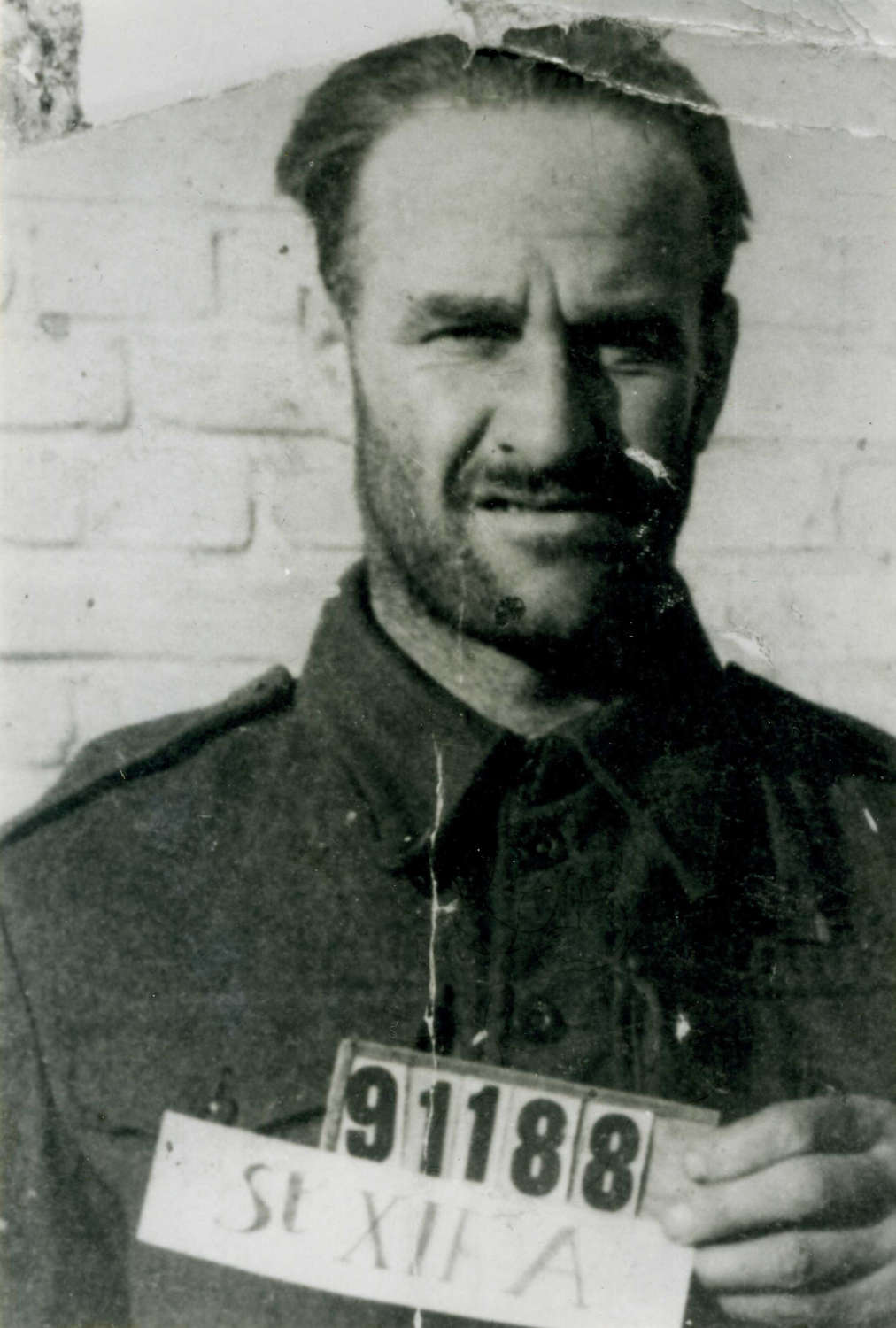
Cpl. George Rae Fenwick was born on the 2nd April 1911 and came from Manchester. He was working as a Foreman Decorator before the War. Photo taken whilst at Stalag 12A. Courtesy of Ken Greenough.
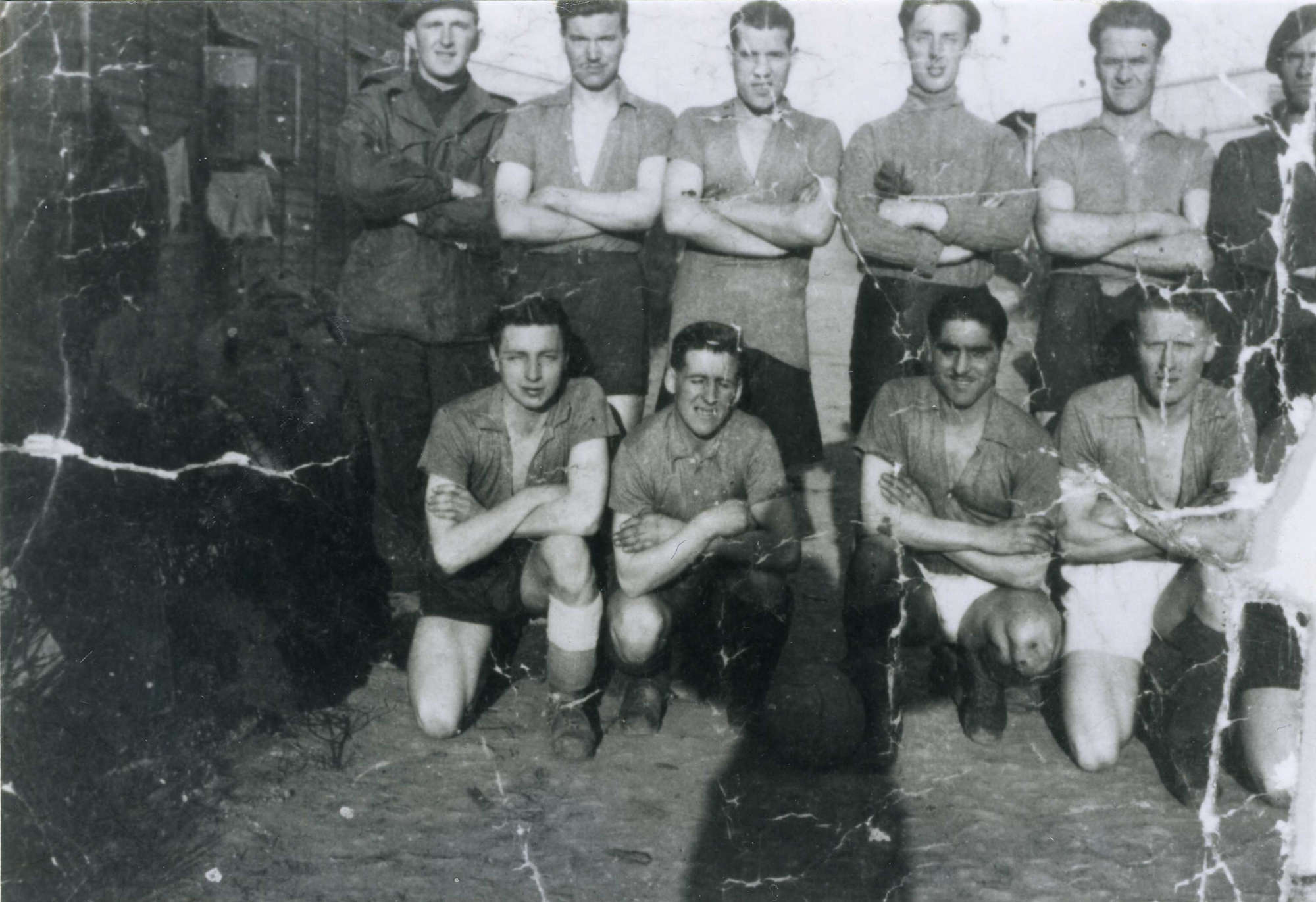
Cpl. George Fenwick had enlisted on the 1st October 1939, and then been posted to the Company on the 30th January 1943. Here he is as a member of the Prison Camp Football team. Back Row, 2nd from right. Courtesy of Ken Greenough.
Another 3 Platoon man taken prisoner at the Bridge was Dvr. Thomas Jones: "It took five days to get to Stalag XIIA at Limburg, where we had a shower, and registered, and were given our POW numbers. I was moved to Stalag IVB at Muhlburg, then to a working party at Stalag IVA, Dresden, which was destroyed by the R.A.F. We stayed there until April. Then the Germans marched us to the German Sudetenland. Then the Russians occupied the area we were in, so we made our own way to Austria, where we met the Americans. We were flown in Dakotas to Regenberg in Germany, then to Reims in France, where we were deloused. The uniform I was in was the same one I had on when I was captured - the Yanks burned them. I came home in an American uniform. We were flown home in a Lancaster bomber. I did not rejoin my Unit, as they were in Norway. After my leave I was sent to Newcastle-on-Tyne for retraining. I ended up in an Ordnance R.A.S.C. Unit - I was finished with the Airborne Division." [11b]
L/Cpl. Alfred Berg was another 3 Platoon man taken prisoner at the Bridge. Born on the 6th April 1917, from London, he had been a General Office Worker before the War. He had enlisted on the 15th February 1940, and had joined the Company on the 9th July 1942, after having tried for The Glider Pilot Regiment, but being turned down for not meeting the required standards. He was sent to Stalag 12A at Limburg, arriving there on the 28th September, where he remained until the 30th October, before being sent on to Stalag 4B at Muhlberg, which he reached on 3rd November. On the 13th January 1945 he was moved to Stalag 4F at Falkemstein. This was used to provide forced labour and he was made to work in a Cotton Mill and on a Railway at Legenfeld, Vogtland. The Germans did not have it all their own way, as whenever he got the chance he carried out acts of sabotage, usually on: "Small items, i.e: Fusing electricity to stop machines." [11c] He was liberated on the 17th April 1945.
Dvr. Jack Taylor, who had been captured on the 18th September near Heelsum: "The four of us spent the first night in a police cell in the town, then a night in a barn, and next to a transit camp at Limburg. There I was surprised to see a lot of our 2nd Platoon in captivity. Conditions there were very primitive with water being supplied by three stand pipes which were only turned on between 6.30 and 7 a.m. each morning. Roll call was 6.30 to 7 a.m. each morning so you can imagine we became very grubby and dishevelled. From there, we were moved by train travelling in cattle trucks to a camp near Berlin, Stalag IV B. On the way there we reached Cologne and an air raid was taking place. The train stopped before we reached the station because it was being bombed and they marched us through the streets to the other side of the station. It was then that I saw a sight that has remained with me to this day. All around was devastation, but the Cathedral was standing there virtually untouched. The workers who were making safe the nearby damaged buildings did their best to drop loose masonry on us but we escaped with minor injuries.
We reached Stalag IV B near Berlin and found there were a lot of Russians there but we were segregated from them and after a few weeks we were moved to a camp near Dresden, again by train in cattle trucks. There we were put to work in a logging camp up in the mountains returning to the camp at the end of the day. This went on through the winter and was extremely cold work. Our guards were quite elderly and not very enthusiastic for the German cause, especially as they now realised the war was lost. One of them had a deformed arm and he informed us that the Americans were only about 50 miles away. We told him that the Americans would shoot him and the other guards if they were still holding us prisoner when they arrived. This did the trick for they allowed us to walk away and they disappeared.
We eventually located the Americans and at first they did not know what to do with us. We just marvelled at their rations for they were eating huge prime steaks. We spent about two weeks with them and even accompanied them out on their patrols. I told them about my watch being stolen and a Sergeant lined up a number of German P.O.W.s, made them roll up their sleeves, and divested them of their wrist watches, giving one to me. It was a good watch which I used for about 18 years. After about two weeks enjoying their hospitality we were airlifted back to the U.K. where I was granted two weeks repatriation leave." [12]
Dvr. John McAndrew from No 2 Parachute Platoon had been taken to the Tafelberg after the ambush at Oosterbeek Hoog Station on the 19th September. He was then taken to Apeldoorn, which he left as walking wounded on the 26th September 1944, and then sent to Stalag 11B: "I lay there until taken prisoner and was later taken to Germany. There I had to work in the lead mines of the Harz mountains until the end of the War. Four and a half years later I had the bullet removed from my back and now have it as a souvenir!" [13]
Dvr. 'Ron' Nutley had been taken to Stalag 4B: "I was then moved to an interrogation camp, put in a cell on my own for 3 or 4 days and regularly interrogated. They wanted to know what was in the canisters that were being dropped and what equipment was coming in. Afterwards I found out we had all been subjected to the same gruelling interrogation.
Next, I was taken by train to a POW Camp for Americans where I was given a suitcase with underwear, socks, a greatcoat and general bits and pieces and taken back to Stalag 4B where I stayed for another 2 weeks before being moved to a working camp at BORNA which was approximately 6 miles from Leipzig, East Germany. The camp was Browns Coal Factory making coal briquettes. We were forced to work on building that railway for 2 months until the Yanks came over in B17's and blew up the railway and large fuel tanks. In the middle of the night the camp Commandant woke us up, there were about 25 of us. We were marched all through the night we did not know where the hell we were or where we were going, finally, we were forced to sleep in a field. When we woke in the morning our German guards had vanished and we found ourselves in one of the fields that surrounded Colditz Castle. The drawbridge was down so we walked into Colditz - it was empty. We did find a bar that was manned by a German so we had a couple of Schnapps, which we had to pay for, then a couple more Schnapps until-the few German Marks we had ran out. Paid yes, we paid- well the chap at the bar was running a business!
On rooting around in the Barracks at Colditz I came across some 'jack' boots, they were size 8, my size .... so I 'acquired' them. They were a lovely comfy fit so, I wore them and carried my own boots. The group I was with were a mixed bag, I did not know any of the chaps personally. Several days went by when 25 of us decided to take off from Colditz. We started to walk back along the road the Germans had marched us during that long night until eventually we ran into the Americans. The Americans took all of us including some Polish to Nijmegen by lorry where we waited for transport to Brussels. When we eventually arrived in Brussels we were taken to a big German Barracks and I'll never forget it we tucked into American Donuts. My they tasted good. We stayed the night at the Barracks. The following day the Americans took us to the airstrip and we got on a Dakota and headed for England. I thought it prudent to change out of the jack boots into my own just prior to arrival at High Wycombe. (I still had those boots 3 years later). We landed at High Wycombe, where we were taken into a big hanger and dusted down I think it was de-lousing powder. From High Wycombe we were taken to a holding company where we were issued new uniforms etc. and released to go home to our family. I went home to my Mother in Alresford, Hampshire." [14]
Cpl. Frank Bater had been wounded and taken prisoner: "I was sent to Apeldoorn, then to Stalag 11B by cattle truck. As time moved on we finished up at Stalag 8C. Early in 1945 we were forced to march across Germany to Bad Orb. With very, very little food, and the first week sleeping in the open, in the snow, it was from Bad Orb, we were released by the American Army, Patton's 3rd, and returned to England." [15] 'Ron' Nutley can add a bit of detail that Frank was too modest to mention: "Frank Bater, he was an Regular Army Cpl in 250 Company, with me in North Africa. I saw him a few days prior to my going into Arnhem. I was unaware that he was to go into Arnhem by glider, he was very badly wounded with leg and groin injuries, he too was taken prisoner and was in 11B." [14]
Sgt. 'Bill' Chedgey had been wounded and taken prisoner, in the final days of the Perimeter Battle: "I was taken into custody eventually and arrived at Lochem where the Germans had set up a temporary hospital in a school. A German doctor set up my leg in plaster and I was later transferred to the barracks at Apeldoorn, thence a hospital, were they removed the plaster. And after that we were either sent to Germany or to the Catholic hospital in Apeldoorn, run by a German order of nuns and where they had a mental block with locks on the windows, so we could not escape. I remained there until after Christmas and then arrived at Stalag XIB, Falingbostel, whilst there I met some of the Company and was told that they were suspicious of a POW who claimed to be a member of the Company and who was completely unknown to anyone, I realised later that he was probably one of those who arrived with Lieutenant Osborne." [16] This was more than likely Dvr. C.R. O'Donnell from 93 Airborne Division Company.
A lot of the prisoners were used as forced labour. Dvr. 'Joe' Middleton was initially sent to Stalag 12A at Limburg, and from there to either Stalag 4B or 4D, where he was sent on a Work Party, his nephew related that: "Joe would never take his shirt off, when I, as a young lad, cheekily asked him why, he told me he had been forced by the Germans to work in a mine, they did pay them a few pfennigs, but if they slackened they were prodded with a bayonet". [21]
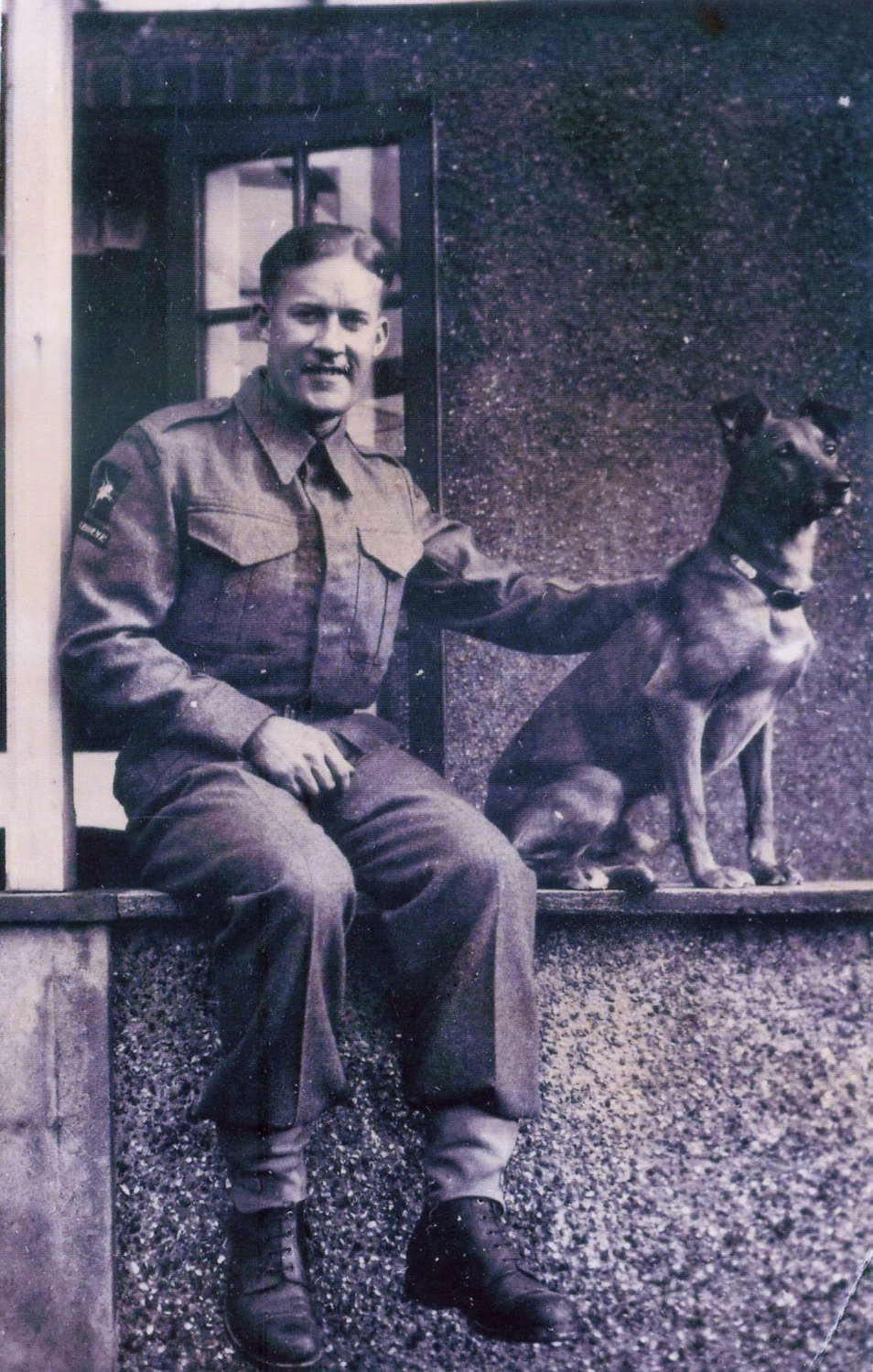
Dvr. 'Joe' Middleton in 1942. This is after he has joined 250 Company in July, but before doing his para course in December: note - no wings. This photo is likely to have been at home in Surrey. He was wounded in action at Arnhem and taken prisoner. Courtesy of Jim Middleton.
By far the most detailed account of his time as a POW comes from Cpl. Burnham Blaxley. It is so long and detailed that only a few extracts can be put in here. We pick up where he had been put on board a train to be transported to a POW Camp: "It would appear that at various stopping places en-route, an extra truck or two would be added to the train. This initiated a lot of shunting to and fro and considerable time. At one point we passed the Krupps factory at Essen. This could first be seen through a crack in the door. This was a long low building with 'KRUPPS' painted on the facing wall.
During the early part of this we were shunted into a siding at Dusseldorf and the engine then moved away. That night the city was bombed by the R.A.F and locked in as we were, minus boots, it was not a pleasant experience. Fortunately we came to no harm. The guards had already vacated their wagons to shelter in the air raid shelters nearby. It was at these stops that the guards would receive their daily ration of food and we our daily ration of 250 grammes of black bread. Sanitary arrangements were non-existent, the results being far from pleasant, especially as some of the men already had problems. Now and then however a stop was made in the countryside and we were permitted to leave our truck in ones or twos to relieve ourselves. Bearing in mind we were under armed guard and unshod, there was little risk of escape.
This journey dragged on for many days and many nights, which is not surprising as we were travelling through the industrial heartland and were bombed both day and night by the R.A.F and U.S.A.A.F. This necessitated many stops to clear and repair the lines. Hearing the roar of an aircraft engine and the angry spitting of multiple machine guns I was hoisted up by one or two of the fellows to look out from the ventilators at the top of the sides of the wagon, I saw a R.A.F Typhoon shooting at the engine which had been uncoupled and was madly racing away leaving us abandoned. The R.A.F were primarily interested in immobilising the engines for without them the trains were inoperative. After a while, the engine was re-coupled and off we went again. We travelled this way with stops and starts until we eventually arrived at a transit camp which we later found to be Limburg. It was from here that the American and Commonwealth troops from the three services were dispatched to their various Stalags in North East Germany and Poland NCO's were drafted separately as they could not be directed to work. The other ranks could be drafted to work on farms, factories, salt mines or forestry. As the prisoners were now so numerous, the permanent accommodation was already filled to capacity by American troops from previous engagements, our accommodation was tented, the tents being 50ft by 14ft and 10ft high to the ridge pole and supported by 4 to 5 uprights.
The walls of the tents were 5ft high and the roof overhung the walls by 2 ft. We dug a trench all around for drainage and the ground inside was strewn with straw. Once again we were packed hard into this confined space, so much so, that it was important to leave your neighbour in charge of your small space if you were absent for any reason. We were now fed once only each day with skilly [3] and our 250 grammes of bread. The other ranks were now directed to work. Feeling very hungry and very bored, one or two N.C.O's, including myself, volunteered to work and we were taken into the town by lorry, under armed guard of course. I was set to work with a wheelbarrow, moving rubble from the site of a damaged house. I needed to balance the barrow along wooden planks above the foundations of the building then empty the load on to a heap of rubble. This would normally take some dexterity, but I had not realised how much weaker I had become during the past weeks with lack of food and sleep. I had to pass the barrow to somebody else, and was directed to move bricks by hand from the cellar instead. Gradually I became aware of an unpleasant smell and the more rubble I removed the stronger the stench became. At last, pulling a piece of black cloth, I realised I had come to the bodies. We called the attention of the civilian workers and were told to dig them out. We refused ( this would have contravened the Red Cross guide lines) and legitimately pointed to our chevrons. Quite soon a party of civilian workers well equipped with protective clothing and masks took over and a number of bodies were recovered. It was now time to return. An abortive trip with regard to extra rations!
It now rained, rained and still it rained. The drainage trench around the tent overflowed and the ground was so waterlogged that the floor was awash. It was on this day that instead of our soup, a crate was carried into the compound and dropped into the mud where it split open. I hurried there post-haste, thrust my hand into the crate had it severely stamped upon and found to my dismay it contained small briquettes of Limburg cheese, fishy and slimy already rotten making it completely inedible. I shall always remember it, as it was the 14th October, my 24th birthday. The days rolled on we now had a regular ration of mint tea, or ersatz coffee in the morning which was always appreciated. Our next meal was our 'skilly' and 250 grammes of Rye bread at Midday. There was no more food until the next morning. Boredom was now our chief enemy. We wandered around the compound or squatted in groups seeking inspiration. We seemed to have exhausted all interesting conversation. It was in this frame of mind one day that I observed through the internal wire fence within the compound, a group of Indian Commonwealth Troops who were preparing a meal. Their allocation of food differed completely from our own as they were bound by rules of their religion and caste, both regarding the food itself and to whom they entrusted its preparation and cooking. They were using a unique home made device which intrigued me. It was similar to a miniature forge and they used it as a cooking stove. I bore this in mind and put it to good use later." [17]
FOOTNOTE. [3] Skilly was a kind of very watery soup, with very little substance.
Sometime in October he, and several hundred others, were put onto another train for transport to a more permanent POW Camp: "We were fed even less now, all I can remember was bread, but we must have had some water from the guards water bottle, as there was no soup issued. It became extremely miserable and we became lethargic. Eventually we came to a clearing in a forest and we stopped. We spilled out on to the ground and were shuffled into marching order. It was a change to stretch our legs, but I was surprised to find how breathless I had become and my legs felt like jelly. After the kaleidoscope of the past events and the monotony of the journey, being bumped and jostled along for miles, it was a new experience to find we had at last arrived. My perceptions were dulled however, I could not absorb too much at once. We could see some workers loading flat railway cars with timber. It gradually became clear that they were women with sacking bound around their legs for protection, they were swathed in shawls and headscarves for warmth. They had a raw boned physique rarely seen in the west. I assumed they were directed labour. We were marched along a track for about 20 minutes when suddenly the woods ended and in front of us was the entrance to a prison complex which we later learned was Stalag VIIIC Sagan, Silesia. We had arrived and were now counted.
I saw a friend and remarked 'Smithy your eyes are yellow'.
'You haven't seen yours yet, Blax', he rejoined.
We were both obviously now suffering from severe dehydration. We passed through some high wire gates, manned by sentries and I noticed a large guard house on the right hand side. I assumed correctly this was the main administration block. We then passed through a second double wire gate into the main barrack enclosure. This I was to learn, consisted of a French section, Russian section, British and Commonwealth sections. Each section was sealed off from the other by guarded gates." [17]
Cpl. Blaxley was to remain in this Camp until 1945: "By the end of January, the Russian Front was advancing fast, and was well into Poland. It was then that we realised something was imminent. We could hear that the Russian guns were much nearer and far more persistent. This was confirmed when we observed the occupants from Stalag Luft Three a few miles South East of us, break camp. We watched them from the cookhouse window passing by and carrying their belongings. They were dragging tables and chairs which they and fashioned into impromptu sledges along with them. This seemed to be a good idea at the time as I viewed the snowy wasteland, but with hindsight, I realised they may have remained healthy without being very fit. They would soon find too many possessions an encumbrance. When I had finished my duty I found they had already unloaded their excess clothing, via the main gate, for us to share. I missed this bonus as I was working. We were now in the direct path of the Russian Army, highly mechanised and advancing swiftly. I had just finished duty at 16:30 hrs, when I was instructed to return at 20:00 hrs and supply soup at midnight. I used some rough flour from stock and a little salt I made up a flat unleavened loaf and mixed the prunes I had pre-soaked from our Christmas parcel into it. I then cooked it under the firebox of the copper. I concealed this on my person together with the cutting knife I had failed to hand in.
We were vacating the camp, all but those in Sick Bay, they were left with one or two Orderlies to look after them and two or three Cookhouse staff one of whom I had previously passed on the rudimentary skills which he may need in the future. The knife I now had with me had been fashioned from a piece of mild steel, by a toolmaker, and given a soft wooden handle. The blade had been hammered and sharpened, but owing to the poor quality of the metal it didn't hold its edge for long and I was constantly buffing it up on any likely stone. I had this, my 'skilly' can, the remains of my share from the recent Christmas parcel and of course my fifth share of the prune loaf. On capture, we had been stripped of our possessions in our small pack and were taken prisoner in the clothes we stood up in, nothing more. That which I missed most was my Airborne smock. I paraded therefore in my hated green overcoat flapping around my knees with K.G.F clearly stencilled across the back.
We paraded and formed Marching Order. Already weakened by malnutrition and not at all rested with this incessant penetrating cold, it would appear we had little hope of survival. Such is hope however, and the optimism of youth, we assembled with thankfulness that we were heading West and to eventual liberation. And not to the East and further cold. We normally paraded with our close associates whom we knew well and had learned to trust, so in rows of five in columns of 100, we formed ranks. There were 500 men in our column. We were counted and marched off. Our Posterns accompanied us, fully armed. They used bicycles which enabled them to cover us quickly and completely, sometimes pushing the bikes and at other times to ride away quickly and to confer with their colleagues." [17]
They vacated the Camp on the 8th February and headed South-West towards Gozdnica and Lipna, and then West towards Bad Muskau, past Dresden, just to the South of Leipzig, and ultimately onto their final destination at Bad Orb near Frankfurt, approx. 600 km's: "We were to march 30 km's each day, other than weekends. 15 km's on Saturday and full days rest on Sunday. We were to have a 15 minute rest every two hours. The first week however, took its toll. The countryside was so bleak with no shelter at all from the biting wind that we kept on the move with no rest days at all for the full seven days, just to keep our circulation going. The first flat area we came to were the grounds of a factory, where we bedded down in the snow. We brushed the loose surface snow to one side and formed a wall to windward. We then lay down in the hollow provided and huddled together for warmth. We covered ourselves with the only blanket provided one between five of us. When one turned we all turned. After our first experience of sleeping in these conditions, we realised we must take it in turns to sleep on the outside. One night outside, the following night inside. Anybody particularly frail, to sleep in the centre.
"Raus Appell, Fertig Machen Aufgehen". The raucous call of the Posterns telling us to wake up and get going, shattered our peace. We stumbled on stiff, and very cold. Some bread was issued but nothing to drink. It is most difficult to swallow dry bread with no liquid to help it on its way. We now were in wooded countryside and followed forest tracks. We did not know at the time that only a relative few miles south East of us heavy fighting at Breslau had caused a general exodus from the area and thousands of panic stricken German civilians were already flooding the roads, moving westwards away from the advancing Russian Army. We were directed further North away from all this congestion and away from all major roads. We walked many more miles this way but it was the only route, there was not alternative.
One morning we awoke to find ourselves covered in about four inches of snow. This cold together with our inadequate clothing, defies description. It was relentless and overpowering, sapping our strength insidiously until we were too numb to think, we became the cold. It possessed every fibre of our being. It became our very essence, we became autonomous, conscious only of the mechanical movement of the man in front and by the side of us. Some of the men from now on were visibly flagging. We came to an iron bridge over a river. It was possibly the Elbe. It was closely guarded by members of the German Military Police." [17]
Approximately half way through this march to the West, the column had nearly reached a small town called Apolda, and was going to take a rest. Cpl. Burnham Blaxley noted in his account: "One man left the column to relieve himself. He was ordered to halt but still moved on, he was shot and left wounded in the snow." [17] He obviously did not know it, but this was a colleague of his, Cpl. Edward Johnson of 'D' Transport Platoon attached to No 3 Parachute Platoon. Wounded and taken prisoner at Oosterbeek on the 24th September, he was evacuated to Apeldoorn and then sent to the POW Camp at Falingbostel, Stalag XIB, arriving there on the 28th September 1944. He was then moved to Stalag 8C, at Sagan on the 24th October 1944. In 1947 an investigation was started to establish what exactly happened, and who was responsible. Statements were taken from several of the POW's in the column, but many of them were conflicting and it appears that no case was ever brought against the German soldier who was responsible.
From the available evidence it would appear that the column halted just outside Apolda on the 27th or 28th February for their mid-day halt, where, as part of the investigation states: 'most prisoners lay down to rest, some went into the fields to get vegetables or to relieve themselves. On that day, new orders had been laid down about leaving the column, though it is doubted whether these orders were made known to everyone. The subsequent events are not clear: what happened in fact was that a number of shots were fired at, or in the direction of prisoners in the field by Germans in charge of the column, and Cpl. Johnson was hit as he squatted down on the ground. A French Medical officer was called to attend him and arranged for him to be taken to Hospital. Johnson was placed on a cart, well wrapped up, and taken away. It is reported later that he died in hospital, so it is quite certain that he was not killed immediately.' As he was buried in the Hunfeld Town Cemetery, which is over 150 km's from where the shooting took place, it is a fair assessment that he was shot on the 27th February and probably died at the Hospital sometime on the 28th.
One of the statements was from Cpl. Frederick Wescott, 3rd Parachute Battalion: "On the 27th or 28th February, 1945, we had reached a point about 2 kilometres from Apolda, when we were halted for a rest. The time would have been somewhere near midday. I was in No. 5 Company. As soon as we received the order to halt, most of us sat down on the side of the road, but a few went a few yards from the road to gather wood to make fires. One man, whom I subsequently knew as Corporal Johnson, went about 15 yards from the side of the road and relieved himself. He was in No. 6 Company and when he was relieving himself, he was not more than 50 yards from me. While he was squatting down, we heard a shot fired and on looking round, I saw the leader of my Company with a revolver in his hand. I saw him fire two shots in the direction of Corporal Johnson, and immediately Corporal Johnson fell. I could see he had been hit. We were not allowed to go over to him, but several members of his own Company did. We were fell in at once and moved off. Later that evening, it was general knowledge that Corporal Johnson was dead. I would like to add that it must have been obvious to the German leader what Corporal Johnson was doing, as it was to us. Corporal Johnson walked the 15 yards away from us at an ordinary walk, and there was no question of him trying to get away. When Corporal Johnson was shot, I was about 75 yards away from the German and, as I have said, about 50 yards from Corporal Johnson. I heard no remarks made by the German, but he appeared to be in a rage, and in fact, he usually was." [18]
This was not the only tragedy to befall 250 Company. A few days before they had passed Leipzig, where the POW Camp, Stalag 4B was still in operation and men were being used as forced labour on work parties. One of these was working on Thaerstrasse, in Leipzig when there was an Allied Air Raid on the 27th February. Amongst those killed was Dvr. Arthur Olsson, who had been taken prisoner at Arnhem Bridge on Thursday, 21st September 1944. He was initially buried in the Leipzig East Cemetery.
One of those in another Working Party near Leipzig was Dvr. Arthur Johnson, luckily he survived, and he was liberated by advancing Allied Forces on the 17th April.
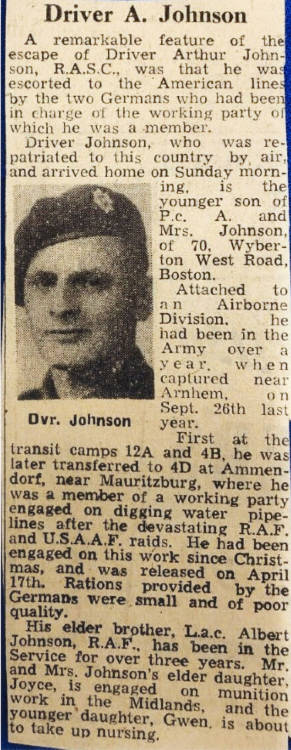
Driver. A. Johnson. A remarkable feature of the escape of Driver Arthur Johnson, R.A.S.C. was that he was escorted to the American lines by the two Germans who had been in charge of the working party of which he was a member. Driver Johnson, who was repatriated to this country by air, and arrived home on Sunday morning, is the son of P.c. A. and Mrs. Johnson of 70 Wyberton West Road, Boston. Attached to an Airborne Division, he had been in the Army over a year, when captured near Arnhem, on Sept 26th last year. First at the transit camps 12A and 4B, he was later transferred to 4D at Ammendorf, near Mauritzburg, where he was a member of a working party engaged on digging water pipe-lines after the devastating R.A.F., and U.S.A.A.F. raids. He had been engaged on this work since Christmas, and was released on April 17th. Rations provided by the Germans were small and of poor quality. His elder brother, L.A.C. Albert Johnson, R.A.F. has been in the Service for over three years. Mr and Mrs Johnson's elder daughter, Joyce, is engaged on munition work in the Midlands, and the youngest daughter, Gwen, is about to take up nursing. Courtesy Boston Newspaper.
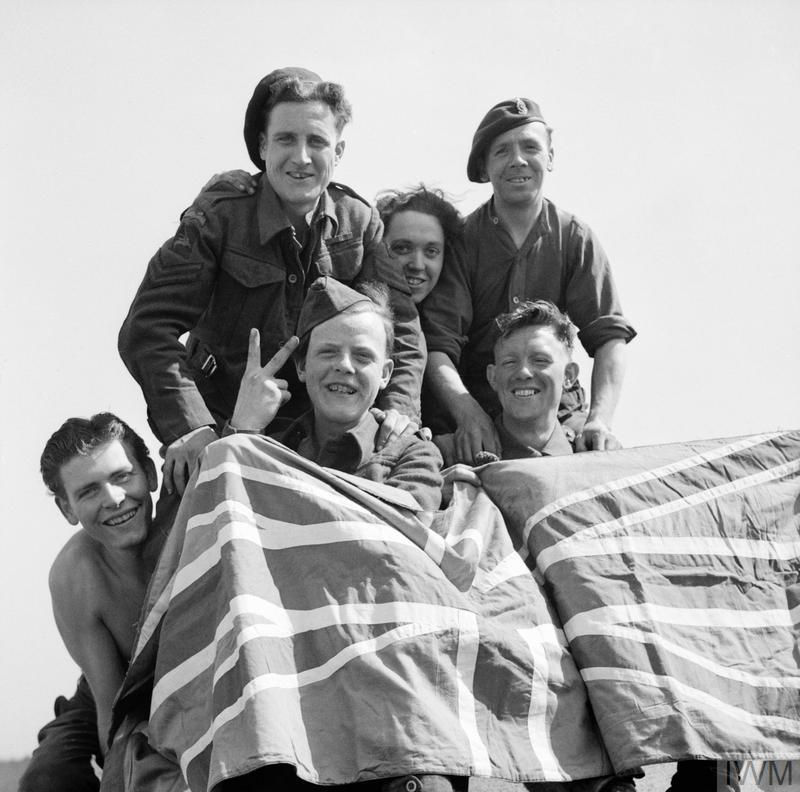
British Prisoners of War celebrate their liberation from Stalag 11B at Fallingbostel, Germany, 16 April 1945. From left to right: Pte. Smyth of Downham, captured at Cherbourg in 1944; Pte. Ryan of Bradford, captured at Hertogenbosch, 1944; Cpl. D.H. Beardmore of Cheadle [3 Platoon, 250 Light Composite Company, R.A.S.C.], captured at Arnhem, 1944; Pte. W.J. Still of Manchester [R.A.M.C. attached 2nd Battalion, The South Staffordshire Regiment], captured at Arnhem, 1944 and Pte. Greare of Glasgow, captured at St. Valery, 1940. Photo by Sgt. Smith. No 5, AFPU. BU3663. Courtesy of the I.W.M.
A few days later the men of the column were to partially experience the ferocity of these Allied Air Raids, Cpl. Blaxley: "At about 20:00 hrs the air raid sirens blasted into action and soon, the sound of heavy aircraft fire was heard overhead. These were the R.A.F. Pathfinders who dropped flares to guide the remaining Squadrons on to target. The following fusillade of anti-aircraft fire and the swish of descending bombs and the roar of explosions were most frightening, although we were not the target and not in danger, we felt sorry for the poor recipients. We fully understood the havoc caused and the suffering as we had suffered it many times in our own country. Erfurt had been the target this time and although we always by-passed towns, were marched through the outskirts of the town the next morning alongside the Railway Station. We found the atmosphere charged with hostility, not without good reason."
The march continued and by the 10th March they were nearing their destination, Cpl. Blaxley: "This was a killing march. Had it not been for the rigorous training we had received at the beginning of our course, I doubt whether we could have finished. I thought of 'Frank' who had been wounded in the foot, yet even though the Postern had cut a hole in his boot to accommodate the dressing he still wore he had manged to soldier on. We had all lost an enormous amount of weight and now looked gaunt and lantern jawed. 'Charlie's' breathing had now become a real problem. 'Chick' and I expended all our energies chivvying him along. We had to concentrate to lift one foot in front of the other. It was a nightmare journey from now on. My boots now disintegrated completely and fell off my feet. I slouched along now to our next stop where I was fortunate to find a discarded pair of sabots, by a rubbish tip. I left my worn out boots in exchange. The sabots were quite different to march in, and I had to pack them with bandages I had made with the strips from my coat. They didn't protect me from the inevitable blister which had worn into a deep whole by the time we reached Bad Orb. I don't remember my arrival at Bad Orb. We must have just collapsed with exhaustion."
Cpl. Blaxley was to remain at Stalag IXB for several more weeks, until it was liberated by American Forces of the 44th Infantry Division, on the 2nd April 1945.
Also on the this march was Cpl. Desmond Stephenson from 'D' Transport Platoon, who had been wounded during the battle in the Oosterbeek perimeter and ended up in one of the medical facilities there: "I went to the hospital to have my leg dressed. It wasn't too bad and I expected to come out again straight away, however I was kept in. This was about 3 p.m. on Friday, 23rd September 1944. There wasn't beds or even room to lay down on the floor as it was overcrowded and only a makeshift hospital, so that I had to sit on the stairs with dozens of others cases. Well for the rest of that day and night I sat and dozed where I was, there was very little water and hardly any food we got ½ cup of tea and 2 biscuits twice in the day and I had ½ a ladle of M&V." Later he was taken to the temporary Airborne Hospital at Apeldoorn, where he was kept until the 6th October 1944, when he was transported on an ambulance train to Stalag 8C at Sagan. "On the march from Sagan (which eventually ended at Bad Orb 620 km's away taking us 32 days), we had been on the road for 4 days. I had slept out in the open each night. This being early February it was extremely cold. Well after 4 days we were supposed to get on a train however this didn't materialise and we had to keep marching. I had an army service watch which I had kept all along and I had intended keeping it altogether, but through conditions on the march from lack of food I contemplated selling it. So I asked God to overrule, and the following morning one of the German sentries offered me 3 loaves of bread and 50 cigarettes for it and this was considered a fair price. Of course I accepted it and my pal and myself shared it buying bread and food with the fags and I'm sure that those there extra loaves kept us going and able to complete the march." Even so, when he got back home he weighed only 7 stone, instead of his normal weight of 13 stone.
Just after the column had reached Spremberg S/Sgt. 'Ted' Ralph of the Glider Pilot Regiment and another P.O.W. escaped into a tumbledown old cottage. S/Sgt. Ralph was one of the pilots that had flown in elements of 250 Company on the 18th September. He was not at large for long, as both were re-captured after two days. However, he was persistent, and they both escaped again, but: "We wandered across the country for two days, then came across a quarry that had been converted into a bathing pool, complete with bathing hut. We decided to hole-up for a few days. Two days later, however, three men discovered us, and handed us over to the Military. An Officer took out his revolver and was going shoot us on the spot, but was stopped by another Officer. This second Officer informed us though, that next time we tried to escape we'd be shot out of hand. We spent the night in the cells and next day a guard took charge of us and marched us off. We eventually joined a column of French P.O.W's on the march. I had developed an ulcer on my left ankle, and using this as an excuse we lagged behind, and finally managed to dodge off."
Moving in a northerly direction they soon came to Reisa, but were re-captured and this time taken to Stalag 4G at Oschatz. S/Sgt. Ralph was then taken to Stalag 4B at Muhlberg. "One day the camp was in rather a pandemonium owing to some strafing taking place nearby. So two other Glider pilots (Sgt. Garnham and Sgt. Griffiths) and myself crawled through the barbed wire surrounding the camp and reached the woods unseen. A few days later we reached Torgau, which the Russians and Americans were occupying. The Yanks fed us up, gave us supplies for our journey and re-kitted us out with Yank uniforms. We'd got this car going - there were lots around where the local Germans had fled and left them behind, because of lack of petrol. We headed towards Paris, but after 400 miles or so, the engine packed up, so we swapped it with a Yank pilot to fly us to Brussels. We arrived there a couple of days after V.E. Day, and from there back to England". [19]
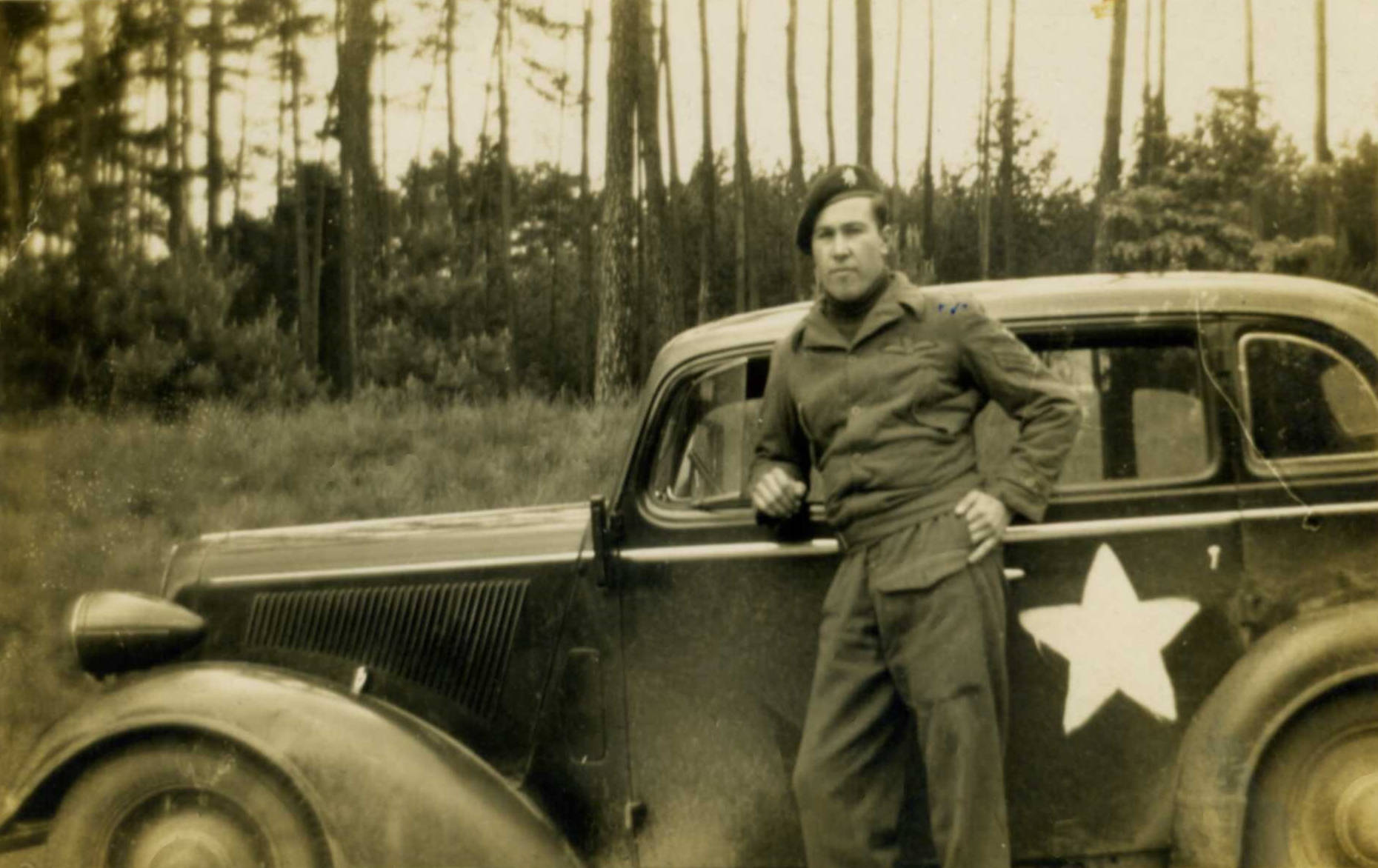
The car used by escaping glider pilots and other POW's in April - May 1945. Standing next to it is S/Sgt. 'Ted' Ralph, just after being re-kitted by the Americans. Courtesy Ted Ralph.
'Ted' Ralph was not the only one to 'blag' transport from the Americans to get home, Dvr. 'Jim' Wild: "I, along with Arthur Edwards, another ex 250 Company member, and three men who had been P.O.W's for two years, were released by General Patton's tanks at a place called Trebsen [Stalag 4B, Muhlberg], between Leipzig and Berlin. The rest of the Camp had been marched away towards Berlin two days before. We had decided to leave Camp until they had gone. The Americans gave us a small car, and told us to make our own way back to the main Allied lines near Frankfurt. We set off on the Wednesday, two days after the tanks had arrived, and were stopped 20 miles short of Frankfurt. The following day we started walking, and a week later, after a couple of lifts and some good luck, Arthur and I and the five lads from the 82nd Airborne, all ex P.O.W's arrived at a French village railway station. We got the train from Longury? into Luxemburg, and from there, after a couple of days being taken care of by the Red Cross, we arrived at Brussels Airfield. There we met five more of our lads, including Captain Gell, who had been released several days before. I lost two stone as a P.O.W., but that did not stop me walking around 100 miles to get home." [20]
Slightly wounded and taken prisoner, after the rest of the unit had withdrawn across the River, L/Cpl. Leslie Withey was initially sent to Stalag 12A at Limburg, and then onto Stalag 4B at Muehlberg, in Germany. In April, with the Russian Forces fast approaching, he made his escape, which was related in a short article in the Gloucestershire Echo, on Wednesday, 23rd May 1945;
ARNHEM PRISONER HOME.
Friends and neighbours extended a warm welcome to Lance Corporal. Leslie G. Withey, the elder son of Mr. and Mrs. E. Withey, of Mye Waye, Hayden-road, Uckington, who has returned after an escape from captivity. Lance-Corporal. Withey, who is nearly 22, is in the parachute section of the R.A.S.C., and he was captured in the Arnhem action last October [September].
He has been in two prisoner of war camps near Dresden, and he made his escape with an English companion and two Americans when the German organisation was crumbling under Allied pressure. After making their way to the Russian lines, he and his companions were motored to an American unit.
At the time of his joining the Army in 1939 L/Corpl. Withey was a student at Chepstow Technical College. He is an Old Grammarian and is the eldest grandson of the late Mr. and Mrs. White of Swindon-road, Cheltenham. He is deeply appreciative of the welcome and kindness extended to him since his return.
This was the third time he had his name in this paper, as each time that his parents heard about him, or from him, an announcement was put in the paper - Thursday, 12th October 1944 and Wednesday, 22nd November 1944! [22]
NOTES:
[1], [2], [3], [4], [5], [6], [7], [8] & [9] 'The Day Gone By'. Richard Adams.
[4b], [6b] & [8b] Personal account of Robert Neilson via Bob Gerritsen. 1990's.
[10] Letter from John Gifford to Frank Steer. 8 February 1999.
[11] Letter from Bill Gell to Frank Steer. 11 January 1999.
[11b] Letter from Thomas Jones. 1996.
[11c] L/Cpl. A.E. Berg. POW Questionnaire. 1945.
[12] From Jack Taylor to Bob Hilton. 28 September 1995.
[13] Account of John McAndrew in 1985 Newspaper and reproduced by the AVC 1986.
[14] Account of Ron Nutley. 2004.
[15] Letter to Bob Hilton from Frank Bater. 26 September 1997.
[16] Account of Bill Chedgey to Frank Steer. 1990's.
[17] Letter & account to Bob Hilton from Burnham Blaxley. 9 July 1998.
[18] Statement made at Brighton Town Hall. 3 July 1947.
[19] Letters from Ted Ralph to Bob Hilton. 1997.
[20] Letter from Jim Wild to Bob Hilton. 1 September 1997.
[21] e-mail from Jim Middleton to Bob Hilton. 19 February 2020.
[22] The Gloucestershire Echo. 23 May 1945.


