Chapter 10
21st to 26th September 1944.
"Out of ammunition. God save The King". Final radio message from the British at Arnhem Bridge, picked up by the 9th S.S. Panzer Division listening monitors.
At the main Arnhem road bridge the British resistance was coming to an end. The last positions that were being held, and able to bring fire to bear on the Germans approaching the bridge ramp, were now completely alight. No heavy weapons could be manned, and the men were down to their last few rounds of ammunition. Capt. 'Bill Gell': "We held our position constantly until, with the building we were occupying on fire and under heavy German attack, we were ordered to disperse in parties of ten men. I led the first party of ten to leave and was attempting to reach the rest of the Division, an impossible task, and we were taken prisoner on the Thursday. Lieutenant Daniells was to lead the next party, with Sergeant Brookes leading the remainder. That was the last I heard of them. It is possible that we were holding the last position in action." [1]
It is possible that 'Bill' Gell was mistaken about the remainder of his Platoon being lead by Sgt. Brookes, as he is not listed as a POW at the Bridge, but Sgt. A.S. Hoye and Sgt. A.W.C. Staples were.
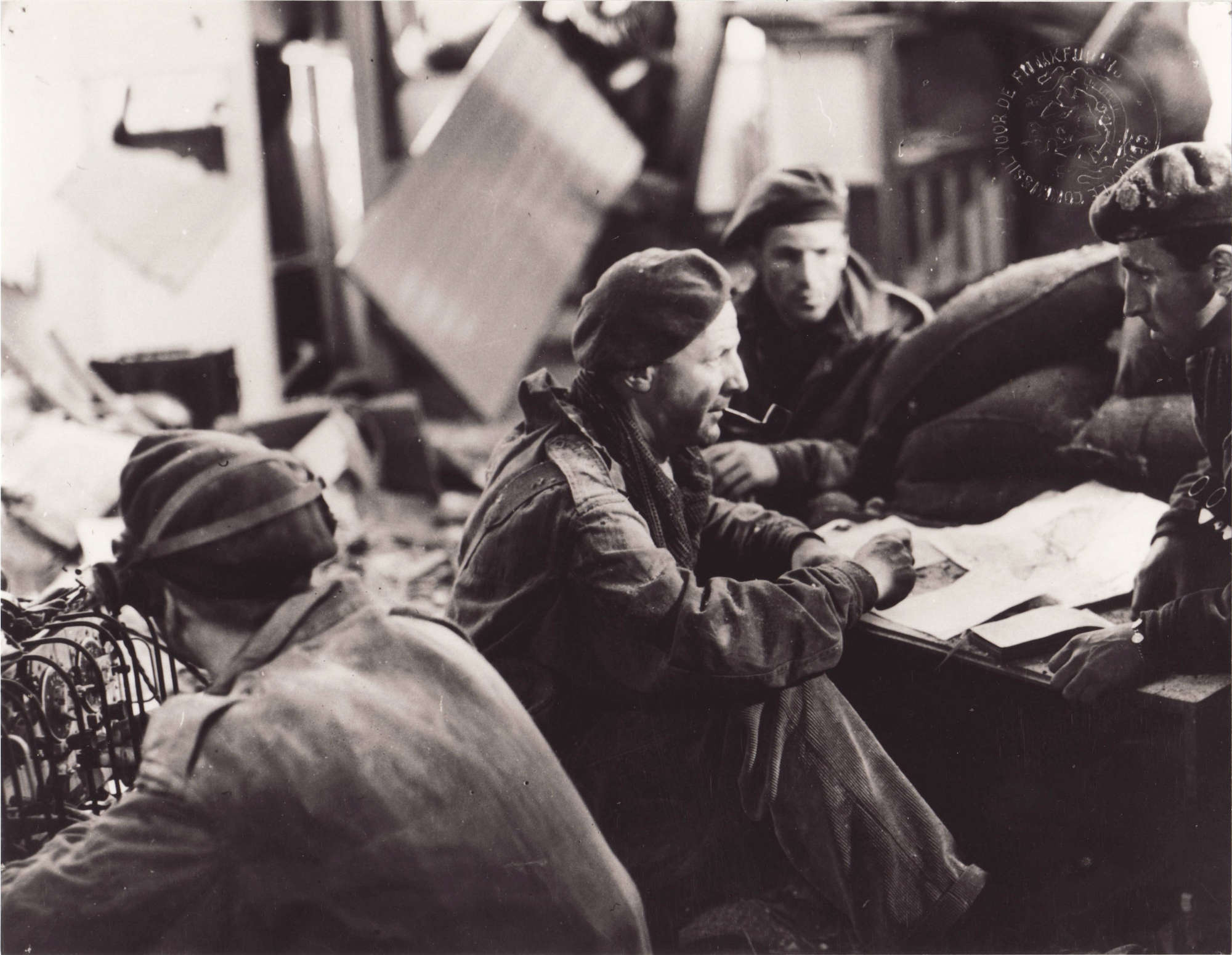
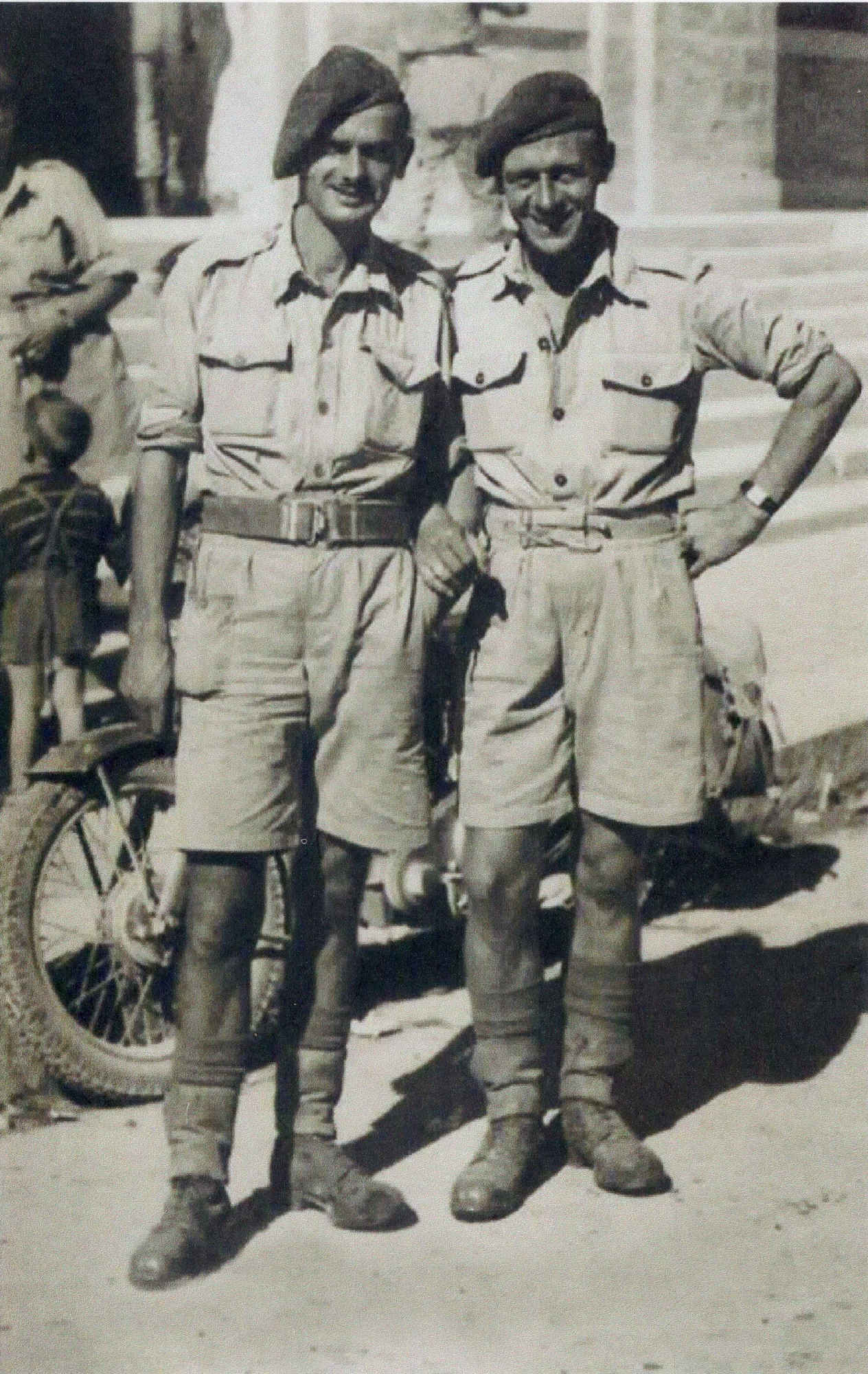
Major 'Freddie' Gough recreating his role for the film, 'Theirs Is The Glory'. 1945, he is talking to Capt. 'Bill' Gell (RASC), "Morning Bill, Morning Freddie". In between them is Lt. 'Tony' Cox (1st A/L A-Tk Bty, R.A.). Courtesy Airborne Assault Museum Archives.
The following account shows how the men started to become split up, Dvr. 'Bill' Mitchell: "By Wednesday evening the position was untenable, and we had to change to another part of the building, which was very close to the Germans. I remember sitting on guard at a window in a room in the dark and listening to quite a lot of Germans talking. When a figure jumped through the window, I fired a shot at him, and missed, luckily for him, as he was a British War Reporter. [2] He suggested that we get out of there quickly, and four of us did get out, and into a coal cellar in a back lane and hid there for the rest of the night. We had lost contact with the rest of the Platoon at that time and were taken prisoner on Thursday morning, but believe the others were taken prisoner before us on Wednesday night. We were kept overnight in the Grote Eusebius Kerke and then transported to Zutphen and into cattle trucks, and onto a P.O.W. Camp." [2]
'Bill' Mitchell is slightly mistaken, as almost all of the Platoon were taken prisoner in the early morning, just after daylight, on Thursday, 21st September 1944.
FOOTNOTE: [2] Could this have been Major. John Anthony 'Tony' Cotterell?
Many years later 'Les' Ransom was interviewed about the final hours of the battle, the interviewer wrote: "With no water, no food and no ammunition, the order came through that it was 'every man for himself'. There were no radios working and 'runners' ran in to give the men this information, risking their lives. The group that had started off as 8, had slowly gone down to 3. There was a German sniper in a church tower by the council offices and he had been picking Les's men off, until they realized where he was and blew the tower up with the last of the ammunition! One of these men, 'Geordie' Hall, was even shot up the bum when he was climbing some stairs, as was seen by the sniper! By that time, everything was burnt out. Les decided the only option was to surrender to the Germans. He and the 2 other men, walked down an alley way and gave themselves up. Les dropped his rifle by accident when he jumped a wall, he jumped back over to retrieve the firearm as it had been drummed into them in the army that you never lose your rifle. Once he'd retrieved it, he threw it away purposefully, not just dropping it by mistake! They were taken prisoner and Les never saw any of the 250 company again." [3]
Dvr. "Geordie" Hall was Edward Hall, who came from Gateshead-on-Tyne, and was shot in the left thigh.
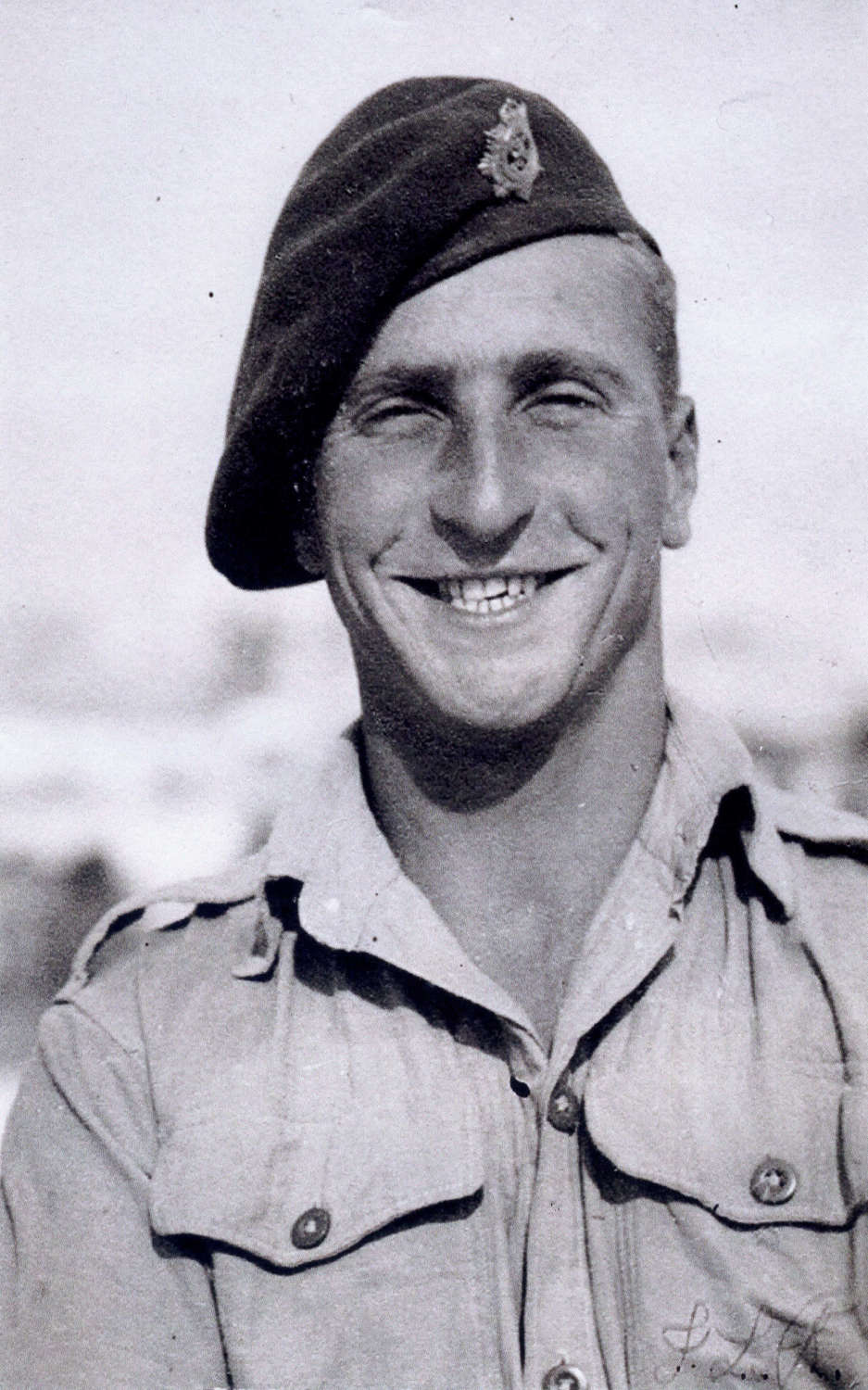
L/Cpl. 'Les' Ransom. No 3 Parachute Platoon. Photo taken in North Africa in 1943. Courtesy of Les Ransom.
Dvr. Thomas Jones: "I was captured in some buildings by the main church. Driver 'Fred' Hill was killed when the Germans opened fire on us after we were captured [had surrendered]. We were held in the church for the rest of the day, then we were moved to a smaller church in Arnhem. Then we went to some houses outside of the town. Later, we were sent to a railway siding, then put in cattle trucks - about thirty to a truck." [4]
Another man that was with this small party trying to escape, was Dvr. Jack Brooks: "I know that we were given the order to scatter and escape. I was with 'Fred' and others in a bombed house when Jerry came in firing Machine Pistols and 'Fred' got it in the stomach and died at once. I will give this to 'Jerry', he let me take off 'Fred's' wrist-watch, as I knew it was a 21st birthday present from his wife. I kept it with me all the time whilst I was a P.O.W. and with the Russians in Poland, and through to when I returned to England. I went to Long Eaton, Notts and gave it to Marjorie, his wife." [5]
Dvr. Frederick William Hill was killed, and later buried in what is now Prinsenhof.
The last three days of action are summed up by Dvr. 'Jim' Wild: "We took up defence positions in a building at the rear of Johnny Frost's H.Q. from which we fought for three days until shelled out, losing several of our lads in the process. I was captured at 08.00 hrs on the morning of Thursday, 21st September." [6]
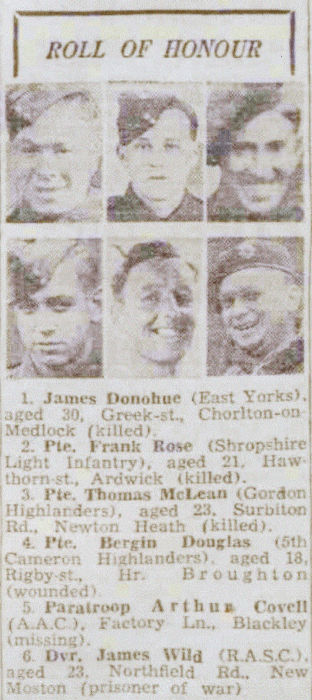
A clipping from the Manchester Evening News, 13th November 1944, listing casualties. 'Jim' Wild is listed at the bottom, and his photo is bottom right. Courtesy of David Locke.
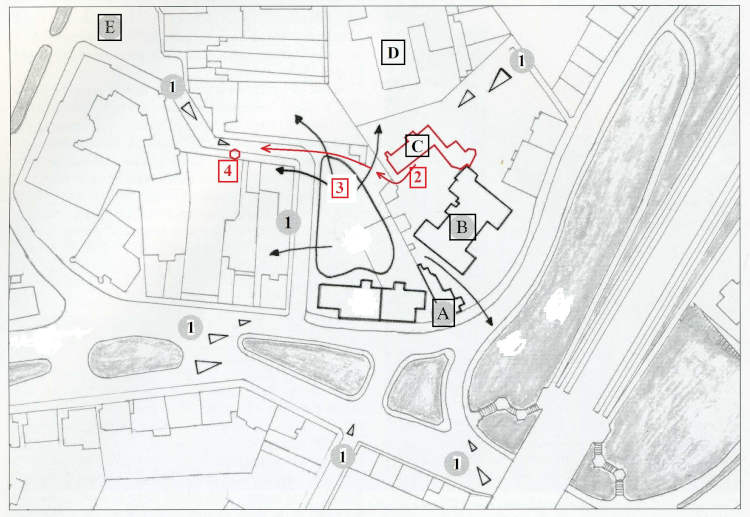
The final hours at Arnhem Bridge. 20 - 21 September 1944.
KEY TO MAP OF THE FINAL HOURS. 21st September 1944.
[A] 2nd Para Battalion H.Q. & R.A.P.
[B] 1st Para Brigade H.Q. & R.A.P.
[C] House held by No 3 Para Platoon, R.A.S.C.
[D] Prison.
[E] Area where POW's were gathered.
(1) German assaults.
[2] No 3 Para Platoon attempted escape route.
[3] Remnants of 2nd Para Bn attempted escapes.
[4] Dvr. F.W. Hill, killed & buried here.
One of those that did not write an account of his time in the Army, was Dvr. George Smith, but he told his daughter some of his memories, especially at Arnhem: "My dad often referred to little things that happened to him during his time in the Army, but always in a jokey way. Having three girls was probably not conducive to battle chat but he didn't ever seem to want to talk about the 'hard' times, preferring to remind us of silly things like; green water (leftover water from cooking cabbage) was very good for us because that was all he got while prisoner of war! Don't know if this was true! He lost his helmet jumping out of the glider, had the heel of his boot shot off, how he pinched a picture of Hitler from a building and hid it under his jacket then when he was captured and searched, thought that was the end of him, but, the German who pulled it out just laughed along with his comrades! Once we married, his son-in-law's were much better for battle chat, but even then, they all said he never really spoke about the horrible things he must have seen or had to do". [7]
With the final positions near the Bridge being overrun, and the last of the men being rounded up, the Germans were now, finally, able to move reinforcements to block the advance from Nijmegen towards Arnhem. Any hope of a successful outcome to Operation 'Market-Garden' now lay with the remnants of the 1st Airborne Division holding a tenuous bridgehead in the Oosterbeek area.
Whilst the last of the defenders at Arnhem Bridge were being burned out of the houses they were defending, or being rounded up in their small groups, as they tried to escape the encircling Germans, the H.Q., R.A.S.C. and its various Detachments, were 'standing-to' again, at 05.00 - 06.00 hrs, and it was reported that the enemy mortar and shelling was 'very heavy on the Divisional area throughout the day'. During this morning 'hate' from the German artillery and mortars, at 07.00 hrs three men were killed by a direct hit on the H.Q., R.A.S.C. position by mortar fire. One of them is known to be Cpl. Frederick Grantham, of the 1st Airborne Divisional Field Park Company, R.A.O.C. The other is believed to be Dvr. Stanley Huggins, who was one of the men attached from 93 Company, and is one of two men listed from the R.A.S.C. as being killed in this area on this day. German records state that he was initially buried in a mass grave just to the west of the Hartenstein. This direct hit caused the H.Q. to have to be moved again, so it was within the Divisional H.Q. perimeter. The other was Dvr. Leonard Peacock of 'D' Transport Platoon, who was also buried in the mass grave to the west of the Hartenstein, but whose body was positively identified after the War.
The attempt to get supplies through to Arnhem using two Carriers did not succeed. From the 1st Airlanding Brigade H.Q. War Diary: '03.50 hrs. [7 Bn, KOSB] Carrier patrol to try and get ammunition to the 1 Para Brigade party on the bridge failed to get through. Ammunition was therefore, handed over to 11 Para Bn.'
From the 1st Airborne Division After Action Report, Part I, Appendix H, for the 21st September 1944: 'Supply drop carried out in very heavy flak and with high percentage of R.A.F. losses. Proportion of supplies recovered and issues made from D.M.A. Special shortage of Sten ammunition. Remainder limited. Small stock of Petrol held. More gun ammunition delivered to Light Regiment during the day by R.A.S.C. Divisional H.Q. dispersed over wide area in afternoon to avoid possible casualties. Tactical H.Q. remained in house in cellar. During this day heavy shelling and mortaring of the Divisional H.Q. area caused fires and explosions in the D.M.A. These fires were only put out with considerable difficulty.'
The resupply drops on this day were carried out in four waves, between 13.25 and 15.30 hrs, with a total of 117 aircraft, 64 x Stirling's and 53 x Dakotas. A total f 273 tons of supplies were dropped, but only approx. 11 tons were recovered to the D.M.A. Part of the drop on this day has lead to a 'Battle of Arnhem' legend, mostly through the film 'A Bridge Too Far', and involves the over dramatized recovery of a 'container' of red berets.
The area where this happened, was that which had been designated as the re-arranged S.D.P. at M.R: 691785 (this is marked [8] on the overall map of 19/09/44). It was an open field area, with troops of the 1st Bn, The Border Regiment to the west, The Glider Pilot Regiment to the north, and elements of the 1st Airborne Reconnaissance Squadron to the east.
The following is the entry that Cornelius Ryan put in his book: 'Sergeant Lawrence Goldthorpe heard the loudspeaker, too. A few hours earlier, he had risked his life to retrieve a resupply pannier - only to discover that it contained, not food or ammunition, but red berets.' [8] 'Larry' Goldthorpe, was a glider pilot of 12 Flight, 'E' Squadron, and he elaborated on this action, many years later: "Re-supply planes dropped their loads on to prearranged positions not knowing these were now in German hands. Len and I managed to get hold of a pannier basket only to find it full of red berets, not the ammo or food we desperately needed." The 'Len' that he refers to was his First Pilot, S/Sgt. L. King. [9]
There are also accounts from the 1st Airborne Reconnaissance Squadron members. First the H.Q. Troop, War Diary. Thursday, 21st September 1944.
14.30 hrs. Supply drop. Very few containers in our vicinity. Pleading Very Lights from Div H.Q. chase one another into the sky. Mortar and M.G. fire stops. Plenty of flak. One Trooper gets a piece of pig iron in the eye through looking up.
16.10 hrs. Investigate 2 containers. One contains berets, the other an assortment of crowns, pips, chevrons and cap badges - gladden a Quartermasters heart - very disappointed.
Secondly some first hand accounts, L/Cpl's. 'Ray' Evans and 'Dick' Edgington went out and recovered one pannier and under the Q.M's supervision Tpr. Allan Samm went out to collect another. "I made it to the baskets in spite of a burst of Spandau from our friends, just to warn me to keep low. They really needn't have bothered. Do you know what was in those two wicker baskets? Those baskets that had come across the sea and the enemy lines and had been dropped, luckily or unluckily, off target into our zone through a flaming barrage where even the fliers were in danger. What was in them? I never dared tell anybody after the battle, because I didn't think I'd be believed, although there is still one bloke around today who could have backed me up. I shouted to Banger and, ever the wag, he shouted back, 'They're for the victory march through Arnhem, Samm.' One was three-quarters full of cap badges and the other was choc-a-bloc with red berets. I ask you! Socks, I could have understood, shirts, I could have understood, but badges and red berets were beyond me." [10]
Obviously, what seems like a stupid blunder by some 'base wallah' or 'brass hat' needs some explaining. The very best person to explain this is the man responsible for the stores for the 1st Airborne Division, Maj. Cecil Cyril 'Bill' Chidgey, the Officer Commanding the 1st Airborne Divisional Ordnance Field Park: "The recovery of a pannier under the most hazardous conditions of battle, which when opened, contained red berets, when food and ammunition were in dire need, added to the frustration of those who risked their lives in the incident. The event has been written about in a number of books, but I have not been aware of a follow up investigation, which would confirm the defects of a complete lack of battlefield to base communication.
The method of air drop supply, lay in a predetermined packaged airdrop planned by the staff officers of the Division, with an input from Brigade and Battalions involved. All based on the operation being a success as planned. The input of dress items was from the experience of 1st Brigade in North Africa, who when performing a victory march, found a shortage of head-dress and clothing. Whilst clothing was in general supply, airborne red berets were not. This was a morale booster.
The predetermined airdrops were carried out because there was no knowledge for change; additional items could be included in the supply, but without knowledge of requirements, the UK base worked in a vacuum. In so far as vehicle, radio and technical spares were considered, meetings between Brigade, unit specialist officers, REME and myself, produced packs of spares for units to carry to the operation and the OFP carried further items in jeeps and trailers. The back up for units based on the Hartenstein area, worked well up to the Wednesday, when the OFP became part of the perimeter defence.
Amongst the soldiers involved in this apparent senseless drop, considerable disenchantment has been expressed, but little emphasis has been made of the naivete of the planning decisions for communication between units, Brigade and Divisional Headquarters and base supply. Perhaps a thought could be spared for those at base supply, who packaged the air drops, thinking their efforts would contribute to the bravery and success of those physically involved in the battle, only to hear later of the criticisms brought about by a 'pannier of red berets'." [11]
Lt-Col. Packe describes the situation: "On some days the weather was foggy and no supply drop could be made. On others, the drop took place, through an ever-increasing intensity of "flak", and sometimes, in spite of violent interference from marauding German fighters. The serene bravery with which the planes, some of them already pouring smoke, flew on unwaveringly to drop their loads is unforgettable. There were many acts of heroism. 7 per cent. of all aircraft taking part in the supply operations were lost, and, with their R.A.F. colleagues, the R.A.S.C. air despatch crews earned great distinction and sustained considerable casualties. It was all in vain. Even though the S.D.P. was correctly spotted, only a very small fraction of the myriad billowing and brightly coloured parachutes which filled the sky, could fall within the Divisional perimeter. The defended area was now too small.
To give some notion of the scale of things, it is enough to record that the D.M.A. had taken up its final abode in the pleasure garden behind the hotel, in whose substantial cellars, Divisional H.Q. was operating. C.R.A.S.C.'s H.Q. - a deep slit trench with head-cover-was between the three-inch mortar and the small arms ammunition stocks, and was exactly thirty-three paces from the A.Q. Office. Out of several hundred tons dropped, only 7 ½ per cent. in all could be collected. Moreover, the mortaring and shelling, always more or less continuous, increased immediately after a drop to a tremendous concentration directed on the dump area. To this, as the situation worsened, sniping and machine gunning were added. The ammunition caught fire and was stamped out several times. The jeeps were knocked out one by one. Well before the end, there were no supplies of any sort, nor a single vehicle left." [12]
A further casualty on this day, was S/Sgt. Robert Snelling, the senior mechanic and N.C.O. of 'F' Platoon (Fitters & Workshops), who was badly wounded and taken to the Tafelberg, but died shortly after. He was buried in the mass grave to the front of the Hotel.
At least one trip was made by Capt. Cranmer-Byng, with a driver and Jeep, to the positions of 'Lonsdale' Force, as he recounted a few years later: "Level" Best will probably remember the Church and the Jeep full of Gammon bombs we delivered there!" The man he is referring to is Dvr. Lawrence Best from his own No 1 Parachute Platoon.
Although from No 1 Parachute Platoon, Dvr. 'Ray' Moon was dug-in near the Fitters and Workshops Platoon, along with other 'strays': "Ronnie Gant was hit in the shoulder and arm. I dressed his wound and took him to the R.A.P. which was at Divisional H.Q. This was on the Thursday. In the same mortar attack, Dvr. Morton's trench received a direct hit. Capt Winter-Goodwin was also hit in his foot, together with a Dvr. Bostock, we took him to the First Aid Post. Dvr. 'Ronnie' Gant and I were called up on the same day for service. We met again when I was posted to 250 Company from para training at Ringway, with Fred Barrett, course No 119." [13a]
Dvr. 'Ron' Nutley, and his friend, 'Jack' Hart were still dug-in near the Hartenstein: "My 48 hour ration pack was long gone and us chaps were getting pretty hungry. I had not personally eaten for days. No supplies were getting through. One day, Jack Hart and I decided to go rummaging around the area. We didn't find any food but we did find a bottle of scotch. Well .... cheers!! A good stiff drink did nobody any harm. As I said, we were 'dug in', we were near the Tennis courts I do remember that in the next trench to me was the Canadian war correspondent Stanley Maxted. I remember listening to Stanley making the sound recordings." [23a]
A few hours later, some of these men would be on the move to a new position in the perimeter. From the Diary of Brig. Hackett: 'During the evening Divisional Commander held a conference and announced retrenchment on North of Divisional area. 21 Independent Para Company would come under my command as a result at 0200 hrs and a party of R.A.S.C. under Capt. Cranmer-Byng at 0300 hrs.'
To the sights, sounds and smells of the intense German artillery and mortar barrage H.Q., R.A.S.C. and its Detachments 'stood-to', between 19.00 and 20.00 hrs.
Friday, 22nd September 1944.
From the Diary of Brig. Hackett. '21 Independent Para Company, 160 strong under Maj. Wilson moved in during early hours to occupy from road junction, M.R: 695780 to including M.D.S. cross roads. Task was to hold defence position and work forward. Detachment from Divisional R.A.S.C. under Capt. Cranmer-Byng was put in same time from including track junction, M.R: 695779 to including road junction, M.R: 695780 with orders to make every effort to move forward and take in next North to South parallel road about 250 yds eastwards. I visited 21 Independent Para Company, M.D.S. (saw Lt-Col. Marrable), R.A.S.C. Detachment (who were rather far back for my intention and whom I ordered forward), 11th Para Battalion, 1st Para Brigade, Light Regiment and the Recce Squadron during morning 22 September.'
This move by a 'Detachment' was also reported in the H.Q., R.A.S.C. War Diary: '1 and 2 Para Platoon's R.A.S.C. under Capt. Cranmer-Byng took over sector of Divisional perimeter and acted as infantry for remainder of operation. Adjt and H.Q. Detachment took up defensive position in 1st Airlanding Brigade area to act as reserve for Capt. Cranmer-Byng's party and so remained for remainder of operation.'
A few years after the War, Capt. Cranmer-Byng related some memories of the position he took over for his H.Q: "Many of you will remember the big house in the Divisional Perimeter where I had my H.Q. during the last days of the battle. It was the one that had such a well stocked cellar! and got knocked about by shells from an S.P. Gun on the last Sunday. Bater, Ashpole and Middleton will remember it, because being wounded, they stayed behind there and were taken prisoner. Well, that house is still standing and has just been patched up sufficiently for the owners to return to it. They were delighted to hear how we ate all their tinned food, drank their vermouth and sent those 50 tins of milk to the Dressing Station [Pietersberg House] opposite." In another account, he related his instructions to one of his Sgt's, and an encounter with a Dutch civilian: "Sergeant get your men into that house over there, see it? Well get in, and stay there. The Sergeant had to break a fence, trample over flowerbeds with his men behind him. We hadn't got a platoon or even a proper section. Just a handful of men who were alive and unwounded, the Sergeant arrived at the house allotted, and noticed the shambles inside it. In the bedroom were beds half made, women's clothing strewn about, a man dress shirt, broken glass, and soap and toothpaste still beside the washbowl. Ten Dutch people in the cellar obviously distressed and frightened. Soon a young woman appeared, and speaking very good English said: 'You cannot fight here, it is impossible, the Germans they are all round, you must not go on with such fighting.' The Sergeant squared his shoulders and said: 'We are going on fighting, we are attacking the Germans, you will be safe as long as you stay in the cellar'. It was better to bluff, than tell the truth he found." [14a]
Capt. Cranmer-Byng would relate a follow-up to this encounter later.
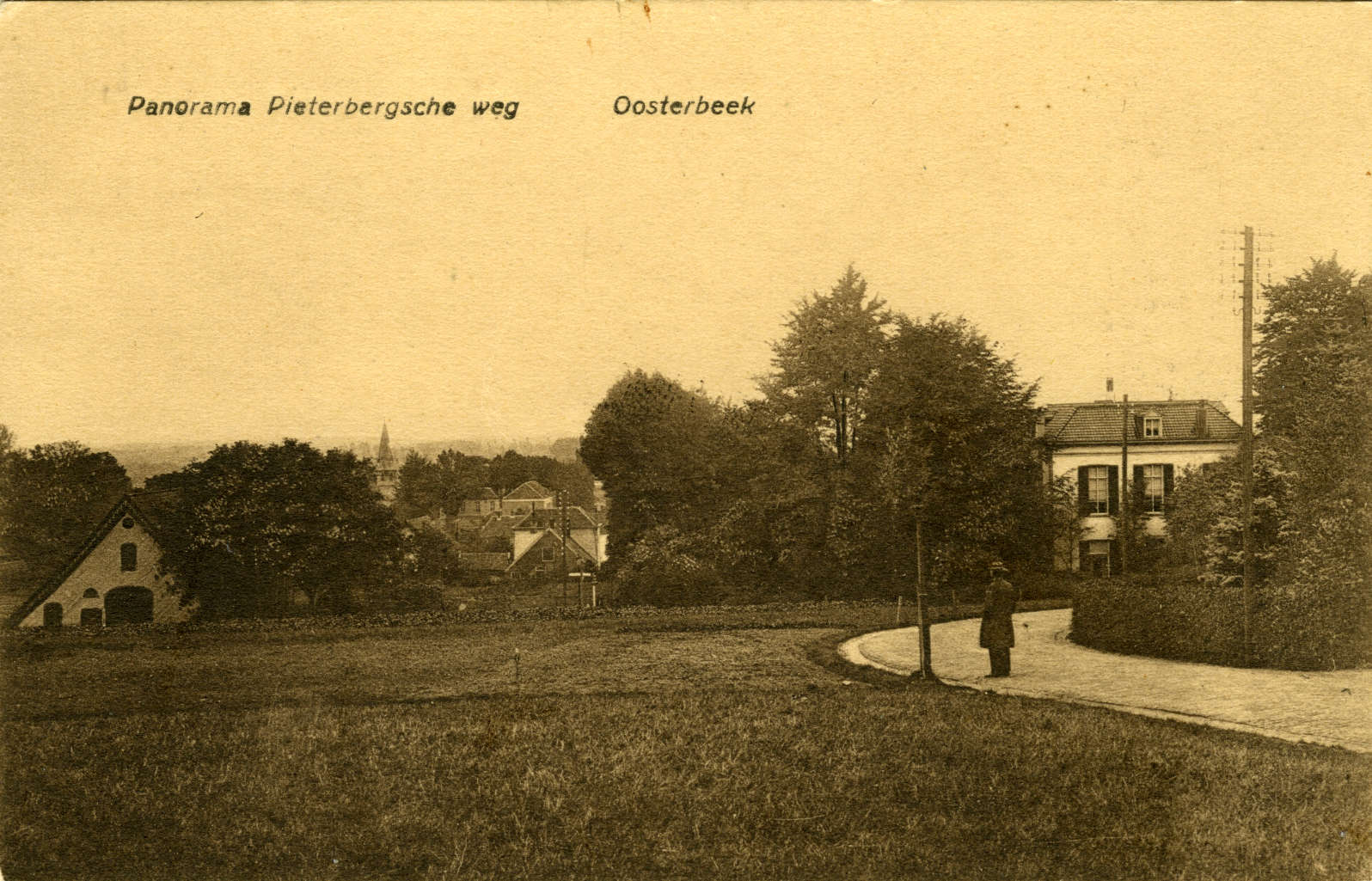
The Villa Rijnheuvel at No 52 Pietersbergseweg, on the right, where Capt. Cranmer-Byng had his H.Q. from 22nd to 25th September 1944. In the middle distance can be seen the Church steeple. Photo taken 1920 - 1930. Courtesy Gelders Archief. 1513-2229.
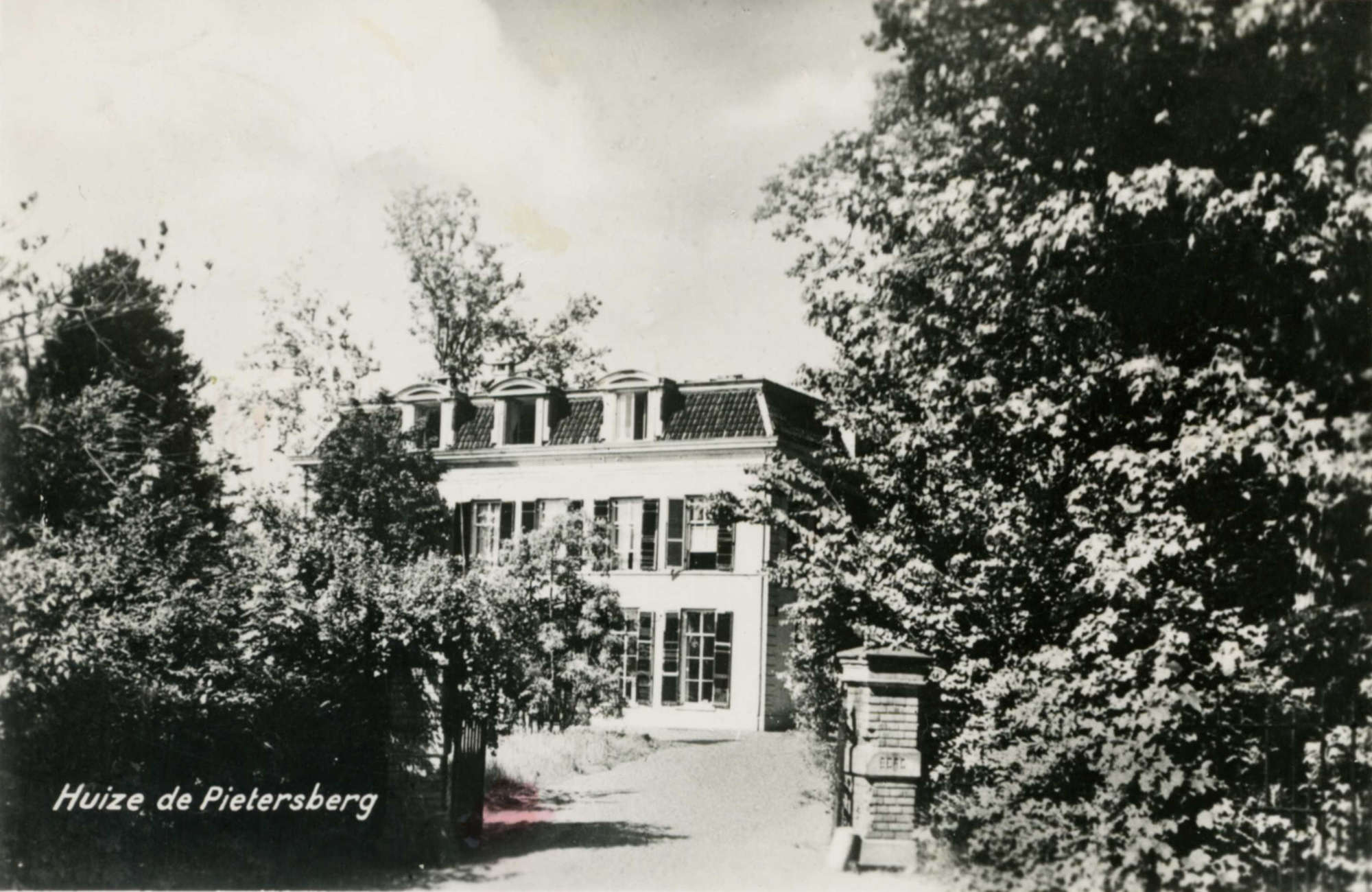
Pietersberg House in the 1930's. This building was taken over by 133 Para Field Ambulance, and is where Capt. Cranmer-Byng sent the 50 tins of milk. Courtesy the Bob Hilton post-card collection.
Sgt. 'Bill' Chedgey: "Eventually several of 250 Company people were identified and formed an ad-hoc Section under Capt. Cranmer-Byng, and he set up his H.Q. in a white house, which was used as a temporary base, from which we moved forward and formed part of the perimeter to the South-East of Divisional H.Q." [15]
Dvr. 'Ron' Pearce: "When Capt. Kavanagh was killed, Capt. Cranmer-Byng told us, 'I want to put you in a house'. We moved deeper and deeper into, what seemed like an enemy controlled, area. We fought into Weverstraat after having been in Jaegerstraat, No 16, some in 18. Only four in our house, twelve in the next." [15b]
Dvr. 'Ken' Clarke: "After two more days of trying to collect supplies and form a depot, which was not very successful, we were ordered to make headway to the lower road in Oosterbeek nearest to the River Rhine to hold a perimeter defence line. Making our way forward, we occupied houses for cover. One house that we entered (which was no ordinary house, more like a village mansion) had a double door. We forced open the outer door and by doing so, a bell rang. It was an old fashioned bell on a spring, very similar to those used in shops years ago. Being surprised by this new noise we dropped flat on the ground, not knowing what to expect next. It could have been a German trap and they were already established in the house, as we had no idea just where they were. However, all was safe and it was just an ordinary bell after all. As I entered the house my eyes spotted a letter that must have been delivered in the past few days. Being a collector of stamps I picked it up and put the letter in my pocket. I managed to keep it with me during my remaining days in Oosterbeek. I brought it back to England and kept it unopened." [16a]
FOOTNOTE. [3] Ken Clarke: After 38 years, I returned to Oosterbeek and retraced my earlier paths. I found the house from where I had taken the letter and I also met the owner of the house at the time of the battle in 1944. Her name was Mrs. Heldring, a wonderful lady of 90 years. Unfortunately, she was now in a home as her eyesight was failing. I also had the privilege to meet her son Louis and her daughter Truus Zelstra Heldring to whom the letter was addressed I have now met the present owners of the house, Mr. & Mrs. Elshof and have been honoured to be their guest, to be able to dine and sleep in those same rooms, is quite unbelievable.
Capt. Cranmer-Byng: "The Sergeant posted his men by various windows, suddenly three Jerries tried to cross the street, and were cut down by Sten fire, two more try to infiltrate into the back garden, a young lad of twenty got them both with one grenade." The Sgt mentioned must be 'Bill' Chedgey: 'From upstairs in one of the buildings he saw a German patrol, and tapping his Bren gunner on the shoulder, he directed him onto his target. A few well aimed bursts killed a number of the enemy, whilst others were wounded and the balance, fled. Bill, realising that he was now a target and expecting the Germans to bring up a tank or an artillery piece, led his men out of the house and went back towards Cranmer-Byng's headquarters. The use of a self-propelled gun or tank against buildings, had become a standard tactic to drive the defenders out into the open. Once they were clear of the protection offered by the buildings, the paratroopers would then be hunted down by the Germans using mortar fire. However, on this occasion Bill and his men were able to escape unscathed and made it back to the headquarters, where they were able to rest.'
Later on that morning, when it had become light, Capt. Cranmer-Byng lead an assault to try and establish a position further forward, or at least, drive the Germans back: "Those of you who were with Lt. Grice and myself that morning when we made a small attack beyond the perimeter, and crossed a road [Weverstraat] into some houses, may be interested in this news: All those houses, except one, are still standing, though pretty badly knocked about. The house was a bungalow (only 2 in Oosterbeek), the 4 grenades I threw did not explode as I took the kit from a chap who was killed in England [Lt. P.E. Thompson], and did not look to see if they were primed! Those of you who went with me into a house that had a balcony at the back, from which we threw grenades on some Jerries in the garden, will be glad to know that the two Dutchwomen living there have survived. Do you remember the woman who spoke English well and begged us not to go on fighting, because she said we would all be killed? Well, she was very apologetic about that incident and was delighted to know that we survived." [14b]
The ad-hoc group had no heavy weapons of any kind, but Dvr. Cyril 'Jack' Cooper remembered that in the group, a Dvr. 'Charlie' Lawes, from No 1 Parachute Platoon, had a PIAT, and he fired it continuously at approaching German armour, but after a while they ran out of PIAT ammunition. "The stench of death was all around us and there were dozens and dozens of dead bodies. I can remember seeing a Dutch family covering some of the British paratroopers with white sheets". [14c]
The rest of H.Q., R.A.S.C. 'stood-to' at 05.00 hrs for an hour, after a comparatively quiet night. Then at 07.30 hrs came a report from H.Q. 1st Airlanding Brigade that during the morning 'hate', a number of men had been killed, and two officers had been badly wounded. One of them was Capt. Lockyer, who was taken to the A.D.S., where he subsequently had a leg amputated.
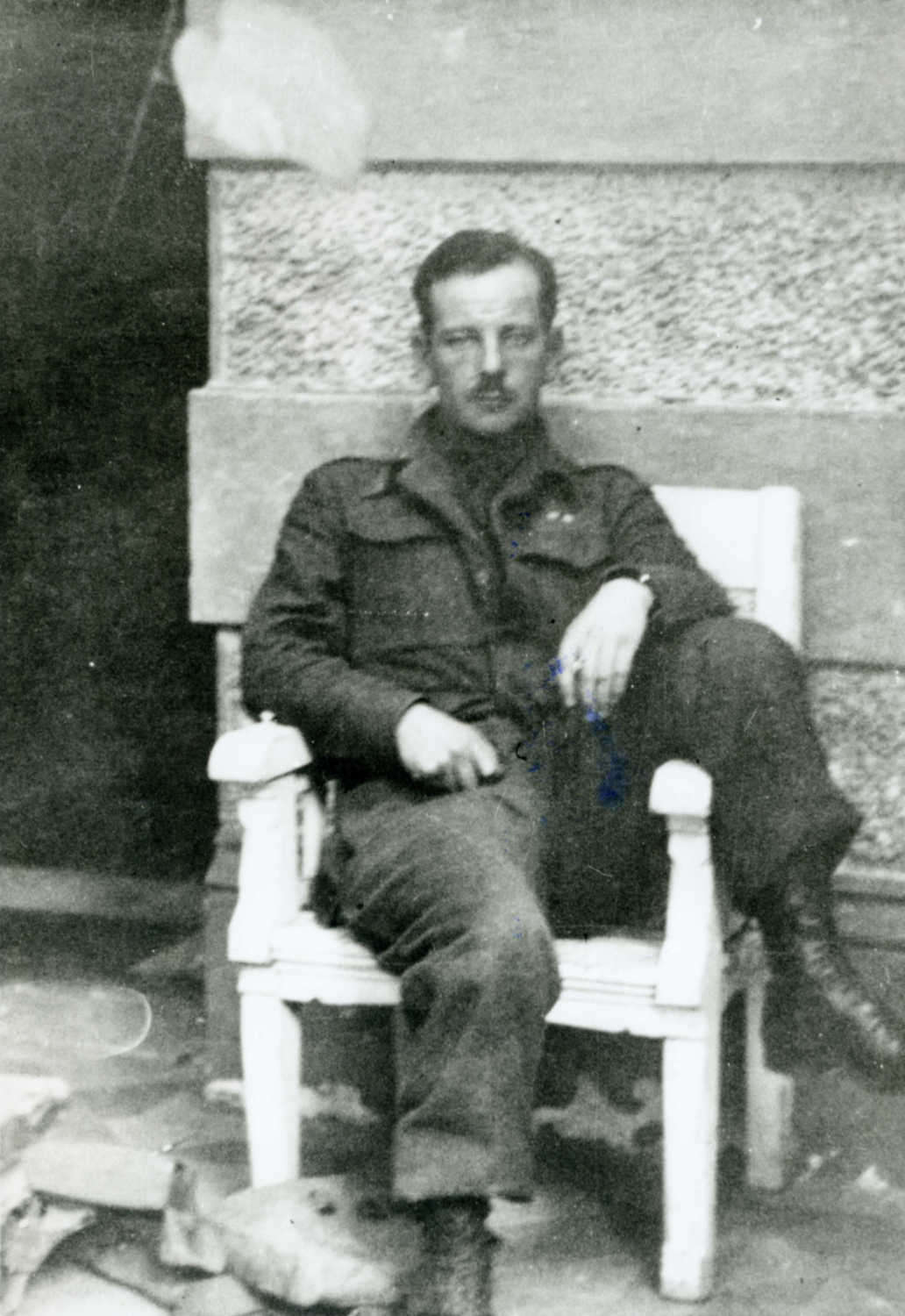
Captain. Colin Harkess, B.R.A.S.C.O. 4th Parachute Brigade. Outside the H.Q. of Brigadier Hackett, Huize Westerpark, just east of the Hartenstein. Thursday, 21st September 1944. Another of the photo's from the collection of Capt. H.B. 'Jasper' Booty. Courtesy Airborne Assault Museum Archives.
From the 1st Airborne Division After Action Report, Part I, Appendix H, for the 22nd September 1944: 'No Re-Supply. During the day, ammunition in the D.M.A. caught fire twice as the result of mortar fire and a stack of 6-pounder ammunition exploded as a result of a direct hit. All fires were again extinguished. Issues were made to the 1st and 4th Para Brigades in Bren Carriers. Message sent asking for special drop of P.I.A.T's, Mortars and P.I.A.T. and Sten ammunition.'
The barrage that hit the D.M.A. area is probably what killed L/Cpl. Henry Davies of 'F' Platoon. He was buried in a mass grave 100m's west of the Hartenstein. Also reported as killed on this day, was Pte. James Morton, but Dvr. 'Ray' Moon had stated that Morton's trench was hit the day before, although this could just be a muddling up of the days. However, there is another account from Pte. James Jones, also of 'F' Platoon, who wrote to the Casualty Enquiry Department in July 1945: "In reference to the list of missing soldiers of my late company the 250 Airborne Light Company, the only soldier I remember last seeing was Pte. Morton. J. T/222698 on the morning of September approx. 25th, 1944 in a trench nearby and he was in good health and fitness at that time. After this, he moved away into another position, and I never saw him again." What exactly happened will probably never be known, except that Pte. James Morton was killed between the 21st and 25th September 1944, and has no known grave. Pte. James Jones was in a trench near the B.B.C. War Correspondent, Stanley Maxted, and at some stage, had been attempting to get through to one of the outlying positions, when he went around a bend with a trailer of ammo and met a tank- he swiftly took a turn into a field and came out another way. Wounded at the end of the Battle, he was taken prisoner. [4]
FOOTNOTE: [4] Some of the RASC personnel were classified as Driver's and some as Private's, this reflected whether they were actual drivers or stores/office personnel. By September 1944 there were 43 men with the rank of Private serving in 250 Company.
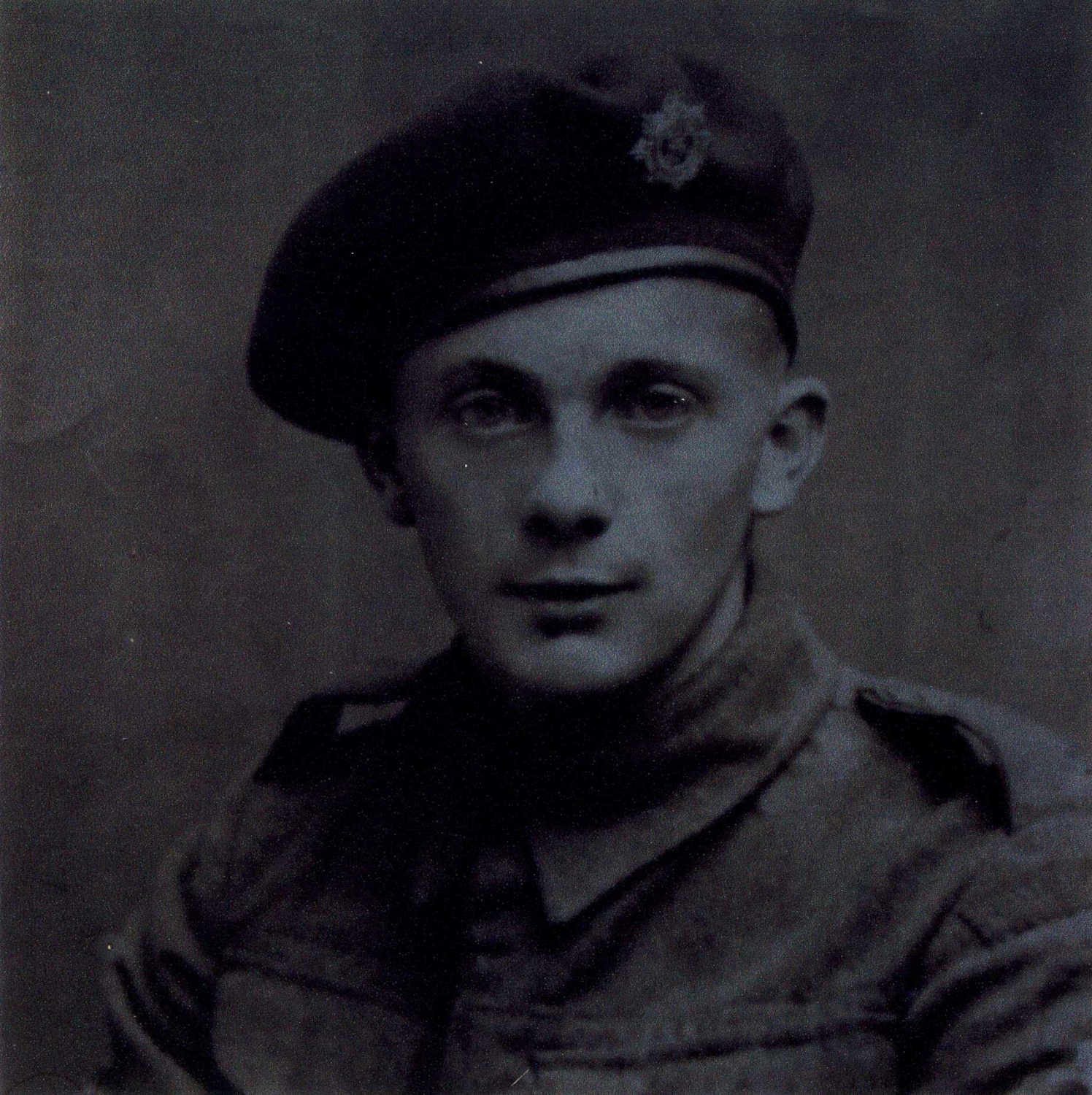
Pte. James Stanley Jones was just short of his 20th birthday when he enlisted on the 23rd April 1942, and then posted to the Company on the 13th July 1942. He flew to Arnhem on the 2nd Lift. Wounded and POW he was sent to Apeldoorn, and then onto Stalag 11B. Courtesy Andy Jones.
The H.Q., R.R.A. Signals Log reported at 22.55 hrs: '4 Para Brigade reports R.A.S.C. sector bullied a bit by Self-Propelled Gun during day, resulting in line bending slightly. Hope to straighten first thing tomorrow.'
From the book 'First Airborne' by Lt-Col. Packe, is the following account of one night in the perimeter: 'Feet pounded overhead and a figure slid into the trench. "Phew," it said, gaining breath; "is there anyone at 'ome?"
"Yes, I am," said James [Lt-Col. Packe] , "you're standing on my foot. Oh, it's you, Corporal Badgem; come in quick."
"Excuse me sir, Sergeant Barker's [S/Sgt. A.E. Brown] been 'it out 'ere. We've got 'im as far as this, but we couldn't get no stretcher, and we think we'd best wait until it stops. Can I bring 'im down, sir?" They lowered him by his armpits, James bracing his knee as a support for his back. They laid him in the safest place, in the middle of the trench.
"Where did it get him, do you know Badgem?"
"'E was putting out the fire in the dump, and one came in right amongst them. 'E's not too bad sir; mostly shock I think." "I'm O.K. sir," said the wounded man sliding himself painfully into a sitting position; "it's only my wrist."
"Let's have a look at it," said James; "Who's got a first field dressing?"
"Here you are," said a quiet voice from the dark end of the trench, "let me come through, I'll fix it."
"Hullo Jocelyn [Capt. Cranmer-Byng], I didn't know you were here; how's it going your way?"
"Never a dull moment. There's an S.P. Gun up the road. Here now, I want a torch and a knife."
"Torch, sir," said Badgem, passing it up; "here's a knife," said James. "Now then sergeant," went on Jocelyn, "take it quietly, you'll be all right. It'll be best to cut that sleeve away, and then bind the wound up tight to stop the bleeding."
"I'm O.K. sir," said Barker again.
"Don't look at it," said Jocelyn; "it's not too bad, just a clean piece out of the arm, no real damage done. But if you look, it'll make you feel sick. That's right; now we'll bandage it up, and you'll do fine."
"Have some whiskey," said James when it was neatly bound; "or is this one of the cases when no alcohol should be administered? I always forget."
"Thank you sir," said the sergeant, taking a pull at the silver flask and wiping his mouth on the back of his uninjured wrist. "I just came up to see you sir," said Jocelyn to James [Lt-Col. Packe]. "We're all right down there. There are some Germans in the wood, but they don't seem to come any closer. There's a good bit of mortaring, but we're well dug in, and as long as we keep our heads down we'll be perfectly all right." "Good," said James; "you'd better stay here now until this stops. There's not long to go, it always packs up at sunset." "I believe it's stopped already," said Jocelyn. "Excuse me sir," said one of the soldiers, "we're going to fill the water can now, before it gets too dark." There was a green slimy well in the farmyard at the bottom of the garden, which the enemy could observe by day and, by setting fire to a haystack, at night. This was the one hour when it was safe to use it. "Goodnight sir, I'll be getting back to my chaps now," said Jocelyn.'
H.Q, R.A.S.C. and its remaining Detachments, mainly HQ and 'F' Platoon, 'stood-to' at 19.00 hrs, to endure the 'ritual hate' of the German mortar and artillery barrage for an hour, but in fact was reported as continuing to be heavy during the night.
Later on Capt. Cranmer-Byng had been visiting his 'outposts' and had returned to the building he was using as his H.Q: 'It was getting dark now, the Platoon officer, who was holding the next two houses and gardens arrived, he had been visiting his men in their various posts: encouraging them, giving them the news such as it was. Suddenly the Platoon officer collapsed, he had been taking a dose of Benzedrine tablets every night to keep himself awake. But this evening he had run out, after taking them for three consecutive nights. The Sergeant got him placed on a bed in the house and left him; he was unconscious until the next morning when the Jerries mortar barrage began to search the area again at first light.' Although writing in the 'third person' this is an account from John Cranmer-Byng, and the Sgt he refers to must, again, be 'Bill' Chedgey.
Saturday, 23rd September 1944.
'Stand to' for H.Q., R.A.S.C and the Detachments was between 05.00 and 06.00 hrs, and very heavy shelling and mortar fire was reported. It was further noted that there was sniper activity in the vicinity of the well near their position, and that there were enemy aircraft over the Divisional area - a sight that would have been immensely frustrating to the men on the ground, who had been told that the Allied Air Forces enjoyed 'air supremacy'!
The 1st Airborne Division After Action Report, Part I, Appendix H, for the 23rd September 1944, has the following entry: 'Supply drop carried out despite very heavy opposition, small proportions supplies collected and distributed as far as possible. At this stage there were only a few serviceable Jeeps and trailers which could be used, the remainder having been rendered unserviceable by mortar and shell fire. C.R.A.S.C. and D.A.Q.M.G. recce'd area towards the river for possible D.M.A. without success, owing to blocking of roads by branches of trees, debris, etc. More very heavy mortaring of D.M.A. after re-supply, ammunition stacks again catching fire. Very few rations received and all were handed over to M.D.S's. Stocks of gun ammunition, P.I.A..T, Mortar and Sten which were in great demand were almost non-existent.'
Cpl. Samuel Staple: "Our part in this battle was to supply the troops with ammunition. Therefore we set up an ammo dump in the woods at the side of the Hartenstein Hotel. Our vehicles did not last for long as they were destroyed by German mortar fire." [20]
The resupply drop took place between 16.00 and 17.00 hrs, with 123 aircraft taking part - 73 x Stirling's and 50 x Dakotas. Of the 291 tons dropped, only approx. 7 tons was recovered to the D.M.A.
Part of this drop impacted on the R.A.S.C. Defence Force on the Perimeter in an unusual way, Capt. Cranmer-Byng: 'It was now daylight again, here were the supply planes again coming in low to drop, three planes were already on fire, yet still they flew over and the panniers were pushed out. Two men jumped, one parachute opened, the other didn't. The crew never got out, and the plane plunged to earth nearby with them in it. The parachutist landed in the garden of a big house held by some RASC men, two of them dashed out and dragged him inside, away from the mortar barrage which always accompanied these daily re-supply flights. He was wearing battledress only with gym shoes on; he had no equipment or weapons. A wounded soldier brought up a mug of tea from the cellar of the big house and gave it to him. The Platoon officer poured a liberal helping of Vermouth into it. It was his first parachute jump and his first battle. From the broken windows of the house, another plane could be seen crashing in flames, while shells, mixed with mortar bombs kept up a continuous barrage. The platoon officer reported over the R.T. to Brigade HQ: "One reinforcement arrived from England!"
From the Diary of Brig. Hackett. 'Most of the afternoon I spent improving and helping to man Brigade H.Q. defence locality against which an even heavier volume of fire was developing. R.A.S.C. defence in centre had a slight reverse, but recovered and I was now pretty confident about the line from including M.D.S. cross roads southwards.'
Dvr. Charles Boardman, No 2 Parachute Platoon: "After we lost the Captain, Sergeant McDowell was in command, and as a runner, I went with him for daily orders to 21 Parachute Company on the eastern perimeter they were working with a wireless set, we occupied several houses next to the Company, Lieutenant Speller was in Command." [17]
Dvr. John Prime, No 2 Parachute Platoon: "During the course of the next few days we appeared to have been pinned down in a series of streets in the village of Oosterbeek. Street fighting, sniping and continuous patrols were carried out under intense, continuous mortar fire. We appeared to be completely surrounded, because whichever way we tried to go, we ran into enemy troops. Food and water had to be scrounged wherever possible - preservatives found in cellars, and water from baths, toilet cisterns if you were lucky." [18a]
Dvr. John Green, No 2 Parachute Platoon, was still laying wounded in one of the buildings near the M.D.S. cross-roads: "On the Saturday morning some Dutch nurses came and washed us, and the boys sorted out their kit and found some meat-cubes from 24-hour packs. We made a sort of stew. The padre came round to us all with a choice of either two boiled sweets or a fag. I took the fag. I was in a room full of all sorts of chaps, officers too, but I was near the wall under the window, and didn't get disturbed much, yet. Everything seemed to be going as well as you could expect when a mortar-bomb landed near the window. This was a nasty do, and the place was properly smashed up. The chaps were put into the passage outside, and I remember an R.S.M. of the Medics dressing me, for I had collected a packet of shrapnel in my left thigh. To add to the fun and games, some Jerries arrived and told us we were prisoners. They put a guard on us, and he was collected by our lads, who must have counter-attacked, who told us we were free again. Then there must have been another counter-attack, for this time the Jerries arrived with ambulances and took us away to Arnhem. Later on, we were put into cattle-trucks and taken by train to Germany." [19]
Dvr. 'Ken' Clarke, and his party, had now moved to the main defensive positions on Jagerskamp: "Things were getting a little uncomfortable by now so we managed to escape to another house down the road. Here we found a table laid out with apples that had recently been gathered from an orchard nearby. Again, we made a meal out of our find. Everything was very welcome as food supplies were getting desperately short. While we were here I remember seeing a German run up the garden path and throw a grenade up to the bedroom window, but fortunately for us his aim was a little feeble and it dropped back on top of him." [16b]
L/Cpl. Leslie Withey and Dvr. 'Jimmy' Cook, both of No 1 Parachute Platoon, were part of this defensive force, L/Cpl. Withey: "I was in No 1 Parachute Platoon which dropped on Sunday, 17th September, with the 1st Parachute Brigade. As the battle proceeded our primary role of supply collection from the D.Z. and delivery to units was superceded by our being used in a defensive role as infantry, together with Glider Pilots and others. In the event I and other survivors were unable to make it to the River on the night of evacuation and were subsequently taken P.O.W." [19a]
'Jimmy' Cook: "You all know now the story, how for nine days we hung on, hoping our Army would get through to us; how we fought against some of the best picked men of the German Army. Shot and shell were rained upon us; it seemed impossible that any of us would get out. The German wireless, with loud speakers, continually called upon us to surrender, but, not one of those lads would have ever given in. We were determined to stand together, even after the last shot had been fired." [19b]
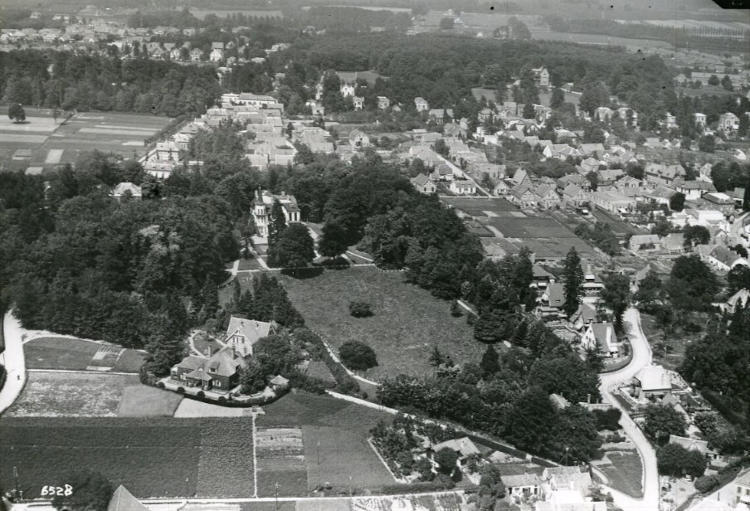
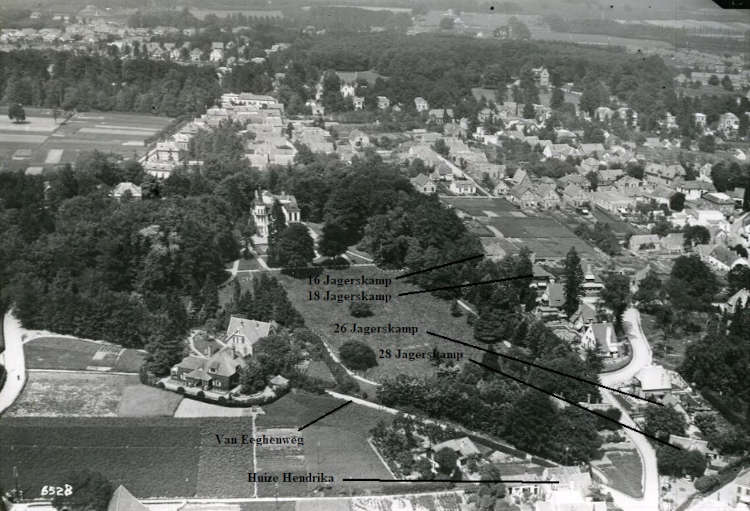
This 1929 photo taken by K.L.M. shows the area of the Weverestraat (at lower right), the junction of Jagerskamp (from its southern end going north), Van Eeghenweg (going from right to left across the lower part of the photo). Courtesy of Gelders Archief 1541-1037.
Compared to some of the other days, this was probably one of the quietest, in regards to enemy action, but it was to be the lull before the storm.
'As night fell the defenders of Oosterbeek settled down for another night of unpleasantness as the Germans, with no Typhoons to worry about in the dark, took up their ritual pounding of the Divisional area with gusto. Sgt. 'Bill' Chedgey, however, was taking the opportunity for some well-earned rest and found himself able to sleep a little; something he had not done for three days. He was not best pleased, therefore, when he was woken after only a couple of hours to be told by Lt. Grice that he would have to go back into the area he had just left. He was even less pleased to hear that he would have to reoccupy the same house for he was certain he would be targeted. Using the dark to conceal movement, and feeling angry and frustrated, 'Bill', with a party of men, followed Grice back to the house they had left earlier that day.'
The well practised ritual of 'stand-to' was again observed by all, from 19.00 to 20.00 hrs.
Sunday, 24th September 1944.
H.Q., R.A.S.C. reported intense mortaring and shelling during the 'stand-to' at 05.00 to 06.00 hrs. During the day they once again reported the presence of enemy aircraft over the Divisional area, and that yet again, enemy machine gun fire was directed at the well in their area.
The comparative inactivity of the enemy the day before was about to end, as the following reports outline:
H.Q., R.R.A. Signals Log. 24/09/44.
09.55 hrs. R.A.S..C. report Tank or Self-Propelled Gun in their area. Destroying a house in which they were defending.
11.04 hrs. R.A.S.C. report being blasted out of houses, moving into new ones. Not to move back.
14.05 hrs. From 21 Independent Para Company. Big attack on R.A.S.C. Platoon on right. Told to help them with all fire power possible.
14.15 hrs. From 4 Para Brigade. Attack coming in on R.A.S.C. Platoon. 'Lonsdale' Force very worried about R.A.S.C. Self-Propelled Gun M.R: 695777. Have no Information of 11th Parachute Battalion.
14.26 hrs. From 4 Para Brigade. Germans Infiltrating into area by R.A.S.C. Platoon. Are and also attacking rear of the 'Lonsdale' Force.
14.43 hrs. To 1st Airlanding Brigade. Enemy penetrating from east to road junction M.R: 693775. Can you place a stop there.
14.47 hrs. From G.P.R. Suggest artillery support in area R.A.S.C. which is very obscure.
1632 hrs. From 4 Para Brigade. 21st Independent Parachute Company have stopped attack and have killed a lot of Germans and joined up with R.A.S.C.
Report by Capt. H.B. Booty, 4 Para Brigade H.Q. Sunday, 24th September 1944.
14.15 hrs. 21 Independent Para Company reports enemy forces moving North up road from M.R: 695780 - No news of R.A.S.C. Platoon and it is thought it must have been by-passed.
'Lonsdale' Force asked to provide a counter attack force if necessary, which was laid on by 1430 hrs, but not immediately available owing to heavy shell fire.
The enemy infiltration was reported to Division with a suggestion that a crump [artillery concentration] be put down at M.R: 697780. Awaiting confirmation from Maj. Wilson, O.C., 21 Independent Para Company that this is alright.
14.45 hrs. Maj. Wilson reports situation obscure, and own troops probably mixed up with enemy. He suggest crump 200 yards forward of R.A.S.C. Platoon last position.
15.15 hrs. 21 Independent Para Company report two S.P. Guns firing 200 yds east of M.D.S.
14.55 hrs. C.R.A. agrees to shoot on enemy, but not S.P. Guns owing to proximity of M.D.S.
15.20 hrs. The German ultimatum to move all troops clear of M.D.S. for 200 yards was refused.
15.25 hrs. The crump commenced.
Between 15.30 and 16.30 hrs, fighting was very confused on both 156 Para Battalion front and 21 Independent Para Company front. Enemy managed to infiltrate amongst the Para Platoon who stood firm. Glider Pilots on right of 156 Bn are reported by 156 Bn to have pulled back.
16.30 hrs. Maj. Wilson reported that he had destroyed a number of enemy. Some of the R.A.S.C. Platoon on right had joined him.
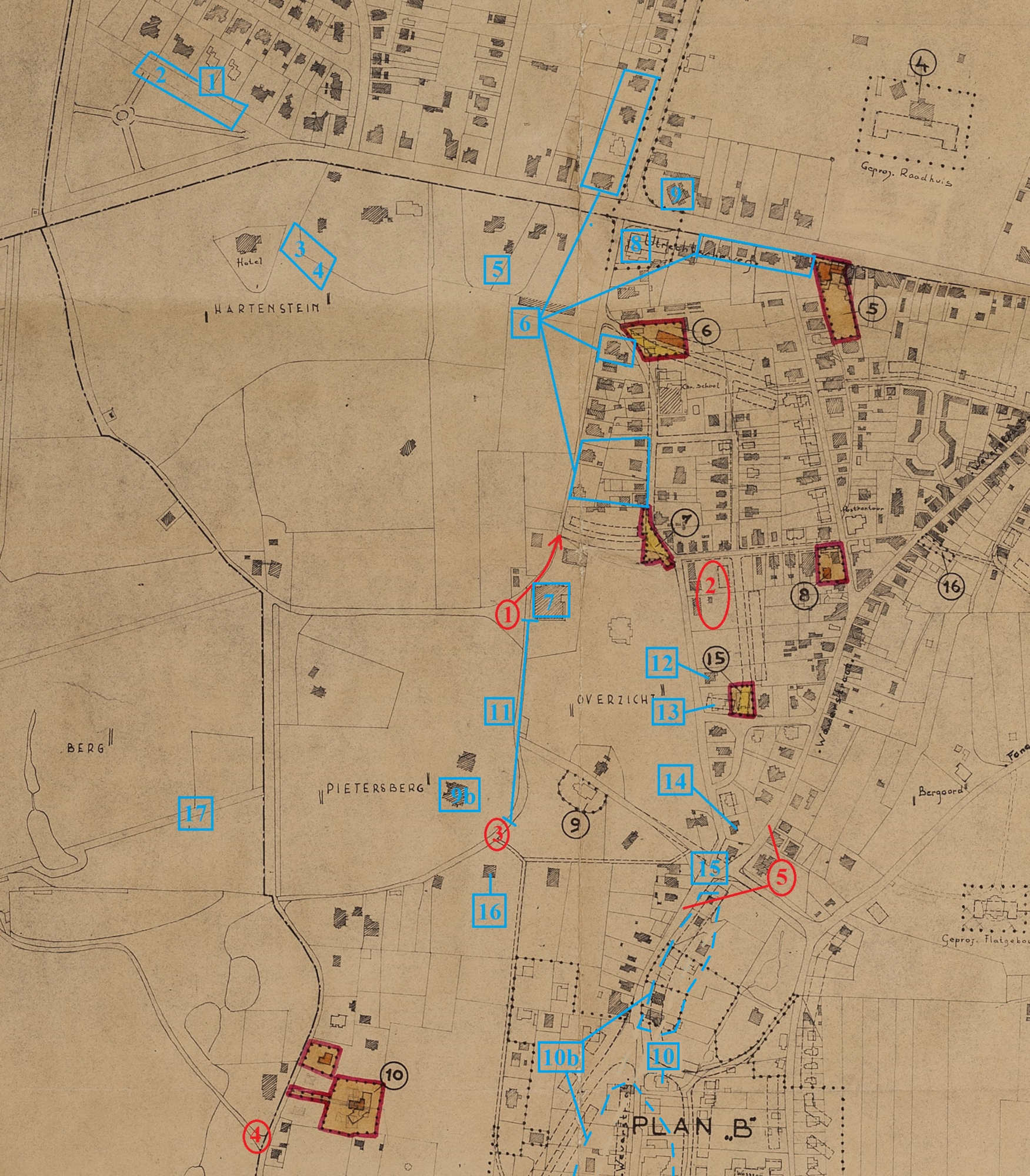
RASC positions and actions, 22 - 25 September 1944.
KEY TO MAP OF POSITIONS, 22nd - 25th September 1944.
[1] 1st H.Q., R.A.S.C.
[2] 1st D.M.A. position.
[3] 2nd H.Q., R.A.S.C.
[4] 2nd D.M.A. position.
[5] H.Q., 4 Parachute Brigade.
[6] 21 Ind Parachute Company. positions.
[7] Tafelberg Hotel.
[8] Schoonoord Hotel.
[9] Vreewijk Hotel.
[9b] Pietersberg House.
[10] Vredehof House.
[10b] Lonsdale Force positions.
[11] Position ordered to occupy by 4 Para Bde.
[12] 16 Jagerskamp.
[13] 18 Jagerskamp.
[14] 26 Jagerskamp.
[15] Cpl. Doubleday killed here.
[16] 52 Pietersbergseweg. Capt. Cranmer-Byng H.Q.
[17] Sgt. McDowell's party - last position. German activity. 24/09/44.
(1) Germany force reported moving North.
(2) German infiltration.
(3) German S.P. Gun.
(4) Furthest German penetration.
(5) German S.P. Guns.
This was the very thing that had worried Sgt. 'Bill' Chedgey: "At approx. 09.00 hrs, Lieut. Grice returned to Cranmer-Byng's H.Q. for orders. At about 10.00 hrs I learnt that our HQ was under attack and the Corporal in charge needed instructions. Capt. Cranmer-Byng had not been seen for at least 4 hours, I realised that we were in an isolated position and decided to withdraw toward Hartenstein." However not long after Lt. Grice left, a Self-Propelled Gun arrived - the storm was about to materialise. Sgt. Chedgey dashed upstairs into the front bedroom for a look, and as he did so the gun fired two rounds into the house. 'Bill' was blown over, tumbling over and over as he fell down the stairs, to end up at the bottom with a broken femur. In great pain, he was left with very few options. Clearly the house was no longer a tenable position, for they had nothing with which to defeat the powerful armoured vehicle pitted against them. It could quite simply stand off and blow the building, with them in it, to pieces. He ordered his men to withdraw, and watched as they raced back across the fields. Some were killed as the German mortars tracked them down, whilst others managed to escape to some relative form of safety in the woods beyond the houses. Discarding his two phosphorus grenades and his two Mills grenades, 'Bill' awaited capture as he lay in pain in the hallway of the house. Soon the barrel of a Schmeisser sub-machine gun was poked into his stomach, and in German he was asked by one of four youngsters where his comrades were. Speaking a little German, he responded that they had gone. Unsure about what to do with their captive, the sixteen-to eighteen-year-old Germans were faced with an injured sergeant. In their world, his equivalent, a 'Feldwebel', was God, and 'Bill' was treated accordingly. Before long they had constructed a stretcher, had made the sergeant as comfortable as they could and carted him off to hospital.'
In a further letter about this day 'Bill' ended a description of this part of the battle with: "Several men were hit, but I was relieved that both officers managed to join the evacuation party." Sarcasm, maybe!
Dvr. Cyril 'Jack' Cooper had re-equipped himself with a weapon from a dead German, and he and two others were 'sniping' at the Germans from an upstairs window, when a shell from an S.P. Gun smashed into the house: "Suddenly the floor had gone and we were down in the kitchen. Me and a lad called Hatton scrambled out of this house and ran across the road into a sort of park, but were cut down in a hail of bullets. Hatton was killed and I was hit in the leg and stomach and I fell to the ground with blood oozing from my stomach". [14c] Cooper may must have been mistaken about Dvr. Hatton, who had been wounded on the 19/09/44 and died of his wounds at the Tafelberg on the 24/09/44. It is possible that he meant Pte. John Hayward, who was in the Jeep Section attached to No 2 Parachute Platoon, as he was wounded and also became a POW. Cooper was soon found by advancing S.S. Infantry, and taken prisoner.
On this day to, the man that 'Bill' Chedgey had replaced, was captured - Sgt. Ford Edmonds, was recorded as being wounded in the right arm (however there is a good chance that this was his previous injury, and that he did not let it deter him), and was made a prisoner on the 24th. He was sent to the temporary 'Airborne' Hospital at Apeldoorn, and left there on an ambulance train, on the 6th October 1944. He was bound for Stalag 11B, at Falingbostel in Germany, arriving there on the 9th October 1944, but was moved to Stalag 8C, at Sagan on the 24th October 1944.
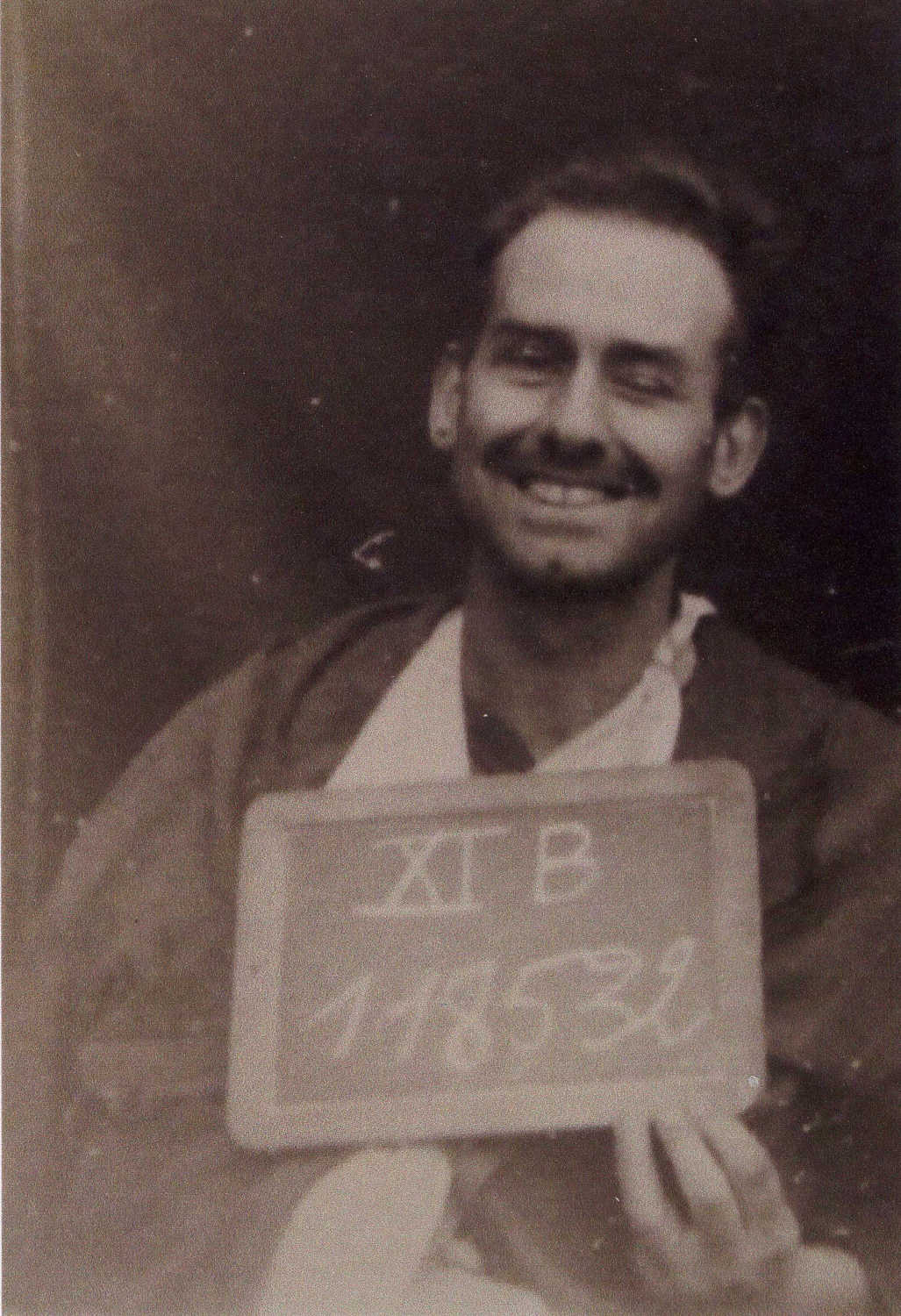
Sgt. Ford Edmonds. 'D' Transport Platoon. Photo taken on the 9th October 1944, when a POW at Stalag 11B. He had enlisted on the 4th March 1940, and was posted to the Company on the 17th July 1940 - right at the start of its existence. Courtesy of John Howes.
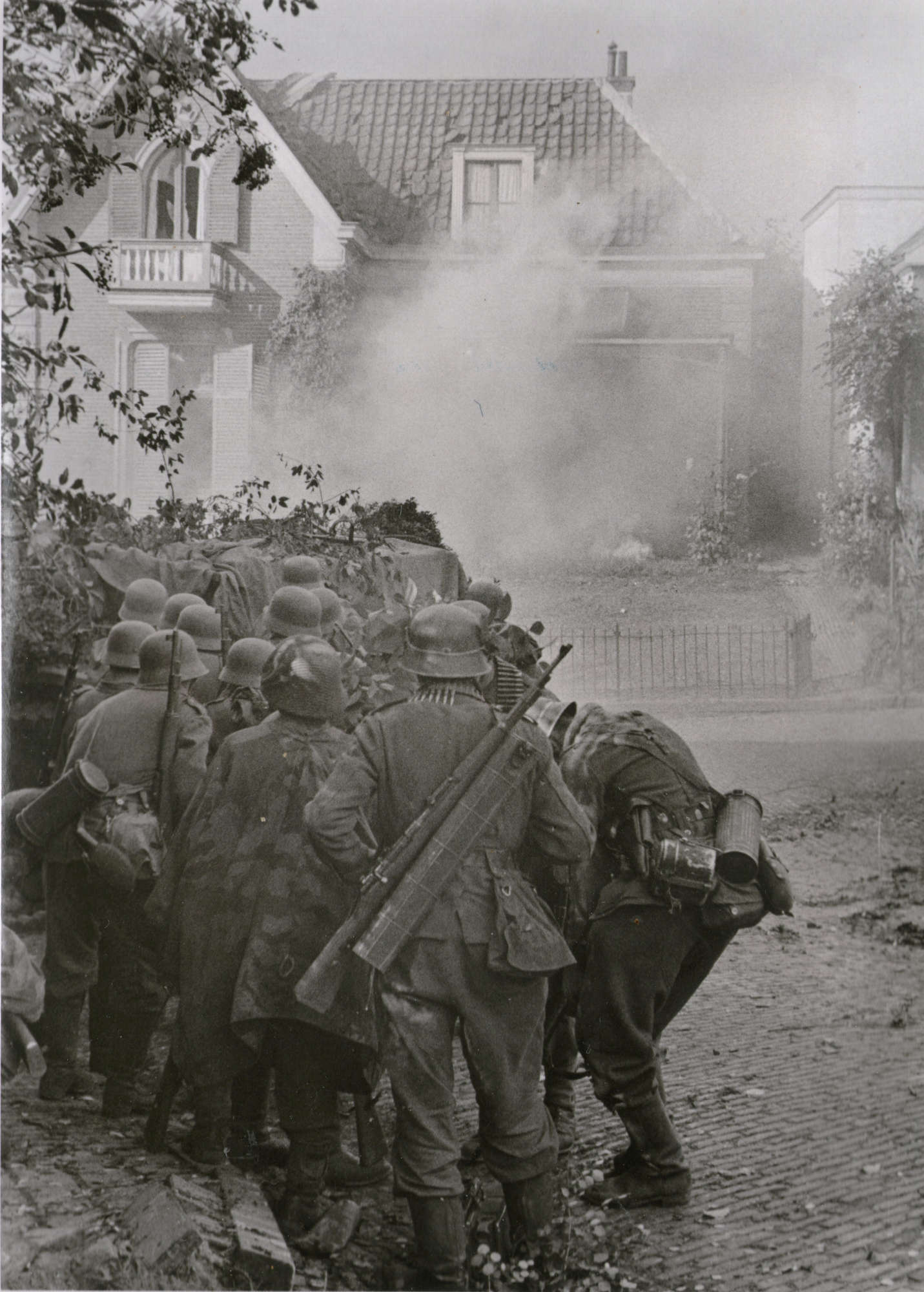
Having spent the previous day probing the British defences, the Germans have now found the most vulnerable point for their attack. Assaulting infantry from Pioneer-Lehr-Battalion 9, attached to the 9 S.S. Panzer Division, move up behind a Stug III, as it fires into a house on Weverstraat. 24th September 1944. This, and the next six photo's, were probably all taken by a German P.K. photographer named Seuffert. Courtesy of Bob Gerritsen.
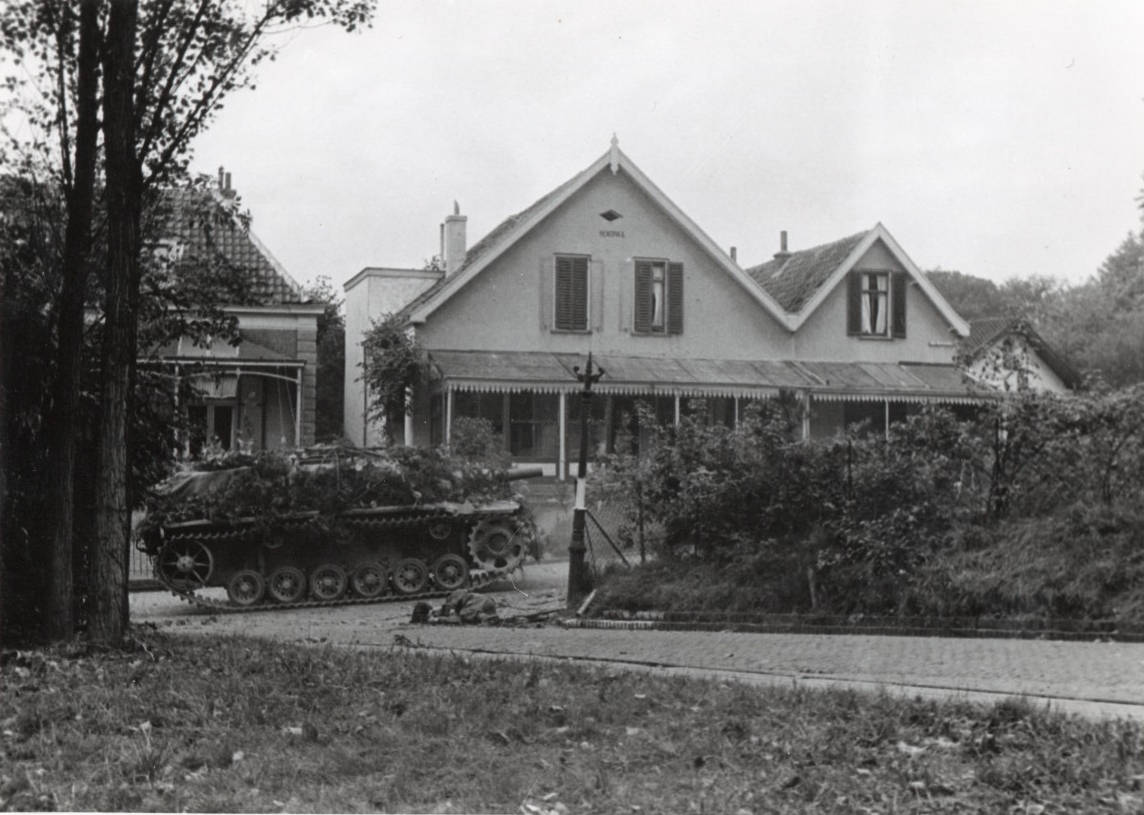
The Stug III moves onto Weverestraat and turns right to face towards Jagerskamp and Eeghenweg. 24th September 1944. Courtesy of Airborne Assault Museum, Duxford.
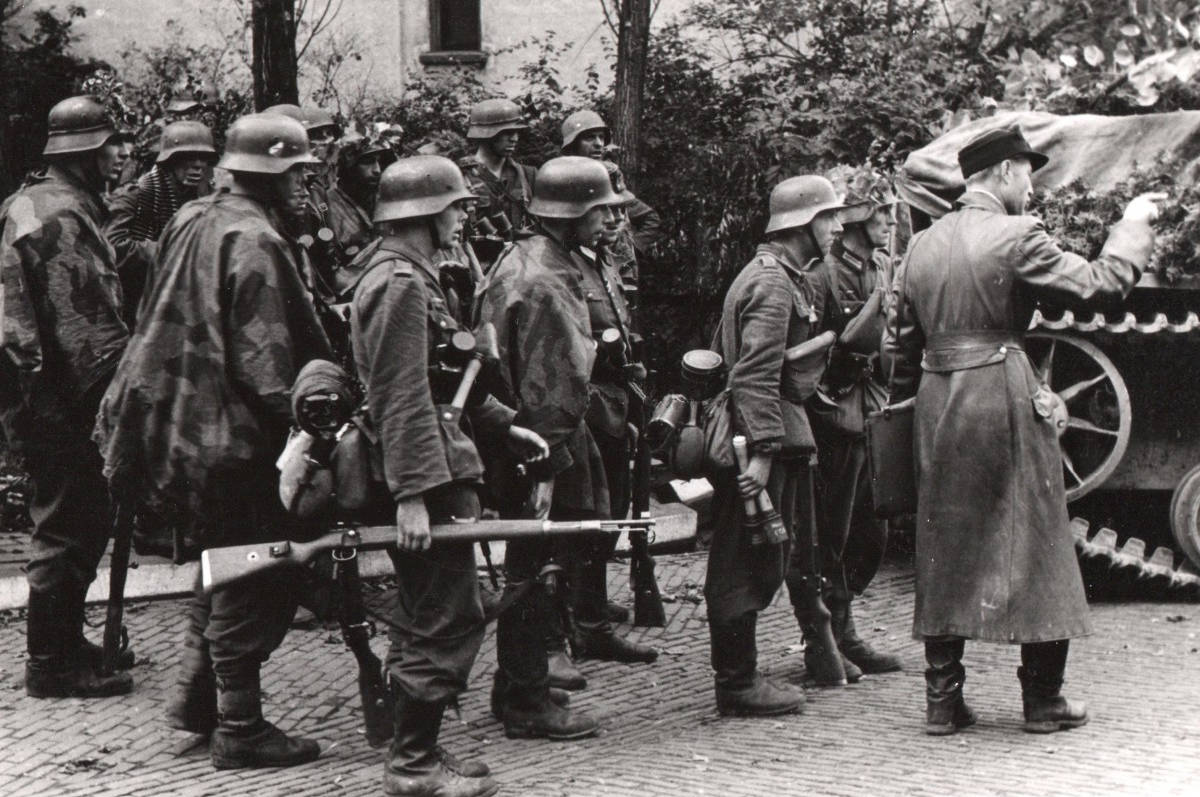
Having cleared the opposition a squad of German troops now gets a set of orders from an officer, whilst waiting behind a Stug III S.P.G. Junction of De Dam and Weverstraat. Courtesy of Bob Gerritsen.
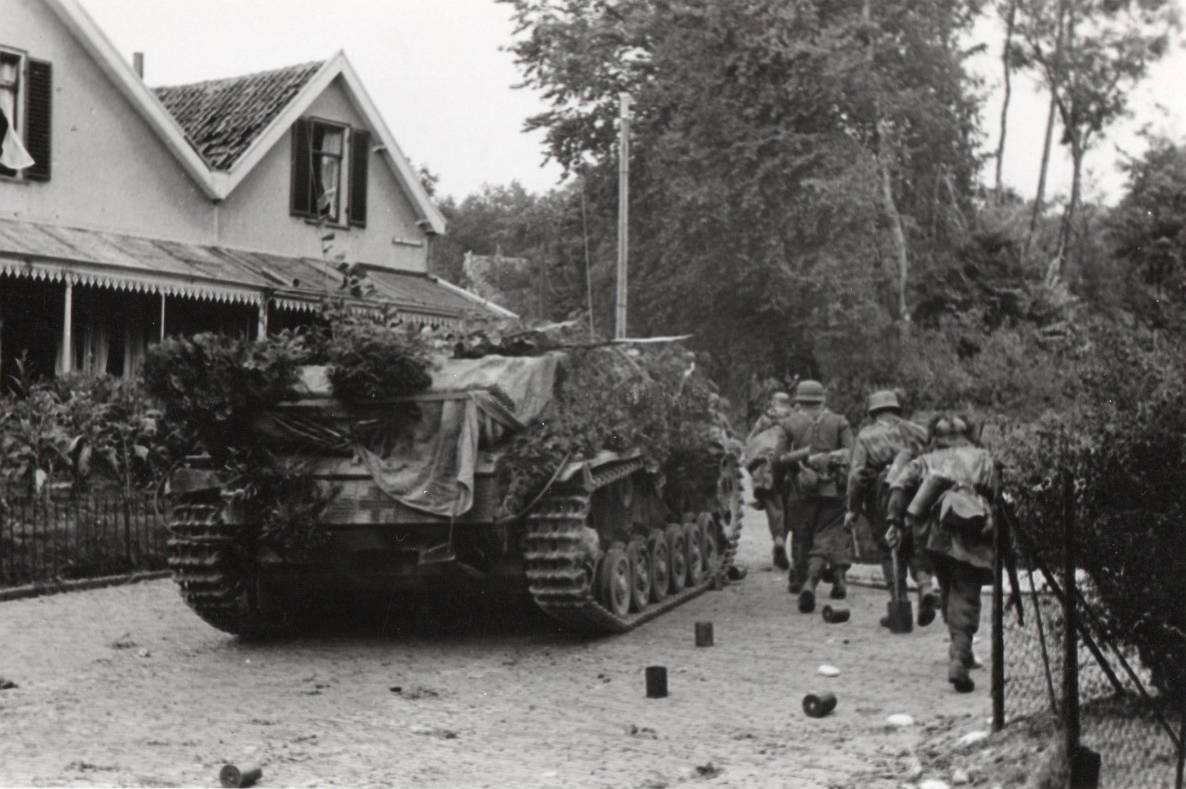
The same Stug III now moves off towards Van Eeghenweg, with the troops still using it for cover from the direction of the British threat. Notice the soldier at the back with his entrenching tool held at the ready. Courtesy of Bob Gerritsen.
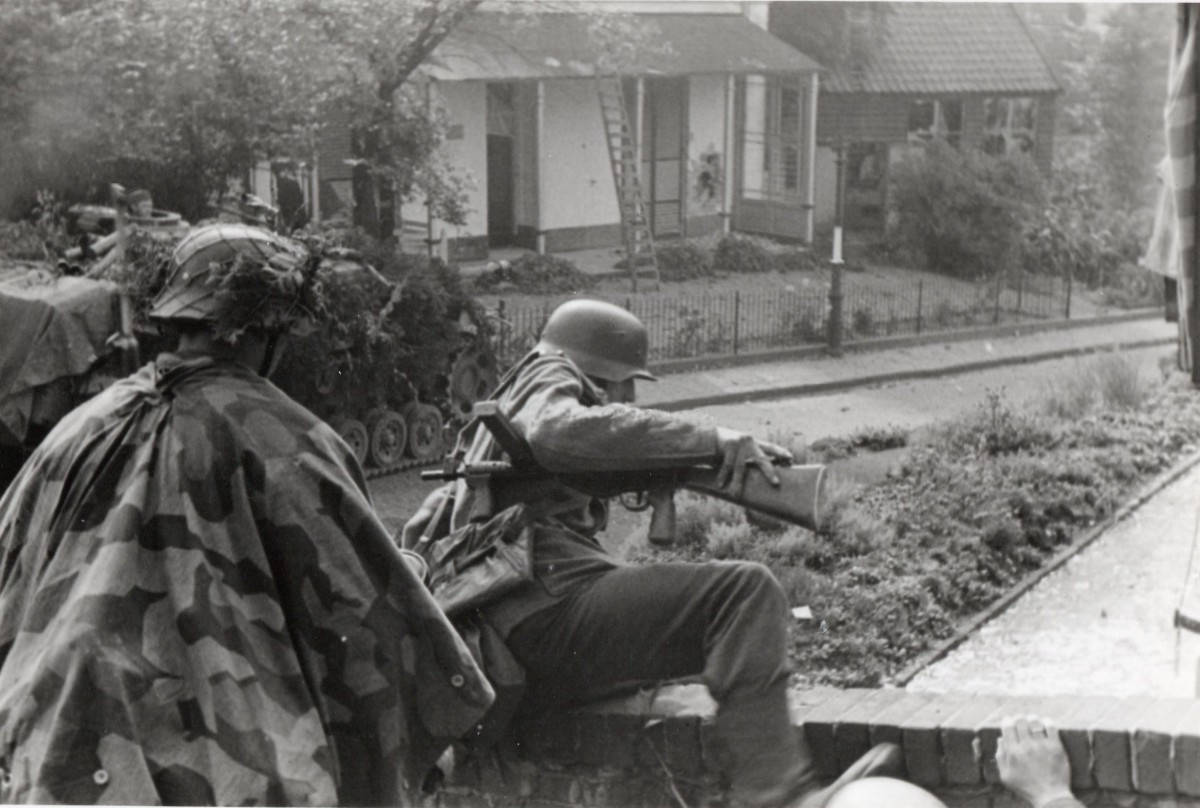
German infantry squad (one of them with a captured British Sten S.M.G.) move up in support of a Stug III on Weverstraat. Courtesy of Bob Gerritsen.
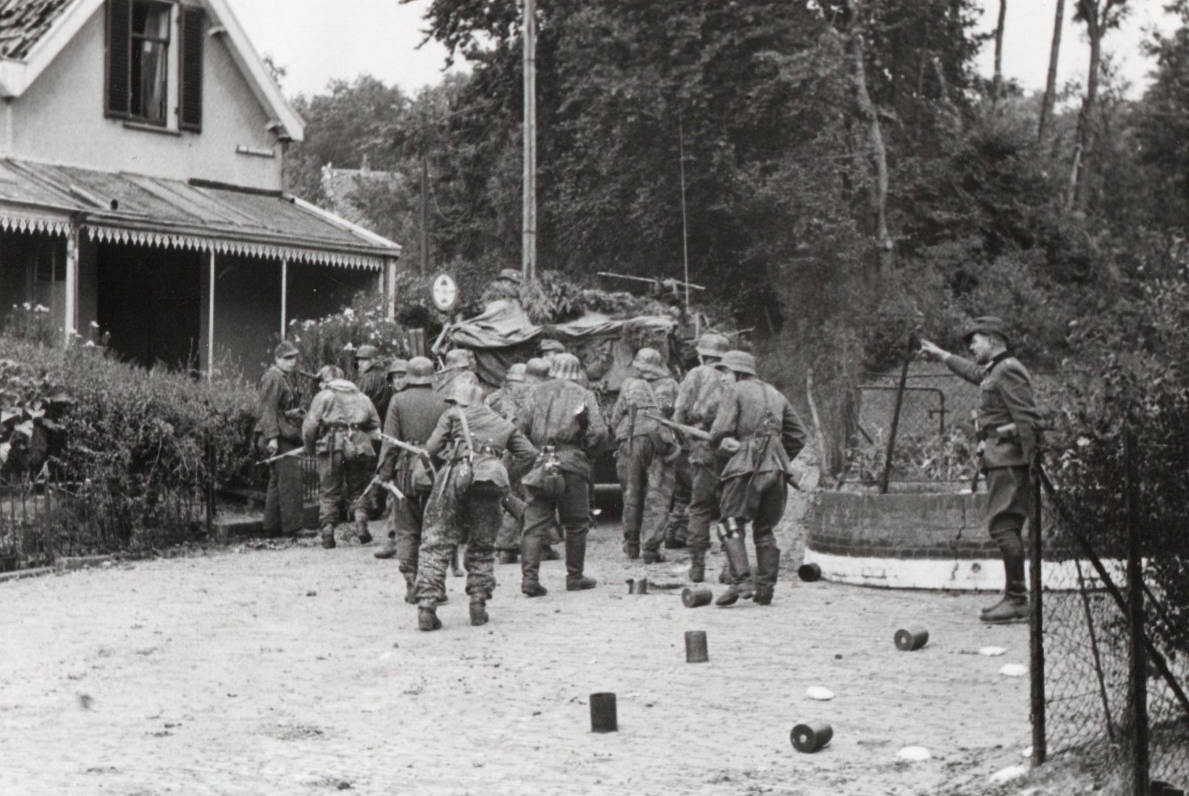
A German Stug III on Weverstraat, moving towards van Eeghenweg, with an infantry squad moving up in support. Notice the German officer on the right giving directions. Courtesy of Bob Gerritsen.
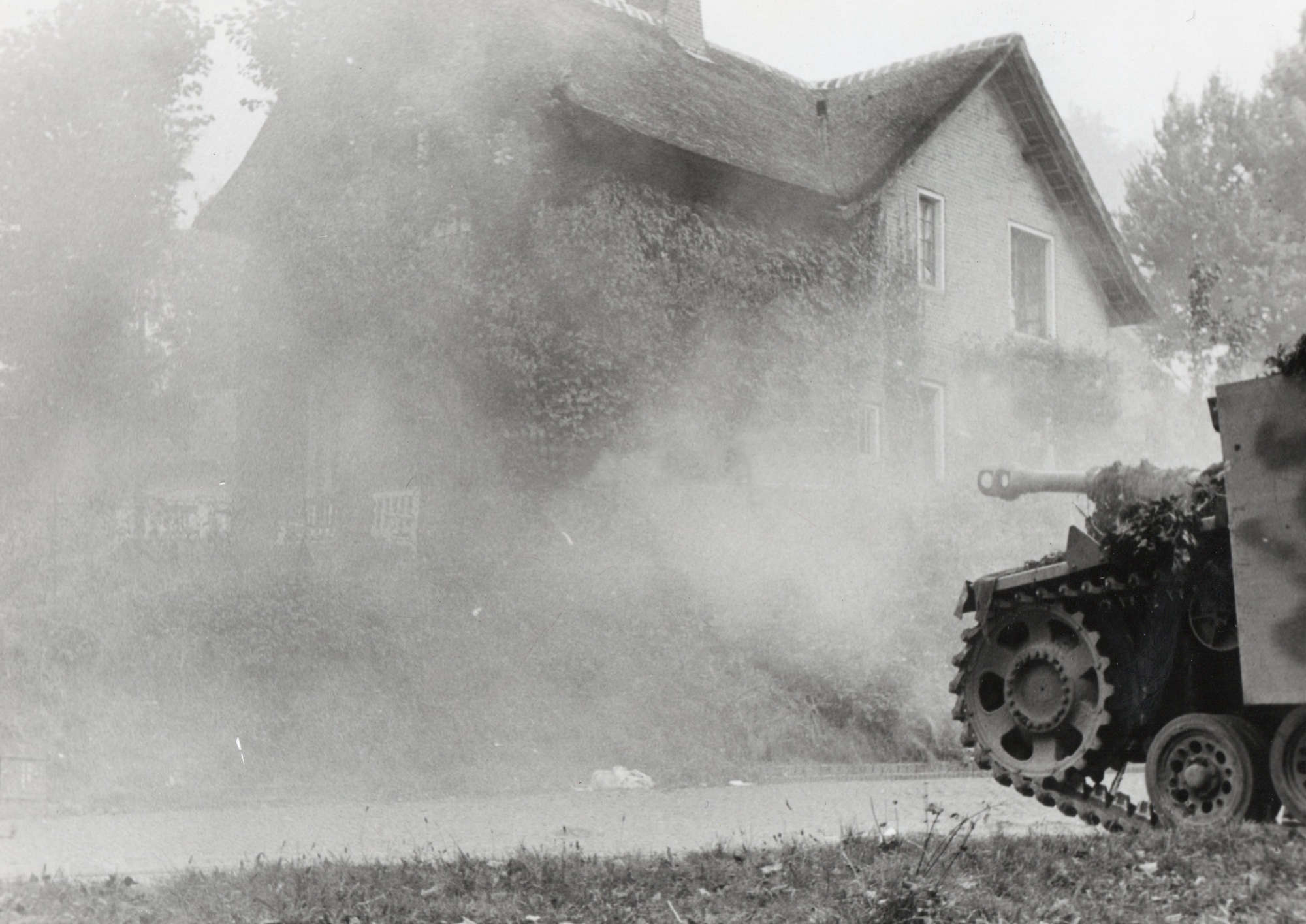
Having been behind the Stug, the photographer then moves round to the left side of the Stug III and takes a photo as it fires again, and captures the smoke and dust of the aftermath of the shot. In the background, obscured, is the house that sits right at the southern apex of Jagerskamp (on the left) and Weverstraat (on the right). Courtesy of Bob Gerritsen.
Dvr. 'Ken' Clarke: "We occupied many houses. One in particular stood on a point with roads leading off in many directions. I think there were about 6-8 R.A.S.C. men in this house. I had just collected porridge tablets and any water that each man had left on him, to try and get some food for us. I had also collected any Meth's tablets (these were issued for cooking) and did the cooking on the floor in the back room. At this point a German M.E. 109 straffed the house, removing the roof tiles. I started to make the porridge and take it round to the men, first going up to the attic to Dvr. Wareing who was complaining about the missing roof when we heard the sound of a tank approaching. Cpl. Doubleday was in charge and someone shouted that the tank was coming up Weverstraat towards us. Cpl. Doubleday gave the order to prime the P.I.A.T, but there was no time to use it. The tank fired a shell which landed in the bedroom, Cpl. Doubleday gave the order to leave the house. I remember at that time I thought how funny it looked to see everyone tumbling down the stairs. A third shell landed in the road outside the house just as Cpl. Doubleday, the last man out, was in the doorway. Sadly he was killed." [16c]
Cpl. Robin Doubleday of No 2 Parachute Platoon was buried in a mass grave 150m's south of the Tafelberg.
Capt. Cranmer-Byng: "Towards the end of the battle it became almost enjoyable when the shells from our guns began to land in the Divisional perimeter, for it kept the Jerries out. A small party of troops had the house they were defending blown down by an SP gun, the Sergeant in charge got them out all right and they slipped back into the edge of a wood where they lay in some empty slit trenches, the men tumbled in while the Sergeant went further into the wood to speak some other troops in position there." The Sgt must have been McDowell, and amongst those with him was Dvr. 'Ken' Clarke: "I, with some others, ran across the field toward the woods. I was without any kit, any weapon or ammunition. I stayed a short while in a house on Pietersbergsweg near to the corner, hiding under the sink in the kitchen. The tank was still following on behind us, so we left the house and made for a dug-out in the woods. There I met some South Staffs. There were two other 250 Coy there, one being Dvr. Carter. I do not remember who the other one was. The South Staffs. had managed to secure a six-pounder anti-tank gun so we stayed together for one day and one night. We scoured the woods for any food we could find mainly berries and nuts, but still being very careful not to attract the attention of snipers that were still on all sides. One of our party came back with a rabbit he had found in a hutch. It must have been a child's pet. It seems horrible to me now that we took it, but at the time we were so hungry the fact of where it had come from did not matter. We all enjoyed the rabbit stew. There was a farmhouse nearby and we saw many dead laid out in rows in one of the barns. It was quite a shocking sight." [16c]
The 1st Airborne Division After Action Report, Part I, Appendix H, for the 24th September 1944, stated: 'No re-supply. Almost all R.A.S.C. Jeeps out of action. D.M.A. now empty except for stocks of 2" Mortar Smoke. 17-pounder ammunition and Petrol. On the night of 24/25 Sep an attempt was made in conjunction with 43rd (Wessex) Infantry Division and Polish Para Brigade to ferry Supplies, Ammunition, Petrol and Medical stores across the river in D.U.K.W's. Nine D.U.K.W's were loaded, but opposition was so heavy that only four of them succeeded in crossing the river. None of these stores could be unloaded as the D.U.K.W's were under heavy enemy fire and it was impossible owing to the state of the roads to bring the D.U.K.W's up to the Divisional area from the river bank.'
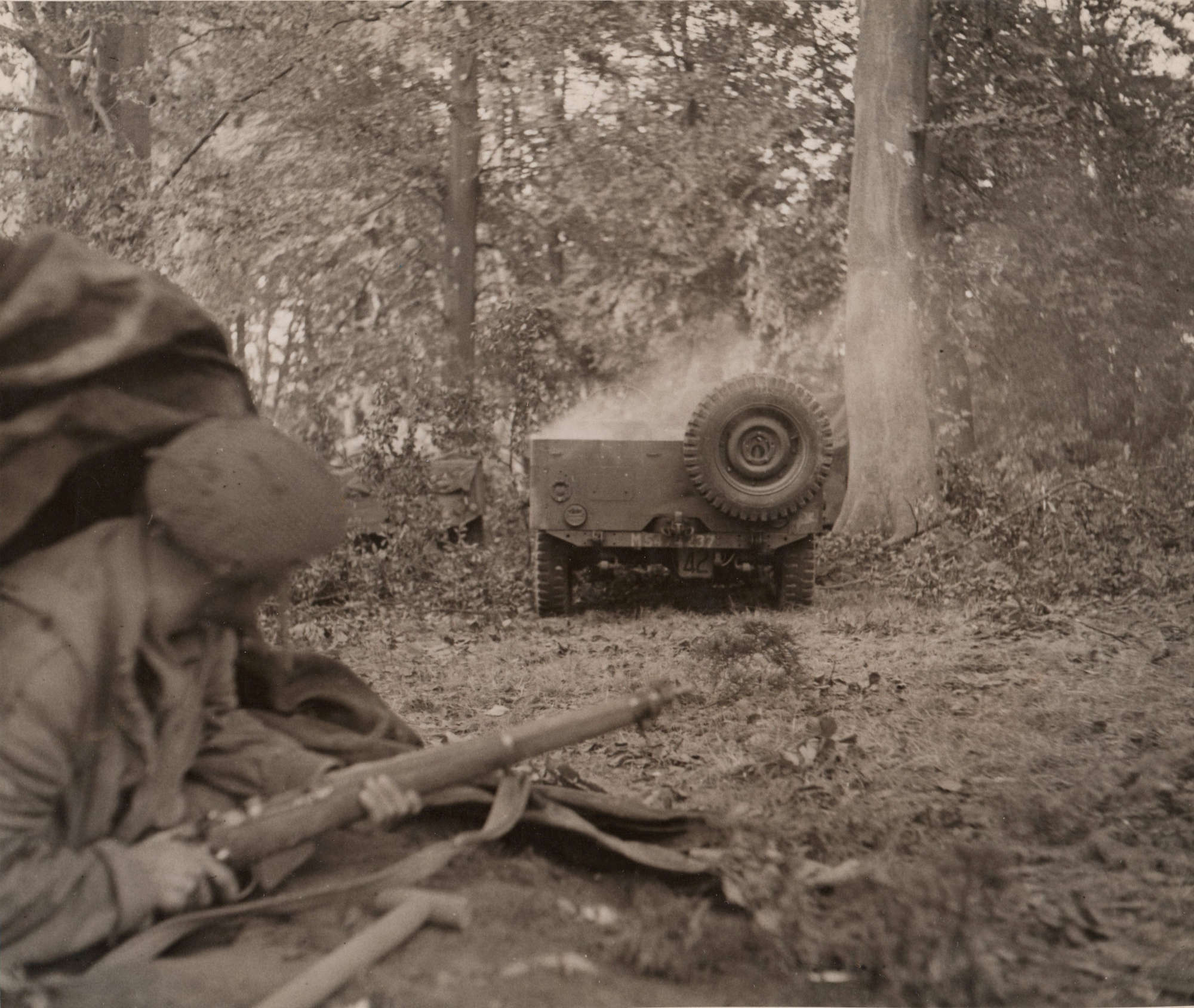
A defender near the Hartenstein maintains his position whilst observing the area near one of the jeeps that has been hit by enemy mortars and set on fire. Notice he has used a scrim scarf to camouflage his beret. Sunday, 24th September 1944. Photo by Sgt. D. Smith, A.F.P.U. BU 1140. Courtesy of the I.W.M.
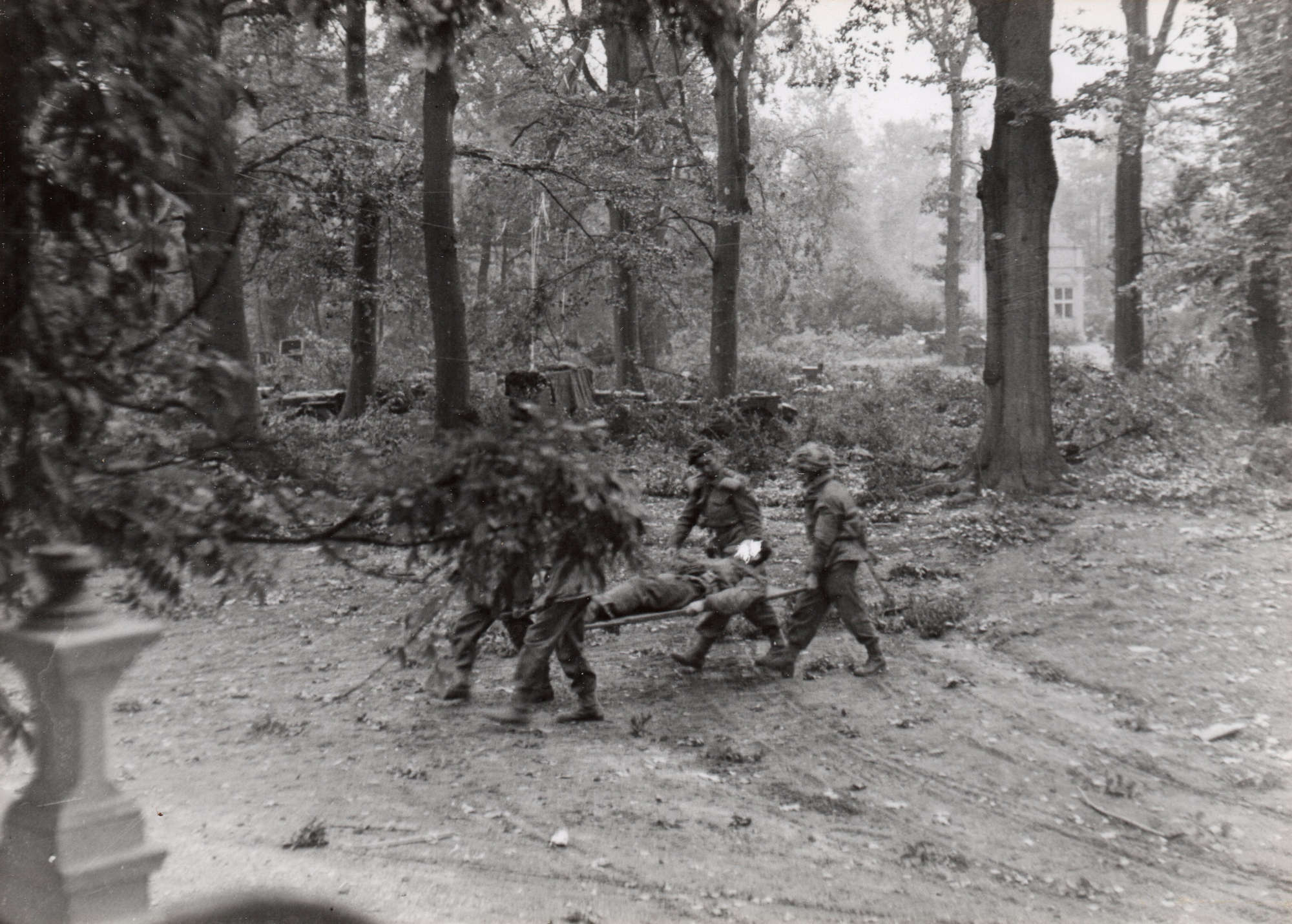
Capt. G.E. Hemelryk of the 1st Airborne Divisional Signals was wounded while leading a supply recovery party. He is being carried on a stretcher by four of his men, L-R: L/Sgt. J.W. Rate, L/Cpl. R. McFarlane, Sigmn. F. Young (with beret) and Sigmn. R.A. Gordon-MacIntosh. They are heading towards the stairway that leads to the basement. Note the supply panniers stacked up in the background. These formed part of the stock's still in the D.M.A. Sunday, 24th September 1944. Photo by Sgt. D. Smith, A.F.P.U. BU 1141. Courtesy of the I.W.M.
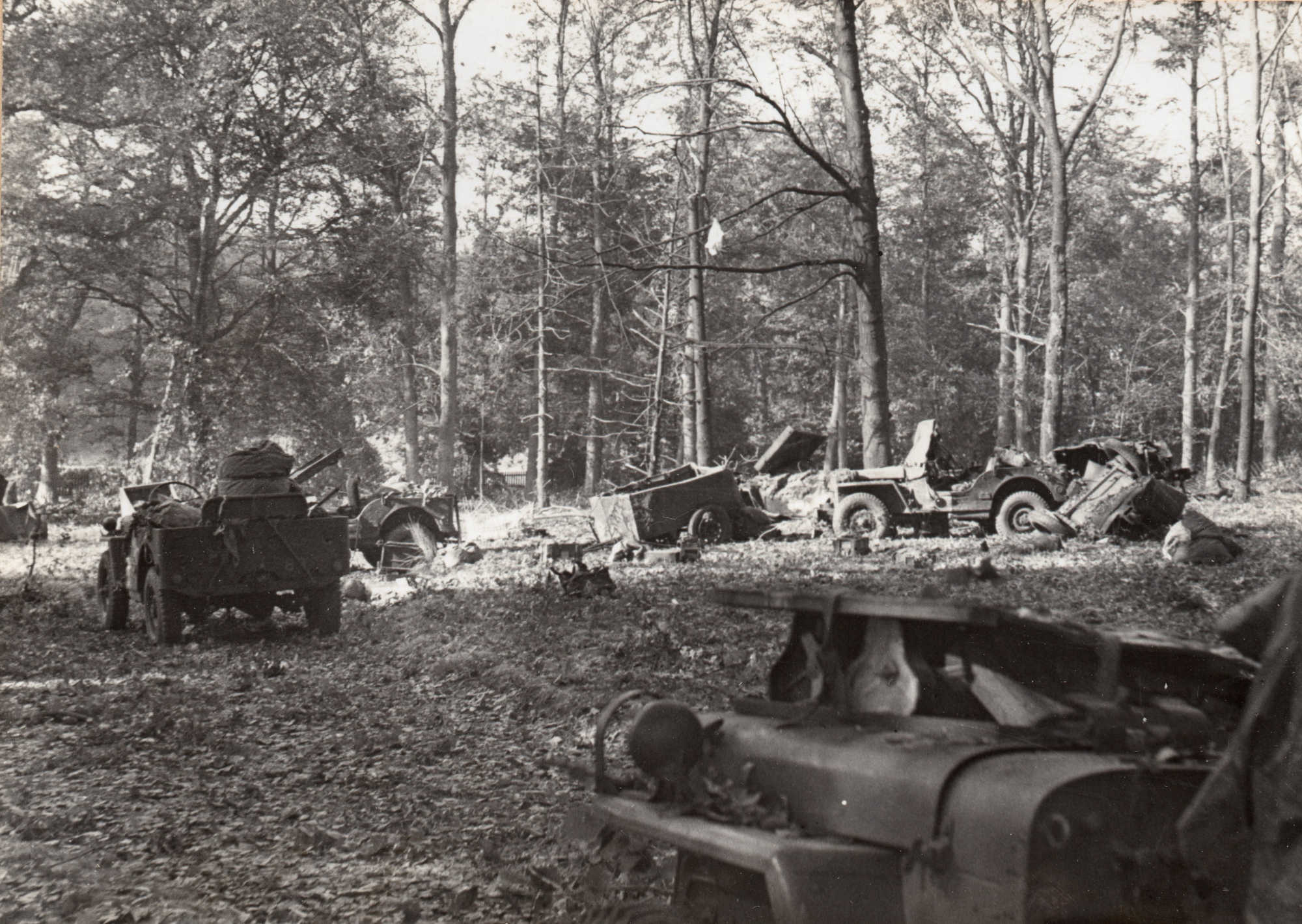
Jeeps damaged by mortar and artillery fire are left abandoned behind the 1st Airborne Divisional H.Q, at the Hartenstein. Sunday, 24th September 1944. Photo by Sgt. D. Smith, A.F.P.U. These three photo's were the last taken by the A.F.P.U. men during the battle - there was no more film left - Sgt. Smith was wounded the next day. BU 1142. Courtesy of the I.W.M.
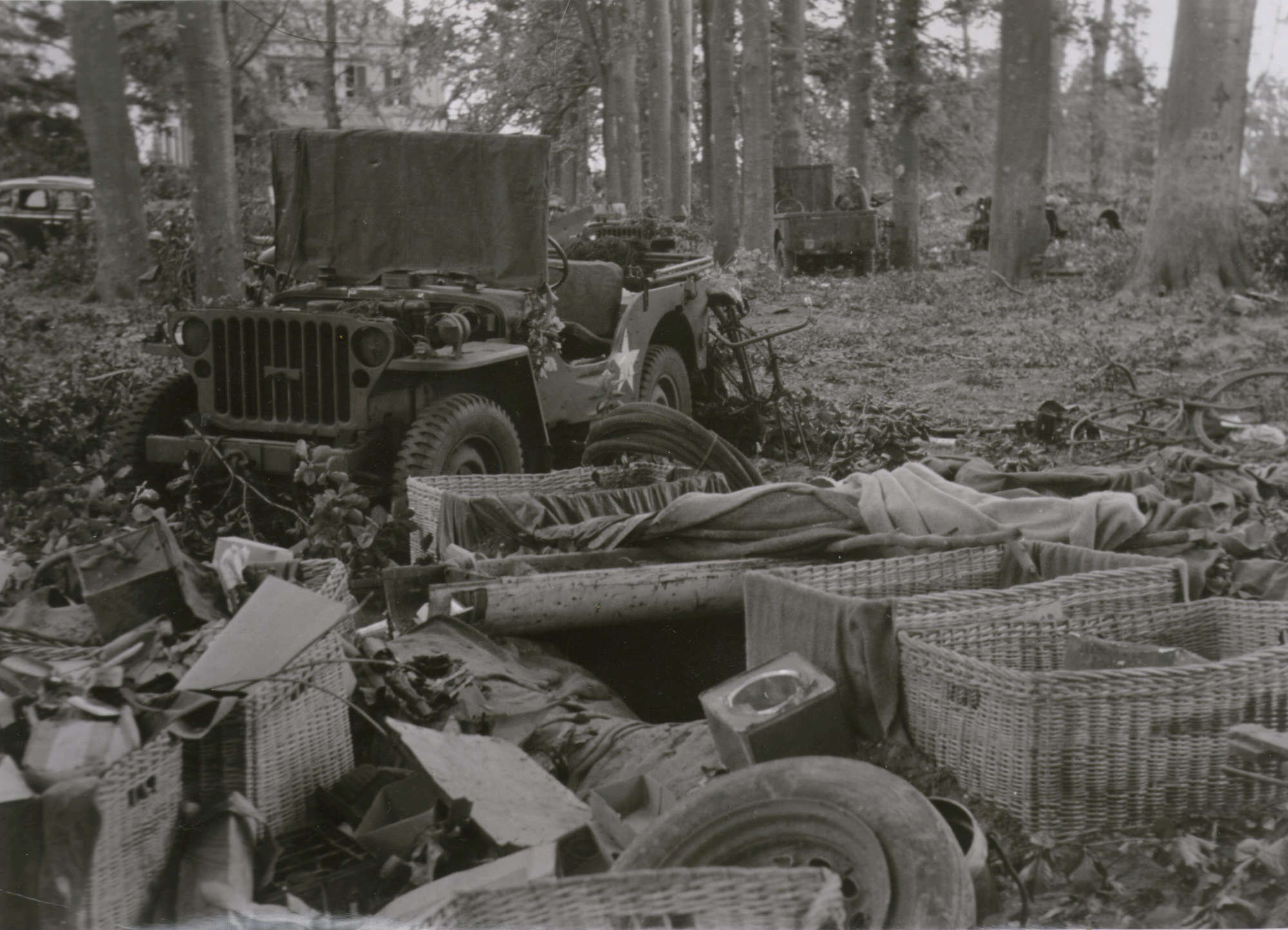
Jeeps, trailers, panniers, and containers left behind by the 1st Airborne Division, are searched by German troops. They would not find much of any use. Photo taken on the 26th September 1944. Courtesy of Bob Gerritsen.
The Perimeter had come very close to being cut in half on this day, which would have trapped the main part of the Division on the northern side of the Lower Rhine, with no means of reinforcement, relief or a way out. It was with the knowledge that the situation was becoming untenable that the men 'stood-to' (19.00 to 20.00 hrs) in their positions that night, very much wondering how much longer this could go on.
Monday, 25th September 1944.
The H.Q., R.A.S.C. War Diary noted that 'stand-to' was carried out at 05.00 to 06.00 hrs, and that there was 'consistent shelling and mortaring throughout day', and the 1st Airborne Division After Action Report, Part I, Appendix H, for the 25th September 1944, stated: 'A re-supply drop of four aircraft took place. No supplies recovered. When the Division evacuated, only two R.A.S.C. Jeeps and trailers remained serviceable and the D.M.A. was empty with the exception of 2" Mortar Smoke, 17-pounder ammunition and Petrol'.
It was at 21.00 hrs that night that the orders to evacuate to the south side of the River came through, and the Other Ranks of H.Q., R.A.S.C. were briefed. At 22.15 hrs, H.Q., C.R.A.S.C. party commenced their journey through the enemy lines to the River. They were ambushed by a machine gun nest - but suffered no casualties - a detour was made around this and other enemy positions, until the River was reached.
Lt-Col. Packe relates in his book, 'First Airborne', his experience of the withdrawal, 'James [Lt-Col. Packe] in the cramped space of his trench, struggled to draw an extra pair of socks over his boots. The flashlight behind him threw dark shadows over his shoulder, so that he was unable to see. Patiently, he lifted it up to the top of the sandy wall of the trench, whence it would throw a more generous beam. His map case fell down, bringing with it a shower of sand which filled his collar and his hair. Next, he went through his equipment, taking out the things which seemed to him to be of most value. Shaving kit, a stump of chocolate, a tin of tobacco and a pipe. A flashlight and the large-scale map; his pistol and compass, and his pocket flask. He stuffed his pockets methodically, fitted his helmet over his tight-drawn scalp, fastened his face veil to obscure the gleam from his skin, and looked at his watch. He was ready, and they had five minutes. The others behind him in the trench were finishing their preparations. There was still some whiskey in the bottle; he filled his flask, took a pull and passed it back to them. He took up his rifle, but finding no ammunition readily available, put it down again, thinking that it would only encumber his movement, and that in any case their orders were to avoid fighting whenever possible in order to retain surprise. He would rely on his pistol; that would be the best thing for their dash. He remembered the tablets with which they had been issued before they left, and, out of the deep dirt and grime of his pocket he eventually found one. It might strengthen his endurance; he felt curious, having never taken one before, to see what result it might have; so he swallowed it. It was time to go. It was time that the Sergeant came with the rest of the men. He was quite clear, and he regretted taking the Benzadrine, as a weakness; he did not need it, he had no hesitation. They were to go down through the woods, hoping to meet with no trouble on the way. It did not sound as though there were much mortaring now. He felt clearer than at any time since he had come to live in this trench. It had represented almost safety for five days, but he did not now feel reluctant to leave it. They would keep to the east of the gas-works; there might be trouble there. They would keep to the woods; it would be bad luck if they met any trouble in the woods. It was that last bit which frightened him; he studied it again on the map. It showed a wide flat [meadow] leading down to the river. The Chief of Staff had said that it was an open expanse of grass. It was dominated by the enemy from east and west, and if they knew that an evacuation was in progress there was no doubt that they would rake it continuously with machine guns. That also was a matter of luck. Once down by the river, there was some sort of cover. Once over the river, there was another open space, and then a high dyke. Once over the dyke, there was safety. The whole distance was not above two miles, and he felt no apprehension. He had a goal, and to that he would make his way, leading his party of men. Before the daylight came again, the matter would be decided; it would be most unhealthy to be the wrong side of the river at dawn. Once they reached the river, he did not doubt that they would be able to cross, unless there were long queues and panic; it was not an impossibly broad river from all accounts. He would be glad to see it.
Such a small thing to have been an obstacle between success and disaster. Now they had to get back over it by their own final effort. There always seemed to be another river to cross. The curtain at the entrance rustled, and it was [S/Sgt. A.E. Brown]. "All here sir," he said. "Come on," James said to the silent men behind him; "we'll start." They gathered themselves up, and climbed out of the trench.
In the open, it was very dark and raining steadily. The noise reached a shattering reality as they came up into the cold air. There was nothing flying in their immediate neighbourhood, and the fury of the enemy's reaction had for the moment died down. James wondered how the troops on the perimeter were faring, and whether they had found it easy to disengage themselves, or whether the Germans would follow them up, bursting in on top of all of them. The shells soared crisply overhead; these were their own. Away to the south-west a violent battle was raging, by the sound of things.
It was fortunate that they were going to keep to the east. The chatter of the machine guns hammered on his head, an outrage, but he was glad of the sound; they were British, from beyond the river, keeping the enemy heads down on their high ground. With their heads kept down, they would not know of their ghostly quarry sliding away across the river which they could so easily dominate. They were soon in difficulties, because the path through the trees backing the tennis court was so thickly strewn with fallen branches and debris that it was invisible in the darkness. The men were silent, not capable of very much in their present state. Even within the boundaries of the garden, he lost them once; it did not promise well for when they had to penetrate unknown woods later on. He put [S/Sgt. A.E. Brown] at the back to chase them on, for he intended to go as fast as he could to the river.
Down by the water point, the haystack was still blazing. The farm buildings were luridly lit by the glare, and he saw troops dodging and gliding between the outhouses. There was no telling who they were, and once he nearly fired on them, convinced that they were Germans, an attack having broken through. When they came to the road, a figure stepped out of the dark trees to meet them. It was Jocelyn [Capt. Cranmer-Byng]. They linked their parties together, and set off into the dark uncharted woods. Before they had gone far, they came upon men tucked into the fallen branches beside the path, huddled close into the bank, nearly invisible and quite silent. They had a quiet conviction of purpose, and as they were heading down the eastern track which would outflank the gas-works, James decided to follow them. They made fine progress down the path, heading at first due south by the compass. They went as quietly as they could, but in spite of their muffled feet, the fallen branches produced a rustling which it seemed must have been heard in Berlin, had it not been for the steady rain stirring the leaves in rival chorus. Sometimes they ran, sometimes stopped to reconnoitre, and at these halts everyone crouched silent, disappearing into the undergrowth beside the path.'
One of those with Lt-Col. Packe's group was Dvr. Raymond Whitwell: "There were several supply drops, but each time all the supplies were dropped in German held territory. After each supply drop we were told to go by Jeep and recover some of the supplies, but we never got any, but it was very exciting! The role of the R.A.S.C. was to supply the Division with all it needed, but with no supplies we could not do that. We were then used as infantry soldiers and given a position on the Oosterbeek perimeter to defend, and stop the enemy when they attacked. We fought our own little battle in the woods for nine days, defending the perimeter. We had no food in that time, but while we were drawing water from a well a sniper shot at us and his bullets made holes in the bucket. After that, getting water took a long time, and was very dangerous, we could have been shot dead at any moment. I got back across the river Rhine, and back to Nijmegen, where we had sleep and food." [24]
Dvr. John Prime: "On the last day, prior to being told by German Troops on a loudspeaker that the Division had surrendered, myself and other members of the Company, with L/Cpl. Bell in charge, were ordered to take up positions in two houses overlooking the enemy positions to our front. Putting two and two together after all these years, we realise now, we had been placed as a rear-guard action, whilst during the night, the Div. H.Q. tried to cross back over the river. During the course of the last day we were continuously attacked by enemy troops, using tanks and S.P. guns. Each house in the street was first shelled, and then finished with flame throwers. By the middle of the day we had completely run out of ammunition, and we knew there was no further possibility of holding the enemy up. Led by L/Cpl. Bell, we tried to break out of our house before it was fired by flame throwers. On leaving the house we were faced by a whole platoon of German infantry, who immediately started firing. L/Cpl. Bell was mortally wounded. On seeing the strength of the enemy troops, we were immediately surrounded and disarmed. We were then informed by a German officer that the Division had been completely overrun, and for us the war was over." [18b]
Dvr. 'Ron' Pearce: "I was in No 16 Jagerskamp with three others, and next door in 18 there were about twelve more of us. It had been very quiet for some time, and the rest said there was no point in staying so they went back to the Hartenstein. We decided to stay in our house, those were our orders. Suddenly, there were a load of Germans coming up the street. I shouted to the Lance Corporal who rushed out to tackle them and was shot in the doorway. They surrounded the house, and fired a Panzerfaust into the house. I was with John Prime, who had learned some German in Italy. Surrounded and with no chance of escape or of doing anything productive we had no choice but to surrender, and so he called out in German. They came to the foot of the stairs and called us down." [15c]
L/Cpl. Robert Bell, No 2 Parachute Platoon was taken to a Hospital at Lochem, but died of his wounds 02/10/44. Cpl. Leslie Judd of 'D' Transport Platoon was also mortally wounded in this attempt to break out from the encircling German forces. He was taken to the temporary 'Airborne' Hospital in the William III Barracks at Apeldoorn, but died of his wounds 15/10/44, and was initially buried in the Heidehof General Cemetery. His daughter, Francine Diana, had only been born on the 27th December 1943.
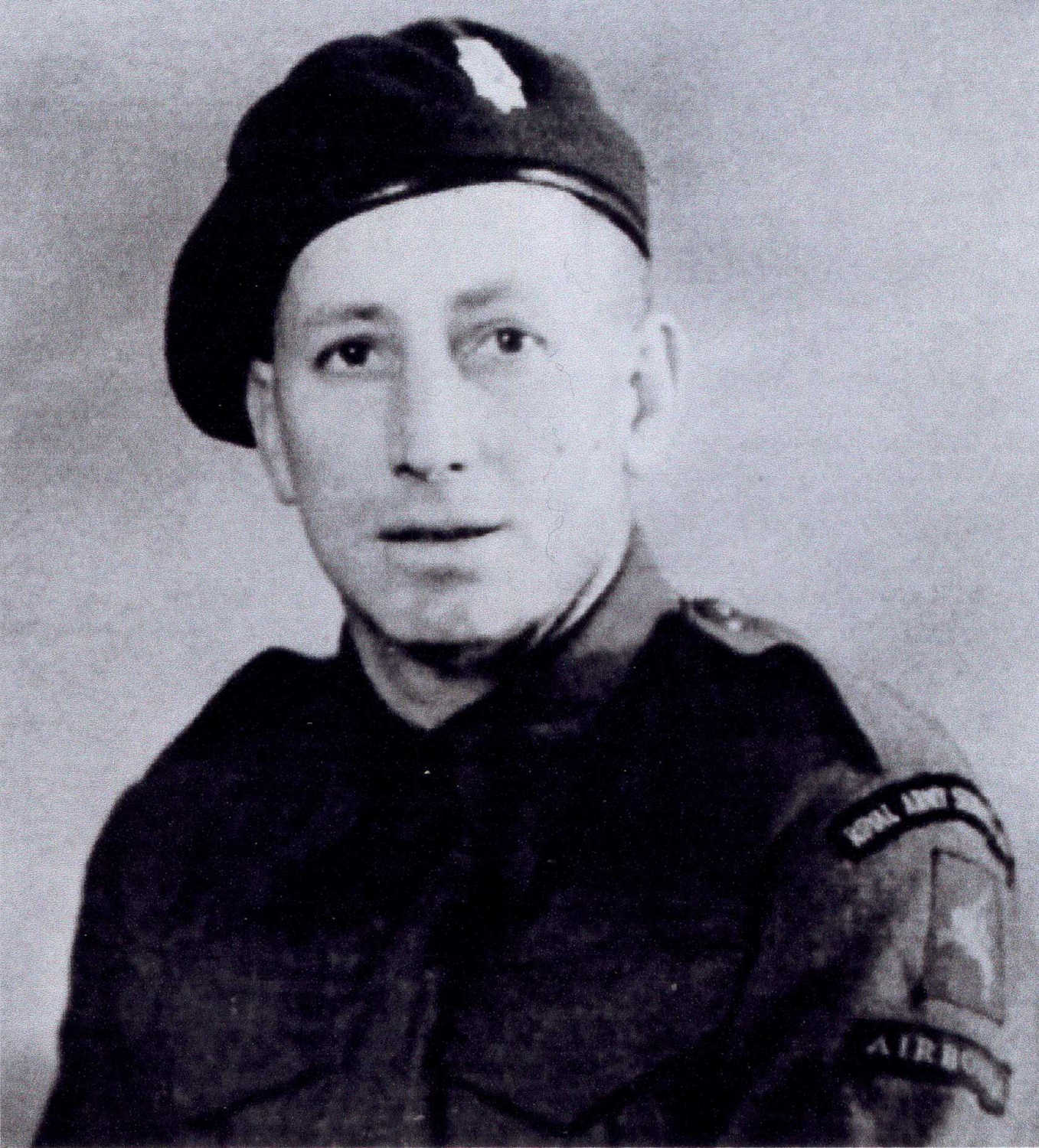
L/Cpl. Robert Bell, No 2 Parachute Platoon. Photo taken 1942. Courtesy of Patric van Aalderen.
Dvr. Dennis Cutting: "We bound our feet in blankets to muffle the sound of us marching and destroyed everything that was valuable. We made our way in the pitch black and rain holding onto each other's straps. It was fine until a German patrol opened up on us and we scattered. I had a tiny compass and headed south. Ten guys joined me. We were ambushed again, one was hit. We all carried a morphine injection, so we gave him that and left him. We had to. We were told not to stop for anything, to head for the water. They were shipping guys across in small boats, but they were fighting over the boats. There was a Sergeant major who said he would shoot them if they did not stop. Many would not wait, they got in the River to swim across. A lot of them drowned." [15d]
Capt. Cranmer-Byng: "The men set off in the darkness and rain towards the river, stumbling over branches and limbs of trees that lay about everywhere over paths and roads. From down the river came the glorious chattering of countless Bren's fired by the 2nd Army as a barrage for a mock attack to distract the Jerries. By now a large queue four or five deep loomed ahead, some crouched down as flares lit up the surrounding countryside, it was a long wait in the pouring rain, but it was wonderful to be away from the perimeter with its load of dead, and pungent smell of death and destruction. The Sergeant gave order for the rifle slings to be dropped, in a few minutes they were spluttering across the dark and rapid flowing river, the engine of the boats made an appealing noise, the boat grounded on the other side of the river and the thankful man jumped out, and started to follow the white tape, one man said: "Thanks Canuck".
Dvr. 'Ken' Clarke: "Later that night we were ordered to make our way down to the river bank and prepare to evacuate across the river. It was pouring with rain and very cold. Our resistance was very low and we were desperately tired. The evacuation was very orderly. There were tapes stretching across the field to the river edge for us to follow. The boats to carry us were very small, carrying about six men at a time. The wounded were the first to go and everyone accepted this without question. All this time the battle around Oosterbeek itself was still raging and the sky was lit up by flares. I remember looking toward Arnhem and seeing the railway bridge that spanned the Rhine between Arnhem and Oosterbeek laying destroyed in the river. This was made very clear by the flares and shells still falling around us. Some men attempted to swim the river but with the cold water that was moving very fast and the lack of strength many failed to reach the other side. For myself I was so tired I lay on the river bank and went to sleep. At last I woke and it was my turn for the boat. It was the early hours of the morning and although still dark, we managed to get into a boat and across the river. We clambered up the bank on the other side which was all mud both from the rain and the troops tramping through it. We were safely on the other bank for which we were very grateful." [16d]
Dvr. 'Jimmy' Cook: "At last we got word to go. If possible back to the British lines, and so in groups we set out to make contact with the Army whom we'd hoped to have met nine days before. I was one of the lucky lads who succeeded, but the lads we left behind I shall never forget. They were the best lads Britain ever produced. They'll be difficult to replace." [19b]
L/Cpl. Walter Inglis had been dug-in near the Hartenstein, and withdrew with the H.Q, R.A.S.C., he noted some of his memories of the time there, where he was lightly wounded: "Slight shrapnel wound, left wrist - no knowledge of this until later on, blown up in trench. G.O.C. & Aide, immaculately dressed, coming round, telling us to be careful, yet shelling & firing everywhere, they acted as if on parade ground. During middle of worst night, Carrier arrived for ammunition, which was non-existent, driver was in tears for letting his men down, went off trying to find some, blown up after travelling few yards."
During the withdrawal both Dvr's. Albert Law and Richard Robinson of No 1 Parachute Platoon went missing, and their bodies were never found.
Tuesday, 26th September 1944.
At 00.15 hrs it was reported that all H.Q, R.A.S.C. personnel reached river bank, and crossed to South side as and when possible. Then at 10.00 hrs, when the Roll Call was taken of personnel at Nijmegen it was found that Cpl. F.C. Cope was missing. He was last seen on the North side of the River at day-break, and would subsequently turn out to have been wounded and taken prisoner.
What of the rest of the R.A.S.C. personnel? L/Cpl. 'Les' Withey: "I was in No 1 Parachute Platoon which dropped on Sunday, 17th September, with the 1st Parachute Brigade. As the battle proceeded our primary role of supply collection from the D.Z. and delivery to units was superceded by our being used in a defensive role as infantry, together with Glider Pilots and others. In the event, I and other survivors were unable to make it to the River on the night of evacuation and were subsequently taken P.O.W." [21]
Cpl. Frank Bater was wounded by a mortar blast to his left foot: "After a whole week in the thick of warfare, endeavouring to do our job of collecting supplies of ammo, which was dropping on the correct D.Z., but with the Gerries pushing us back. In the end I was wounded and taken P.O.W. Cpl. Sharp was my pal, he wanted to stay with me when I got wounded, but Captain Cranmer-Byng refused to let him, as everyone really was on orders, "Every man for himself to the river". Cpl Sharp has never been reported since, and has no known grave." [22]
Cpl. Walter Sharp of 'D' Transport Platoon attached to No 1 Parachute Platoon, was killed whilst trying to cross the River, and his body was never found.
Cpl. Frank Bater and Cpl. Walter Sharp in Italy, September - October 1943. Courtesy of Frank Bater.
Dvr. 'Ray' Moon: "I met up with Dvr 'Charlie' Jackson [2 Para Pln] on Friday (he came from Doncaster). We were captured on the morning of the Tuesday, 26th September, along with a Dutch Sgt, Wim de Waart. When I was captured there were 5 or 6 of us, the Dutch Sgt, Sgt Donaldson (a Glider Pilot), 'Jacko' and myself, and the lad at the back of the line was from 250 Company, and I'm almost certain it was 'Danny' Butten [Butten was killed on 19/09/44, so this could be either Dvr. Albert Law or Dvr. Richard Robinson]. He was shot and very badly wounded at the time, when we were being taken away, Germans were treating him. I've never been able to find 'Jacko' after spending our POW days together. We finished up working on the railway near Dresden." [13b]
Dvr. 'Ron' Nutley was still in his position at the Hartenstein: "Jerry finally broke through and we were captured. I personally was captured by the Tennis Courts either on 25 or 26 September can't remember which - dates were not on my mind at the time! (The last time I saw my mates 'Jack' Hart and 'Jim' Brown was just prior to my capture). I was put in a field with others who had been captured, there were dead soldiers everywhere, dead horses, it was carnage. We were then marched to a big barn by the railway where we slept in hay overnight. Later the following day we were put into railway trucks heading for Germany and eventually ended up at STALAG 4B where we were kept for 2/3 weeks." [23b]
Cpl. Samuel Staple: "As the days went by our area got smaller and on the ninth day we got the order to pull back to the Rhine. I got across that night and was lucky to get to Nijmegen." [20b]
Dvr. Charles Boardman, No 2 Parachute Platoon: "Sergeant McDowell later was awarded the American Bronze Star. When on patrol we were surrounded by Germans, but under his command we broke through in a bayonet charge to the perimeter. Sergeant McDowell and I were out searching for ammo when we came across a case of compo rations, 'Mac' was putting the tins of food into a bag when we heard a voice, a young chap with a baby in his arms asked for something for the child, we gave him the two tins of rice pudding and a tin of corned beef for himself. Later we took the walking wounded to the river when we were withdrawn." [17b]
The final part of Sgt. McDowell's Citation states: 'Finally, when ordered to withdraw, he brought back the remainder of his Platoon in good order across the river, having displayed throughout the whole action, leadership far higher than that normally consistent with his rank.' Altogether he managed to bring back 14 men of his Platoon.
What of the small Detachment of men from 93 Company? Four men had come down short on the 18th September, but all reached Allied Lines, with the assistance of the Dutch Underground. One, Dvr. Huggins, had been killed, and two got back across the River, Dvr's. Beer and Lawrie. Dvr's. O'Brien, O'Donnell and Weaver were all taken prisoner. Dvr. 'Ray' Weaver: "Things were going very badly by now and we were beaten back to Oosterbeek, where we finished up with Major Lonsdale in 'Lonsdale Force', and fought in the perimeter until the evacuation. The remainder of the Division withdrew through us to the river, but by the time we reached the river it was too late. Daylight came and I with a couple of hundred others were taken prisoner. My pal 'Lawrie' managed to get away, but the other one - O'Donnell was killed. I finished up, finally, in Sudetenland, working in a coal mine until being released by the Russians the day after the war was finally over and getting back in early June." [26]
FOOTNOTE: [5] Ray Weaver phoned me at home in Aldershot on the 2 July 2003. He told me that he saw Dvr 'Lofty' O'Donnell shot and thought he had been killed, so was very shocked and surprised to learn he was only wounded and taken prisoner. 'Lofty' was sent to Stalag 11B, which was confirmed for Ray by Frank Newhouse who had a copy of the POW Roll in WWII. Ray was philosophical about not now being able to find out what happened to 'Lofty' after becoming a prisoner. They were great mates.
Capt. Cranmer-Byng relates the experience of reaching the South bank: 'They didn't keep together now, but simply followed the white tape, plodding along, dazed, but happy, finally they passed through a village and then halted, another queue. This time for a good swig of rum, as they came out of the barn which was used as a rum point it was getting light, one man began to sing exultingly but quietly to himself, they quickened their pace as though anxious to get away as far as possible from the noise and reek of the interminable battle. A small detachment of British infantry looked curiously at the survivors of Arnhem as they trudged, bearded and dirty, past their positions, one of the survivors called out "good morning" as he passed these fresh troops, but they kept silent, watching the men of Arnhem trudge past as though they were unreal. At last they were picked up by lorries, and driven into Nijmegen, across the great bridge, which had been so difficult to capture.' Altogether 24 men of No 1 Parachute Platoon, including Capt. Cranmer-Byng, made it back across the River.
By 16.00 hrs all of the R.A.S.C. personnel had linked up with their respective Seaborne Echelon's in Nijmegen.
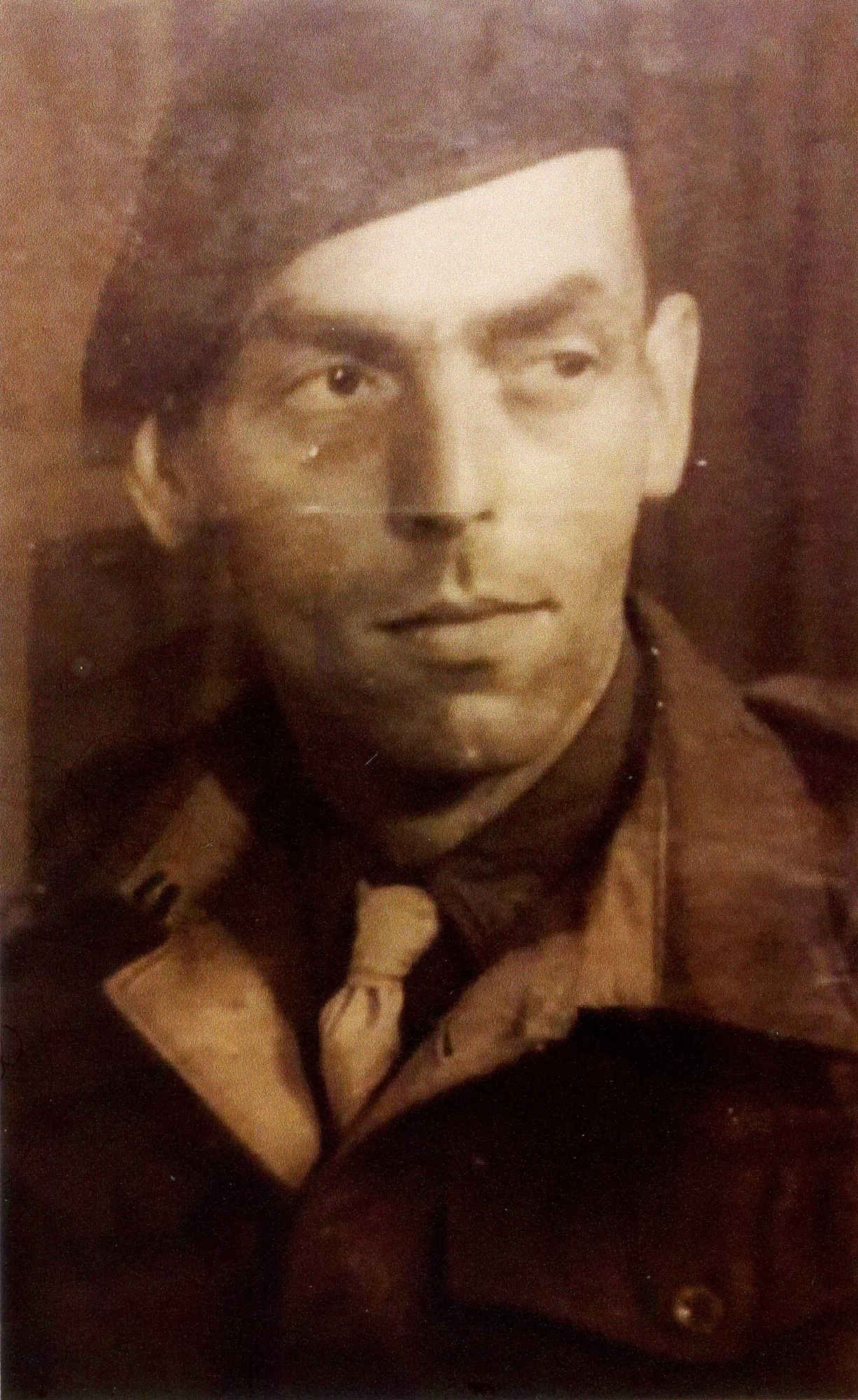
Pte. Graham Molony. Born on the 2nd June 1916, from Tunstall, Stoke on Trent, he had enlisted on the 31st January 1940, and was posted to 250 Company 25th January 1943. He was in 'F' (Workshops) Platoon, and spent most of the battle dug-in near the Hartenstein Hotel. Courtesy of Andy Glenfield.
Dvr. 'Ken' Clarke: "We all assembled in a nearby farmhouse where we were given a tot of rum. On empty stomachs it dulled our senses somewhat. We then marched to a reception centre in Elst. From Elst we were given transport to Nijmegen where a meal and a nights sleep awaited us. This was very welcome before being taken to Louvain in Belgium to rest, from there to Brussels Airport and a plane back to England." [16d]
One of the members of 'D' Transport Platoon, Dvr. Robert Oliver, related his memories of the last few days to a newspaper reporter: At 11 o'clock last Monday night he was crouching in his trench when 'one of the lads' told him they were going to be moved out. "I had been away from my Company all the day carrying wounded and fetching supplies," he said, "so I linked up with a party of glider pilots and we made our way through the woods to the north bank of the river. We reached there somewhere round about mid-night and waited for our turn to get across. Things were very warm and we had to lie very still as Very lights went off. Eventually our turn came and we crossed the 250 yards wide river without incident, being met the other side by Canadians, who took us to a sort of barn about four miles away, and there we had a mug of tea with rum in it and some cigarettes. Two hours later we were on the move again, this time to a field hospital from which trucks took us to Nijmegen. It was there that we were able to have our first good meal, but I'm sorry to say that I couldn't keep it down. That was about nine o'clock in the morning and we slept the whole of that day, and we should have slept throughout the night, too, I think, if there had been no air activity." The men were sorted into their respective units and were then moved down the corridor towards Brussels and near the Belgian Capital they spent two nights in the ruins of a monastery which had been burned down by the Germans. The return flight to England was made by Driver Oliver from Brussels aerodrome in a Dakota troop carrier which was given a cheery welcome by the station dance band when it landed in this country. [25]
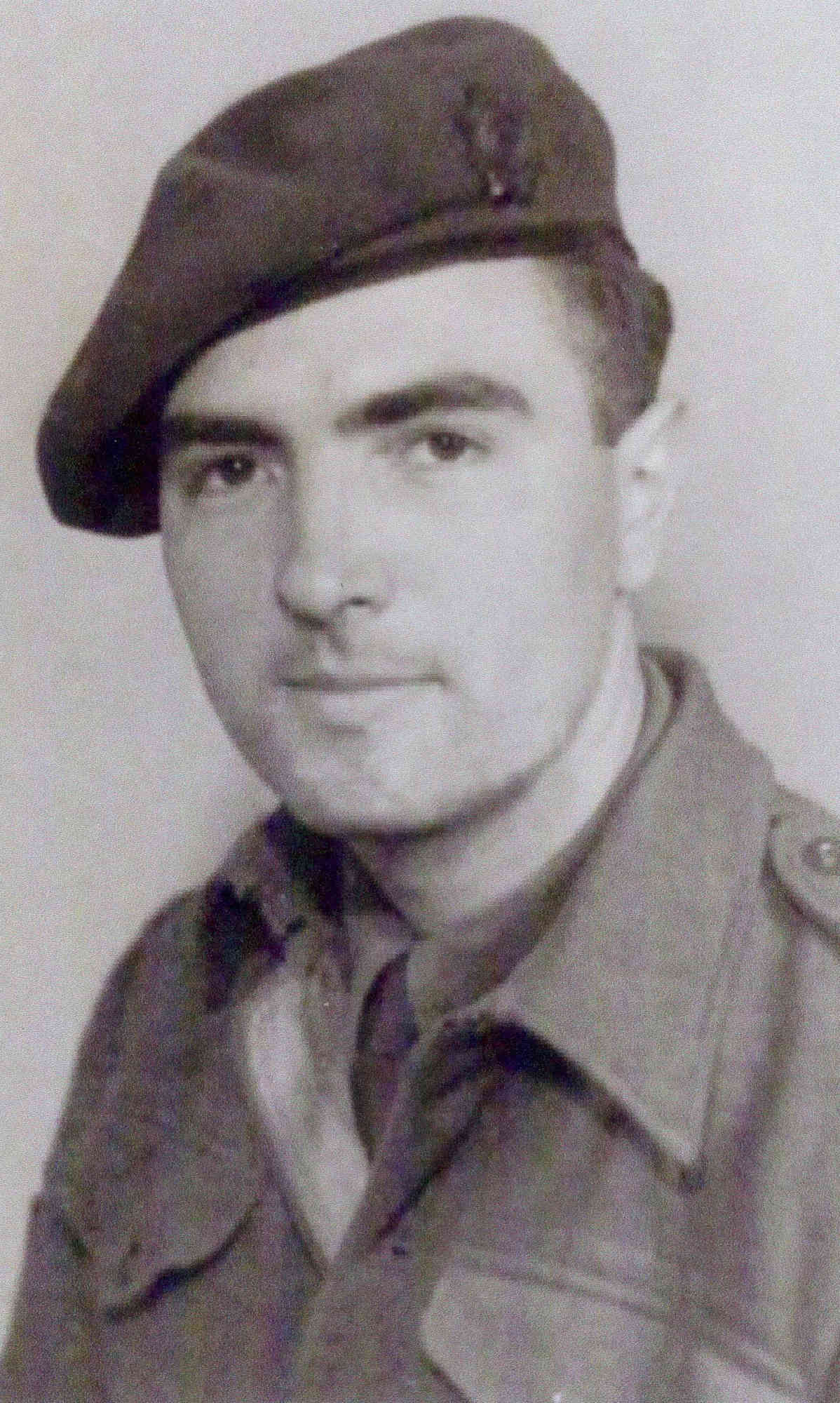
L/Cpl. Harold Roscorla. 'D' Transport Platoon. Born on the 3rd August 1917, from Harrow in Middlesex, he had been a Carpenter before the War. He had enlisted on the 18th September 1941, and had then been posted to the Company on the 12th December 1941. Photo taken in 1945. Courtesy of Patric van Aalderen.
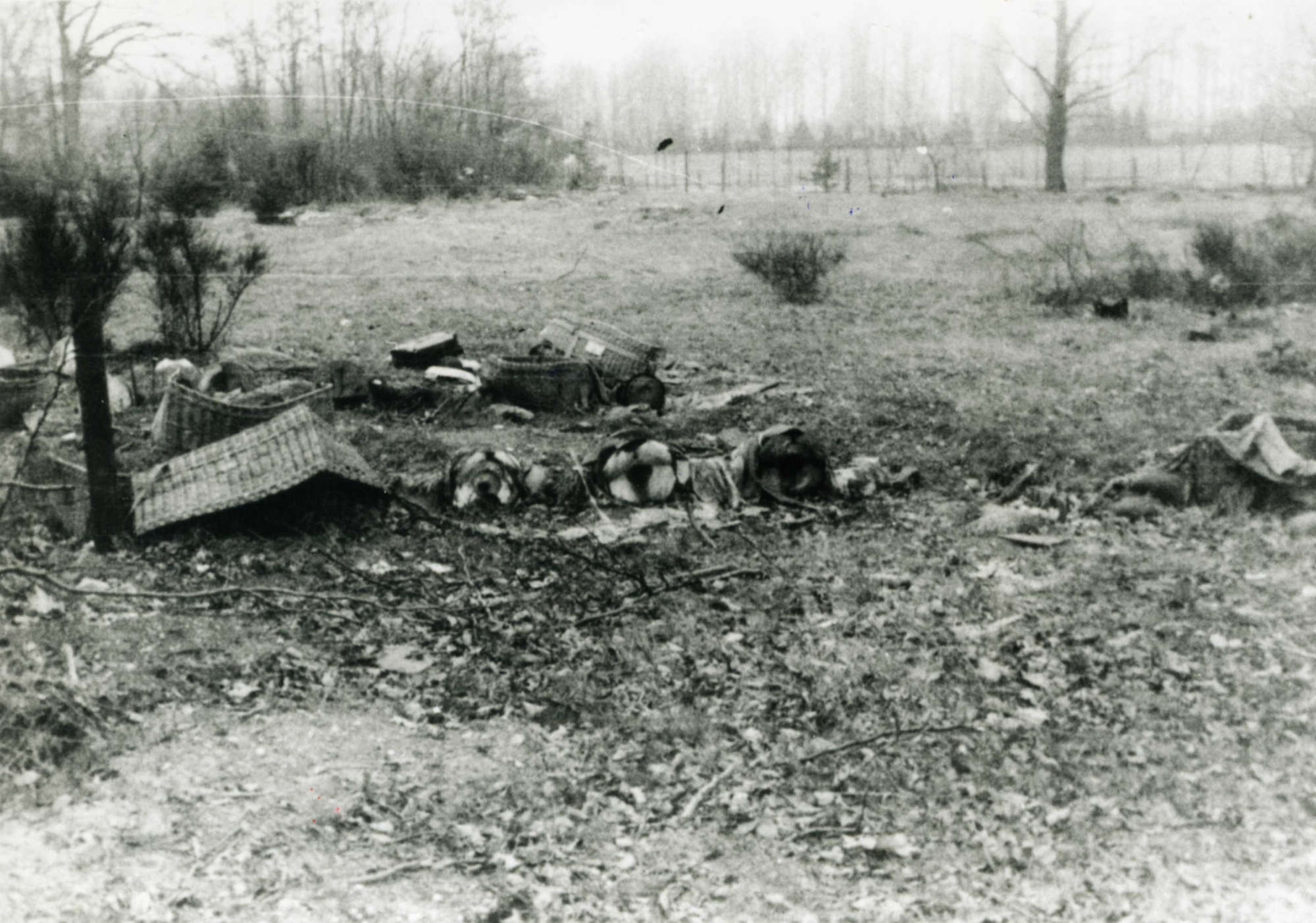
Abandoned supply panniers and containers in the meadows between the River and the Church. Photo taken in 1945. Courtesy Hartenstein Museum.
NOTES:
[1] Letter from Bill Gell to Bob Hilton. 31 October 1997.
[2] Letter from Bill Mitchell. 1996.
[3] Account from Les Ransom Booklet.
[4] Account from Thomas Jones. 1996.
[5] Letter from Jack Brooks to Bob Hilton. 8 October 1997.
[6] Letter from Jim Wild to Bob Hilton. 1 September 1997.
[7] Correspondence with Johanna Legg. 2019.
[8] 'A Bridge Too Far'. Cornelius Ryan. Pages 385-386.
[9] Letter to Bob Hilton from Larry Goldthorpe. 3 August 1997.
[10] 'Traitor of Arnhem', by Allan Samm. Minerva Press. 1996.
[11] Arnhem 1944 Veterans Club Newsletter, June 1994.
[12] Royal Army Service Corps Review Vol. 1, Nr 5. 1952.
[13a] & [13b] Letter from Ray Moon to Bob Hilton. 20 January 1998.
[14a] [14b] Personal accounts from Capt. Cranmer-Byng. 1947/48.
[14c] Account of Cyril 'Jack' Cooper. Lincolnshire Life. September 1979.
[15] Letter from Bill Chedgey to Bob Hilton. 28 September 1997.
[15b] & [15c] Telephone conversion, Ron Pearce with Frank Steer. 1990's.
[15d] East Anglian Times, Saturday, 17 September 1994.
[16a], [16b], [16c] & [16d] Personal account of Ken Clarke. 1945/46.
[17] & [17b] Charles Boardman personal account 1996.
[18a] & [18b] Account by John Prime. 1994.
[19] Personal account in the Pegasus Journal, July 1946, pages 45 - 47.
[19a] Letter from Les Withey to Bob Hilton. 1997.
[19b] Extract from an interview in The Daily Mail. 17 October 1944.
[20] & [20b] Letter & account to Bob Hilton from Sam Staple. 16 September 1997.
[21] Letter to Bob Hilton from Les Withey. 1997.
[22] Letter to Bob Hilton by Frank Bater. 26 September 1997.
[23a] & [23b] Account of Ron Nutley. 2004.
[24] Letters from Raymond Whitwell. 2011 & 2015.
[25] The Lincolnshire Echo. 2 October 1944.
[26] Letter to Bob Hilton from Ray Weaver. 24 September 1997.


