Chapter 9
Wednesday, 20th September 1944.
"We had some incidents and we finally got knocked out on the 24th, I was myself wounded and became a P.O.W." 'Bill' Chedgey. 28 September 1997.
H.Q, R.A.S.C. and the Detachments carried out their usual routine of 'stand-to' at 05.00 to 06.00 hrs, and suffered, what was to become, the regular morning 'hate' of mortar fire from the Germans.
Early on this morning, having been taken prisoner, Cpl. Blaxley was being moved further away from the battle area: "We were assembled in the garden, about 30 - 40 of us by then, and marched smartly under guard, through the outskirts of the town. We naturally squared our shoulders and smiled and acknowledged the waves of the civilians who cheered us on. The guards weren't too pleased about this and fired into the air with their automatic weapons bringing down the leaves from the trees and causing the women to scream and move away. We still kept up a good pace until one of the guards in the lead called out 'Tempo, tempo' and indicated by his hand movement we should slow down.
After a further few miles we reached a railway siding with the usual store sheds. We were locked into one these store sheds under guard. A little later a barrel of soup was brought into us and placed in the middle if the shed. Mess cans were issued and collected afterwards as we had all been forced to leave our equipment behind. Here we were now; unwashed, unshaven, tired, very unkempt and very hungry. Although the soup was very watery, it was hot and we did justice to it. A tall and very distinguished looking Major had made himself responsible for allocating it and a piece of Rye bread. Black and very heavy. We had a portion of 250 grams which was to become our standard issue every 24 hours. As it was heavy, the slice was quite small. He looked very out of place and I felt sorry for him, but I assumed he would soon be whipped [taken] off to an Oflag, and would not have to endure our hardships. During the afternoon, some cattle trucks with an engine attached, were assembled outside the building. We were ordered to remove our boots which were then put into bundles of 10, we had identified our own boots by tying the identity disc from our left wrist to them prior to parting with them. Each soldier had one round identity disc on a tie around his neck and an oblong one on his left wrist. We were to observe this practice on several subsequent occasions.
The boots were then placed in a separate truck which was occupied by the Posterns [Guards] who were our armed guards throughout our journey. We were then loaded into the cattle trucks, 40 to 50 in each truck. This resulted in our being so tightly packed that we could either stand or sit down, but once in we couldn't change position. We were locked in from the outside. During the early, evening the train got under way, we heard the clanking and banging of an engine felt it jerking the train into motion as the engine pulled away, but could see nothing. The guards were travelling in separate trucks at strategic points." [1]
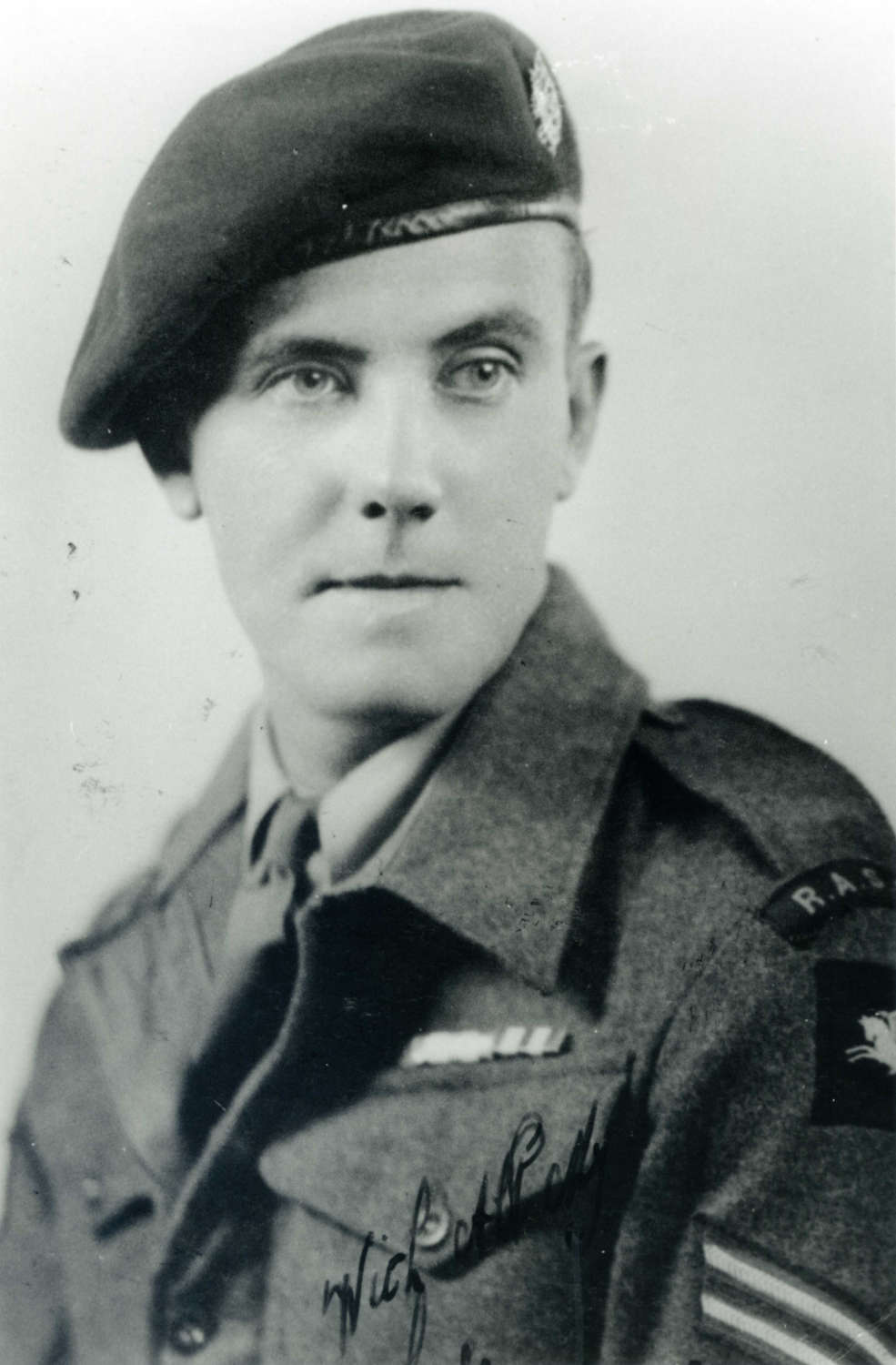
Cpl. Burnham Blaxley. No 2 Parachute Platoon. Photo taken after he had returned from POW Camp and had survivors leave. 1945. Courtesy of Burnham Blaxley.
Also moving away from the area of the Oosterbeek Railway Station, was Dvr. John Green, but towards their own 'lines': "On the Wednesday morning we crawled as best we could - for we realised we weren't going to feel any better messing about there - to a house about 200 or 300 yards away. It was empty. We hadn't any shaving-kit, and we were bearded and grubby, but we managed to clean up a bit, and found some wine and a pack of English playing-cards. We sorted ourselves out generally and found we had now only about forty rounds between us. We barricaded the place up as best we could, and kept a lookout for the Medics. We saw some about dinner-time and they took us in a Jeep to a restaurant [Schoonoord] in Oosterbeek which was being used as a hospital for the less serious cases. I heard the hospital was kept for the worst cases only. We were in the restaurant for a couple of hours - it was crammed with wounded - and when our arms and ammo had been taken from us and some dressings done, we were put into a nearby house out of the way. It was getting dark, but the muck went on flying." [2]
The 1st Airborne Division After Action Report, Part I, Appendix H, for the 20th September 1944, has the following entry: 'Resupply carried out in heavy flak, but fair proportion recovered, including 2,000 rations which were all issued and represented a general ration of 1 between 3. Very heavy mortaring on D.M.A. continued in morning. Casualties fairly heavy. As a result of increased small arms fire, issues from D.M.A. became impossible and it was moved within Divisional H.Q. perimeter. Further issues of ammunition made from D.M.A. including first delivery of gun ammunition to Light Regiment by R.A.S.C. Some units were, however, able to collect additional supplies and ammunition from outlying areas. M.D.S. captured and majority of casualties removed by Germans. Own medical staff looking after remaining under A.D.M.S. Two Carriers loaded with ammunition attempted to reach 1st Parachute Brigade without success. Casualties in Divisional area heavy and many R.A.S.C. Jeeps were diverted as Ambulances, and trailers for carrying water to M.D.S. During the evening of 20/21 September the bulk of the Divisional R.A.S.C. were formed into a Composite Platoon under the command of Capt. J. Cranmer-Byng, MC., R.A.S.C., and took over a portion of the Divisional perimeter from the 4th Parachute Brigade.'
It is worth going through this entry, and looking at some of it in detail. The H.Q., R.A.S.C. War Diary had the following entry to describe the re-supply effort: '15.00 hrs. Resupply on to Divisional area - partially successful, but number of rations collected sufficient only for one third rations to be issued. Further heavy casualties to resupply a/c.'
So, it depended whereabouts in the perimeter you were, and what your job was, as to how the resupply drop on this day, was viewed! The statistics make stark reading. There were 163 aircraft on this mission, one hundred Stirling's and sixty three Dakotas. Between them, they dropped 390 tons of supplies, and only 41 tons was recovered by the Divisional R.A.S.C, usually by driving round to the area's where containers and panniers had ben seen to drop within the perimeter. A few more tons were collected by other units and utilised by them, without taking it to the D.M.A. A total of seventeen aircraft failed to return to base.
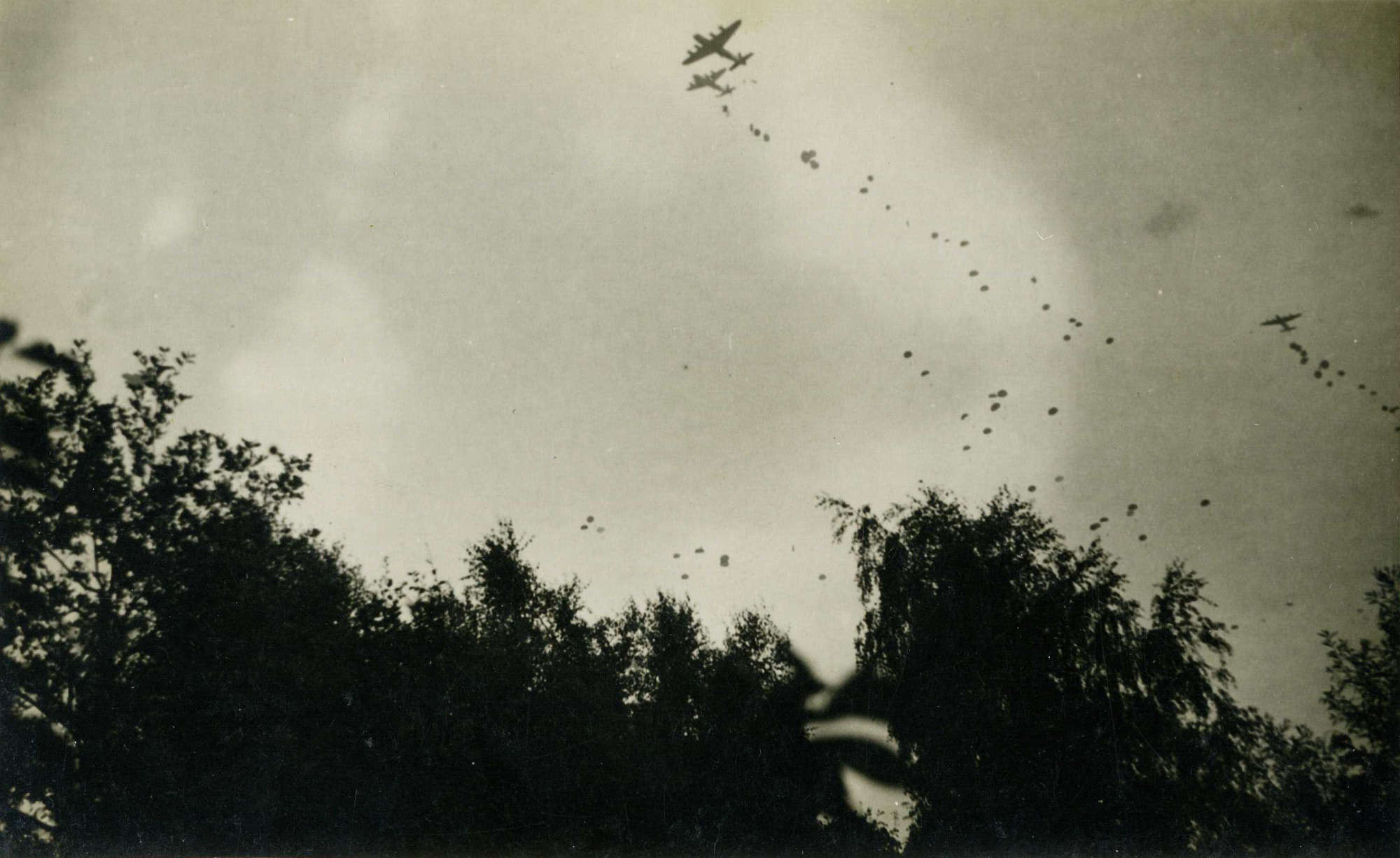
Supplies being dropped from three Stirling aircraft over the ever dwindling perimeter of the 1st Airborne Division at Oosterbeek. Wednesday, 20th September 1944. Photo by Sgt. C.M. Lewis, A.F.P.U. BU 1106. Courtesy of the I.W.M.
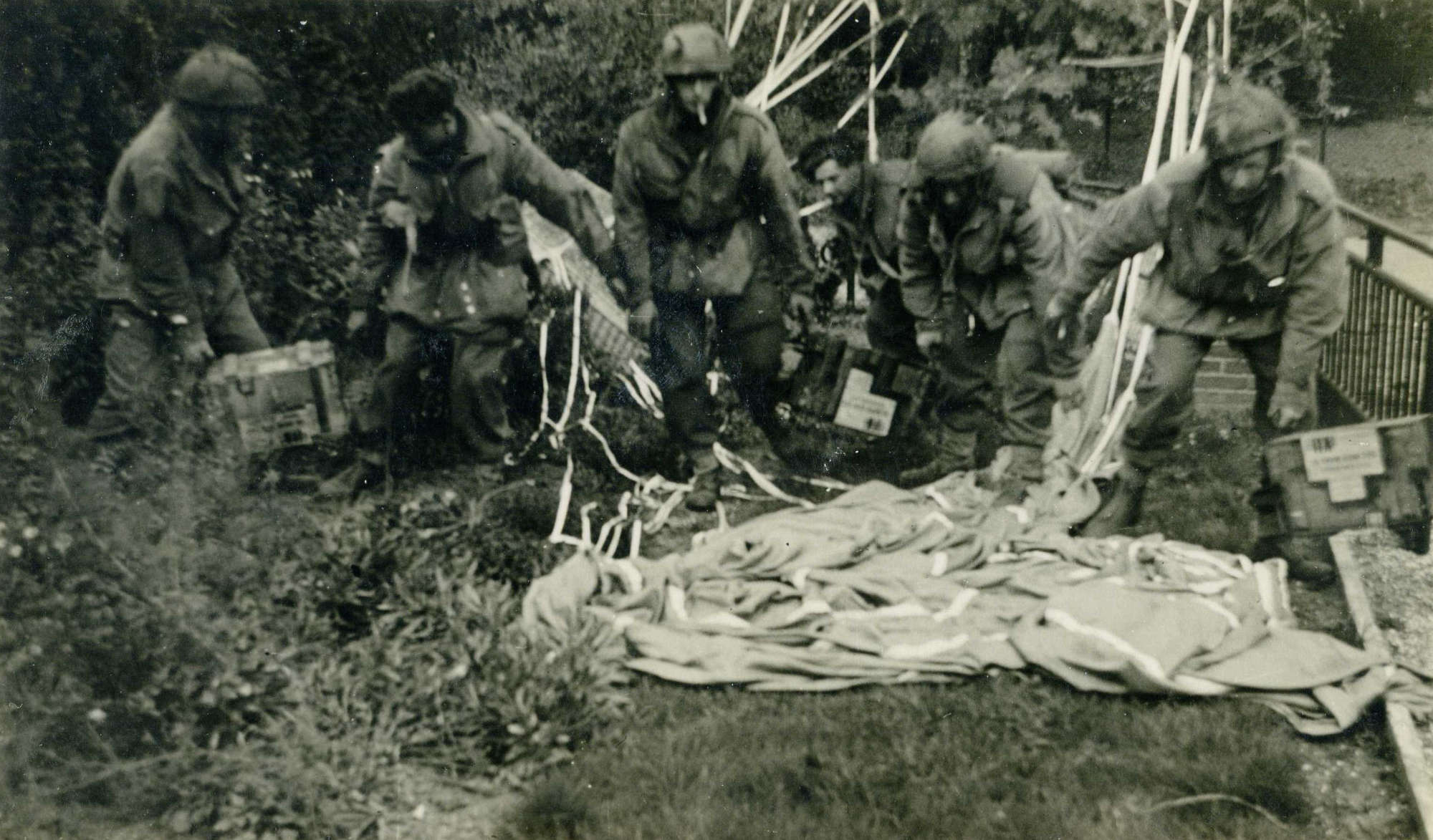
Gathering in part of the re-supply drop at No 16 Van Lennepweg, Oosterbeek. The panniers contained boxes of .303 ammunition. The men are from C-Company, 1st Bn, The Border Regiment. L-R: C.S.M: George Stinger, Cpl. Jim Swann, L/Cpl. Freddie Webster (smoking a cigar), Pte. J. Boow, Pte. Eric Blackwell and unknown. Photo by Sgt. C.M. Lewis, A.F.P.U. BU 1107. Courtesy of the I.W.M.
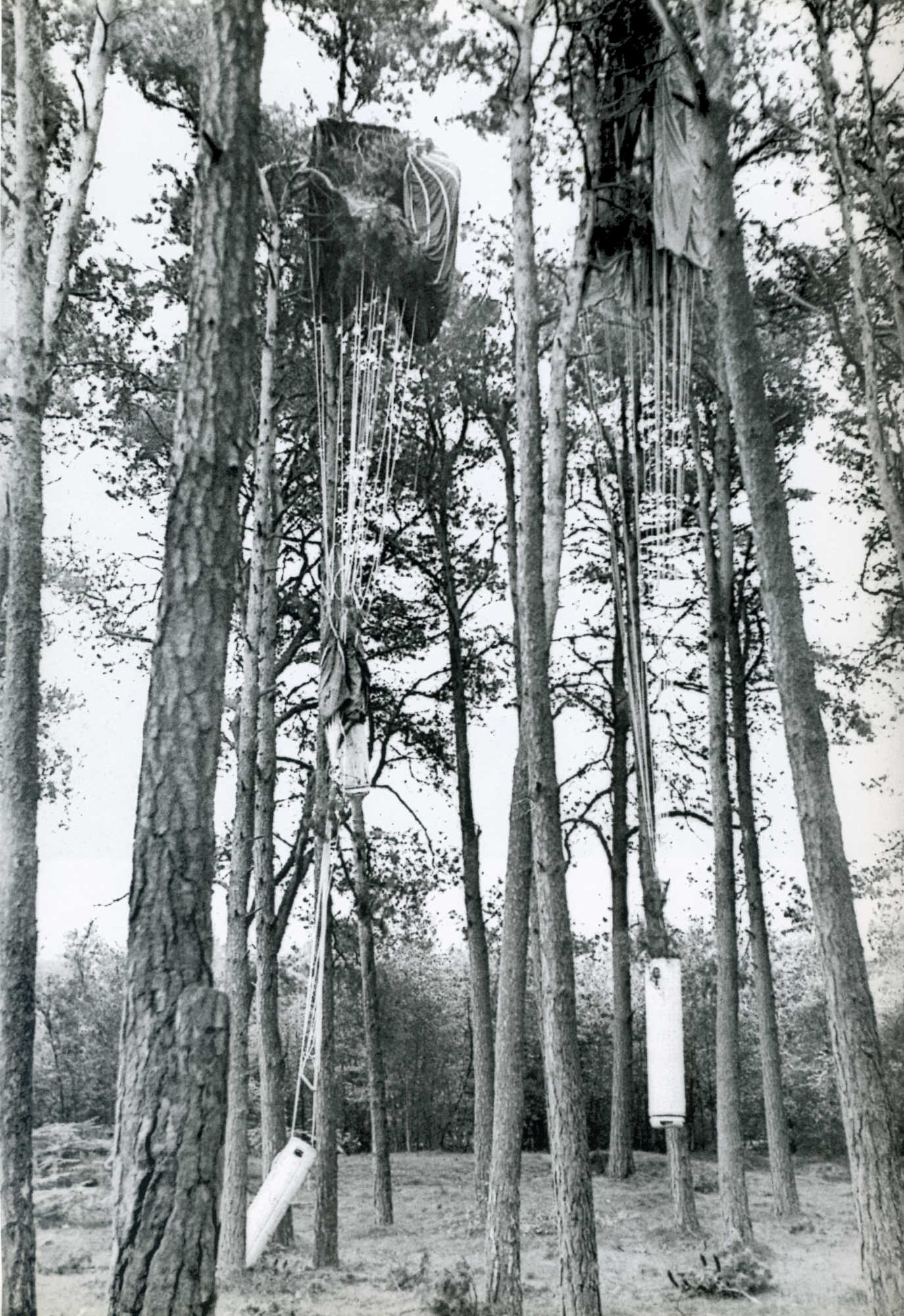
British C.L.E. supply containers hung up in trees, on the Dreijenseweg, near the S.D.P. 'V'. Oosterbeek. Wednesday, 20th September 1944. Courtesy Bundesarchief, 101l-M2KBK-772-04.
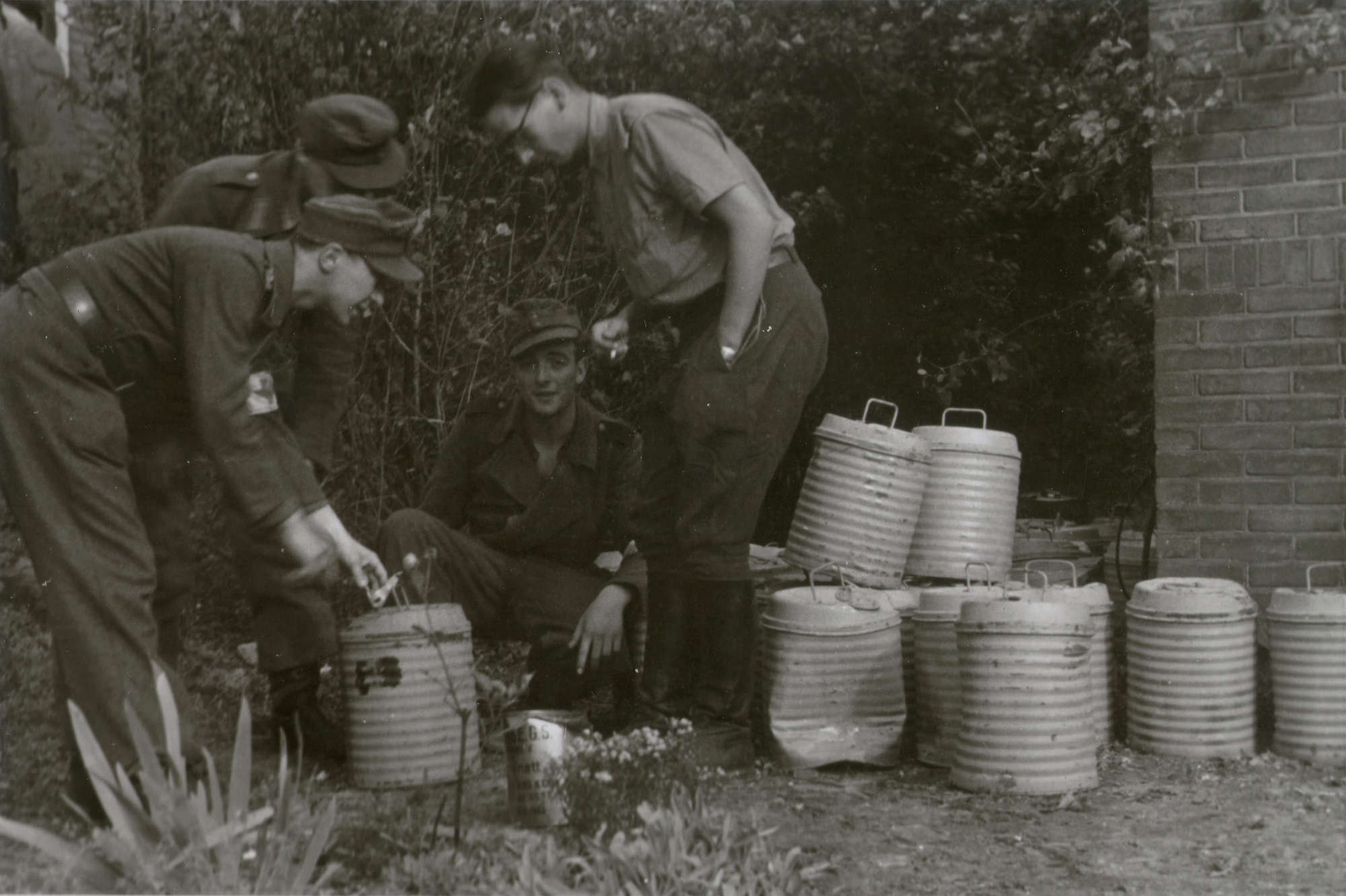
German support or supply troops, of the 280th Assault Gun Brigade, one with a medical arm-band, sorting out British 4 gallon drums of petrol from a supply-drop in their area. Emmastraat, Oosterbeek. 24th September 1944. Courtesy Bundesarchief.
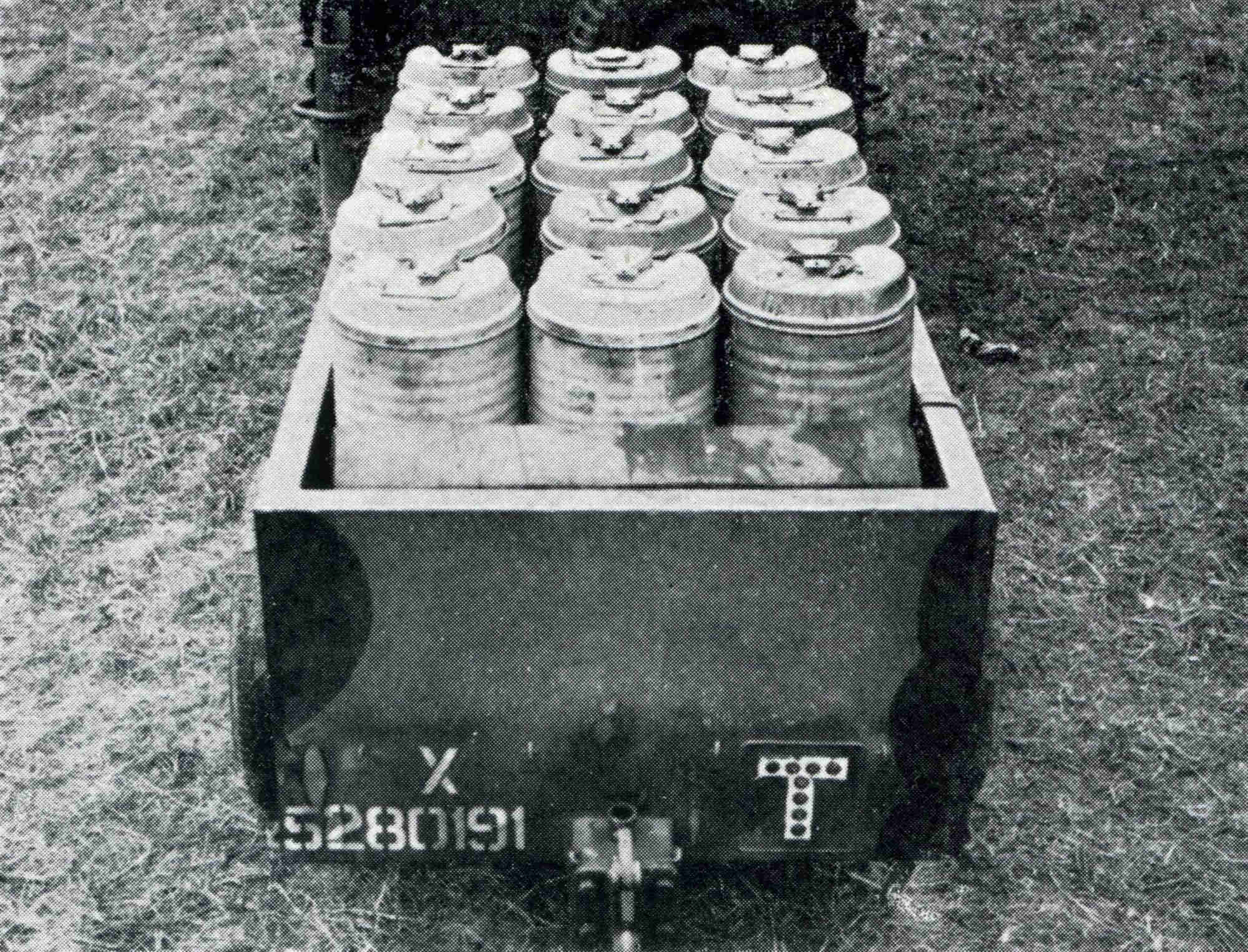
How the 4 gallon drums of petrol were to be stacked in an Airborne Trailer. 1944. Courtesy Supplies & Transport, Volume II.
As an illustration of how dangerous the supply drop could be, here's an extract from the After Action Report of No 1 Battery, 1st Airlanding Light Regiment, R.A: '07.00 hrs. Heavy mortaring started early and continued all day. A tank alert was in force all day, but no tanks appeared. One container, during the re-supply, came through the roof of the Command Post.' No casualties were reported, though!
The increased amount of small arms fire from the enemy, with his infantry attacking from the north, meant that the D.M.A. had to be moved across the road from the Hartensteinlaan and the Utrechtseweg, and into the grounds of Divisional H.Q. in the Hartenstein Hotel. This was completed by 10.30 hrs. Lt-Col. Packe: "Soon, however, the dumps came under heavy attention not only from the ubiquitous mortars, but from small-arms and. machine-gun fire, so that it became a matter of difficulty and danger to make further issues. The dumps were then moved into a position of greater safety and better concealment behind Divisional Headquarters. The enemy, however, seemed to be in no doubt as to their whereabouts, and the area was subjected to ever-increasing and extremely accurate mortar and shell fire. Fortunately, the German is as methodical as ever in his habits, and these concentrations seemed to follow a definite programme, with peak periods at dawn and dusk and an extra period for good measure at midday or whenever there was no other more attractive target: it also became plain that a short, sharp bout would invariably follow a supply drop, when the enemy reckoned to catch a lot of people in the open. During the next few days, the rest of the R.A.S.C. contingent did what little could be done. Under continual mortaring, Jeeps chased about recovering baskets and containers all round the inside, and while the situation was still fairly fluid, the outside of the perimeter. A new D.M.A. was formed and a new S.D.P. marked out with yellow triangles and other signals. For a brief period, units were able to draw ammunition fairly normally, although what little food there was, was reserved for the hospital. But the net tightened rapidly, and the Division was soon confined in a very narrow bridgehead based upon the river, incessantly and bitterly attacked at every point." [3]
The decision to move the D.M.A. was not taken by Lt-Col. Packe, but by Lt-Col. Philip Preston, the A.A. & Q.M.G. who sent a runner to Packe's H.Q. This was Sgt. Neville 'Bill' Griffin an R.A.S.C. Clerk with Col. Preston's Staff: "Colonel Preston told me he wished to see Colonel Packe, and asked me to go and get him. I asked Norman Davidson to come with me. "Not likely" was the immediate reaction, but he came anyway. We crossed the main road, and saw a house with a dim light which was a cellar. I stuck my head in and said, "Colonel Packe?". I was lucky not to get shot. I told him he was wanted, and with a very unhappy Colonel Packe, we padded back across the road." The C.R.A.S.C's H.Q. became a deep slit trench with overhead cover between the 3" mortar and the small arms ammunition stacks, and was exactly thirty-three paces from the A.Q. Office; much easier for 'Bill' Griffin to get him next time! [3b]
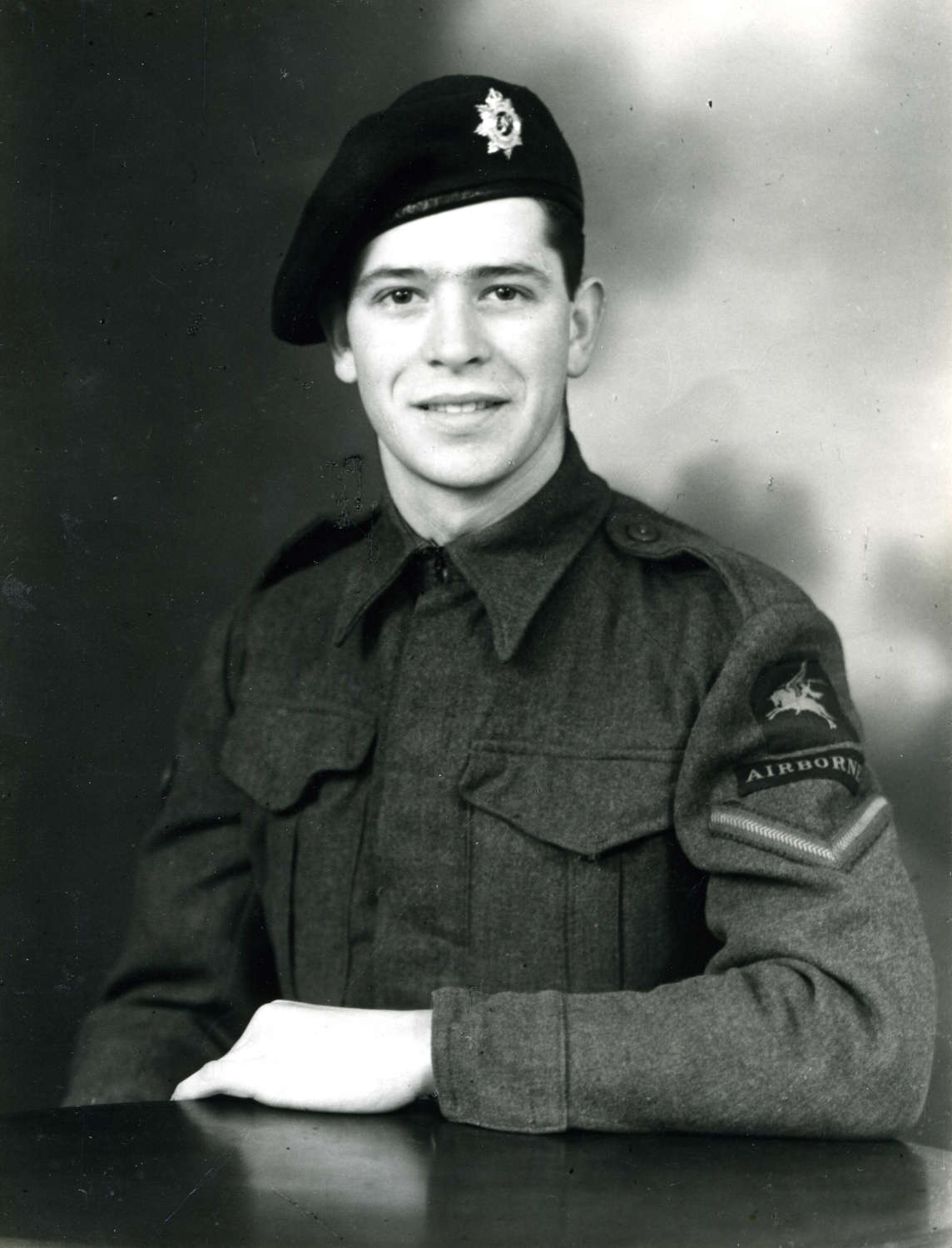
L/Cpl. Neville 'Bill' Griffin in 1942. He would serve with Britain's Airborne Forces from 1941 to 1952. Courtesy Bill Griffin.
The further issues of ammunition made from D.M.A, including the first delivery of gun ammunition to the 1st Airlanding Light Regiment by the R.A.S.C, was delivered in one of the captured German trucks. It turned out to be a fortunate mission, as it found one of its 'lost' members. Dvr. 'Ron' Nutley had been adrift since Sunday: "All I had with me was a Mk4 Lee Enfield rifle which was no good against a tank. I kept my head down and stayed the night in a ditch. In the morning I found I was within our own lines. 1 think this was pretty close to the middle road.
Later on, I remember taking my Trenching Tool off my back to 'dig in' and found that shrapnel had hit the metal blade and the impact of the hit had split the wooden handle in two. I think shrapnel must have hit it when I was still in the Dakota. I know for sure I was a lucky bloke! After this I did not see the remainder of my Company for 3 days. I eventually ended up with some of the South Staffords Regiment at Oosterbeek. I clearly remember taking cover in a house. I was in a room at the top of the house as this afforded a good view all round to watch out for Jerry. A chap from the South Staffords was with me, I can't remember his name. We took turns with a Vickers Gun, we had to take a pop at Jerry. Jerry finally got a mark on us and a Tiger Tank [S.P. Gun] fired into the house and took the roof off so we both scarpered. He went one way I went the other. (I did not see the South Staffs chap again). I slipped down into a ditch, through a field which took me down to a fork in a road at Oosterbeek. Later I saw a church, I attempted to cross the road to get into it. but there was a Jerry with a Spandau letting fly. I only had a rifle and had to wait and bide my time before I made a dash across the road, trying not to get riddled with bullets. I fell through the church door and turned right. Inside I found the place was packed - a mixed bag of various British and Polish Coy's sitting in the pews. I could not make out anybody I knew, too many faces.
An officer with a black patch over his eye, obviously wounded, was standing in the pulpit addressing the men. I continued to make my way past the pulpit, down through the middle of the church and out through a side door to the left that lead to the road. Just at that very moment, my old mate 'Jack' Hart happened to roll up in a lorry, he called out to me and said 'What ya doing Ron? Come on I'll give you a lift to HQ'. I hopped on board and Jack took me to the Hartenstein Hotel.
Upon arrival at the Hartenstein Hotel I found some of my Company were dug in. It was good to be back with some of my unit. Jack and I dug an 'L' shaped trench together, drove the lorry over the trench to get extra cover. There were anti-personnel shells going off overhead the noise was horrendous. We were dug in for a couple more days." [4]
The medical situation seemed to be well in hand, with most of the main locations seemingly well out of the way of the enemy and the main fighting. There were three main locations, the Tafelberg Hotel, the Schoonoord Hotel and the Vreewijk Hotel.
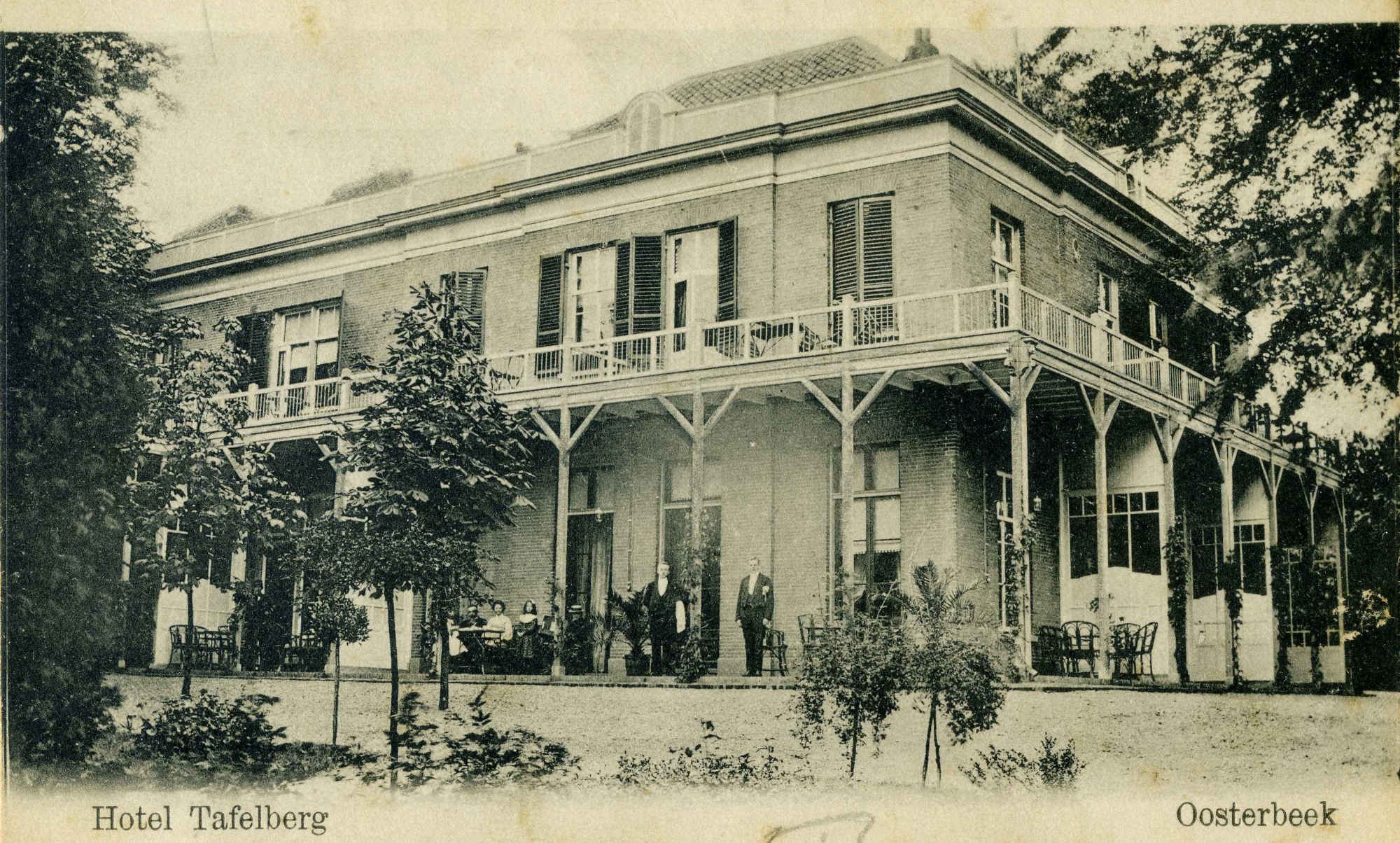
The Hotel Tafelberg in the 1920's. Courtesy the Bob Hilton post-card collection.
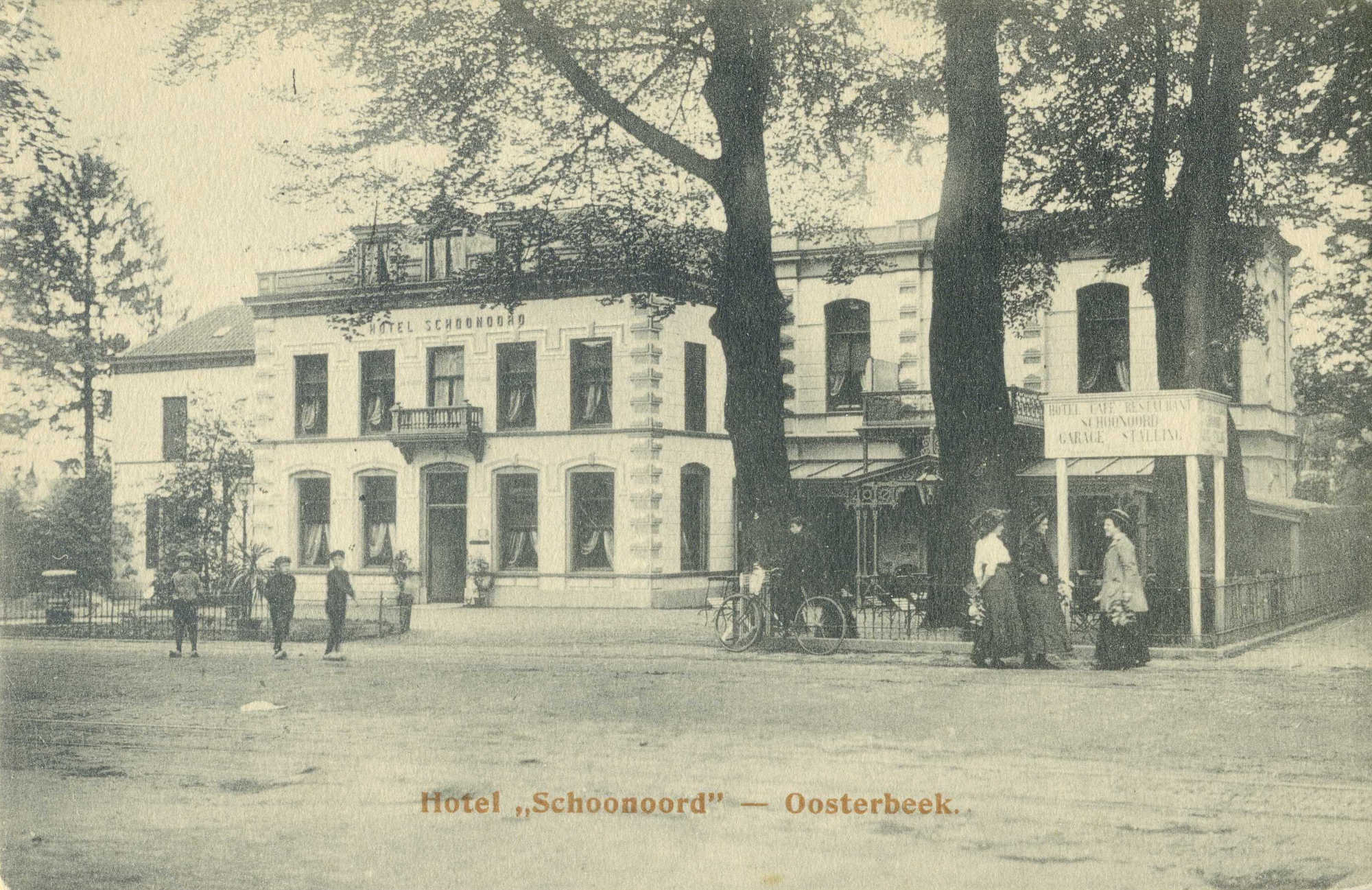
The Hotel Schoonoord in the 1920's. Courtesy the Bob Hilton post-card collection.
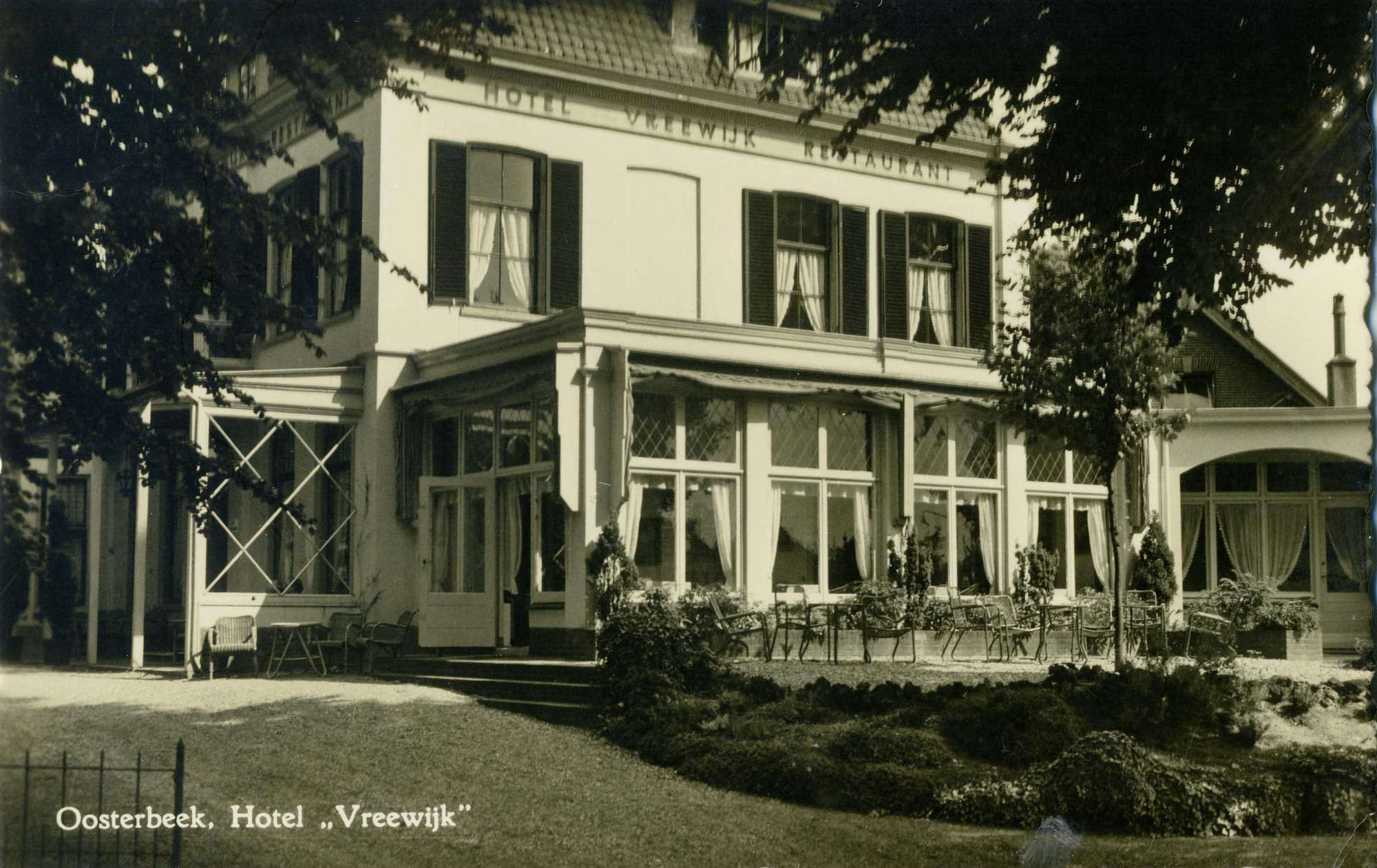
The Hotel Vreewijk in the 1950's. Courtesy the Bob Hilton post-card collection.
A Surgical Team of the 181 Airlanding Field Ambulance, R.A.M.C. had been set up in the Tafelberg, which was located on Pietersbergseweg. The Main Dressing Station being located at the Schoonoord, about 300 m's north of it, on the south-east corner of the junction with the Utrechtseweg. Directly across the road from it, to the north, was the Vreewijk, which was taken over to handle the ever increasing number of casualties. However, the German attack against the remnants of the British Airborne Force in the western outskirts of Arnhem and the eastern end of Oosterbeek, had broken through the main crossroads in Oosterbeek, right onto the junction of the Utrechtseweg and Stationsweg, bringing the medical facilities into the front line. The removal by the enemy of many of the walking wounded, medical staff and transport, left the Division in a difficult position.
The rapidly deteriorating situation was further commented on by Lt-Col. Packe: "In spite of all this, the business of collection and issue of supplies - such supplies as they were - went on without interruption. The dump area became a mass of debris; roads became impassable even to Jeeps; men were found dead in their slit trenches, or were brought in badly wounded. And yet-tireless and seemingly fearless drivers, were continually out on their job, until they failed to return or until their Jeeps were knocked out under them. Many, under cover of the Red Cross, were continually engaged in carrying casualties to the enemy occupied hospital or fetching water from an enemy-controlled well. On at least one occasion a driver while so engaged met a German tank, but was allowed to proceed unmolested, having been asked for an undertaking not to disclose the tank's position." [3c]
That R.A.S.C. man that was tasked to help out, with the recovery of wounded, was L/Cpl. Herbert 'Dixie' Dean of 'D' Transport Platoon: "During the period I was dug in at the Hartenstein, I was detailed to proceed with Jeep and fellow medic to a map reference to pick up wounded of 156 Para. We had to leave by the driveway at the back, as the other drive was covered by an S.P. Gun dug in near the Schoonoord. No doubt other squatters at the Hartenstein will remember this. We went down the main road towards Renkum, turned right through a little spinney, then belted across open ground 150 yards to another spinney, where we were welcomed by a Jerry tank and quite a few infantry.
The medic had a chat with the German officer, telling him of our purpose and had he - the German - any wounded? The conversation lasted only a few moments, but they seemed like years to me, lying on my belly, with young German lads grinning down at me about 20 yards away. The officer asked for the medic's word of honour that he would not disclose his position and shook hands, after which we raced back up the main road towards the Hartenstein for some 200 yards, then left down another lane near the Bilderberg Hotel, where we found the 156 Para.
I had hardly returned to the 'safety' of my trench at Hartenstein (a deep trench, as I had the luxury of a spade on my Jeep), when there came a shout for me again - (Oh No, not another trip like that?!). It was the G2 (I think), who asked me about the adventure and had I given my word of honour as well? On learning I had not spoken, he asked, 'well, where's that bloody tank?'" [5]
Whether he did disclose the tanks position is not revealed!
To the south west of the Divisional H.Q, a group of glider pilots from 17 Flight, 'A' Squadron had established a defensive position and dug-in. The scattered resupply drop meant an extra hazard for some, as described by Sgt. Norman Ramsden: "The next day [20/09/44] Flight was moved and split, S/Sgt. Ralph and Sgt. Fenge joined another group, and the Section I joined, with Lieut Markwick, moved out into the woods and dug-in alongside a track. Plenty of enemy mortaring, some setting off ammunition in re-supply panniers caught up in the branches." [6]
One of those in the D.M.A. and definitely wishing he was somewhere else was L/Cpl. Walter Inglis: "After the big fall back to Oosterbeek, we were detail under Capt. G. [Possibly Lt. Grice], and walked quietly to take up position. A Lt-Col [Packe?] charged up to us saying we were walking into an ambush. Everyone thought he was mad, because things were so quiet and then everything opened up - every man found a hole in 10 seconds flat. We still had a lot to learn. This, my 23rd birthday was spent in a trench in the Oosterbeek perimeter." [7]
Extracts from the War Diary 1st Airlanding Brigade Headquarters:
17.30 hrs. Resupply dropped all over Brigade area. Panniers were collected by units of the Brigade and reported to C.R.A.S.C. for collection.
18.00 hrs. Two Carriers from 7th Bn, K.O.S.B. sent to Divisional H.Q. to rush ammunition to bridge and distribute supplies.
18.30 hrs. Maj. Winchester, Commander 9th (Airborne) Field Company, R.E. arrived at Brigade H.Q. to enquire whether the ferry at 6876 was still under our control. On being informed that it was, he went down to recce it.
The collection of the scattered drops within the Brigade area, and the deliverance of them to the D.M.A. would have been organized by Capt. Leslie Lockyer, the B.R.A.S.C.O. He was one of the few officers not to be killed or seriously wounded earlier that day, when Brigade H.Q. received a direct hit from enemy mortar fire at 08.30 hrs.
In the south-west 'corner' of the perimeter that was now forming, were the positions of the 1st Bn, The Border Regiment, and within the area controlled by 'B' Company was the Driel ferry. This was supposed to be used by the Polish Parachute Brigade to get across the Lower Rhine and to reinforce the Division, after they had jumped onto the 'new' D.Z. 'K' south of the River. They were already a day late. A Polish War Correspondent, attached to Divisional H.Q., Marek Swiecicki joined the patrol that went to meet them. However, when they got there it was apparent the ferry was gone, and our own troops 'hold' of the area was tenuous, but while there he was witness to a typical 'British' act:
"In a trench at the roadside two soldiers made a bet of a very unusual and even original kind. I could hear their raised voices.
"You see, I'll bring in that box of supplies which fell in the meadow," said one of them.
The box with its parachute lay on an open stretch of meadow some fifteen yards from the embankment and the bushes which masked our positions.
"It can't be done," the other answered. "A fly couldn't settle there."
"Bet me a packet of Players?"
"Okay, but I'll be sorry for you."
"Don't you worry about me!"
The stake was high: a packet of Players was a small fortune to us now. An agile, athletic figure ran quickly across the road and dashed into the bushes, coming out again suddenly on the embankment some dozens of yards farther on. There was a crash, and the clatter of automatic pistols. Spandaus chattered ominously. The Germans certainly controlled the bank. Bullets sped after the Britisher, tried to overtake him in the meadow, fell all around him. But he was determined to win his bet. He made two great bounds and dropped beside the box. With a large knife he cut the ropes of the parachute and crawled back on his return journey. He crawled because the box was heavy, and there could be no thought of running. In addition he had to crawl in zigzags, to make it as difficult as possible for the enemy.
The sight was unnerving. I lit a cigarette, and was filled with anger. I could have used my fists on those two men!
"These sportsmen, damn them!" I cursed louder and louder. "Must have something to bet about!"
The man who looked like losing the bet turned his head towards me and laughed at my state of nerves.
"Don't you worry!" he said, "it looks as if I've lost".
The other man was now crawling along the embankment. It was not very wide, and an easy mark to aim at. So he made one great effort, flung the box on to his shoulders and ran the last few yards like a streak of light. In a couple of seconds or so he had vanished into the bushes. The machine-guns died away. No point in wasting ammunition. This British-German match was finished. A score of one-nil to the British." [8]
The statement about 'the bulk of the Divisional R.A.S.C. being formed into a Composite Platoon under the command of Capt. J. Cranmer-Byng, MC., R.A.S.C., and taking over a portion of the Divisional perimeter, from the 4th Parachute Brigade', was a clerical error, as the 4th Parachute Brigade had only just made it into the forming Divisional perimeter by the evening of the 20th - it is 24 hours later, that this happens.
Capt. Cranmer-Byng made the following observations about the 'siege' which the Division was starting to endure: "By now the Germans knew pretty accurately the whereabouts of the bulk of the Division, and concentrated mortar barrages fell round the area of Division HQ. For many men, this was their first spell in a real barrage, First Aid Jeeps went speeding past, with wounded lying on stretchers, one barrage seemed to lengthen into another. The nerves got accustomed to the noise, and the instincts sharpened to judge the right moment for jumping into a slit trench. A variation occurred, when the Moaning Minnies, a six barrelled mortar, joined in. By now, the pilots who flew in the re-supply planes, knew what was happening to us, and consequently dropped their panniers and containers all over the small Divisional area. A small proportion fell within the perimeter, and was saved by the R.A.S.C. men who drove about the place in jeeps, hoping they would not bump into the enemy." [9]
From the diary of Brig. Hackett: "Towards nightfall I had decided after consultation with Major George De Gex (2 i/c, 1st Airlanding Light Regiment, R.A.), to break through in the direction of Divisional H.Q. with whom we had no contact since 1000 hrs. Enemy apparently determined to liquidate position before dark and now pressing in more than ever. We had a dash for it, Major De Gex and myself leading, and got through with few casualties to position of a Company of Borders at 687786 (I think).
There I re-organised into 156 Detachment and Brigade H.Q. Detachment and disposing in defensive positions met O.C. 4 Parachute Squadron, R.E. (Maj. Perkins), with half his unit intact and remainder believed K.O'd. elsewhere. Reported to Divisional H.Q.
Divisional Commander ordered me to take over, with effect from next morning, command of East side of Divisional perimeter from about 695785 round to river in the neighbourhood of church 697774.
Major De Gex reverted to Light Regiment, to my regret. Capt. Harkess, B.R.A.S.C.O, was at Divisional H.Q. with an assortment of men and Lt-Col. Smythe with about forty of 10 Bn, later increased to about seventy. 156 Detachment (about 50 strong, Maj. Powell in command) were lodged immediately in the area it was proposed they should defend (houses 694786). I visited them before they moved in and Brigade H.Q. Detachment at Sonnenberg and then slept at Divisional H.Q., which was in its same location (693784)."
By now, the situation for the British Airborne Force at the northern end of the Arnhem Road Bridge was critical. Even so, most of the battle so far, had concentrated against the troops holding the buildings on the north-eastern side of their small perimeter, with some attacks coming in from the north. Now, however, the British Force had been so reduced that they were concentrating in and around the building used as Brigade H.Q, and this brought the R.A.S.C. Platoon into the 'front line' of the action. By far the best account of the battle, was recorded by Maj. 'Tony' Hibbert: "10.00 hrs. One of the 22 sets which had been 'searching' suddenly picked up the Divisional forward net. This was very good news, and I immediately got on the set. The first words I heard were Brig Hackett remonstrating with the G.O.C; 'Yes, but you must realise that we have no anti-tank guns', which did not sound too good. I got hold of Gordon Grieve (Capt. Grieve G.S.O.3 Operations HQ 1st Airborne Division), and put him in the picture and got an outline picture from him. In meantime, I had sent a message to Lt-Col. Frost that we were through to Division and just as he arrived the G.O.C. came up on the air, and asked for our 'Sunray' and I put Lt-Col. Frost on the set. The G.O.C. first of all congratulated him and said he was delighted that we had got on the bridge, and wished his congratulations to be conveyed to all ranks. He said that XXX Corps were expected soon, that the Division itself was getting stick in the Oosterbeek area, and that we must hold out till XXX Corps arrived. Lt-Col. Frost said that our position was satisfactory for the time being, and that we could hold out for some time yet, but that we must have supplies of food and ammunition immediately, also a surgical team with medical supplies to look after our wounded. The G.O.C. then suggested that we should organise the local civilian population to bring in food, ammunition, and stores from some of the re-supply containers, which had gone astray the previous day. Lt-Col. Frost replied that we were fighting in the middle of a devastated area, that there were no civilians, that we were surrounded by a superior and somewhat aggressive enemy force, and that it was by no means possible for civilians to wander backwards and forwards through the lines carrying containers full of supplies (of which, in any case were not in the vicinity). We then, passed back our official estimate of casualties inflicted on the enemy during the first two days fighting.
19.30 hrs. It became clear that the main attack was being directed against Capt. Gell's Platoon, and the right flank of 2nd Battalion. The enemy had occupied the high building overlooking Capt. Gell, and poured a steady stream of MG fire and rifle grenades into his house, and increased the mortar fire on it. A high wall separated the two houses, and the enemy proceeded to blow down the southern end of it. Capt. Gell's men withdrew to the passages ready to re-occupy the rooms when the German infantry advanced to the assault. Vigorous action on the part of fire fighting picquets put out all the fires that were started. Brilliant work was also done by the Brigade Signals Section, who maintained the wireless sets in the attic under extremely heavy fire."
Dvr. 'Jim' Wild gives a graphic account of this assault: "The first shot hit the corner of the roof. It didn't explode because the only resistance it had was the slates on the roof, but it left a hole nearly two yards across. The lads underneath it were showered with debris; I wouldn't like to repeat what they said. The shell exploded against the brickwork at the other end of the long room. We were all down on the floor. A lot of shrapnel was flying about, and I think one man was killed and one wounded. We decided to get out, down to the ground floor, when the second shell exploded against the front wall of the room we had been in; we would all have been killed if we had been there."
Maj. 'Tony' Hibbert continues: "Meanwhile the Brigade H.Q. building was under heavy fire from 105 mm and 88 mm guns, and from tanks. When sufficient of the outside walls had been blasted away phosphorous shells were fired into the building, and fires broke out at several places at once. These were kept under continual shell-fire, and it was found impossible to keep them under control. The medical situation was growing acute. Capt. Wright and Capt. Logan with a medical section, had established an A.D.S. in the cellars of the Brigade H.Q. building. On the second day, the water supply had failed, and by the evening of the third day they were dealing with about 250 wounded. The space was terribly cramped, there was very little light, and both Capt. Wright and Capt. Logan had been without sleep since the beginning of the engagement."
Dvr. Jack Brooks: "We were in a building next to the Prison (I think it was), with 'Jim' Wild, George Hutchinson and others, having a go at Jerry across the road, and also, trying to pick off the Jerries in the Church Tower, who were directing the mortar fire on our position. We had to evacuate the top floor of the building when we came under heavy fire, and I was on the lower floor with 'Fred' Hill, when the Tiger tank behind the wall, opened fire several times and made a bloody big hole in the wall. We were only yards away and what happened next you may not believe, but a Jerry poked a Machine Pistol through the hole and on the end was a white flag (I mean a piece of white material). We knew that they were not surrendering, so gathered that they meant us to, this we did not do then, and 'Fred' and a couple of other blokes lobbed some hand grenades over the wall. This happened a day after we evacuated the upper floor (roughly)." [10]
20.00 hrs. As the Brigade H.Q. building was now well alight, the order was given to evacuate the wounded to the house occupied by Capt. Gell. Space was entirely inadequate though, as the only part of the house not under direct and continual fire, was a space under the stairs, and a short length of corridor. There were about 250 wounded and the available space was soon filled up. At this moment, the Germans started using the same tactics which had been so successful on Brigade H.Q, and owing to the fact that the house was largely constructed of wood, it was soon burning furiously. I was away at the time making a reconnaissance of some houses to the north, which I found to be unoccupied. I put a section in these houses and returned to Brigade H.Q, where I found considerable confusion. Both houses were burning fiercely; the entrances to both completely blocked by wounded, and considerable numbers of wounded in the square between the two buildings, which was under fire and being mortared. To this, was added a number of frightened refugees and German prisoners.
I reported to Maj. Gough who had been to see Lt-Col. Frost. It was decided to order a 'cease fire' while our wounded were evacuated and handed over to the Germans. There was no alternative as we no longer had anywhere safe to put them, and could not provide them with the medical attention which they required. At the same time, it was necessary to have the defenders of the Brigade H.Q. and R.A.S.C. buildings, as the houses were well alight and would soon be untenable. I told Maj. Gough that it would be possible to move everyone to the houses just to the north. This was agreed to, and we managed to get about 130 men out. Unfortunately though, the houses which I had recce'd ten minutes previously, a long block of flats, had been set on fire by another house at the further end, and they were now untenable."
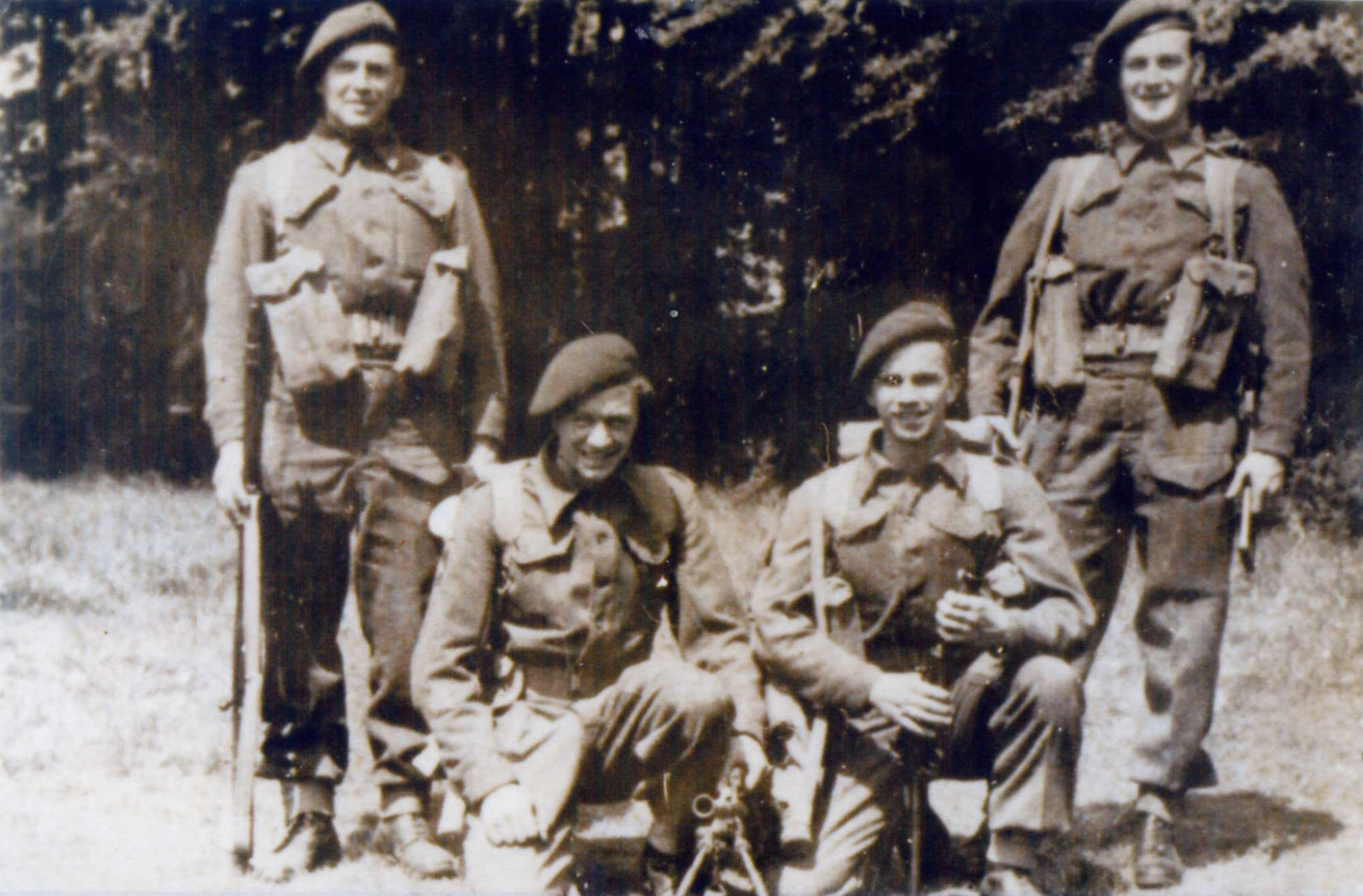
Back left, Dvr. Henry 'Jock' Ferguson, back right, Dvr. Herbert 'Charlie' Payne. Front left, Dvr. Edward 'Teddy' Chapman, front right, Dvr. George Smith. All served in No 3 Parachute Platoon at Arnhem Bridge and were taken prisoner on the 21st September 1944. The photo was probably taken in the grounds of Longhills Hall, Lincolnshire in the Summer of 1944. Henry Ferguson was born on the 18th January 1911, and came from Airdrie in Lanarkshire. He enlisted on the 24th October 1940, and was posted to the Company on the 3rd January 1941. He was married and was a Butcher's Driver before the War. Herbert Payne was born on the 4th August 1920, and came from Chelsea in London. He had enlisted on the 9th January 1941, and was posted to the Company on the 1st June 1942. He was married and had been a Driver before enlisting. Edward Chapman was born on the 8th January 1920, and came from Mitcham in Surrey. He had enlisted on the 6th June 1940, and was posted to the Company on the 3rd August 1940. He had successfully completed Parachute Course No 19 in July 1942. He had been a Driver for a coal Merchant before enlisting. George Sidney Smith was born on the 12th August 1922, and came from Canning Town, East London. He enlisted into the General Service Corps on the 17th September 1942 and was sent to No. 51 Infantry Training Centre, then on the 28th October 1942 he transferred to the Royal Army Service Corps and was posted to the 7th Training Battalion, where he was trained as a General Duties Driver. On the 11th February 1943 he was posted to the 250th (Airborne) Light Composite Company, R.A.S.C. Photo courtesy Mrs. Johanna Legg.
Back in the main Divisional Perimeter positions, the H.Q., R.A.S.C. and Detachments 'stood-to', again, between 19.00 - 20.00 hrs. They reported that there was intermittent shelling and mortaring during the night.
NOTES:
[1] Letter & account to Bob Hilton from Burnham Blaxley. 9 July 1998.
[2] Personal account in the Pegasus Journal, July 1946, pages 45 - 47.
[3] & [3c] The journal of the RASC. Vol LXIX. No 2. 1944 & Royal Army Service Corps Review Vol. 1, Nr 5. 1952.
[3b] 'Arnhem, The Fight To Sustain' by Brigadier Frank Steer.
[4] Account of Ron Nutley, sent to Bob Hilton. 8 September 2004.
[5] AVC Newsletter No 12, June 1987.
[6] Letter from Norman Ramsden to Bob Hilton. 20 April 1998.
[7] Cornelius Ryan Questionnaire. April 1967.
[8] 'With The Red Devils At Arnhem', by Marek Swiecicki. 1945.
[9] Personal account by Capt. J.L. Cranmer-Byng. 1947.
[10] Letter from Jack Brooks to Bob Hilton. 8 October 1997.


