Chapter 8
Tuesday, 19th September 1944.
"Suddenly, without prior consultation, Captain Kavanagh streaked off, turning left onto the main road to Oosterbeek Station." Burnham Blaxley. 9 July 1998.
Throughout the night the R.A.S.C. men dug-in by the Hartenstein, had heard the distant sounds of gun-fire, mortars and artillery, both from the North and to the East. At 05.00 hrs, they were all stood-to for an hour. It was reported that there was sniping from the built-up area behind H.Q., R.A.S.C, so, further slit trenches were dug and a proper defence was organised.
In the Wolfheze area the 4th Parachute Brigade had now moved further east. Brig. Hackett wrote the following in his detailed diary: '19/09/44. Returned own HQ about 01.30 hrs. Hostile bombing during night with flares, intermittent and annoying no damage. Orders sent to units in conformity with task. 156 to secure Koepel, 10 Bn to occupy firm base, road, area 693811. 4 Para Sqn remain in position as back stop area 638814 plus Troop Anti-Tank, 2 Para Platoon RASC = Bde reserve. 133 Wolfhezen. Bde axis including track north of railway. Bde HQ moved to 668805, about 0730 before brew up.'
This area is approx. 300 m's further on from the Wolfheze Station and Crossing, on the north side, on the Johannahoeve track. It is evident from this, and the following accounts, that the two elements of No 2 Parachute Platoon and their Transport Section had now completely joined forces. This is also when it was confirmed that 2/Lt. G. Osborne had not arrived, and the Transport Section was under the command of Sgt. 'Bill' Chedgey and Cpl. Burnham Blaxley. The Platoon appears to have been split up at this stage, with the main element making a 'dash' for the D.M.A., a Section to remain at Wolfheze, guarding the supplies, and a Section to try and recover supplies from L.Z. 'L'.
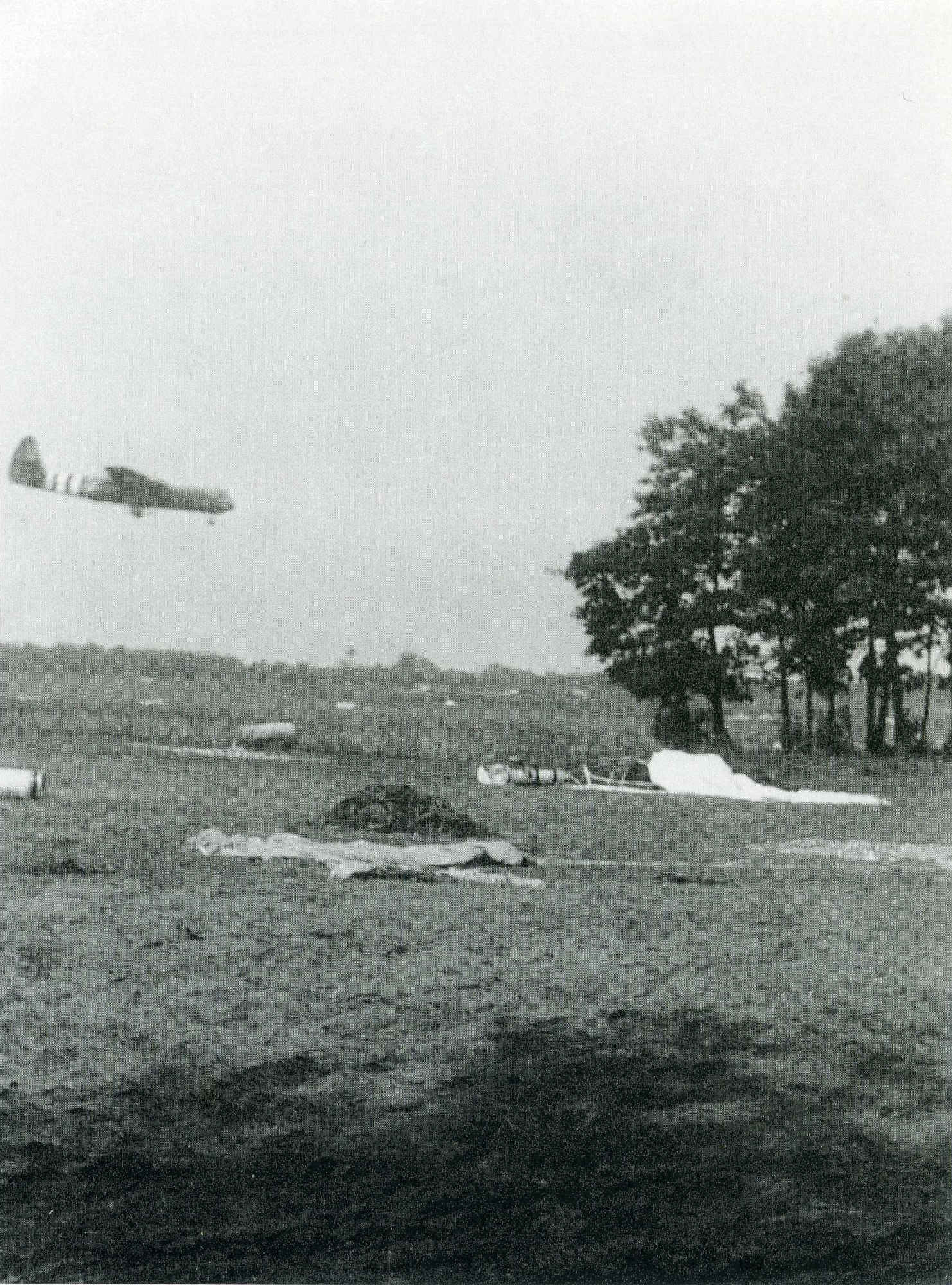
The gliders of the Polish Lift coming into land on L.Z. 'L' on Tuesday, 19th September 1944. 'Gliders & re-supply. Arnhem. Sep 19th. Section 2, No 5'. Another photo taken by Capt. H.B. 'Jasper' Booty, with his notes on the back of it. The previous days supply dropped containers can be clearly seen. Courtesy Airborne Assault Museum Archives.
Cpl. Burnham Blaxley: "Before our proposed dash, we off loaded a selection of ammunition on to the green sward under the trees and covered it over with camouflage nets. Then at first light the whole of No 2 Para Platoon piled on to the transport; magazines primed, and an escape was made as silently and swiftly as possible. It was of course still quite dark, there were no lights, so care had to be taken not to crowd each other, we dare not have any accidents. On our way into Oosterbeek we encountered no opposition and passed through our own reconnaissance patrol with no delay. Soon after this, we passed the vehicle which had carried the German General who had been shot and killed together with his driver by one of our forward patrols. It would appear, his intention had been to establish the strength of the opposition. A mile or two further on we came to the Hartenstein Hotel which our Div. General had made his H.Q. It was on the green opposite the hotel that our Company lines had been established. These we joined, then off loaded the ammunition and supplies we had brought in from Wolfheze, adding them to those already brought in by other sections." [1]
Dvr. John Prime: "We were ordered to enter into Oosterbeek. Our duties from then on were to protect the transport vehicles and crews, and collecting supplies dropped by the supply planes." [2]
Dvr. 'Ken' Clarke: "The Germans were in dug-outs and houses all round this area, so early next morning, we were given the order to make our way via Wolfheze and join Gen Urquhart at H.Q. This we attempted to do. On reaching Wolfheze we took up position in the Post Office where I remember looking through the back upstairs window and clearly seeing a German Focke-Wulf 190 plane fly past and saw the pilot sitting in the cockpit. My request for permission to take a shot was turned down as it would have given our position away and the pilot may have returned to destroy the house. I realise now, after my recent return and taking a longer look, the reason I saw the pilot so clearly was that he was flying along the railway cutting which brought him level with the house windows. By now we were under considerable attack and again we were ordered to make our way to Oosterbeek along the main road and re-group opposite the Hartenstein Hotel on the Arnhem Road. This we eventually managed to do." [3a]
So, 'Ken' Clarke was definitely still in Wolfheze at 10.30 hrs, whilst the main part of the Platoon had made their 'dash' to Oosterbeek from Wolfheze. The Luftwaffe attack and the attempt to recover supplies from L.Z. 'L' was witnessed by L/Cpl. John Hughes, the Clerk to Capt. Harkess, the B.R.A.S.C.O. at 4th Para Brigade H.Q. "A couple of hours later we moved off again, along the road [by the railway line] and set up HQ once again. We hadn't been in the position 10 minutes, before one of the Intelligence Section, looking up at the sky, said - very quietly - "F.W. 190's" - and started walking to a tunnel underneath the railway. True enough, the planes circled round and peeled off to straff us. They hit the house and barn setting them on fire, the cannon shells hitting the ground and trees a few yards in front of where we were hiding. They also started to straff the R.A.S.C. boys, who were trying to collect supplies that had been dropped a short time previously. Naturally the work had to be suspended, there were no casualties." [4]
Somehow or other, Sgt. 'Bill' Chedgey had become separated from the rest of his Platoon: "There was a general drift towards Oosterbeek, Div H.Q. had been established there, and we generally helped out until the remainder of our Platoon was eventually contacted. When we landed, I didn't see Captain Kavanagh. I followed the crowd and we ended up at the Hartenstein. The first person I saw there was Lieutenant Colonel Packe, and near him was Sergeant Watson digging a slit trench and just then, we were mortared and all dived for cover." [4a]
There was another attempt to get supplies to the men fighting in Arnhem and at the Bridge, by Dvr. Ronald Pearce, No 2 Parachute Platoon. This must have been soon after the arrival of the Platoon at the D.M.A. and composed a mixed group of men. The time would have been between 08.00 and 09.00 hrs. He describes how a 'team' with a Jeep and 2 trailers, loaded with ammo, was despatched to Arnhem: "Team for Bridge got to St Elizabeth's, stopped by an officer, asked what they were doing. Told him our orders. He responded - they should go back, wouldn't get 300 yards. Back to Hartenstein." 'Ron' Pearce was one of the younger men in the Company, being born on the 13th April 1925, and having only complete his parachute course on the 21st August 1944.
Amongst the others was a Dutch civilian, but a member of the Resistance, Mr. H. Beekhuizen: "In the beginning of 1944 I was working for the A.K.U. in Arnhem and was part of the Horstman group. During the air drop in September 1944, I was unable to contact my commander. I reported as a volunteer at the Headquarters of the military forces in the Hotel Hartestein. I carried out all kinds of work there such as digging graves and transporting ammunition and other supplies. I tried in vain again and again to get into telephone contact with Arnhem. After this, I was taken on as a guide to collect ammunition which had been dropped all over Oosterbeek. This was successful, although during the attempt under constant sniper fire, five British military were killed. Amongst these was a Dutch Commando, August Bakhuis Roozeboom, who came from Canada." [4b]
The account by Mr. Beekhuizen contains a typical civilian exaggeration of casualties, as no others are known to have died in this incident, in this area. Pte. August M. Backhuis Roozeboom was a Dutch Commando from No 2 (Dutch) Troop, No 10 Inter Allied Commando, and had landed with Divisional H.Q. on the 1st Lift. It was on the return from the attempt to get into Arnhem proper, that they were fired upon at the underpass near the Lower Oosterbeek Station, and in the ensuing battle, he was mortally wounded. He was taken back to the Hartenstein, but died of his wounds and was buried nearby.
No 2 Para Platoon had not long unloaded their supplies, when they were ordered back to Wolfheze to pick up the rest of the supplies, Cpl. Burnham Blaxley: "We had barely got our breath and had a quick brew up before I was ordered to return to Wolfheze and pick up the supplies and ammunition we had left behind, and so carefully camouflaged. We had left them in the hope that the 156 Battalion could be directed to them and have earlier access. I took my complete section of 5 jeeps and 10 trailers, together with a Bren gun for defence, and made the return journey as quickly as possible. On our return to Wolfheze, I established defensive positions and the remainder of us reloaded the supplies. We quickly climbed back on to the transport and hurriedly made our exit. The noise of heavy fighting to the left of us was getting even heavier and increasingly near, it spurred us on back to Div. H.Q. and Company lines." [5]
Cpl. Blaxley must have had his Section re-enforced with other Jeeps and crews, as one was 'missing', and another had been sent into town.
Meanwhile, at 10.30 hrs, Lt-Col. Packe attempted to pass a signal back to the Base in England altering the pre-arranged S.D.P., which was now found to be in enemy hands. In a Review for the R.A.S.C. Journal in 1952, he wrote the following: "The prearranged S.D.P., so far from being consolidated on the first day, was never captured at all; signals sent to divert the supply drop due on D+2 failed to get through, and in consequence, the armada of Stirlings and Dakotas sailed through murderous fire right over the Divisional perimeter and dropped their cargoes well away in enemy hands." [6]
Even so, efforts were still being made to alter the S.D.P. and a further signal was sent back to England altering the S.D.P. to map ref 685783 - this is right on the point of the road junction Utrechtseweg and the Valkenberglaan, and almost on top of the Koude Herberg! Units were alerted to the drop taking place at 10.30 hrs the next day. 1st Airborne Divisional Signals received a message from Rear H.Q. Airborne Troops (Base) showing that base wave day crystals were being despatched to them by re-supply today - containers carrying 76 sets with crystals to be distinguished by black parachutes. They also reported, that from 10.00 hrs onwards, there was light mortaring and shelling of Divisional H.Q, with some casualties. It was further reported that they were being continually sniped at.
It was probably as a result of this intermittent enemy fire that Dvr. John Walford, of 'D' Transport Platoon, attached to No 1 Parachute Platoon, was killed. Those troops not involved in the fetching of supplies, or taking them to the forward units, were dug-in along the Hartensteinlaan, and on the 'green' in between there and the Hartenstein Hotel. Cpl. Samuel Staple: "We dug trenches in the piece of land in front of the Hartenstein, where the memorial now stands. Here, we parked our jeeps and trailers. From this point, we went out on patrols to drive the Germans out of the houses. My mate, 'Johnny' Walford, unfortunately, was killed on the piece of land in front of the Hartenstein and he was never found again." [7]
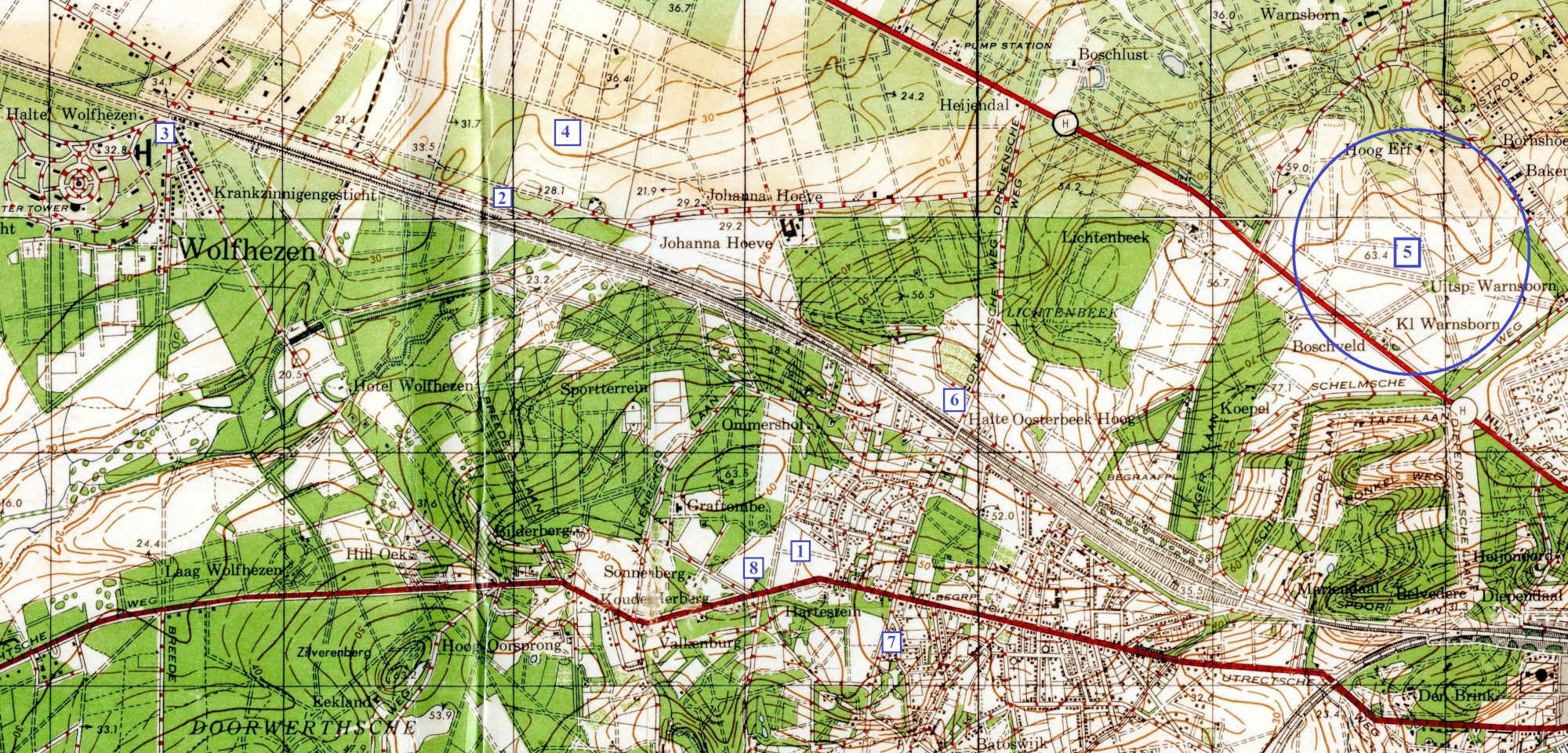
RASC positions and movement. 19 September 1944.
KEY.
[1] D.M.A.
[2] 4 Parachute Brigade H.Q. 10.30 hrs.
[3] No 2 Parachute Platoon. 06.00 - 10.00 hrs.
[4] L.Z. 'L'.
[5] S.D.P. 'V'.
[6] Oosterbeek Railway Station and Crossing.
[7] Petrol pumps at M.R: 696782.
[8] Re-arranged S.D.P. at M.R: 691785.
As the day wore on, the noise of battle from north of the railway line grew in intensity and volume. From the diary of Brig. Hackett: 'About 14.20 hrs the G.O.C. (Maj-Gen. Urquhart) arrived at my H.Q. and gave me account of his adventures in Arnhem. Little, or no news of my 11th Bn. We discussed possible retrenchment and I advised cutting losses north of railway in case we were caught by counter attack troops (which were undoubtedly now gathering) too spread out. Difficulty for my Bde area was railway. No longer commanding Wolfhezen crossing which might any moment by occupied by enemy unless we controlled Halte Oosterbeek Hoog crossing (699792).'
Later on, but time not noted: 'Brig. Hicks arrived at my H.Q. and confirmed his arrangements for attack on railway crossing at 699792 and asked for support from 156 Bn, which I confirmed had been laid on. He then left.'
The above needs some analysis. Firstly, this is the only mention of Brig. Hicks visiting Brig. Hackett at his H.Q. Secondly, there is no other mention anywhere of an attack by the 1st Airlanding Brigade on a railway crossing. Thirdly, the railway crossing referred to at Grid 699792, is the Oosterbeek Railway Station.
There has been considerable debate about the actions of Capt. Kavanagh, some of which has mentioned the fact that the Germans were in far to strong a position on the north side of the railway, and especially along the Dreijenscheweg, for his 'dash' to have had any hope of success. However, this is in hindsight. What was known at the time, was that the 1st Parachute Brigade were fighting in western Arnhem, with the 11th Parachute Battalion launching an assault across the railway line from south to north in the area of the Oranjestraat Bridge at Lombok - as ordered by Maj-Gen. Urquhart. This was meant to link up with the assault by the rest of the 4th Parachute Brigade on the German blocking line at the Dreijenscheweg, and through to the high ground at Lichtenbeek and Koepel. This would then bring them within reach of the S.D.P. 'V' at Warnsborn. So, with all of the above taken into consideration, is it possible that Capt. Kavanagh was aware of this, when he set off?
All of those in the R.A.S.C. contingents were awaiting the first mass re-supply drop. From the H.Q., R.A.S.C. War Diary: '15.00 hrs. Resupply a/c dropped on pre-arranged S.D.P. in spite of all signals - a/c suffered heavy casualties from flak. Collection of panniers and containers dropped in Divisional area organised - only very small proportion of stores dropped were recovered.'
Sometime soon after the supply drop had taken place, Lt-Col. Packe ordered Capt. Kavanagh to take his Transport Section and see what he could recover. In a letter to Capt. Kavanagh's father, written on the 3rd October 1944, he said: "He dropped by parachute on 18th Sept with his platoon, and soon linked up with the main body. He was with me for the remainder of that day and until the afternoon of 19th. A supply drop was then made, and for various reasons, a lot of it fell wide in one of the Brigade areas. I detailed Paddy and his platoon to go over and see how much of it they could recover. He set out at the head of his platoon, but instead of going by the recognised route, he decided to take a short cut to save time. He led his platoon over a hump-backed railway bridge, and on the other side found that he was in a German ambush."
Lt - Col. Packe has his dates slightly wrong, as Capt. Kavanagh was in the area of the Wolfheze railway crossings and Station until early on the morning of the 19th September. He must also mean that the recognised route was via the Wolfheze Crossing, which is where the previous attempts to retrieve supplies had been made from. Ref the 'ambush', he got his information from the survivors, as he did not see the area of the action for himself, so he couldn't know that the description of "a hump-backed railway bridge" was not accurate.
There is another 'clue' to Capt. Kavanagh's actions on this day, and it comes from one of his drivers, Dennis Cutting: "All of us who were available were summoned to an 'O' Group where we were told by Captain Kavanagh that the Dutch Resistance had informed our Commanding Officer, Lt-Col. Packe, that a quantity of supplies had landed just beyond our perimeter, which was in enemy hands. Captain Kavanagh told us we would have to dash in, grab all we could and get out fast. We were to leave all heavy equipment behind, taking personal weapons only, going as light as possible, so as to move quickly. We took three jeeps and trailers, Captain Kavanagh in the first jeep with his driver, Thomas, I was in the first trailer." [8a]
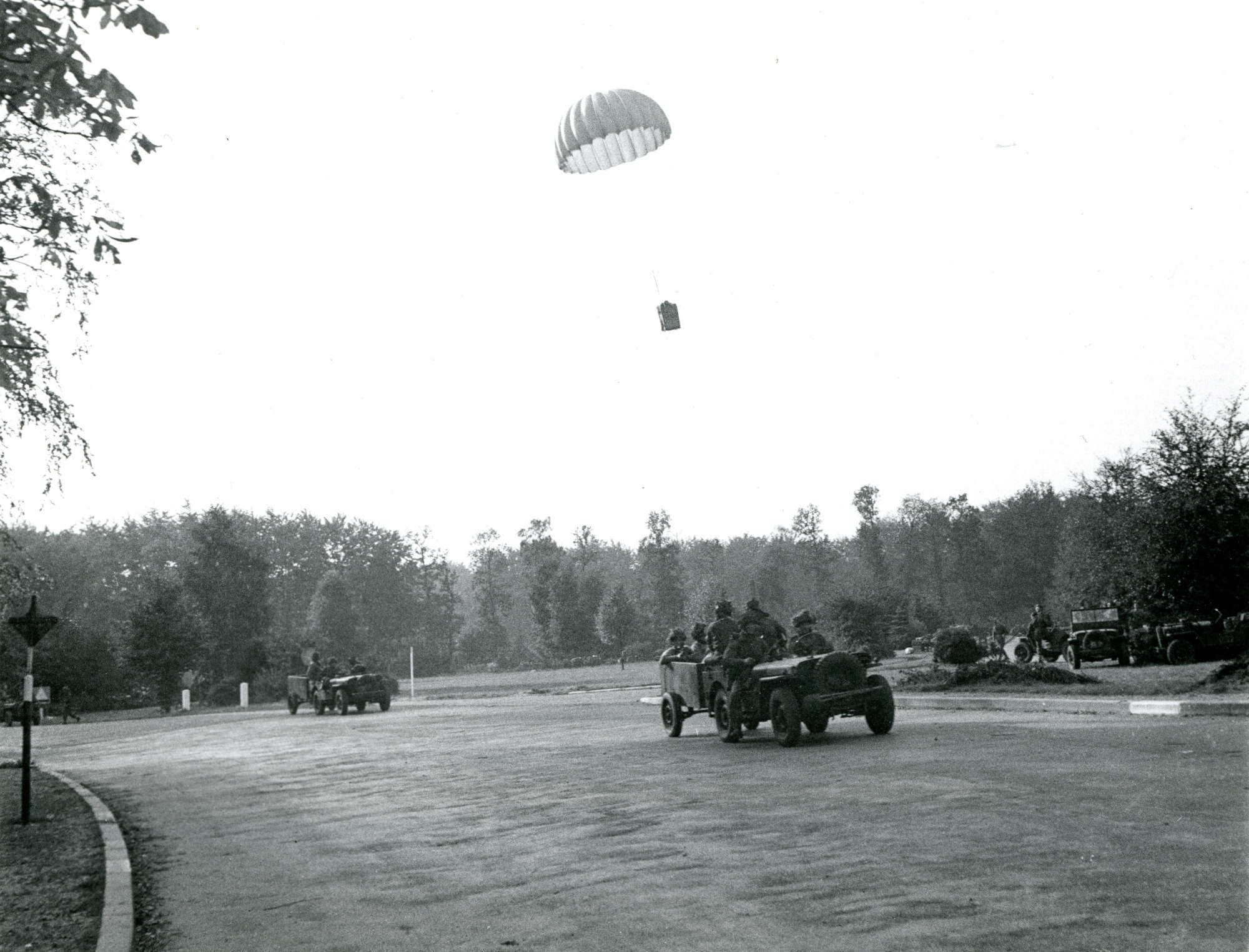
A supply pannier dropping on the green opposite the Hartenstein, whilst Jeeps of the 250th Light Composite Company, R.A.S.C., under the command of Captain 'Paddy' Kavanagh, drive past on their way to the S.D.P. In the back-ground on the right is the D.M.A, set up by the R.A.S.C. and the 1st Airborne Ordnance Field Park, R.A.O.C. Photo by Sgt. D.M. Smith. A.F.P.U. BU1093. Courtesy of the I.W.M.
Cpl. Burnham Blaxley continues his account, after his return from Wolfheze: "On our return I vaguely remember delving in to our haversack rations for a quick snack and brew up, fortunate for me because it was shortly after this Captain Kavanagh was summoned to a conference with Colonel St. John Packe. He returned from this and instructed me to have my section ready immediately for retrieval of supplies dropped by the RAF well behind enemy lines. On this occasion, I decided to take only one trailer per jeep; this would provide extra mobility. I left one man, Driver Stevens [a man of this name cannot be found], to guard the remaining trailers. Captain Kavanagh occupied Jeep Number One, driven by Driver Thomas. I followed in Jeep Number Two, driven, I believe, by Driver Docherty. The remaining jeeps took up position behind me, supervised by Lance Corporal J. Syme. Sergeant McDowell was with the Platoon Scout Section who spread themselves out among the convoy.
There was now far greater activity in the air on this latest trip, as the Polish Brigade were now landing, and even more supplies were being dropped owing to the very heavy anti-aircraft fire and the low altitude of the supply aircraft, many of which were on fire, the supplies were well scattered. This particular operation was most hazardous and I marvelled at the dedication of these aircraft crews in the face of so much opposition.
We left Div. H.Q. and turned left off the main road into a much narrower road lined with hedges on both sides. Suddenly, there was an open space with a road bridge over a railway cutting. Immediately to the front was a reconnaissance jeep with its crew lying in the road still bleeding I turned round and instructed the Bren gunner with his No 2 to dismount and give us cover over the bridge. With no further thought, Captain Kavanagh accelerated over the bridge with the remainder of us following him. We had barely left the bridge when we encountered heavy machine gun fire and small arms fire from both sides of the road. This is where Captain Kavanagh lost his life together with his driver, my driver, and several others. It was at this point that he called out "Every man for himself" and I rolled out of my seat into the base of a hedge. A voice shouted "In here Blax, in here", I snaked backwards through a gate into a garden where I discovered Batsford and Bennet had taken cover and were badly wounded. My small pack had taken the small arms fire and was like a pepper pot. This all happened simultaneously and barely a minute later, the enemy scout section located us and made their way through the bushes into the garden. I dealt with them single handed to the best of my ability firing magazine after magazine and of course it was when I was changing magazines, that I was taken prisoner. I was caught off balance. My gun spluttered to a stop. "Damn", I muttered and I reached behind me for a fresh magazine. My left hand was behind me, and I was precariously balanced on one knee, when I heard the command in faultless English, "Stand up, and drop your equipment or I will shoot you". With much trepidation I complied, offering up a silent prayer I turned to face my captor and saw a young German officer with the barrel of a Luger resting on his forearm, pointing directly at me. I asked if I could attend my wounded. Looking around, he agreed, saying "and my wounded too". Between us we tended two of my section I had been safeguarding, and one of his own men. He told during this short spell, that he had been educated at Bristol University in South West England. I owe my life to this officer, and have often wished that I could thank him."
The exact number of Jeeps is not known, but if five were taken, then at least one or two were 'borrowed' from another Section to make up the numbers. Cpl Blaxley is mistaken about a recce vehicle, as there were none near this spot at this time.
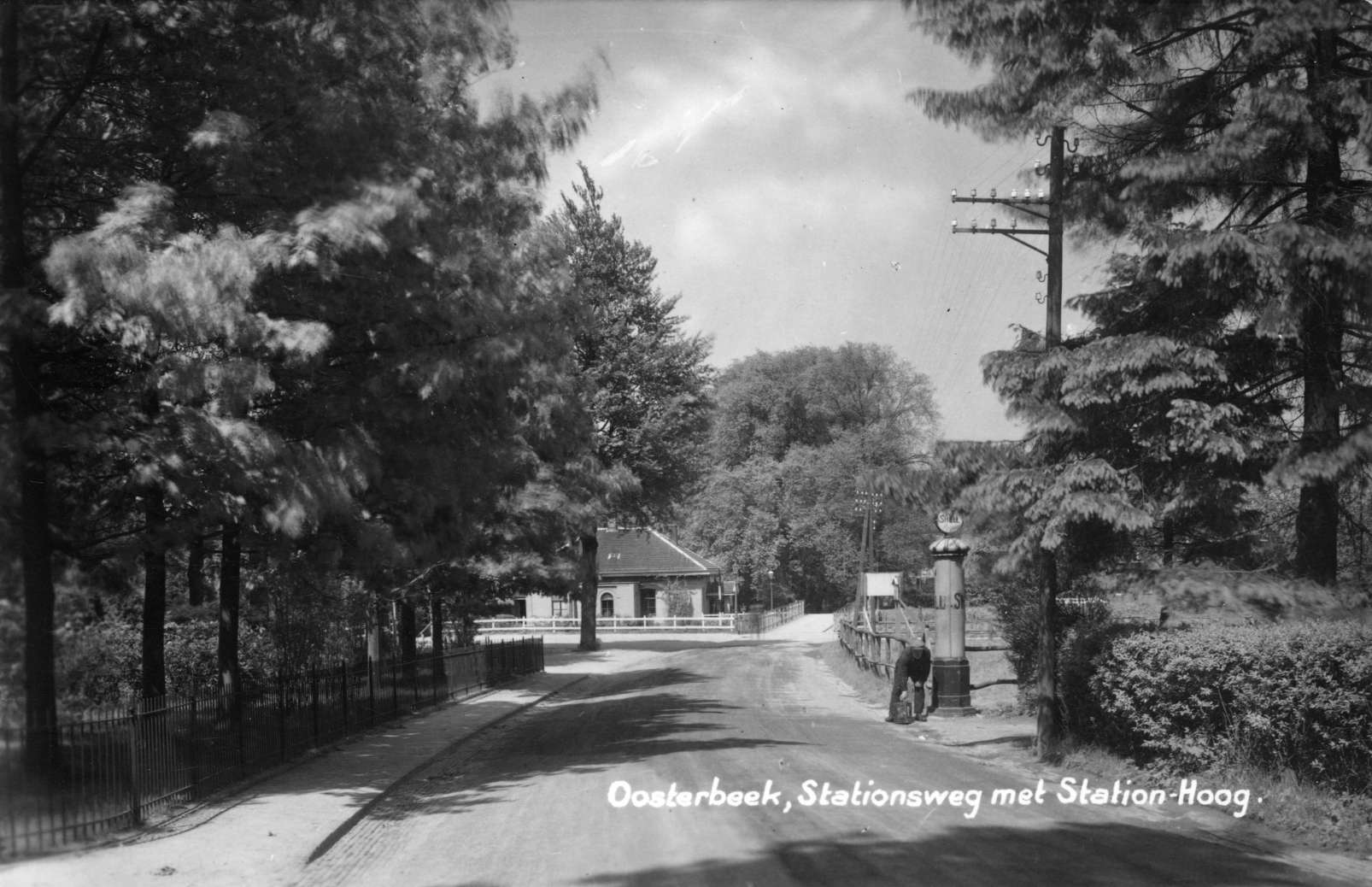
The approach to Oosterbeek Railway Station along Stationsweg, looking to the North. 1929. Courtesy of Gelders Archief. 1513-2814.
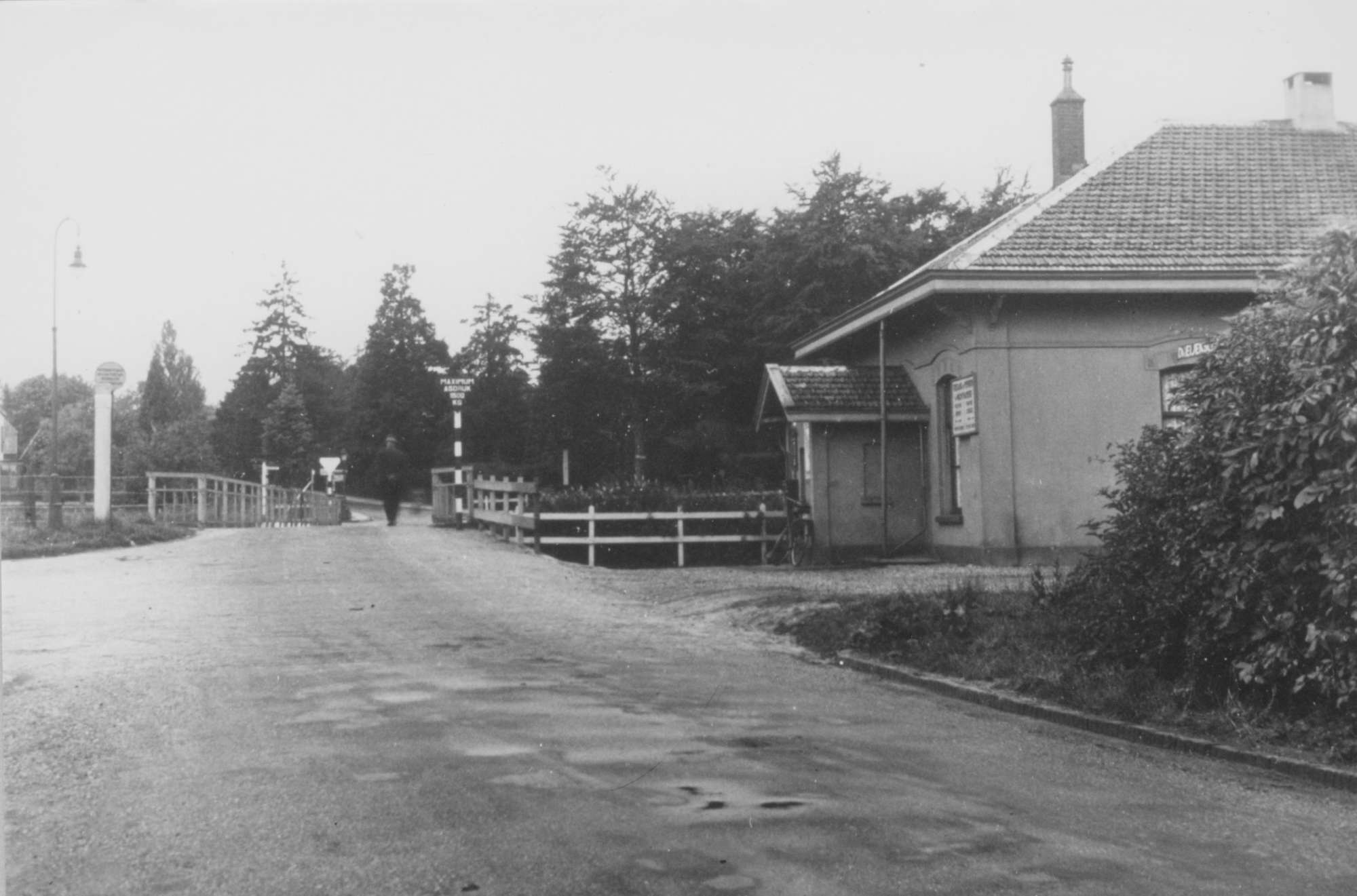
Oosterbeek Station and Bridge from the Dreyenseweg, looking South. 1920-1930. Courtesy of Gelders Archief. 1541-38.
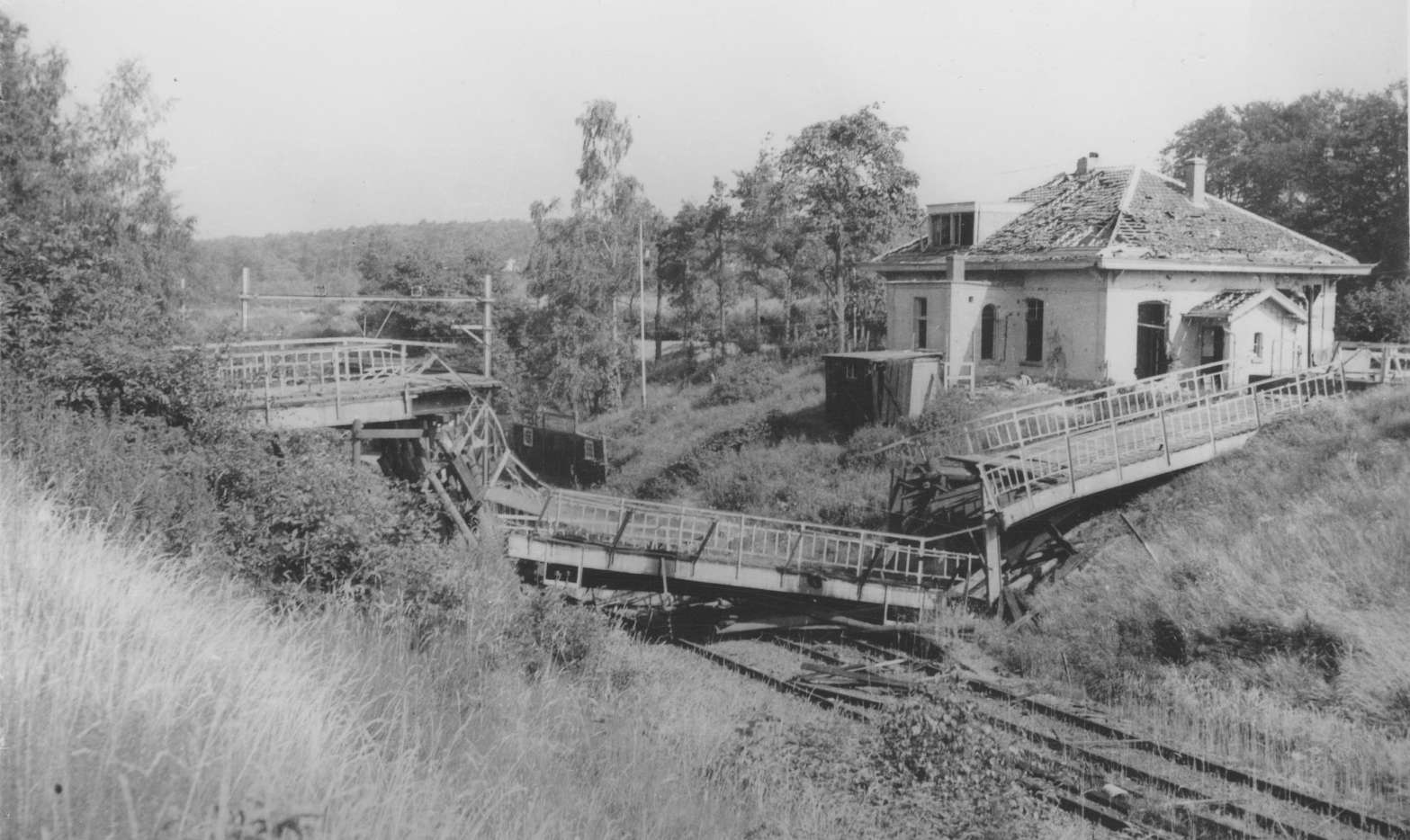
Oosterbeek Station and its temporary bridge (built during the war by the Germans), now blown up. Photo taken in May 1945 by Mr. H.J. Willink. Courtesy of Gelders Archief. 1579-16.
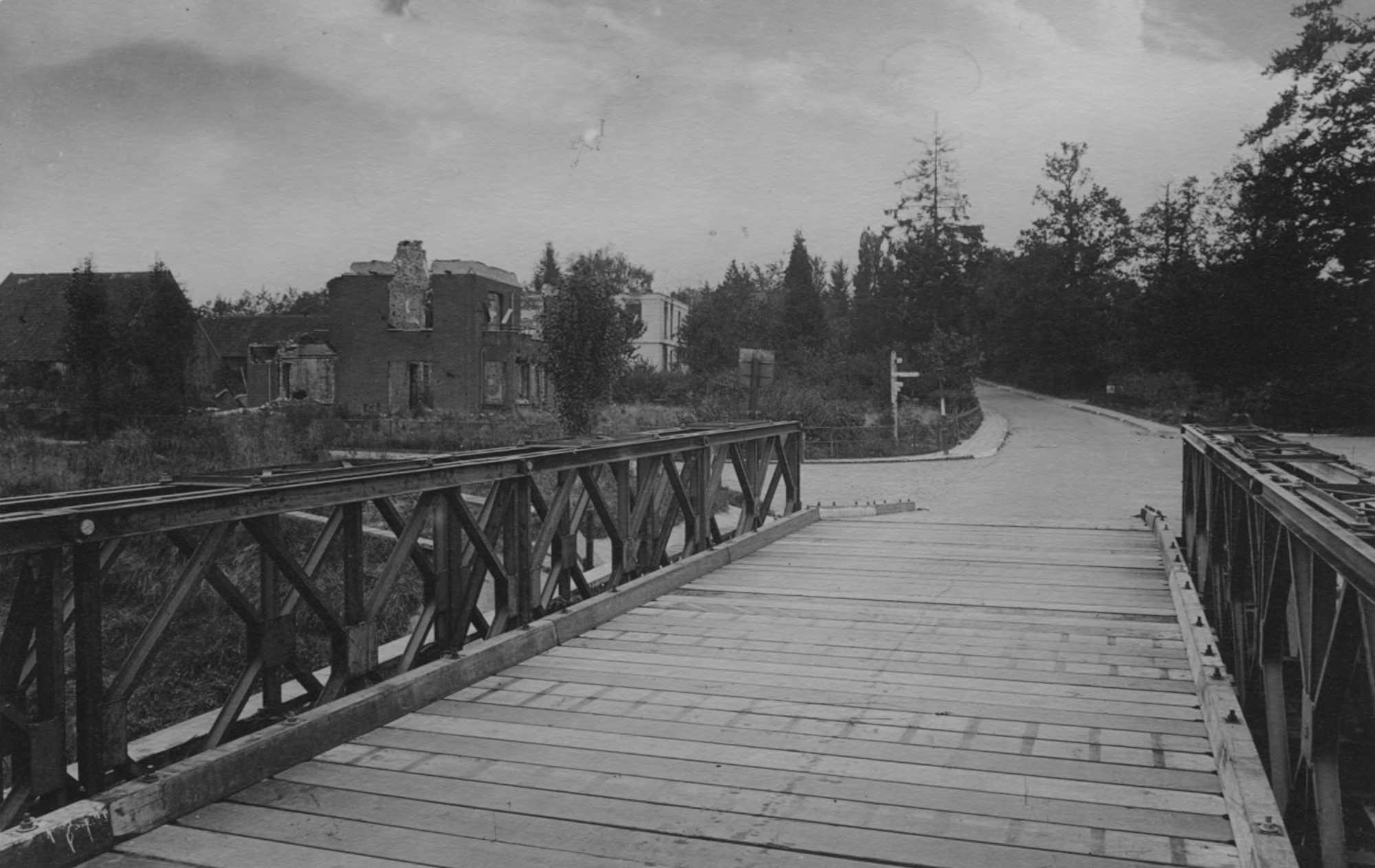
The Bailey bridge built by British and Canadian Engineers, as a temporary replacement, over the railway at Oosterbeek Station. The view is to the South. Photo taken in September 1945 by Mr. D. Renes. Courtesy of Gelders Archief. 1579-17.
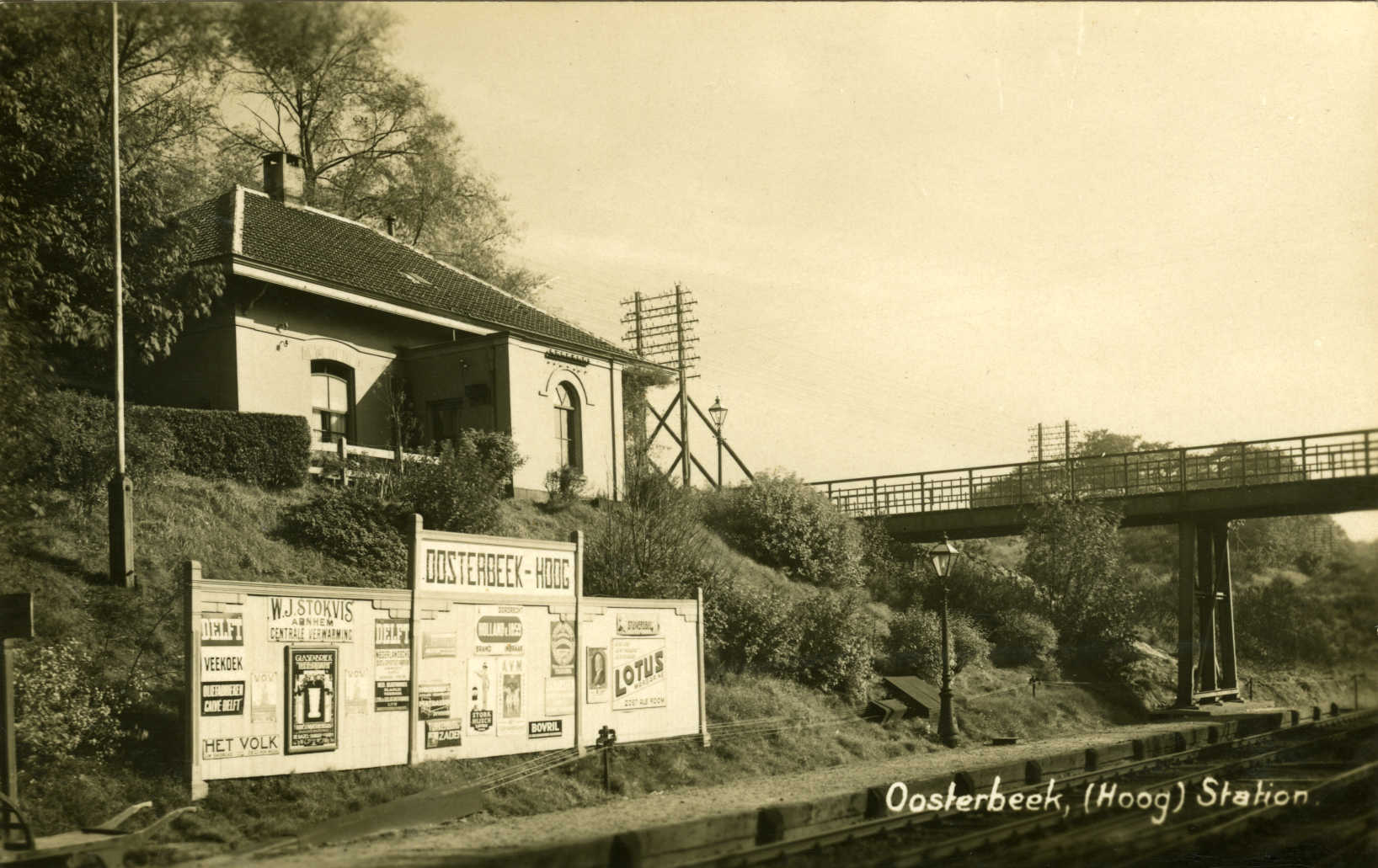
Oosterbeek Station 1930-1940. The view is to the North East. This gives a good impression of the railway cutting, and the steep bank that the survivors of No 2 Parachute Platoon had to run down, and then back up the other side to get away. Courtesy of Gelders Archief. 1513-2806.
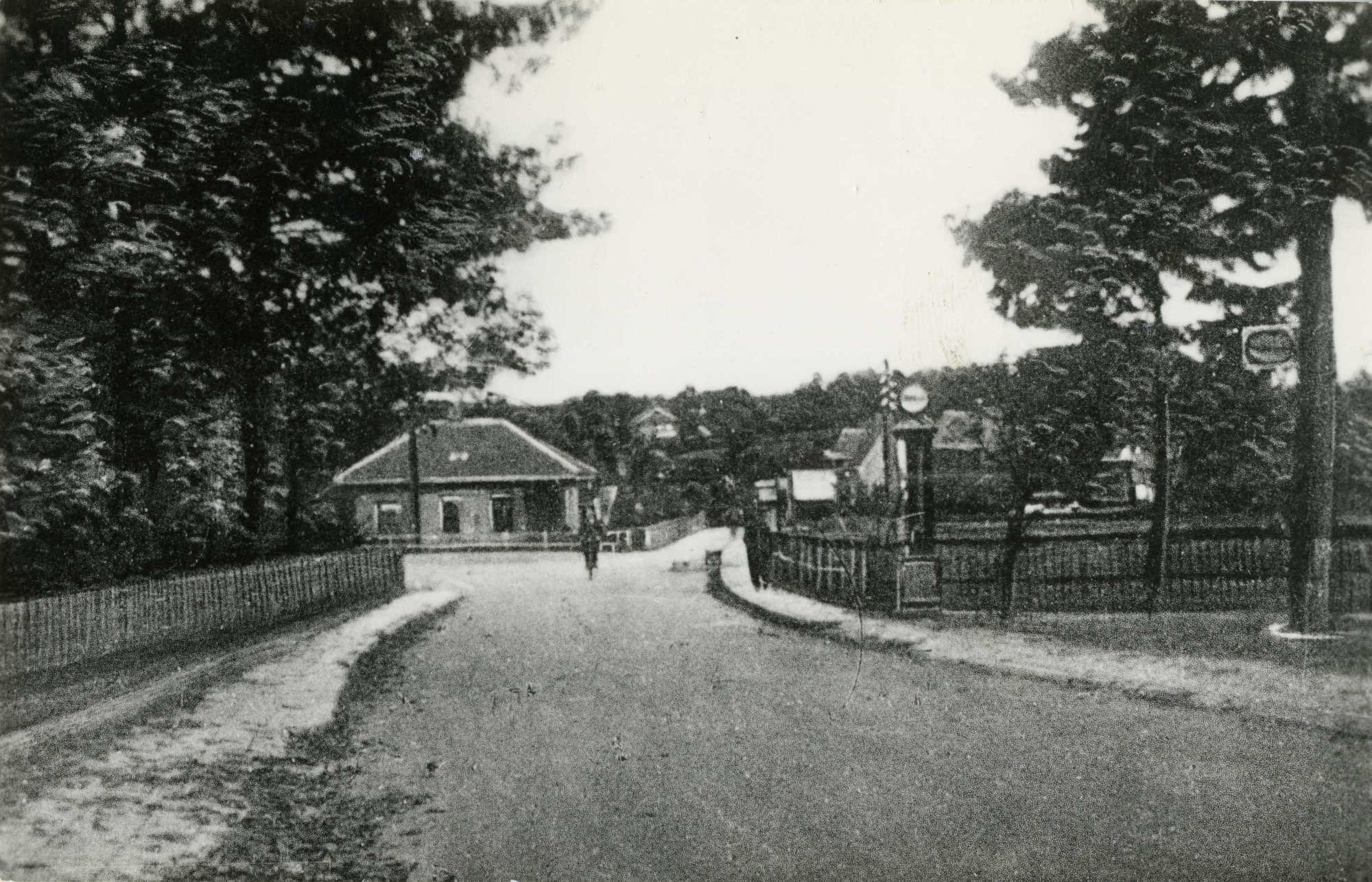
The view from the South of Oosterbeek-Hoog Station on Stationsweg. An early 1900's post card. Courtesy Bob Hilton Collection.
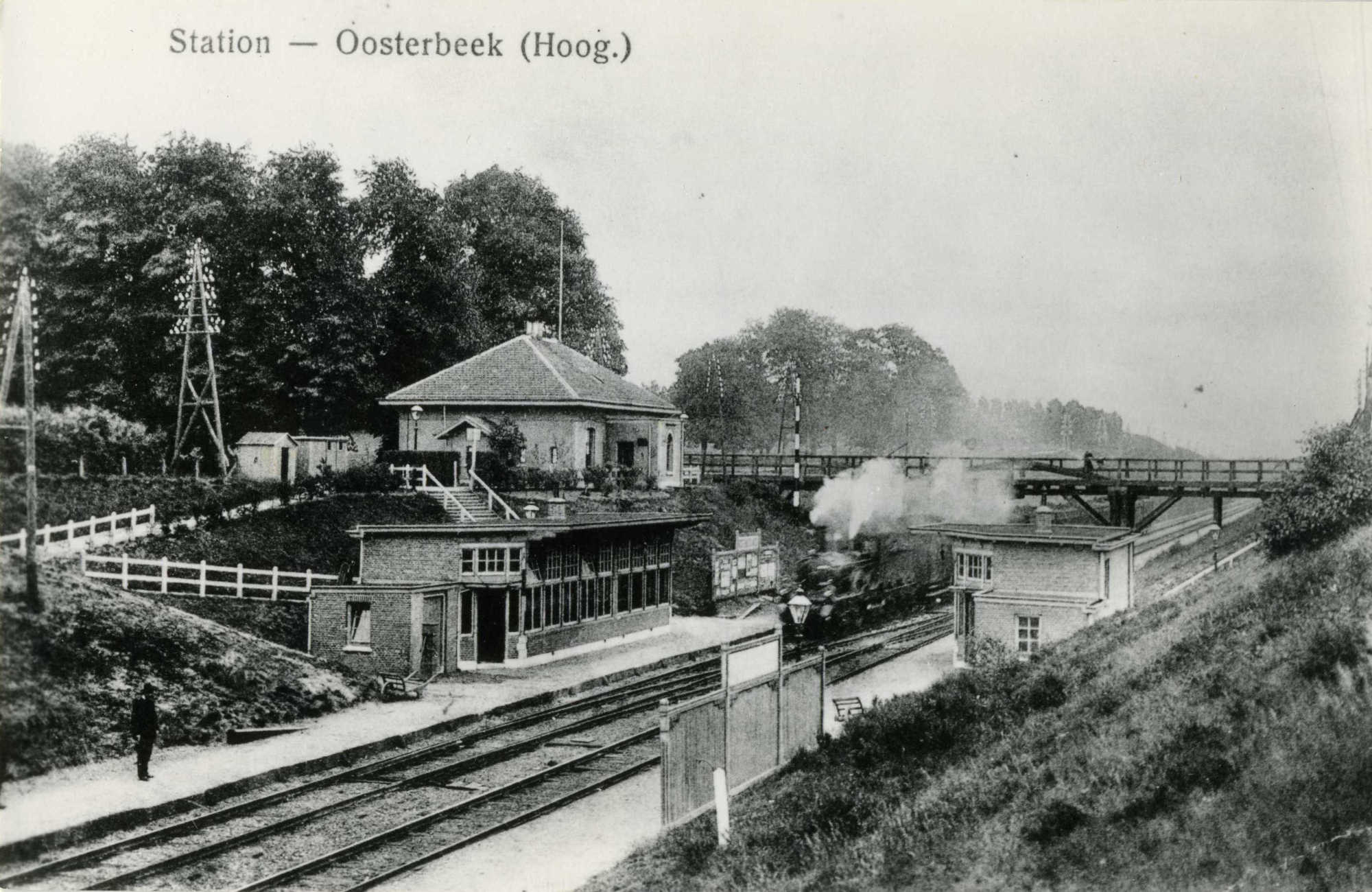
Oosterbeek-Hoog Station looking East, towards Arnhem. Falling back from the scene of the battle with the Germans on the Dreyenseweg, to the left of this photo, the survivors of No 2 Platoon, would have come down into the railway cutting, then back up it on the right, and moved back towards Oosterbeek. A 1930's post card. Courtesy Bob Hilton Collection.
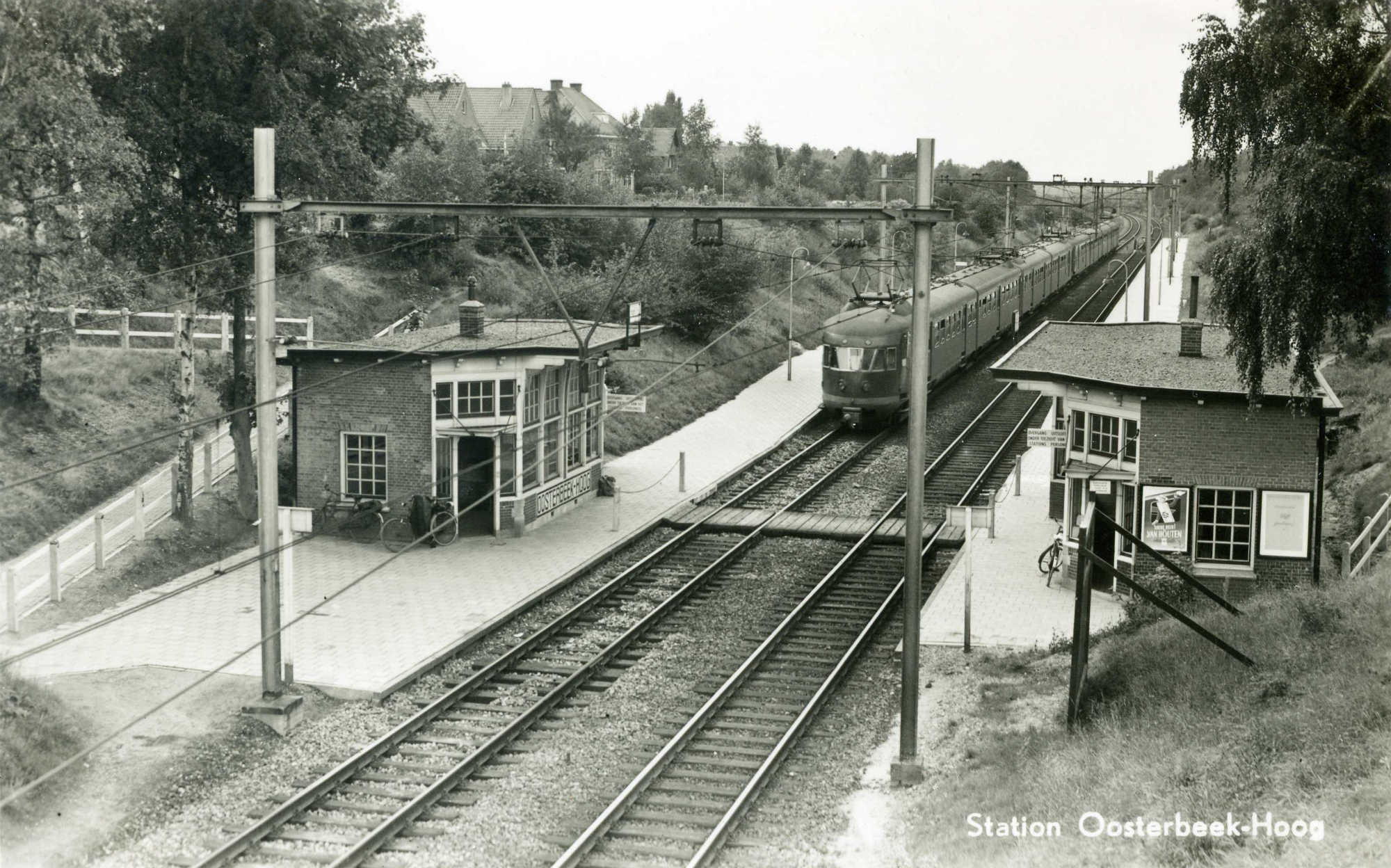
Oosterbeek-Hoog Station looking West, towards Wolfheze. Faling back from the the scene of the battle with the Germans on the Dreyenseweg, to the right of this photo, the survivors of No 2 Platoon, would then have had to move up the bank to the left and back towards Oosterbeek. A 1950's post card. Courtesy Bob Hilton Collection.
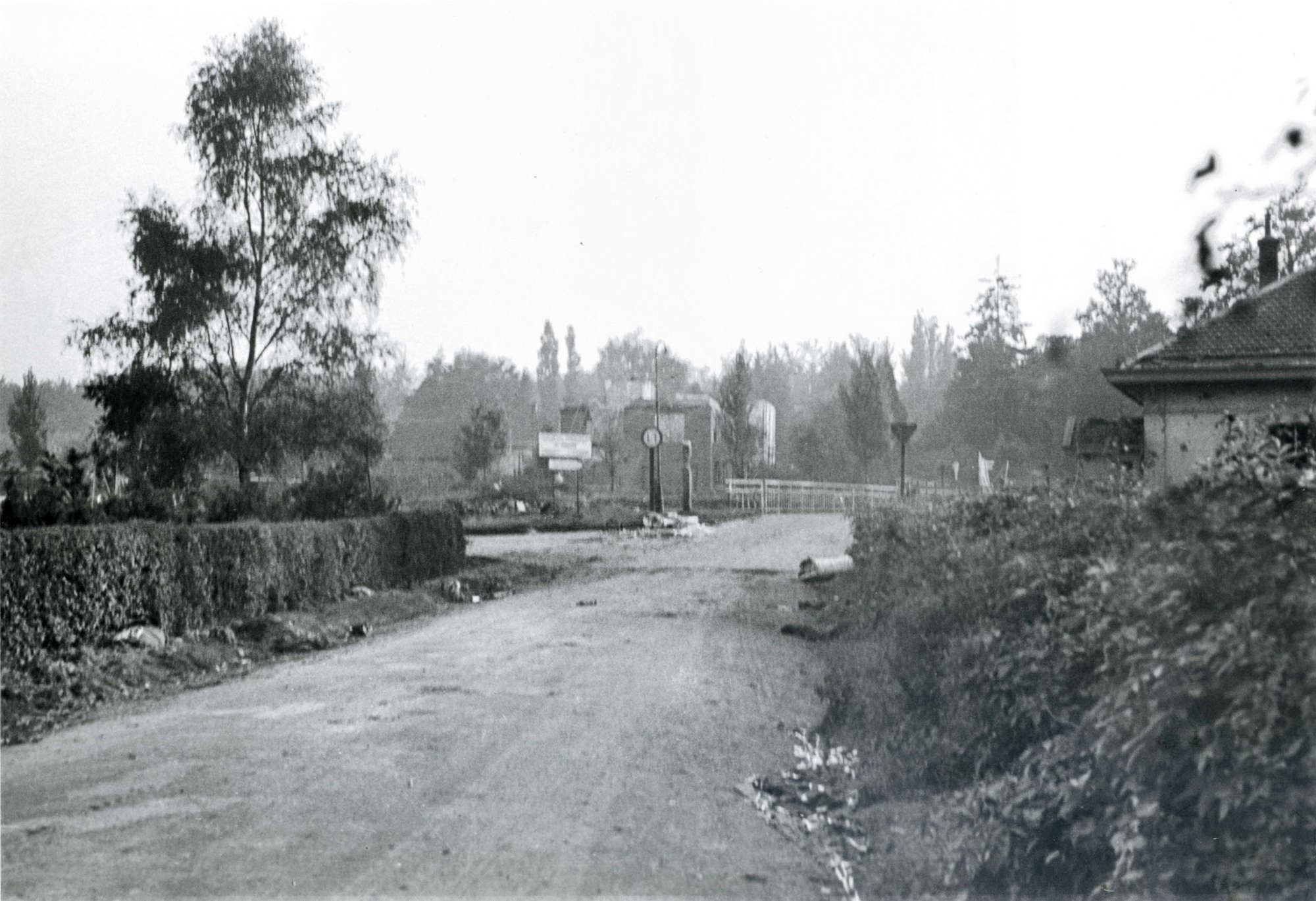
The aftermath of the attempt by Captain Kavanagh and his Platoon to reach the Supply Dropping Point, just North of Oosterbeek-Hoog Station, on the Dreyenseweg, C.L.E. containers can be seen in the middle distance, and there are four dead bodies to each side of the road. A German Kriegsmarine photographer, Hoppner, took this photo the next day, 20th September 1944. Courtesy Bundesarchief, 101l-M2KBK-771-18.
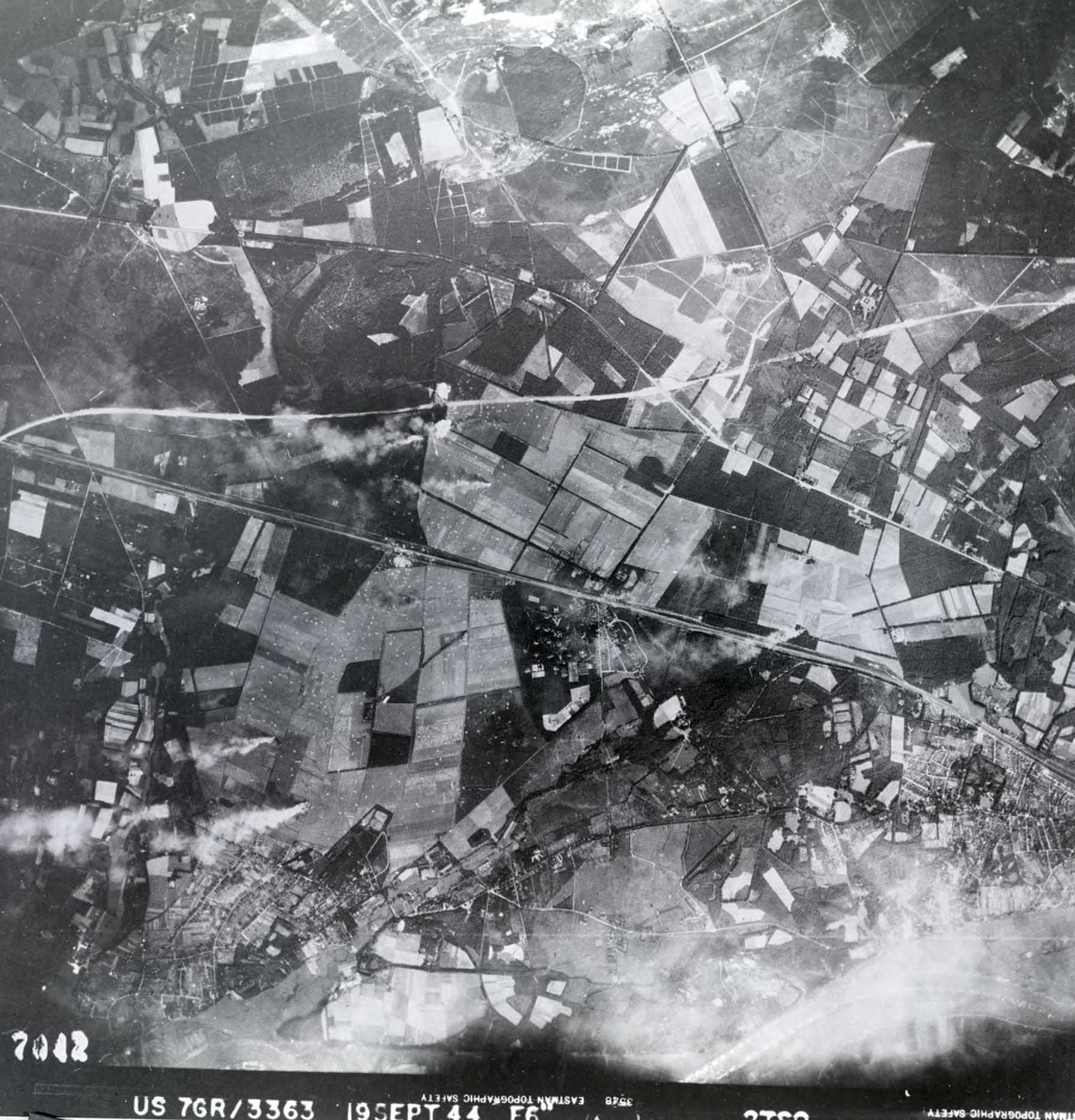
This aerial photo shows the area around D.Z. 'X' and L.Z. 'Z' on the 19/09/44, and Klein Amerika Farm is clearly on fire, with smoke billowing from it. Courtesy of Gelders Archief. 5041.
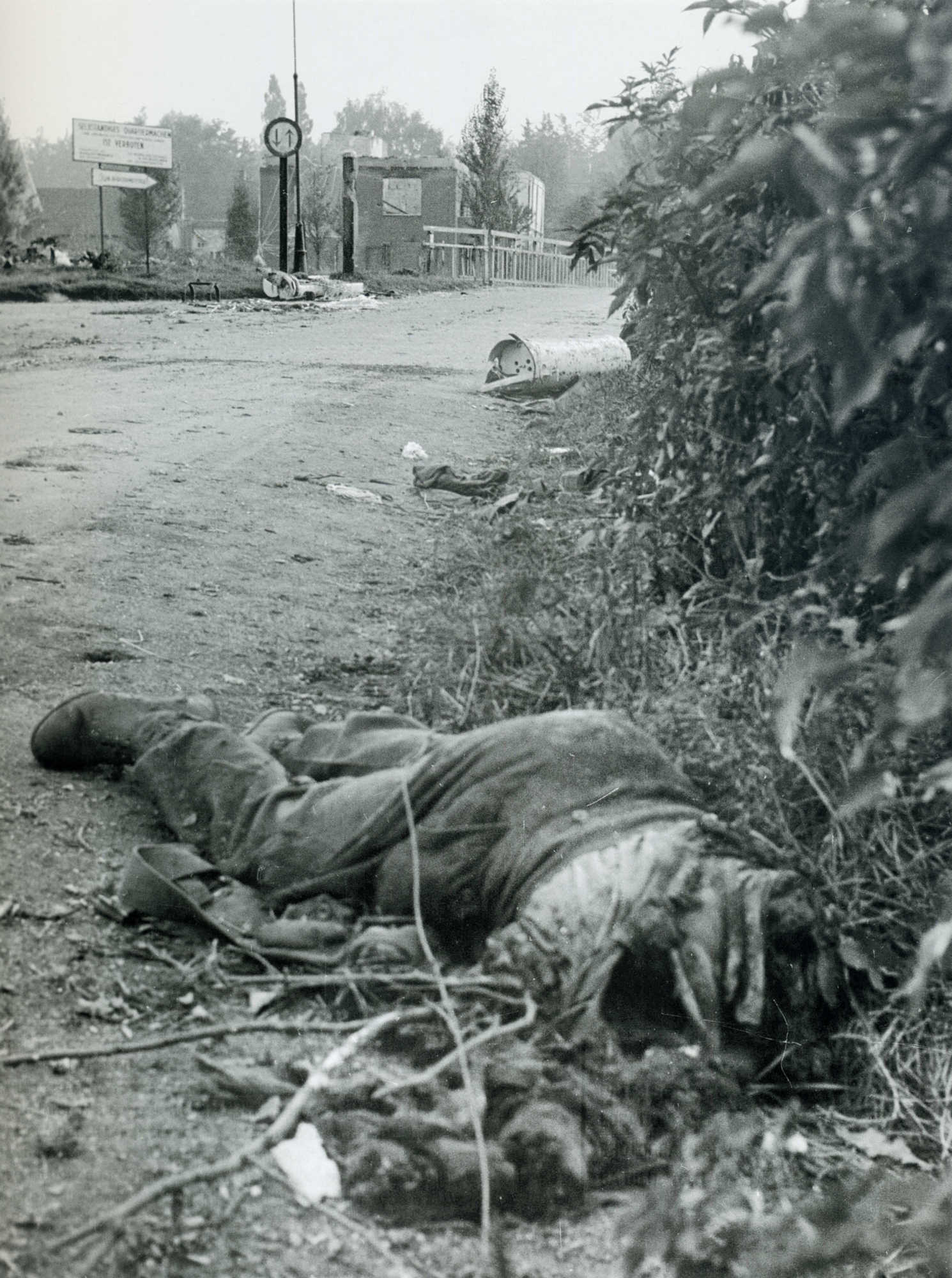
A close up of one of the British dead on the North side of Oosterbeek-Hoog Station, on the Dreyenseweg. A German Kriegsmarine photographer, Hoppner, took this photo the next day, 20th September 1944. Courtesy Bundesarchief, 101l-M2KBK-771-20.
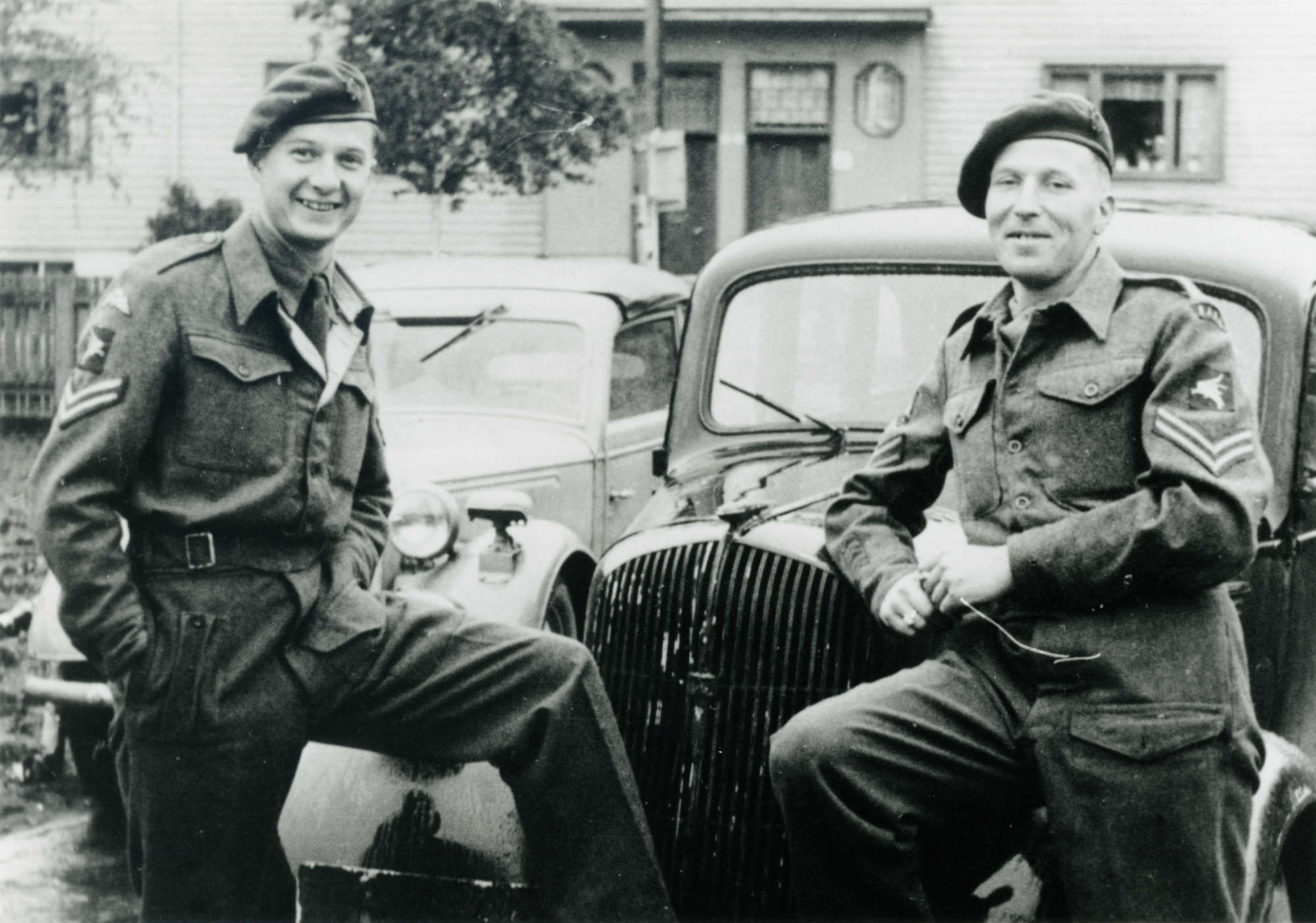
Cpl. Dennis Cutting (on the left), and a fellow Corporal of 250 Light Company. The photo was taken in Norway in 1945. Courtesy of Dennis Cutting.
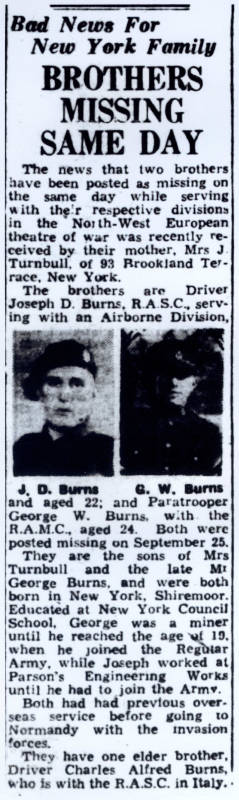
THE EVENING NEWS, TUESDAY, OCTOBER 24. 1944. Bad News For New York Family. BROTHERS MISSING SAME DAY. The news that two brothers have been posted as missing on the same day while serving with their respective Divisions in the North-West European theatre of war was recently received by their mother, Mrs. J. Turnbull, of 93 Brookland Terrace, New York. The brothers are Driver Joseph D. Burns, R.A.S.C. serving with an Airborne Division, and aged 22; and Paratrooper George W. Burns with the R.A.M.C., aged 24. [1] Both were posted missing on September 25. They are the sons of Mrs. Turnbull and the late Mr. George Burns, and were both born in New York, Shiremoor. Educated at New York Council School, George was a miner until he reached the age of 19, when he joined the Regular Army, while Joseph worked at Parson's Engineering Works until he had to join the Army. Both had had previous over-seas service before going to Normandy with the invasion forces. They have one elder brother, Driver Charles Alfred Burns, who is with the R.A.S.C. in Italy. NOTE: [1] This was 2061133. Pte. G.W. Burns. 133 PFA, R.A.M.C. Evader/Pegasus I. Courtesy of Major James Brudenell.
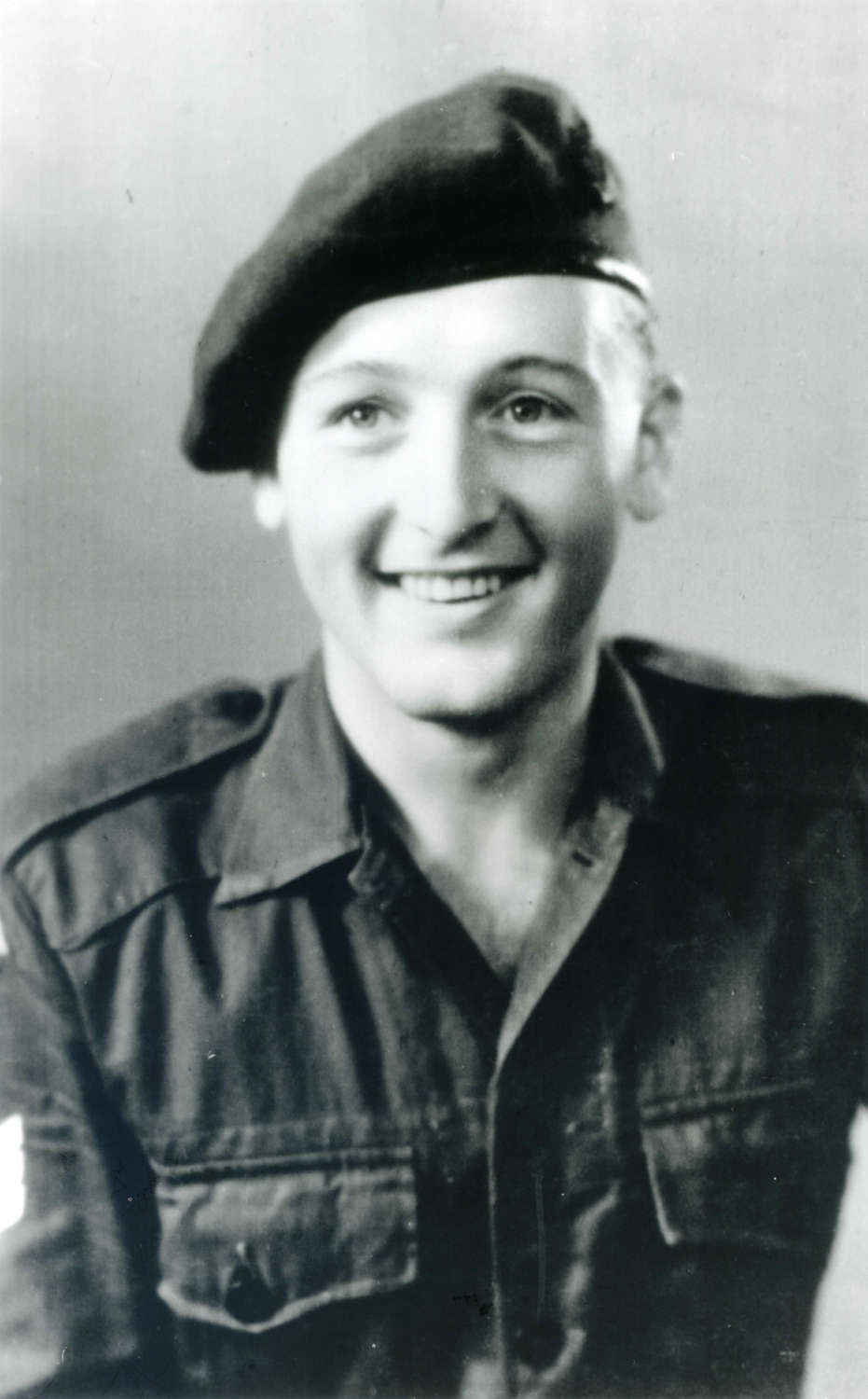
Dvr. 'Ken' Clarke. No 2 Parachute Platoon. Photo taken in 1945, after he had been promoted to Sgt. Courtesy of Ken Clarke.
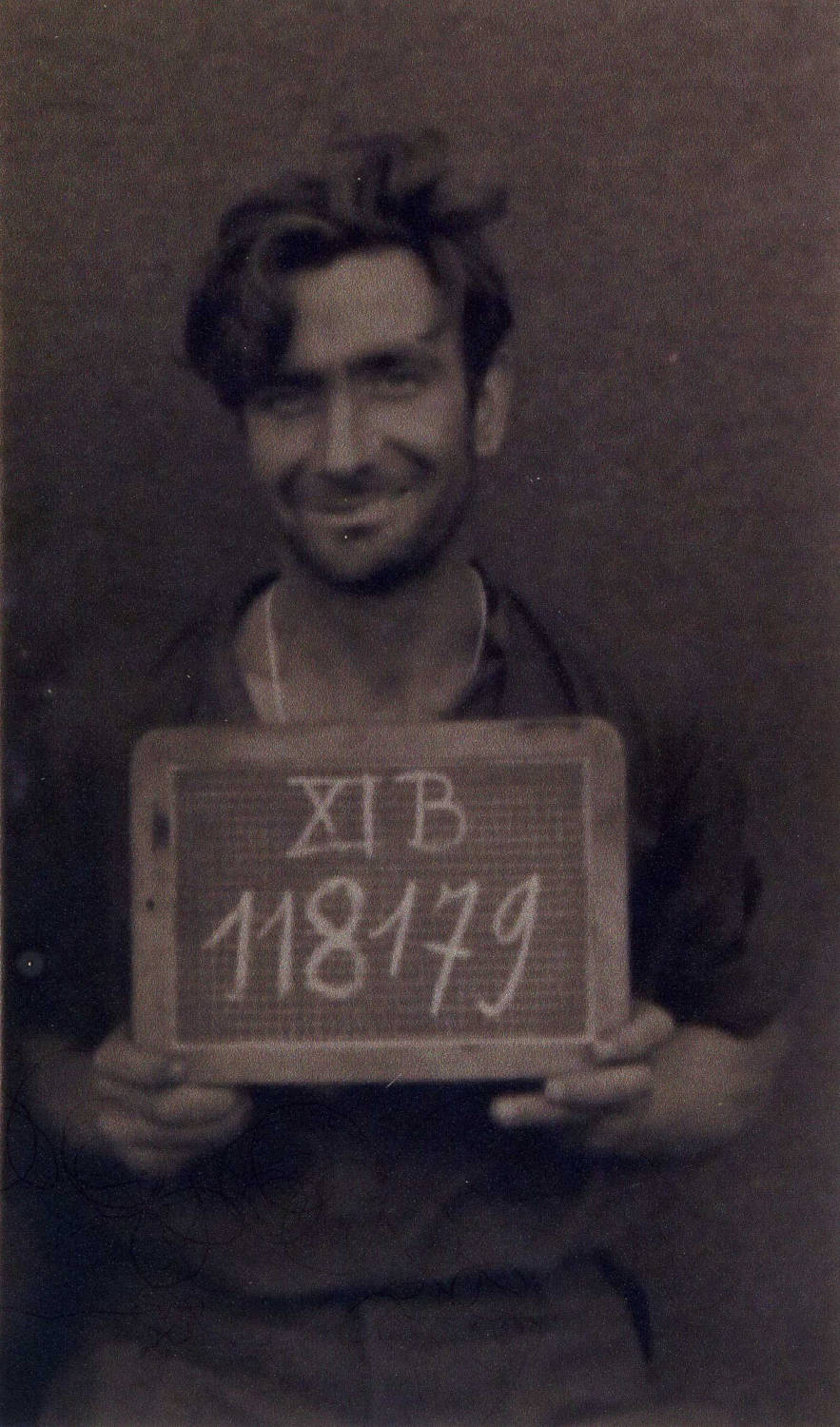
Dvr. Percival Batsford. 'D' Transport Platoon, attached to No 2 Parachute Platoon. Born on the 4th October 1914, from Southgate London, he had been a builders labourer before the war. He enlisted on the 18th July 1940 and joined 250 Company on the 19th February 1944. He was wounded with shrapnel to the left foot and right leg. Photo taken on 06/10/44 whilst a POW. Courtesy of John Howes.
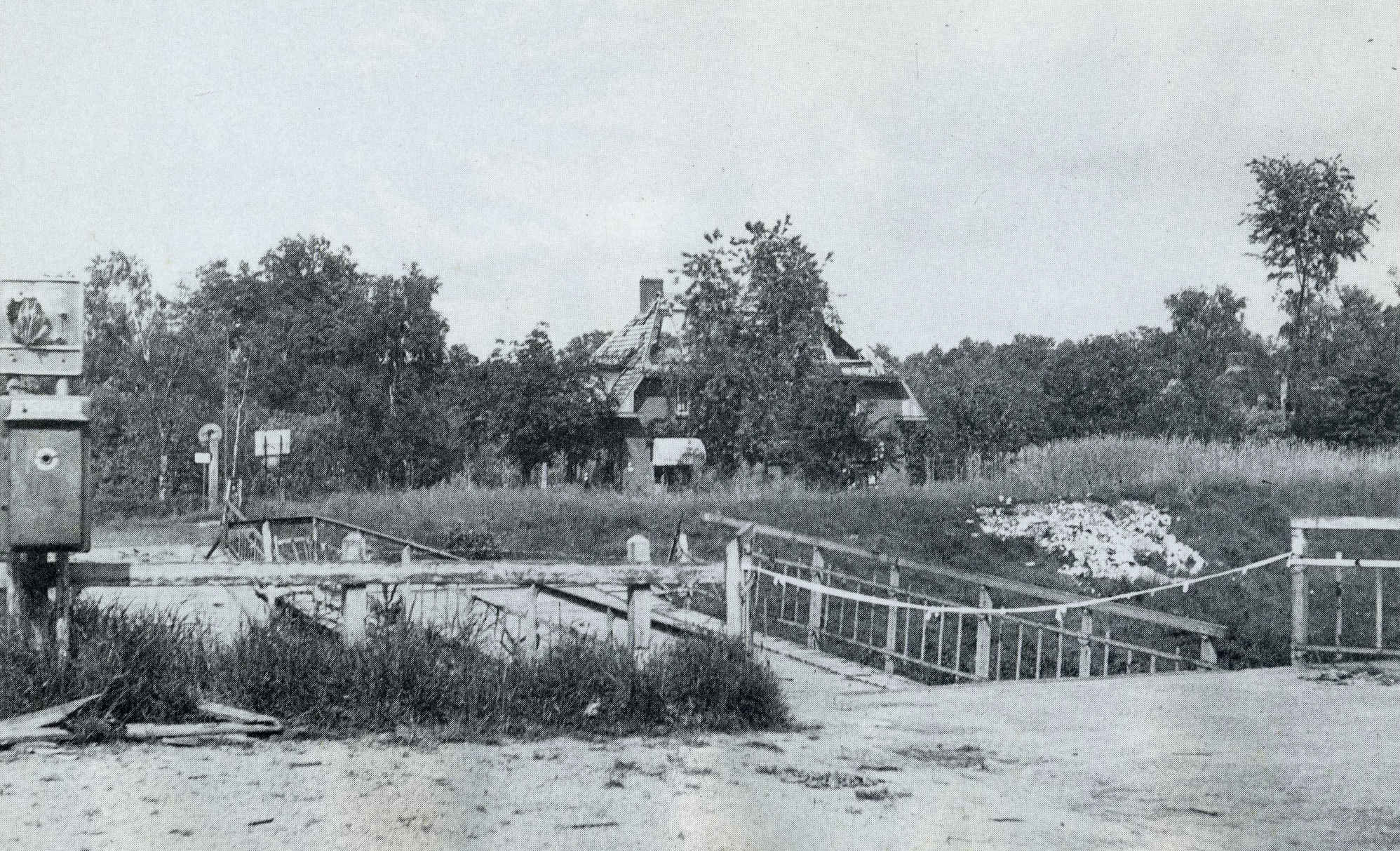
The temporary wooden bridge constructed by the Germans during the War over the railway line at Oosterbeek Station, which they themselves blew up in April 1945. No 2 Van Limburg Stirumweg in the background. Photograph taken in 1945. Courtesy Mr. J. Leusden.
Dvr. 'Ken' Clarke: "We had a few Jeeps and Trailers in readiness to collect supplies of food and ammunition to be dropped to us by air. The planes had of course been given a D. Z. when leaving England. My most memorable experience was on the second day. With our Capt. and others, we travelled from the Hartenstein Hotel along Stationsweg to an area we knew the R. A. F. were to drop supplies. We had four Jeeps and Trailers and as we went along Stationsweg, we passed a burning Bren Carrier with the personnel all dead around it. Looking back now, this should have been an indication that something was wrong in the area. Never-the-less we headed straight on to the railway bridge. It was at this point that the attack took place. The first Jeep took a direct hit. It came so suddenly that the following three Jeeps and Trailers all telescoped into each other as we were travelling at a considerable speed. Those that were not thrown out, jumped out, some took cover to the left of the road and some to the right. Those on the right were unfortunately in view of the enemy and paid the price. Capt, Kavanah had been in the first Jeep and he jumped to the left with myself and others. He called for the Bren Gun (which had been in my possession since landing), so I moved along the ditch to be at his side.
He exchanged his Sten-Gun for the Bren and said 'when I stand up you all run back over the bridge.' This he did, standing in the road obviously diverting attention to himself to cover our escape. I know the Germans were occupying the houses on Drienseweg and Van Limburg-Stirumweg, because I saw them, and it was from the third house along that a grenade was thrown, and a shot fired that killed one of my best friends Cpl. Wiggins. I asked permission to throw a smoke grenade into the house, but Capt. Kavanagh's last instruction to me was 'no, just run for it'. As we ran towards the embankment leading to the railway I was ordered by Sgt. McDowell to stand on the corner and give covering fire with the Sten-Gun. This was long enough for the others to get away. I followed last of all."
Unfortunately now that Capt. Kavanagh had swapped weapons with Dvr. Clarke, and ordered him back, he only had one magazine for the Bren, and his pouches were filled with Sten gun magazines.
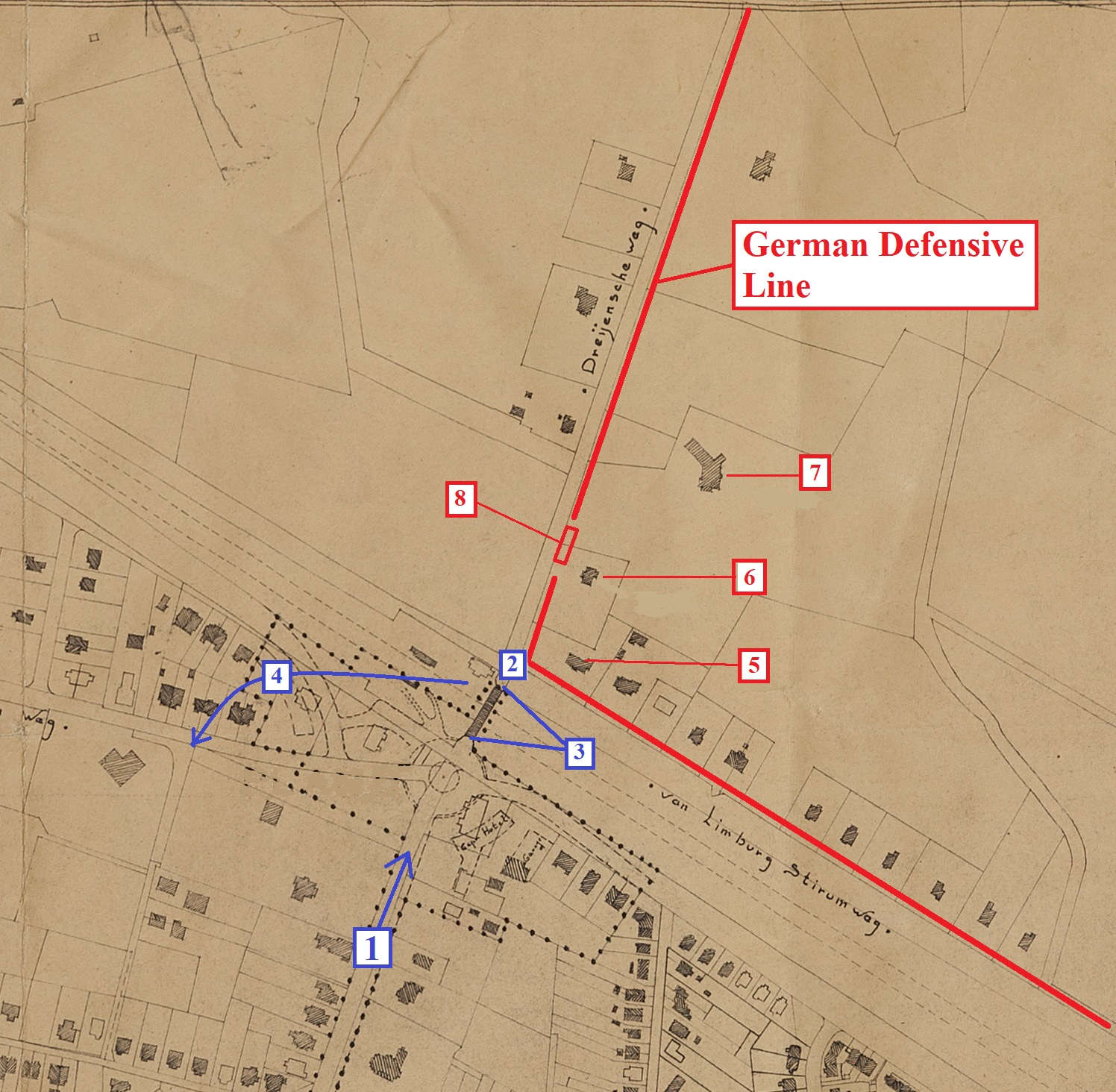
No 2 Parachute Platoon and Transport Section. 19 September 1944.
KEY:
[1] Direction of approach for No 2 Para Platoon.
[2] Capt. Kavanagh Jeep hit & halted approx. here.
[3] Jeep column stopped in this area.
[4] Withdrawal route of survivors.
[5] No 2 Van Limburg Stirumweg.
[6] No 1 Dreijenscheweg.
[7] No 9 Dreijenscheweg.
[8] Approx position of Mass Grave.
Dvr. Dennis Cutting clearly remembered the ambush: "Moving at a fair pace, we crossed the railway bridge at Oosterbeek. A shell hit the Captain's jeep, killing the driver instantly, we all scrambled out, or were thrown out and took up positions behind the jeeps. I got behind a wheel and we all began firing in the direction of their machinegun, which was aimed directly at us. However, we could not locate the target, as it was heavily tree lined. Several of our boys were hit right away, Captain Kavanagh could see it was a desperate situation, and within seconds I saw him grab 'Ken' Clarke's Bren gun and shouting to Sergeant McDowell, "get them out of there, get them out of there", he turned around and the last I saw of him, he was running toward the machinegun firing, and calling desperately, "get them out, get them out." [8b]
In the fourth Jeep along the column was Dvr. John Green: "Just as we got to the outskirts some mortars opened up on us: the first Jeep got hit; the other two collided with it; and I remember our Jeep shooting over the edge of the road and dropping over into the ditch. It was a fairish, drop - several feet anyway - and we were all flung out, except the driver, who got caught by the steering-wheel and was killed. I heard one of the other chaps moan about his arm, tried to get up, and found my right ankle was done in. It was painful and swollen up, and I couldn't walk. We felt pretty groggy, and I lay 'doggo' in the shelter of the embankment all night." [9]
In the immediate aftermath of this violent action, Cpl. Blaxley was ordered by the German Officer to get a Jeep for the wounded: "I followed his further instructions, which entailed loading the wounded into a jeep. There was only one available and that didn't look as though it would go very far. The radiator was badly shot up. This vehicle was the fourth one down the line so I moved it to the left of the road near to the garden gate. The body of Capt. Kavanagh was propped up by the bonnet of the first vehicle. He had obviously tried to engage his opponent with a Thompson 45 machine gun [Bren gun], but had drawn fire to himself and slithered down by his jeep, his gun was on the ground by his side. I returned to the garden, and supporting one of my wounded on each shoulder, we struggled to the jeep together. It was now that a barrage of 6 inch mortar was directed on the road itself. I just had to let go of the wounded into a slit trench on the left, and tumbled in after them, right on top of the German occupants. I froze inside, but they laughed at the situation. Another reprieve!
After this short bombardment I was allowed to move the trailer to the wounded and load them onto it. The officer and an escort now accompanied us into and behind, the enemy lines. It was now that I realised the foolhardiness, and futility of our attempt to retrieve any supplies whatsoever, dropped in this area. The opposition were firmly entrenched and furthermore, well supported by mobile guns and tanks. I could hear the clanking and squeaking of their tracks as they made their way through the nearby woodland. A little further on, we stopped at a large detached house. The Jeep now ground to a halt in the forecourt. It had at last expired. This building was being used as a Casualty Clearing Station, and it was here, that I dropped off my two wounded and a further two German wounded. There were several well dressed German officers and one or two army photographers. It looked so well established that I was in no doubt that they would be in good care.
I was now loaded onto a flat farm trailer, under guard, with a dozen or so others in captivity, and pulled by a farm tractor, we went even further behind the lines. We stopped on the way to pick up a very badly wounded Polish parachutist, obviously from the recent Polish drop. His injuries were so severe it was decided to give him a dose of morphine leaving the expended tube to his identity disc.
We now came to another large house with a hard tennis court at the rear. An expanded wire fence and wire gate enclosed the area. We were directed into this wire enclosure, placed under close guard and gradually, more prisoners arrived. I looked at them as they joined us, hoping I might see somebody I knew. Later in the afternoon, we were marched two or three miles under guard to a large garden with a cement built sunken air raid shelter. I noticed three or four young Dutch men already here against the wall. They were wearing orange arm bands on their left arms. They were soon marched off and we were directed into the air raid shelter. It had two benches the length of the shelter, facing each other. We squeezed onto these and I found myself opposite an R.A.F. officer who had lost his boots as he made a parachute descent from his stricken aircraft. We had by now received neither food nor drink for 24 hours, and with our small pack confiscated when we dropped our equipment, we had not even a biscuit between us. We huddled together for warmth and I invited the Air Force officer to put his stockinged feet under my airborne smock for extra warmth. We remained like this, fitfully dozing throughout the night."
The survivors that were still on the northern side of the ambush area, ran down the railway embankment, into some temporary cover, Dvr. Dennis Cutting: "Sergeant McDowell ordered us to withdraw down the railway embankment and up the other side, I noticed one of our boys beside me, had his eye hanging by a thread down as far as his waist. On the top of the embankment, were three rows of barbed wire, 'Joe' Phillips and I ran forward jumped and threw ourselves across the wires and the rest of the section ran over our backs. The last two men stopped to pull 'Joe' and I off the wire, we dived into an empty house, where some of us tried to fix up the boy's bad eye as best as possible.
While trying to decide our next move, we saw an older man across the street, a civilian, tall and lean standing in a doorway. He raised his hand with the palm facing toward us, indicating for us to stay put. As he crossed over to us we noticed he held a little girl by the hand, who I took to be his grand-daughter. She was carrying a music case. We intimated to him we wanted to get back to our Headquarters at Hartenstein, he understood although, he could not speak English and of course we couldn't speak Dutch. He spoke to the little girl, and as she walked away she gestured to us to follow her, which we did at a distance. We soon recognised the area around the Hartenstein, however to our surprise, the little girl was nowhere to be seen, she just disappeared, we could not even say 'thank you'. The courage of the Dutch people has always amazed me. I shall never forget the risks that were taken with no thought for themselves." [8c]
Dvr. 'Ken' Clarke: "After realising what had happened, and the fact that we were being fired on from all angles, we scurried down the embankment and gathered together in a small shelter on the platform for a moments relief and out of the sight of the Germans. We finally reached H.Q. yet again without the valuable supplies we so badly needed and our Jeeps lost. The most disturbing thing about our trek back to the Hartenstein was, that as the occupants of the houses saw us coming there was horror on their faces, not because they were afraid of the British but they knew by helping us, the Germans would demolish their houses and possibly reprisals would be taken against them." [3b]
The letter by Lt-Col. Packe to Capt. Kavanagh's father continued: "Machine guns were firing at short range from a house straight in front, and there was fire from both flanks. There was no cover on either side of the road and no way except back over the bridge. Paddy took a Bren gun and advanced down the road towards the enemy, firing at the house. He then took up a position with a few other men and engaged the machine guns. Meanwhile the Sergeant, acting on his initiative [the word initiative was crossed through and orders substituted] orders, withdrew the remainder of the platoon over the bridge and reported back to Headquarters. Nothing further has been seen or heard of Paddy or the other men with him. The Sergeant went out again with an infantry patrol and a gun, to attempt to knock the house down from the other side of the railway, but they were unable to get near it. The whole area North of the railway passed into enemy hands shortly afterwards. Paddy and nine of his best men are missing from this operation - some of them known to have been wounded before or during, the withdrawal."
Sgt. Ronald McDowell was put forward for the Military Medal, and part of his Citation reads: 'At Arnhem, on the second day of the battle, 18th [19th] September 1944, Sergeant McDowell led the bulk of his Platoon back from an ambush in which his Platoon Officer and several other men became missing, believed killed. Having reported the facts, he then volunteered to accompany a relieving force with a 6-pounder Gun to the scene of the ambush in an unavailing attempt to rescue the remainder of the Platoon.'
One of those in this relieving force was Dvr. John McAndrew: "My Captain and a few more went to recover some of the supplies dropped; they were ambushed and some, including the Captain, were killed. A Sergeant took four of us to try to bring back any survivors, but we were met by machine-gun fire. I myself got a bullet in the back. I was taken by jeep to the Tafelberg Hotel in Oosterbeek, which was being used as a military hospital." [10]
Of those killed immediately in this action, Capt. D.T. Kavanagh and Cpl. A. Wiggins were buried in a mass grave to the north of the Railway Station, in the garden between No 1 and No 9 Dreijenscheweg, and are now buried in the Arnhem/Oosterbeek War Cemetery. Although Dvr's. W. Bennett and M. Field were known to have been buried in this mass grave, they now have no known grave. The burial places of Cpl. H. Whittet, Dvr's J. Butten and J. McKinnon are not known. Four men were brought out of the ambush area and back to medical facilities, but died of their wounds: Dvr. R. Thomas on the 19/09/44, and was initially buried in a mass grave near the Hartenstein Hotel. Dvr. J. Burns was taken to the Tafelberg, but died on the 21/09/44, and was initially buried in the mass grave at the front of the building. L/Cpl. A. Docherty had been taken back to the R.A.P. at the Hartenstein, but succumbed to his wounds on the 23/09/44, and was initially buried in another mass grave near the Hartenstein Hotel. Dvr. D. Hatton was also taken to the Tafelberg, but died of his wounds on the 24/09/44, and was initially buried in a mass grave 150 m's south of the Tafelberg.
Taken prisoner at the same time as Cpl. Blaxley, were Cpl. D. Bolton, L/Cpl. J. Syme, and Dvr. P. Batsford, the last two being wounded. Those who were able to withdraw form the ambush, or avoid it, were Sgt. R. McDowell, Cpl. D. Cutting, Cpl. R. Doubleday, Dvr's. C. Boardman, K. Clarke, R. Higgs, and J. Phillips. Those known to be wounded and taken to medical facilities, and survived as POW's are, Dvr's. J. McAndrew, J. Green, and A. Shaw.
Dvr. Robert Thomas had been attached to No 2 Parachute Platoon as Capt. Kavanagh's driver for some time during the summer of 1944, and whilst most of 'D' Transport Platoon were at Harwell Transit Camp he was retained at Oakham. However, in August he was taken ill, and his place was taken by Dvr. Wilfred White. Not wanting to be left out of the next Operation that was definitely on, he joined his Detachment at Harwell and flew with them to Holland on Monday, 18th September 1944 - he was nine days short of his 24th birthday.
The 1st Airborne Division After Action Report, Part I, Appendix H, summarised the days events, thus: 'Petrol pumps captured at map ref 696782. Units notified to draw up to 8 galls per vehicle in own jerricans. Supply drop for 19th dropped on pre-arranged S.D.P owing to non-receipt of message sent on 18th. Only isolated containers recovered. During this recovery approximately half the R.A.S.C. Platoon was lost in an ambush. Message sent to Base requesting urgent re-supply on map ref 691785 earliest possible 20th September. Possible new D.M.A was recce'd during morning, but found untenable. As it was appreciated that supply drop was not likely to be successful, attempts were made through the Dutch Liaison Officers to obtain local supplies. Only very small quantities could be produced, the main items being a sack of flour and a pig. These were handed over to the A.D.M.S. for consumption at the various D.S's. Mortaring and SAA fire caused casualty on D.M.A. All Units warned utmost conservation ammunition, supplies and petrol necessary and re-distribution of remaining Compo on basis of one third ration per man as far as possible. Units informed that limited quantities of ammunition were still available from D.M.A.'
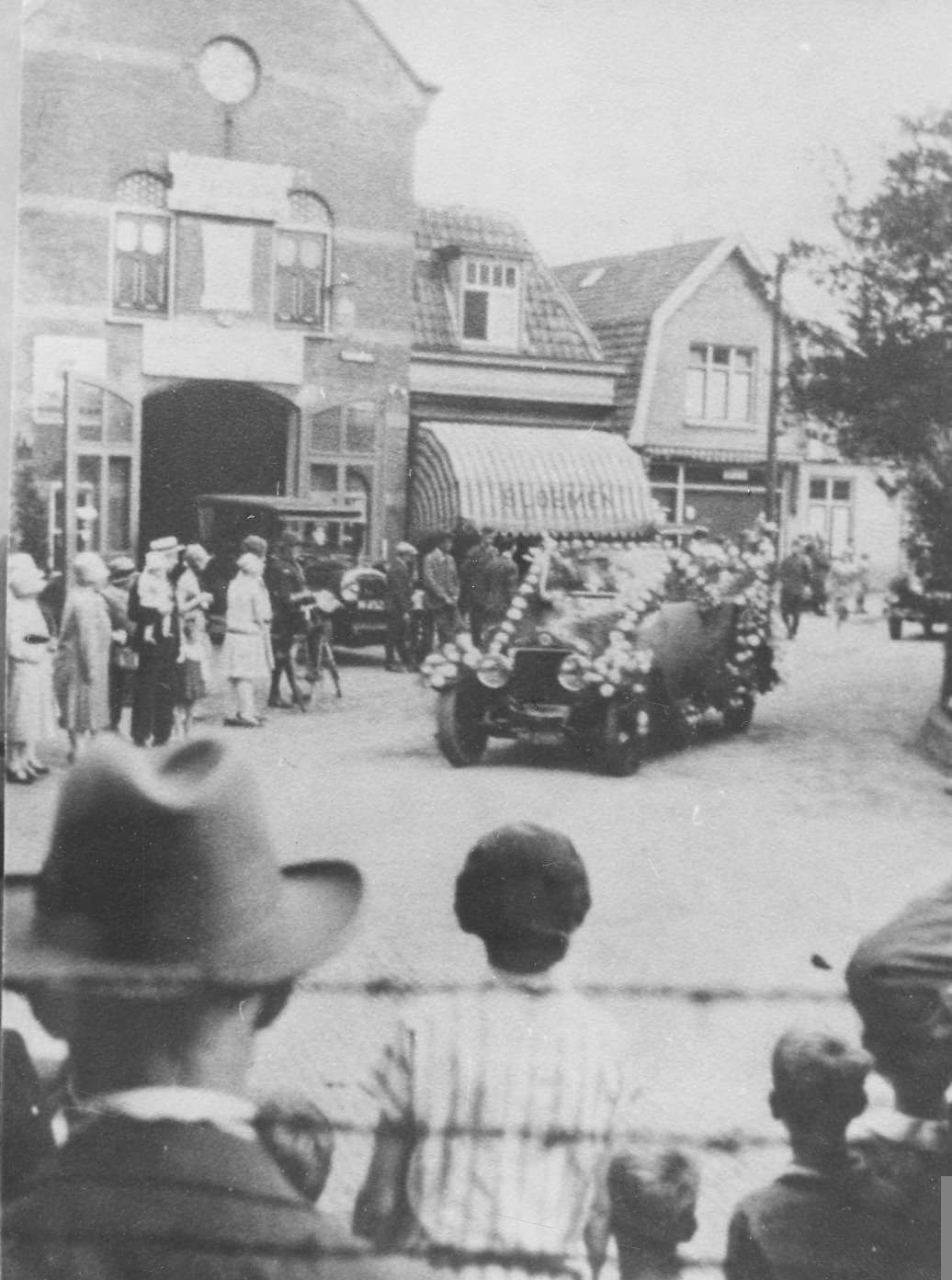
A parade through Oosterbeek, lead by a 'decorated car', circa 1930. Photographer unknown. It shows No's 2 (The Sukkel Garage), 4 and 6, Paasberg. This where the 'Petrol pumps captured at map ref 696782' were located. Courtesy Gelders Archief, 1541-196.
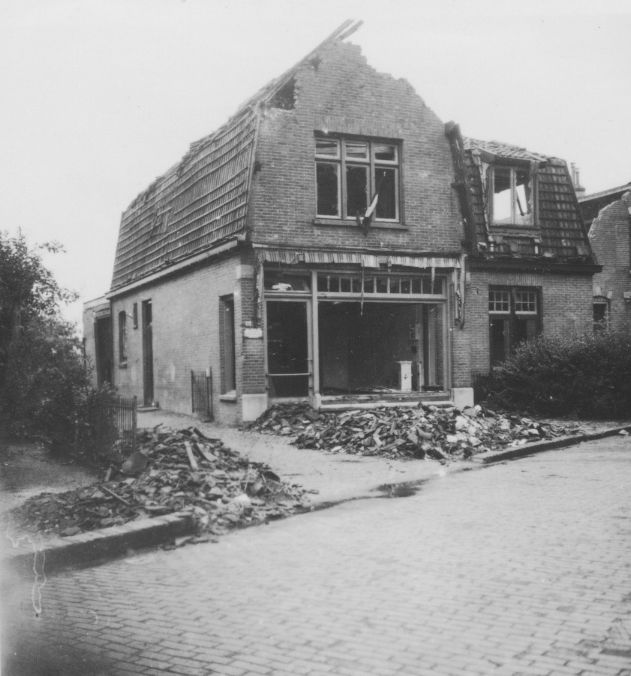
The bicycle shop at No 6 Paasberg, Oosterbeek, which shows the destruction in the area, and photographed by Mr. H.J. Willink in 1945. Courtesy Gelders Archief, 1579-10.
The facts from this supply drop make stark reading. There were 164 aircraft on this mission, one hundred and one Stirlings and sixty three Dakotas. Of the 392 tons of supplies dropped, it is estimated that only 21 tons was recovered. There were a total of nineteen aircraft lost on this mission. The shooting down of one was witnessed by a Miss. D. Drooglever, who lived in the Batoswijk area just north of the Benedendorpsweg in Oosterbeek: "The afternoon of that day became a dramatic event, one of the most sensational. Suddenly large groups of planes came flying along from the direction of the Betuwe, in contrast to other days when they flew from the direction of Wolfheze straight for Oosterbeek. Minutes later, they flew over our heads, large transport planes, heavy and noisy which were continuously attacked by anti-aircraft artillery. The sturdily built corridor in our solidly built house, was again our shelter. We could not however resist the temptation of going outside into the front garden, back garden or loft despite the danger, to see how the battle progressed. And what did we see? The sky above Oosterbeek was saturated with many coloured parachutes. Look there, a plane right above us was hit and started burning - pulled itself up again - very neatly released all its parachutes, pulled itself up once again - circled away - then had to make an emergency landing because of the fire. Great was our admiration and respect for those pilots who under such great and grave danger, first released their supplies and then tried to save their own lives. Unsung heroes. Maybe their act was not even noticed by their own countrymen, but certainly noticed by the Oosterbeek spectators who in silence gave tribute to such deeds of heroism. Still continuous anti-aircraft fire and still more planes came roaring in. We saw many being hit and bursting into flames. How fear gripped us when we saw more and more planes approaching. We knew what hell was facing them and we wrung our hands every time another plane went through the firing line. 'God save them', was our prayer. All this I witnessed from a window in the loft. When I went downstairs everyone seemed down and very depressed. Right in front of our house on the other side of the River Rhine, a burning plane had come down. Our people had seen it coming down on fire, still trying to land correctly, but just before it touched the ground, the front of the plane was blown off. And there it was lying, beaten - then large flames and thick dark clouds of smoke restricted our view." [10b]
The feeling of utter futility of that days, mostly failed, supply-drop was graphicly described by Maj. Geoffrey Powell, the Commander of 'C' Company, 156 Parachute Battalion: "Then, to the south of us, across the top of the rail cutting, I saw the familiar shapes of a line of Dakotas, approaching at about 1,000 feet. In a minute the sky was crammed with them. It was the first [large] supply drop, about which we had been told at the briefings. But the DZ was a couple of miles away, over the other side of the hill, right in the middle of the enemy positions. By now, of course, the Division should have captured the area, but the Boche still held it. Already, the Dakotas were in trouble. Multiple explosions from the enemy light ack-ack guns hammered from every direction, and the results were visible in the black, circular bursts which seemed to all but fill the gaps between the ranks of aircraft. But not all were missing their targets. One plane exploded in a ball of fire to vanish behind the trees. And then, as the first aircraft passed over our heads, the parachutes started to open, carrying the ammunition and food which we so desperately needed right into the middle of the German positions. Regardless of the danger, some of 8 Platoon were on their feet, waving their weapons or helmets, or the small yellow squares issued for the purpose, trying to attract the attention of the pilots. The sky was empty. The last plane had gone. But we still stood watching the place where the Dakota had vanished, mourning the futility of the self-sacrifice we had just witnessed. Two hours later the memory of the R.A.F. crew and the R.A.S.C. despatchers still nagged through my other cares." [11]
Shortly after this, the 156 Parachute Battalion had to start withdrawing from its attack on the German blocking line, that had been established along the Dreijenscheweg, and Maj. Powell recalled: "Following the tail of a further party from Battalion Headquarters, the RSM in charge of them, I led the company out on to the track, down towards the open ground which we had crossed early that morning. It was the fourth time we had gone that way during the past twenty-four hours. Now the ground was littered with the hulks of gliders, some still smouldering, and the bodies of the Polish gunners. Bullets flew over our heads. A body of men from the other battalion was converging on us from the right. Then, about fifty yards in front, a man fell and lay still on the track. Now, mortar bombs started to explode around the marching men. The pace quickened a little. A party of R.A.S.C. appeared, moving in the same direction. The Colonel's jeep drove past, a sign that the whole of the Battalion must have got away; otherwise the Colonel would not have moved." [12]
This is the second mention, by a member of the 4th Parachute Brigade, of a party of R.A.S.C. in the area of L.Z. 'L' on this day, but unfortunately, it has not been possible to identify exactly who they were. Another witness to the attempts by men of the R.A.S.C. to recover supplies from L.Z. 'L', comes from Sgt. 'Ron' Kent of the Pathfinders, who had been tasked, along with No 1 Platoon to set up the navigation aids on what was now to become L.Z. 'L' for the Polish Parachute Brigade glider element. However, they also knew about the other Platoon's task of marking S.D.P. 'V', which could not be accomplished. In his book 'First In', published in 1979, he wrote: "Precious supplies of ammunition, food and medical equipment fell into enemy hands", and that on their own area, "the R.A.S.C. salvaged what they could, aided by No 2 Platoon, at considerable personal risk".
Later on, once his Company had crossed to the south side of the railway line, Maj. Powell came across some containers that must have been part of the drop on Monday: "Scattered across the grass ahead were six parachute containers, each still attached to its vivid circle of coloured nylon. Some pilot, either in error or distress, had jettisoned his load out here, well away from the flight-path of the aircraft. Food and ammunition! I remembered hunger once again. Soon we must have food, if our strength was to hold out, but even more important, was the need for ammunition. Three-quarters of the Bren magazines were empty; the spare bandoliers which many men had been carrying last night had all been used; and many of them were reduced to no more than twenty or thirty rounds each for their rifles. Only Sten gun magazines were still full and no grenades had yet been used: all the fighting had been at long range.
CQMS. [T. Thomas], with [F. Tracey] and Jones helping him, was already opening the first container, his fingers fumbling in his haste to discover its contents. There was a curse of disappointment. It contained ammunition for the 6-pounder antitank guns, of no value to us at all. [Cpl. J.N. Rosenberg], who was opening the next one some yards away, called across to say that the contents were the same. With Corporal [V. Jones, RAMC] I ran to the third, and together, we wrenched it open. Angry and disgusted, I swore obscenely. Then, remembering Pritchard's prejudices, I glanced rather shamefacedly in his direction, to observe him doubled up in silent laughter. The irony penetrated and I laughed myself, rather too loudly. Crammed tightly in the container were serried rows of brand new red berets! By now all the containers had been opened. The rest were full of the anti-tank ammunition. About a dozen men had gathered around the berets, swearing or laughing, before I swept them back to their sections with a reminder of the target they were offering any wandering Boche patrol.
Despite my disgust, I knew the explanation. The contents of supply-drops had to be pre-packed to a standard formula, and anything or everything might be wanted in the course of a battle - ammunition of a multitude of types, medical supplies, radio batteries, and even red berets. After all, the beret was a valuable psychological weapon. Ever since 'the airborne troops had first worn this new headdress in action in Tunisia, the enemy, both Boche and Italian, had learned to hate the sight of it. Everyone dropped with his beret tucked into a pocket, and little notice was taken when someone mislaid his weighty steel helmet. After all, the latter's value was limited : it might deflect a not too heavy fragment of shrapnel, but it would certainly not stop a bullet. Already quite a few men had rid themselves of their helmets and were wearing their berets - wearing them squarely on their heads in the airborne fashion as no one else could.
Probably only the one container of berets had been included in that supply drop, and it was just our luck to happen on it." [13]
This was the first of many incidents, where not only did the men find what they considered useless items - the berets - but also supplies and munitions that were no good to their immediate needs - infantrymen needing small arms ammo, finding anti-tank ammo.
At the Arnhem Bridge area things were beginning to get desperate. There are no detailed accounts of the day to day, or hour by hour battle by No 3 Parachute Platoon, but Maj. Hibbert, noted the following on this day in 1st Parachute Brigade H.Q. Diary of Events: '20.30 hrs. Both 22 sets mounted in the attic of R.A.S.C. Platoon house, neither of them through to anyone. We had last heard from XXX Corps at approximately17.00 hrs, and it seemed doubtful whether they had then crossed the Nijmegen bridge, and they would not estimate a time by which they would be with us, beyond "soon". Many more houses burning round the perimeter causing a certain amount of danger and fire from flying sparks. This danger was now considerably increased as the water supply had been cut off, and there was not enough water even to drink.'
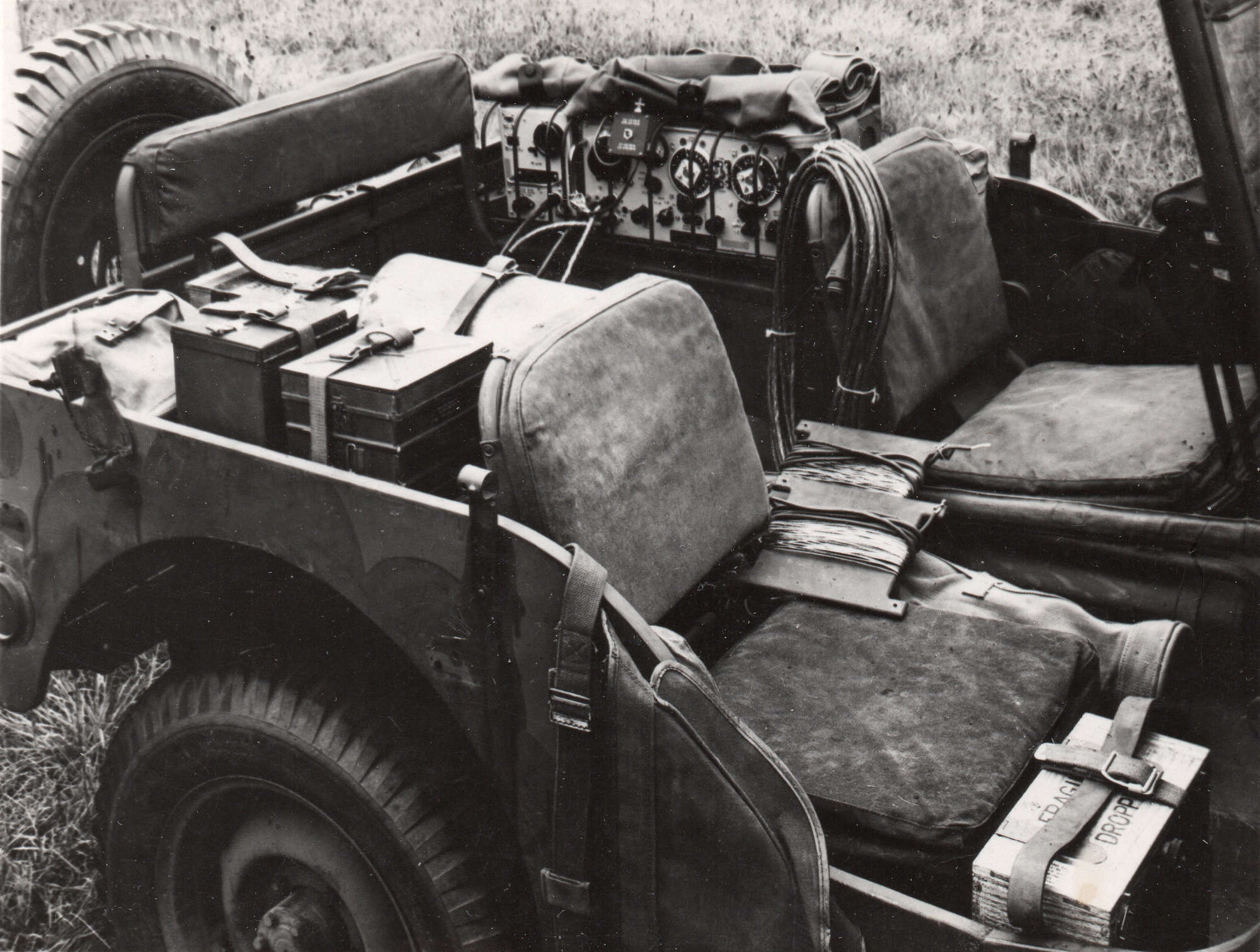
A 22 Wireless (Radio) Set mounted in the rear of a Jeep. A.F.D.C. 25 July 1944. Courtesy Airborne Assault Museum Archives.
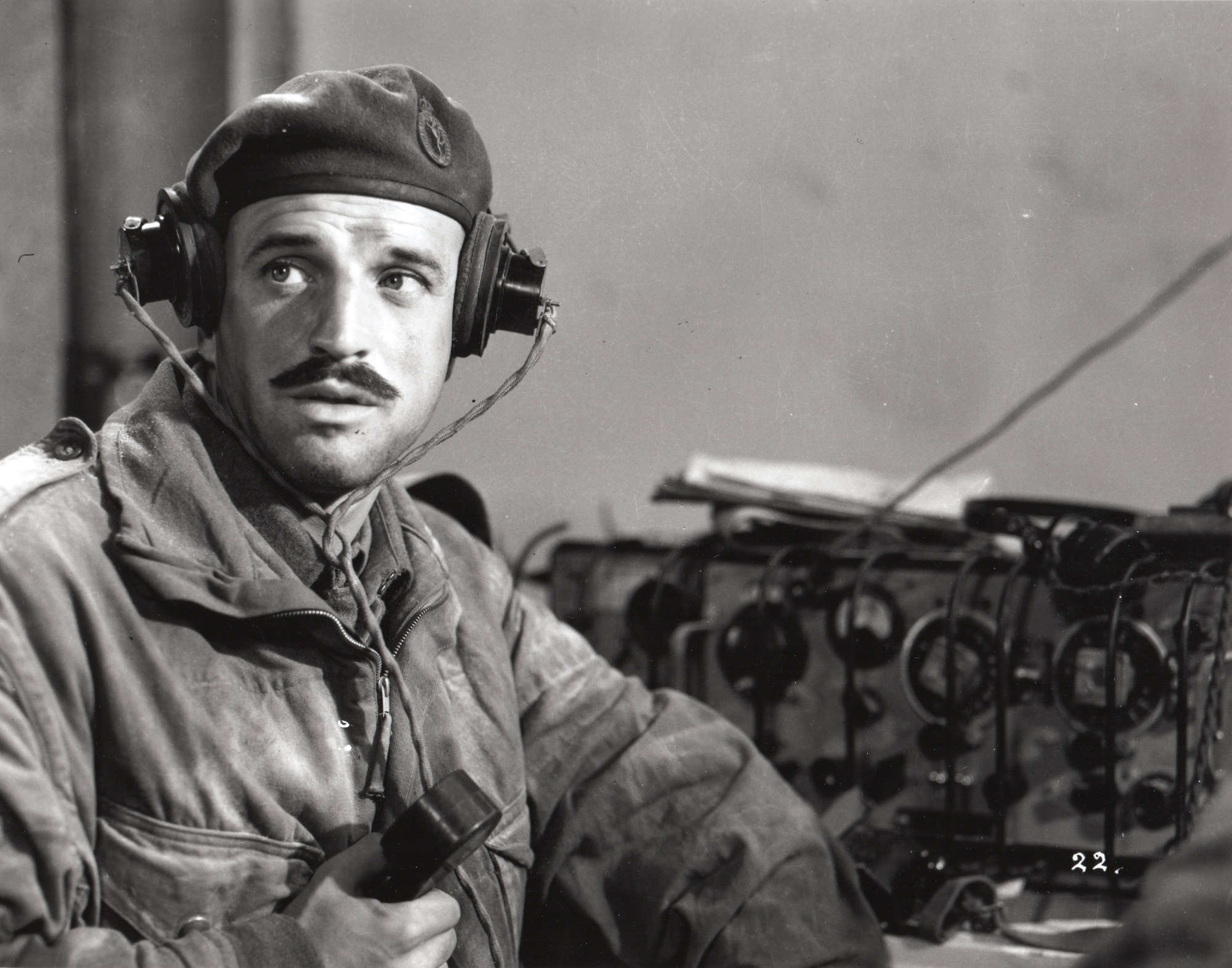
A still from the film 'Theirs Is The Glory' depicting a signaller, using a 22 Wireless (Radio) Set, at Arnhem Bridge in September 1944. Courtesy Airborne Assault Museum Archives.
In the area of the D.M.A. the H.Q., R.A.S.C. and Detachments 'stood-to' between 19.00 and 20.00 hrs, and only intermittent enemy activity was reported during the night.
NOTES:
[1] & [5] Letter & account to Bob Hilton from Burnham Blaxley. 9 July 1998.
[2] Account by John Prime. 1994.
[3a] & [3b] Account by Kenneth Clarke. 1944-45.
[4] Account by John Hughes.
[4a] "ARNHEM. The Fight Too Sustain". Brig. F. Steer. Pen & Sword. 2000.
[4b] 'Arnhem After Arnhem'. Compiled by Robert Stopforth.
[6] Royal Army Service Corps Review Vol. 1, Nr 5. 1952. Lt-Col. M. St J. Packe.
[7] Letter & account to Bob Hilton from Sam Staple. 16 September 1997.
[8a], [8b] & [8c] Dennis Cutting. Personal account. November/December 1996.
[9] Personal account in the Pegasus Journal, July 1946, pages 45 - 47.
[10] From an article in the A.V.C. Newsletter, June 1998. [10b] 'Arnhem After Arnhem'. Compiled by Robert Stopforth. Pages 143-144.
[11] 'Men At Arnhem'. By Geoffrey Powell. Pages 78 - 80.
[12] 'Men At Arnhem'. By Geoffrey Powell. Pages 88.
[13] 'Men At Arnhem'. By Geoffrey Powell. Pages 92 - 93.


