Chapter 7
Monday, 18th September 1944.
"I have to say it has been almost 60 years since I jumped out of that Dakota, but the events of the days that followed are still quite vivid in my mind." 'Ron' Nutley. 8 September 2004.
The night had been fairly quiet for No 1 Parachute Platoon, and the others, at the Klein Amerika Farm, but after it got light, the peace was short lived. At some stage late in the morning, the farm started to come under both machine-gun and mortar fire. Capt. Cranmer-Byng: "The Jerries landed three shells and set the barns on fire that Monday morning, of course the farmer lost his house, barns and everything, but the Dutch Government have set him up again and he is farming the same land although he lives in a little brick cottage now". [1]
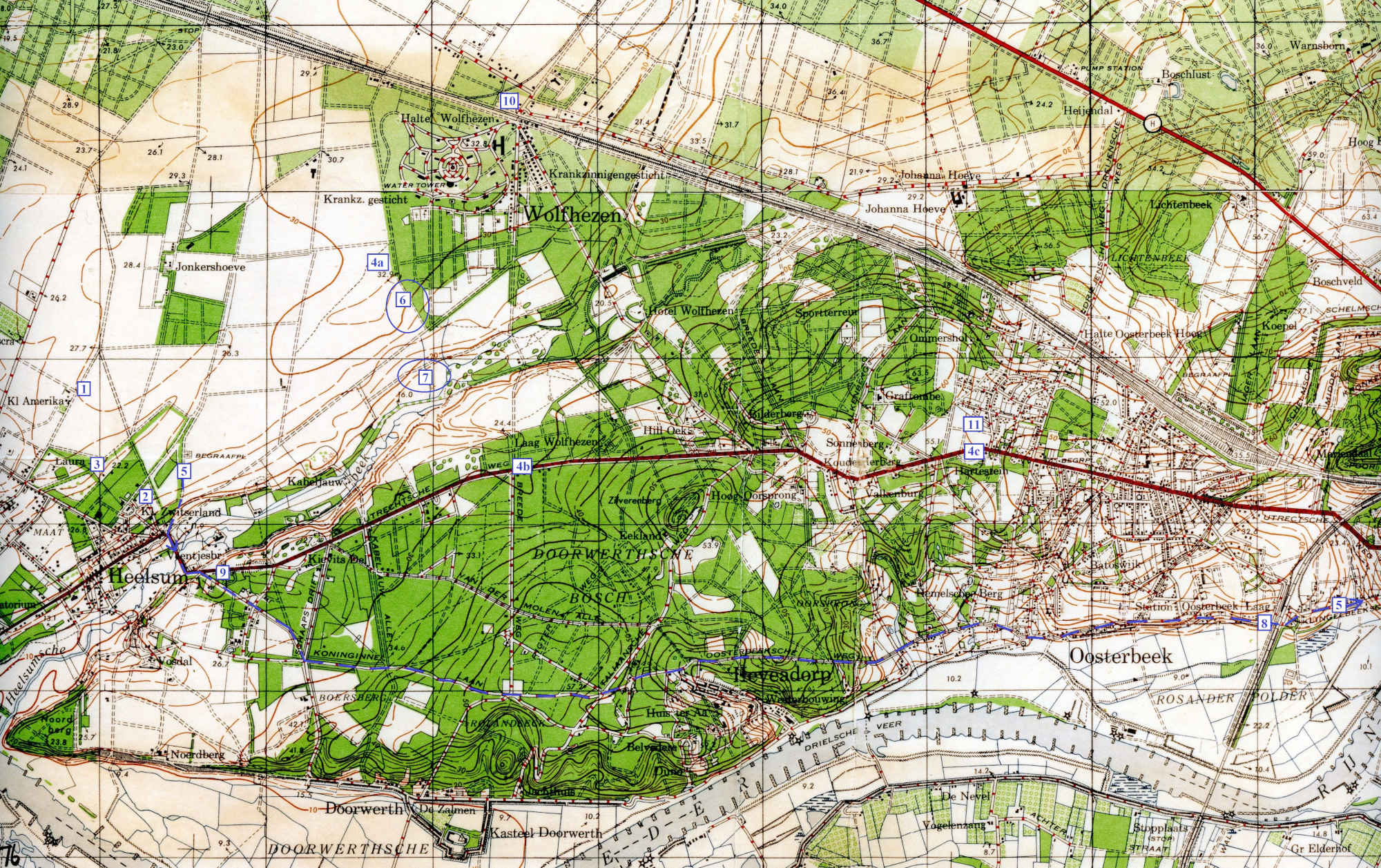
RASC positions, actions and moves on 17 - 18/09/44.
KEY TO MAP OF AREA. 17th - 18th September 1944.
[1] Klein Amerika Farm.
[2] Klein Zwitserland Hotel.
[3] Laura Woods.
[4a], [4b] & [4c] 1st Airborne Division Headquarters
[5] Route of 3 Platoon, 250 Company. 17/09/44.
[6] 'C' Company, 1 Bn Borders.
[7] No 1 Battery, 1st A/L Lt Regt, R.A.
[8] Ambush of truck at Railway Underpass. 17/09/44.
[9] Ambush of bus. 18/09/44.
[10] Main R.V. point, 2nd Lift.
[11] C.R.A.S.C. and the D.M.A. 18/09/44.
Some of the men from the Section of 'C' Troop, 1st Parachute Squadron, R.E. remember what happened, Spr. 'Alex' Johnston: "My stick was detailed to collect stores from the D.Z by means of our two wheeled trolleys and a horse, and a cart from somewhere, and to make a stores depot at a nearby farm yard. After a short while, the farm yard area came under German fire from small arms, shells and mortars. The house or a straw stack was set on fire. A Dutch policeman, in blue riding breeches and shiny leggings had obtained a rifle and was helping us to return fire. A mate from my stick had a toe shot off, his lasts words to me was 'I'll see you in Blighty'. He was eventually taken to the hospital and became a prisoner of war."
The man who lost his toe was Spr. 'Geoff' Hulme, and Cpl. Silas Cosadinos remembered: "The chap who was wounded on the second day was always saying, 'I'll see you in the Stalag'. I should think he would be one of the first there".
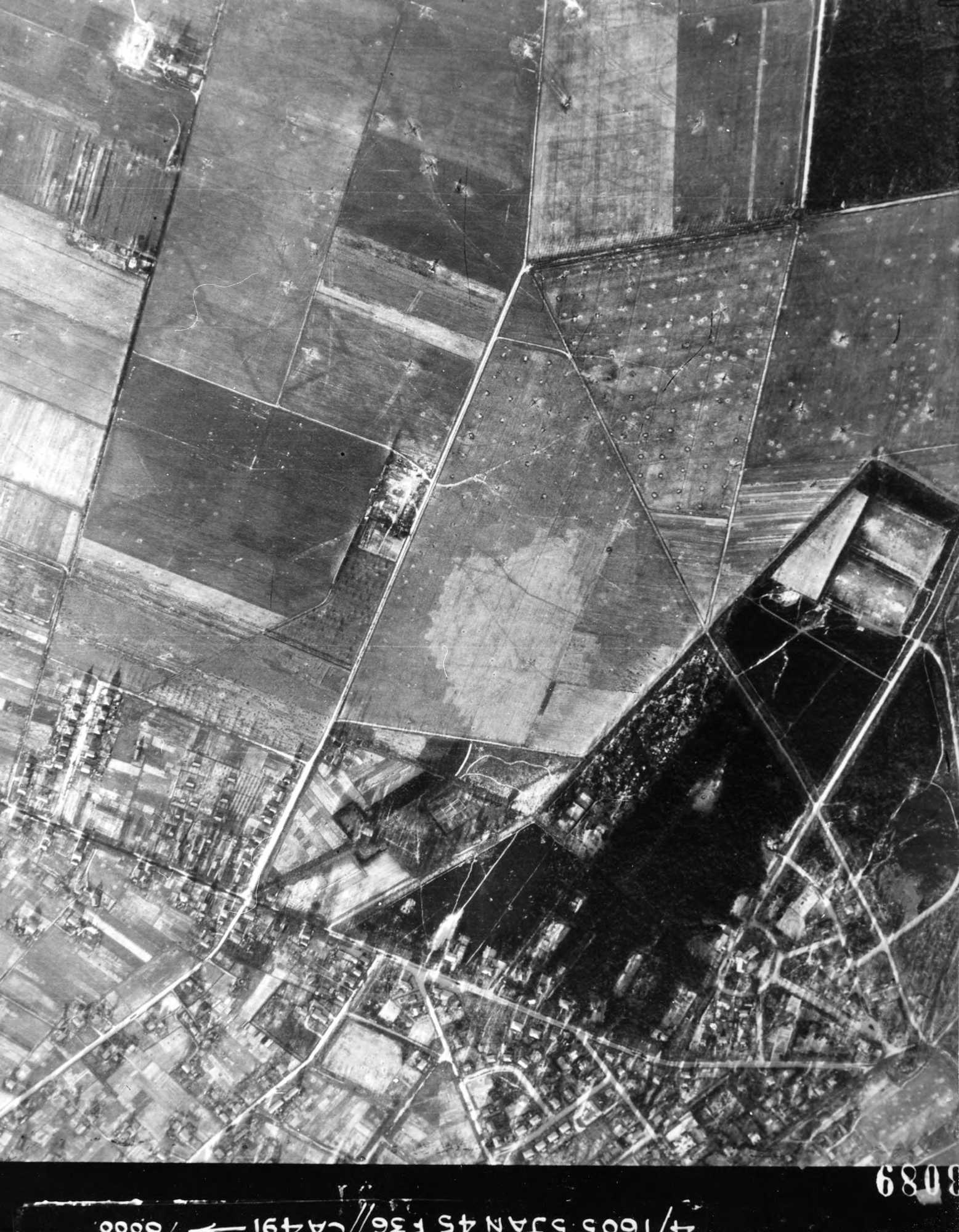
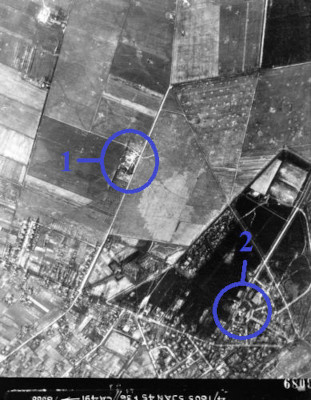
Klein Amerika Farm, Renkum - Klein Switzerland Hotel, Heelsum area. Aerial photo taken 05/01/1945. KEY: (1). Klein Amerika Farm - burnt down. This was used by No 1 Parachute Platoon, 250th (Airborne) Light Composite Company, R.A.S.C., and a Section of the 1st Parachute Squadron, R.E. on Sunday, 17th September, through to Monday, 18th September 1944, as a base for bringing in supply containers. (2). Klein Switzerland Hotel - German base in September 1944. Courtesy of Gelders Archief, 1560-929.
At 07.00 hrs, it had been decided that Divisional Headquarters would start to move forward from its position on the L.Z., nearer to Arnhem, and so a position was established on the Heelsum to Oosterbeek road - the Utrechtscheweg, at the junction of the Breedeweg. In the 1st Airborne Division After Action Report, Part I, Appendix H, it states: '18 Sep. As further quantities of reserve ammunition could not be got through to 1 Parachute Brigade this and other ammunition collected from DZ's and LZ's, was taken to Divisional HQ at x-roads 665784 where a small dump was formed.'
How was this 'reserve ammunition' and 'other ammunition collected' and moved to the Divisional Headquarters on the Utrechtscheweg. Cpl. Harry Symmons, and six men, L/Cpl's. Leonard Plant and Albert Hurst, Dvr's. Norman Allcock, Jack Taylor, Arthur Start and Eugene Zambonini, were all tasked by Capt. Cranmer-Byng to find some transport to move the collected supplies. Spr. 'Les' Plummer: "During [Monday morning] a party of soldiers and some Dutchmen came with a coach and loaded it with ammunition and shells and escorted it away. I don't know how far they got!"
Dvr. Jack Taylor had the answer to this: "A five [seven] man patrol consisting of L/Cpl. Plant, L/Cpl. Wiggs? [Hurst], Driver. Start, Driver Zambonini and myself were sent to forage for any transport that was in the area. The only vehicle we came across was a school bus in Heelsum, which we commandeered. The driver volunteered to drive it for us on the understanding that should we be captured, we would tell the Germans that we had forced him to do so. Villagers told us that the woods to the rear of the village were occupied by German troops, but at that time we made no contact with them. We returned to the D.Z. collection point and loaded up, the first dump was to be located in a clearing in the woods on the outskirts of Oosterbeek, we reached the site and unloaded the supplies. On our return to the D.Z, we ran into Germans on the outskirts of Heelsum and our driver was killed. We left and took up position in the gardens of a nearby house and returned fire. It was there L/Cpl. Plant was killed. As the Germans were occupying the higher ground we took over the house and engaged them until we ran out of ammunition, when we were taken prisoner." [2]
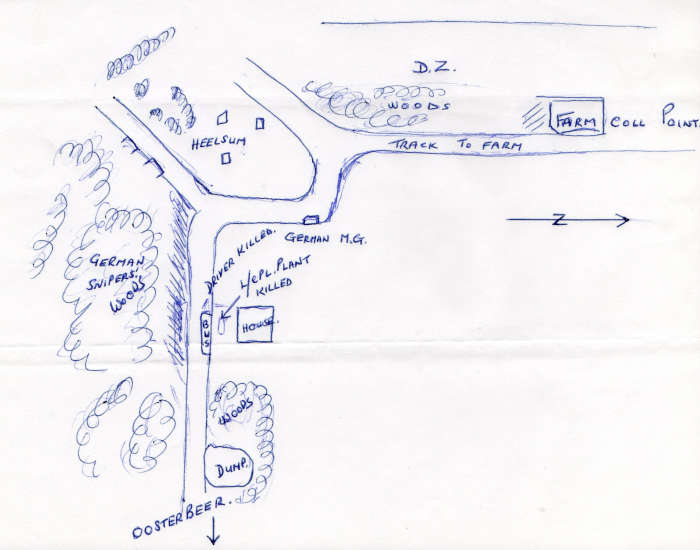
Sketch Map of the bus ambush point. 18th September 1944. Courtesy Jack Taylor.
Born on the 31st January 1917 and enlisting on the 2nd January 1941, Cpl. Harry Symmons, had been with the Company since the 8th March 1941, and he later confirmed: "Previously wounded - believed killed:- T/83849. L/Cpl. L. Plant (KIA) during one engagement on outskirts of village Heelsum, 5 or 6 miles N.W. of Arnhem at approx. 12.10 hrs on Monday, 18th Sept 44. Myself (Cpl. H. Symmons), L/Cpl. A. Hurst, Dvr's. N. Alcock, E. Zambonini, [J.A. Taylor], A.E. Start, & an Irishman (whose name I am unable to remember) were captured there. L/Cpl. Hurst who was with L/Cpl. Plant when he was hit, will be able to offer a more accurate account than I." [3]
Dvr. Arthur 'Ned' Start related what happened, many years later; "The bus driver had insisted that if we were captured by the Germans he would say that he was forced to work for the paras. L/Cpl. Plant took cover behind a tree as the Germans were firing an machine gun at the bus. L/Cpl. Plant was hit in the neck by small arms and was killed. Myself and the rest of the Section made our way to a nearby house and a vicious fire fight broke out. With all the ammo used the only thing we could do was wait for the Germans to come. I was expecting a grenade to come through the window, but it never came. The door was kicked in and the Germans forced us out. We were taken to a barn and interrogated by a senior German officer". [3b]
L/Cpl. Leonard Plant was initially buried by Dutch Air Raid Wardens at the Onder de Bomen General Cemetery at Renkum.
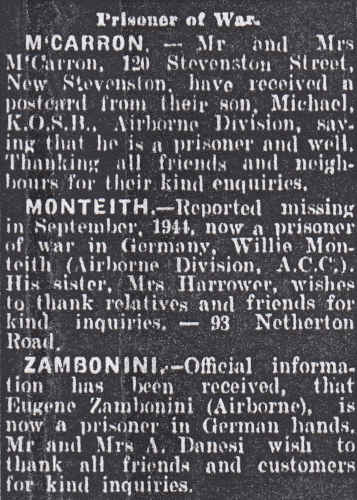
Newspaper clipping from a Scottish newspaper (circa October/November 1944) about prisoners of the 1st Airborne Division from the Battle of Arnhem - third one down is reference Dvr. Eugene Zambonini. Courtesy Alistair Taylor.
FOOTNOTE: The Irishman that could not be named by Cpl. H. Symmons in his account of the bus ambush is possibly T/6984399. Dvr. J.J. Glenn, from Enniskillen, Co Fermanagh, who was taken POW & sent to Stalag 4B, 91874. He is the only man from No 1 Parachute Platoon that is listed as having an Irish home address, that was also taken prisoner.
In less than 24 hrs, 250 Company had three men killed, and at least a dozen wounded and taken prisoner, and a complete platoon - No 3 Parachute Platoon - of approx. 34 - 36 men, cut-off, out of the approximately 76 that had landed. No 1 Parachute Platoon was beginning to find itself very isolated.
The crossroads of the Utrechtscheweg and Telefoonweg, just to the West of their position was held by 'D' Company, 1st Bn, The Border Regiment. They were protecting the Southern end of what had been D.Z. 'X', but was now to be a landing zone for the 2nd Lift of gliders, and they were being hard pressed by German Forces approaching from the South through Renkum. The next nearest friendly units were 'C' Company, 1st Bn, The Border Regiment, and No 1 Light Battery, R.A., but they were 2 kms East of the farm. The War Diary of the Border Regiment noted that: 'D Coy were mortared and attacks by enemy platoons throughout the day, but repulsed all attacks with help of Light Battery firing on Laura 6378.' This was the wood to the North of the Klein Zwitserland Hotel, and was where the fire had come from onto the farm at Klein Amerika.
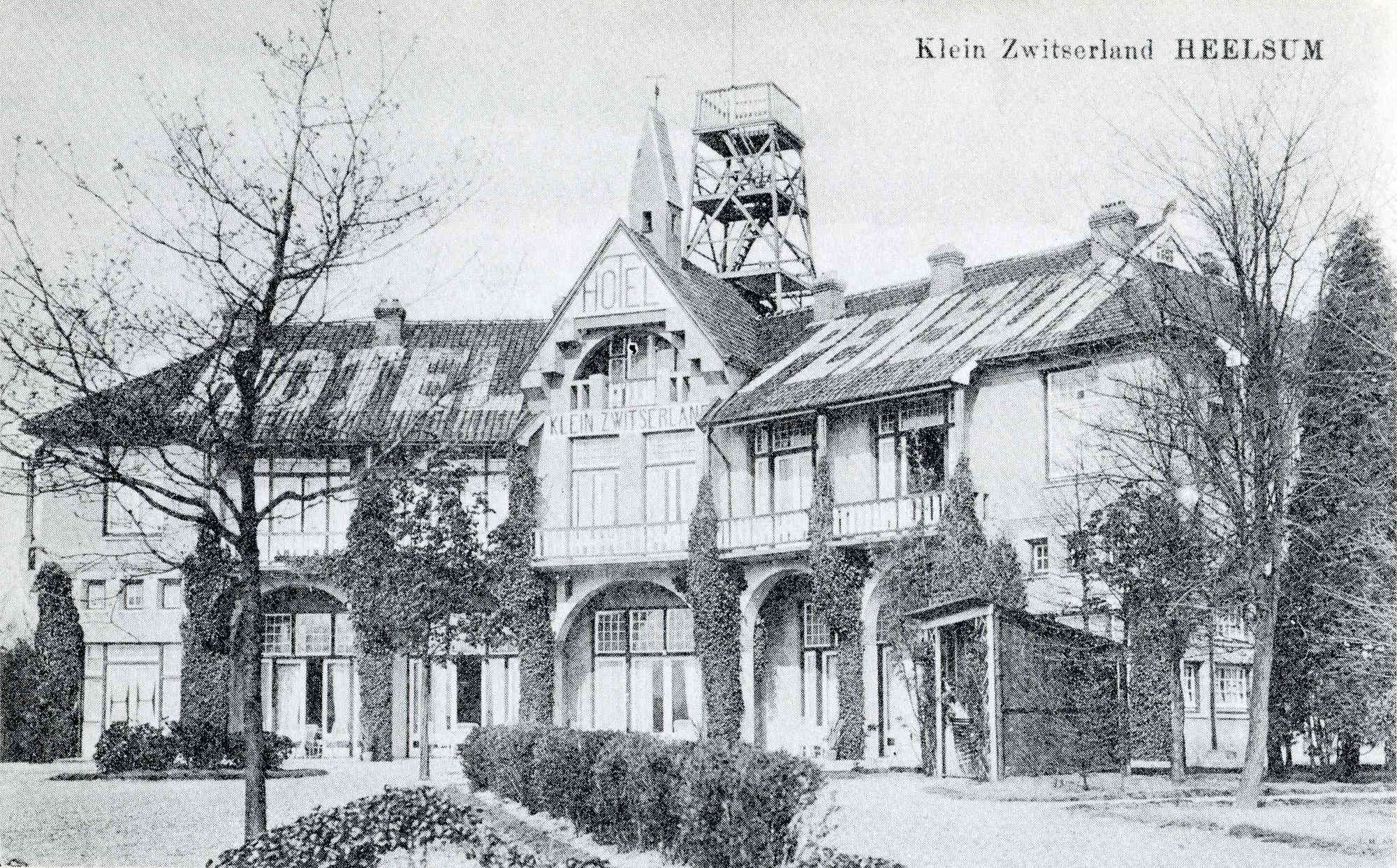
The Klein Zwitserland Hotel, Heelsum, circa 1900. This photo clearly shows the watchtower that overlooks the wood 'Laura' behind the hotel. This would have made an excellent Observation Post. Courtesy Renkum & Heelsum in Old Postcards.
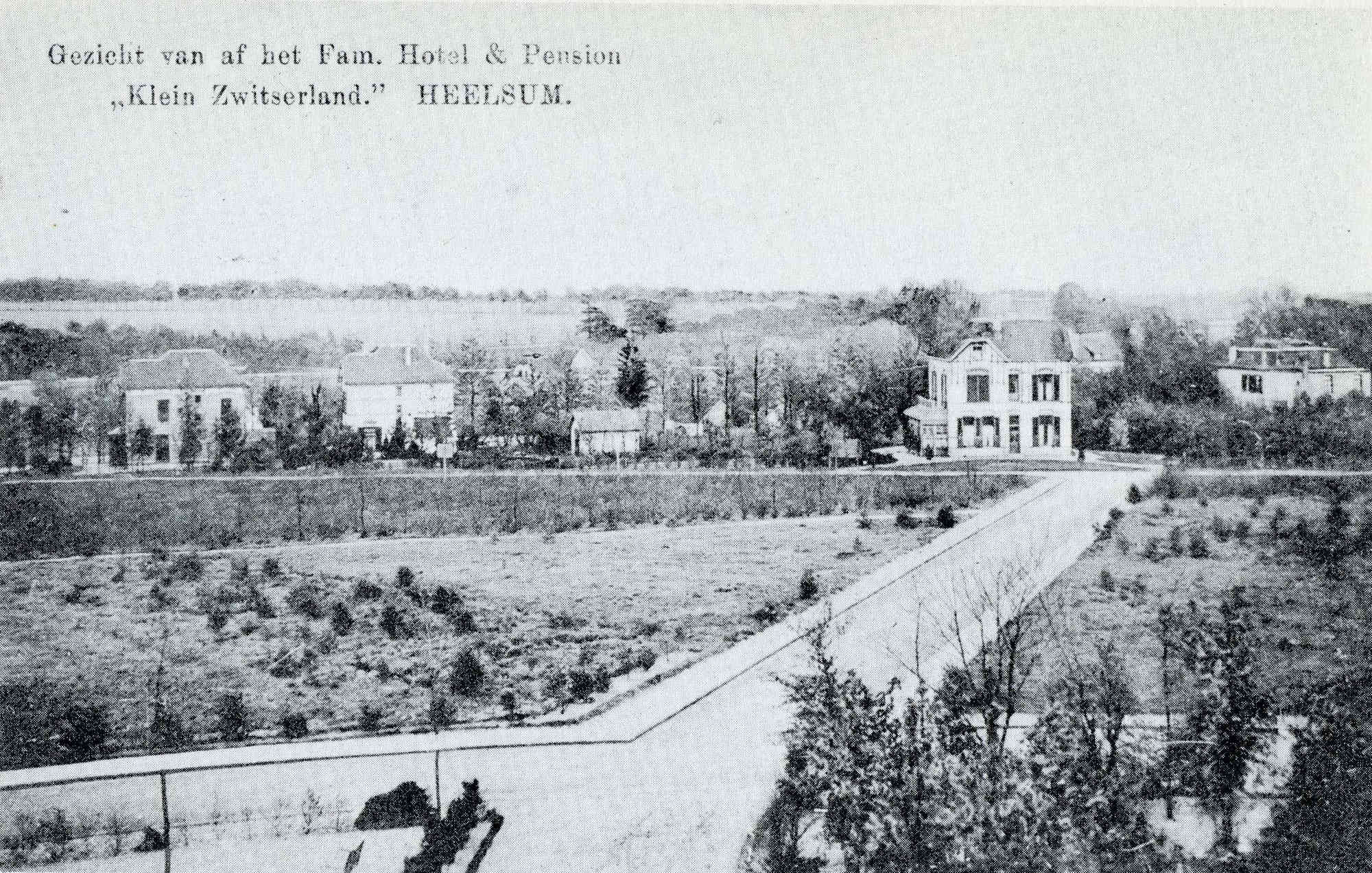
This is the view directly south from the top of the Klein Zwitserland Hotel, along Narcislaan, and onto Utrechtsestraatweg, circa 1900. The bus used by the men of No 1 Parachute Platoon would have driven from right to left along the Utrechtsestraatweg. Courtesy Renkum & Heelsum in Old Postcards .
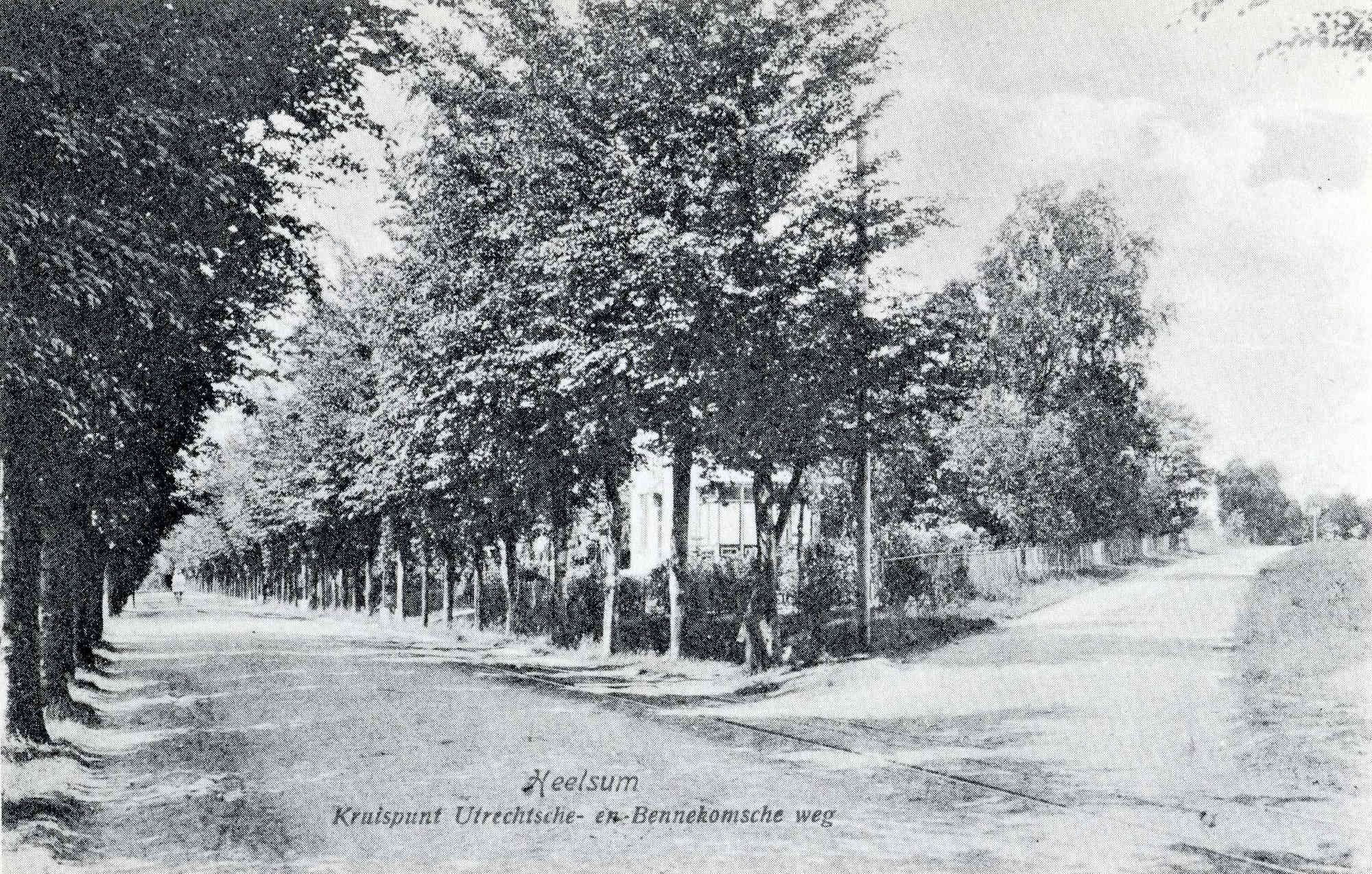
On the left the Utrechtsestraat, which goes through Heelsum towards Lower Renkum. On the right the Bennekoscheweg, which goes towards the Telefoonweg, past Klein Zwitserland and Klein Amerika Farm, circa 1900. Courtesy Renkum & Heelsum in Old Postcards .
'B' Company, 1st Bn, The Border Regiment had been cut off in Renkum, and a patrol from 'C' Company was sent to try and get through to them. Lt. Alan Roberts, 18 Platoon: "Monday, 18th, I was sent out with my Platoon towards Renkum, because one of our Companies hadn't been traced since the previous day. We failed to get through because of opposition. We were then told to go through to Heelsum. There was a lot of firing on the way and we suffered several casualties. We were at first overwhelmed by people trying to give us tea, cakes, etc, from all the cottages we passed on the road to Heelsum. We met up with other members of the Company and went back along the road towards Oosterbeek. A vehicle passed with some paratroopers on board, then ahead of us we heard a lot of shooting and we came across several bodies of soldiers by the road." [4] This incident obviously refers to the bus being used by No 1 Parachute Platoon, 250 Company.
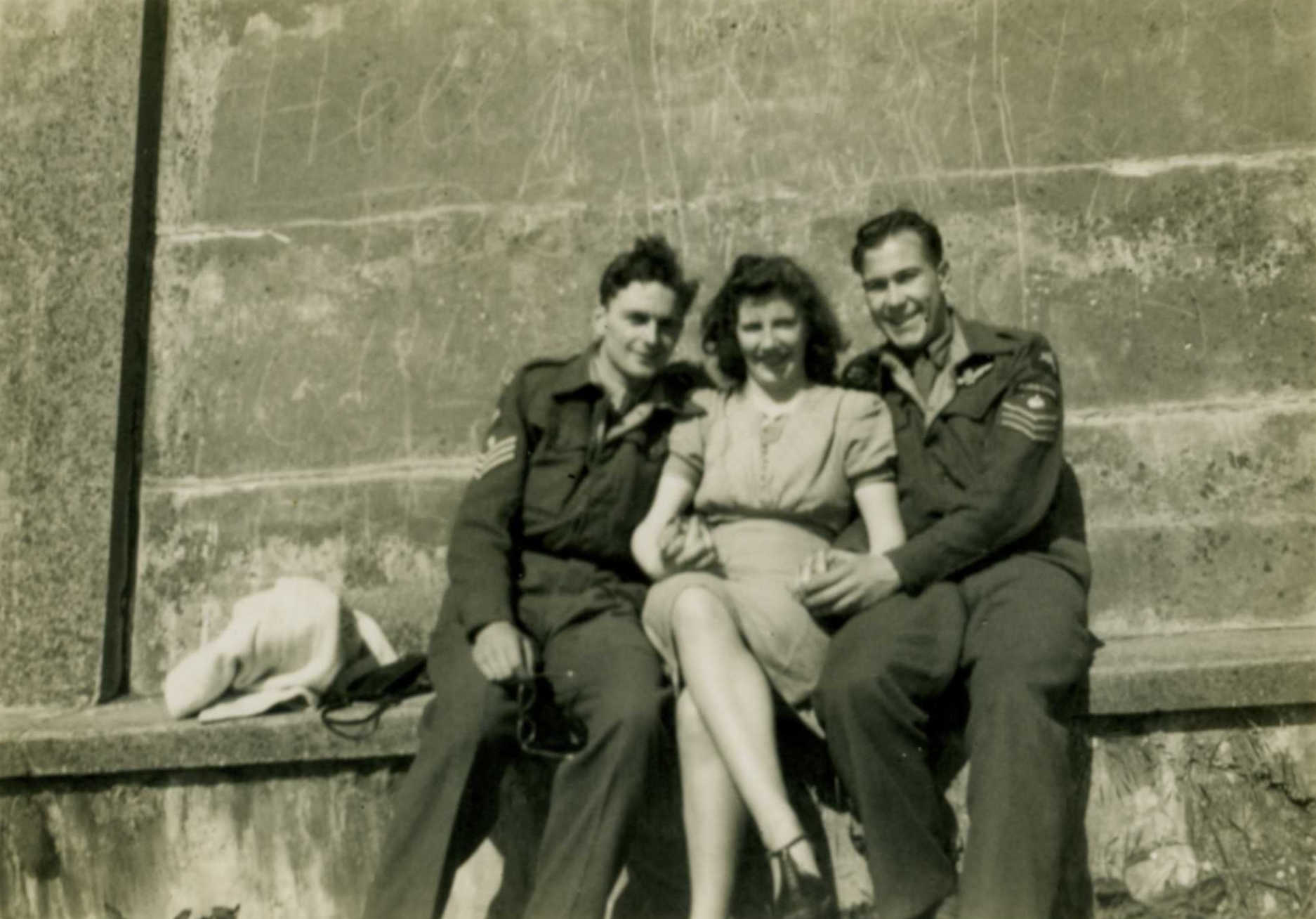
Sgt. Norman Ramsden, his wife and S/Sgt. Ted Ralph, of 17 Flight, 'A' Squadron, The Glider Pilot Regiment. 1944 or 45. Courtesy Ted Ralph.
No 3 Parachute Platoon, and their much reduced Transport Section, had reached the Bridge area, under the command of Capt. 'Bill' Gell; "The ammunition that we brought with us to the Bridge in our Jeeps and trailers was, so it turned out, invaluable for the Units at the Bridge. Then, on orders from Major Hibbert, we took up a defence position on the North-West of the perimeter facing Arnhem Prison, and with Brigade H.Q. to our rear." [4b] The building they were placed in, was behind that of the Water Works Offices, and covered the perimeter from the North-West through North, to the North-East. The men were spread throughout the building, and some would find themselves in strange defensive posts, Dvr. Jason Leslie 'Les' Ransom, 'found about 8 of his outfit and they ended up in the toilet of some council offices. He ended up in this bathroom for 4 days with nothing to eat and no water, and ended up drinking water from the radiators.' [4c] However, it depended where you were posted in the building as to what action you experienced, Dvr. Thomas Jones; "We were sent to some buildings to take up a defensive position. It was quiet for two days, very little happened." [4d] This situation was not to last.
Dvr. William 'Bill' Mitchell, who had been with the Platoon since September 1942: "We went by glider on the 17th September and made a very good landing at Wolfheze Heath. Thereafter, we marched 8 miles towards the bridge without much incident due to the fact that the 2nd Para Battalion were along this secondary road ahead of us. By the time we got near the bridge it was dark and a small German patrol came down a side street and immediately retreated without engagement. We spent the night in a building fairly near the bridge, and then took up defensive positions at Brigade H.Q. in the morning." [4e]
Only Capt. Gell, who had to report at regular intervals to Brigade H.Q., had any idea of the savage fighting taking place on the Bridge ramp area.
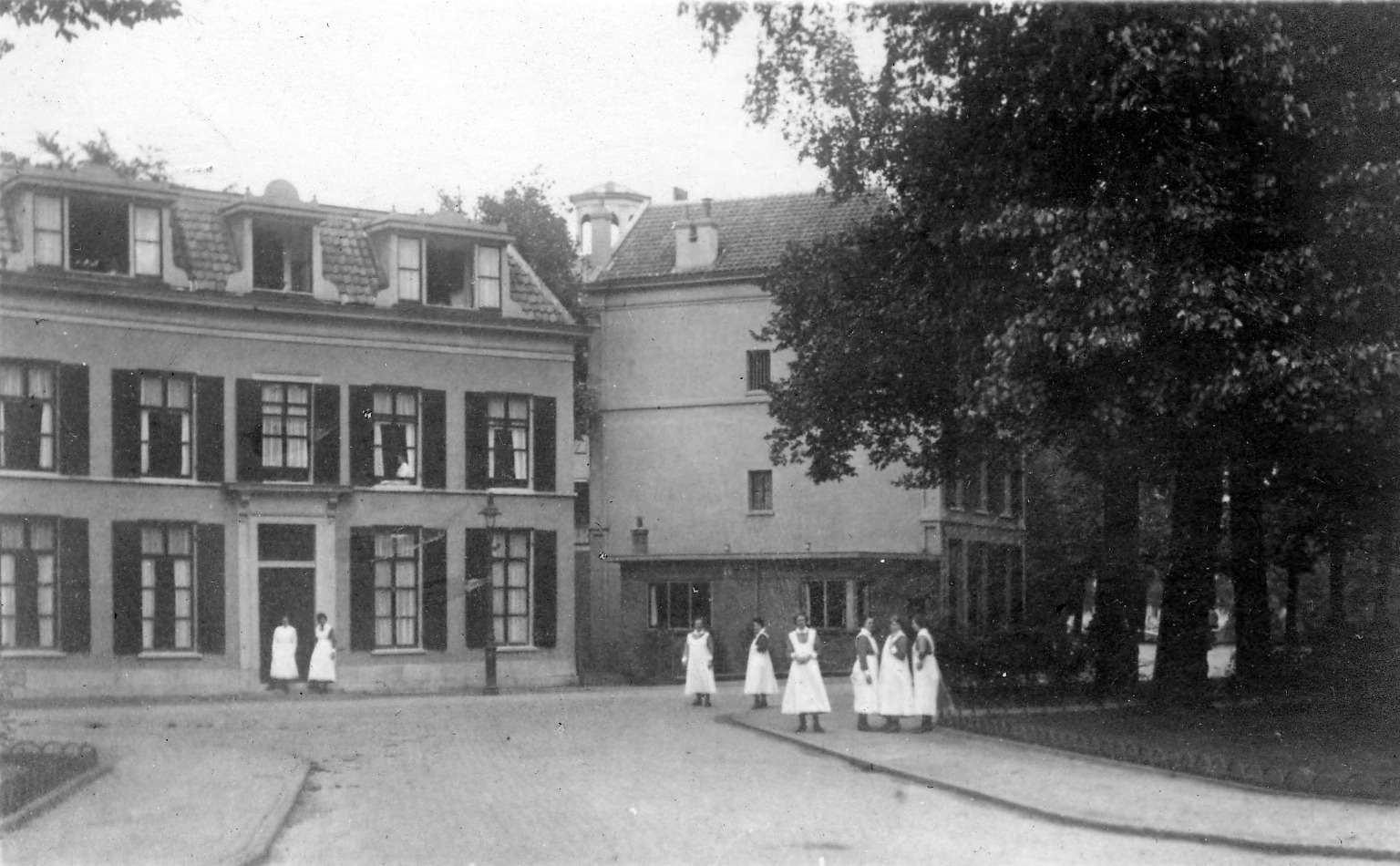
The Sisters of the old Municipal Hospital at the rear of the building circa 1920's to 1930's. The tower of the Hospital is just visible. This is what became the Public Works and Traffic building, where the 1st Parachute Brigade HQ was located in September 1944. The buildings behind the sisters were held by No 3 Parachute Platoon, 250th (Airborne) Light Composite Company, R.A.S.C. Courtesy Gelders Archief 859.
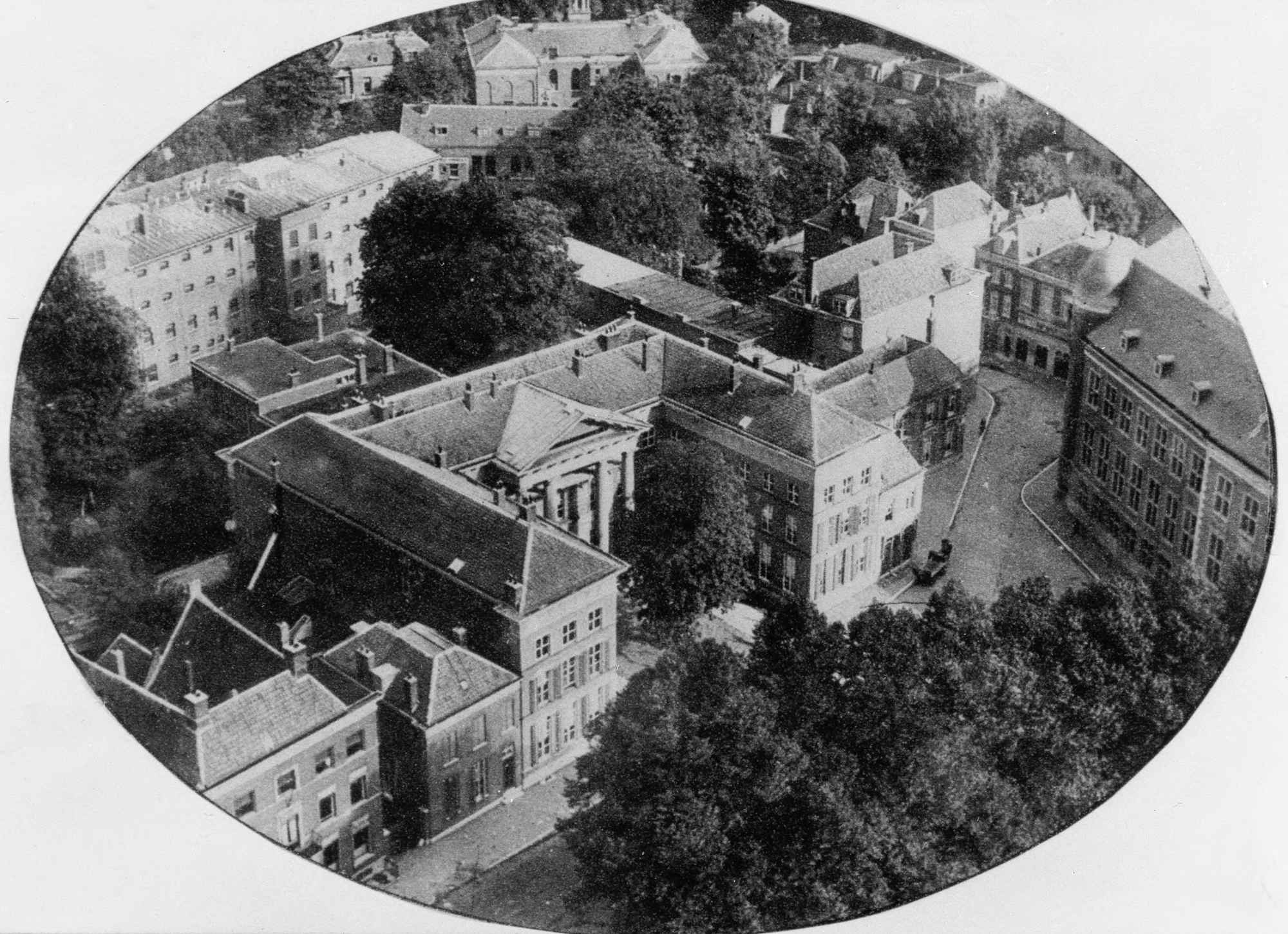
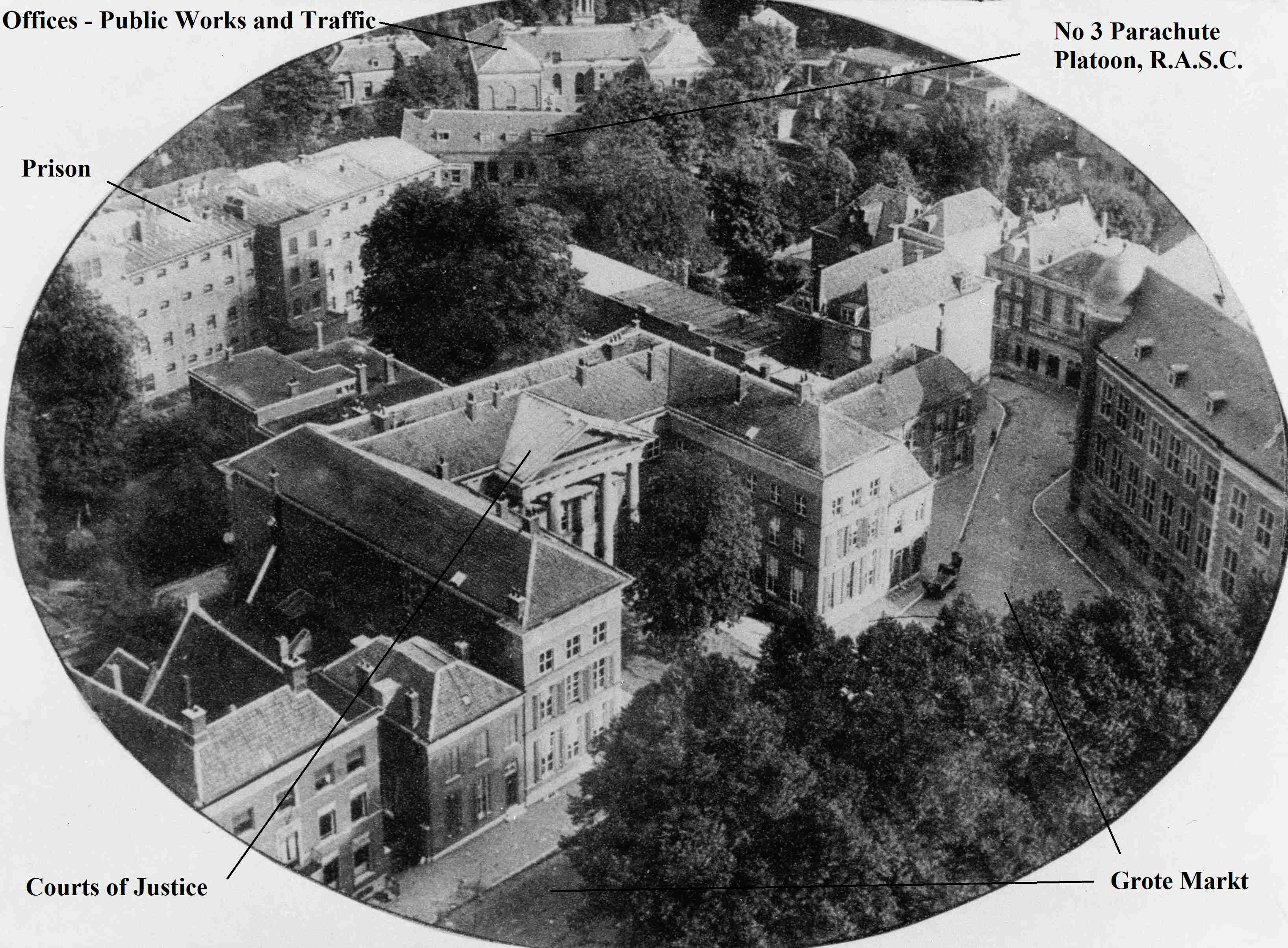
View of the Grote Markt (Grand Market) and surroundings. This view is from the Eusebius Church, and shows the rear of the buildings defended by the 1st Parachute Brigade H.Q., the Defence Platoon and No 3 Parachute Platoon, R.A.S.C. Photo taken between 1930 and 1940. Courtesy of Gelders Archief 1501-04-7761.
Everyone had been waiting for the arrival of the 2nd Lift, due at 11.00 hrs, but that time had come and gone, and there was still no sign of it - an unwelcome appearance was put in by the Luftwaffe at this time, as they fired on the empty gliders and inflicted a few casualties, but none to the R.A.S.C. men. However, at 15.00 hrs the sound of friendly aircraft engines was heard by those desperately holding positions covering the dropping and landing zones, and into view to the south of D.Z. 'Y' came the Dakotas carrying the 4th Parachute Brigade. They began to drop at 15.06 hrs and within just twelve minutes, all aircraft had crossed the drop zone. This time the R.A.S.C. men were grouped together and No 2 Parachute Platoon jumped from aircraft No's 635 and 636 (part of Serial A-31), of the 50th Squadron, 314th Troop Carrier Group, U.S.A.A.F. flying from Saltby aerodrome.
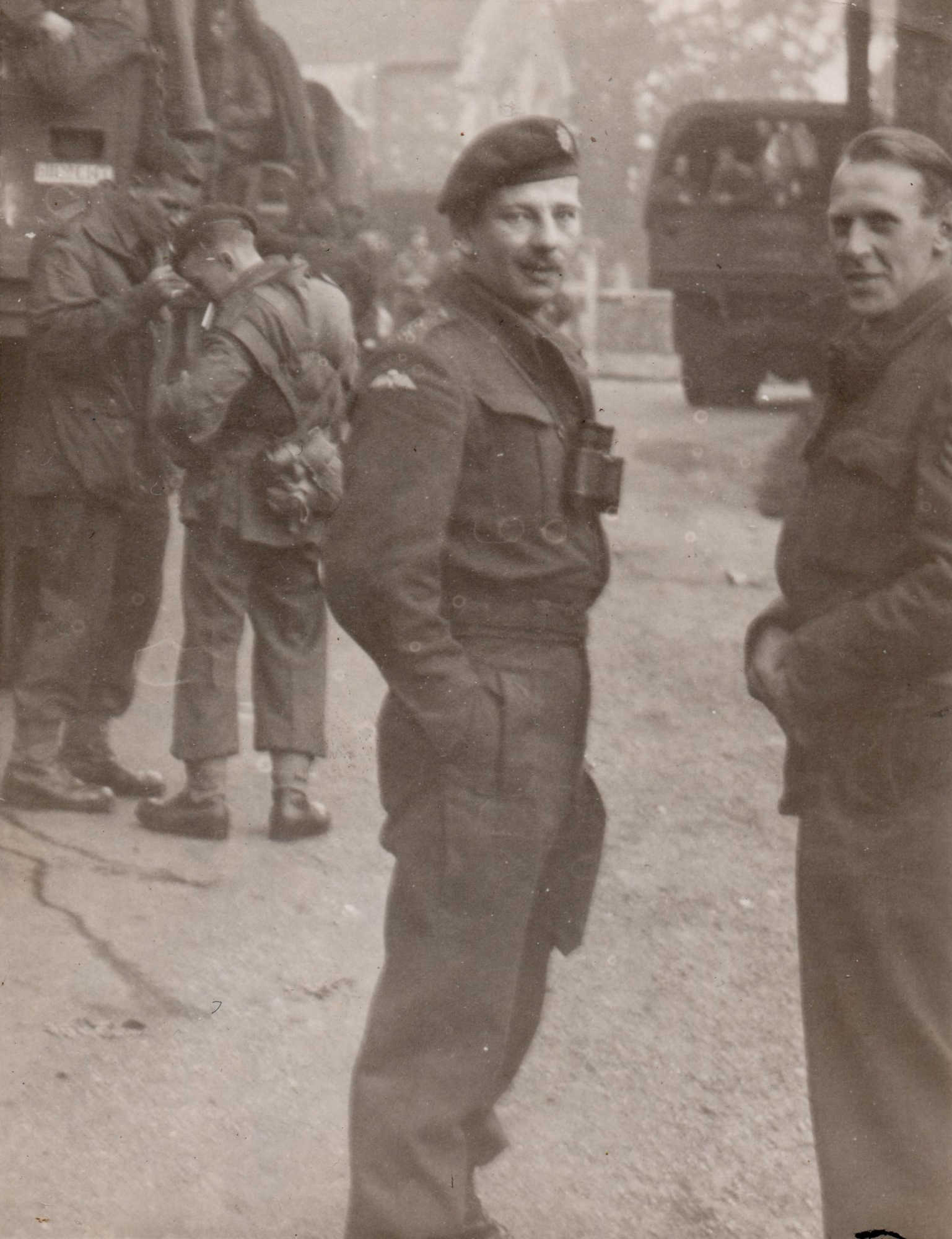
'Capt. C.R. Harkess, 4 Para Bde HQ at Knossington before leaving for airfield, September 18th.' This was written on the back of the photo by Capt. H.B. 'Jasper' Booty, of the 4th Parachute Brigade H.Q., who had taken the photo. Courtesy Airborne Assault Museum Archives.
The reception on drop zone 'Y' was somewhat different to that of the day before, with a lot of enemy fire coming up at the aircraft, and the men once they had jumped. Dvr Kenneth William Clarke, who was 21 years old, and had joined the Company on the 17th September 1942, after just under a year in the Army, "I took off from Saltby on Monday the 18th September 1944, we were the second wave of paratroopers to land on Ginkel Heath, to the north of the previous days D.Z., and north of the railway line, between Arnhem and Utrecht. The German defence by now had been well reinforced and our drop from the sky was, to say the least, very hectic. I saw some of my friends killed by tracer bullets and shell fire before they had even reached the ground. In our instructions, before leaving England, we were given a colour flare as our assembly point on landing. Our colour was blue. Once on the ground we made our way to the blue flare as quickly as possible. The assembly point was slightly to the north of the D.Z., near to a small wood. I had a poor drop and landed on my back. As I was carrying the kit-bag with the Bren gun and ammunition, etc. I was also on the opposite side of the D.Z. from the flare. When I at last caught up with the main body of 250 Company, they had already had a set-to with some Germans in the small wood." [5]
The jump and subsequent action is further remembered by Dvr. John William Prime, "After a late take off, the second lift started landing at approximately 14.00 hrs [15.00 hrs local]. This included my own platoon No.2 Para, commanded by Capt. D.T. Kavanagh. On leaving the plane, I realised that all was not well. At the dropping zone, where we were to land, men who we found out to be members of the K.O.S.B were fighting an action, and trying to secure the dropping zone as we were landing. On reaching the ground, our platoon rendezvous point was a blue smoke flare. Crossing the D.Z. was a hazardous time, as German machine guns were sweeping it with heavy fire, plus 20 m.m. cannon shells. Two members of our platoon were instantly killed, and others were wounded even before reaching their rendezvous." [6]
Dvr. Prime is slightly mistaken about the numbers that were killed on the D.Z. Although several men were reported as missing at the R.V. Point, only Dvr. John Joseph Kennell would later turn out to have been killed.
Dvr. John Edward McAndrew was born on the 1st March 1910, and came from Bolton In Lancashire. Before he enlisted, on the 24th November 1938, he had been working as a Driver. He was posted to the Company on the 16th June 1942, and initially served in 'B' (M.T.) Platoon, before going on to serve in No2 Parachute Platoon. "After serving with 1st Airborne in North Africa, and Italy, the next operation was the big one - Arnhem. I had never heard of the place until I dropped by parachute on September 18th. Our dropping zone was near Ede. My mate was killed as soon as he touched down [Dvr. J.J. Kennell]. The first landing on the 17th had been fairly quiet, but when we landed the Germans were waiting for us. We came under fire from mortars and machine-guns. After combing the woods for the enemy we moved off towards Arnhem, eight miles away." [6b]
Twenty one year old Dvr. John Green had been with the Company since the 10th July 1942, and had initially served in 'B' (M.T.) Platoon, before joining No2 Parachute Platoon, "I knew this wasn't just another flap. The first bunch had left for Holland, so we knew this was it! It's a pity that op's always have to get you out early in the morning especially when it's misty and cold - and this op. was just the same. We had a twenty-five minute trip to the airfield, and visibility was so bad there that we didn't know whether to hope it would be off, or to get cracking at once and not just put off the agony. Anyhow, it had to be on. The first bunch had gone. They must have done quite a bit of fighting by now. So, we couldn't be kept back. All the same we found we were not leaving at 7.30 as we'd thought; and we were kept hanging about miserably, until midday. At least, we thought we were miserable! Later on, we knew what being miserable really meant-when you had time to think about it.
Anyway, off we went at midday, and the chaps were pretty quiet in the plane. We were all from the same mob, except for a Ringway Instructor who'd just come "for the trip." It's funny what some people's idea of a trip is!
We smoked a bit, and some of the lads sang paratroopers' songs - though sone of us wished they wouldn't, because we felt they did it to show they weren't feeling scared, and we knew you couldn't be human without feeling just a bit rum in the turn. However, except for the singing, it was pretty quiet at first: we could see the Channel, we could see the ships down below, and suddenly we heard some shooting up. We were O.K., but we saw a couple of planes behind us go down, and somebody said: "There go some poor beggars! Still, they'll be back in Blighty before we are!" There wasn't quite so much singing after that.
I don't know much geography, but I recognised Holland all right. You could tell it by the floods. A glider had landed in them, and we could see the blokes hanging on to her. I wonder what happened to them? I expect they got put in the bag. We were all surprised not to be shot up more over Holland, but there was very little nonsense until we were right over Arnhem. Then we heard stuff hitting the bottom of the plane, but, thank God, nothing came through. Still, it made you feel a bit uncomfortable, and I suddenly realised I was nervous. You see, I always used to wear gloves for a drop, because letting my kitbag down used to hurt the hands; and when I tried to pull a glove off to get a handkerchief out of my pocket - for I realised my forehead was sweating like anything, I just couldn't get my glove off. My hands were wet through with sweat, and my gloves had stuck. So, I had to mop up with my smock. It didn't matter, because it got much muckier later on.
It seemed to take a bloody long time to get to the D.Z. after Arnhem, and when the order, "Hook up!" was given we were all glad to have something to do. It wasn't long then before we got "Two minutes to go!" and were all ready for it. There was a roar of engines as I jumped, and as they died away I could hear automatic fire from the chaps below as I went down. It was a bit windy, and when I landed I was dragged along a few yards on the wet ground. Hell! This bloody release-box is clogged up with mud. Phew! That's done it! Good! Anyhow, our aircraft's getting away nicely, he's going pretty strong. Some nasty landings. Look at those poor beggars in the trees. That chap's going to - damn! He's hit a telegraph wire. Where's this blue smoke we heard so much about?
Well, I couldn't find any blue smoke, and the other chaps couldn't either. So, we joined the biggest mob going, and I recognised several of the blokes from the battalion we were with, so it seemed the best thing to do." [6c]
Dvr. Cyril 'Jack' Cooper was another experienced member of the Company having joined it on the 17th February 1943, and had served in North Africa. Born in 1919 he had also done his parachute course in North Africa. During one of the reorganisations of the Company in 1944 he was moved from a Transport Platoon to No 2 Parachute Platoon. In September 1979 he was interviewed for the Lincolnshire Life magazine, in which he described the experience of jumping from the aircraft with enemy fire coming up at them, and then the landing on the drop zone, whilst under fire: "It was chaotic and confusion reigned everywhere and I had great difficulty making for the yellow [blue] smoke signal, for the firing was continuous". [7]
Although the procedure, mentioned by the men, was to R.V. on the blue smoke flare, this was not quite as simply done, as it was planned. This is explained by the 4th Parachute Brigade Commander, Brig. John Winthrop Hackett; "Considerable small arms fire on D.Z., and apparently an engagement proceeding on South or South West and possibly South as well as mortar fire occasionally. Had some difficulty in collecting myself and then numbers of Brigade H.Q. all of whom scattered and rather confused. No sign of Advance Group and no blue smoke in view. After 10 minutes, or so, saw 10th Battalion's green smoke South of main road. Found Capt. Temple (the Brigade GSO. III) and told him to set up blue smoke at about 627838 and R.V. there. House just to North occupied by enemy." [8]
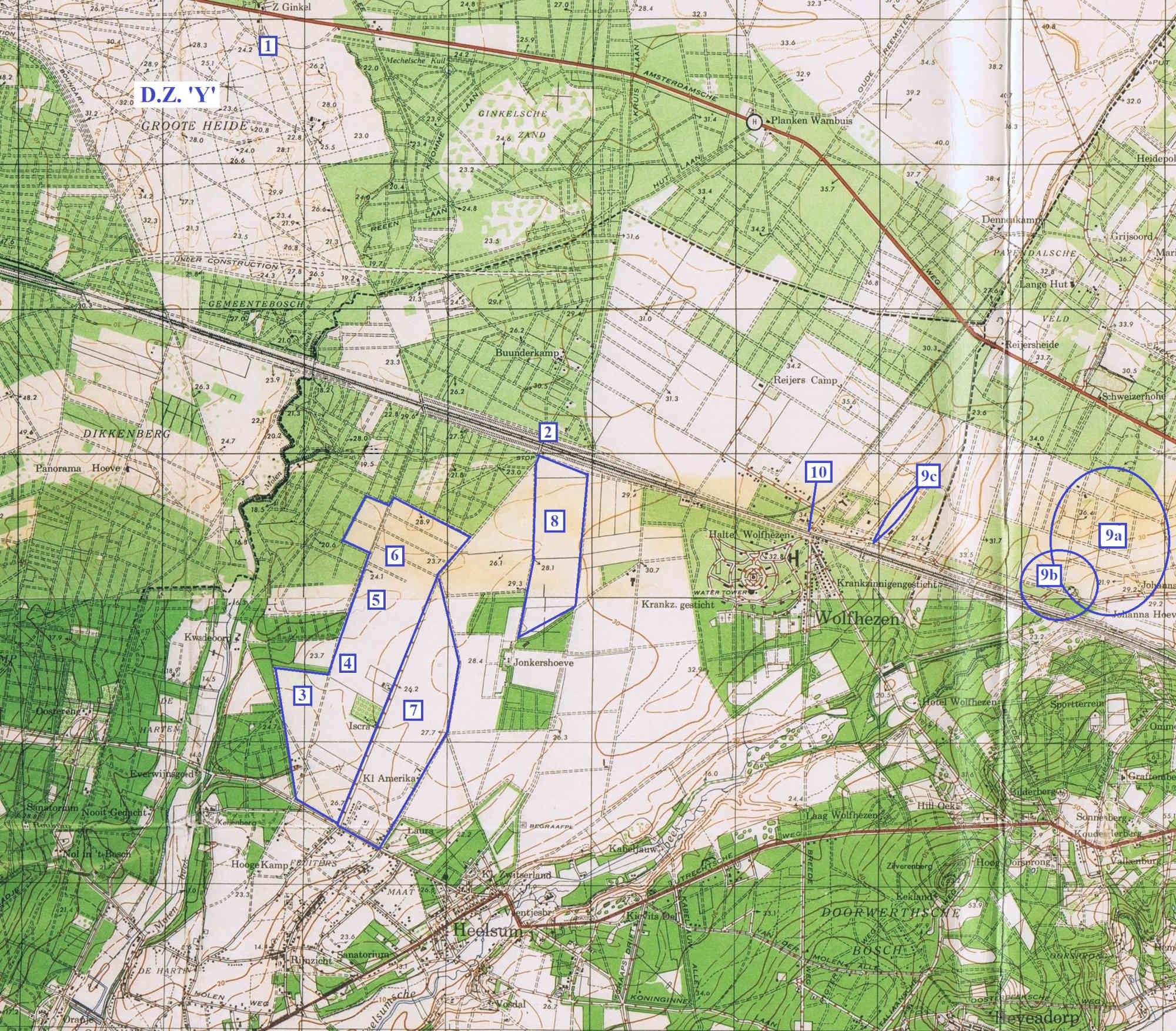
RASC Landing Zone's, Drop Zone, and Supply Dropping Point. 18 September 1944.
KEY TO MAP 2nd LIFT, S.D.P. ON L.Z. 'L', AND MOVEMENTS.
[1] R.V. point for No 2 Parachute Platoon.
[2] No 2 Parachute Platoon overnight position.
[3] Landing area for gliders from R.A.F. Broadwell.
[4] Landing area for gliders from R.A.F. Down Ampney.
[5] Landing area for gliders from R.A.F. Blakehill Farm.
[6] Landing area for gliders from R.A.F. Tarrant Rushton.
[7] Landing area for gliders from R.A.F. Fairford.
[8] Landing area for gliders from R.A.F. Harwell.
[9a] S.D.P. 'L' - planned.
[9b] S.D.P. 'L' - actual.
[9c] Stray re-supply drop.
[10] R.V. point for main R.A.S.C. Party on 2nd Lift.
Capt. Kavanagh would have approx. 30 - 32 men available, and a very good Platoon Sgt to organise it. Ronald James McDowell, from Chadwell Heath in Essex, was 25 years old and had enlisted on the 1st February 1940, being posted to the original No 4 G.H.Q. Company, R.A.S.C. on the 26th June 1940, when it was formed. He had remained with the Company throughout its many transformations, and had served in North Africa and Italy.
Hard on the heels of the parachute drop, was the glider landing. This would see the main R.A.S.C. effort in support of the operation, with over thirty gliders allocated, but flying from six different airfields. The sequence of take-offs and landings was as follows:
Horsa glider No 793, had been allocated to the H.Q., R.A.S.C., and was carrying a Jeep, two trailers and two personnel. This was probably carrying Capt. Benjamin Winter-Goodwin, who had been allocated to 250 Company from H.Q., R.A.S.C. with a driver, for the operation. It was flown by glider pilots of 'D' Squadron, flying from R.A.F. Blakehill Farm, towed by 437 Squadron, R.A.F. It landed intact, on L.Z. 'X'.
Horsa gliders No's 835 and 836, each carrying a Jeep, two trailers and probably four men, was flown by glider pilots from 'F' Squadron, from R.A.F. Broadwell, towed by 575 and 437 Squadron's, R.A.F. As far as is known, these two gliders also made it intact to L.Z. 'X'.
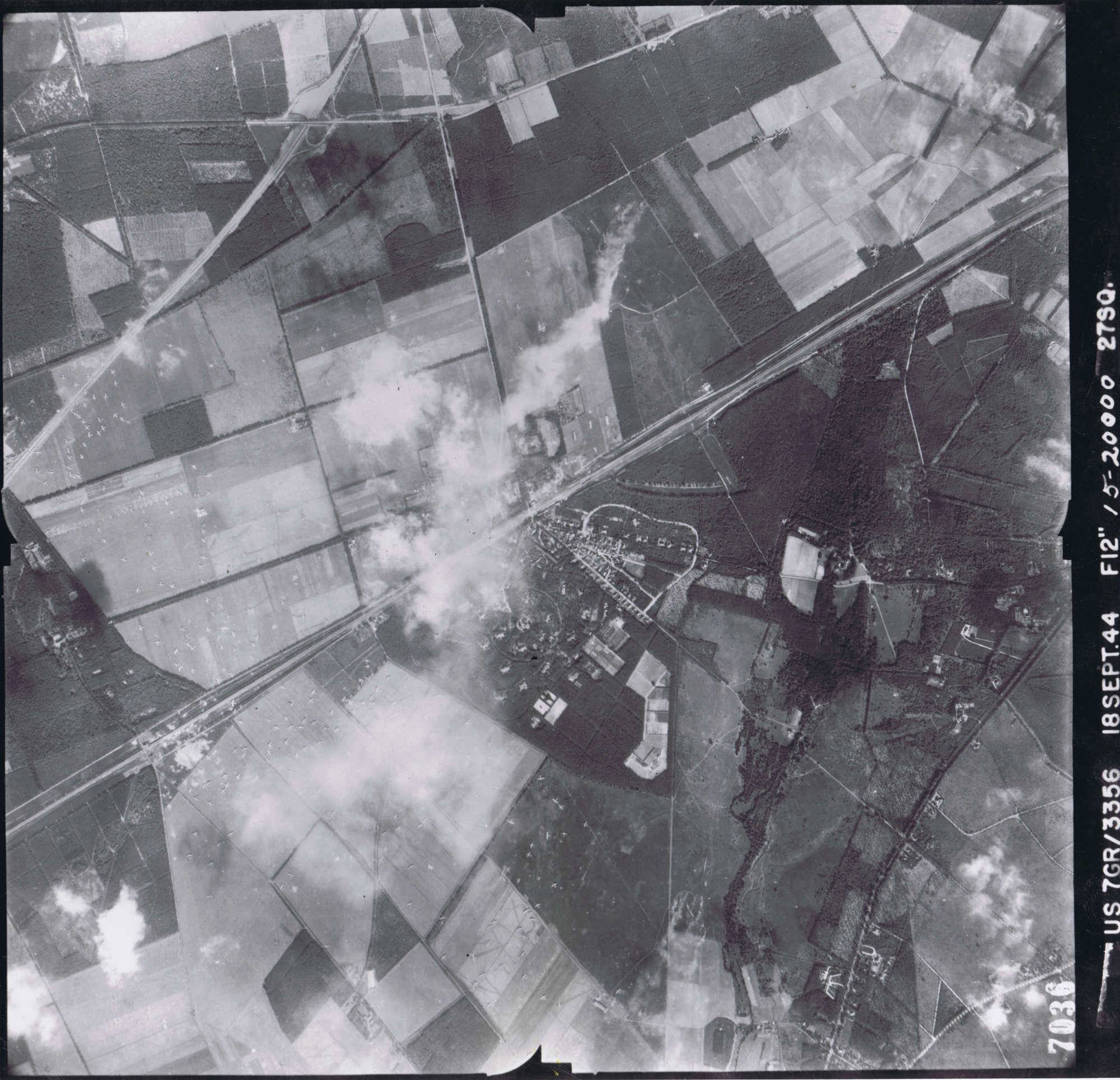
Aerial photo of the L.Z's and Wolfheze. 18/09/44. Courtesy of Gelders Archief.
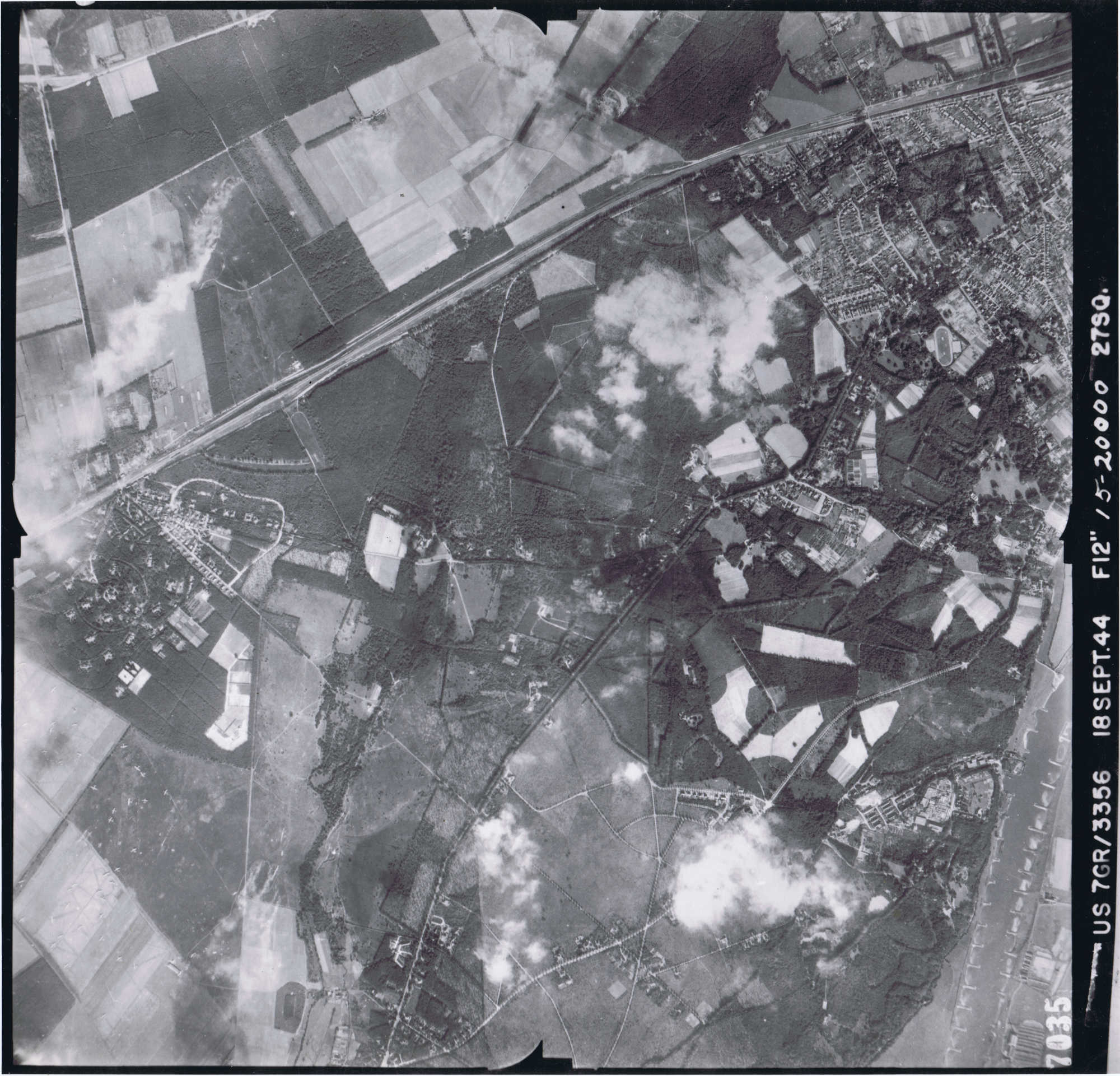
Aerial photo of the LZ's, Wolfheze and Oosterbeek. 18/09/44. Courtesy of Gelders Archief.
Horsa gliders No's 853 to 858, carrying a total of six Jeeps, twelve trailers, and twenty four men of an extra Section from 'D' Transport Platoon, 250 Company. They were flown by glider pilots of 25 Flight, 'E' Squadron, from R.A.F. Down Ampney, towed by Dakota aircraft of 271 Squadron, R.A.F. All of these gliders made it intact to L.Z. 'X', but it was not all 'plain sailing', as related by Sgt. Desmond 'Des' Page; "I did the usual glider training and joined 'E' Squadron early in May. I was lucky enough to team up with Stan Graham as my first pilot. He passed on all his experience and expertise to me. The squadron was over-crewed and I missed 'D' Day. I think they wanted to win! Along came Arnhem and Stan and I took off on the second lift, carrying a Jeep, trailer, a motorcycle and three men of the Royal Army Service Corps. We landed on Landing Zone 'X' towards the end of the afternoon and unloaded under fire. We didn't hang about. We moved to Wolfheze and the home for the blind there, where the inhabitants sang the National Anthem for us. Despite the odd bit of sniper fire we stood to attention, though I felt more like ducking down." [9]
Another pilot in this glider group was S/Sgt. Denis Hall, "I took off from Down Ampney on the Second Lift, i.e: Monday, 18th September. I cannot remember the Chalk Number, the landing was smooth and safe on L.Z. 'X'. My Second Pilot was Sgt. Bruce MacKenzie, brother of S/Sgt. 'Wally' MacKenzie in another Squadron. The load was a Jeep and two trailers of ammunition and Sgt. Edmonds, Cpl. Fairweather (nicknamed Cpl. Storm) and another, possibly Dvr. Alton [Arkell], all in the R.A.S.C. About a quarter of an hour before reaching the landing zone, the glider was hit by small arms fire from the ground - we were flying at about 2000 feet - and one bullet punctured one of the tyres on one of the ammunition trailers and another wounded Cpl. Fairweather in the calf (I think it was his right leg). We landed safely, got the load out and changed the wheel, and set off for Wolfheze, where Sgt. MacKenzie and I parted from Sgt. Edmonds, Cpl. Fairweather and Dvr. Alton [Arkell], and re-joined Lieut. Ron Johnson's Section." [10]
Cpl. Clifford Fairweather, who had joined the Company on the 24th December 1940, was wounded, by a gun shot to the right leg, and was initially sent to an Aid Station, before ultimately being sent to Apeldoorn, and the temporary 'Airborne' Hospital.
Hamilcar gliders No's 913 to 915, flown by glider pilots of 'C' Squadron, from R.A.F. Tarrant Rushton, and towed by 298 and 644 Squadron's, R.A.F. These were bulk loaded with stores, under the direction of Capt. 'Pat' Jerome, had twelve men on board, and were under the command of Capt. Winter-Goodwin. Although all landed safely, one of them came under fire and was not able to be unloaded. Sgt. Robert Simpson was a glider pilot of glider 914, and recorded some details of that day, "1st Pilot, Lieut. R.D. Goodman, 2nd Pilot. Sgt. R.J. Simpson. Load: Ammunition & explosives, R.A.S.C. On the flight over Holland our glider was hit by anti-aircraft fire, suffering a large hole in the wing, in front of the main spar. We left the landing area, after unloading, and made our way up the road to Oosterbeek." [11]
Horsa gliders No's 919 to 923, carrying five Jeeps, ten trailers and 15 - 16 men of 'D' Transport Platoon, attached to No 1 Parachute Platoon as their Jeep Section. These gliders were piloted by men of 17 Flight, 'A' Squadron, flying out of R.A.F. Tarrant Rushton, and towed by 298 and 644 Squadrons, R.A.F. All of these landed successfully on L.Z. 'X', and Sgt. Frederick 'Fred' Ponsford has given some details of his glider and load, etc, "My 1st Pilot was Lieut. Eric Markwick, and our load was a Sgt, three men, a Jeep and two trailers. Landing Zone 'X'. Time airborne = 11.35. Time landed = 15.55." [12] The Sgt was probably Victor George Brain, and along with Lt. John Grice, it would be their task to rendezvous with Capt. Cranmer-Byng, but there would be a problem with this, which we will come to later.
One of those from this Section that does not appear to have met up with the rest was Cpl. Samuel 'John' Staple. Married, and from Dorset, he had his 28th birthday on the 7th September, and had been a French Polisher before the war. He had enlisted on the 1st March 1940, and had been posted to the Company on the 26th June 1940. "On the 18th September 1944, we took off from Tarrant Rushton in a glider. The glider was carrying a jeep and trailer with ammunition. Except for the glider pilots, the only RASC men in the glider were my friend Dvr. Johnny W. Walford and myself. Our landing zone was 'Z' ['X'] close to the Wolheze Railway. As we cast off from our tug, our glider pilot was shot in the chest and collapsed over the controls. The glider nose dived and the second pilot shouted to me to pull the injured pilot off. I tried to but the pilot would not leave go off the controls. As I eventually pulled him back, the controls came back as well and the glider levelled off. The pilot then regained consciousness and shook his head and said, "I'm bringing her in". He did and made a lovely landing. With the help of the second pilot we got him out and sat him up against a tree. We then unloaded the jeep and trailer, we just had one trailer behind our jeep, by getting the tail off and went to our destination. We drove in the direction of the railway-line towards the village of Wolfheze. We encountered German machine gun fire, so we turned around and headed south towards the road which runs through Oosterbeek to Heelsum. When we arrived on this road, Utrechtseweg, we picked up two Dutch Underground men. They told us that the Germans were coming along the banks of the Rhine towards Oosterbeek. When we arrived in Oosterbeek, in the area of the Bilderberg Hotel as far as I can remember, we handed the two over to the Recce officer for interrogation and we went on to the ammo dump." [12b]
Another man from this Section of 'D' Transport Platoon was Dvr. Robert Oliver, who had been in the Army for just over a year, and had joined the Company at the beginning of March 1944. Later he gave an interview to his local newspaper: On Sunday, 17th September he, with other members of his Company watched our troop carriers and gliders taking men of his Division to Holland, knowing that the next day they were to follow. "We had a good night's sleep," he said, "because we didn't know how we should be faring for the next few nights, and as it happened, on the Monday night I was on guard all night at a driver's maintenance area not far from Arnhem. We had made the trip in a glider and had made a very good landing about two [eight] miles from Arnhem and four miles north of the River Lek. There had been a considerable amount of flak over the dropping zone and our glider had been hit, but very little damage was done and there were no casualties". He added that, after unloading the motor-transport, he had difficulty in starting up his jeep, but eventually it was running and the Company moved off to the drivers' maintenance area which was situated in a park. "Things were pretty lively", he said, "The main force of the Airborne Division, which had arrived on the Sunday, was pushing on to the town and there was plenty of shelling going on." [12c]
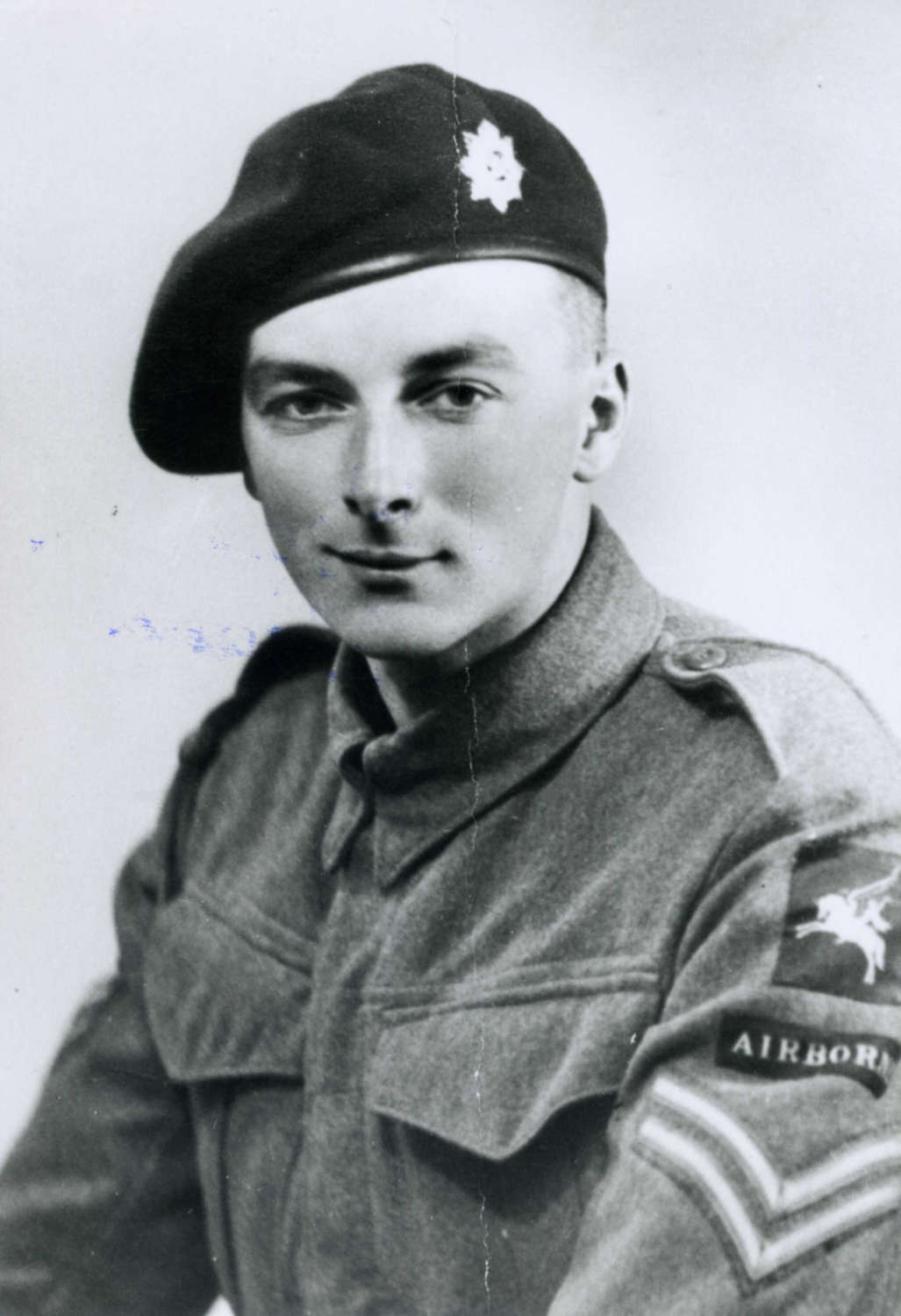
Cpl. Samuel Staple. 'D' Transport Platoon, attached to No 1 Parachute Platoon. Photo taken in 1942/43. Courtesy of Sam Staple.
Horsa gliders No's 924 to 929, carrying six Jeeps, twelve trailers and twenty four men, who had returned from the Seaborne Echelon, from 'C' Transport Platoon. The glider pilots were from 17 Flight, 'A' Squadron flying out of R.A.F. Tarrant Rushton, and towed by 298 and 644 Squadrons, R.A.F. Five of these six gliders made it to the L.Z. successfully. S/Sgt. William Meiklejohn gives a brief description of his circumstances leading up to that day, "I was a S/Sgt in 17 Flight, 'A' Squadron, stationed at Harwell. But, about a fortnight before the operation most of 17 Flight, was sent down to Tarrant Rushton and we left from there. My co-pilot was my regular, Sgt. D.J. Griffiths, and we had a beautiful, uneventful trip and a perfect landing, with no opposition - 2nd Lift. We carried a Jeep, and a trailer, filled with, I think, anti-tank ammunition." [13]
The crew of glider 926 have both left details of their load, flight and landing, S/Sgt. Edward 'Ted' Ralph, "I was a member of 17 Flight, 'A' Squadron, based at Harwell. However, a few weeks prior to "Market-Garden" we were sent down to Tarrant-Rushton and it was from there we took off for Arnhem on the 18th September 1944 (my 21st Birthday). My 2nd Pilot was Sgt. N.T. Ramsden. I'm afraid I cannot remember my Chalk No, but we carried, as far as I can remember, a Jeep, trailers and a number of [R.A.S.C.]. We were fortunate and had a text book landing at the L.Z., much to my passengers delight." [14] Sgt. Norman Thomas Ramsden, "2nd Lift from Tarrant Rushton, operational chalk number unknown, load = Jeep, trailer and members of R.A.S.C. Good flight and landing, unloading completed. Left the L.Z. and headed up to railway line, then joined procession towards Wolfheze." [15]
Glider 927 did not make it to the landing zone. Piloted by S/Sgt. H. Ranfield and Sgt. J. Bruce of 17 Flight, 'A' Squadron, and carrying a Jeep, two trailers and four men, had its tow-rope shot away by flak and came down at Wageningen, just on the North side of the Lower Rhine, and a few miles short of the landing zone. S/Sgt. Herbert 'Bert' Ranfield, "Rope shot off by ground fire [on the] Arnhem trip. We were off course and some minutes late, after rope went, I fence hopped in a field" [16] Sgt. Jack Bruce, "Glider load = 250 Light Composite Company, R.A.S.C. Glider number HG 453 from Tarrant Rushton, towed by Halifax. Tow rope hit by flak, force landed at Wageningen. 4 personnel on board, 1 killed on landing, the rest all POW. Took no part in action at Arnhem." [17]
Amongst the R.A.S.C. complement were Cpl. Stanley West, who was born on the 6th June 1916, and came from Pontypridd. He had enlisted on the 1st February 1940, and posted to the Company on the 26th June 1940. He had been one of those on the Sea Tail contingent, but sent back to U.K. when a further allotment of gliders became available. Dvr. William Taylor was wounded by the flak that hit the glider, but by far the worst casualty, was Dvr. Kenneth Geere, who had been quite seriously wounded and was quickly taken to Ziekenzorg Hospital, but unfortunately died of his wounds the next day. He was initially buried in the Wageningen General Cemetery.
On board one of this allocation of gliders, that did make it to the L.Z, was Cpl. Frank Bater, "September, 18th, 1944, I with others, went to Arnhem, by glider, I was then with Captain Cranmer-Byng, all under the command of Colonel Packe. We landed just off Oosterbeek with a Jeep and trailers, loaded with explosives and ammunition. Before going to Arnhem I was in 'C' Platoon with Captain Richard Adams - he did not go to Arnhem, that's why I came to be with Captain Cranmer-Byng. On meeting up with the others at the Railway Station, our main job was to feed the forward troops with extra ammo." [17b]
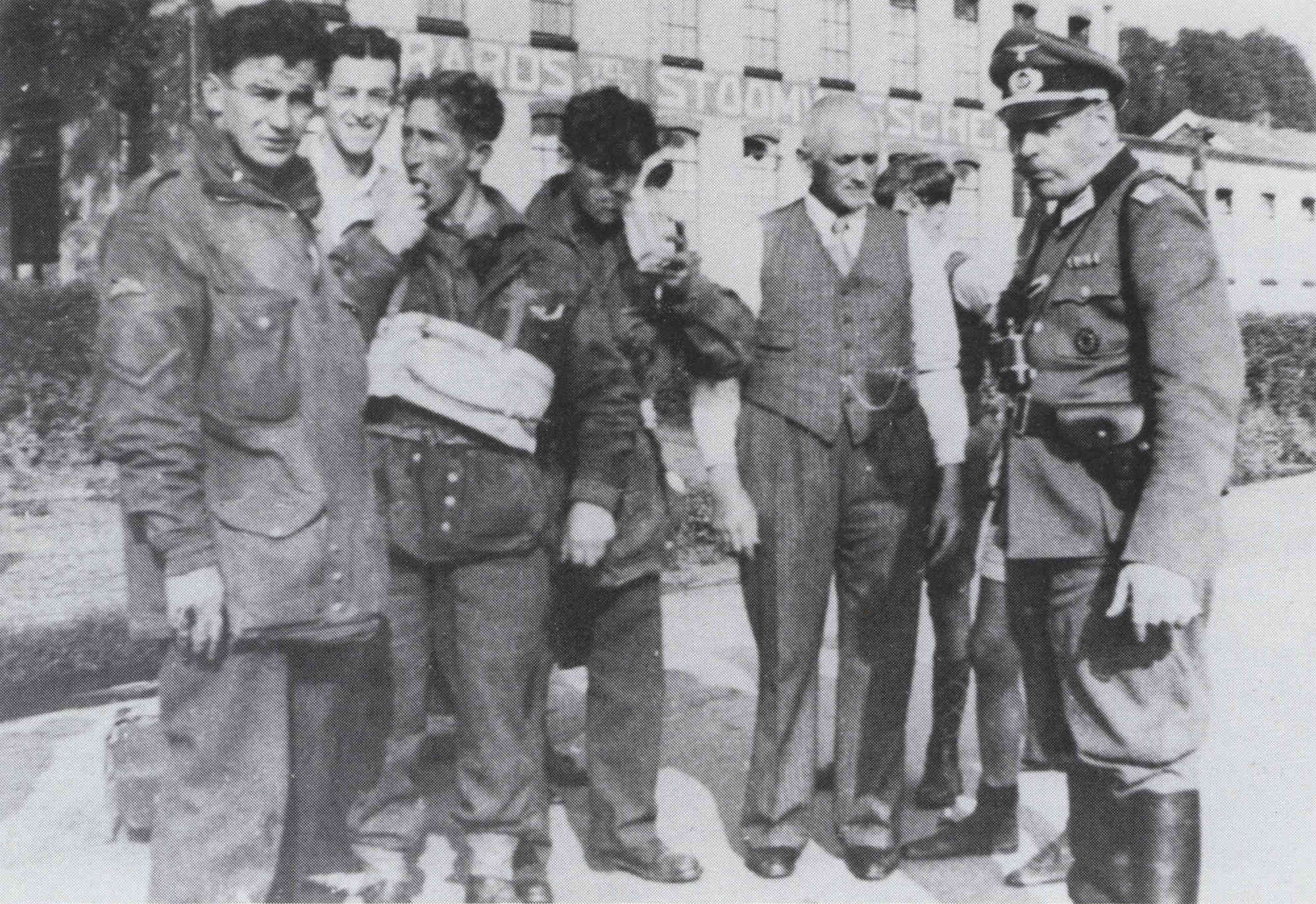
After glider 927 came down at Wageningen, on Monday, 18th September 1944, the glider pilots and passengers were quickly rounded up by German troops. They are photographed on the Veerweg in Wageningen. From L-R: This is possibly Cpl. Stanley West, RASC (even though he only has a LCpl's stripe!), an unknown civilian, Sgt. Jack Bruce, GPR (still wearing his lifebelt, and eating an a pear provided by the civilian in shirt-sleeves), Dvr. William Taylor, RASC (who was wounded by the flak that caused the glider to come down short), two unknown civilians, and a German Officer. Courtesy of Mr. J.C. Leinweber.
Horsa glider No 941, part of the Divisional allocations, and carrying the C.R.A.S.C., his Adjutant (Capt. John Denis Naylor), a Jeep, and his staff. The glider was piloted by men from 'G' Squadron flying out of R.A.F. Fairford, and was towed by 620 Squadron, R.A.F. Sgt. Albert Midgley relates some details of his glider load, journey and landing, etc, "18th September - Fairford - 'G' Squadron. 1st Pilot: Lt. John M. Bewley. Glider: Horsa Mk I. Tug: Stirling, 190 Squadron, R.A.F. Glider No: LH346. Chalk No: 941. Landing Area: L.Z. 'X'. Occupants: Lt-Col. N. St J. Packe (Supplies) and approx. 8-9 men RASC, Jeep and trailer. No problems on flight (northern route), some light flak, and we made a good landing, no damage at all to glider. Released the tail and unloaded, sporadic small arms fire, difficult to assess from what direction. We set off with our passengers (instructions were to stay with them as long as they needed us) on our way, as we thought en route for Arnhem, alongside troops of the South Staffs Regiment. Fairly quiet at first, I vaguely remember Wolfheze Station." [18]
The C.R.A.S.C., Lt-Col. Michael St John Packe, has left an excellent account of that day in his book 'First Airborne', starting at the Blakehill Farm Transit Camp and then driving to the airfield, where they were taken directly to their assigned glider, and dropped off. As they stood inspecting it, "there was a stirring and a nudging in the circle about him as two newcomers pushed their way through into the tiny arena. These were the glider pilots. They were dressed like everyone else in battledress and steel helmets, and carried their luggage with them; but they had an air of being at home in these circumstances which made a contrast to the rather awkward good spirits of the rest." After a few questions and loading up, "the ladder was pulled up and the door was locked. Everyone fastened their safety belts, making themselves as comfortable as possible. Outside, there was a continual rushing and roaring of engines as the great four-engined tugs moved imposingly round the perimeter track and drew up on the start line. There was little to see through the inadequate portholes in the belly of the glider, but from his seat of honour [Packe] saw between the heads of the pilots the whole forward length of the runway before them. As each tug drew up, a small army of aircraftmen took up a rope from the long grass beside the runway and carried it forward to attach one end to the tail of the plane. At the same time a fussy little tractor attached itself to the glider next in order, dragging it reluctantly up to its own start line where it was securely hitched. Then, everyone stood away to watch the developing struggle between the two monsters they had brought together."
After a fairly smooth flight, with only slight flak, they arrived over the L.Z. and were released from their tug-aircraft, and started to descend, "They were low now, running over plough. [Packe] saw dust clouds filled with an ominous black-blue smoke, but there was no time to wonder about them because they were down - down with no more than a jolt - down and settling. He gave the signal; everyone gathered up their weapons, undid their safety belts, stood up crowding towards the door. They all knew what to do, that they had to get out quickly to tackle the grey-uniformed enemy who would be surrounding the glider, so that the others could get the tail off and unload the precious transport. James stood with his hand on the door handle, and his gallant band thronged round him bristling with inexpert weapons; he felt proud of their eagerness. They had stopped. He pulled the handle, and they all pressed forward behind him. He pulled again, harder; he swung his whole weight, he hit the handle with the butt of his Sten gun. The glider was sourly achieving its revenge by a last-minute stubbornness. They were stuck. It was ridiculous. [Bewley] removed his flying helmet, settled his controls and came back to assist. The door was freed and they all tumbled out. There were no Germans."
According to the H.Q., R.A.S.C. War Diary: 14.15 hrs. C.R.A.S.C, Adjt and 9 ORs landed successfully at Oosterbeek, Holland. Gliders unloaded under heavy Mortar and small arms fire. "Presently the tail fell away with a great crash, and they hastened to extract the long metal troughs down which the jeep was to run to the ground. [Packe] seized one side of one of these and the freckled Corporal took the other. It was heavy, although only a foot wide; as they faced each other across it they had difficulty in raising it up to the open end of the truncated glider. Suddenly, the narrow width of trough between their hands emitted a violent metallic clang and leapt from their grasp. The corporal's face was a study of astonishment. Quickly they finished the job; then [Packe], with a gait so slightly hastened as to be not quite dignified, proceeded round to the other side of the glider. Behind, there came again those dust clouds with their black blue filling which he now identified as mortar fire. The earth spurted brown around them; every so often there came the crack of a bullet passing overhead, or the thin mournful whine of a ricochet." [19]
Also on board this glider was Dvr. Raymond Whitwell, "I flew on the Second Lift on Monday, as far as I can recall from Fairford at about 2 pm. We had a Jeep and trailer on board the Horsa. I don't know what the trailer was loaded with. The only two people I can put a name to who were in the glider are Lt-Col Michael St John Packe, Andy Duckett, and possibly Driver Thomas. We flew over the North Sea and over land (Holland) we were shot at by anti-aircraft guns, but we were not hit. When we reached Renkum Heath, the glider cast off from the tug plane and we made a good landing." [19b]
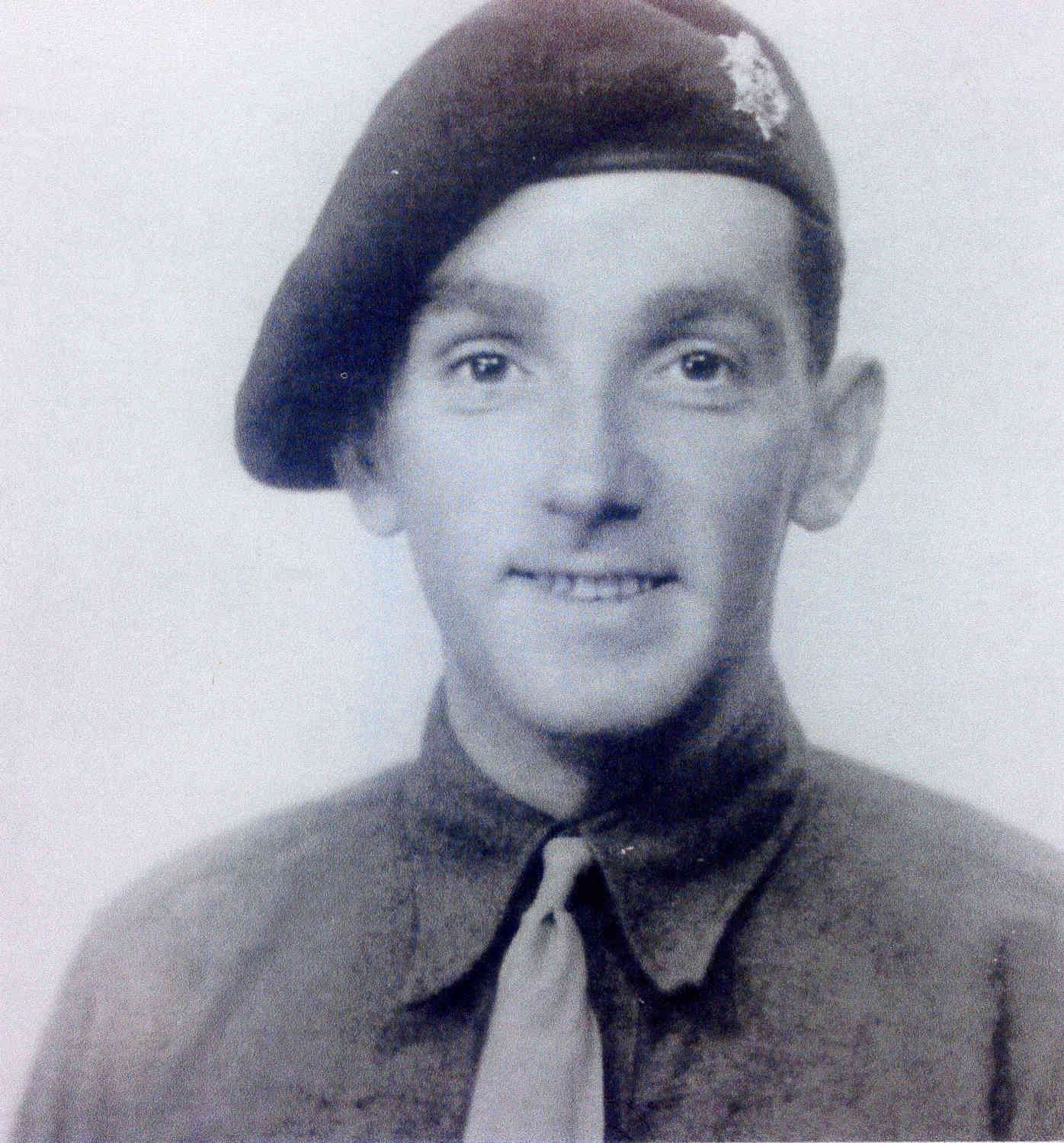
Dvr. Raymond 'Ray' Whitwell. H.Q., R.A.S.C. 1st Airborne Division. 1943 - 1945. Courtesy Ray Whitwell.
Horsa gliders No's 970 to 974, carrying five Jeeps, ten trailers and 21 men of 'D' Transport Platoon, attached to No 2 Parachute Platoon as their Jeep Section. These were flown by glider pilots from 2 Flight, 'A' Squadron from R.A.F. Harwell, and were towed by 570 Squadron, R.A.F. Glider No 974, with 2/Lt. G. Osborne, and three men on board, did not make it, after the tug aircraft developed engine trouble on take-off and the glider landed back at the aerodrome. It was allocated to the 3rd Lift. However, it still did not make to the Arnhem area, and came down just North of the Maas-Schelde Canal in Allied held Belgian territory, just to the South of the Dutch village of Valkenswaard. S/Sgt. John Jenkins was the 1st Pilot of this glider, "I took off for Arnhem. Unfortunately just as I was airborne, the Stirling developed a fault in the port inner engine and I had to pull off and do an emergency landing just inside the perimeter. We took off again on 19th September, this time as a lone glider combination, with orders to link up with the Polish Airborne over the Channel. Owing to patchy cloud we failed to locate them and on approaching the enemy coast, we encountered troublesome flak. I called up the Tug Pilot on the intercom, which was carried through the cable-tow, and asked him what he thought of the situation. He replied that he had heard over the radio that all Landing Zones at Arnhem were in enemy hands, but he left the final decision to me. The flak started again as we turned North towards the Dutch border, and so I decided to pull off, in order to give the Stirling better evasive action, and continue our journey by road, with the Jeep and trailer. We eventually arrived at Nijmegen and reported to HQ." [20]
On board another one of these allotment of gliders was Cpl. Burnham Blaxley, "I was most impressed to see the organisation required just to get my own small section on to the ground. My section consisted of ten men, myself included, five jeeps and ten trailers. Each trailer was loaded with various supplies, mostly ammunition. Five Horsa gliders with their ten glider pilots, and five Stirling aircraft each with a complete crew of seven to tow the Horsa gliders. Immediately on landing we had dropped the tail plane, fitted the steel troughs, unloaded the transport, and located the blue 'Rendezvous Smoke'. Everything had worked like clockwork. It was at this point that Sergeant Chedgey met me." [20b]
Horsa gliders No's 974A, B, C and D, were a last minute addition, carrying four Jeeps, eight trailers and ten men of 93 Airborne Composite Company, R.A.S.C. Flown by glider pilots of 2 Flight, 'A' Squadron from R.A.F. Harwell, they were towed by 295 and 570 Squadrons, R.A.F. This group of gliders, and the previous group, were put under the overall charge of Sgt. 'Bill' Chedgey, "I had recently joined No 2 Para Platoon, when another Sergeant broke his arm. I became the Sergeant to accompany the transport. We moved to several different airfields as various operations were laid on and then cancelled. Whilst in Gloucestershire, the Lieutenant fell out of a Jeep and was killed. I forget his name [Lt. P.E. Thompson] I carried on without an Officer and was at Harwell for the final performance. We were to accompany the 4th Parachute Brigade on the second day, 18th September 1944. On the 16th September a Lieutenant turned up and announced that he was to take over, Lieut. G. Osborne. He had just joined the Company and asked if I could let him have a look at a glider as he had not seen one! He also gave some good news. He was arriving with some more men the next day. As I recollect, about 8 or so turned up having joined the Unit the previous few days. They too had never seen a glider nor had they instructions as to their job. After the minimum instruction I advised all to look for a column of blue smoke after landing and hoped we would all meet later. In fact Lt. Osborne, if that was him, went to the wrong battle and landed at Nijmegen." [21a]
Who were these men from 93 Company, and why had they been chosen? They were not the most obvious choice. 250 Company had just over 30 men on Rear Party, which included 6 men from 'D' Transport Platoon and 10 - 12 men from the 1st Reinforcements. Why were these men not used? The other choice was men from 93 Company with 'air experience', such as Capt. C.G. Simmons and some of his 46 men, who had undergone a week's worth of air experience as 'Live Load Detail' (training on gliders) in February 1944, but they were now in France with the rest of 93 Company!
So, who else was available? As well as some men and vehicles from 250 Company being sent back to the U.K, at the end of August, 93 Company had also been ordered to send back some men. Lt. E.I. Lyon, who had not long been posted to 93 Company from 253 Company, took 55 Other Ranks of his 'B' Light Transport Platoon, back to England, where they were sent to join 165 Company, R.A.S.C. (Air Composite) at Lechlade, only 18 miles from R.A.F. Harwell. By the 18th September they would, therefore, be the closest available troops. 165 Company was part of the Airborne Forward Delivery Airfield Group, and it was planned for this unit, and others, such as the 2nd Air Landing Light Anti-Aircraft Battery, R.A. to fly in and prepare a captured airfield for the further airlift of forces, if the airborne part of the operation was successful.
However, it is apparent from a later entry in there War Diary that this sub-unit of 93 Company only contributed one Jeep crew, the others came from the Company Rear Party. This is explained by Dvr. Raymond 'Ray' Weaver: "We were on the Rear Party in Lincoln waiting to join the Company in France, but on the Saturday, 16th September, we were driven to Blakehill Farm and briefed for Arnhem. I cannot remember why we could not leave on the Sunday, but in the morning we were rushed to Harwell and left on Monday with the Second Lift. Myself with two friends, 'Bob' Laurie, and 'Lofty' O'Donnell, were shot at [on the approach to the L.Z.], where we had quite a hairy landing, and managed eventually, after a very memorable journey to reach the outskirts of Arnhem." [21b]
One of the glider pilots of this allotment, 970 - 974, and 974A - 974D, was Sgt. Frank McCaig; "On the morning of Monday, September 18th 1944, I am accompanied by my friend, 'Jock' Ferguson from our billets in R.A.F. Harwell, to the airfield, and the waiting tugs and gliders, weighed down with our equipment, so heavy that we had to assist each other to get packs on our backs; the instructions are to take what you want, as you're going to have to use it! Apart from food, special packs of condensed food, sandwiches from the NAAAF, fags, Beret, emergency ration (Chocolate), escape map, field dressing, rifle & bayonet, 2 bandoliers of 303 (ammo) and 4 hand grenades, toilet kit, etc. The 1st Lift has gone, yesterday, and got there O.K, we understand, but our Lift, the Second Lift is delayed, bad weather and fog; we sit in our glider and wait. I am crewed up with S/Sgt 'Wendy' Hiller, - the pecking order has made it that some have had a little more training on Horsas, being earlier courses and so get the S/Sgt rank, but we think of ourselves as Co-Pilots rather than 1st and 2nd.
Eventually, we get the green light, (thank goodness, we did not want to miss it). We are carrying a Jeep and trailer loaded with shells H.E. and crew, (I hope they have secured the load properly) - no problems on take-off, and we are soon over the Channel and heading for Arnhem, but we are not there yet, the Flak is coming up at us with a vengeance, flaming onions we called the incendiaries. We were hit just once, straight through the floor and out of the roof, with a peculiar noise that can only be described as being like kicking over an old galvanised bucket on a flag-stone! I am told later that the glider behind us was shot down, with all personal lost, - the pilots Harris and Boswell I knew well, particularly Boswell, I had been on exercise with him on Brecon Beacons. Our crew were okay - rather busy being sick mostly, (not much fun swinging about the sky on the end of a rope !) Cast off in a good position, hedges and trees on fire below us, straight in, slithered to a stop and then dead silence, that awful moment; the [R.A.S.C.] lads had the tail off in a trice, and the jeep and trailers out, and off we went like a bat out of hell, Hiller and I on the back, a few bullets flying around but safely off L.Z. 'X', down the track to rendezvous at Wolfheze station." [22]
Glider No 974C, carrying a Jeep, two trailers and two men failed, and came down short between the Dutch villages of Rosmalen and Molenhoek, after its tow-rope was shot away by flak. The following Evaders report was filed in the 93 Company War Diary: At 16.00 hrs on the 23 Sep. Dvrs Speller and Clark of this unit reported to Coy location at Nijmegen. They stated that together with 8 other members of this unit, Second Lift, they took off in Gliders from Harwell Aerodrome, U.K. at 181215 A. Their glider, which was No 4, was hit by flak and made a forced landing at Molenhoek, Sheet 2A and 3A, Map Ref 3647. They salvaged their Jeep and, with the assistance of 2 Dutch Patriots reached the American lines. They then made their way to this unit location. They had no information regarding the other members of the Second Lift.
Glider No 974D, also carrying a Jeep, and two trailers with two or three men, failed to make L.Z. 'X', suffering in the same way as 974C, being hit by flak just a few moments after. It came down near the village of Geffen, near Oss in Holland. The pilots and passengers had to set fire to the glider and its contents, to save it from falling into the hands of the enemy, but were themselves, able to evade capture with the help of the Dutch Resistance.
The previous days failed glider, Horsa No 519, with a Jeep, two trailers and three men on board from No 3 Parachute Platoon's Transport Section, took off again from R.A.F. Fairford, still piloted by men from 'G' Squadron, and landed okay.
As per the H.Q., R.A.S.C. Orders, each glider load was responsible for clearing the L.Z. as rapidly as possible and for its own local protection while doing so. They were then to R.V. with the 2 i/c, Maj. Clark, at the Road Bridge under the Railway at Pt 665805. [1] They were then to move in single convoy under direction of the 2 i/c to the D.M.A. There, they were to unload the trailers and await further instructions. Furthermore, after off-loading in the D.M.A, Capt. Winter-Goodwin, in charge of the Hamilcar Group, was to arrange the unloading and clearance to the D.M.A. of stores in the Hamilcar gliders. Whilst waiting, the crews of the Hamilcars were to remain as a guard on the gliders until transport had arrived to clear the contents. As Divisional H.Q. was in the process of moving towards the Hartenstein Hotel in Oosterbeek, some of the R.A.S.C. Jeeps, with their fully loaded trailers, were sent there, to start establishing the D.M.A., under the direction of the C.R.A.S.C and his staff, and then return to Wolfheze to pick up other supplies. Other Sections would have temporarily dropped off their supplies at Wolfheze Station area, and then, under command of Capt. Winter-Goodwin, returned to the L.Z. area to unload the Hamilcars.
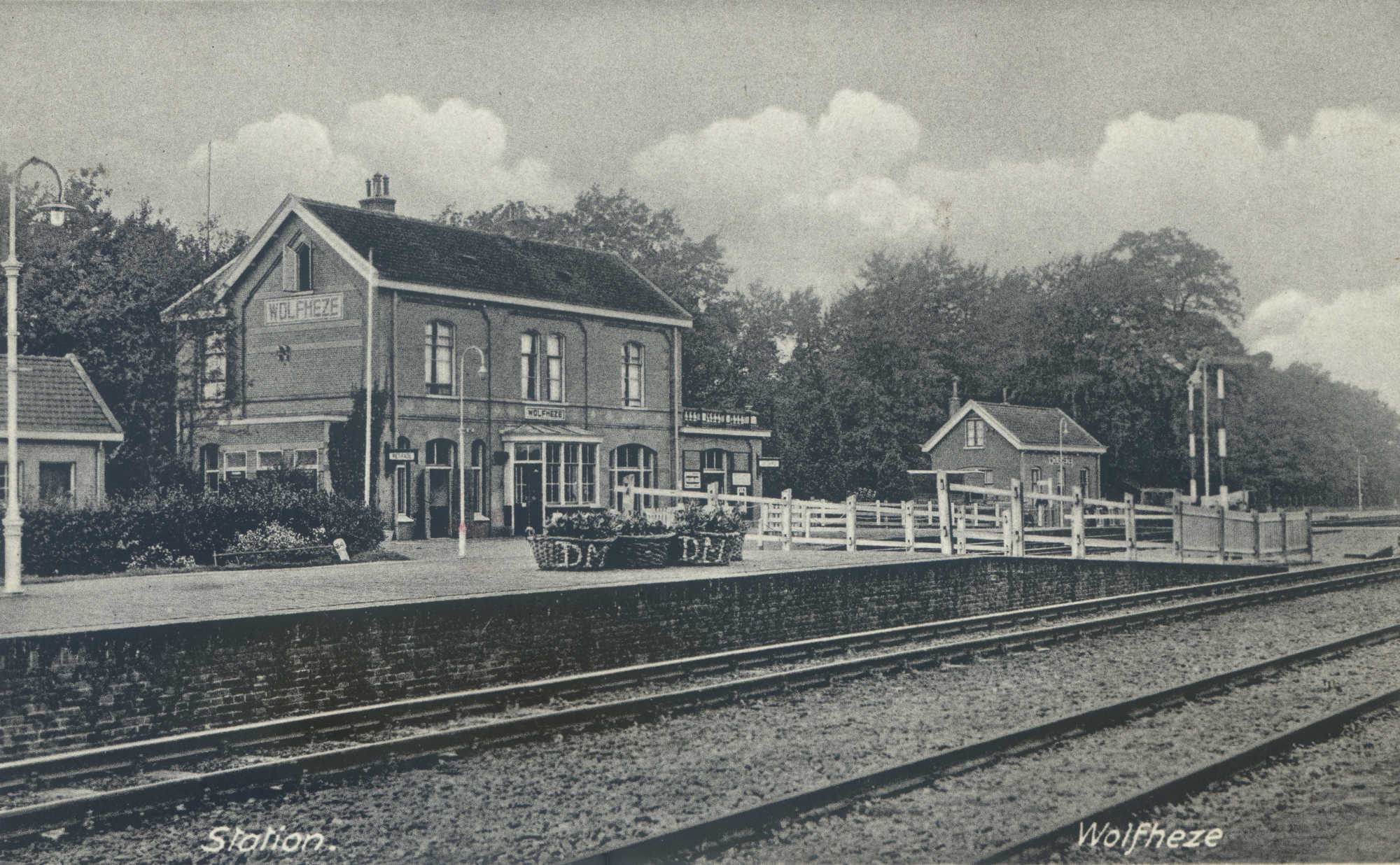
Wolfheze Railway Station. 1935. The view is from the North-East, looking towards the area of the dropping and landing zones beyond Wolfheze. Courtesy of Ulbe Anema.
Several parts of the rest of the Orders, could not be complied with, for a variety of reasons, not least of which was the enemy interference. As those unloading and moving to the R.V. was taking place the first re-supply drop was also taking place. An area to the North-East of Wolfheze, S.D.P. 'L', was designated for the 35 Stirling aircraft, flying from R.A.F. Harwell, to drop 24 Containers , and 4 Panniers each. Only 30 dropped near the designated point, with one aircraft (C/N: 1034, of 295 Squadron, R.A.F.) reporting that it had dropped its supplies on the Eastern end of L.Z. 'S' [2]. Altogether, the R.A.F. Crews reportedly dropped 739 Containers and 124 panniers. This was the main part of the days supply drop that could be recovered, as the Orders had stated; 'Before arrival of second lift, establish spotters on L.Z. 'L' on which 35 Stirlings are to drop. Arrange clearance of all stores from SDP into DMA. On completion of this task, return to DMA and await further instructions. R.V. HQ RASC 1200 hrs D+1.' Unfortunately the 3rd Parachute Platoon, and part of its Transport Section, were now in Arnhem, and there was no sign of the 2 i/c, or the 1st Parachute Platoon, which was approx. 4 kms away, with no transport! This is the main reason that only 14% of the supplies, out of 87 tons reported as successfully dropped, were recovered. [3]
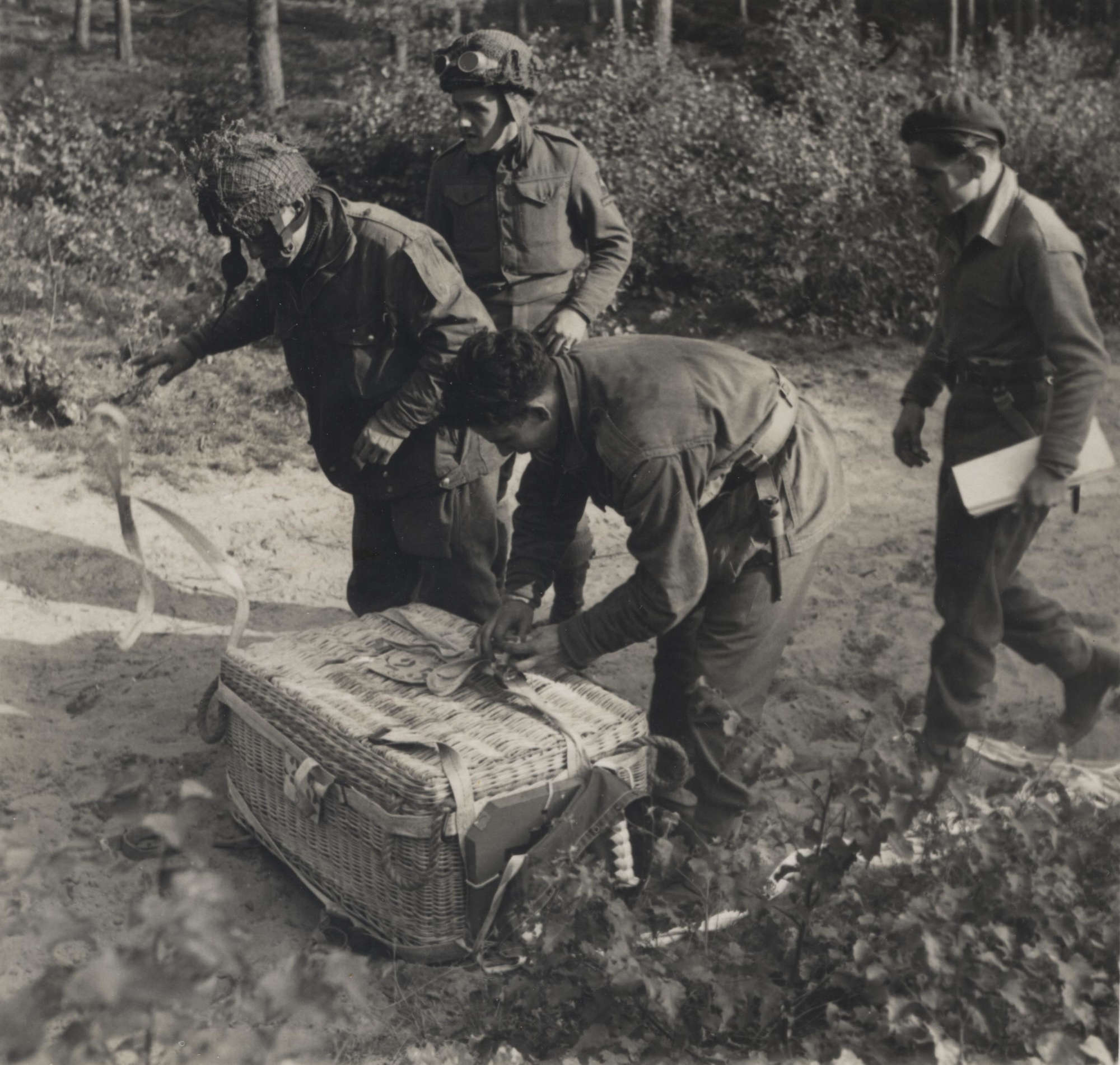
British Airborne troops undoing the straps on a Pannier, dropped on a re-supply flight on Monday, 18th September 1944, near Wolfheze. Left to right: Unknown, Gunner 'Bill' Hartley (wearing goggles, a Driver with HQ, 1st Airlanding Anti-Tank Battery), bending over the pannier, S/Sgt. John McGeough ('C' Squadron, Glider Pilot Regiment), and on the right carrying a handful of vital paperwork is probably a R.A.S.C. Clerk! Photo by Sgt. D.M. Smith. A.F.P.U. BU 1147. Courtesy of the I.W.M.
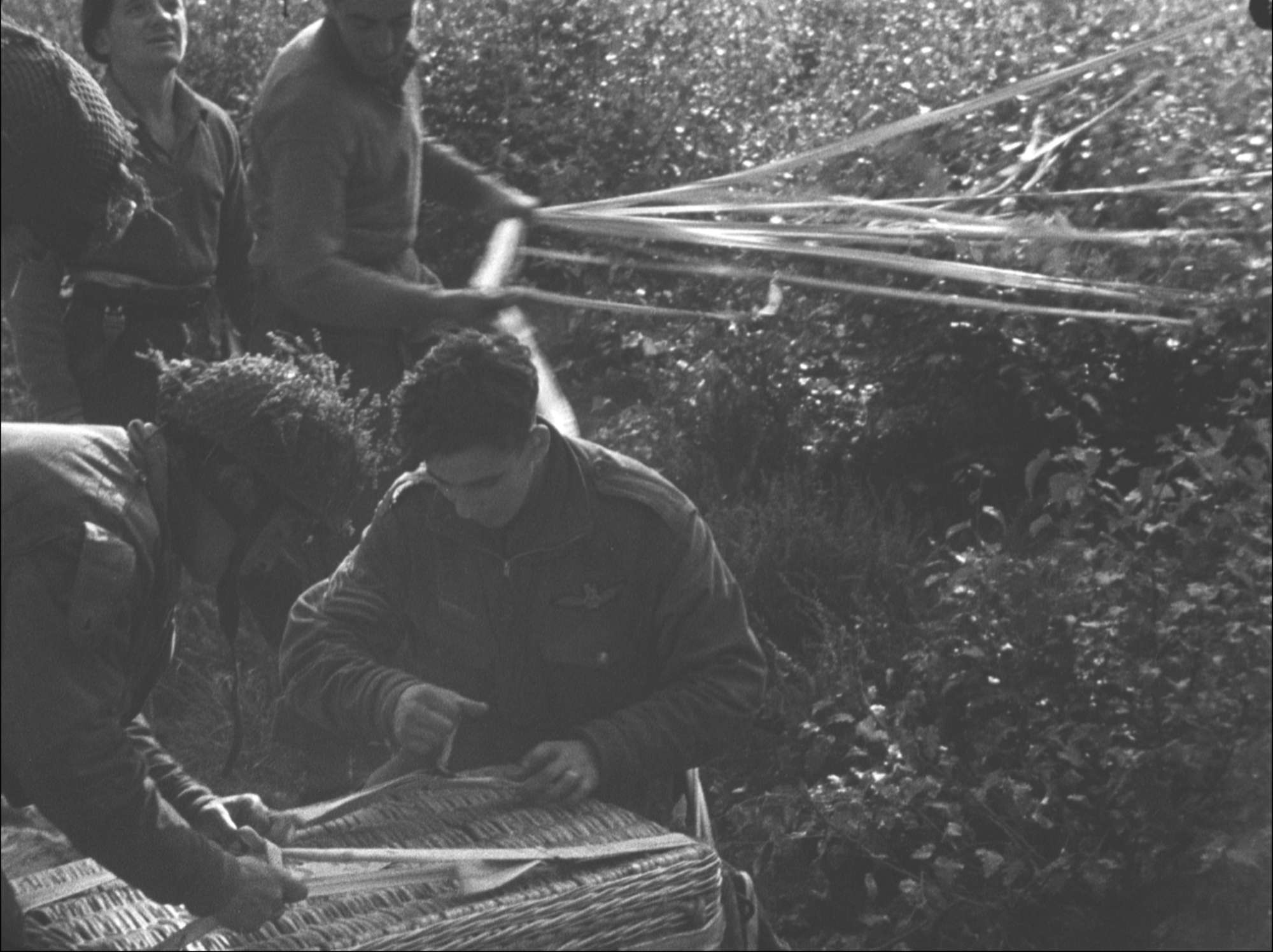
The supply drop on the 18th September was not a great success, but film was obtained of supply panniers being recovered, when a load was dropped near the troops at Wolfheze, by mistake. The caption usually given to this 'still' is: 'The man with helmet is Staff Sergeant John McGeough, a glider pilot of C-Squadron (he had flown in a Hamilcar on the first day). Helping him is CQMS Holderness of the 250th Company, RASC'. NOTE: This is incorrect as Staff Sergeant John McGeough is the bareheaded man, his rank stripes and glider pilot wings can be clearly seen. The man helping him is not CQMS Holderness as he was in fact an SQMS (Squadron Quarter Master Sergeant) of the 1st Airborne Reconnaissance Squadron, and was at this stage the Acting SSM (Squadron Sergeant Major), as SSM. Meadows had been badly injured the day before. By the time of the Supply Drop the main element of the Recce Squadron was in Oosterbeek, the only ones near L.Z. 'L' at this time were 'C' Troop. The CQMS for 250 Company, Colour Sergeant. Alec Smallwood, did not take part in the airborne part of the operation. The R.A.S.C. Clerk is now looking up, possibly to see if they will get anymore of the supplies dropped in their area. From Sgt. C.M. Lewis. A.F.P.U.
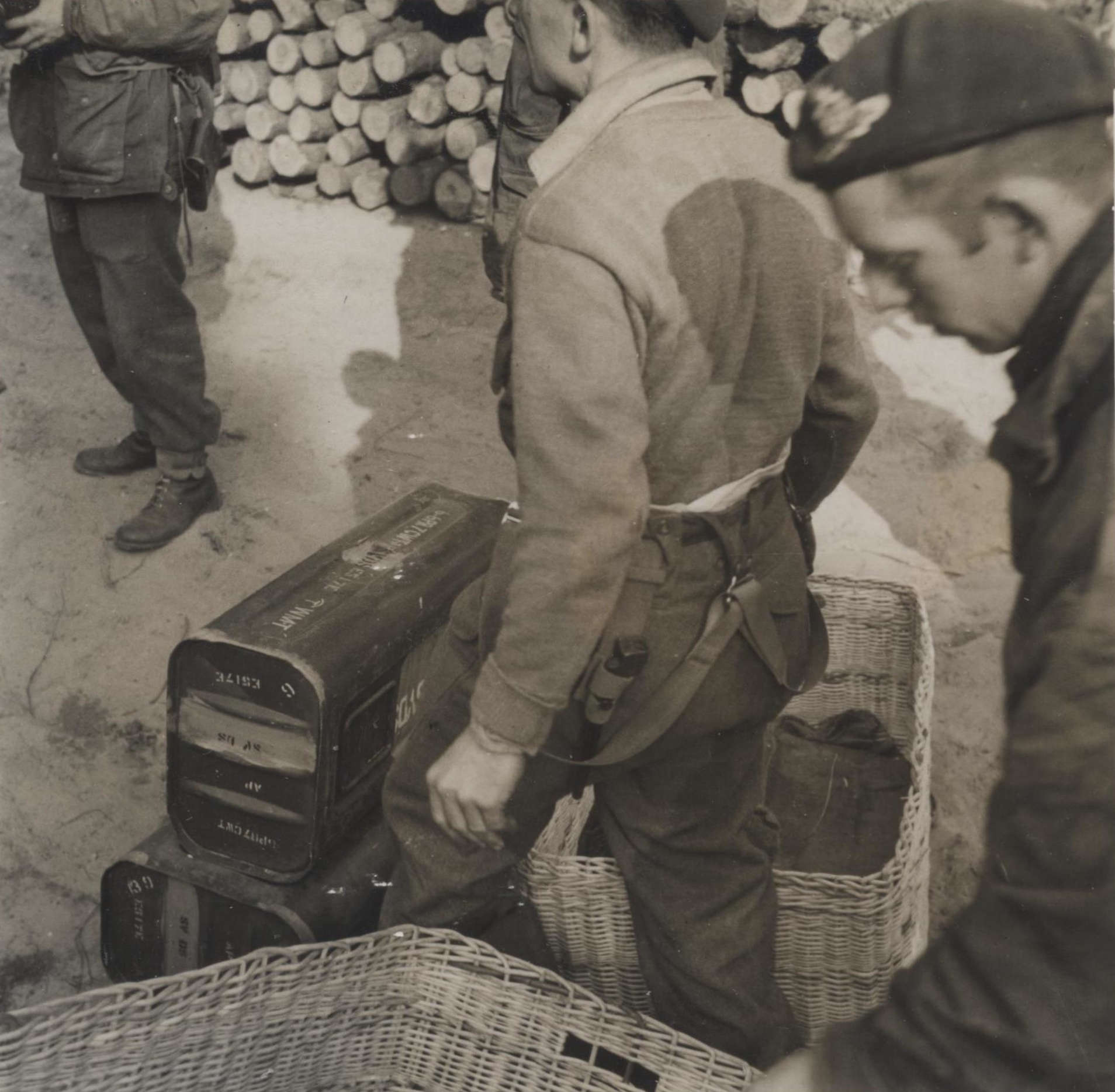
6-pounder anti-tank gun ammunition is retrieved from the re-supply drop, on Monday, 18th September 1944. On the right is Gnr. Albert Victor Hubbard, Batman to Capt. Norman McLeod, the Second-in-Command of the 1st Airlanding Anti-Tank Battery, R.A. Photo by Sgt. D.M. Smith. A.F.P.U. BU 1148. Courtesy of the I.W.M.
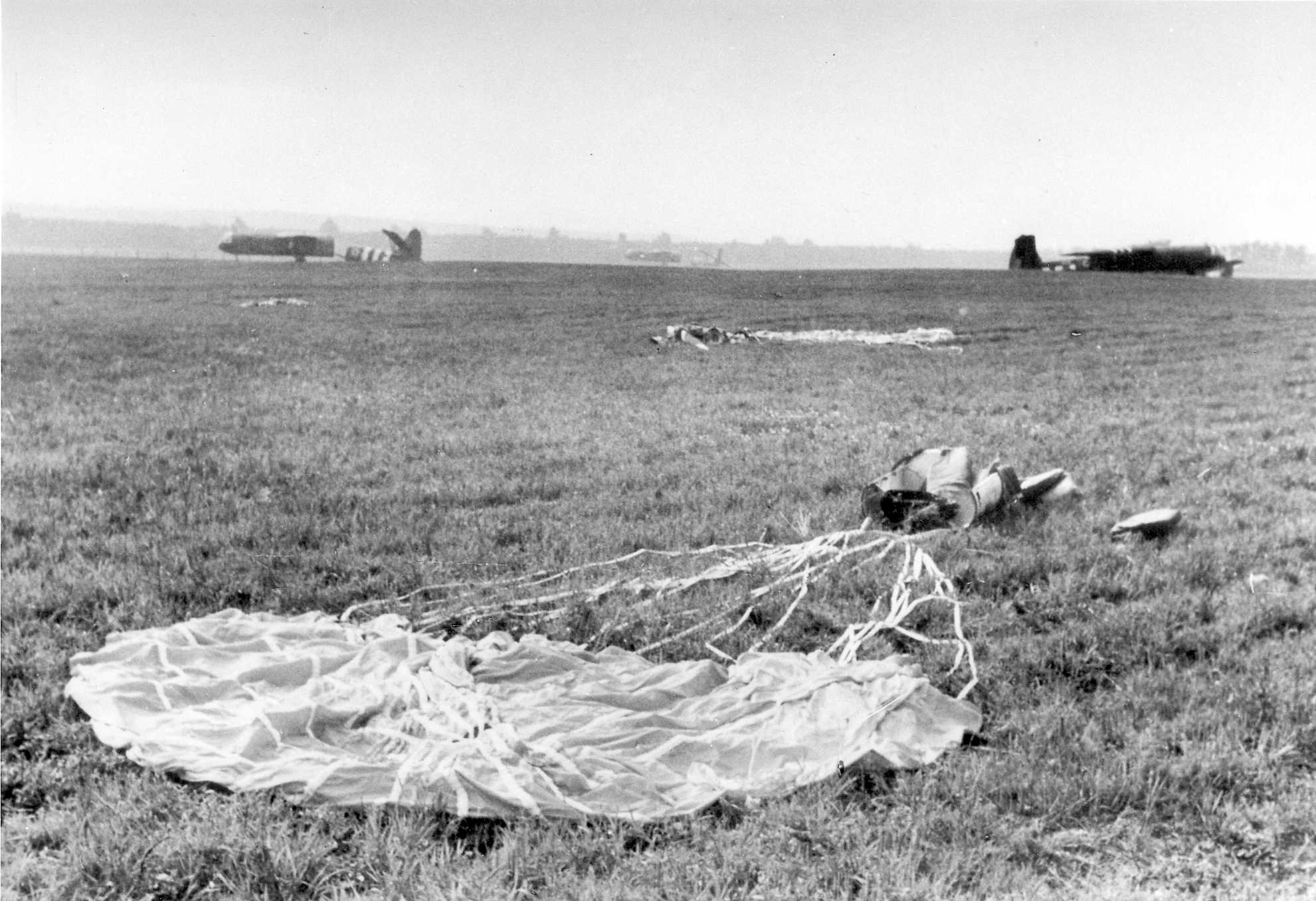
A German photo of CLE containers and Horsa gliders on S.D.P. 'L', which was also used for the glider landing on the 18th September 1944. AhGldA_1560_5478 KB FRed Rieder. Courtesy of Bob Gerritsen.
Sgt. 'Ron' Kent was serving as a Section Commander in 1 Platoon, 21st Independent Parachute Company: "Dawn comes with surprising suddenness - my Platoon is ordered forward to prepare and secure a zone for the reception of supplies which are expected to be dropped to us at 10.00 hrs. We set off and follow the line of the railway for a mile and here contact a reconnaissance unit [1st Airborne Reconnaissance Squadron] which informs us that German snipers are operating in the area we have to secure. We halt now as the Platoon Commander goes forward to make a reconnaissance of the ground ahead. Taking my section forward as a standing patrol - we investigate a farm house and then taking up defensive positions in and around it - wait for ten o'clock and the arrival of the supplies. Eleven o'clock - and no sign of supplies or aircraft yet. I decided to dig in and when, about twelve o'clock a dozen Messerschmitts come down to strafe us, we were well protected.
The day wore on and was brightened by a number of civilians coming along with news which we extracted from them through a member of my section who could speak German. I passed them back with an escort of two riflemen to my Platoon Commander for further questioning. At half past three in the afternoon, Stirlings and Dakotas filled the sky - then all the flak guns around opened up making our lives precarious from falling shrapnel, machine gun bursts from Stirling rear-gunners too, as they tried to hit the crews of the flak guns and last of all - but not least - the heavy, swinging metal containers showering in on us." [22a]
There was a civilian eye witness to these events, a farmer from Johannahoeve, Mr. Van Manen: "18 Sept about 12.00 some men came from the West, out of the edge of the wood. They began to mark out a dropping zone with yellow rags [Marker Panels]. The farmer warned the men in his cellar, who joined the men with the rags. Gliders came over, flying in the direction Arnhem. They loosed their hawsers [tow-ropes]. The gliders turned and flew in a Western direction, [and] disappeared behind the trees. (This must have been the second lift). Immediately after they had disappeared, planes dropped parachute with containers and baskets on the zone, traced [marked] with the yellow rags [Marker Panels]. (Obviously supply). The troops, which popped up afterwards, used a part of this supply, the rest was a welcome booty for the Germans". [22b]
None of the secondary tasks for any of the Platoons, that of clearing the 'Compo' from the 1st Lift gliders on any of the L.Z's, could have been carried out.
It is very probable that someone was able to direct the allocated Transport Section to No 1 Parachute Platoon at Klein Amerika Farm, and after loading up, they move out with the 1st Bn, The Border Regiment along the Utrechtseweg, towards Oosterbeek. Capt. Cranmer-Byng: "Suddenly there was a shout, and someone pointed to the sky, there they were, an endless stream of tug planes and gliders. The German ack ack fire started, by now gliders were landing all round the farm, and the great massed formation of paratroop planes had come into view. The men in the farmyard laughed and ran out into the open. It was alright now reinforcements had arrived. But, on the L.Z. all was not well. In one field three gliders were on fire before their crews could get out. There were pockets of Germans all round and some men were hearing the fire of Spandaus for the first time and it was directed to them. By now, however jeeps and trailers were pouring out of the Gliders, finally the long cavalcade got moving."
L/Cpl. Walter Inglis was on the 2nd Lift. He had been 'called up' on the 9th December 1940 and joined the Company on the 25th March 1941, initially serving in 'B' Motor Transport Platoon. Originally from Tipperary in Southern Ireland, the family had moved to Beeston, in Nottinghamshire, where he worked as a Charge hand for a mineral waters company. He had then married Myra in May 1944, who came from Neath, in Glamorgan. Originally 'earmarked' for the Rear Party, he was allotted to the Second Lift when more gliders became available. Although he had seen service abroad, in North Africa and Italy, he had not yet 'been in action', and although anxious, he also felt resigned as to what was to come. His experience of the flight across was, "pleasant, not much conversation, but generally of past actions and women. Worried about flak, but not unduly. Briefing stated no fighter opposition, etc. No enemy except aged and wounded." The rumours he had heard about the operation were that it would be, "'Piece of cake' - 'walkover'. All we had to do was hold Bridge for 36 hours, [at the] longest. War then practically over, back home within a week." He would land okay and move to the designated Divisional Admin Area in Oosterbeek. Part of this move was supervised by Capt. Cranmer-Byng, who Walter remembers as acting, "very cool & reliable - just another exercise." [23]
The 1st Airborne Division H.Q. Diary of Events, as affecting the admin side, has the following entry: 'D.A.A.G, D.A.Q.M.G and Staff, together with remaining Heads of Services (C.R.A.S.C, A.D.O.S and R.E.M.E rep) and bulk of admin echelon, arrived during the afternoon. Divisional H.Q. was then in the process of moving to HARTENSTEIN 6978. Two captured German vehicles were put into running order and were used for ferrying ammunition to D.M.A. and later, for delivery of gun ammunition to the Light Regiment. The re-supply of 35 aircraft was carried out in conjunction with the arrival of the 2nd Lift but dropped largely on pre-determined S.D.P's which were then in the hands of the enemy; little could therefore be collected. In the evening at 2030 hrs, the D.M.A opened on main road 693784. The contents of the D.M.A. came from the balance of the reserve ammunition from the 1st Parachute Brigade, from the supply drop ammunition above, and from the bulk loaded Hamilcars, which had come in with the 2nd lift and two of which, had been completely unloaded. The third, was captured by the Germans before unloading could take place. No petrol was available in the D.M.A. Owing to the general situation, a message was sent to Base changing location of S.D.P. for following day.'
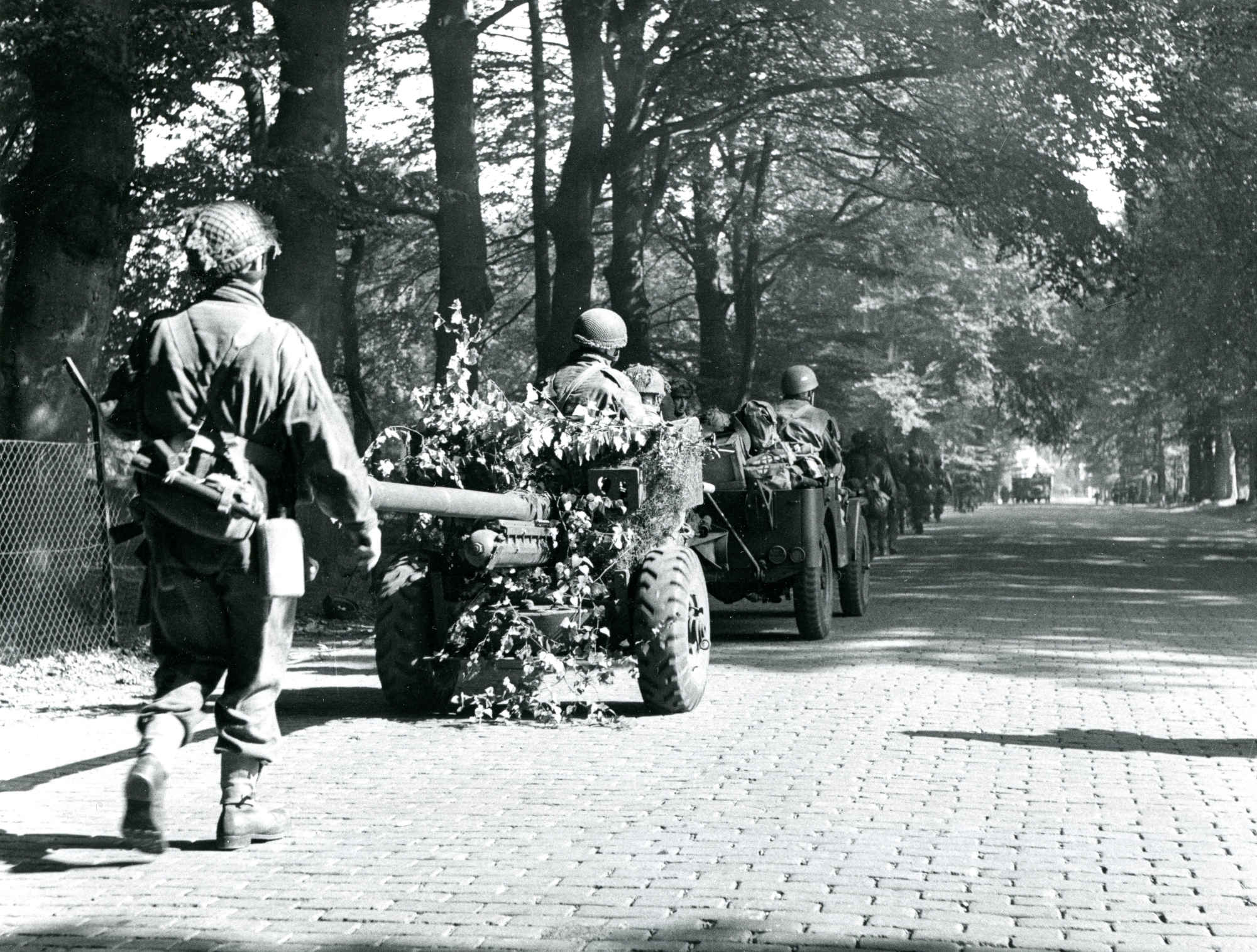
A Jeep towing a 6 pounder anti-tank gun from the 2nd Battalion, The South Staffordshire Regiment, moving east along the Utrechtseweg, Oosterbeek, towards Arnhem, in the late afternoon of Monday, 18th September 1944. In the distance a truck can be made out in the middle of the road, facing towards the cameraman, with possible a second truck behind it, and they are both by the area of the D.M.A. Are these the two trucks mentioned in the Diary of Events? Photo by Sgt. D.M. Smith. A.F.P.U. BU 1091. Courtesy of the I.W.M.
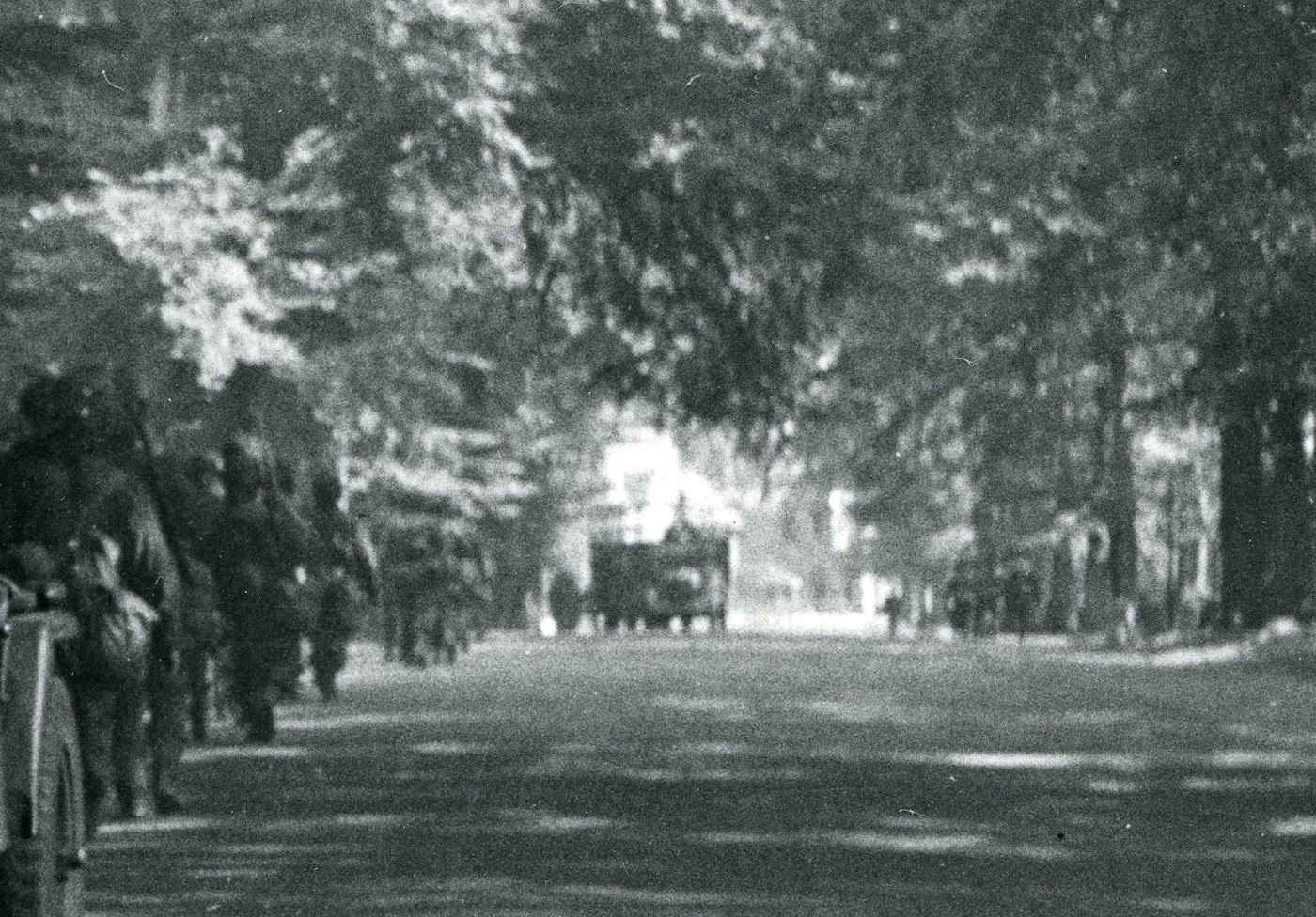
A close up of the previous photo showing the two German trucks, just having turned onto the Utrechtseweg from the Oranjeweg.
The H.Q., R.A.S.C. War Diary adds a more specific time to the move from Wolfheze: '15.30 hrs. Party after R.V. proceeded to Hartenstein and established H.Q. and D.M.A - location under moderate enemy fire - no enemy activity, except sniping during the night. Collection of resupply and stacking in DMA organised.' One of those proceeding with the R.A.S.C. group was Sgt. Albert Midgley, "I remember seeing the body of the German General Kussin, hanging out of his bullet riddled car - I think it was called the 'Tiger' route. After many stoppages, we arrived at Oosterbeek and were told that we could not go any further, owing to enemy action along the road. Colonel Packe then commandeered a house on the green opposite the Hartenstein Hotel and set up his H.Q. The Dutch family who lived there moved into the cellars - we stayed (Lt. Bewley and I) with the Colonel and during the following three days, or so, with the help of a Dutch Resistance man and a van, we collected what containers we could - which was very few and rather hectic, as we came under small arms fire frequently - luckily the Dutchman knew his way around and what with the help of Dutch civilians warning us of the whereabouts of the German soldiers, we survived. A few containers were dropped nearby, one actually landing on the roof of the house we occupied, and the present owner of the house has a photograph of the container protruding through the roof." [23b]
Probably driving Lt-Col. Packe's Jeep, was Dvr. Raymond Whitwell, "After unloading the Jeep and trailer, we set off for Arnhem, but we only got as far as Oosterbeek by late afternoon, then we ate our 24 hour rations. And that was the end of our food. Later we were strafed by a German fighter plane, but he missed and no one was hurt. As for the kit, I had a Mark VI Sten gun with a wooden butt, 2 x hand grenades, 2 x Phosphorous grenades, 2 x front pouches of loaded Sten gun magazines, small pack containing a change of underwear, spare socks, razor, soap, etc, and a twenty-four ration pack, which incidentally, was the only food I had for the whole of the 9 day operation, apart from a tame rabbit taken from a hutch by a Cockney (his name has gone from my memory). The rabbit was killed, skinned and boiled in a tin of water on a fire of twigs and broken dead tree branches, of which there was an abundance in the woods of the perimeter. The rabbit was shared by five of us, which I think included Captain Cranmer-Byng [more likely to be Capt. J.D. Naylor, Adjutant, HQ, RASC]. I also carried a ground sheet, gas mask, small bayonet, steel helmet. Airborne smock, and red beret (in small pack)." [23c]
Lt-Col. Packe has left some vivid memories of his arrival in the Wolfheze area, and his subsequent move to the Hartenstein area, "The road, straight and cobbled, was lined with leafy trees. Amongst these on either side, large suburban houses stood back within their private gardens. Inside them, no doubt, pinstriped and respectable Dutch citizens had long worshipped their God of cleanliness, and in recent years had sadly watched the marching Germans. From the track up which he had come, an endless line of jeeps, guns and men poured on to the main road, heading east towards Arnhem. In the middle of the road, officers wandered, idly chattering and issuing peremptory orders as they would have done on manoeuvres. A policeman, turned parachutist for the duration, was directing the traffic as unconcernedly as if he were back in his own provincial city centre. Down to his left, soldiers were contentedly engaged in their old ritual of brewing tea. Dogs, children and girls, in faithful fulfilment of one of the universal edicts of international usage, were pressing round them with excited curiosity. The soldiers, natural and unembarrassed under this detailed scrutiny, laughed and joked, overcoming with indifferent ease the barrier of language. There could be no doubt at all that what was said to the girls was both understood and appreciated. Trade flourished between these two nations of shopkeepers; cigarettes were exchanged for apples, and bottles of beer with patent stoppers for chocolate if there was any, and otherwise for sheer goodwill." Lt-Col. Packe was met by the A.A. & Q.M.G., Lt-Col. Philip Preston, who, "explained the situation, and together they discussed the future. Naturally in such circumstances, their prearranged course of action had already gone awry, and their conversation was largely confined to "where the hell are we going from here?", or "what on earth happens next?", although both parties in the presence of the troops were careful to phrase their sentences in a more military jargon."
Lt-Col. Packe then felt an enthusiastic grip on his arm, turned to find a bright-faced L/Cpl agleam with excitement.
"Well, Groves," he said indulgently; "how's it going? You were first lift, weren't you?"
"Oh, I'm all right now sir, only we pranged when we landed. I got lost, sir."
"What happened to the rest of your Platoon?"
"I never saw them after the crash, sir; I had a bang in my chest, and as we were in the wrong place, I got left behind. But I heard afterwards that Corporal Badgem and the rest had come in all right, though I haven't seen them myself."
"That's good news, then."
"Yes sir, I'm afraid one of the lads bought it when we hit, sir."
"Oh? Who was it?"
"Private Martin, sir."
"Private Martin?"
"Yes sir, Private Bill Martin, sir. You know, the one as used to be D.R. for the H.Q. Corporal Badgem, he wasn't half upset. I helped him get the body out, and he was raving and swearing, looking proper mad all of a sudden. He kept saying it was his fault, or something; that except for him Martin never would've joined the Div. I found this ring on his finger, sir; thought I'd better bring it in case it got stolen. I think it was from his girl."
This exchange is from 'First Airborne', and must refer to the crash of glider 264, and the 'characters' referred to are; Groves = L/Cpl. Clay, Cpl. Badgem = L/Cpl. White, and Pte. Martin = Dvr. Bondy.
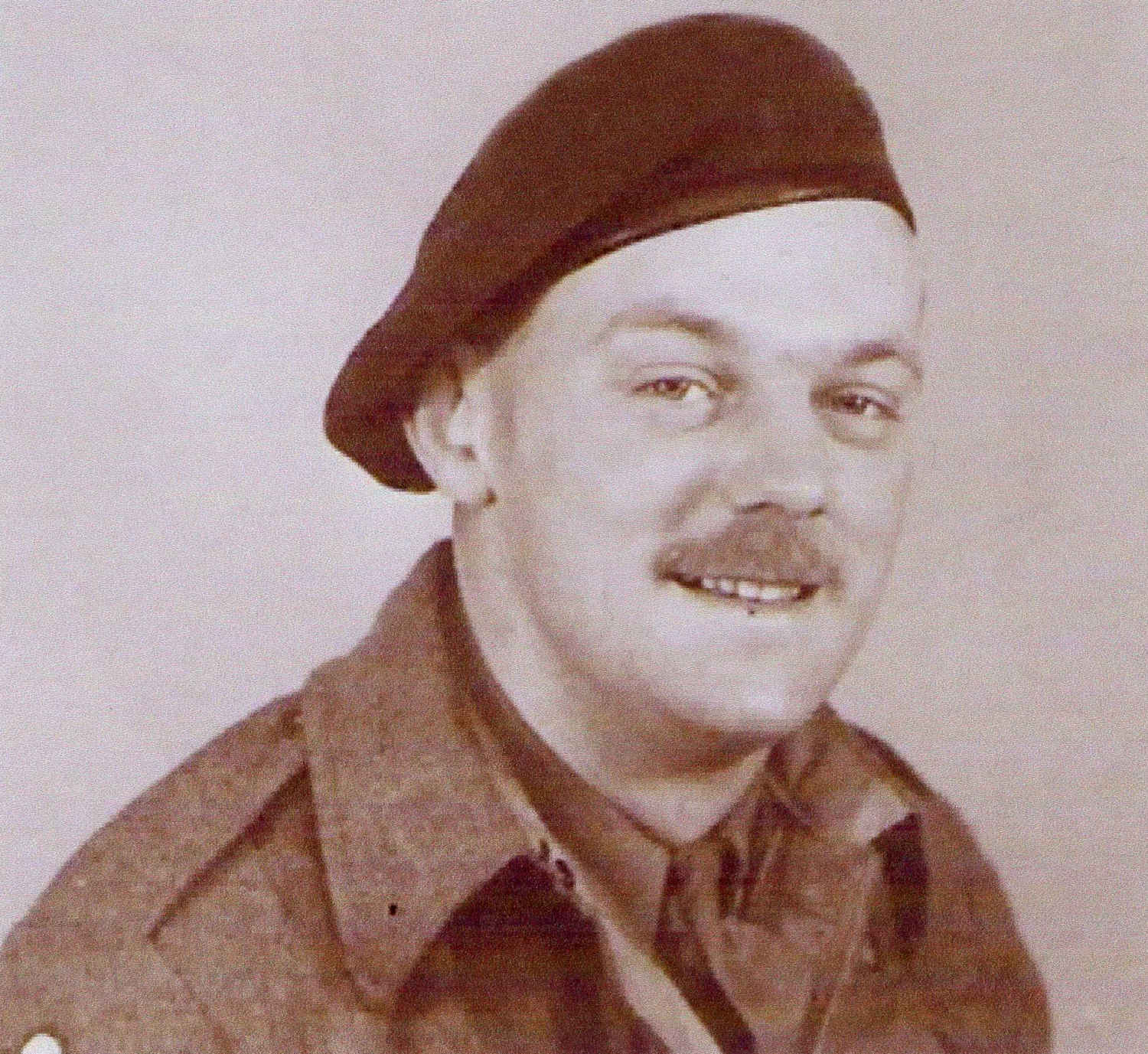
L/Cpl. William Clay. 'D' Transport Platoon, attached to No 3 Parachute Platoon, but assigned to work with the Maj. Clark, 2 i/c, H.Q, R.A.S.C. Photo taken in 1945. Courtesy Patric van Aalderen.
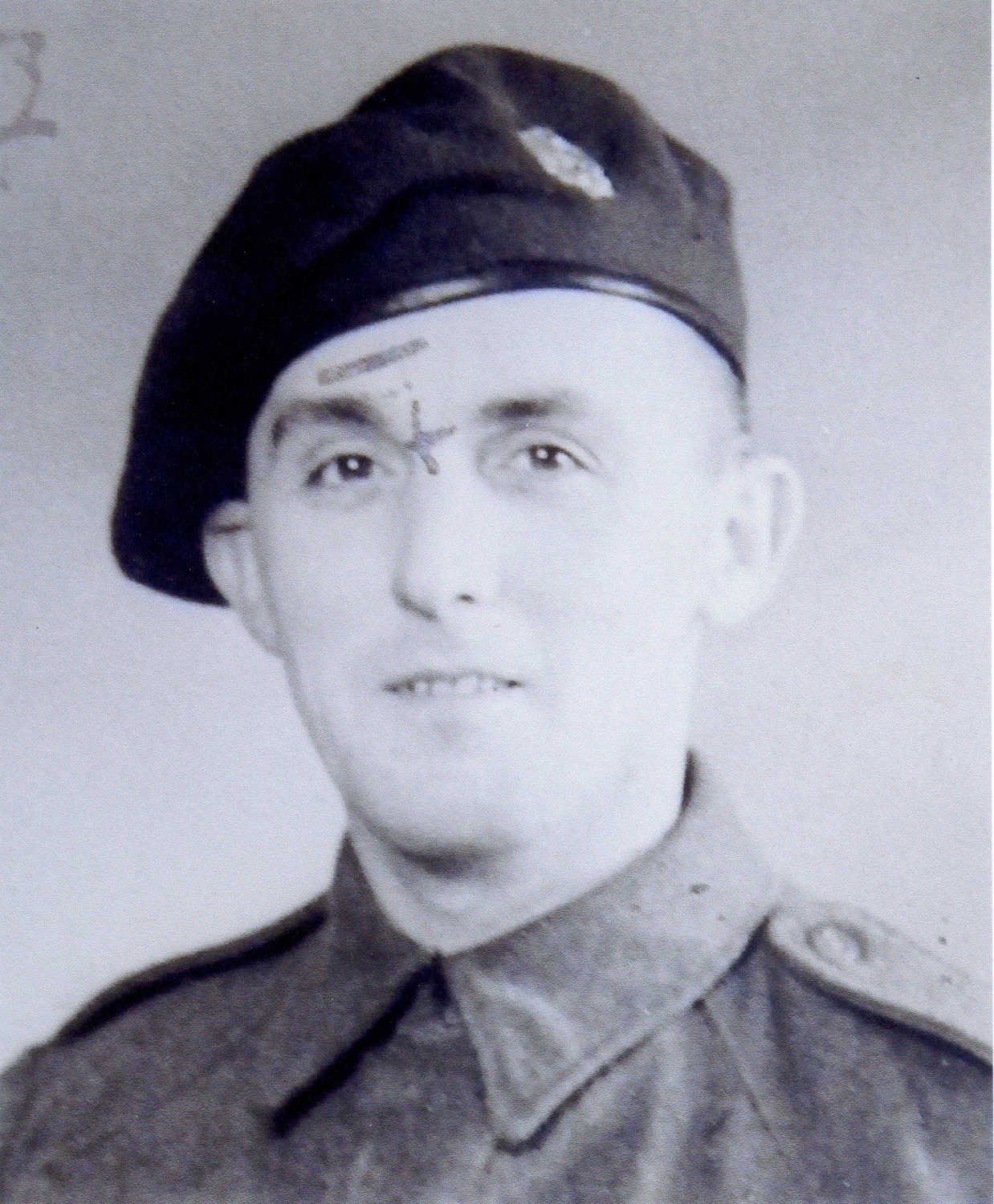
Dvr. Robert Bondy. 'D' Transport Platoon, attached to No 3 Parachute Platoon, but assigned to work with the Maj. Clark, 2 i/c, H.Q, R.A.S.C. Photo taken in 1942/43. Courtesy of Dilip Sarkar.
Lt-Col. Packe was then advised by Lt-Col. Preston to "go and find yourself a new headquarters", near Divisional H.Q. whilst he waited at Wolfheze to gather in the rest of the Admin elements. Proceeding, in their Jeep, down the Wolfhezerweg, "They came to a crossroads where there was a wrecked car, with smashed windscreen, tyres flat, holes through the bonnet; it lay in the awkward posture of anything which has met a sudden end through violence. Both doors were open, and out of them sprawled on either side, a body. That nearest them was startling. The head, thrown back, was pallid, and showed a long white neck. The glazed eyes were open. The flaxen hair lay on the road surface, stained dark by drying blood of which there was a crimson pool running underneath the car. The arms hung helplessly, and the grey field tunic was punctured by many bullet holes. The local German Commander, hearing of the landings, had driven out to investigate."
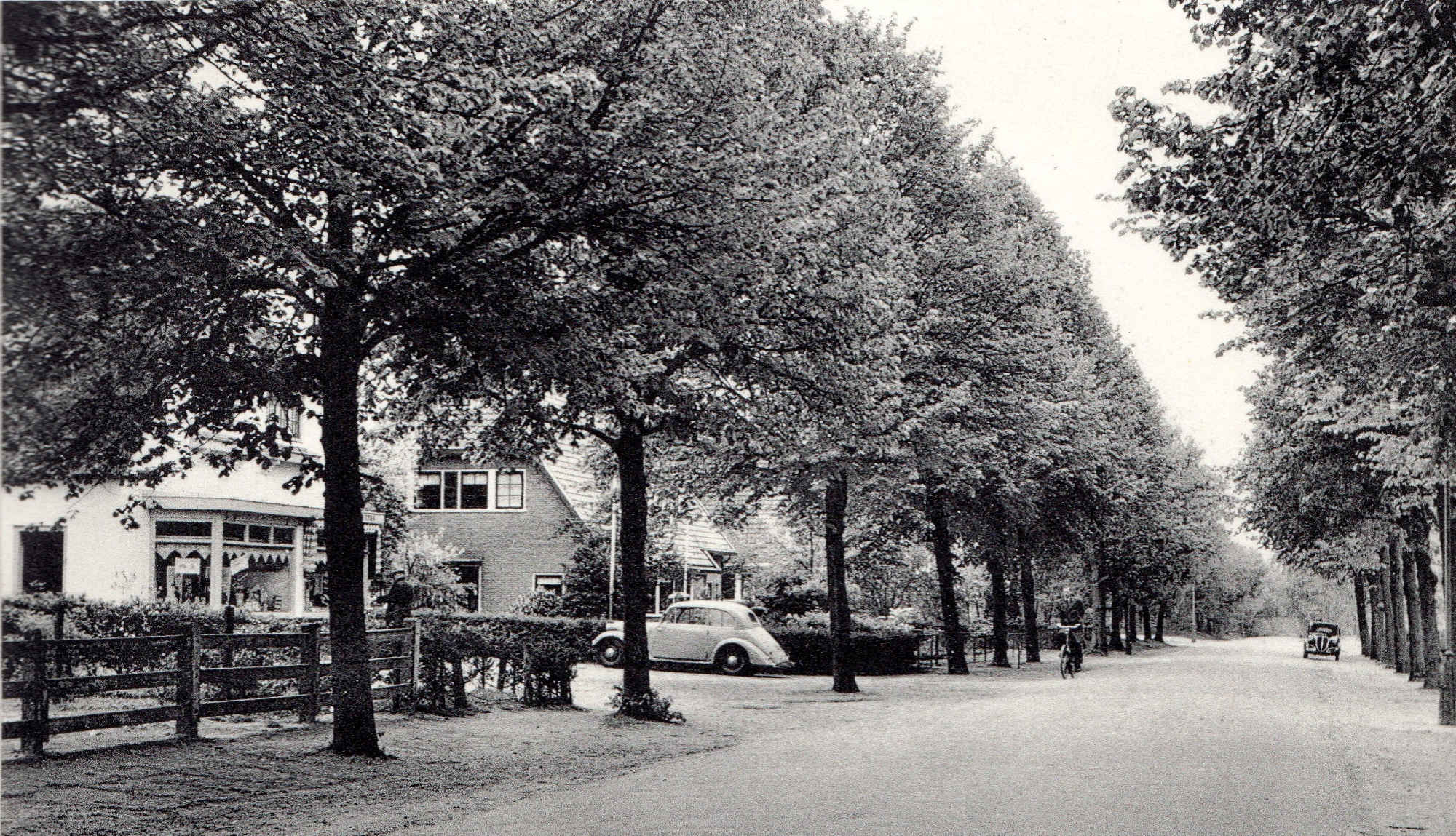
The Wolfhezerweg, looking South from the Railway Station, towards Oosterbeek. A post-card circa 1940's/50's. Courtesy Airborne Assault Museum Archives.
Having found a suitable place for his H.Q. and to set up the D.M.A., on the Hartensteinlaan, Lt-Col. Packe left his staff and the glider pilots to sort things out, whilst he returned to Wolfheze to inform Lt-Col. Preston of the location. "When he returned there was no sign of Lieut. Bewly, but Capt. Cranmer-Byng had arrived with his Platoon, who had settled in on an open triangle in front of the houses and were busily digging trenches for themselves in the loose sandy soil. Capt. Cranmer-Byng , smiling blandly, saluted as the Jeep drew up. "Hullo John; so you've made it," said Packe heartily.
"Oh yes sir, no trouble at all; we've just marched here. We haven't seen Capt. Winter-Goodwin and the transport yet, but I expect they'll be along soon. There's a bit of hold-up in the traffic.
"Did you have a good drop?"
"Perfect. Couldn't have been better. We felt rather foolish at having got so het up about it on the way over. There were no injuries, and we hardly lost any equipment.
"Did you get any flak?"
"Nothing to speak of; one piece came through the fuselage; that's all."
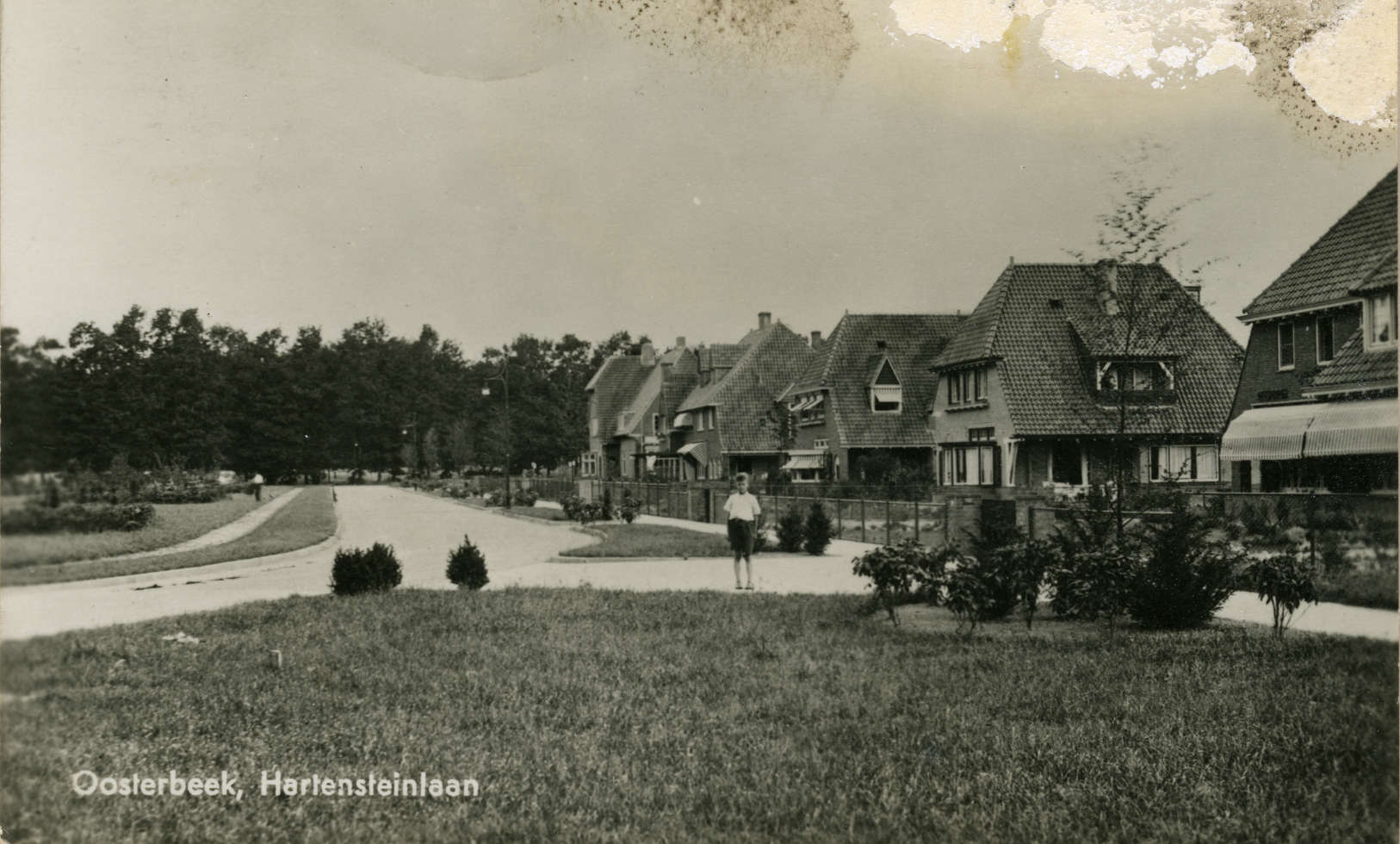
Hartensteinlaan, Oosterbeek, looking to the west. Photo taken between 1934 and 1940. This is exactly where the D.M.A. was first established. Courtesy of Gelders Archief. 1513-1862.
With No 1 Parachute Platoon, and the bulk of the rest of the R.A.S.C. in the Hartenstein area, and No 3 Parachute Platoon in Arnhem, what of No 2 Parachute Platoon? According to the 4th Parachute Brigade War Diary and Brig. Hackett's diary: '15.00 - 17.00 hrs. Meanwhile Brigade H.Q. Defence Platoon and detachment from R.A.S.C. Platoon and other Brigade H.Q. personnel had been securing some sort of defensive area round Brigade H.Q. with spasmodic fighting against disorganised elements. A score odd of prisoners were brought in, together with two vehicles and a 37mm anti- tank gun, 81mm Mortar etc. and a couple of vehicles. Approx 18.00 - 19.00 hrs. 2 Para Platoon R.A.S.C. was forming firm base on road (Brigade axis) in Brigade H.Q. - 646812.
The following accounts describe the actions of No 2 Parachute Platoon and their Transport Section on that first night, Dvr. John Prime, "It appeared, and we were told, that things weren't going too well, and we were ordered to proceed, after wood clearing and intensive fighting on the D.Z., towards the village of Wolfheze. We were then placed in defensive positions around the railway station for the rest of the day and night. During the night, extensive patrolling activity was carried out." [24]
Dvr. 'Ken' Clarke, "After gathering at the assembly point we all marched in an orderly form [down] the Heath. As I was at the rear of the party, due to the weight I was carrying, an Air-Landing member caught up with us and told me to hurry along as the Germans were moving up. We finally reached the level crossing keepers house. Here we spent our first night." [25]
Cpl. Burnham Blaxley, with the Transport Section, "We followed the track and made our way to Wolfheze and occupied a café which was empty. It was also a private house, but the occupants had moved away. We dispersed the Jeeps and trailers camouflaging them and took up defensive positions. Our directive was to service 156 Battalion with their supplies. We now had to locate them. I instructed my signallers who were equipped with 46 sets and unable to find the right wavelength, to move out of our location and see if reception could be improved elsewhere. The immediate surrounding countryside was covered with mixed woodland, restricting our vision. After awaiting their return for some considerable time, I became anxious and decided to look for myself. This proved to be quite useless, so I returned to our H.Q. at Wolfheze. A little later, the two men returned and reported that they had had some very narrow escapes from some enemy patrols in the area and radio communications were completely non-existent. During the early evening when the light was fading, Captain Kavanagh approached me in his usual self-assured way and said, 'Well Blax, you will be pleased to know that we are completely surrounded, but we'll make a dash for it to Divisional H.Q. at first light.' During the night we helped to evacuate our own wounded from the local mental hospital where existing staff and our own medics had attended them. This was carried out by medic jeeps which had been fitted with two stretchers lengthways, strapped in feet first." [26]
It is apparent from the above accounts that the main part No 2 Parachute Platoon remained with 4th Parachute Brigade H.Q. and that Capt. Kavanagh took a Section further forward to Wolfheze Station, where he met up with his Transport Section. Dvr. Cyril 'Jack' Cooper confirms this assessment: "At Wolfheze I searched the Hotel Van Dijk and in the cellar shut out the horrors of the war while I ate a jar of pears". At the same time he also picked up a 1930's post card of the hotel, which he still had 35 years later. [7]
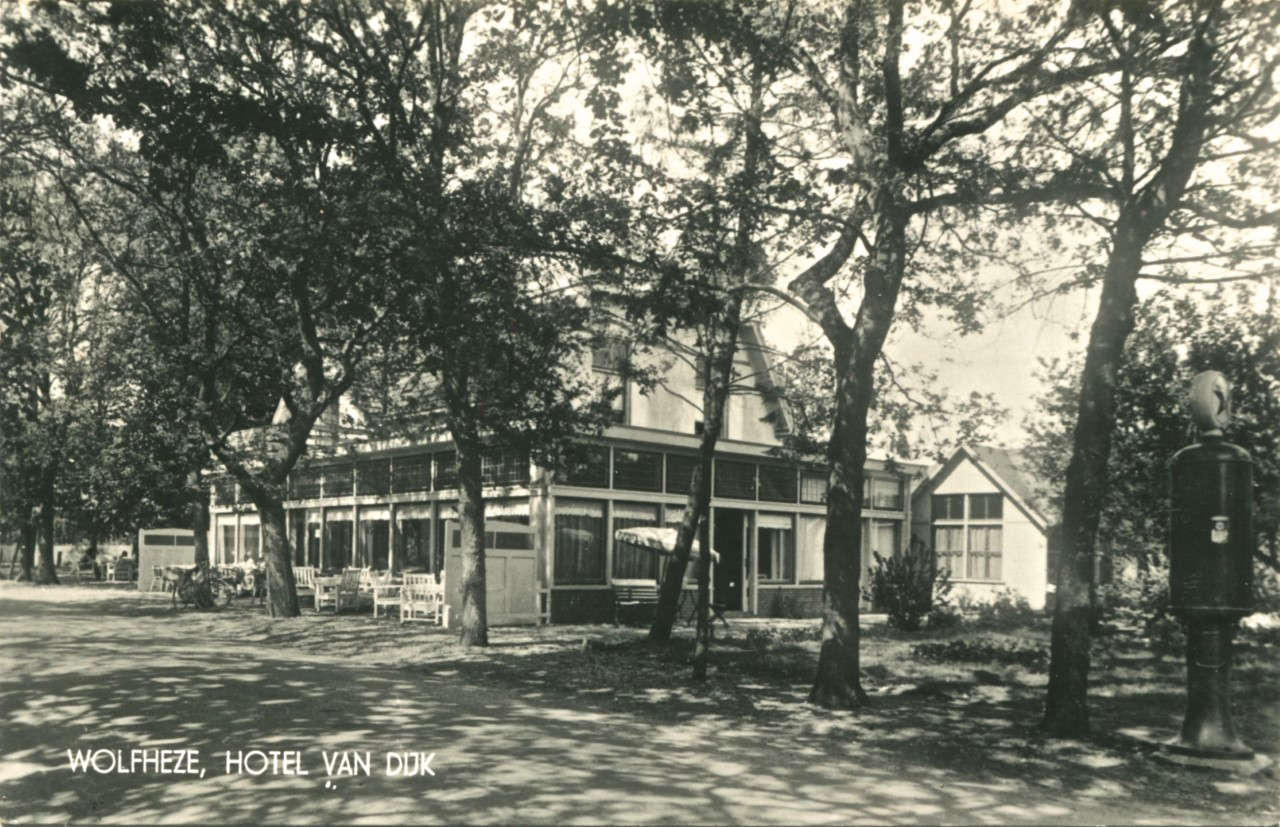
The Hotel Van Dijk at Wolfheze, circa 1942, where Dvr. Cyril 'Jack' Cooper picked up a postcard - just like this one! The hotel was slightly damaged in the bombing of 17th September 1944, but in January 1945 the Hotel was destroyed by a V-1, launched by the Germans from East Gelderland or Overijssel, which was meant for Antwerp. Courtesy of Ulbe Anema.
The 1st Airborne Division H.Q. Diary of Events, as affecting the admin side, had one further entry for the day: 'Convoy of 6 Jeeps and 12 trailers loaded with ammunition organised and stood by, ready to go to 1 Para Brigade. This convoy never left, owing to the situation, and part of the load was subsequently transferred to 2 carriers which later got through to 2nd Bn, The South Staffords and 1st Para Battalion, but NOT to Bridge.' These were very likely the two Universal (Bren) Carriers of the 2nd Bn, The South Staffords, which had been held back with a large part of the Support Company element of the battalion by the Acting Divisional Commander, Brig. Hicks.
The R.A.S.C. Detachments and H.Q. all 'stood-to' between 19.00 and 20.00 hrs.
Footnotes.
[1] Notice how the orders describe the railway crossing at Wolfheze, Pt 665805, and it is only when the map is closely studied, that it does indeed look like a road under the railway line!
[2] This is the part of the drop that was filmed, by Sgt. C.M. Lewis, and photographed by Sgt. D.M. Smith, both of the A.F.P.U.
[3] For full details of all supply drops I can highly recommend "Green On!" by Arie-Jan van Hees.
NOTES:
[1] "THE 250". Arnhem Pilgrimage, by Jack Cranmer-Byng. Newsletter. 1947.
[2] Letter from Jack Taylor to Bob Hilton. 28 September 1995.
[3] Letter from Cpl. H. Symmons to the Casualty Department. 6 July 1945.
[3b] Account from Arthur Start. 1990's.
[4] Correspondence with Alan Roberts. 1997 & 1998.
[4b] Letters to Bob Hilton from Bill Gell. 12 September & 31 October 1997.
[4c] Booklet of Les Ransom's wartime experiences. Produced 2013.
[4d] Letter to Bob Hilton from Thomas Jones. 25 February 1996.
[4e] Letter from Bill Mitchell. 1996.
[5] & [25] Ken Clarke personal account. 1945.
[6] & [24] Account by John Prime. 1994.
[6b] Account of John McAndrew in 1985 Newspaper and reproduced by the AVC 1986.
[6c] Personal account in the Pegasus Journal, July 1946, pages 45 - 47.
[7] Account of Cyril 'Jack' Cooper. Lincolnshire Life. September 1979.
[8] Brig. J.W. Hackett. Personal Diary. 18 September - 2 October 1944.
[9] Letter to Bob Hilton from Des Page. May 2015.
[10] Letter to Bob Hilton from Denis Hall. 9 January 1997.
[11] Letter to Bob Hilton from Robert Simpson. 12 July 1997.
[12] Letter to Bob Hilton from Fred Ponsford. 5 May 1997.
[12b] Letter & account to Bob Hilton from Sam Staple. 16 September 1997.
[13] Letter to Bob Hilton from William Meiklejohn. 10 February 1997.
[14] Letter to Bob Hilton from Ted Ralph. 15 May 1997.
[15] Letter to Bob Hilton from Norman Ramsden. 20 April 1998.
[16] Letter to Bob Hilton from Bert Ranfield. 1997.
[17] Letter to Bob Hilton from Jack Bruce. 13 October 1997.
[17b] Letter to Bob Hilton by Frank Bater. 26 September 1997.
[18] & [23b] Letter to Bob Hilton from Albert Midgley. 15 January 1997.
[19] Account of Lt-Col. M St J. Packe in his book 'First Airborne'.
[19b] & [23c] Letter to Bob Hilton from Raymond Whitwell. 14 March 1998.
[20] Letter to Bob Hilton from John Jenkins. 1 August 1997.
[20b] & [26] Letter & account to Bob Hilton from Burnham Blaxley. 9 July 1998.
[21a] Letter to Bob Hilton from Bill Chedgey. 28 September 1997.
[21b] Letter to Bob Hilton from Ray Weaver. 24 September 1997.
[22] Letter & account to Bob Hilton from Frank McCaig. 9 January 1997.
[22a] 'Arnhem Venture' by Ron Kent. 1944.
[22b] From the Papers of Col. Th.H. Boeree. 1950's.
[23] Cornelius Ryan Questionnaire. April 1967.


